1 575 résultats
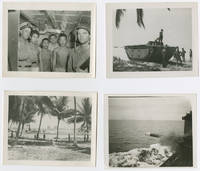
1944WRCAM54351At sea in the South Pacific and on Guam 1944. Twenty loose photographs. Minor wear a few images slightly faded. Very good. An interesting and unique group of annotated photographs from an unknown United States Navy midshipman aboard the USS PRESIDENT MONROE recording activities in the Pacific Theater during World War II. All twenty photographs have notes written on one or both sides. The USS PRESIDENT MONROE was built just prior to World War II and proved instrumental during the Gilbert Islands invasion the operations in the Marshall Islands and at the invasion of Guam. All three of these events are memorialized here with images of the Navy on and in the waters around Guam a shot of indigenous people and another of a U.S. tank on Tarakawa Gilbert Islands and shots of prisoners of war captured on the Marshall Islands. <br> <br> Five of the photographs show the Japanese and Korean prisoners of war in the sick bay aboard the MONROE. Four of the photographs depict Japanese prisoners; one image shows Korean captives. One shot shows a Navy doctor performing a surgical procedure on one of the wounds of the "Wounded Jap prisoner of war.captured in Marshall Islands." Another photograph of a struggling Japanese P.O.W. is annotated on the verso "Wounded Jap prisoner of war in sick bay on board USS Pres. Monroe was captured on Marshall Islands. Note shrapnel wounds on legs." The notation on the back of a photograph picturing a trio of P.O.W.s standing amidst armed American soldiers reads: "Korean war prisoners captured on Kwajalein Marshall Islands. Picture was taken in brig on U.S.S. Pres. Monroe." Other images show the destruction of Kwajalein one of the Marshall Islands and Navy men on Tarawa in the Gilbert Islands. unknown books
194575299Germany: Second Armored Division. Very Good. 1945. Original Vintage Map. 29 x 42 inch original vintage map produced by the U.S. Military titled "Hell on Wheels War Against the Axis 1942-1943-1944-1945" detailing the route and battles of the 2nd Armored Division as they worked their way from France through Belgium and into Germany in World War II. This is the larger version of a map which was issued the previous year. The map shows general handling wear and some edge chipping. There is a small mostly closed tear in the lower left quadrant. Included with the map is the original heavy mailing tube which shows it was sent by a Private Anderson APO New York to his family in Quinnimont Fayette County West Virginia. The map appears to be scarce in the trade with only 1 original currently listed for sale online vialibri. An example is listed and shown at David Rumsey's map website. We are offering this vintage World War II map with its original mailing tube. OCLC offers this note: "Shows route of 2nd Armored Division from Littry France to Gutergluck Germany with historical notes for selected locations. Includes brief history of the 2nd Armored Division. Marginal information includes place names military insignia and names of military divisions. Passed for press duplication by A.E.F. Field Press Censor." . Second Armored Division unknown books
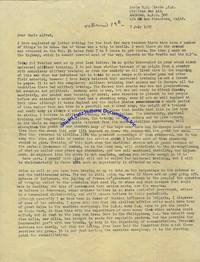
4293WORLD WAR II LETTER. TLS. 2pg. 8 ½†x 11â€. July 7 1945. No place likely the Philippines. A typed letter signed by Boris Clarke during the closing days of World War II. He wrote to his uncle Alfred Lane of Cambridge Massachusetts who was a Harvard professor. Clarke wrote “I have neglected my letter writing for the last few days because there have been a number of things to be done. One of these was a trip to Manila. I went there on the second and returned on the 4th. It takes from 7 to 8 hours a day to get there. The time I make on the highway which is cement covered most of the way depends on the traffic and the M.P.s. Today Col Patrick sent me up your last letter. I am quite interested in your stand about universal military training. I do not know whether because of my origin from a country with compulsory military training or from the anxiety we all lived thru in the beginning of this war when our inductees had to train in some camps with wooden guns and other field materiel however I have always believed that universal training is not a threat to peace. It is not the compulsory military training that causes war in Europe. All the countries there had military training. The forces that create war are not preparedness but economic and political. Germany went to war but was not ready to attack Russia immediately she needed some boosting of moral sic some victories to present to her people before she attacked a country that had a standing army even if not so well equipped at that time. Although it takes England and the United States a short period of time before they can throw in a powerful and trained army the weight of a trained and ready army is always a sobering factor to those that decide that this is the time to strike. I believe in military training as a discipline. The comradeship physical training and toughening discipline the training to take orders and to give orders on the whole an experience quite different from the normal civilian experience will strengthen the youth of our country. Many of the boys over here and in Europe could not live thru the shock that army life imposed on them. The change was too great for some. When they returned to civilian life the greatest percentage of them recovered. But in the army they were not able to render the service which I believe most of them sincerely wanted to give. Training of this sort when the emotional strain not so great because of the certain imminence of combat as is the case now will contribute to the strengthening of what we called some years ago character and now call emotional stability and adjustment. An argument like the above is not complete unless you believe enough in it to take part. I myself most likely will not be called for universal training but I will be wholeheartedly in favor if such an opportunity is afforded my son…The war is still going on even if there are no guns going off. Spheres of influence the juggling of phrases as ‘government chosen by the people’ the question of bringing relief to the countries that need it by whom and what pressure that would have in deciding the type of government that nation wants are the weapons. We believe in democracy other nations believe in a state controlled government others in a benevolent dictatorship and still others believe in their pocketbook. Although generally I have been in favor of Russia’s influence in Bulgaria I disprove of some of her methods. I agree with you that USA civilian affairs units would have been of great value in the immediate emergency. The U.S. army C.A. aims to get the people on their feet but it cost in the long run less. Here in the Philippines C.A. has rebuild many rice mills saw mills has brought in seeds for vegetable gardens and has provided the Commonwealth government with new trucks to help in the organizing of transportation. These services are costly but they are lasting. They have laid the foundation from which these services can grow. It is not just meeting the immediate emergency it is the starting point for rehabilitation. Thru Patrick you have already received the news that I am on my way home…McArthur has declared the Philippines secure. The Commonwealth Govt is taking over the civil affairs…At first contact with the people here we are too apt to judge them by our own standards and think that they are lazy. That is not the case. They have adopted their life to the environment if we were to go on the way we do in the States we would burn out very fast. The older in residence and wiser of the white people here have adopted the afternoon siesta…it tends to make my nights sleepless…â€. The letter has mailing folds and the original envelope and is in fine condition. unknown books
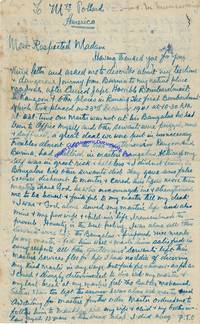
5112WORLD WAR II IN INDIA. AL. 4pgs. N.d. 1941-2 N.p. An unsigned handwritten letter to Mrs. Pollard in America from an Indian servant who survived a 1941 Japanese attack in Burma during World War II. He details his family’s flight from Burma back to their native Madras India. “Most Respected Madam Having thanked you for your kind letter and asked me to describe about my tedious & dangerous journey from Burma to my native place Madras after cursed Japs. Horrible Bombardment in Rangoon & other places in Burma. The first Bombardment which took placed on 23rd December 1941 at 10:30 A.M. at mail time…I did not leave the Bungalow like other servants did they gave some false excuses dishonest to master & cared their lifes more than master’s. Thank God he who encouraged me & strengthened me to be honest & faithful to my master till my death…merciful master paid my wages in addition to any pay master paid Rs 100 hundred for my way expenses & ordered me to go to Calcutta by walk…We had none there to comfort us & encourage us & give help to us but God alone was with us…The place was in a Horrible state any people too missing cursed my worst life cried loudly & bitterly & searching my wife & the child. Thank God I found them after a great & unbearable troubles search although …successful in my undertakings after seeing my poor people & was rejoiced & thanked God for his unfailing mercy…I entrusted my family to the hands of God Almighty we walked & crossed jungles & mountains all rocky paths sharp stones our feet became sore & swollen all jungle very thick forest wild beast one side & other side robbers & thieves…we reached the city of Calcutta may God bless these two kind nations with long lifes & prosperity we never dreamt even that we arrive Calcutta with life our sorrows & calamities is inexpressible…â€. A dramatic and harrowing story. The letter is in good condition and written in blue ink. unknown books
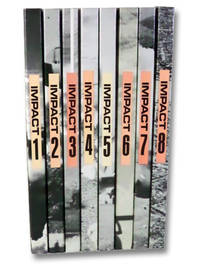
19802291466The Air Force Historical Foundation / James Parton and Company Inc 1980. First Edition. Large Hardcover. Near Fine/No Jacket - Pictorial Cover. 1980 Large Hardcover. Complete in eight hardcover volumes. Black-and-white photographic covers. A detailed pictorial account of the aerial portion of World War II based on declassified records. Includes fourteen retrospective essays by WWII leaders and journalists. The Air Force Historical Foundation / James Parton and Company, Inc hardcover books
19802201679The Air Force Historical Foundation / James Parton and Company Inc 1980. First Edition. Large Hardcover. Near Fine/No Jacket - Pictorial Cover. First editions. Vol. 6 spine a bit toned common with these volumes. Original receipts for each individual volume laid in showing that the original owner purchased these for $13 each in the early 1980s a total of over $300 in today's money. Complete in eight hardcover volumes. Black & white photographic covers. A detailed pictorial account of the aerial portion of World War II based on declassified records. Includes fourteen retrospective essays by WWII leaders and journalists. The Air Force Historical Foundation / James Parton and Company, Inc hardcover books
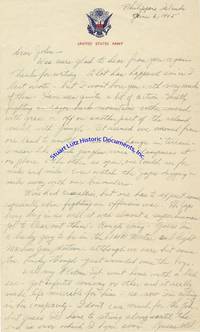
4410WORLD WAR II IN THE PHILIPPINES. ALS. 3pg. 6†x 10 ½â€. June 6 1945. Philippine Islands. An autograph letter signed “Claude†an American GI stationed in the Philippines. He wrote on “United States Army†stationery to his friend John about fighting the Japanese: “Dear John Was sure glad to hear from you again Thanks for writing. A lot has happened since I last wrote - but I won't bore you with very much of them - Have seen quite a bit of action. Mostly fighting n razor back mountains either covered with grass or off on another part of the island covered with jungle - It seemed we moved from one land to another - such a change in terrain - I mean like thick jungles vines & dampness at one place & the other so open one could see for miles and miles - even watch the japs digging in miles away with our binoculars. We’ve had casualties but one has to expect some especially when fighting an offensive war - The japs being dug in so well it was almost a superhumanjob to clear out them - Rough going - guess I'm a lucky guy to be in the 60MM Mortar and light Machine Gun platoon - although we were hit some too. Lucky though just wounded were the boys. Well my Platoon Sgt. Went home with a bad ear - got infected someway or other and it really made life miserable for him - so now I'm acting in his compacity - I don't care much for the job but guess I'll have to string along until the end is over which I hope soon. Guess old Nick here was lucky - Had a few close one's too close for comfort. just hope my luck holds on. Guess as far as the point system goes - I'll be in the Army quite awhile yet. Only can figure out 69 points - Quite a jump to dig up 16 more And I've been in this Army 38 months already - Seems like half my life - When I get home I won't know how to act like a civilian - ha - I know one thing I'll have to learn to control my Army slang or else - I'm writing this in our rest area - although we aren't resting as yet - A lot of hard work to build it up & get it in shape first - Haven’t been her long - but it's a nice area - About like Fort Lewis. Pine trees - cold at night need three blankets still my pups get cold and now that the rainy season has set in it reminds me of Fort Lewis more so as we had so much rain there. Have one camp on a golf course - Been quite some time since I played golf - last tie in the Hawaiian Is. on the isle of Moloka! - More or less pasture. I'd send you a v-mail but as far as I know yet they go straight home with out being photographed and I don't think you'd want that kind. So am using the borderless airmail variety - No two cent overprints have showed up in this area as but if they do I'll remember you - Some of my other friends were asking about them too. Mr. Weltack has been sending me a first day cover now and then and I really appreciate it - as I have no way or time to bother with them. Hope I can continue after the war as I really get a kick out of FD. 's F.Fs F.AM's & all the other better covers. I belonged to the AAMS at one time and have been thinking about joining the MACC in the future. Its been a long time since I saw a good game of baseball- Was in 1939 I guess - In Chicago at the Cub park - The Cubs were playing the Giants at the time. My dad & cousin are great Cub fans but me I like to see a good game - The best men win - I used to play a little too. You know how young guys are - getting up a team & trying to lick the neighboring town teams a log of good clean fun. Well John write when you have time. I enjoy hearing from you. Best of Wishes Sincerely Claudeâ€. The letter is in fine condition. unknown books
1944WRCAM41429Mios Woendi 1944. Three pages of typed index followed by sixty- two photographs each 5 x 6 1/2 inches. Photographs numbered in lower right corner corresponding to index and backed by linen. Oblong 12mo. Original Plexiglas binding brad bound with a cover reading: "Construction Photographs 55th Seabee's." The photographs are clean and clear. Near fine. A very interesting album of photographs documenting the construction of the U.S. Navy Base on the tiny island of Mios Woendi during World War II. Located in the Dutch East Indies near Indonesia Mios Woendi was an important base for American PT boats and for larger ships as well. The photographs in this album show the construction of the base by the U.S. Navy construction battalion known as the "Seabees." The photographs give aerial views of the island the dense foliage the Seabee's camp and dozens of detailed views of all stages of the construction of the base. Also dozens of PT boats - this could be "McHale's Navy." Likely produced in a very small number for military authorities and participants in the construction. We are unable to locate any other copies. unknown books
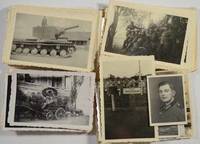
14875Collection of over 90 Gelatin silver print vintage black and white photos of German World War II soldiers on the French and Russian fronts. The photos depict life in the barracks preparing tanks for battle on the front grave sites countryside and city destruction and close up portraits of the young men. The Germans' army military was managed through mission-based tactics rather than order-based tactics which was intended to give commanders greater freedom to act on events and exploit opportunities. In public opinion the German Army was and sometimes still is seen as a high-tech army. However such modern equipment while featured much in propaganda was often only available in relatively small numbers. This was primarily because the country was not run as a war economy until 1942-1943. Only 40% to 60% of all units in the Eastern Front were motorized baggage trains often relied on horse-drawn trailers due to poor roads and weather conditions in the Soviet Union and for the same reasons many soldiers marched on foot or used bicycles. Such details appear in this photo collection. Photos come in their original envelope and have some age related foxing and creasing. Overall good condition. unknown books
194646302Camp Cooke CA 1946. 1st printing of the divers issues. Printed self-wrappers. Modest wear with the occasional chip/short split along a fold. Age-toning to paper. Folded into quarters. Overall Very Good. 30 issues 2 duplicates ~ 4 pages each 8 columns per page. Illustrated with half-tone b/w photographic images. Comics ~ 3 strips p. 4. 22" x 17-1/2" <br/><br/>In 1941 the United States Army sought more and better training centers for the rapid development of its armored and infantry forces. In March 1941 the Army acquired approximately 86000 acres of open ranch lands along the Central Coast of California between Lompoc and Santa Maria. Most of the land was purchased. Smaller parcels were obtained either by lease license or as easements. With its flat plateau surrounding hills numerous canyons and relative remoteness from populated areas the Army was convinced it had found the ideal training location. Construction of the Army camp began in September 1941. Although its completion was still months away the Army activated the camp on 5 October and named it Camp Cooke in honor of Major General Phillip St. George Cooke a decorated cavalry officer whose career spanned 50 years 1827 - 1873. Although the construction of Camp Cooke continued well into 1942 troop training did not wait. The 5th Armored Division rolled into camp in February and March and the steady roar of its tanks and artillery soon became part of the daily scene. From then until the end of the war other armored and infantry divisions kept up the din before they too left for overseas duty. Besides the 5th Division the 6th 11th 13th and 20th Armored Divisions as well as the 86th and 97th Infantry Divisions and the 2d Filipino Infantry Regiment were all stationed at Cooke at varying times during the war. Also trained at Cooke were an assortment of anti-aircraft artillery combat engineer ordnance and hospital units. Over 400 separate and distinct outfits passed through Camp Cooke. A maximum security army disciplinary barracks was constructed on post property in 1946. Confined to the facility were military prisoners from throughout the Army. When Camp Cooke closed in June 1946 From August 1950 to February 1953 Camp Cooke served as a training installation for units slated for combat in Korea and as a summer training base for many other reserve units. On 1 February 1953 the camp was again inactivated. The disciplinary barracks meanwhile was transferred to the U.S. Bureau of Prisons to house civilian offenders in August 1959. Today it is known as the United States Penitentiary Lompoc. Wiki An invaluable source for local history at the end of World War II. the copy has the usual camp activities but also includes such informative pieces as "Camp Cooke History . Here's Chapter 2" Vol V - Number 3 March 29 1946. unknown books
2002268015Garden City: Military Book Club 2002. hardcover. good/very good-. Illus. 512pp. 8vo two-toned boards d.w. lightly dampstained d.w. creased on back inner flap boards soiled. Garden City: Military Book Club 2002.<br/><br/> Military Book Club unknown books
196326031London: Heinemann 1963. First Edition. Illustrated. 1 vols. 8vo. Green morocco spine over marbled boards t.e.g. a fine copy. First Edition. Illustrated. 1 vols. 8vo. Inscribed on flyleaf "For Dora Struart-French / from / Charles Drage / 17/viii/67". Heinemann unknown books
1943M5534New York:: Philosophical Library 1943. 1943. FIRST EDITION. 235 x 160 mm. 8vo. 684 pp. Illus. tables. Gilt-stamped green cloth; rubbed some staining to the covers and rear end-papers. Very good. Philosophical Library, (1943). hardcover books
194444721Ryan Field Hemet California: 5th A.A.F.F.T.D. 1944. 1st Printing. Light brown paper wrappers printed in dark brown stapled. Now housed in an archival mylar sleeve. General signs of use. VG - VG. Unpaginated though 44 pp. Illustrated with drawings & photographs. 1--3/4" x 8-1/2" <br/><br/>Not found on OCLC though the CSL has an issue featuring class 42-J. 5th A.A.F.F.T.D. unknown books
194547585Breendonk: Amicale des Postiers Prisonniers Politiques Rescapés 1945. Original broadside pictorial diploma 24.5x32cm. printed lithograph on cream stock in red gilt and black accomplished in manuscript and rubberstamp. Minor foxing else a fresh Fine example. Exceedingly uncommon diploma awarded to a survivor of the Nazi prison camp at Fort Breendonk outside Antwerp. The camp generally held political prisoners members of the Resistance and Jews who were almost all subsequently dispersed to the larger concentration camp across Eastern Europe. More than 3000 prisoners passed through Breendonk of whom approximately ten percent died or were executed within its walls while half perished following deportation to other camps. The present certificate awarded to a member of the French resistance a mechanic outside Saumur in the Maine-et-Loire department of Western France his arrest part of a massive purge following the assassination of a Dr. Ritter representative of Gauleiter Sauckel in France see Colonel Remy "La Résistance en Anjou Touraine et Orléanais" 1975 Vol. 1 p. 103. The entire town of Saumur was later awarded the Croix de Guerre for its role in the resistance. <br/><br/>Certificate margins adorned with poignant vignettes of camp life men in striped uniforms awaiting execution working in the mines or caught in barbed wire fence. In the case of Huberdeau his first name here spelled "Villiam" he was awarded this diploma for "sa déportation dans le bagnes nazis" "his deportation to the nazi camps". Though no mention is explicitly made to Breendonk it appears that the award was given to survivors of that camp specifically. We find no other examples in the trade auction records of separately catalogued in OCLC as of February 2020. Amicale des Postiers Prisonniers Politiques Rescapés] unknown books
197226455Paris: Editions Robert Laffont 1972. First Edition #40 of 40 copies printed on velin chiffon. Illustrated. 1 vols. Large 8vo. Bound in full green and black morocco "Reliure mosaique dans la forme & la couleur du Ruban de la croix de la liberation" with a bronze medallion inset in the front cover "une medaule des compagnons de la liberation" a.e.g. by Sangorski & Sutcliffe. A beautiful binding. First Edition #40 of 40 copies printed on velin chiffon. Illustrated. 1 vols. Large 8vo. Inscribed at the front and with an A.L.S. from the author tipped in at the back. Editions Robert Laffont unknown books
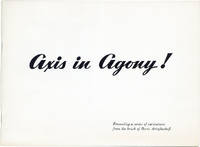
194447251New York: Wickwire Spencer Steel Company 1944. First Edition. Oblong octavo 14cm x 19cm; black and white printed wrappers stapled; 48pp; chiefly illus. A few tiny stains to rear wrapper else very Near Fine. <br/><br/>A corporate paean to the end of the Axis powers reproducing 23 caricatures by Boris Artzybasheff painted expressly for the Wickwire Spencer Steel Company a prominent steel manufacturer during the first half of the 20th century. Artzybasheff cleverly incorporated a different Wickwire Spencer product into each of the caricatures turning the volume into both a catalog for the company as well as a propaganda tool for distribution. Scarce with OCLC showing 10 holdings in member institutions. Wickwire Spencer Steel Company unknown books
194119803Various Fort Lewis WA and The Pacific Theatre ca. 1941-1944. Four reels of 8mm film stock. Majority color with some black and white. Approximately 800ft. total. Metal reels in two-piece outer cans. Cans with etched titles and dates and mounted labels. Stock clean playback clear. Very good overall. A preliminary digitization of the films is available. <br/><br/>Freshly-discovered 8mm color film footage of World War II service shot by Montana-native Charles W. Hash b. 26 May 1910 d. 26 Feb 1998 of the 41st Infantry Division. Spread across four approximately 200-foot reels of film totaling some 45 mintues the action covers Hash’s stateside training at Fort Lewis and combat duty with the 41st in Australia near Rockhampton Hollandia New Guinea Biak and The Philippines. Highlights include: the immediate aftermath of the Battle of Biak with soldiers walking around the smoldering ruins of bombed villages; ground advancement and rural airstrip scenes of The Philippines with views of period planes nose art and the like; a beach landing and other troop and operations maneuvers; soldiers climbing among the wreckage of several crashed combat planes; intimate and candid footage of fellow soldiers drinking eating cooking bathing and shaving; and extended scenes of Pacific-Island natives. The second of the four reels could be mistaken for more pedestrian tourist scenes of Australia though the remaining three are all of service footage with majority of that in-theater. Throughout Hash displays a strong cinematic eye: filming for example the advance of ships presumably toward action in the Philippines through an unusual vantage point tucked behind a ship’s rope with the sea and ships in a soft focus. He often seems to be constructing scenes and/or directing others to either humorous or in the case of a young Filipino woman alluring effect. And the footage is creatively titled using homemade screens of white pegboard letters laid over a standard G.I. wool blanket to mark dates locations and settings. He was clearly an avid hobbyist with a strong documentarian instinct that belies what must have been his normal day-to-day responsibilities. Hash enlisted in the Army in 1930 served in World War II Korea and Vietnam — earning multiple decorations including the Silver Star for actions in the Papuan Campaign. He was commissioned as a captain during WWII commanding Company H a rifle division of the 163rd Infantry Regiment of the Montana National Guard. He later commanded the entire Army Reserve Forces of Northern California and retired a Colonel in 1965. Despite his clear interest and skill we find no evidence that Hash was officially involved in film at any point in his long and distinguished military career. Therefore the footage here offered represents an unfiltered vernacular look into the daily lives of ordinary combat soldiers. This is especially noteworthy because strict censorship regarding photography was in place during the War. And while many GIs captured snapshots of combat and wartime service only a handful of similar moving picture footage is known. A motion picture camera would have been much more difficult to conceal than a standard film camera though Hash’s advanced rank perhaps made this less of an issue and shooting in color would have been both prohibitively expensive and techincally difficult for most soldiers of the era. Indeed it wasn't until the 1990s when dramatic 16mm European Theatre footage shot by Hollywood director-turned-G.I. George Stevens was discovered that color film of the war by Allied forces was even known to exist this footage was later condensed into a short documentary GEORGE STEVENS: D-DAY TO BERLIN. Since then several troves of official color footage have emerged. The National Archives holds thousands of reels of news and officially captured footage of the War much of it mined for the recent epic documentaries THE SECOND WORLD WAR IN COLOUR 1999 and THE WAR 2007. And in 2016 the Marine Corp unearthed and subsequently donated a large collection of sanctioned color war films to the University of South Carolina for preservation. Nevertheless primary soldier-level film is almost unheard of. Indeed at the time Stevens' was thought to be the only soldier-shot wartime color footage known; and only a handful of later discoveries including a trove of German-shot film seem to have surfaced since. As Stevens' son said in the wake of the discovery of his father's footage: "World War II was a black-and-white war. That's how we see it. That's how we saw it. And suddenly to see it in colour it just took on a whole other dimension." Skillfully and intimately captured Hash's footage vividly documents the ground-level reality of wartime soliders in the tropics. Quite possibly the only entirely amateur WWII color footage by an American soldier extant. Rare important and worthy of preservation prominent institutional placement and further study. unknown books
16409World War II Original war time U.S. War and Navy Departments first editionsPocket Guide books for 18 countries. These guidebooks were prepared by the U.S. War and Navy Departments to educate American soldiers stationed overseas during the conflict. It includes points on culture language including slang local history and the military justification for American presence in the area; in this sense these pocket books are a unique distillation of American wartime policy composed by the highest decision-makers in government for the soldiers actually setting foot on foreign soil. These guides provide a concise yet rich example of wartime indoctrination and the resulting cultural associations and relationships formed within the average American by the war.<br/><br/> All 18 guide books are war dated and they include: Alaska 1943; Australia 1944; Egypt 1943; France 1944; Paris and Cities of Northern France 1944; Cities of Southern France 1944; Great Britain 1944; India 1944; Iran 1943; Iraq 1943; Italian Cities 1944; New Caledonia 1944; New Guinea and the Solomons 1944; New Zealand 1943; Northern Ireland 1942; Panama 1943; Syria 1942; West Africa 1943. Washington DC: War and Navy Departments 1942-1944. Stapled bindings. 5.25" x 4.25" inches. All first editions. Written often in a casual approachable way From the Pocket Guide to Iraq: "Herr Hitler knows he's licked if the peoples united against him stand their ground" these guides repeatedly drill in the strategic necessity for Americans to create diplomatic relations wherever they are stationed. For example from the Pocket Guide to New Zealand: "Always remember that it is to our enemies' advantage to sow seeds of discord between us and our allies and it is to our advantage to understand them and to make them our friends." They also illustrate explicit policy motivations as with the Pocket Guide to Iran: "As an American soldier assigned to duty in Iran once called Persia you are undertaking the most important job of your life. There is no other war theater where military success by the United States and her fighting allies will contribute more to final victory over the axis. You've heard a lot of talk in this war about life lines - the sea lanes and land routes by which military supplies flow into the combat zones to be turned against the enemy. Iran is much more that a life line. It is a major source of the power that keeps the United Nations' military machine turning over -- oil. Because of its prime strategic value Iran in the only country in the world where the armies of three of the United Nations -- Great Britain Russia and the United States -- are operating in daily touch with each other . You as an American have a responsibility that goes beyond the ordinary military duties required of you. Your country has a reputation throughout the world for decency and unselfishness in its dealings with other nations. That reputation is a major asset for us in this global war. By your actions you can uphold it or destroy it." Includes period maps of the respective regions as well as cartoon illustrations to accompany the instructional text. Scattered soiling and wear. Altogether very good. unknown books
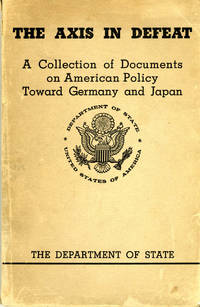
9529First Official Govt. Printing of surrender documents of the Axis. Titled "The Axis In Defeat - A Collection of Documents on American Policy Toward Germany and Japan". year 1946. Printed by the US Dept. of State . 118 pages. Text of the surrender documents signed by the Germans and also the Japanese surrender document the authority of Gen. Mac Arthur as SCAP the official Declaration regarding the Defeat of Germany. Covers aged two pages creased otherwise good. unknown books
5962Historic WWII Newspaper. Baltimore News Post MD August 24 1945. Large bold banner above the masthead: "ATOMIC BOMB RAYS KILL THOUSANDS JAPS CLAIM". Also has small front page photo of MacArthur. In very good condition. unknown books
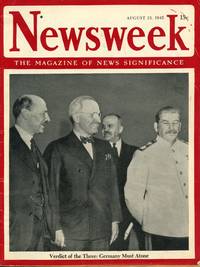
9898Original Newsweek August 13 1945 Declaring the Division of Europe a week after the end of World War II and The Atomic Bomb on Hiroshima. Cover depicts Stalin Churchill and Truman; "Big Three ended the Potsdam meeting. Germany was stripped of her power to make war." Some other featured articles: Awesome Force of Atom Bomb Loosed To Hasten Japanese Surrender. "and "Germany Must Pay for War Guilt" Good condition minor wear. unknown books
196234997London: privately printed 1962. Tall quarto. Typescript. 1 18 20 19 3 leaves. Color folding map of central Africa with additions in manuscript. Modern red morocco backed cloth.<br/> <br/>Provenance: Sir John Marriott presentation inscription from Platt on the front endpaper<br/> <br/>Unpublished typescript of three lectures given by the commander of the Sudan Defence Force during the East African Campaign.<br/> <br/>Platt's lectures given in 1951 reviews the problems facing the British in East Africa in the years leading to 1940 and gives a very detailed account of the campaign against the Italians the British victory and aftermath. This copy inscribed by Platt to Sir John Marriott the commander of the 29th Indian Infantry during the campaign. privately printed] unknown books
194138962South Africa 1941. Quarto. Unnumbered title plus 32 numbered leaves recto only. Signed by Bostock on the upper wrapper. Publisher's stapled wrappers.<br/> <br/>Provenance: Humphrey Winterton booklabel<br/> <br/>A very rare WWII "regimental history" of a South African battery in the East African Campaign.<br/> <br/>Written by Bostock with contributions by others in the regiment the introduction below the title describes the work: "These few sketches of our life principally in Abyssinia but to some extent in Kenya from October 1940 to May 1941 started as a personal record which I thought might be of interest to friends in South Africa and Overseas. Our Battery Commander however was good enough to take the view that somewhat expanded they might constitute a kind of interim battery record of those interesting months." Organized alphabetically entries include both serious and humorous contributions. OCLC records but a single extant example. unknown books
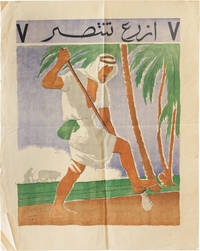
194344248Baghdad: S.i. ca.1943-44. Original illustrated poster offset printed in five colors on beige stock measuring 56.75cm x 72.75cm 22.25" x 28.5". Signed "FAIK H" in plate at lower left corner. Two old folds smoothed out trivial wear to intersection of folds at center with a handful of short marginal tears and attendant creases; unbacked; Very Good. Superb example of this agricultural-themed wartime propaganda poster designed by Iraqi painter Faeq Hassan 1914-1992 widely heralded as "the father of Iraqi modern art." Born poor in Baghdad Hassan showed an early aptitude for art. When he was 12 he visited his uncle a gardener in the royal palace for King Faisal I; when the King saw his drawing of a horse drinking from a river he recognized his talent instantly and offered him a scholarship. Faisal died in 1933 while Hassan was still in high school though his successor King Ghazi carried out his father's will and send him to the École des Beaux-Arts Paris in 1935. After returning from Paris Hassan founded Al-Ruwad The Pioneers Group a group of Iraqi artists who eschewed the traditional studio atmosphere; while engaging with nature and choosing the chronicle the daily realities of Iraqi life through their art the group played a critical role in bridging the gap between heritage and modernity. <br/><br/>Little scholarship exists regarding Hassan's activities or artistic output during World War II though the present example suggests he put his talents to some use creating home front propaganda after the Anglo-Iraqi War. The poster depicts a male laborer in traditional garb digging in a field with a bag of seeds tied at his waist beneath the slogan "If You Plant You Will Win" flanked by twin V's. Despite the traditional Iraqi setting the message is similar in tone to the American propaganda campaign encouraging the populace to plant victory gardens to help the war effort. A notably early work by Hassan and a rare survival with no examples found in the auction record and none found in the holdings of any OCLC member institution. cf."Profile: Faik Hassan." Al Jazeera 30 October 2005. S.i. unknown books