11 490 résultats
19168Without place or date but the quoted documents dating from 1914 and 1915. . Three documents all in fair condition lightly aged and worn each of the total of six leaves with three later punch holes to the inner margins of the leaves. On the same browned thin wove paper. The source of these items is uncertain but they appear to date from the first decades of the twentieth century. ONE: 'Disposition of Troops in the Canal Defences 15th January 1915.' 4pp. folio. Beginning with: 'G.O.C. Canal Defences. - Major-General A. Wilson. Chief Staff Officer Canal Defences. - Br.-General A. H. Bingley.' Followed by the 'Troops' and 'Posts in Sector' for three sections as well as the 'Advanced Ordnance Depot' and 'Defence of Railway and Sweet Water Canal' 'General Reserve Camp Moascar'. TWO: 'British Force in Egypt in August 1914.' 1p. 8vo. A nine-line list. THREE: Transcription headed 'Letter - General Maxwell to Lord Kitchener. 16th October 1914.' An abridged portion of a letter quoted in full in Sir George Arthur's 'Life of Lord Kitchener'. Text begins 'There is rather more nervousness in Egypt' and ends 'the Canal ought to be safe'. Without place or date, but the quoted documents dating from 1914 and 1915. ] unknown
17153Covering letter dated from Budapest Hungary 8 April 1985. 27pp. 8vo. The article on 'The Budapest War Cemetery' is 7pp. 8vo and the accompanying 'Register of the Graves in the Budapest War Cemetery' is 21pp. 8vo. There is also a page of 'Abbreviations to the Register'. A few manuscript emendations. The covering letter is addressed to 'David' and is effusive in its offer of further assistance the author urging 'David' to rewrite the piece as he sees fit. It is signed faintly and undecipherably. The author writes in good but not entirely idiomatic English and has gone to some trouble. The article describes the wartime background to the establishment of 'The English Cemetery at Solymár' from the first man buried there Flight Sergeant Gordon G. Pemberton an Australian pilot of a Wellington bomber shot down on the night of 3 April 1944. The 'Register' lists the 205 graves each with all the information to be found on the tombstone. Also present are four strips of negatives with one larger negative of a single image and a contact sheet strip reproducing the 35 pictures on the negative strips. The last is annotated on the reverse in pencil. Also included are three black and white photographs described as 'three bad prints' in the letter: one of the cemetery in snow and the other two of Pemberton's crashed Wellington bomber. Covering letter dated from Budapest [ Hungary ], 8 April 1985. unknown
191827182no place : War Department Office of the Surgeon General 1918. First Edition. Staplebound. Very Good. First Edition. XX 169 leaves. 7 3/4 x 10 inches. Printed on recto only. Mimeographed stapled. With buff printed cover. "Capt. Morison" inked at top of front cover. Marked "Not for publication" at top of front wrapper. Staplebound. Bulletin IV as offered was the last of a four bulletin series "Abstracts Translations and Reviews of Recent Literature on the Subject of the Reconstruction and Reeducation of the Disabled Soldier and Sailor:. and was replaced by a printed montly magazine "to be called CARRY ON The Disabled Soldier's and Sailor's Magazine". The Foreword notes that the new name "CARRY ON" was suggested by Mary Roberts Rinehart.<br /> <br /> Bulletin IV May 25 1918 is the second part of a detailed report "The Story of the Crippled Soldier's Progress from Disablement to Replacement in Civil Life" and reports on work in Italy Belgium Canada and other Countries. The previous Bulletin No III. April 15 1918 is more commonly seen and is a companion volume to the current offering dealing with the same topic but in only 96 pages and covering the work in France and Great Britain. <br /> <br /> The introductory remarks are particulary interesting as they work through the many challenges facing cruppled soldiers as they are treated and released into civilian life. Many of the issues could have come from today's headlines. While medical technology has advanced considerably in 100 years many of the same psychological issues remain. War Department Office of the Surgeon General unknown
24124Without date or place but apparently written in Mesopotamia in late 1916. This poem is said to be an earlier work by ‘A Tommy’ the pseudonymous author of the collection ‘If I Goes West’ published in London by Harrap in 1918. WorldCat has no entries to support a second claim: that the present poem was published in 1917 with the subtitle ‘Verses written by a “Tommy†who has fought suffered and triumphed in Mesopotamia and is still on active service there’. While there is no indication that the poem has ever been published in its entirety extracts from it appeared in ‘The Bystander’ 27 November 1916; and ‘The Near East’ 6 July 1917; the latter headed ‘An Alphabet from Mesopotamia’ being preceded by the following: ‘A member of our Fighting Forces in Mesopotamia has composed some verses which he entitles “ The Alphabet of Mesopotamia.†Through the kindness of a correspondent we are allowed to reproduce here some specimens’. There may also be a reference in Catherine W. Reilly’s 1978 bibliography ‘English Poetry of the First World War’. Duplicated typescript titled ‘ALPHABET OF MESOPOTAMIA.’ 2pp foolscap 8vo. Text complete on two leaves of air mail paper glued together. Apparently contemporary and with the look of an item that has been handed around the mess room. Twenty-six four-line stanzas: one for each letter of the alphabet apart from a joint stanza for S and T and ending with an ‘ENVOI’. The first stanza reads: ‘ “A†Was an apple that grew so they say In the Garden of Eden down Qurnah way Till Eve came along and ate it one day And got thrown out of Mesopotamia.’ The poem includes the following stanzas: ‘ “F†Stands for Fritz who flies in the sky To bring down the brute we’ve many a try But the shells that we shoot seem to all pass him by And fall --- on Mesopotamia.’ ‘ “J†Is the jam with the label that lies And states that in Paris it won the first prize But out here we use it for catching the flies That swarm in Mesopotamia.’ ‘ “U†Is the Lake we call Umm-el-Brahm And guards our flanks from all possible karm sic And waters Gorringe’s Barley Farm In the middle of Mesopotamia.’ ‘ “V†Is the Victory we won at Dujailah I heard of it first from a friend who’s a sailor Who read it in Reuter’s on board a mahela On the Tigris in Mesopotamia.’ ‘ “W†Stands for the wonder and pain With which we regard the infirm and insane Old Indian Generals who guide the campaign Which we’re waging in Mesopotamia.’ ‘ “Y†Is the yearning we feel every day For a passage to Basra and thence to Bombay If we get there we’ll see that we stay right away From this wilderness - Mesopotamia.’ Without date or place, but apparently written in Mesopotamia in late 1916. unknown
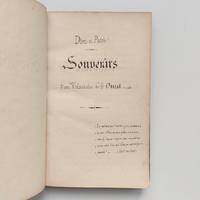
187219726<p><strong>Probably the only surviving copy of this rich account of the enlistment and service of a young volunteer soldier from the West.</strong><br />Entirely autographed and illustrated with a few compositions the author recounts in 24 chapters the war in which he took part his enlistment in the 4th company of the 3rd battalion at Le Mans his Chassepot bayonet rifle his comrades and superiors the Papal Zouaves the descendants of Charette and Stofflet his travels in the West and of course the Prussians.</p><p><em>"My aim is not to invent a novel of pure fantasy; there is no such thing as the simple statement of a fact stripped of all fabulous exaggeration. My intention is therefore to relate very imperfectly no doubt memory is so unfaithful the vicissitudes in the midst of which I lived during four months of a campaign at the height of winter and the impressions I was able to bring back. I wish to preserve in this account an entire truth a character of frankness and authenticity that removes the slightest doubt."</em></p>
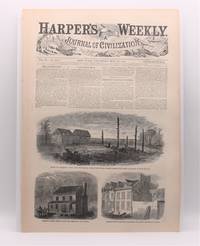
1865W2380New York: Harper's Weekly 1865. 16 pages. Large folio 16 inches by 11 1/4 inches. Original complete issue of Harper's Weekly. Harper's Weekly was the most important American pictorial newspaper in the 19th century. Because the original wood engravings in virtually every issue are highly collectible complete issues are becoming more difficult to obtain. The issue offered here focuses on the events following the assassination of Lincoln. On the front page are articles on the assassination and the funeral along with three original wood engravings: one showing the ruins of the Garrett barn where John Wilkes Booth was shot; another showing the house where Booth died; and a third engraving of the house of Booth's co-conspirator David Herold. On the interior are multiple engravings of various Lincoln funeral sites. Among the unrelated engravings is the double-page centerfold by Thomas Nast entitled "Palm Sunday"--one side portraying the arrival of Jesus in Jerusalem and the other side Lee surrendering to Grant. This issue of Harper's Weekly is disbound from an annual volume and has the usual sewing holes along the binding edge but it is still in very good condition: clean and bright with minimal toning of the paper. Note: we have available more than 500 complete issues of Harper's Weekly as well as thousands of individual wood engravings. Please inquire if you are looking for specific items. First Edition. Paperback. Very Good. Elephant Folio - over 15" - 23" tall. Magazine. Harper's Weekly Paperback
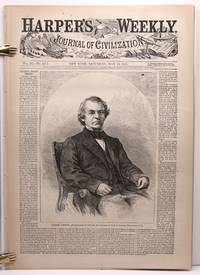
1865W2422<p>New York: Harper's Weekly 1865. 16 pages. Harper's Weekly was the most important American pictorial newspaper in the 19th century. Because the original wood engravings in virtually every issue are highly collectible complete issues are becoming more difficult to obtain. The issue here focuses on Lincoln's New York City funeral procession and the capture and killing of John Wilkes Booth. The front page features a wood engraving of the newly sworn-in President Andrew Johnson. It is based on a photograph by Alexander Gardner. The centerfold is a double-page wood engraving captioned "President Lincoln's Funeral--Procession in New York City." It is based on a photograph by Matthew Brady. Other wood engravings include "Sergeant Boston Corbett" a portrait based on a Brady photograph of the man who shot Booth; "Planning the Capture of Booth and Harold" based on a Gardner photograph; "Booth's Capture--The Assassin Brought to Bay" a recreated view of Booth in the burning barn in which he was killed; "President Lincoln's Funeral--Removal of the Body from the City Hall to the Funeral Car New York"; and "Post-Mortem Examination of Booth's Body on Board the Monitor 'Montauk'." There is text accompanying most images. Especially striking is the lengthy description of the interaction between Booth and his pursuers before he was killed. This newspaper is disbound from an annual volume and has the usual sewing holes along the binding edge but it is still in very good condition: clean and bright with minimal toning of the paper; a long but neat closed tear along the centerfold line of the double-page engraving; a one-inch closed tear limited to the blank margin of the front page; and a 1.5 inch by 3.5 inch triangular chip out of a corner of the last leaf primarily impacting one word in the title of an advertisement. Note: we have available more than 500 complete issues of Harper's Weekly as well as thousands of individual wood engravings. Please inquire if you are looking for specific items. . First Edition. Paperback. Very Good. Elephant Folio - over 15" - 23" tall. Magazine.</p> Harper's Weekly paperback
188352571London & New York: Blackie & Son Ltd.; Charles Scribner’s Sons c. 1883 1895. 12mo. 352 pp. plus 32 pp. publisher’s catalogue. Frontisp. 7 plates. Blue pictorial publisher’s cloth illustration on front cover in gilt brown green & blue gilt & blue lettering front cover & spine very slight shelfwear very minor rubbing faint offsetting on endpapers from binder’s glue still NF copy w/ former ownership signature dated 1895 on ffep. Early Blackie printing of this historical adventure of a young sea captain’s son fighting with General Wolseley in the Third Anglo-Ashanti War detailing the British advance the attack on Elmina the British victory at the Battle of Amoaful and the capture of the Ashanti capital city Kumasi. Blackie & Son, Ltd.; Charles Scribner’s Sons, hardcover
194463298New York: G.P. Putnam’s Sons 1944. 8vo. xi 1 243 1 pp. Map illust. on title. Beige publisher’s cloth Africa map in green & black lettering on front cover map endpapers minor dustsoiling edgewear w/ d.j. cover art of Africa outline map red lettering chipping & soiling head & foot of spine edgewear creasing minor spotting still VG/G- copy signed by Wells w/ small elephant illustration by the author on half-title. First edition of this informative handbook written and prepared by Wells from his successful preparation lectures for Allied Armed forces moving into North Africa and West Africa during World War II. In addition he makes specific references to the strategic materials and human resources available across Africa’s vast size and large population during the War and forecasting future possibilities. G.P. Putnam’s Sons, hardcover
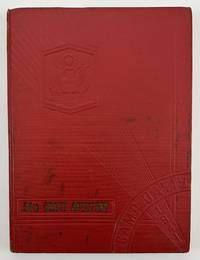
19414820Los Angeles Ca: Army and Navy Publishing Company Inc 1941. Very good. 21028pp. Original red cloth decoratively stamped in blind with title stamped in gilt on front cover. Boards soiled and rubbed minor scuffing to edges. Light occasional foxing. A rare yearbook memorializing the first year of training for the 54th Coast Artillery during the early stages of World War II at Camp Davis North Carolina. The 54th Coast Artillery was an important African-American support unit during the war which according to the opening letter here from Major General F.H. Smith was designed "to build up antiaircraft antitank antinaval and balloon barrage units prepared to assist effectively in the defense of our Country its cities airports naval bases and foreign possessions." The majority of the personnel of the 54th Coast Artillery was comprised of enlisted men from Texas Kansas and Missouri. The present yearbook includes photographic portraits of the staff officers and other personnel at Camp Davis scenes around the base action shots of the soldiers in various aspects of training scenes of the soldiers during recreational sports and more.<br /> <br /> Most notably the book includes photographic portraits of hundreds of African American enlisted men who served in the 54th including Private Leo Beasley who is pictured on page 68. The album was given to Beasley in early December 1941 by his commanding officer and then presented by Beasley to his mother. By the time he received the yearbook Beasley had attained the rank of corporal. Interestingly in 2023 the mayor of Pacific Grove California issued a special proclamation recognizing the service of the 54th Coast Artillery in World War II noting that "Despite that these troops were armed and clothed with used weapons and secondhand uniforms dating to World War I they did not complain and served with pride and distinction."<br /> <br /> OCLC records just four copies of this yearbook from the 54th's first year of service at the Pentago Library East Carolina University UNC-Chapel Hill and NYPL listed by either the cover title or the first sectional title page which gives the title as Historical and Pictorial Review Antiaircraft Training Center Camp Davis North Carolina 1941. Army and Navy Publishing Company, Inc unknown
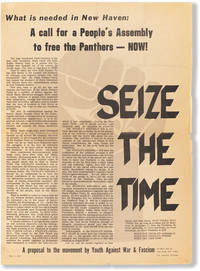
197062899New York: Youth Against War & Fascism 1970. Original broadside with text and illustration offset printed in black on newsprint measuring 42cm x 58cm 16.5" x 22.75". Light toning two old folds smoothed out with several tiny nicks tears and attendant creases to extremities and a thin partial split at the intersection of the center folds; Very Good. Pictorial broadside in support of the New Haven Panthers calling for a People's Assembly to occupy the city of New Haven for "as long as it takes" and do whatever is necessary to free the Panthers. "What is needed in order to insure that we do not witness another protest followed by an execution - as in the cases of Sacco-Vanzetti the Rosenbergs et al. - is for the movement to immediately establish in New Haven a center which would become a magnet to draw thousands upon thousands of people from all over the country. By their overwhelming presence they could exert great power and influence in New Haven to see that this outrageous frameup is ended - NOW!" Issued May 1 1970 as an insert in The Partisan by Youth Against War & Fascism the youth arm of the Trotskyist Workers World Party. We do not locate any separately catalogued examples in OCLC though we do note copies held by Harvard and the Victoria & Albert Museum. Youth Against War & Fascism unknown
198264026New York: Vantage Press 1982. First Edition. First Printing. Octavo 21cm; red cloth with titles stamped in black on spine; dustjacket; iv2031pp. Lengthily inscribed by the author on the front endpaper: "17 October 1986 / To Joe - Remember me gal I'm one of those fortunate birds who barely got through Josiah Cox's class. Now is that taking you back - or what!! Memories can also be memorable. Sometimes all we have to do is slow down and reflect. Good luck in to you and yours! Thomas D. Williams Mingo. Laid into this copy is a short ANS from Williams to the recipient along with his business card. Spine ends gently nudged faint paper-clip impression to upper margin of title page and the following two leaves; very Near Fine. Dustjacket is unclipped priced $8.95 with light wear to extremities and a few tiny tears; Near Fine. Debut novel by this African American author set during and after the Vietnam War with the story revolving around three central characters: Hubert Jackson a Black Marine private Lo Quan Duc a Vietcong guerilla and Tony Martinelli an Air Force pilot and son of a Mafia chieftain. Not in Blockson and not in Newman Vietnam War Literature: An Annotated Bibliography; OCLC notes 11 holdings. Vantage Press unknown
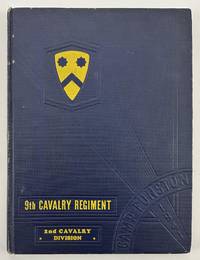
19414214Camp Funston Ks 1941. Very good. 4981pp. Illustrated throughout with photographs. Folio. Original blue cloth decoratively stamped in yellow and blind. Minor edge wear corners worn. Light foxing mostly to terminal leaves. An informative and profusely illustrated historical treatment and yearbook documenting the Second Cavalry Division of the U.S. Army based at Camp Funston Kansas and including numerous segregated African American troop units of the 9th Cavalry - Buffalo Soldiers. The present book was owned by Private Nolen W. Winfrey of the 9th Cavalry's Troop C; Winfrey is pictured on page 86 among his fellow soldiers in Troop C. Winfrey has also filled out the partially-printed certificates at the beginning of the book noting that he was a member of the 9th Cavalry as of February 27 1942. The work itself is a slick production which includes a history of the division letters of introduction by the commanding officers portraits of all the officers and enlisted men in the division organized in yearbook fashion photographs of the men in training and in the field a long history of the 9th Cavalry - Buffalo Soldiers and their service fighting Native Americans the Spanish-American War and during the Mexican Border War and more. Nolen Winfrey was born in Mississippi and worked as a farm laborer in Wynne Arkansas before joining the service. unknown
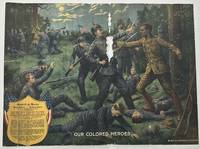
191813008Chicago: E.G. Renesch 1918. Chromolithograph 11.75 x 15.75 inches. Moderate surface wear a few closed tears and significant insect damage in the image area costing about a half-inch by four-inch section in the center of the image. Trimmed especially along the top margin. Fair condition only and priced accordingly. A stunning chromolithograph produced to commemorate the heroism of Henry Johnson and Needham Roberts two African American soldiers of the 369th Regiment's "Harlem Hellfighters" during World War I. The two soldiers were stationed as guards in a French sector when a powerful German raiding party of two dozen men arrived and Johnson and Roberts managed to fight them off despite their inferior military equipment. The present scene shows each of the men fighting off German soldiers one at upper left bayoneting a German soldier and one at center-right sticking a knife into the chest of another German soldier sadly part of the insect damage to the middle of the scene. A U.S. flag waves proudly in the distance behind the soldiers.<br /> <br /> The story of the bravery of Henry Johnson and Needham Roberts is told here at the bottom left printed inside a shield. Titled "Honored as Heroes. Henry Johnson Needham Roberts. Cited for Bravery and Receive Croix de Guerre. Colored Man Is Eager to Show His Mettle and Do His Bit." The story is then detailed through "General Pershing's Communique" of May 19 1918. The two soldiers were cited for bravery and presented with the French Croix de Guerre two of the first Americans to receive this particular award. Johnson was never recognized by his own government for his heroism during his lifetime. He died young in 1929 and was posthumously awarded a Purple Heart in 1932 and then the Medal of Honor almost a century after his service by President Barack Obama in 2015. Roberts was also awarded a Purple Heart in 1932 and died in 1949.<br /> <br /> A wounded example of a truly wonderful celebration of African American heroism during the First World War. Rare with only three institutional holdings per OCLC at Harvard Texas A&M and the Pritzker Military Library. E.G. Renesch unknown
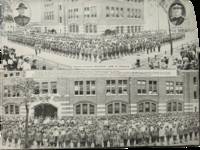
19183418Camp Pike Ar: Ewing Incorporated Official Photographers Sept. 30 1918. Fair. Regularly-spaced heavy creasing center crease almost split through some small chips and tears minor soiling. A wonderful image but will require preservation. A captivating panoramic photograph featuring the African American members of the 74th and 94th "casual" companies of the United States Army during their time training for service in World War I at Camp Pike Arkansas. The caption in the negative reads "Casual Cos. 74 & 94." Casual companies are nontraditional units of the Army meant as holding units for combat replacements groups awaiting transport or discharge a specialized unit assembled for specific duty or one comprised of soldiers on convalescent duty. These units are not usually pictured in military photographs much less in panoramic images during wartime.<br /> <br /> The present panoramic photograph features about 150 African American servicemen in uniform and a few white officers arranged in roughly four rows at Camp Pike located just north of Little Rock. Camp Pike opened in late 1917 and served as a training center for troops in World War I; towards the end of the war Camp Pike was used as a replacement training facility and as a demobilization station either of which could explain the presence of casual companies at the base. Since 1937 Camp Pike has been known as Camp Joseph T. Robinson. Images of African American units serving during the First World War are rare especially from casual companies and especially from training sites in Arkansas. A fantastic image in less-than-ideal condition but priced accordingly. Ewing Incorporated, Official Photographers, Sept. 30 unknown
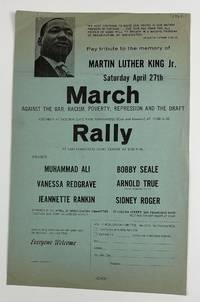
19683397San Francisco 1968. Very good. Broadsheet on blue paper 13.5 x 8.5 inches. Slight discoloration along top and bottom edges minor edge wear a few soft creases old horizontal folds. An exceedingly rare broadsheet advertising a multi-faceted public march and rally against the Vietnam War and "racism poverty and repression" which took place in San Francisco California about three weeks after the assassination of Martin Luther King Jr. The organizers of the event the April 27 Mobilization Committee framed the day's activities around Dr. King's opposition to the Vietnam War; the broadside calls for the protesters to "pay tribute to the memory" of Dr. King his portrait is printed at the top of the front side of the broadsheet and the entirety of the verso prints excerpts of an April 4 1967 speech by Dr. King railing against the Vietnam War. Particularly interesting is the eclectic list of speakers who participated in the day's events on April 27 1968 which included Muhammad Ali Vanessa Redgrave Jeanette Rankin Bobby Seale Arnold True and Sidney Roger. Ali was in the midst of his appeal after his conviction for draft evasion the previous year and was a natural candidate to speak against the injustices of the Vietnam War. Bobby Seale co-founder of the Black Panthers was four months away from participating in protests at the 1968 Chicago Democratic Convention after which he was arrested and tried as part of the sham Chicago Eight fiasco.<br /> <br /> The diversity of the speakers echoes the quantity of different issues represented by the current broadsheet: Civil Rights the Vietnam War the recent assassination of Dr. King Muhammad Ali's legal fight against the war Bobby Seale's controversial role with the Bay Area Black Panthers women's rights and the role of the American military. We could locate no other copies of this broadsheet in auction history or OCLC. unknown
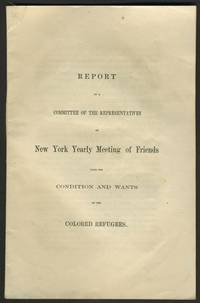
186227695New York: The Religious Society of Friends 1862. First printing. Pamphlet. Very good condition. Three reports from the Quakers during the Civil War on their ministry amongst the "Colored Refugees" of Virginia & Washington DC reporting on the conditions and needs at Fort Monroe Camp Barker Craney Island Alexandria Hampton Norfolk etc. Conditions are tough in the refugee camps but none wish to return to where they have fled from. "Slaves have been abandoned and we must help. Don't we owe them for our prosperity--- enjoying indirectly from the unrequited labor of these people." <br /> <br /> Encyclopedia Virginia writes on their website- "In this report dated May 1864 the Committee on Colored Refugees who were representatives of the New York Yearly Meeting of Friends gives its assessment of the needs of the formerly enslaved people escaping behind Union lines and how Quaker charity efforts were meeting them in contraband camps across Virginia including Alexandria. One of their agents Harriet Jacobs wrote her own letter documenting what she saw in Alexandria and Washington D.C. For Quakers the abolition of slavery was a moral and religious imperative."<br /> <br /> Title continues: Address of the Representatives of New-York Yearly Meeting of Friends to Its Members.; Third Report of Committee of the Representatives of New York Yearly Meeting of Friends upon the Condition and Wants of the Colored Refugees<br /> <br /> 1862 Report OCLC: 21308787 8vo 30pp black title on cream paper wraps saddle stitched. Clean throughout. 1862 Address OCLC: 25519700 8vo 10pp. October 24th 1862. 1864 Third Report OCLC: 25113848 cites 9 copies; 8vo 23pp May 1864 slt. marked wrapper. <br /> <br /> All in their original self wrappers overall in very good condition. The Religious Society of Friends unknown
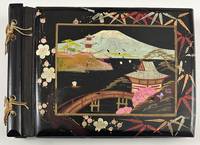
195212821Various locations in and around Seoul South Korea 1952. 22 leaves illustrated with seventy-three black-and-white photographs in mounting corners. Oblong quarto. Contemporary black lacquered gutta percha covers illustrated in Korean style string tied. Minor wear. Very good. A unique peek into Army life in 1952 memorializing the experiences of African-American soldiers during the Korean War. The photographs are uncaptioned but provide a vivid picture of camp life during the conflict. Here the soldiers pose alone and in groups both inside and outside military tents and other structures in both sunny and snowy conditions engaged in lifting weights driving a tank working around the base general carousing and other activities. One image captures an African-American soldier standing outside the Seoul City Hospital likely indicating the soldiers were based near the city. In addition to the American servicemen the album includes several images featuring Korean women with a couple of images capturing a pair of women singing and dancing onstage for the troops. A few other images picture simple portraits of Korean women including one image showing a young Korean woman posed with one of the soldiers. The album also features a handful of shots of the Korean countryside with one image picturing a nearby village. Original albums featuring Black soldiers in the Korean War are rarely encountered in the present market. unknown
1917List3309United States: N.p. 1917. Lithographic poster measuring 15 ½ x 11 ¼ inches. Some damage to edges including small section torn off upper right side good condition. A poster celebrating the Eighth Infantry Regiment Illinois National Guard during World War I. Text on the poster reads:<br /> <br /> “Eighth Illinois Regiment Now In France / The Regiment was mustered in the U.S. Volunteer Service as the Eighth Infantry 370th U. S. National Guard Illinois U. S. Volunteers. / On June 28th officers were commissioned by Governor John R. Tanner then Governor of the State of Illinois. The first commander was JOHN R. MARSHALL who commanded the Regiment and saw service during the Spanish American War in Cuba. He was placed on the retired list January 1st 1914 and was succeeded by the present Commander COLONEL FRANKLIN A. DENNISON January 12th 1914 who is at present Commanding Officer in France. The Eighth Regiment is now about 3000 strong and is now in France on active duty. There are over 157000 negro troops either in France or on their way.â€<br /> <br /> The Eighth Illinois was the only African American combat regiment at that time that also had Black officers. Brig. General Franklin A. Denison pictured at the top left and mislabeled as “Franklin H. Denison†was Colonel of the regiment in France and was the first Black American to be promoted above Colonel when he became a Brigadier General in 1918; when Denison was replaced with a white officer Lieutenant Colonel Otis Beverly Duncan of the Eighth became the highest-ranking African American officer in the US Army.<br /> <br /> The Eighth fighting under the French Army saw significant combat earning the nickname “Black Devils†from the Germans and receiving more honors than any other American regiment on the Western Front. We find records of holdings at Yale and the Chicago Public Library but no examples on the market or at auction. N.p. unknown
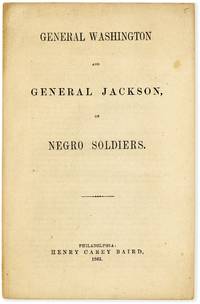
186388000Philadelphia: Henry Carey Baird 1863. First Edition. Octavo 23cm. Sewn pamphlet; printed self-wrappers 8pp. A clean fresh copy Very Good or better. <br /> <br /> Argues for the promotion of African-Americans - who had already been admitted to the U.S Army & Navy in non-combat roles - to front-line fighting units stressing their successful participation in the Revolutionary and Mexican wars: "our bravest and most patriotic generals our Washington and our Jackson did not hesitate to solicit to employ and to reward the military services of Negroes in the War of the Revolution and again within the memory of many of us in our last war with England." Though not signed the essay is generally attributed to the Philadelphia economist pamphleteer and publisher Henry Carey Baird 1825-1901 under whose imprint the tract appeared. Henry Carey Baird unknown
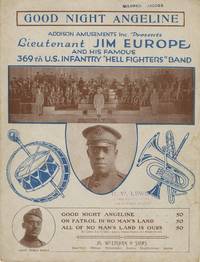
1919List3638New York City: M. Witmark & Sons 1919. Sheet music measuring 9 ¼ x 12 ¼ inches. Small ownership stamp to top margin some light wear overall very good. James Reese Europe 1881–1919 was a composer and bandleader instrumental in the transition from ragtime to jazz whose popularity and influence is impossible to overstate. He conducted the Clef Club Orchestra in New York City which only played music by African-American composers and was the first Black orchestra to perform at Carnegie Hall. Europe’s Society Orchestra toured the country with dancers Vernon and Irene Castle popularizing ragtime dancing. In 1916 Europe enlisted with the 369th Infantry Regiment also known as the Harlem Hellfighters a primarily Black regiment that became one of the most highly decorated American units in World War I. Europe was a second lieutenant and led the Hellfighters Band which toured France in 1818 and is credited with bringing jazz to the continent of Europe. James Europe died in Boston in 1919 when a member of his band taking issue with Europe’s criticism stabbed him in the neck during the intermission of a concert at Mechanics Hall.<br /> <br /> Offered here is the sheet music for “Good Night Angeline†composed by James Reese Europe and his frequent collaborators Noble Sissle 1889–1975 and James Herbert “Eubie†Blake†1887–1983. The cover features a photograph of the Hellfighters Band above a portrait of Europe. We find four other copies of “Good Night Angeline†at the Oakland Public Library the Library Company of Philadelphia the Library of Congress and the Smithsonian Museum of African American History and Culture. Of interest to scholars of African-American musical and military history. M. Witmark & Sons unknown
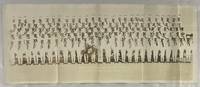
19433552Great Lakes Il 1943. Good. Panoramic photograph 8 x 19.75 inches. A handful of heavy vertical creases irregularly rolled moderate edge wear minor soiling. A unique annotated panoramic photograph picturing the segregated Company 1011 of the United States Navy at the U.S. Naval Training Station in Great Lakes Illinois during World War II. The photograph appears to have belonged to Emerson O. Norton of Paris Illinois whose name and address are written in the margin of the verso. The remainder of the verso is comprised of a penciled chart in which about half of the 133 Midshipmen have signed next to the number keyed to their image on the front of the photograph. The soldiers also sometimes include their address or home city next to their name; the soldiers hail from cities all over the country including California the Midwest Michigan and Ohio Missouri and all the way down the eastern seaboard from New York to South Carolina and the Deep South from Alabama to Louisiana. A wonderful source for researching the African-American experience in World War II. unknown
19414104Fort Knox Ky: June 1941. Good. Panoramic photograph 8 x 36 inches. Vertical creases throughout minor edge wear. The African-American soldiers of Company A 4th Battalion of the United States Army's Armored Force Replacement Training Center are pictured here along with their white officers who sit at center of the first row. The company numbers almost 200 soldiers all featured here in beige uniforms and envelope caps arranged in four rows. The soldiers who composed the Armored Force were specially trained at Fort Knox in mechanized warfare especially in tanks.<br /> <br /> "The Armored Force School and the Armored Force Replacement Center were officially established at Fort Knox on December 1 1940. The school trained armored force soldiers in military fundamentals and in specific areas such as tank gunnery armor tactics communications and maintenance. As the armored force grew and the U.S. entered World War II the school expanded proportionately. From an initial cadre of 155 officers and 1458 enlisted men in October 1940 the school grew to more than 700 officers and 3500 enlisted men by May 1943. The Armored Force School at the peak of its operation during the war operated on two daily shifts to satisfy the demand for qualified armor soldiers. The training reflected the rapid evolution of armored warfare doctrine which changed constantly in the face of battle experience and in the alterations to the force structure and its tables of organization and equipment" - Gary Kempf The History of Fort Knox. June unknown
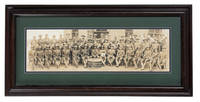
1918List1733Ohio 1918. Silver gelatin photograph in glass-fronted frame image measures 24 ¼ x 6 ⅞ inches. Matted and framed not examined out of frame. The 317th Engineer’s Band was a part of the 317th Engineer Regiment an element of the 92nd Division which was composed of over 15000 African-American soldiers from across the country. The 92nd was one of two African-American regiments to fight in the war the other being the 93rd and was unique in that it was under the command of the United States. The 317th Engineer Regiment was organized in November 1917 at Camp Sherman Ohio several months before this photograph was taken and saw action in Europe as part of the 92nd. Camp Sherman was the third largest training camp in the country at the time with over 2000 buildings capable of housing 40000 men and 12000 horses. As well as being the training site for units of the 92nd also known as the Buffalo Division it served as the training site entire 83rd 84th 95th and 96th divisions. It later became a trade school. <br /> <br /> The 317th Engineer’s Band performed locally around Chillicothe and at other military functions eventually becoming known according to a contemporary newspaper account as one of the best bands in the army. They traveled to Indianapolis to perform in March of 1918. A New York Times article from 1918 mentions them briefly and describes them as ‘famous’ but does not elaborate. They performed at the ‘Colored Club’ in Chillicothe a social club for African-American servicemen in a converted hotel. We find no other record of this image. unknown
1950Cat309Mainly Asia and Oceania 1950. Photo album measuring 10 ½ x 14 ½ inches containing approximately 160 photographs; photos are mainly 4 x 5 inches and smaller with several 8 x 10 inch photos. Album covers completely detached pages with damage to edges fair; many photographs stapled in some with damage very good minus. Overall very good minus. A photo album likely belonging to Edgar “Saxman†Synigal Jr. 1937–2017. Synigal’s draft registration lists his occupation as “delivery boy†for Weidies’ Drug Store in New Orleans; he would go on to lead B.B. King’s band1 and has recording credits with artists including Bobby Womack Branford Marsalis and Jimmy McCracklin. This photo album dates from the 1950s and its identified locations are Hong Kong Kwajalein Atoll Japan Guam Formosa Taiwan the Philippines Singapore Australia and New Zealand.<br /> <br /> Many photographs show the naval rituals surrounding the crossing of the equator. Naval equator-crossing ceremonies—often called “Crossing the Line†rites—date back centuries in European seafaring and mark a sailor’s first passage across the Equator transforming them from a “pollywog†into a “shellback†under the theatrical authority of King Neptune and his court. This often includes rough initiations: being doused with seawater crawling through messy or humiliating setups mock “shaving†with crude tools or being tossed into pools. <br /> <br /> The local women comprise another recurring subject especially in Japan Taiwan the Philippines Hong Kong New Zealand and Australia where the women—and other local youths—are pictured hanging out on the docks and on the ship with one shot of a concert aboard the ship based on a captioned photograph Synigal was likely aboard the USS Bremerton. The young women are pictured on city streets and in clubs with the Navy men with some more formal portraits.<br /> <br /> Several shots show Synigal playing saxophone with a Navy band; in one he sits behind the nametag “Frank†and in another “Ron†though a manuscript caption on the recto of the latter identifies him as “Saxman Synigalâ€. Other subjects include the “Centennial Celebration of the Opening of Japanâ€; “Hometown Friends†which shows young African American people posing outside presumably in New Orleans; “Boot Camp Buddiesâ€; and several interesting shots of Singapore city streets including one of a man in a songkok fez wrapping a snake around the shoulders of a man in Navy uniform.<br /> <br /> Of interest to historians of the Navy during the Cold War especially relations between Navy men and local women in Asia.<br /> <br /> 1 Leonard Feather “Show Affirms That B.B. King Reigns†The Los Angeles Times February 21 1985. unknown