1 575 résultats
188258456Fort Laramie WT 1882. 4to. Three pages approximately 275 words in part: "There is not to my mind outside of Divine Writ so convincing an evidence of the immortality of the soul as is furnished by the growth and development of the mind and character of this greatest of American Presidents to meet the exigencies of the direction and control of a great Revolution on the successful issue of which depended the happiness of one fifth of the world . as his career differed from that of the other heroes of history in that he lived and strove for reforms that would benefit mankind though his own life should be the price in so far is Abraham Lincoln the greatest of Reformers the noblest of Patriots the ablest of men." This essay was published along with other tributes to Abraham Lincoln in The Lincoln Memorial NY 1882. Very good. Folded. #6317. Wesley Merritt graduated from West Point in 1860 serving briefly in the West before returning east for Civil War service in the Union cavalry attached to the Army of the Potomac participating in its major campaigns and battles through Appomattox ending the war commanding a division as a Major General. Following the war he commanded the 9th Cavalry in Texas for eight years; promoted to colonel in 1876 he took command of the 5th Cavalry in Wyoming participating in the Custer campaign and other actions against the Indians and serving in that capacity until 1882 when he was appointed to a five-year posting as superintendent of West Point. He commanded the 1898 expedition to the Philippines during the Spanish-American War. <br/><br/> unknown books
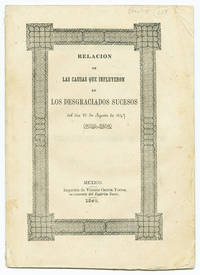
1847WRCAM52463Mexico: Vicente Garcia Torres 1847. 36pp. Original printed wrappers. Light corner and edge wear to wrappers spine extremities slightly chipped. Initial leaves slightly wrinkled. Very good plus. In a red cloth folding case leather label stamped in gilt. An anonymous account dated Aug. 24 1847 documenting the causes of the Mexican defeat at the Battle of Contreras on Aug. 19-20 1847. It was there that the Mexican defensive position commanded by Valencia was overwhelmed by Gen. Scott paving the way to the fall of Churubusco the defeat of Santa- Anna's principal army and eventually the fall of Mexico City. This documented version of the events places the blame squarely on Valencia who is accused of disobeying orders to retreat and vindicates Santa-Anna: "La falta de obediencia del general Santa-Anna completamente y su imprudente arrojo dió al enemigo un triunfo" p.8. Reprints numerous official documents. HOWES R187 "aa." STREETER SALE 268. PALAU 4434. SABIN 48633. Vicente Garcia Torres hardcover books
1847WRCAM42138U.S. Store Ship Fredonia off Anton Lizardo 1847. 4pp. Quarto on a folded folio sheet. Old fold lines. Central fold running the horizontal length of the sheet reinforced with tape. Minor soiling else fine. A very affectionate letter from a sailor to his wife back home full of pining declarations of love and devotion. The sailor Gregory notes that he is safe and likely to stay that way as they are at a good anchorage and the coast has been entirely secured. He indicates that she should direct her letters both to Vera Cruz and Pensacola and that either way they will surely find him with the Gulf Squadron. He also mentions a possible posting to the Naval Observatory which would bring him home to his dearest Jenny. <br> <br> "The frigates 'Potomac' & 'Raritan' have both sailed for home some days ago but we had no opportunity of writing by them as the former sailed from Sacrificios & the latter from Tobasco. You will doubtless have heard long ere you receive this all about the taking of Tobasco. The whole coast is now in our possession and there remains not the slightest chance of any more fighting for the squadron. I must not omit to mention my sweet little wife the Gibbon Edwards Kennard & myself have received an answer from Mr. Maury respecting our application for the Observatory. He says he is very anxious to have us all back again and that he would that day 22d of April go to see the Honl. Secretary and try to get us ordered; but he said he had but faint hopes of success for it was known at the same time at the Dept. that we were very short of officers in this squadron." unknown books
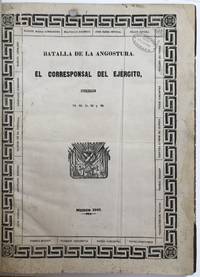
18471307Mexico City 1847. Good plus. 202pp. Large folio. Original printed wrappers bound in contemporary marbled boards rebacked and recornered in recent morocco gilt leather spine label all edges marbled. Numerous additional blank leaves bound in. Rubbing and scuffing to boards moderate edge wear; wraps with repaired chips and tears. Early 20th-century bookplate on front pastedown small ink stamps scattered throughout. A couple of short repaired edge tears internally; light tanning and foxing. A rare Mexican view of the defeat suffered by forces under the command of Santa Anna in the Battle of Buena Vista at the hands of Zachary Taylor during the Mexican-American War. The battle occurred in late February 1847 when Santa Anna freshly recalled from exile in Cuba rushed his new army north to halt the southern advance of Taylor's forces from Texas. Taylor had already been victorious at the battles of Palo Alto and Resaca de la Palma and had captured Monterrey and Saltillo before much of his army was sent to assist in the invasion of Veracruz being prepared by Winfield Scott. When Santa Anna attacked the American forces dug in at Buena Vista south of Saltillo on February 22nd he did so with an army far superior numerically but also one far less trained and experienced and was driven back with heavy losses. Taylor's enhanced reputation and legend that grew out of the battle took him to the White House in 1848.<br /><br />Both sides claimed victory in the battle. Santa Anna did so on the perhaps dubious grounds that although his own army suffered numerous casualties and withdrew from the field Taylor with his now limited forces halted his advance after the conclusion of the engagement. The present work provides a detailed account of the battle from the Mexican point of view printed as five consecutive issues of their official military periodical but published separately with its own wrappers and a sheet with two large woodcut maps. The report as the introduction from the editor makes clear was intended as a defense against criticism from parties within Mexico concerning the conduct of the brief campaign: <br /><br />"Despues de terminar los partes oficiales nos encargaremos de refutar un cuaderno que se ha impreso recientemente con el solo objecto de eclipsar el brillo que las armas mexicanas adquierieron el mes de Febrero ultimo en el estado de Coahuila y que parece escrito si no por Taylor mismo si bajo su influencia y por el poder del oro americano. El ilustre general Santa-Anna nunca ha sido mas digno del amor y reconocimiento de sus conciudadanos y nunca tampocoha debido considerarsele come general y como mexicano mas digno de elogio que en la epoca actual."<br /><br />The work first contains a lengthy report by Santa Anna and several shorter ones from his lieutenants that present the performance of the Mexican army and the results of the battle in the most positive possible light. The majority of the work comprises a unit-by-unit account of Mexican action during the battle with detailed descriptions of the participation of each regiment including lists of soldiers killed wounded and missing in action. The two woodcut maps delineate the geography and trails of the area surrounding Saltillo and the initial order of battle on the field. As a result the work serves not only as a brisk defense of Mexican military conduct but also as an important and comprehensive record of the Mexican side of the engagement.<br /><br />Very rare -- we locate only three copies at Yale Harvard and the University of Texas and none in auction records. books
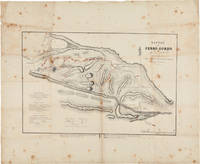
1847WRCAM43715Washington D.C. 1847. Engraved map 12 1/2 x 18 1/2 inches with hand- coloring on a 19 1/2 x 23 3/4 inch sheet. Old folds. Small splits at four cross-folds. Foxing. Good. A scarce and detailed map of the Battle of Cerro Gordo one of the important battles of the Mexican-American War. General Winfield Scott's victory at Cerro Gordo over a much larger force commanded by Santa Anna allowed the Americans to move closer to Mexico City. The map shows the location of the Mexican battery at the pass as well as an additional Mexican battery of seventeen guns. Most dynamically it shows the location of several American forces including those commanded by Shields Riley Twiggs Worth and Pillow as well as the location of the American dragoons and light artillery. A printed note below the map records that Scott commanded some 8325 men while Santa Anna had twice that under his command. A further note records a total of sixty-three Americans killed and 367 wounded. The Mexican forces took some 1000 in killed and wounded. The map was drawn by George B. McClellan then a captain under Winfield Scott and a participant in the battle some fifteen years before he achieved notoriety as a commander in the Civil War and as the Democratic nominee for president in 1864. unknown books
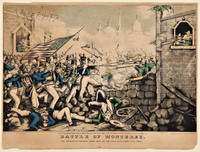
1846WRCAM5666New York: N. Currier 1846. Aquatint lithograph trimmed close but not affecting image uniformly toned. Fair overall. Archival matting and protected with Mylar sheet. A forceful primitive lithograph showing the American assault under the Stars and Stripes while the defenders blaze away. N. Currier unknown books
1850241569New York: F.J. Dow & Co. 139 Nassau St 1850. First edition. Illustrated with 15 beautiful engravings. 128 pp. 1 vols. 8vo. Original red cloth gilt spine spine chipped. Bookplate internally fine. First edition. Illustrated with 15 beautiful engravings. 128 pp. 1 vols. 8vo. Howes M564 F.J. Dow & Co., 139 Nassau St unknown books
1846WRCAM46339Monterey 1846. Broadside 12 1/4 x 8 1/2 inches. Old fold lines. Minor wear. Near fine. In a cloth clamshell case. American forces under the overall command of Gen. Zachary Taylor fought for control of the important city of Monterrey Mexico during September 22-28 1846 in one of the most important battles of the Mexican- American War. The Mexican forces under Gen. Ampudia trapped in the city plaza and bombarded with artillery decided to negotiate and Taylor agreed to a controversial armistice lasting eight weeks. The occupation of the city was disrupted by the behavior of the American troops especially the Texans who were as a result sent back north. On October 5 a Mexican lancer was shot by an American soldier - without provocation - while riding through the streets. Taylor was forced to ask for instructions on how to try the man only to find that no American laws applied and that he could only discharge the man and send him home. With the present decree the U.S. Army tried to establish some legal principles for ruling the city in this period. All rights enjoyed by citizens under Mexican law are to be retained including commercial laws for dealing with foreign merchants excepting supplies purchased for the use of the army; additionally no payments can benefit the government of Mexico and every supplier of the army must be registered. hardcover books
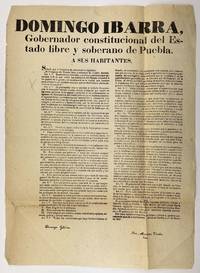
18471731Puebla 1847. Good plus. Broadside approximately 17 x 12.25 inches. Previously folded near lower and right edges to fit in a folio volume with several small stab holes at left edge where previously bound. Some separation from left edge along lower fold line and small area of loss at fold point not affecting text. Light tanning and faint foxing. A rare broadside that promulgates a March 16 1847 decree of the Puebla state government that sought to raise emergency funds for the army facing the American invasion at Veracruz during the Mexican-American War. This decree printed and published in Puebla the following day under the authority of its governor Domingo Ibarra orders the formation of a group to be called the "Patriotic Board of Aid" in order to assure the participation of its citizens. The first article of the decree announcing the establishment of the junta reads as follows:<br /><br />"Entretanto se decretan y realizan contribuciones generales á fin de que todos los habitantes del Estado cooperen á los goastos de la guerra se establecerá en la capital una reunion para proporcionar prontos recursos que se denominará 'Junta patriotica de auxilios.'"<br /><br />The subsequent sixteen articles define the constitution authority and goals of the group. The second article for example stipulates the specific legislative judicial religious and municipal bodies that will nominate two members each to the junta. The fourth article outlines the responsibilities of the board -- to acquire a loan of up to 100000 pesos using the state income as collateral; to seek cash and military supplies via donation loan or purchase; to administer the delivery of goods and money to the army at Veracruz; and to issue state treasury bonds to lenders. The group according to the last article has eight days to amass a much as possible before reporting their results to the state.<br /><br />At this point in the war not only was the entire country under enormous pressure from the landing of Winfield Scott's army but Puebla was also suffering from the significant unrest of the Polkos Revolt which had led to an unsuccessful insurrection aided by a portion of the military garrison in the city just a week prior to the publication of this decree. Indeed the need to ensure the participation of all citizens in the costs of the war is mentioned and emphasized at several points in the decree. The larger size of this broadside underscores the importance of the message and its distribution as well. <br /><br />A fascinating and rare document of emergency efforts at the state level to support the war effort against the United States. We locate only one copy of this rare broadside at Yale. books
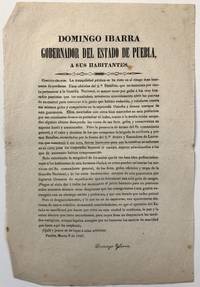
18471729Puebla 1847. Very good. Broadside 12.5 x 8.5 inches. Minor foxing and toning. An unrecorded broadside that prints the thanks and admonitions of the Governor of Puebla Domingo Ibarra following an attempted insurrection there in late February and March 1847 during the Mexican-American War. The uprising was a part of the so-called Polkos Rebellion that followed popular outrage at a January law that allowed the federal government to seize church property in order to pay for the war effort. In Puebla the revolt involved elements of the city's military garrison but was successfully put down by the rest of the guard. Ibarra begins by lamenting the sedition and thanking the loyal portion of the garrison:<br/><br/>"La tranquilidad publica se ha visto en el riesgo mas inminente de perderse. Unos oficiales del 2o Batallon que no merecian por cierto pertenecer á la Guardia Nacional ni menos tener por gefes a los muy honrados patriotas que los mandaban intentaron atrevidamente abrir las puertas de su cuartel para convocar á la gente que habian seducido y rebelarse contra sus mismos gefes y compañeros en la espresada Guardia y demas cuerpos de esta guarnicion. Solo calculando la magnitud de los males que de tan loca idea podian sobrevenir á los habitantes de esta hermosa ciudad es como puden estimarse los servicios del Sr. comandante general de los Sres. gefes oficiales y tropa de la Guardia Nacional y de los otros benémeritos cuerpos de esta guarnicion que lograron librarnos de aquellos sin que derramase una sola gota de sangre."<br/><br/>And he continues by warning the citizens of Puebla against continued foolishness in the face of the enemy and also by asserting his resolve to resist further insurrection:<br/><br/>¡Plegue al cielo dar à todos los mexicanos el juicio bastante para no provocar sobre nostros mismos otras desgracias que las consiguientes à una guerra extrangera con un enemigo astuto y ponderoso y que nos invade por todas partes! Pero si desgaciadamente y lo que no es de esperarse aun aparecieren sìntomas de nueva rebelion descansad conciudadanos en que el ejecutivo del Estado se sacrificará por hacer que reine en esta ciudad la confianza la paz y la union sincera que tanto necesitamos."<br/><br/>A strong statement by a clearly relieved Mexican state official. We locate no copies in OCLC or available sales records. unknown books
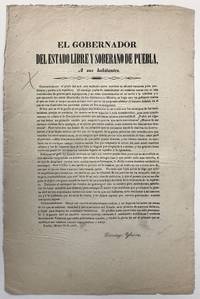
18471730Puebla 1847. Very good. Broadside 12.75 x 8.5 inches. Minor soiling and wear. A rare broadside that prints the thanks and admonitions of the Governor of Puebla Domingo Ibarra following an attempted insurrection there in late February and March 1847 during the Mexican-American War. The uprising was a part of the so-called Polkos Rebellion that followed popular outrage at a January law that allowed the federal government to seize church property in order to pay for the war effort. In Puebla the revolt involved elements of the city's military garrison but was successfully put down by the rest of the guard. In this address Ibarra seeks to inspire unity amongst the citizenry and to warn them of the imminent danger of the American army having just landed at Veracruz. The broadside begins:<br/><br/>"Conciudadanos: el génio del mal está soplando nosotros su aliento venenoso para perdernos y perder á la república. El enemigo acaba de desembarcar en nuestras costas con un tren considerable de guerra para sojuzgarnos y en estas circunstancias se os invita á la rebelion y á que apoyando las miras liberticidad de los disidentes de México se haga caer un gobierno contra el que se tiene el mayor encono porque es el que se ha propuesto afirmar el sistema federal en el que se ven frustrados los perversos planes de los monarquistas. Si hoy que se vé la patria en un peligro tan imminente no se contienen los enemigos de las instituciones porque su ambicion de mando se hace superior à toda consideracion ¿qué será cuando estemos en calma si la Providencia permite que salvemos nuestra nacionalidad"<br/><br/>The landing of Scott at Veracruz was probably the primary encouragement for negotiations between rebel factions and the federal government. Ibarra concludes:<br/><br/>"Obrad con vuesta acostumbrada cordura y asà dejareis burladas las miras de los que os seducen. Atendad à que la salvacion del Estado es el primero de nuestros deberes y dejad para despues las cuestiones domésticas. El pérfido norte-americano nos está provocando á las guerra casi en nuestras mismas puertas: corramos á combartirlo: auxiliémos à nuestros hermanos de Veracruz que están pidiéndonos socorro y tendrà la gloria de ser el primero que sacrifique con vosotros vuetro conciudidano y amigo."<br/><br/>A stirring address and rare. We locate only one copy at Yale. unknown books
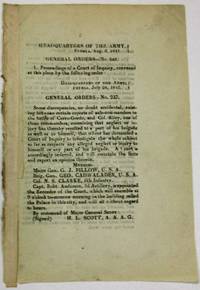
184735511Mexico City 1847. 5-1/2" x 8". 6pp. Disbound lightly toned. Signed in ink by H.L. Scott A.A.A.G. "By command of Major-General Scott." Ink notation at head of first page "See W.D.G.O. 21 of 1848." Very Good.<br/><br/> The issue concerned "the removal of two small howitzers on the 14th of September from Chapultepec." They had been under the command of Major General Gideon Pillow a Tennessee lawyer who was a close friend of President Polk. The howitzers were found as Pillow states "in my own baggage wagon." Hints and innuendo suggested that Pillow had deliberately taken them. Insisting that "this was done without my knowledge or authority" Pillow requested a Court of Inquiry which vindicates Pillow. "It does not appear that Major-General Pillow had any information of the actual fact that the howitzers were in the city of Mexico until the evening of October 8 subsequent to the order of the General-in- Chief in relation to trophies etc. when and subsequently he seems to have used all proper measures to have them restored. unknown books
1886WRCAM44320San Francisco: Fraternal Publishing Company 1886. 30pp. plus illustrations. Text in double columns. Printed wrappers pictorial vignette on rear wrapper bound into contemporary gilt cloth. Front hinge cracked endpapers discolored. Very clean internally. Very good. A presentation copy inscribed on the front pastedown: "Major Gen. Oliver O. Howard U.S.A. Commanding Division of the Pacific San Francisco California / with the compliments of Edwin A. Sherman Chairman of the Committee of Arrangements Oakland Cal. / would have been sent before but absence in Mexico prevented." Howard was one of the "vice presidents" of the celebration and was instrumental in its execution and Edwin A. Sherman was the "orator of the day." Howard was an important Union General who played a key role at Gettysburg and later in the Indian wars. Fraternal Publishing Company hardcover books
1847WRCAM52366Mexico City: Printed by R. Rafael 1847. 7pp. Dbd. Minor toning soft vertical crease throughout. Very good. The English-language portion of a rare bilingual-printed Mexican pamphlet from the waning months of the Mexican-American War. The Spanish portion of eight pages was published with a separate titlepage as INSTRUCCIONES OTORGADAS POR LA JUNTA GENERAL DE ELECTORES A LOS REPRESENTANTES DE LA CIUDAD Y DISTRITO DE MEXICO. Ostensibly a short instructional guide for future elected representatives in Mexico the work is also a bitter indictment of both American imperial expansion and ineffectual Mexican political authorities. The author rails against the "deplorable occupation" of the United States and also the "imbecile abandonment" by Mexican authorities. The article concludes with a list of seven guidelines for the formation of a new elected assembly. OCLC records just five bilingual copies including the copy at the Biblioteca Nacional which reports the Spanish and English portions separately. OCLC 2576135 651382166 651382169. Printed by R. Rafael unknown books
1846WRCAM16540Washington 1846. 33pp. Dbd. Remnants of spine reinforcement else very good. President Polk's calling for war to revenge the "wanton insults" by the Mexican government. An important document with much on the annexation of Texas and other examples of the deteriorating relationship with Mexico. unknown books
1846WRCAM4695Washington 1846. 131pp. Dbd. Minor marginal dampstain to a couple of leaves. Very good. Sen. Doc. 29th Cong. 1st Sess. A fundamental document in the history of the Mexican-American War. President Polk describes the status of Mexican-American relations asserts that a state of war exists and calls for upon the Congress to recognize the state of affairs. Specifically Polk transmits the details of the Slidell mission which sought the purchase of New Mexico and California. The failure of John Slidell's mission was a proximate cause of the ensuing hostilities. This message is dated May 11 1846 and Congress declared war the very next day. Also included is supporting correspondence and the details of U.S. and Mexican troop movements. TUTOROW 1668. unknown books
1846WRCAM4677Washington 1846. 81pp. Dbd. Very good. In a blue cloth folder. Prints correspondence from generals Gaines and Scott and concerns Scott's taking command of the army of occupation on the Texas frontier. hardcover books
1848WRCAM21846Washington 1848. 1277pp. Large thick octavo. Modern half calf and marbled boards leather label raised bands. Occassional light fox mark. Overall very good. A huge report chock full of material on the Mexican-American War printing correspondence messages reports etc. "Perhaps the most important collection of material we have for the history of the Mexican War" - Sabin. SABIN 48114. hardcover books
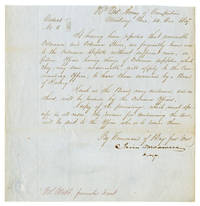
1847WRCAM42125Monterey Mexico 1847. 1p. plus integral docketing leaf. Quarto on a folded folio sheet. Old folds. Minor soiling else very fine. A fair copy of orders from U.S. Army Headquarters issued at the command of General Wool ordering that no ordnance be condemned as unusable without proper review first; signed by Irvin McDowell a member of General Wool's staff. The order reads: "It having been reported that serviceable ordnance and ordnance stores are frequently turned over to the Ordnance Depots without sufficient cause in future officers having charge of ordnance supplies which they may deem unserviceable will apply to the commanding officer to have them examined by a Board of Survey. Such as the Board may condemn and no others will be received by the Ordnance Officers. A copy of the proceedings which must specify in all cases the reasons for condemning the stores will be sent to the Officer who is to receive them." unknown books
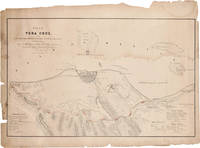
1847WRCAM48455Washington D.C. 1847. Engraved map 16 x 25 1/4 inches with hand- coloring on a 19 1/2 x 27 inch sheet. Worn around the edges with chips and loss not affecting the map imagery itself. Two closed tears in the left edge do intrude into the map. Paper tanned upper portion stained. About good. A scarce and detailed map of the Siege of Vera Cruz a turning point in the Mexican- American War. Winfield Scott with ten thousand American troops and a siege train landed on the beach near Vera Cruz on March 9 1847. The American forces outnumbered the Mexican defenders of the city by a two-to-one margin and the American guns were especially devastating. The city's castle was undamaged but the terrified citizenry implored Gen. Juan Morales to capitulate which was done at the end of March. The map notes American casualties as twelve killed and sixty-one wounded the actual numbers were slightly higher; the casualty rate among Mexican soldiers and civilians outnumbered that of the Americans. Vera Cruz would become an important port base for the American forces. This map shows the coastline from the road to Jalapa to the landing point of the American troops. The city and its main defenses are shown in detail and the headquarters of American commanders Scott Worth Patterson and Twigg are also shown. The Line of Investment is colored in red as is the location of the American hospital. Text on the map describes the make-up of the divisions led by Patterson Worth and Twigg. This map was drawn by George B. McClellan then a captain under Winfield Scott and a participant in the battle some fifteen years before he achieved notoriety as a commander in the Civil War and as the Democratic nominee for president in 1864. OCLC records some sixteen institutional copies but in our experience this map is scarce in the market. unknown books
1847WRCAM4384Washington 1847. 16pp. Dbd. Soiled. Good. Against the war. TUTOROW 1315. unknown books
1846WRCAM12576Washington 1846. 16pp. Dbd. Soiled and dampstained else good. Against the war. unknown books
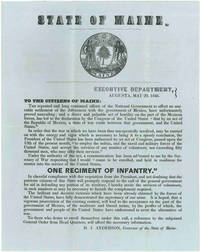
1846WRCAM48647Augusta Me 1846. 2pp. on bifolium sheet of blue paper. Printed on recto of each leaf only. Early soft creases from folding. Tiny separations at cross-folds. Small bit of discoloration on second page. Very good. Message of Maine governor H.J. Anderson and a general order from Alfred Redington Commander in Chief of the Maine militia calling volunteers to arms in the Mexican- American War. Anderson explains that "the repeated and long continued efforts of the National Government to effect an amicable settlement of the differences with the government of Mexico have unfortunately proved unavailing" resulting in the American declaration of war. Anderson notes that the President has requested one regiment of infantry from Maine and writes that he has no doubt "that the patriotic citizens of this State will promptly respond to the call of the general government for aid in defending any portion of its territory." Redington's general order lists the positions in the infantry volunteer corps being assembled and transmits instructions for volunteers. "Maine although distant from the scene of the conflict will be as prompt as any of her sister States in repelling the forces of the invader. Her patriotic citizens will be as ready to vindicate rights upon the Rio Grande as upon their own immediate territory. Their love of country knows no section but embraces the entire boundaries of the Republic" - Redington. unknown books
1846WRCAM4388Washington 1846. 52pp. Dbd. Very good. The committee outlines reasons for the U.S. declaration of war against Mexico in May 1846. unknown books
184735509Puebla Mexico 1847. 5-1/4" x 8". 4pp. Signed in ink by H.L. Scott A.A.A.G. "By command of Major-General Scott." Disbound spine reinforced else Very Good. <br/><br/> This is the report of the Court of Inquiry whose President was Gideon Pillow; its Recorder was Robert Anderson. The Court concludes that the "movements of Col. Riley's brigade had an important influence in the achievement of that brilliant victory that Col. Riley had an active participation in them and that his conduct and that of his command should be suitably noticed in the Official Report of his superiors. unknown books