11 490 résultats
1981012184Old Tappan New Jersey U.S.A.: Scribners 1981. 374 pages including index bibliography and glossary. The jacket is slightly discoloured under a plastic wrapper. Using over 500 photographs this a history of allied and axis aerial photo-reconnaissance and photo interpretation operations in World War II. Small tear on dj. Text clean. 1st Printing. Cloth. Near Fine/Very Good. 4to - over 9¾" - 12" tall. Scribners Hardcover
1981004108Old Tappan New Jersey U.S.A.: Scribners 1981. 374 pages including index bibliography and glossary. The jacket is slightly discoloured under a plastic wrapper. Using over 500 photographs this a history of allied and axis aerial photo-reconnaissance and photo interpretation operations in World War II. . 1st Printing. Cloth. Near Fine/Very Good. 4to - over 9¾" - 12" tall. Scribners hardcover
1981005306Old Tappan New Jersey U.S.A.: Scribners 1981. 374 pages including index bibliography and glossary. The jacket is slightly discoloured under a plastic wrapper. Using over 500 photographs this a history of allied and axis aerial photo-reconnaissance and photo interpretation operations in World War II. 1st Printing. Cloth. Near Fine/Near Fine. 4to - over 9¾" - 12" tall. Scribners hardcover
200635383Stackpole Mechanicsburg PA 2006. Folio with photographic title-spread photographs and charts throughout and diagrammatic endpapers; olive cloth backstrip lettered in black a fine copy in unclipped dustwrapper. Revised version of the original edition of 1984. VERY SCARCE. Stackpole, Mechanicsburg PA, hardcover
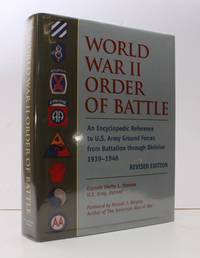
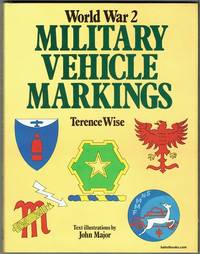
1981220035Cambridge: Patrick Stephens 1981. 1st. Hardback. Near Fine/Near Fine. John Major. First edition hardback 1981 with price-clipped jacket. In overall near-fine used condition with only very slight signs of age handling and storage. Binding tight and appears almost unread. Internally clean no annotation or inscriptions; text and illustrations bright and clear throughout. Not an old library book. Patrick Stephens hardcover
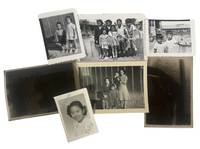
1944206531944. WWIIJapanese American Photo archive of Japanese American families and children confined in United States War Relocation Authority camps during the Second World War. These images taken during the 1940s incarceration of approximately 120000 people of Japanese ancestry following the issuance of Executive Order 9066 capture informal scenes of family life in the camp system that held both immigrants and American-born citizens. More than two-thirds of those imprisoned were United States citizens including thousands of children whose early years were spent inside the camp environment. The photographs show the everyday domestic and social life in incarceration centers recording children parents and small family groups living within the controlled environment established by the War Relocation Authority.<br /> <br /> Archive of seven original photographs including five silver gelatin prints and two photographic negatives dating to the World War II incarceration period. The images depict small groups and individual portraits of Japanese Americans in relocation centers. One group photograph shows six children seated on a wooden fence with rows of barracks-style housing structures visible behind them. Another image depicts two mothers seated on a wooden bench with their toddler-aged sons in front of a wooded camp building; the verso is inscribed identifying the women as "Mrs. Chyoko Okita" and "Mrs. Hayashima." A school-style portrait of a young girl includes her name written on the recto. Two negatives show adult figures outside built environments including one man standing in a suit before a brick building and another image showing a man posed with three women beside an automobile with leafless trees in the background. The photographs range in size from approximately 1.5 × 2.25 inches to 2.5 × 3.5 inches.<br /> <br /> Japanese American incarceration camps held entire family units between 1942 and 1945 producing a social landscape in which children attended school and families attempted to maintain ordinary routines. Approximately 6000 children were born in War Relocation Authority centers during the war years and many young children spent their earliest developmental years entirely within the camp system. Vernacular photographs such as these offer rare glimpses of daily life beyond official government photography preserving personal moments of families and children navigating incarceration under wartime policy. Minor edge wear to several photographs with otherwise clear images and strong tonal contrast; negatives well preserved. Overall very good condition. An evocative record of Japanese American family life during U.S. internment. unknown
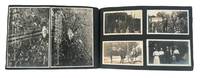
1915200651915. World War I photograph albums created by soldiers and travelers often juxtapose the brutality of industrial warfare with scenes of civilian life and personal travel revealing how participants understood the global conflict unfolding around them. This album of approximately 101 photographs dating from roughly 1915 to 1918 documents both the European theater of World War I and an extraordinary American automobile journey from San Francisco to Washington D.C. The images capture the material culture of early twentieth century mobility the devastation of trench warfare in France and the civilian landscapes through which soldiers and travelers moved during the war years. Together they form a visual narrative of a world simultaneously engaged in modern leisure travel and mechanized global conflict.<br /> <br /> Photograph album containing approximately 101 photographs measuring roughly 3 x 2 inches to 4.5 x 6.5 inches including albumen prints silver gelatin prints and sepia toned photographs many with captions written in white ink directly on the prints. Early images document an automobile expedition labeled "Automobile Camping Trip San Francisco to Washington DC" with the additional caption "Approx. 4000 miles in 27 days" showing touring cars modified for long distance travel with seats folded down and bedding arranged inside the vehicles. Several photographs feature family members identified in French captions including an albumen portrait reading "Suzane et Jeane Vincent 'a leur grand ami" as well as group photographs labeled the "Cateret Family" depicting picnics garden scenes lakeside outings and automobile travel in Europe. Wartime images depict the destructive landscape of the Western Front including a trench scene captioned "After a Yank barrage 1800 Boches deads near Soissons" a photograph labeled "Bombarded house Grandpre 1917" showing a destroyed structure with smoke rising from the rubble and views of Belleau Wood. Additional photographs document military technology and battlefield operations including German artillery German observation balloons anti aircraft guns camouflaged British tanks captured artillery pieces wrecked airplanes and soldiers in formation. One photograph depicts German Field Marshal Paul von Hindenburg pointing toward a soldier. Several images show supply depots in France during 1918 as well as groups of Allied soldiers in camps and on maneuver.<br /> <br /> The album concludes with portraits of children and family members visually contrasting the domestic life of civilians with the devastation of the European battlefields recorded earlier in the volume. The presence of both American and European subjects reflects the international dimension of World War I which drew soldiers civilians and travelers into a shared landscape shaped by mechanized warfare and unprecedented global mobility. Approximately 101 photographs mounted in an album with manuscript captions. Album binding remains tight with minor wear along edges; photographs clear and well preserved with only light handling wear. Overall condition very good. unknown
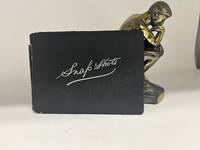
191887875SELF PUBLISHED: Privately Printed 1918. Photograph Album. Very Good Plus. Photo album with thick paper-covered boards labeled on front board in white script "Snap Shots" 7 in. x 5 1/4 in. 36 black mounting pages with 66 4 1/4 in. x 2 1/2 in snapshote plus three tiny "gems" affixed to inside of rear cover. 3-inch flap-tear to spine revealing that paper used in construction of this album was "printers waste" and a photographic image of trees may be seen on reverse of flap. Easily gluable but buyer might want to see this unique example of early "recycling". Minor edgewear to boards and a crease to rear board which has been cracked -- but with no serious damage. <br /> <br /> First photo depicts "Dead Man Hill" in Verdun the next few vast bombing destruction in Reims; cannon and troops; street scenes and overview of Le Mans. Also mounted is a 1917 Cinquante Centimes banknote Issued by the French army with a compelling designe by Ludovic Vallee depicting the "victorious return of the soldier who did his duty baggage under his arm and welcomed by his dog advancing with outstretched arms towards his family. The wife in peasant attire also with outstretched arms is surrounded by two children the older daughter of whom lays a laurel wreath at the winning hero." Numista site.<br /> <br /> Other photos depict a barracks built at the edge of the Sarthe River showing bathing soldiers and hanging laundry; more street scenes in Le Mans; graveyards and urban destruction in St. Mihiel; children amongst the ruins in Chateau Thierry; devastation in Verdun; more graveyards; underground bunkers; bridges. Several pictures of Salt Lake City Utah Mormon Temple SLC street scene and several shots of soldiers recovering from battlefield injuries in the hospital.<br /> <br /> Roughly half the photos are identified/captioned "Campbell" "Cpl. Evans."; ;German Prison Camp"; "Our first picture in the AEF"; ; "Prison Camp for Pro-German" etc. ".the AEF an American Expeditionary Force consisting of troops from both the United States Army and Marine Corps units. .The AEF counter-offensive combat action at Château-Thierry was relatively brief starting on July 1 1918 and lasting for less than a week and was part of the allied effort to push back the recent German advance. American forces had linked up with their French allies at the Marne River on June 3 1918 and had forced the Germans back across the river. This set the stage for the action at Château-Thierry and at the Battle of Belleau Wood. ." Wikipedia. Privately Printed unknown
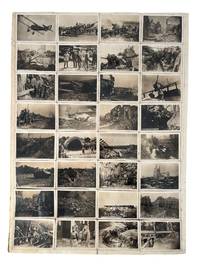
1914213901914. World War I battlefield scenes documented in photographic postcards produced during the conflict between 1914 and 1918. The images record key elements of industrial warfare on the Western Front including trench systems artillery deployments armored vehicles aerial combat and the destruction of urban centers in France. Together the photographs present a visual survey of military technology battlefield conditions and command leadership during the war. Scenes of soldiers in trenches artillery firing positions advancing tanks and devastated cities illustrate the scale of mechanized warfare that defined the conflict and reshaped military operations in the twentieth century.<br /> <br /> Archive composed of 32 vintage real photo postcards mounted on two cardboard display sheets. Each photograph measures approximately 3 x 4.5 inches and is captioned in the negative. The images depict multiple aspects of the Western Front including French soldiers occupying front line trenches and artillery units operating large caliber guns such as a Canon de 220mm Schneider mortar. Several photographs show armored vehicles including Renault FT tanks advancing near Andicourt in the Aisne region. Additional images document captured German heavy artillery including large siege mortars identified as 21 cm Mörser guns seized by British forces. Aerial warfare appears in photographs of fighter aircraft in flight including an image attributed to the aircraft of French ace Captain Georges Guynemer. Urban destruction is represented through photographs of damaged French cities including scenes of devastation in Reims with the cathedral visible above surrounding ruins. Infrastructure damage is also recorded in photographs of a destroyed bridge at Château Thierry. Leadership and command figures appear in several images including a photograph of Georges Clemenceau visiting a French aviation camp near the front and another showing Marshal Ferdinand Foch with General John J. Pershing at American General Headquarters.<br /> <br /> The photographs collectively illustrate the transformation of warfare during World War I through the introduction of mechanized weapons systems coordinated artillery operations and the integration of air power into military strategy. The presence of tanks aircraft and rail mounted artillery demonstrates the technological changes that characterized the conflict and influenced subsequent military development. Mounted photographic postcards also functioned as documentary and commemorative imagery circulated during and after the war to illustrate the scale of military operations and battlefield destruction. Thirty two photographs mounted on two cardboard sheets measuring approximately 12 x 19 inches. Light wear and minor creasing visible on several images with overall strong photographic clarity. Overall very good condition. The mounted set preserves a broad visual record of Western Front combat and military technology during the First World War. unknown
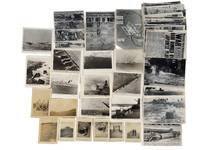
1945213921945. U.S. military operations in the Pacific Theater during World War II photograph and newspaper archive 1941-1945 documenting the Battle of Iwo Jima and the attack on Pearl Harbor. The archive pairs soldier-taken snapshots with official U.S. Navy and press photographs showing how combat equipment and battlefield conditions. The featured original snapshots contain handwritten notations en verso identifying dates specific locations soldiers and equipment.<br /> <br /> The archive comprises 39 silver gelatin photographs ranging from roughly 3.5 x 5 to 6 x 8 inches together with original wartime front pages of the Honolulu Star-Bulletin covering the attack on Pearl Harbor the fall of Italy and the Allied invasion of Europe. Images include amphibious landings on the black sand beaches of Iwo Jima with landing craft advancing under naval bombardment; U.S. Navy battleships destroyers and landing craft firing on shore defenses; and aerial scenes of dogfights and bombing runs. Close-up battlefield images depict the wreckage left in the wake of combat including destroyed landing craft craters from naval artillery and Japanese fortifications. Several photographs focus on the role of air power with images of Japanese aircraft under attack U.S. planes engaging in dogfights and B-29 Superfortresses bombing enemy positions. A particularly striking image captures a Japanese bomber scoring a direct hit on the USS Yorktown with billowing smoke rising from the carrier. Handwritten notations on some images identify U.S. servicemen locations such as Mount Suribachi and captured Japanese positions. The series of larger military-produced photographs and newspaper clippings have inscriptions on verso identifying locations and vessels depicted as well as the name tag "K .Benden." Among these are portraits of American soldiers posing at key strategic points inspecting captured bunkers and standing beside wrecked aircraft. <br /> <br /> Reconnaissance images show terrain and fortified positions; ground-level views show cratered landscapes wrecked landing craft and captured Japanese fortifications. One image shows the USS West Virginia during the Pearl Harbor attack with fire damage and crew visible; another shows a Japanese aircraft striking the USS Yorktown. Other photographs show servicemen near Mount Suribachi inspecting bunkers and beside wrecked aircraft. Many images carry printed captions within the negatives; others have handwritten verso annotations identifying locations dates vessels and personnel including one marked "K. Benden." Light wear minor edge creasing and occasional surface marks; overall in very good with strong image clarity. unknown
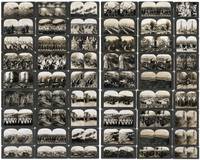
1918231911918. World War I stereographic photographs documenting mass mobilization and wartime public messaging with scenes of troop training segregated transport naval preparation military medicine battle damage and demobilization across the American and European war effort. The photographs preserve the structure of modern war and the language used to justify it through in captions linking domestic reunion to major campaigns and in racialized commentary on Black troops moving toward embarkation. The archive moves from recruitment and preparation to overseas destruction and return to family life and preserving the framework through which these scenes were presented to American viewers.<br /> <br /> Photo archive of 46 silver gelatin stereographic photographs each approximately 7 x 3 inches produced in the United States circa 1918 to 1919 with scenes photographed in both the United States and France. The cards are mounted on gray stock with printed titles serial numbers and lengthy descriptive texts on the versos. Visible scenes include the "1918 Graduating Class at Annapolis" linking the group to officer and naval training; "Fighters Who Broke the Hindenburg Line Parading Down Fifth Avenue" showing victory procession in a major American city; and "Troops on March En Route to Camp After Leaving Transport New York Harbor" where armed servicemen advance through streets lined with civilians waving flags and handkerchiefs while several spectators watch from a rooftop. Other cards show massed formations under the title "Our Answer to the Kaiser 3000 of America's Millions Eager to Fight for Democracy" naval recruits standing at parade rest a church converted into a hospital with rows of wounded men on cots a disappearing coast defense gun elevated for firing at Fortress Monroe African American soldiers shown segregated from white units and halted beside railway cars in "Colored Troops Taking Train Rest" and "Shooting German Airplanes Aircraft Gun Concealed in the Woods" showing two servicemen aiming anti-aircraft artillery skyward. Additional views show soldiers searching shattered ruins in France peace delegates visiting devastated Arras embarkation and harbor activity prisoners under guard and soldiers reunited with wives and children. The printed verso texts sharpen the wartime framing throughout: the New York Harbor parade card invites viewers to imagine securing "the lofty station on the lamp post" for a better view of the "long brown line"; "Happy Reunion for Soldier Fathers" connects domestic embrace to Chateau-Thierry Soissons St. Mihiel and the Meuse-Argonne; "Our Answer to the Kaiser" frames troop concentration as a democratic national response to Germany; "Colored Troops Taking Train Rest" preserves both the visibility of Black military movement and the paternal racial language used to describe Black soldiers during the period; and the anti-aircraft gun card identifies the weapon as part of the defense of Paris against air raids.<br /> <br /> These stereographs treat World War I as a coordinated military and social system moving from academy training and troop embarkation to anti-aircraft defense hospital care ruined French cities victory parades and reunion at home. The group preserves the language that organized public understanding of that system including patriotic appeals to democracy and openly racialized descriptions of Black troops in transit making the cards evidence of both wartime experience and wartime instruction. Light general handling wear with minor edge and corner wear; printed titles and verso texts clean and legible. A sustained visual account of how the First World War was mobilized staged for public viewing and folded into American memory and national myth-making. unknown
739340131Brand_New. NEW condition -SEALED- Fast ship and satisfaction always guaranteed. unknown
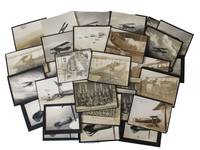
1918177171918. World War I military aviation. Primary-source photographs documenting early United States military aviation training at Henry Post Airfield Fort Sill Oklahoma during the formative period of the U.S. Army Air Service following its establishment in May 1918. The images record the first generation of American military pilots operating within a rapidly developing aviation program built in response to World War I supporting research into the expansion of U.S. airpower pilot training infrastructure and the integration of aircraft into military operations. The presence of DH-4 two-seat biplane bombers the principal American-built combat aircraft of the war situates the archive within the transition from experimental aviation units to operational military squadrons. A dated caption identifying "October 29 1918 Sergeant Schauble" flying at 3700 feet further anchors the material within the final phase of the war.<br /> <br /> Archive of 26 silver gelatin photographs Fort Sill Oklahoma circa 1917-1918 each measuring approximately 7.25 x 5.25 inches. The archive includes many photos of the biplanes in the air one photo shows several DH-4 bombers soaring in the clouds in a Flying-V formation. A handwritten caption on one image "October 29 1918 Sergeant Schauble " is depicted flying in a DH-4 at 3700 feet as well as going on a "parachute trip". One photo shows a serious plane crash with two DH-4s biplanes nose down in the ground. The pilots are also depicted in hot air balloons. Fort Sill was home to several US Army Balloon Companies during this period which were still primarily used for reconnaissance and directing aerial bombardment during World War I. The photo archive includes many shots of biplanes in the clouds or on runways with pilots in goggles including 4 images of pilots or troops in group shots. Most photos show the planes or balloons in mid air. . Army balloon companies stationed at Fort Sill for reconnaissance and artillery observation. Several images capture aircraft at altitude among cloud formations while others document runway activity and pre-flight staging. Versos of many prints retain remnants of black album paper indicating removal from a compiled photographic album.<br /> <br /> The archive documents the early operational environment of American military aviation at a moment when the United States was rapidly expanding its aerial capabilities following limited prewar development including the Army's first acquisition of aircraft from the Wright brothers in 1909. Henry Post Airfield functioned as a central training site for pilots entering service during World War I and the inclusion of both airplane and balloon units reflects the continued reliance on multiple aerial technologies for reconnaissance and combat support. The photographs provide visual evidence of training practices aircraft deployment and the material conditions of early air service operations during a period of institutional formation. Minor edge wear and surface wear are present with album residue on versos; overall very good condition. A cohesive photographic record of early U.S. military aviation training and aircraft use during World War I. unknown
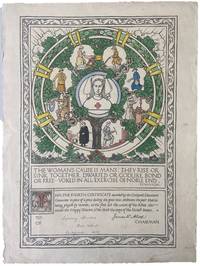
1918179031918. Liverpool Education Committee Holt School nursing award certificate 1918 honors women's World War I service through an elaborate visual program centered on a Red Cross nurse. The certificate places nursing within a wider field of women's wartime labor showing smaller portraits of women working in traditionally male occupations around the central nurse figure. Its imagery and Tennyson quotation connect female service to national duty civic recognition and arguments for women's public importance during the final year of the war.<br /> <br /> Holt School. Nursing award certificate. Liverpool: Liverpool Education Committee 1918. Printed and hand-colored certificate. 12 x 17 inches. Blank verso. The design features an 8.5 x 8.5 inch medallion with a Red Cross nurse at center framed by a tree whose branches contain portraits of women at work all enclosed by a bright floral border. Beneath the image appears the Tennyson quotation: "The woman's cause is man's: they rise or sink together dwarfed or godlike bond or free. Yoked in all exercise of noble end." The text states that it was "the fourth certificate awarded by the Liverpool Education Comittee in place of a prize during the great war."<br /> <br /> The certificate belongs to wartime educational culture that publicly acknowledged women's labor while the war accelerated debates over citizenship work and social recognition. Small half-inch tear at margin not affecting text or image; illustration bright and detailed; very good. An attractive World War I certificate preserving how British schools commemorated women's nursing and war work in 1918. unknown
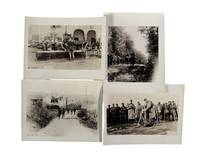
18537World War One Archive of photographs of US soldiers in action produced by the U.S. Army Signal Corps. 4 black and white photos each measure 8.5" x 6.5." One photo shows soldiers of the 168th infantry washing up in a stone trough. Another photo shows the marking of the grave of 1st Lieutenant Quentin Roosevelt son of former President Teddy Roosevelt. Quentin was KIA in July 1918 when his plane was shot down in France. One photo shows American soldiers on horseback from the 167th infantry marching to attack in a "Boche" or abandoned German trench. In the last photo we see soldiers carrying supper to other soldiers in front line trenches with a war torn medieval French home in the background. Because this was official photography from the U.S. signal corps these photos are high quality and present a cohesive representation of a GI's experience in WWI. These photos mostly present the American soldiers in the final days of World War I in France. Photos have a number at the bottom left corner Signal Corps U.S.A. and/or U.S. Official badge at bottom edge. The Photographic Section of the Signal Corps was established in June 1917 and it was responsible for the U.S. Army's official ground and aerial photography of World War I. The photos came with detailed captions that give valuable context. In very good condition overall. unknown
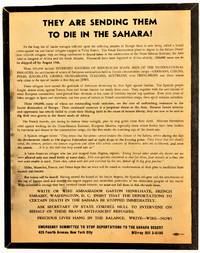
1941189981941. Broadside issued in 1941 by the Emergency Committee to Stop Deportations to the Sahara Desert articulating an urgent appeal against the forced deportation of anti-fascist refugees by the Vichy French government during the early years of the Second World War. Written by Edward K. Barsky a leading figure in the Joint Anti-Fascist Refugee Committee the document calls on American citizens to intervene diplomatically by contacting both the French Embassy in Washington D.C. and the U.S. Secretary of State. The broadside documents contemporary awareness of mass deportations and forced labor policies under the Pétain regime describing plans to remove large numbers of refugees-including veterans of the Spanish Civil War members of the International Brigades and political exiles from across Europe-to labor camps connected to the Trans-Saharan Railroad. The text situates these actions within broader patterns of repression highlighting the targeting of anti-fascist populations and the international composition of those affected. As such the document provides primary-source evidence of early wartime advocacy efforts in the United States responding to refugee persecution and authoritarian policies in Vichy-controlled territories.<br /> <br /> Single-page printed broadside. New York: Emergency Committee to Stop Deportations to the Sahara Desert 1941. Measuring approximately 10.25 x 8 inches. Printed in black text within a ruled border on brown paper. The text consists of a headline explanatory statement and direct appeal for public action including instructions to contact diplomatic officials.<br /> <br /> Light wear consistent with age; text clear and legible; overall very good condition. A scarce wartime advocacy document reflecting early American engagement with the European refugee crisis under Vichy rule. unknown
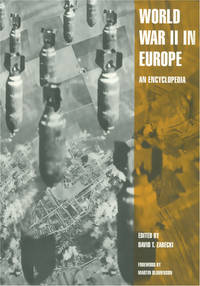
1999WWII-16New York: Garland Publishing 1999. Comprehensive highly acclaimed two-volume set presents a detailed historical account of the social political and military events of World War II including topics covering strategic maps of WW II military operations; weapons and equipment with technical data tables; strategy tactics and operational techniques; battles campaigns and operations; leaders and individuals; units and organizations; socio-political issues; tables of comparative ranks; allied and axis code names; chronology of WW II in Europe; index of military units and warships; etc. 1920 pgs. collectively. Illustrated. Heavy item. First Edition. Pictorial Hard Cover. As New. 4to - over 9¾" - 12" tall. Garland Publishing Hardcover
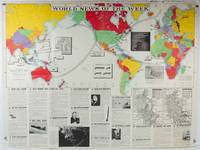
1942202620Army Orientation Course. / News Map of the Week Inc. Volume 4 No. 32. 13 April1942. Folding colour pictorial map on sheet 88 x 119 cms blank on verso inset maps two photographic diagrams and black and white photographic illustrations descriptive text top edge chipped a few short edge tears and lower corner torn no loss pinholes at the corners inoffensive tidemark at a lower corner in good condition. Colour world map showing political boundaries and military events of World War II from April 3 to 9 1942. with descriptive text beneath including: the loss of two British Cruisers off Ceylon; the occupation of Bataan by the Japanese and their landing on Manus; Japanese war tactics revealed by Malay prisoners and the increasing importance of Central Africa to the Allied war effort. The. Map is indexed according to these notes. Two inset maps of Europe chart Hitler's gains in 1941 and activity on the Russian Front. Additional diagrams on the main world map show war spending and the civilian and war output of US industries. . Army Orientation Course. / News Map of the Week, Inc. unknown
19981659140304016Hbo Home Video 1998-01-01. VHS Tape. New. Brand-new unused unopened. small chip on cover corner. still sealed up. Hbo Home Video unknown
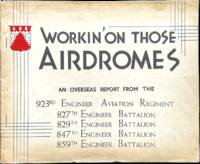
194577632923rd Engineer Aviation Regiment IX Engineer Command 1945. Wraps. The 923rd Engineer Aviation Regiment was a segregated African American unit activated August 1 1942 at Eglin Field Florida under the command of Colonel I.D. Brent. Sent to the United Kingdom to construct vital airfields for the American strategic bomber offensive the regiment arrived on August 14 1943 establishing its headquarters at Eye Suffolk. The 827th 829th 847th and 859th Engineer Aviation Battalions were joined to the regiment giving it a total of approximately 3200 black enlisted men and 130 largely white officers and making it the largest African American unit stationed in the United Kingdom during World War II.<br /> <br /> According to this unit history "The two greatest accomplishments of the men of this Regiment were the construction of Eye and Debach airdromes in England. The men of this organization worked long hours learned new trades and skills and gave up much treasured off-duty time to meet the exacting completion dates which were imposed upon us. On D-Day 6 June 1944 the first flight of Liberators took off from Debach; these planes together with those from Eye which had already been bombing Germany for several days dropped many hundreds of tons of bombs on the invasion beaches of Northern France in support of the invading Armies."<br /> <br /> Following the successful Allied invastion the 923rd built airfields in France for the First Tactical Air Force supporting the 7th Army and the First French Army advancing from the south. "In one case the Battalions joined together for the quick construction of a field for French fighter-bombers at Luxeuil finishing the runway in record time just as the first planes arrived. Later we maintained and built new facilities for Ninth Air Force fields. After V-E Day the Regiment took its part in the Occupational Air Force Program and completed two of the first fields which are to be used in policing Germany and enforcing the peace which we have won."<br /> <br /> This visual record of the 923rd Engineers includes images of the regiment's activities throughout the war. A photograph of the regiment drilling on Organization Day September 21 1944 is captioned: "the largest assemblage of colored troops in the ETO." There are also snapshots of boxer Joe Louis visiting the troops and a rehearsal by the famous U.S. Army Negro Chorus which was comprised of 200 members of the 923rd Engineers who performed at the Royal Albert Hall in September 1943 with tenor Roland Hayes and the London Symphony Orchestra and subsequently went on tour to Liverpool Manchester Glasgow and Edinburgh. The images are accompanied by a brief unit history a detailed description of the Eye and Debach airdromes a list of the airfields constructed improved or maintained by the 923rd Engineers and an "In Memoriam" listing the names of those who had died in service during the war.<br /> <br /> Oblong quarto: 41 p. with numerous photographic illustrations. Regimental insignia is reproduced in color on two pages and on the wrappers. Bound with staples in the original printed paper wrappers which are a bit edgeworn with some some general toning. Scarce OCLC locates only three holdings: University of Illinois U.S. Army Service Academy Missouri and U.S. Army War College. 923rd Engineer Aviation Regiment IX Engineer Command unknown
2021SKU0570551Elsevier 2021-06-07. paperback. Good. 8x1x10. Textbook May Have Highlights Notes and/or Underlining BOOK ONLY-NO ACCESS CODE NO CD Ships with Tracking Elsevier paperback
2021SKU0618058Elsevier 2021-06-07. paperback. New. 8x1x10. New Textbook Ships with Tracking Elsevier paperback
2025x-0443124841Elsevier Science Health Science 2025. Paperback. New. 7th edition. 448 pages. 10.87x8.50x10.80 inches. Elsevier Science Health Science paperback
48394775like new. unknown
48394775-nnew. unknown