1 575 résultats
196756895NY: Dodd Mead & Company 1967. First Edition. With a rare signed presentation from one of the French Resistance Fighters mentioned in the book on the front endpaper. In French but a rough translation is "To my little sister illegible name remembering the bad hours of the war spent together. Bacher another illegible name possibly her married name. `Baddah'. page 13.". Possibly to Bacher's own sister Desoline Bacher aka "Buddah" has her involvement in the French Resistance cited on page 13 which she has highlighted by an ink line down the margin. She had also marked her listing in the Index while someone presumably her has also made a spelling correction on page 125. See scans. Bacher worked as a secretary at the French Embassy from 1951 until her retirement in 1983. A native of Corsica she received citations for her efforts in the French Resistance. She died in 1996. 8vo. yellow cloth in dust jacket; 133 pages. Illustrated With Photographs. Very Good covers nice; contents clean & tight; some wear some rubbing tiny chips & tears d/j. Dodd, Mead & Company unknown books
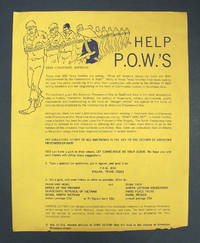
40020Dallas n. d. 1st printing presumed. Yellow paper printed in navy ink. Modest wear to paper light creasing age toning to edges. Section at bottom seems to have been excised. An about VG example. Single sheet printed recto only. Blue illustration at top of Vietnamese soldier marching morose American POW's tied in ropes. 10-5/8" x 8-1/2" <br/><br/>"The treatment given the American Prisoners-of-War in Southeast Asia is the most unconscionable in history. Starvation beatings the pulling of fingernails solitary confinement public harassment and brainwashing in the form of "thought reform" are typical of the kinds of tortures being employed by the Communists to American Prisoners-of-War. All together there are over 1600 American servicemen missing in Southeast Asia and believed to be Prisoners-of-War. More and more people are asking "WHAT CAN I DO" Flyer explains the steps civilians can take to help the POWs - signing petitions sending letters. Even gives a small "sample letter" paragraph. No holdings located on OCLC. Rare in the trade. unknown books
1945011277Okinawa: Headquarters Special Troops US Army 1945. 1st Edition. Soft cover. Near Fine. 4to self-wrappers illustrated pp 20. First edition of a souvenir compiled by Headquarters Special Troops and reproduced by 3020th Engr. Top. Co. Corp. An account of the surrender of the Ryukus islands to General Joe Stillwell. Mimeographed four photos two maps a list of the 10th Army Staff etc. Wrappers a tad browned. else near fine. Headquarters Special Troops US Army unknown books
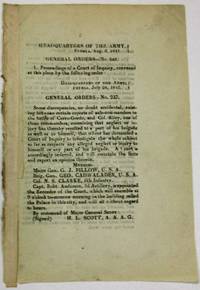
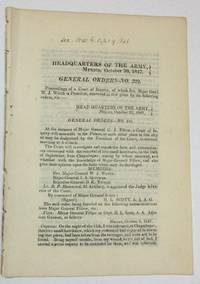
184735509Puebla Mexico 1847. 5-1/4" x 8". 4pp. Signed in ink by H.L. Scott A.A.A.G. "By command of Major-General Scott." Disbound spine reinforced else Very Good. <br/><br/> This is the report of the Court of Inquiry whose President was Gideon Pillow; its Recorder was Robert Anderson. The Court concludes that the "movements of Col. Riley's brigade had an important influence in the achievement of that brilliant victory that Col. Riley had an active participation in them and that his conduct and that of his command should be suitably noticed in the Official Report of his superiors. unknown books
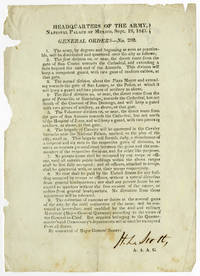
1847WRCAM42041Mexico City 1847. Broadside 8 1/2 x 6 1/4 inches. Tears in left edge and upper edge not affecting text. Very good. A rare order issued by Gen. Winfield Scott just a few days after he captured Mexico City. Following victories at Cerro Gordo Contreras Churubusco and Molino del Rey Scott fought the battle of Chapultepec and victory there led to the capture of Mexico City. On September 17 Scott declared martial law in the Mexican capital in order to ensure order and to protect the American troops as well as the Mexican citizenry and their property. In this order dated September 18 and issued from the National Palace of Mexico Scott distributes and quarters his army throughout the municipality locating them near the strategic entry points to the city. He orders that no private house would be used to quarter American soldiers "until all suitable public buildings within the above ranges shall be first fully occupied" and orders that all officers be quartered with or near their troops. He also orders that the collection of customs duties by the civil authorities at the gates to the city should continue unless modified by himself or Maj.- Gen. Quitman "but supplies belonging to the Quartermaster's and Commissary's departments will at once be exempted from all duties." <br> <br> The order is signed in manuscript at the end by Winfield Scott's Assistant Adjutant General H.L. Scott. Garrett locates the copy at the University of Texas at Arlington. No copies are listed on OCLC. Rare. GARRETT p.391. unknown books
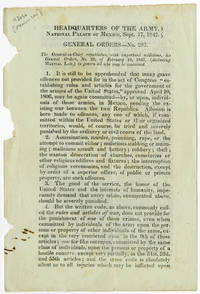
1847WRCAM42040Mexico City 1847. 4pp. printed on a. single folded sheet. Old vertical crease. Three tears along the central fold resulting in loss of paper but no text. Very good. A rare copy of an important order issued by Gen. Winfield Scott just days after his victory at the Battle of Chapultepec and his taking of Mexico City. Chapultepec was the final victory in Scott's march to the Mexican capital following victories at Cerro Gordo Contreras Churubusco and Molino del Rey. Largely outnumbered against Santa Anna's forces Scott produced a series of stunning victories leading to his capture of Mexico City and the issuance of this broadside which seeks to establish order by proclaiming martial law in the capital. <br> <br> A preamble to the General Orders announces that this is a restatement "with important additions" of Scott's order of Feb. 19 1847 issued from Tampico which also declared martial law. In the present order meant to maintain order in the newly conquered city Scott lays out the prohibitions for a wide variety of acts including assassination murder poisoning rape assault robbery theft the desecration of churches and cemeteries and more. Significantly he announces that such rules will apply equally to Americans as to Mexicans. He points out that these laws are important not only to guide his army but "for the protection of the unoffending inhabitants and their property about the theatres of military operations against injuries on the part of the army contrary to the laws of war." Scott further extends martial law to any part of Mexico under the control of U.S. forces. Lastly he announces that the American army will safeguard all of the churches monasteries convents inhabitants and property in Mexico City and announces a "contribution" of $150000 to be imposed on the capital to pay for these services payable in four equal installments. <br> <br> The order is signed in manuscript at the end by Winfield Scott's Assistant Adjutant General H.L. Scott. Garrett locates the copy at the University of Texas at Arlington and OCLC adds copies at the California State Library Sutro copy and the University of North Carolina. GARRETT p.390. OCLC 52501908. unknown books
184724284Mexico City 1847. 4pp. printed on a single folded sheet. Old vertical crease. Three tears along the central fold resulting in loss of paper but no text. Important order establishing martial law in Mexico City.<br/> <br/>A rare copy of an important order issued by General Winfield Scott just days after his victory at the Battle of Chapultepec and his taking of Mexico City. Chapultepec was the final victory in Scott's march to the Mexican capital following victories at Cerro Gordo Contreras Churubusco and Molino del Rey. Largely outnumbered against Santa Anna's forces Scott produced a series of stunning victories leading to the capture of Mexico City and the issuance of this broadside which seeks to establish order by proclaiming martial law. A preamble to the General Orders announces that this is a restatement "with important additions" of Scott's order of February 19 1847 issued from Tampico which also declared martial law. In the present order meant to maintain order in the newly-conquered city Scott lays out the prohibitions for a wide variety of acts including assassination murder poisoning rape assault robbery theft the desecration of churches and cemeteries and more. Significantly he announces that such rules will apply equally to Americans as to Mexicans. He points out that these laws are important not only to guide his army but "for the protection of the unoffending inhabitants and their property about the theatres of military operations against injuries on the part of the army contrary to the laws of war." Scott further extends martial law to any part of Mexico under the control of U.S.forces. Lastly Scott announces that the American army will safeguard all of the churches monasteries convents inhabitants and property in Mexico City and announces a "contribution" of $150000 to be imposed on the capital to pay for these services payable in four equal installments. The order is signed in manuscript at the end by Winfield Scott's Assistant Adjutant General H.L. Scott. Garrett locates a copy at the University of Texas at Arlington and OCLC adds copies at the California State Library Sutro copy and the University of North Carolina.<br/> <br/>Garrett p.390; OCLC 52501908. unknown books
184735511Mexico City 1847. 5-1/2" x 8". 6pp. Disbound lightly toned. Signed in ink by H.L. Scott A.A.A.G. "By command of Major-General Scott." Ink notation at head of first page "See W.D.G.O. 21 of 1848." Very Good.<br/><br/> The issue concerned "the removal of two small howitzers on the 14th of September from Chapultepec." They had been under the command of Major General Gideon Pillow a Tennessee lawyer who was a close friend of President Polk. The howitzers were found as Pillow states "in my own baggage wagon." Hints and innuendo suggested that Pillow had deliberately taken them. Insisting that "this was done without my knowledge or authority" Pillow requested a Court of Inquiry which vindicates Pillow. "It does not appear that Major-General Pillow had any information of the actual fact that the howitzers were in the city of Mexico until the evening of October 8 subsequent to the order of the General-in- Chief in relation to trophies etc. when and subsequently he seems to have used all proper measures to have them restored. unknown books
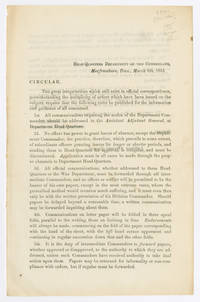
1863WRCAM53711Murfreesboro Tn 1863. Small broadsheet 8 x 5 inches. Light tanning and dust soiling a couple of marginal fox marks. About very good. Gen. William Rosencrans commander of the Union Army of the Cumberland in 1863 asks that the multiplicity of orders and the resulting variations thereof be addressed and the attendant confusion in the ranks be resolved and orders various measures be taken to ensure proper communications. Grant replaced Rosencrans with Gen. George H. Thomas near the end of this year after a series of failures in Tennessee. Not in Allen or OCLC. unknown books
186319805Columbus Ohio 1863. Broadsheet 8" x 10" ordering a Descriptive List of Pay and Clothing for Wm. Harris 44th Ohio Volunteer Infantry who is awaiting discharge papers. Completed in manuscript it is dated May 15 1863 and signed by order of Brig. Genl. Mason. The verso is a printed letter from Assistant Adjutant General Samuel Breck to Capt. Albert Dod 15th U.S. Infantry Columbus Ohio regarding eligibility for final statements and descriptive lists. unknown books
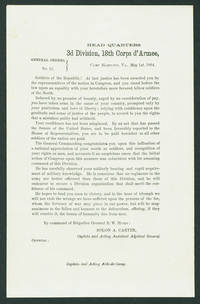
1864WRCAM55912Camp Hamilton Va 1864. 1p. on an octavo sheet. Faint tideline to upper left corner. Near fine. An important order announcing equal pay for "colored troops" in the Union Army issued by Capt. Solon Carter on behalf of Gen. E.W. Hinks. This is a field press printing of one of Hinks' earliest and most consequential orders upon taking command of 3rd Division of the 18th Corps of the Union Department North Carolina composed entirely of United States Colored Troops U.S.C.T. This order was issued over a month before Congress finally authorized equal pay for U.S.C.T. troops on June 15 1864. Until then black soldiers were paid $7 per month plus $3 for clothing while white soldiers earned $13. The order begins: "Soldiers of the Republic! At last justice has been awarded you by the representatives of the nation in Congress and you stand before the law upon an equality with your heretofore move favored fellow soldiers of the North." <br> <br> One of Hinks' other early orders was to appoint Carter then captain of Company G 14th New Hampshire Volunteers as Assistant Adjutant General of Volunteers and Aide-de- Camp to Hinks. Carter later served on the staff of Gen. Charles J. Paine 3rd Division 25th Corps. For his service and bravery he was breveted Major and then Lieutenant Colonel at the end of the war. In 1900 at a meeting of the Military Order of the Loyal Legion of the United States Commandery of Massachusetts Carter presented a paper titled "Fourteen Months' Service with Colored Troops" in which he praised the service of the U.S.C.T.: <br> <br> "The object of the present paper is to tell in simple language without exaggeration or embellishment the story of what the Colored Division of the Eighteenth Corps did and how they did it throwing here and there a side light upon previous descriptions of their deeds of valor and heroism. That the lights are of such exceedingly limited power must be attributed to the fault of the instrument rather than lack of loyalty to the memory of the gallant officers and brave men living and dead whose acts are commemorated." <br> <br> Carter went on to describe their role in the Bermuda Hundred Campaign leading up to the Siege of Petersburg and how they earned the respect and admiration of their fellow white soldiers. <br> <br> The United States Colored Troops were regiments in the Army composed primarily of African-American soldiers although members of other minority groups also served including Native Americans Pacific Islanders and Asian Americans. By the end of the Civil War U.S.C.T. regiments constituted about one-tenth of the Union Army although they had a casualty rate about thirty-five percent higher than white Union troops. The U.S.C.T. fought with distinction: fifteen U.S.C.T. soldiers received the Medal of Honor among numerous other awards. <br> <br> In July 1862 Congress passed the Confiscation Act freeing slaves whose owners were in rebellion against the United States and then the Militia Act of 1862 empowered the president to use former enslaved men in any capacity in the army. Lincoln opposed early efforts to recruit black soldiers although he approved of the army using them as paid workers. However once he issued the Emancipation Proclamation recruitment of African Americans became widespread. On May 22 1863 the War Department issued General Order 143 establishing the Bureau of Colored Troops to better facilitate the recruitment and mustering of African-American soldiers. Regiments of infantry cavalry engineers light artillery and heavy artillery units were recruited from all states of the Union. 175 regiments totaling more than 178000 "colored" soldiers served during the last two years of the war. <br> <br> U.S.C.T. regiments were led by white officers and rank advancement was limited for black soldiers with very few receiving commissions. The courage displayed by black troops during the war played an important role in African Americans gaining new rights after the war. In his speech "Should the Negro Enlist in the Union Army" delivered at National Hall Philadelphia on July 6 1863 Frederick Douglass stated: "Once let the black man get upon his person the brass letter U.S. let him get an eagle on his button and a musket on his shoulder and bullets in his pocket there is no power on earth that can deny that he has earned the right to citizenship." Douglass was a prominent supporter of recruitment for the U.S.C.T. and Douglass' two sons Lewis and Charles were two of the first to enlist in Massachusetts. <br> <br> We could find only two copies of this general order held in institutions: Hampton History Museum and the University of Rochester. An important early step on the road to racial equality in the United States armed forces. OCLC 1101179313. Solon A. Carter "Fourteen Months' Service with Colored Troops" in CIVIL WAR PAPERS READ BEFORE THE COMMANDERY OF THE STATE OF MASSACHUSETTS MILITARY ORDER OF THE LOYAL LEGION OF THE UNITED STATES Boston: F.H. Gilson 1900 vol. 1 pp.155-179. hardcover books
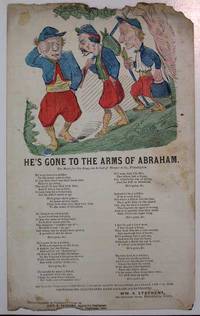
33366Cincinnati / Philadelphia: Geo. P. Jenkins / Wm. A. Stephens n. d. Ca mid-1860s. Cf. Wolf AMERICAN SONG SHEETS 879e. Staining & wear to top & bottom edges with some loss. An About VG copy. Single sheet folded once vertically 4 pp. Printed p. 1 only on blue ruled paper. 7 verses of song lyrics. Hand-colored lithograph image 4-1/4" x 4-1/2" at top of sheet depicting 3 bedraggled Union soldiers. 9" x 5-5/8" <br/><br/>P. 3 with 8 lines of faded handwriting. apparently a soldier writing to his true love: ". I love you now as heartly as ever ." Shortly thereafter cut off in mid-sentence the letter was unfinished. Geo. P. Jenkins / Wm. A. Stephens unknown books
1718106614<p>Folio newspaper extracted illustrated 369=384 pp. Disbound some pages separated double page illustration torn and separated a bit at the center with some loss normal aging; otherwise about good. This issue features Secretary of State William H. Seward on the cover. This issue contains a short article on the capture of Jefferson Davis. Also double page panoramic view of Richmond based on a photograph of Alexander Gardner. Included is an almost full-page picture of Major General William T. Sherman.</p> Harper's books
186359270NY 1863. folio wraps ragged at edges. Includes large images of he encampmet of the Army of the Cumberland View of Chattanooga and Union encampments the Army of the Potomac. unknown books
1866106240<p>Folio newspaper illustrated 33-48 pp. Some chipping tears and soiling to edges. spine and margins some creasing to front page especially near middle column occasional staining normal aging and browning; otherwise about very good. This issue which was published shortly after the Civil War has some excellent illustrations including a couple of cartoons by Thomas Nast. There is also a full-page illustration of American beauty featuring headshots of women. Another full-page illustrations shows the sentencing of Eduard Ketchum for forgery.</p> Harper & Brothers, books
1867106241<p>Folio newspaper illustrated 225-240 pp. Chips and small tears in margins a little staining or soiling normal aging and browning; otherwise very good. This is a well-illustrated issue with a number of wood engravings including a double page and three full-page illustrations. One of the full-page illustrations concerns the Fenian Uprising in Ireland. Another series of illustrations on features African hair fashions. More importantly this issue includes a significant Thomas Nast cartoon about Reconstruction and voting rights. This cartoon shows a black man with a vote permit and a white man representing the Confederate States of America without a vote.</p> Harper & Brothers, books
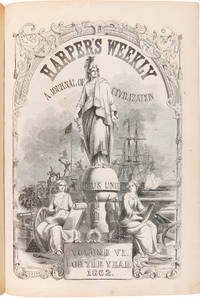
1865WRCAM56383New York 1865. Ten volumes. Volume V No. 210 through Volume IX No. 470. 416; 417-502507-534539- 706711-832; iv230235-416; 417-422427- 438443-832; iv416; 417-502507-832; iv390395-416; 417-848; iv400; iv401- 832pp. Profusely illustrated. Lacks eighteen leaves. Folio. Contemporary three-quarter black morocco and cloth spines gilt. Noticeable wear to spines. Long horizontal closed tear and minor chipping to a few leaves occasional foxing and minor soiling a handful of misbound gatherings and detached leaves. Lacking eighteen leaves and priced accordingly. Overall a fair to good set. The famous Civil War volumes of HARPER'S WEEKLY covering the period from January 5 1861 to December 30 1865 profusely illustrated with engravings after many famous artists of the day most notably Winslow Homer who worked for the magazine in the first years of the war and with a number after photographs by Matthew Brady depicting Civil War scenes important political figures and satirical cartoons. These volumes of HARPER'S WEEKLY. constitute a remarkable illustrated record of the Civil War for the duration of the conflict full of first-hand accounts of battles political news and wonderful engravings and maps some folding nearly all relating to the war. Included is ample reporting of Sherman's march Lincoln's assassination and funeral and all the major battles. "The most popular periodical of its day and valuable for a study of any aspect of the war; the illustrations are unsurpassed" - Nevins. With much on the campaigns in Florida early in the war and so very much more. Though this set is a bit wounded it still holds a wealth of pictorial and textual history on one of the defining events in American history. Also includes a single issue of FRANK LESLIE'S ILLUSTRATED NEWSPAPER November 28 1863 bound into the second volume of HARPER'S WEEKLY for 1863. NEVINS p.15. SERVIES 4601-4615 4696. hardcover books
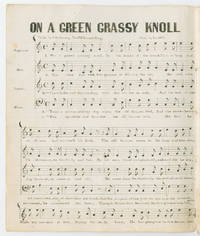
1864248261864. No binding. Condition: Fine. Manuscript Pen and Ink Folk Art Song Book ca. 1864. 24 pp. 6 5/8 x 8 in. This hand-sewn booklet contains eight songs popular during the Civil War era with music and lyrics in calligraphy. Songs include "On a Green Grassy Noll" by J. D. Canning with music by Ira Odell; "The Old Mountain Tree" by James G. Clark; "Harmonian Waltz"; "Year of Jubilee or Kingdom has Come!"; "Squire Jones's Daughter"; "The Sweet Birds Are Singing"; "Lament of the Irish Emigrant"; and "Soon and For Ever" by J. B. Monsell. The last page of the booklet is dated February 21 1864. Partial Transcript: Year of Jubilee or Kingdom has Come! I come up Norf on a little bender Left Missus at home wid no one to tend her Ole Massa's gone I dun-no what to; Sambo pretty sure he don't much care to. Chorus: Den sound de horn beat de drum Sound de horn and beat de drum De year ob jubilee am come Sound de horn and beat de drum De year ob jubilee am come. Met genral Bloaregard on my way here He told me dat I had better stay dere He said up Norf dey would skin and eat me Dat was a yarn dat a little heat me. He said he had just whipp'd Gen-ral Bu-el Grant and Wallace All three in a duel. I axed him den why he was running away Sam-bo says he dat question aint fair play. Oh times down Soth am getting quite rotten He's so berry scarce they have to burn cotton I left dat land ob oppression and gas And roam de free Norf without nary pass. Molasses Junction was a big scarecrow Nigh its wooden guns nobody didn't dare go; But when McClellan got a good ready De Southern Gentry seemed quite unsteady. Abraham Lincoln and Emancipation De two tallest tings in dis tall nation; Hurrah den boys let us still be merry Kingdom has come boys we've good times berry. Historical Background: Music played a prominent role in the American Civil War. On the battlefield and in the camps it boosted morale and released tensions. On the homefront it helped individuals and families express political sentiments grief and longing. Music entertained and often carried political religious and social messages. "The Year of Jubilee or Kingdom has Come!" was written by "Sambo" and first published in 1862 by H. M. Higgins in Chicago. "Squire Jones's Daughter" tells of the virtues of "The prettiest girl in the State of Maine" and was copyrighted by New York publisher Henry De Marsan in 1860. "The Sweet Birds Are Singing" is a cheerful pastoral duet about springtime that dates to at least 1836. "On a Green Grassy Noll" by J. D. Canning was first published in Boston in 1852 and is an elegy for a nameless old farmer who has "ploughed his last furrow." "The Old Mountain Tree" is a ballad in the form of a quartet by James G. Clark first published in 1854. It expresses longing for an old homestead. Clark 1829-1897 enlisted in the 35th New York as a 1st lieutenant and was detailed to remain in the recruiting service. He used music in his efforts to enlist soldiers in the cause and was dubbed "The People's Poet." "Lament of the Irish Emigrant" is a ballad by Helen Blackwood 1807-1867 with music by William R. Dempster 1808-1871 first published in Boston around 1840. It tells the story of an Irish emigrant who has buried his wife Mary and their child. Blackwood Baronness Dufferin and Claneboye was a British songwriter composer poet and author. Dempster a Scottish singer was very popular in the United States. "Soon and For Ever" is a sentimental hymn by J. B. Monsell about the Christian's union with Christ in Heaven. Rev. James Samuel Bewley Monsell 1811-1875 was an Irish Anglican clergyman and poet. He wrote the poem in 1853 or earlier.Condition: Very minor soiling else near fine.<br /> books
002291Washington Government Ptg Office 1941. In wrappers. Minor soiling. Charts and diagrams throughout. Washington Government Ptg Office 1941. unknown books
1955274716Santa Barbara Ca. : Pacific Coast Publishing. 1955. . Hardcover brown boards brown titles. Owner’s inscription to endpaper otherwise a very good copy in a lightly soiled and edgeworn dust jacket with a small piece missing at the top edge of the back panel. . 8vo. Pacific Coast Publishing. hardcover books
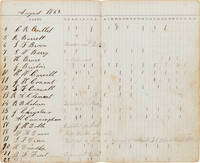
1862WRCAM55597Various locations mostly Louisiana 1862. 120pp. Contemporary sheep later leatherette backstrip title stamped in dark brown on front board reading "GUARD BOOK D. CO. 12TH. REG. MAINE." Some edge wear mild chipping and light scuffing to boards. Front hinge detached spine cracked. Occasional thumb-soiling to text. Still very good. A manuscript record book documenting an entire year of guard duty worked by various members of Company D 12th Maine Infantry Regiment Volunteers during the early part of the Civil War. The majority of time recorded in this book emanates from Louisiana while the 12th Maine Regiment was attached to Butler's Expeditionary Corps from January to March 1862. On their way to Louisiana the regiment travelled on the Steamship Constitution to Ship Island Mississippi serving there until May 4 1862. The Regiment then traveled to New Orleans for guard duty at the U.S. Mint until October 1862. While in New Orleans the Regiment took part in the expedition to Pass Manchaca from June 16 to 20 and the expedition to Ponchatoula from September 13 to 18. In October the Regiment moved slightly north to Camp Parapet in Shrewsbury Louisiana and served there until November 19 1862; the record book ends here. <br> <br> Each two-page opening of the ledger is pre- printed with a large column on the left for names and thirty-one numbered smaller columns for marking days served on guard duty. Most days have just one or two tick marks for any particular soldier indicating just one or two men were on active patrol mostly privates but also sergeants corporals musicians wagoners and others. The number of guard shifts worked by the regiment increased dramatically in May 1862 when they arrived at the U.S. Mint in New Orleans before falling off again the next month presumably after some relief arrived. In addition to guard duty service notations indicate reasons for absences such as "died at" "sick" "in confinement" "permanent detail" "enlisted for cook" "light duty" "in the woods" and "hospital." Notations from February 1862 indicate that James H. Andrews died onboard the Constitution on February 14 and two other soldiers caught sickness at Fortress Monroe. Another entry shows that S.G. Tracy "Died at Ship Island 12 of April 1862." Later in July Capt. H.W. Dunn is detailed for daily duty at the "Reding Press" in New Orleans. In August G.F. Drown is "Detailed as Nurse in General Hospital St. James Hotel N.O." <br> <br> Material from the Trans-Mississippi West is rare this early in the Civil War and also usually not as thorough as the present record book documents an entire year of service. A unique record of Civil War service for a peripatetic Maine volunteer infantry regiment serving in the Bayou State. hardcover books
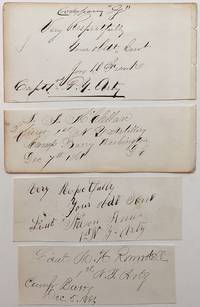
1861267089New York 1861. unbound. Excellent group of signatures with rank and command on various sized paper the largest measuring 2.5 x 5 inches comprising the earliest known autographs of the founding three officers of Battery G First New York Light Artillery along with the last Captain to take command through attrition. Includes: J.D. Frank "Very respectfully - Your Obdt. Servt. - Captain 1st N.Y. Artillery"; M.H. Rundell "Lieutenant - 1st N.Y. Artillery - Camp Barry - Dec. 5th 1861"; Nelson Ames "Lieutenant - Very Respectfully - Your Obdt. Servt. - 1st N.Y. Artillery" and S.A. McClellan "2nd Lieutenant - 1st N.Y. Artillery %u2013 Camp Barry - Washington D.C. - December 7th 1861." Battery G was engaged with the enemy in every battle the Second Army Corps participated in during the war and never was driven by the enemy's fire from a position it was ordered to hold. They also hold the distinction of never falling back until ordered and never losing a gun or carriage of any kind during its term of service. This is an almost impossible-to-assemble group of signatures that are all boldly signed and in very good condition.<br/><br/> Battery G First New York Light Artillery: Originating from New York they distinguished themselves at Gettysburg whereby a monument was erected and dedicated in their honor on July 3 1893. First recruited at Mexico Oswego County New York in September 1861. It joined the regiment at the general rendezvous at Elmira and was there mustered into United States service for three years September 24 1861 with the following officers: Captain J.D. Black First Lieutenant Nelson Ames Second Lieutenant Marshall H. Rundell. The battery remained at Elmira engaged in drilling with the rest of the regiment for a short time and then went by rail to Washington D.C. arriving on October 31. On January 13 1863 Captain J.D. Frank left the battery on sick leave and was shortly afterwards discharged on surgeons certificate. First Lieutenant Nelson Ames was promoted to Captain and took command. On October 15 1864 Captain Nelson Ames was discharged as his terms of service three years had expired. In his place First Lieutenant S.A. McClellan was promoted to Captain and took command of the battery and remained in command until the battery was mustered out.<br/><br/> unknown books
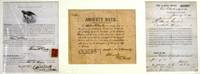
25188Partly printed documents completed in manuscript varying sizes measuring in the range of 7-7.5" x 9-9.75". Matted and mounted behind glass in a 17" x 34" gilt decorative frame. Very Good.<br/><br/> Former Confederates were required to sign oaths of loyalty before regaining citizenship and voting rights. The language of these three oaths differs slightly but each requires the signer to "defend the Constitution of the United States" particularly in reference to the emancipation of slaves.<br/> Davis's oath taken in the District of Columbia is printed at page 105 of Stanley Turkel's book "Heroes of the American Reconstruction" 2005. Davis's background and State of residence are not disclosed. Arthur McMurtry was a corporal in the 26th Texas Cavalry. He is listed in the 1870 Federal Census and two later Galveston directories 1888-1891 as a bookkeeper. Cousinard was mayor of East Baton Rouge from 1857-1859. He enlisted with Company B of the 9th Battalion Louisiana Infantry in 1862. After signing his amnesty oath he became sheriff of East Baton Rouge on May 11 1864.<br/> Arthur McMurtry is distantly related to Pulitzer Prize winner Larry McMurtry: his great-grandfather John McMurtry 1748-1790 was the brother of Larry McMurtry's great-great-great-great-grandfather Samuel McMurtry 1744-1796. Lineage determined using several family trees on Ancestry web site and cross-referencing with Federal Censuses death records and information found on the Texas State Cemetery website. unknown books
19161392San Antonio 1916. Near Fine. Ten original photographs plus two real photo postcards. Most 3 x 5 inches one smaller. Occasional very minor wear. Images generally crisp and clean. A collection of ten photographs that depict activities of F Troop of the 13th U.S. Cavalry Regiment on the border with Mexico in the vicinity of Columbus New Mexico during the mid-1910s. The regiment was assigned to the Army's El Paso border patrol in 1912 and eventually became headquartered in Columbus. In New Mexico the unit's patrol area consisted of approximately sixty-five miles between Noria and Hermanas; F Troop was stationed in the field near the tiny town of Hachita. The regiment played a key role in defending against Pancho Villa's 1916 raid on Columbus and took part in Pershing's Punitive Expedition which served as retaliation for the attack. The images here show members of the troop in training heading out on patrol in their field camp at attention during inspection and horsing around. The versos of most photographs are stamped "Fox Tone Print Fox Co. San Antonio." Also present are two photo postcards showing I Troop of the 2nd U.S. Cavalry which was also briefly stationed at El Paso. A nice group. unknown books
11070Group of 8 Congressional documents all war-date octavo some multi-paged most with good content in small part: pensions to widows of deceased chaplains and soldiers transportation of troops new recruits for old regiments and armament of fortifications. A nice grouping of U.S. government documents pertaining to the War. unknown books