15 095 résultats
1838604664Salzburg u. Innsbruck, Mayr, 1790-1838. Hldr., Pp. d. Zt od. OBr. Meist m. Bibl.-St. S. teilw. braunfl. Einbde häufig beschäd. u. bestoßen. 1811 Bd. 2 vord. Deckel u. Tit. lose, Rücken fehlt. 1822 Bd. 4 ohne Deckel, Rücken stark beschäd., Vorsatz u. Tit. beschäd. 1790 Bd. 1 bis S. 22 u. ab S. 300 m. Wurmfraß. 1838 Bd. 1 fehlen Extrabeilage Nr. 26 u. Bd. 2 fehlen Extrabeilagen 36-44. Bd. 3 fehlen Nr. 71-78 u. im Ergänzungsbd. 40 fehlen Nr. 1028-1033.
1848637594Nürnberg, Schrag, 1818-1848. Kl.-8°. M. insges. 87 Taf. u. mehr. Tab. u. Textill. 94 einheitl. Ppbde. d. Zt. m. goldgepr. u. meist rotem Rsch. Einbde. angestaubt, Ecken bestoßen u. Kanten berieben. Wenige Rücken m. Fehlst. u. wenige Rsch. verblasst. Ehemal. Bibliotheksex. m. St. a. Tit. od. Vorsatz. Zahlr. Bde. haben Bleistiftanstreich. Papier (so auch Taf.) häufig braun- u. teilw. stark braunfl. Bd. 2 d. 1. Reihe ist 2. Aufl. (1828), alle anderen Bde. sind 1. Aufl. Es fehlen: 1. Reihe: Bd. 3, 7, 16-17. 2. Reihe: Bd. 10, 33-34, 47-48.
33413146 pages in4 montées sur onglets et reliées en 1 volume - Reliure plein chagrin rouge - dos cinq nerfs - petits frottements aux nerfs - Trés bon état -
1917A131-1308ca. 1917-1918. 8 original Tuschzeichnungen, Format der Bl?tter ca. 29-29 x 23 ,5 cm b.z.w. 32 x 24 cm
1842414595Stuttgart u. Leipzig, Ebner & Seubert u. Wiegand, 1842-78. M. zahlr. lith. Taf., zahlr. Ill., Tab. u. Curven (diese auch teilw. a. Taf.). 3 Taf. fehlen. Jg. 1-6 in einheitl. Ppbdn. d. Zt., Jg. 7, 9, 11 u.13 in einheitl. Hlwdbdn., sonst abweich. in abweich. Hlwdbd. N.F. 1- 3 in Hldr. Einbde. teils beschabt. Die Bde. d. Forts. in einheitl. Hlwdbdn. m. goldgepr. Rtit. Rücken teilw. etwas beschäd. Rücken u. Vorderdeckel von Jg. 19 fehlen. M. mehr. St. Fast durchgängig (teils großfläch.) m. Wasserfl. od. Stockfl. In Jg. 14 d. ersten Reihe fehlen d. S. 1-172.
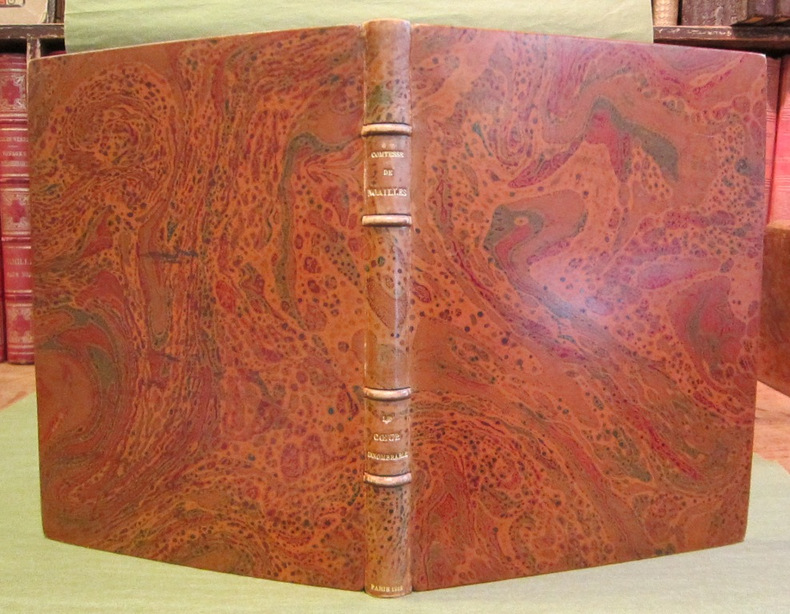
1918000784Paris Pelletan 1918
199441335HEYNE WILHELM 1994. 10. softcover. Flußwelt Deutsche Erstveröffentlichung! HEYNE, WILHELM paperback
1938272038Bln: Mittler 1922/1938. *schöne und komplette Folge mit allen bis zum 2.Weltkrieg erschienenen Bänden der Reihe in orig. HLn. o. Ln. Einbänden*.
1710174924Amsterdam, Wolters, 1710. Kl.-4°. M. gest. Titel u. 7 (teils gef.) Kpfr.-Taf. 28 Bl., 42 S. Ldrbd. d. Zt. m. Rsch. a. 5 Bünden. Einbd. beschabt u. bestoßen (Ecken stärker m. Fehlst. im Lederbezug) sowie etwas fleckig. Rücken leicht angerissen. Vorderdeckel am ob. Rand m. kl. Fehlst. Vorsätze leimschattig. Gest. Titel lose beilieg. 1 gef. Taf. m. Einriss. Gebräunt, teils braunfl. bzw. m. leichter Nässespur. Titel in Rot u. Schwarz. Lateinisch-holländ. Paralleltext.
1911CA0100a3 volumes. Volume 1. vi314 with frontispiece and plates; volume 2. 372 pages with frontispiece and plates. volume 3. 518 pages with frontispiece and one plate. Royal octavo 9 1/4" x6 1/4" Bound in quarter leather with gilt lettering to spine and raised spine bands; marbled boards. Preface par M. le Cte de MoüyFirst edition.<br /><br />Mémoires: L'Intervention Française au Mexique by Charles Blanchot. This very rare memoir by Charles Blanchot was aide-de-camp to General Bazaine Supreme Commander of French Forces in Mexico during Mexico's Second Empire. There is so much in here that has never seen light in either Spanish or English for instance: the powerful if behind-the-scenes role of Doña Juliana de Gómez Pedraza widow of Manuel Gómez Pedraza and the vicious if as Blanchot suggests unfounded rumors circulating in Mexico City about Bazaine in 1866-7. Blanchot who married an American of French origin in Mexico City also offers a detailed and lively portrait of Mexico City society at the time.<br /><br />Condition:<br /><br />First signature of volume one detached with some edge wear along the fore-edges title to volume two detached binding edges and hinges rubbed spines darkened. A good copy of a very rare and scarce work. Librairie Emile Nourry hardcover books
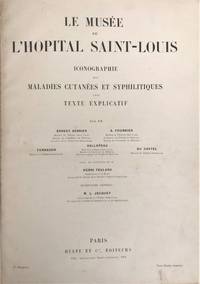
1895M13445Paris:: Rueff et Cie 1895-97. 1895. Folio. 2 iv 346 pp. 50 chromolithographic plates 23 engravings 18 photogravures. Contemporary half crimson gilt-stamped morocco marbled boards raised bands. Very good. RARE. First edition. A MASTERPIECE OF PHOTO-CHROMOLITHOGRAPHY. "The authors of this book were senior doctors at the Hôpital Saint-Louis. Besnier presided over the 4th International Congress of Dermatologists held in Paris in 1900. The museum had been founded by Devergie in 1865. During his 25 year long career Devergie commissioned water colour paintings of the major skin diseases for use in his lectures. It was not long before these were supplemented by photographs and moulages. Between 1867 and 1894 the Italian moulage artist M. Baretta 1834-1925 produced 1800 such models. He devised the internal colouring technique. This is a technique whereby the colours are applied in between the layers of wax. The effect is one of transparency and greater similarity to the colour of human skin Zanca and Tagliavini. The various separate lesions have been portrayed exceptionally well. Less attention was paid to facial expressions. The museum now has a collection of 4667 moulages at its disposal Dahm. The finest among them were reproduced in this book. The printing technique used was photochromy." – Franz Ehring Skin Diseases: 5 Centuries of Scientific Illustration. pp. 176-177. "Ernest Besnier was born in Honfleur in 1831. He studied in Paris and was a celebrated pupil of Hardy and Bazin. Having been graduated in 1857 he turned his attention exclusively to dermatology and by 1872 had become a chief at l'Hôpital Saint Louis." "Besnier was active in all phases of dermatology. Although essentially French in his diathetic thinking he was responsible for translating Kaposi's text into French with masterful annotations by himself. His monograph on psoriasis his work on atopic dermatitis. and his work on eczema entitle him to his place as the leading French dermatologist of his time." - Shelley & Crissey Classics in Clinical Dermatology p. 246. "Ernest Besnier was the unquestioned master of French dermatology towards the end of the 19th century. When he took over the leadership of the Parisian dermatology clinic in 1873 French dermatology had lost its premier position and fallen behind the Vienna school not only in regards to research and teaching but also in terms of space and equipment. Besnier reformed French dermatology incorporating many advances from Vienna such as establishing laboratories for bacteriology mycology and histopathology and encouraging basic research. As he retired just before the turn of the century French dermatology had closed the gap." "Ernest Henri Besnier was born on 21 April 1831 in Honfleur a small village in the Normandy. Since his father was a customs official the family moved frequently including stays in Marseille and Orleans. Besnier studied medicine in Paris and advanced to Interne des Hôpitaux in 1853. His teachers included Ernest Bazin Philippe Boyer and Henri-Louis Royer whose niece Besnier married a few years later. In 1857 his doctoral thesis on the diagnosis and therapy of ileus was accepted. He continued to address mainly internal medicine themes. Named Medecin des Hôpitaux in 1863 he published between 1864 and 1872 studies ranging from cholera to diseases of the spleen to rheumatic diseases to gall stones becoming one of the best known internists in France. As signs of recognition he was elected Vice-President of the Societe anatomique in 1861 and Secretary-General of the Societe Medicale des hôpitaux in 1864. He served as a military physician in the Franco-Prussian War of 1870/1871 and was awarded the highest military honor being named a Chevalier de la Legion d'Honneur." "When Bazin retired as head of dermatology clinic at Hôpital Saint-Louis at the end of 1872 Besnier was the highest ranking faculty member and entitled to the position. Although no one dreamed he would desert internal medicine for dermatology he accepted the challenge. With little experience but great energy he started his new job on 1 January 1873. Within a few months he had read the entire dermatologic literature concentrating on the works of Bazin and Erasmus Wilson; he profited greatly from the immense clinical experience of his colleague Charles Lailler who tactfully assumed the role of the old experienced tutor. Besnier also benefited from working together with Adrien Doyon the founder and editor of the Annales de Dermatologie et de Syphiligraphie; Doyen made him aware of the great advances in dermatology in Germany and Austria. With Besnier' encouragement Doyen translated into French Moriz Kaposi's textbook from 1880 Pathologie und Therapie der Hautkrankheiten. Besnier employed his by now encyclopedic knowledge of the dermatologic literature to provide commentaries which enhanced Doyen's translation. The French edition appeared just one year later 1881 and dominated the training of dermatologists in France for the next two decades and helped to reduce the differences between the French and German-speaking schools of dermatology. In 1881 Besnier also became editor of the Annales de Dermatologie et de Syphiligraphie and was named a member of the medical academy." "Kaposi's Clinic in Vienna was the model of a modern dermatology clinic for Besnier. In 1882 he asked Doyen for a detailed report over the Viennese clinic which was published in the Annales de Dermatologie et de Syphiligraphie and including information not only about the teaching program and costs of inpatient care but also covered such details as patient clothing the size of hospital rooms and how instruction signs were posted on the walls. When compared to Vienna the conditions in Hôpital Saint-Louis were primitive. Besnier described his outpatient clinic as a sleazy ramshackle hut completely unworthy of a great capital city. He demanded the construction of new inpatient wards and emphasized the importance of a histopathology laboratory. He also established the first laboratory for bacteriology and mycology at Hôpital Saint-Louis. Besnier demanded a change from purely descriptive dermatology turned against the nosologic speculations of his predecessor Bazin which he felt had lost validity through the groundbreaking work of Pasteur and demanded the incorporation of knowledge from bacteriology and histopathology into dermatology. In addition he tried to get dermatology incorporated into general medical education so that medical students could not graduate without some exposure to dermatology – that had not been the case previously." "Besnier's daily activities were highly regimented. He arrived every morning at 8:45; once a week he made inpatient rounds while the other days were devoted to specialty clinics. After each patient contact Besnier washed his hands and cleaned under his fingernails. He was always carefully dressed and reserved. his students including Louis Brocq Raymond Sabouraud Lucien Jacquet 1860-1914 George Thibierge Felix Balzer 1849-1929 and Emile Leredde 1866-1926 consider him the ideal academic teacher. He stimulated them to produce many papers. His lectures were clear and contained a great deal of clinical and histopathological information embedded in a broad theoretical background. They attracted a wide range of listeners ranging from pharmacists and medical students to guest physicians from abroad. in 1888 Besnier started weekly meetings on Thursday for all physicians working at Hôpital Saint-Louis during which all the interesting cases of the week were discussed. Out of this meeting evolved in 1889 the Societe francaise de Dermatologie et de Syphiligraphie with Besnier as a founding father. He served initially as Vice-President and then became President in 1892." "Besnier published very little. In 1879 he described the diagnostic possibilities made available by histologic examination and coined the term biopsy. In 1889 he described the diagnostic possibilities made available by histologic examination and coined the term biopsy. In 1889 he described lupus pernio which was recognized a few years later as a manifestation of sarcoidosis and in 1892 he provided the first precise description of atopicdermatitis. In order to properly describe this illness Besnier stated that one had to break away from the tyranny of Willan's and consider not only the primary lesions but all the findings. He stated that the central symptom is pruritus intensive pruritus waxing and waning often worse in the evening with seasonal remissions and exacerbations. The lesion morphology in contrast had little meaning; instead he pointed out that one absolute fundamental characteristic was that none of the lesions associated with or triggered by the illness were specific. Besnier did not use the terms lichen or eczema employing instead lichenification and eczematization to emphasize that the skin changes were not specific but instead banal lesions which resulted from itching and scratching. The disease often started in early childhood and took a variable but chronic course. Sometimes the disease left the skin and presented then primarily as emphysema bronchitis asthma hay fever or less often gastrointestinal problems. Since he felt a congenital tendency towards pruritus existed which then could appear in varying degrees of severity Besnier designated the disease as Prurigo diathesique." – Loser Plewig and Burgdorf Pantheon of Dermatology pp. 89-93. Franz Ehring Skin Diseases: 5 Centuries of Scientific Illustration. pp. 176-177; Loser Plewig and Burgdorf Pantheon of Dermatology pp. 89-93; Shelley & Crissey Classics in Clinical Dermatology p. 246. Rueff et Cie, 1895-97. hardcover books
1975187831975. Mixed media on paper. Signed dated and numbered "#02" Alexander Sarantos Tremulis 1914-1991 was the designer of the production version of the 1948 Tucker Torpedo and was America's most original design theorist of the post-war era. He was born in Chicago and without any training in drawing or engineering joined the design team of Auburn-Cord-Duesenberg in 1933. He was chief stylist when the company failed in 1937. He worked for GM Chrysler and Custom Motors in Beverly Hills which designed unique cars for movie stars. During World War II he worked for the Air Force designing aircraft and in the process drew what may have been the first visualizations of extra-terrestrial transport: flying saucers. After the war Tremulis worked with Preston Tucker and later for Ford. He formed his own consulting firm in the 1960's. This quite beautiful design and other similar ones were made for the ill-fated Bricklin car company which existed from 1974 to 1976 and whose demise had nothing to do with Tremulis's designs. He was inducted into the Automotive Hall of Fame in 1982. unknown books
1922157188Berlin, Hirschwald, 1885-1922. M. 2 Portr. In 32 einheitl. Hlwd.- u. 5 einheitl. Pp.-Bdn. m. goldgepr. Rtit. Es fehlt: Jg. 36 kompl. u. Jg. 5 H. 8. Einbde. bestoßen u. beschabt. Tekt. u. St. a. Vorsatz. In Jg. 10 u. 11 einige S. gelockert. Jg. 15 ist d. Rücken eingerissen. In wenigen Bdn. vereinzelte S. braunfl.
191464951(Wien, Hof- und Staatsdruckerei, 1914). Gr.-8°. Titelbordüren u. Umrahmungen in Orange von Rudolf Junk. Mit einem Orig.-Holzschnitt v. Moritz Jung (Bildnis des Kaisers Franz Joseph I.), 2 Skizzen zur Raumausgestaltung von Josef Hoffmann, einem gefalt. Orig.-Holzschnitt von Ella Graf, 3 Holzschn.-Entwürfen von C. O. Czeschka u. einigen weiteren Illustrationen. 263 (1) S., Prächtiger grüner Ldr.-Bd. d. Zt. m. goldgepr. Deckel- u. Rückenbordüre, blind- u. goldgepr. Mittelfeld, goldgepr. Rückentitel, Steh- u. Innenkantenverg. u. dreiseitigem Goldschnitt.
198642567HEYNE WILHELM 1986. 1. softcover. Flußwelt Deutsche Erstveröffentlichung! HEYNE, WILHELM paperback
1876603571Leipzig, Engelmann, 1876. 4°. M. 20 (1 farb.) lith. Taf. XVI, 382 S. Hlwd. m. goldgepr. Rtit. St. verso Tit. u. a. wenigen Textseitenrändern. Gutes u. sauberes Ex.
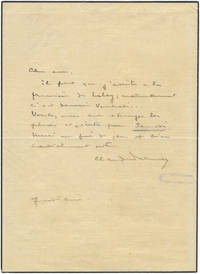
268361 page. Octavo ca. 168 x 122 mm. Dated Thursday evening. On mourning stationery. In French with translation. <br/><br/>"I have to attend Louis Laloy's premiere; naturally that is tomorrow on Friday. Would you change the enclosed tickets for Saturday Thanks again."<br/><br/>Slightly worn and browned; creased at folds and upper outer corner of final blank folio; small rust stain from paper clip to inner margin of final folio not affecting text. "One of the most important musicians of his time Debussy's harmonic innovations had a profound influence on generations of composers. He made a decisive move away from Wagnerism in his only complete opera Pelléas et Mélisande and in his works for piano and for orchestra he created new genres and revealed a range of timbre and colour which indicated a highly original musical aesthetic." François Lesure and Roy Howat in Grove Music Online.<br/><br/>"Laloy 1874-1944 was a noted defender of contemporary French music and was a close friend of and mediator between Ravel and Debussy with whom he collaborated on some unrealized stage works; he was also the author of the first major work and the first in the French language on Debussy." John Trevitt in Grove Music Online. unknown books
1868GF357931868 Paris - Cadart et Luce - 1868 - Bel album de 11 eaux-fortes toutes marges: format 31,5 x 48,5 cm - La couverture papier est effrangée mais les eaux-fortes sont intactes -
1916244481916 Gouache et mine de plomb, titrée, signée, et datée en bas à droite, 1916, 16.3 x 23 cm.,
1840604713Berlin, Oemigke, 1796-1840. M. mehr. Portr. u. zahlr. (teils kol.) Taf. Pp. Jg. 2 Hldr. Einbde. berieben. Stellenw. wasserrandig od. braunfleckig. Es fehlen: Jg. 19, 20 u. 36/2 je 1 Taf.; Jg. 21, 22, 24/2, 26, 27/1, 28, 29/1, 31/1, 32, 33, 34/1, 35, 36/1 je 1 Portr.
1980627331Hamburg, Gräfe & Sillem, 1897-1980. 4°. M. zahlr. Portr., 592 Taf. u. zahlr. Textabb. In 38 Hldr.-, 59 Hlwd.-, 8 Pp.- u. 2 Lwdbdn., Rest in Heften. Fehlen: Bd. 13 nur bei "Röntgen-Praxis" TI; 14 nur H. 1-3 d. Röntgen-Praxis; 18 H. 6; 106 S. 617-634; 107 H. 5; 115 H. 1 u. 5; 120 H. 1-5: 125 H. 3; 132 H. 2 u. 4. Bei einigen Bdn. fehlt die fremdsprachl. Zsfssg., bei wenigen liegt sie lose bei. Bei zahlr. Bdn. sind d. Seiten papierbedingt verklebt. Die Bde. sind meist bestoßen u. beschmutzt. Das Papier ist häufig gebräunt od. leicht fleckig. Bei wenigen Bdn. ist die Bindg. u. einige S. u. Taf. teilweise lose. Einige Bde. haben Bleistiftanstreich. Wenige Bde. sind Bibliotheksex. u. haben St. a. Tit. u. mehr. S. Rücken d. 1. Bd. wurde unsachgemäß m. Pflaster geklebt.
198141745HEYNE WILHELM 1981. 1. softcover. Flußwelt Deutsche Erstveröffentlichung! HEYNE, WILHELM paperback
1842187844Paris, 1830-1842. Fol. 64 (47 farb./1 als Doppeltaf.) lith. Taf. Lose in 4 Pp.-Mappen, diese in Hlwd.-Mappe m. Stoffschließbändern u. hs. Deckelbeschriftung. Vorderdeckel m. Sign. Tafeln teilw. auf Leinen aufgezogen, stellenw. gebräunt bzw. (mitunter auch stärker) stockfl. Wenige Taf. m. Anmerk. Ohne Text.
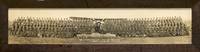
1918128889Wendover: 'Photo by Panora Ltd. 60 Doughty St. W.C.' 1918. Wendover 'Photo by Panora Ltd. 60 Doughty St. W.C.' March 1918. A vintage gelatin silver panoramic photograph visible image size 185 × 952 mm recently reinserted behind glass in a contemporary polished wooden frame external dimensions 273 × 1040 mm; in excellent condition. The Australian War Memorial has the following caption on an example of this impressive group photograph in its collection: 'Wendover Buckinghamshire England 1918-03-11. Large group portrait of officers cadets NCOs and men of the Australian Flying Corps AFC together with two women centre in front of a B.E.2 aircraft at Halton Park Camp. In the centre sitting are Major A. Broun Officer Commanding Depot; Major Henley Commissioner of the Australian Comforts Fund; Mrs Henley; Miss Henley; Lieutenant Colonel E.H. Reynolds Staff Officer for Aviation; Major Brooke Australian Army Medical Corps AAMC. Fifth from the wing is Wesley William Jones. The unit is an AFC Training Depot where aircrew and mechanics are trained. The men wearing wings badges on their uniforms right are flying instructors while the men with white hatbands on their hats left are aircrew cadets who are being trained as pilots and observers. Sitting in the front row of the group are the members of the AFC band with their musical instruments. Laid out on the ground in front of the group are three flags two Union Jacks and an Australian flag between them. Behind the flags is a large stack of gift parcels provided by the Australian Comforts Fund. They are labelled: "Australian Xmas greetings"' AWM reference C303998. English-born Sir Thomas Henley 1860-1935 migrated to Sydney in 1884 and became an influential politician and building contractor. In 1915 he 'volunteered to go to Egypt as a commissioner for the Citizens' War Chest Fund. Organizing the distribution of comforts from Alexandria Marseilles and Le Havre France and London Henley personally accompanied the goods. He was gazetted lieutenant-colonel to overcome objections to civilians entering the battle zone and was appointed CBE and KBE in 1920' 'Australian Dictionary of Biography'. 'Photo by Panora Ltd., 60 Doughty St. W.C.' unknown