93rd Infantry African American SoldiersBiblio.com
1 570 résultats
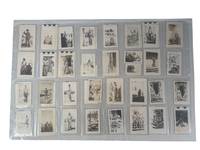
1943214881943. African American MilitaryWWII African American U.S. Army soldiers photo archive from Fort Huachuca Arizona 1943 documenting the lived experience of segregated military training during World War II. The archive shows Black army soldiers in training for the 93rd Infantry Division one of only two African American infantry divisions organized during the conflict. While the division is not explicitly named in the photographs contemporary handwritten annotations identify Fort Huachuca and the 1943 date strongly suggesting the men pictured were a part of that unit.<br /> Archive comprises 46 original black and white snapshot photographs measuring approximately 2.5 x 3.5 inches to 3.25 x 5 inches several bearing manuscript identifications of location and named soldiers. The images depict Black servicemen in standard World War II U.S. Army dress including M 1941 and M 1943 field jackets wool service uniforms garrison caps and M1 steel helmets. Rank insignia are clearly visible across multiple photographs including private first class corporal technician fifth grade staff sergeant and other non commissioned officer grades. Identified individuals include Sgt. Aaron C. Morton Sgt. William U. Dean Sgt. Lockleau and Sgt. Asbury the latter humorously photographed overturned on a barracks railing with a caption noting his antics. Several images show non commissioned officers posed with younger recruits underscoring internal mentorship and command structure within segregated companies. One photograph captures a soldier manning an M1919 Browning .30 caliber machine gun reflecting weapons training and infantry preparedness. Other images depict barracks life informal camaraderie saluting poses and interactions that convey unit cohesion during stateside training.<br /> <br /> Fort Huachuca functioned as a central site for Black military training during the years of segregation prior to the Korean War. The 93rd Infantry Division would later deploy to the Pacific Theater where elements engaged in security operations and combat patrols under conditions shaped by discriminatory assignment practices. These photographs document the formative training phase preceding overseas service capturing visible evidence of rank progression technical specialization and heavy weapons instruction within Black units. The presence of named non commissioned officers enhances the archive's value for regimental research. Minor curling and light edge wear to several photographs; manuscript annotations remain legible; overall very good. A substantial visual record of African American military service within the segregated U.S. Army during World War II mobilization. unknown
190001110712Cincinnati: The Ohio Valley Press 1900. Regimental history of the 94th Ohio Infantry Regiment part of the 14th Army Corps which fought extensively with Sherman's army. Gilt lettering on the front cover with a red acorn the 14th Corps badge on deep blue cloth. 166pp. Moderate wear extremities. Penciled owner's name on second ffep. 1 1/2" edge tears on pages 2 and 165. Ex-library with usual markings. A solid clean example of the original edition of this scarce title. Nd ca. 1900. Hard Cover x-library. VG-/No Jacket as Issued. Large Octavo. Book. The Ohio Valley Press Hardcover
01110085Cincinnati: The Ohio Valley Press This unit was part of the 14th Army Corps and fought extensively with Shermans army. It fought in the Army of the Cumberland from Perryville on they were with Sherman in the Atlanta Campaign on his famous march in Georgia and through the Carolina Campaign. Gilt and red titles on blindstamped deep blue cloth. 166pp. Owner's handstamp name on rear free end paper otherwise unmarked. An especially nice example of this scarce history. Hard Cover. Very Good/No Jacket. Large Octavo. The Ohio Valley Press Hardcover
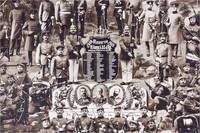
3733807<p>Metz Alsace-Lorraine German Empire: Gebrüder Notton Römerstr. 10 1908. Composite silver process photograph. Mount: 18¾ x 23½ inches. Image: 14¼ x 17¾ inches. Light rubbing to edges of mount with minor wear at bottom right; margins foxed; small mark at bottom extending faintly into image; very good.</p> <p>This is a rich and complex composite photograph from 1908 captioned with the words “Zur Erinnerung an Meine Dienstzeit†which translates to “In remembrance of my service time.†It was created for the 10th Company 8th Württemberg Infantry Regiment Grand Duke Frederick of Baden’s Regiment—possibly light infantry as in “Jäger infanterieregiment.†This regiment was based in Strasbourg in Alsace-Lorraine and served within the Imperial German Army. </p> <p>The surnames of these men are: Baibel Baierl Bauer Berger Jos. Burger Joh. Bumb Büchel Dirr Dirschedl Echtler Feibler Forster Fuchs Gaibl Ganslmeier Gundel Habender Hagl Haub Haüselmeier Herzog Hiemer Huber Jacob Janker Keim Kirchbauer Klemm Knott Kopp Kraus Kreckl Kübel Laubhardt Laubenbacher Lautner Lippert Maier Joh. Maier Seb. Merkel Miehling Moosburger Petermann Pfeilschifter Pflug Prior Rachl Rauschecker Ries Rommel Schmid Schmidt Schnabel Scholz Schraudolf Schweiber Stegmeier Sutter Ulm Weber Weindl Wenniger Wohlfarth Zieringer Zeilinger Zirngibl.</p> <p>The photograph presents a multitude of uniformed soldiers in a staged setting designed to resemble a military encampment or a gathering. The arrangement of soldiers is not casual but highly structured with officers shown with swords and details prominently positioned in the foreground. Many of the men are shown hoisting enormous beer steins with rather serious expressions.</p> <p>The photograph also features regimental flags and other military regalia which were symbols of pride and unity for the unit. The arrangement of soldiers in rows with some seated and others standing is typical of military portraiture of the time intended to display the order and discipline of the troops.</p> <p>The backdrop of the photograph features a bucolic scene a blend of a real outdoor setting and painted backdrops. This kind of photography allowed for the superimposition of studio-taken images onto a different background giving the impression that all individuals were present at a single location. Such methods were used to create cohesive unit photographs when it was not possible to gather everyone at once.</p> <p>The inclusion of phrases like “Mit Gott für König und Vaterland†With God for King and Fatherland reinforces the patriotic sentiment of the era and the soldiers’ commitment to their country and monarch. Other phrases such as “Die Well ist grofs Die Welt ist schön; Wer weifs ob wir uns wiedersehn!†“The world is big the world is beautiful; Who knows if we will see each other again!†reinforce the romanticism of military service.</p> <p>From a photographic history perspective the image represents the advancements in photo montage techniques at the turn of the 20th century. The image quality clarity and composition indicates that the photographers Gebruder Notton used a large-format camera which was capable of capturing detailed group portraits.</p> <p>A rather remarkable photograph encapsulating the military ethos of the German Empire during a period of intense nationalism and militarism leading up to the First World War.</p> unknown
1904827901904. WISCONSIN REGIMENTAL. 12th WISCONSIN INFANTRY. Reunion of the Company E Association at Kilbourn Sept. 20 and 21 1904. 1st ed. 8vo. 18 pp. Orig. wrappers. Light toning to the extremities of the wrappers else fine. Dornbusch I WI-111. One of a series of reunions of Company E. Obituaries of those who'd passed. All the publications are scarce in commerce. unknown
1988144168Ringwood East: 2/5 Battalion Association 1988. First Edition. Hardcover. Very Good/Fine. Ringwood East 2/5 Battalion Association 1988. Quarto 423 pages with 145 illustrations from photographs and 16 colour maps. Papered boards very lightly bumped and rubbed; an excellent copy with the fine dustwrapper. 2/5 Battalion Association hardcover
1998LFA-126737854Un ouvrage de 140 pages, format 220 x 300 mm, illustré, broché couverture couleurs rempliée, publié en 1998, BBK Edition, bon état (avec un envoi à un ancien du "8e Choc")
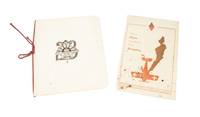
1956LFA-126738536Une plaquette de 20 pages, format 155 x 210 mm, brochée, publiée en 1956, L'As de Pique, bon état, peu courant
1920129462London: Hodder and Stoughton 1920. First Edition. Hardcover. Very Good. London Hodder and Stoughton circa 1920. Large octavo xx 468 pages with 20 maps and diagrams plus 3 folding maps and 16 plates including 2 tipped-in colour plates. Gilt-decorated cloth a little marked and mottled and slightly bumped at the extremities; endpapers offset; edges foxed with light scattered foxing elsewhere; pages adjacent to all plates uniformly tanned; occasional ink underlining to about 20 pages; uneven tanning to three openings from acidic bookmarks no longer present; trifling signs of age and use; a very good copy of a book that does not wear well in our experience. The foreword in French is by Marshal Foch four pages including the translation. A contemporary gift inscription 'To Mother and Father with love from Enid. September 4th 1920' is written in ink on the front flyleaf. Mounted on the front pastedown is a contemporary postcard-format commemorative photographic portrait with the printed caption 'For the Honor of Both . Victoria A.I.E.F. 1916'. Inscribed below it in ballpoint pen thus at a much later stage is the name 'Edwin' and 'Australian Imperial Empire Force 1916'. The honor roll for the 60th Battalion has a pencil mark next to the name 'Gunn Pte E.I.' see page 463. We presume the portrait depicts 1797 Private Edwin Innes Gunn who was killed in action at Fromelles on 19 July 1916 less than three weeks after disembarking at Marseilles. <p>Dornbusch 311; Fielding and O'Neill page 225; Trigellis-Smith 188. Hodder and Stoughton hardcover
1920117167London: Hodder and Stoughton 1920. First Edition. Hardcover. Very Good. London Hodder and Stoughton circa 1920. Large octavo xx 468 pages with 20 maps and diagrams plus 3 folding maps and 16 plates including 2 tipped-in colour plates. Gilt-decorated cloth a little marked and slightly unevenly sunned; edges foxed with occasional scattered foxing elsewhere; flyleaves heavily offset with minor silverfish damage to the bottom corner of the rear one; a very good copy. The foreword is by Marshal Foch. The book is not identified as such but it comes from the personal collection of Lieutenant-Colonel Alexander Thomas Paterson 1886-1950 Commanding Officer of the 39th Battalion AIF and the author of that battalion's history. Dornbusch 311; Fielding and O'Neill page 225; Trigellis-Smith 188. Hodder and Stoughton hardcover
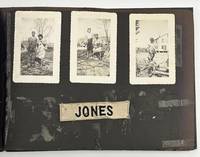
19603443Kansas and Germany 1960. Very good. Twenty-two leaves illustrated with 167 photographs most mounted and captioned in white ink with a handful of loose images and one cloth nameplate. Some images removed. Oblong folio. Contemporary dark blue leatherette triple-ruled gilt borders on front cover string tied. Faint manuscript title on front cover reads "Book of the Past." Front cover detached some edge wear. Minor chipping to initial leaves first two leaves detached photos in generally nice condition. A unique collection of photographs documenting the military service of Private Eugene Jones an African American soldier in Company B of the 26th Infantry known as the Blue Spaders for the spade-like device on the unit's insignia. According to the manuscript captions written on the inside front cover which include his serial number Private Jones hailed from New York City and was stationed in Baumholder Germany as part of the 26th Infantry's 1st Battle Group. The 26th Infantry regiment was sent to Berlin and other spots in Germany in the early 1960s as part of the United States' efforts to reinforce West Germany against the Cold War forces in East Germany. Company B was likely some kind of support unit as Baumholder is located in the far-western portion of Germany much closer to France than Berlin.<br /> <br /> The present photo album contains numerous images of Jones' fellow soldiers most identified by name in manuscript captions. Other photographs picture the unit during their brief training at Fort Riley in Kansas before deploying to Germany. Once in Baumholder the soldiers are pictured in the bivouac area on the streets playing baseball with various women on base and in the barracks on patrol unloading Jeeps at the airstrip and more. One photo shows the exterior of the Baumholder Department Store. Some of the later pages contain earlier photographs showing some of Jones's friends and family from New York; these pages appear to have been ported over from another photo album. The only non-photographic item in the album is Jones's cloth nameplate.<br /> <br /> An interesting photographic record of service in an integrated unit in Cold War Germany. unknown
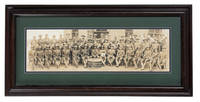
1918List1733Ohio 1918. Silver gelatin photograph in glass-fronted frame image measures 24 ¼ x 6 ⅞ inches. Matted and framed not examined out of frame. The 317th Engineer’s Band was a part of the 317th Engineer Regiment an element of the 92nd Division which was composed of over 15000 African-American soldiers from across the country. The 92nd was one of two African-American regiments to fight in the war the other being the 93rd and was unique in that it was under the command of the United States. The 317th Engineer Regiment was organized in November 1917 at Camp Sherman Ohio several months before this photograph was taken and saw action in Europe as part of the 92nd. Camp Sherman was the third largest training camp in the country at the time with over 2000 buildings capable of housing 40000 men and 12000 horses. As well as being the training site for units of the 92nd also known as the Buffalo Division it served as the training site entire 83rd 84th 95th and 96th divisions. It later became a trade school. <br /> <br /> The 317th Engineer’s Band performed locally around Chillicothe and at other military functions eventually becoming known according to a contemporary newspaper account as one of the best bands in the army. They traveled to Indianapolis to perform in March of 1918. A New York Times article from 1918 mentions them briefly and describes them as ‘famous’ but does not elaborate. They performed at the ‘Colored Club’ in Chillicothe a social club for African-American servicemen in a converted hotel. We find no other record of this image. unknown
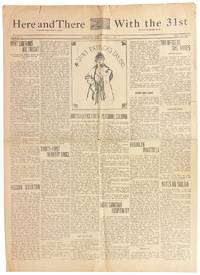
191947912Vladivostok Siberia: 31st Infantry Regiment 1919. Very Good -. Vladivostok Siberia: 31st Infantry Regiment 1919. First Edition. Oversized tabloid 59.5cm; 6pp. Folds chips and a few splits along edges; paper toned and a bit brittle; Good to Very Good. <br /> <br /> Quite scarce publication from the 31st Infantry Regiment published "Every Once In A While" "Wherever We Happen To Be." This issue was published during the Russian Civil War and the United States' failed Siberian Intervention. The paper itself is full of local and international news and leads with an article "What Siberians Are Taught: One Paper Says America Treats the Russians in the Same Way as Negroes."<br /> <br /> We find three holdings in OCLC at the Hoover Institution Montana State and U.S. Army War College. . 31st Infantry Regiment unknown
1924LFA-126740864Un ouvrage de 216 pages, format 105 x 185 mm, illustré, broché, publié en 1924, Charles Lavauzelle & Cie, bon état
ORD-12976N°11877 du Bulletin des Lois N°312. 5 Août 1829. In-8 (ca 135 x 210mm) sans couverture, non rogné, tel que paru, pages 289 à 315 du bulletin. Exemplaire taché, état moyen.
193863712Berlin, Verlag der Reichsdruckerei, 1938. Kl.-8°. Mit zahlr. meist ganzs. Abbildungen. 192 S., OKart.
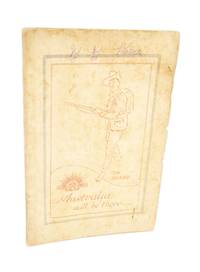
19184145Amesbury England: printed "In Camp" by the Battalion 1918. Octavo pamphlet in original printed wrappers 28 pp. illustrated. Covers chipped some foxing but good condition overall. Scarce First World War Australian Battalion history.</p> <p>The preface gives some indication of the production of the pamphlet being the work of Private H. MacPherson with sketches by Private W.H. Smith. The author writes: </p> <p>'This work is a continuation of the career of the 44th Battalion of the Australian Imperial Forces from Western Australia. We find that the Battalion is now absorbed by the 11th Brigade; consequently the publication assumes a Brigade aspect. We have endeavoured to portray the different affairs at the training camps with a splash of history interwoven.'</p> <p>Typical of such Battalion mementos produced in training camps in the English countryside this publication reflects the lives of soldiers at rest from the harrowing conditions across the channel in European battlefields. The author describes the terrain as similar to the Western plains of New South Wales and includes some information on Stonehenge and local hamlets. Light hearted digs at the officers and mixed with poems including one such verse named 'The Kaiser's Dream'. The pamphlet concludes with an illustrated page titled 'A London Girl's Opinion of the Australian Soldier' penned by one Nellie Ellis who is gushing in her enthusiasm for the ANZAC boys about town.</p> <p></p> <p>The pamphlet is rare and only three copies are held in Australian institutional collections at the State Libraries of New South Wales and Western Australia and also at the War Memorial in Canberra. It is not recorded in the Bibliography of Australin Army Unit Histories by Trigellis-Smith and others although Battalion histories for the 41st 42nd and 43rd are included. Likewise the pamphlet is not included in 1963 checklist Australian Military Bibliography by C.E. Dornbusch. However both Trigellis-Smith and Dornbusch note that an informal account of life in the 44th Battalion was published by one Captain Longmore Perth 1921.</p> <p>The pamphlet bears the colophon of Bennet Brothers printers in Salisbury. printed "In Camp" by the Battalion unknown
19184144France: unknown 1918. Postcard measuring 90 x 146 mm. printed on both sides; with a string tied folding Christmas card containing two leaves 113 x 143 mm. A few ink spots affect the postcard yet both items are in good condition. Two pieces of ephemera from the 23rd Battalion A.I.F. created just after the armistice of 11 November 1918. </p> <p>Raised in Victoria in March 1915 the 23rd Battalion served at Gallipoli between September to December of that year before redeployment to France. In July of 1916 the battalion suffered a horrific casualty rate over ninety percent during the battles of Pozieres and Mouquet Farm. By mid-1918 the 23rd was rolling back the German line at Amiens and Hamel a precursor of defeat and the armistice.</p> <p>The postcard reads "Just a Plane Good Wish I am Dropping" and is inscribed by one Frederick to Martha and Dad. Dated November 16th the card was sent just five days after the armistice was declared. The Christmas card contains two printed leaves depicting Mont de Cats in France opposite gum trees in Geelong.</p> <p>Instances of quality First World War ephemera are becoming increasingly scarce on the market. unknown unknown
1992LFA-126742109Revue de 16 pages, format 290 x 425 mm, illustrée, bon état
89702Paris, Baudouin, s.d. (1790) in-8, 8 pp., dérelié.
189045898Rathenow, Max Babenzien, o. J. (um 1890). Kolor. Orig.-Holzstich (Blattgröße ca. 25 x 17 cm).
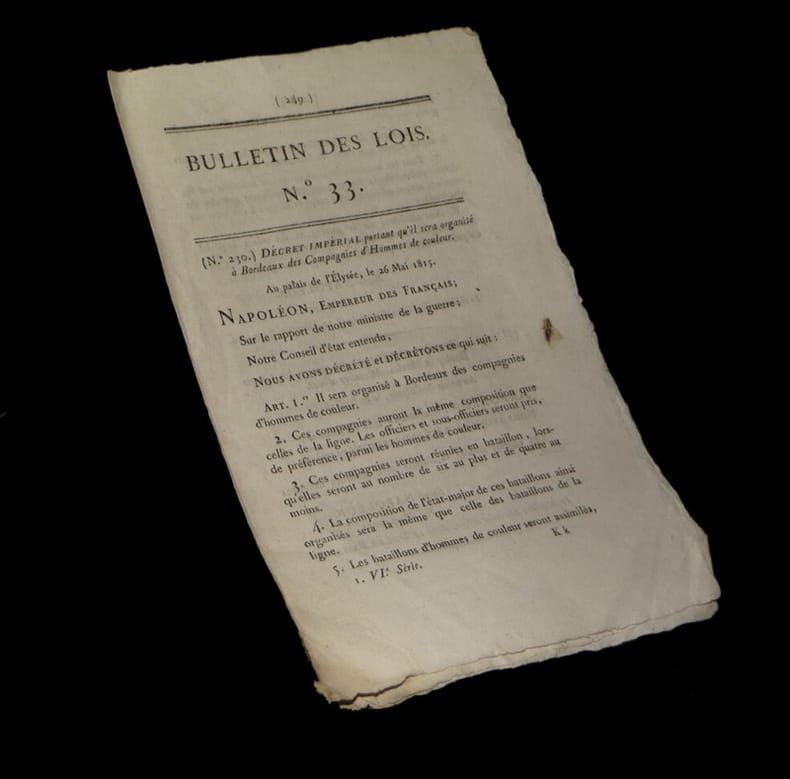
180413298A Paris, de l'Imprimerie Impériale, 1815 (2 juin). Un document au format in-8 (222 x 148 mm) de [8] pp.
1918LFA-126750016Une plaquette de 18 pages, format 110 x 170 mm, brochée, publiée en 1918, Presse Régimentaire du 23e d'Infanterie, bon état, rare
8180Undated 1840s. English. 12mo leaf dimensions 16 x 11 cm 60 pp. Stitched notebook of thirty leaves without covers. In fair condition aged and with wear to extremities of outer leaves. On laid Italian paper with the watermark of the Italian firm G. & C. Cini. Neatly written with the body of the writing in one hand and the mottos in another. Text clear and apparently complete. Begins: '1st. Regiment of Life Guards. Peninsular Waterloo. Scarlet Facings Blue. Returned from France January 1816.' A typical entry reads '58th. the Rutlandshire Regt. of Foot. Gibraltar with the Castle and Key. Montis Insigna sic Calpe. The Sphinx with the words. Egypt Maida Salamanca Vittoria Pyrenees Nivelle Orthes Peninsula. Returned from Ceylon June 1839. Facings Black.' Lists the first 99 regiments of foot as well as the rifle brigade West India regiments Ceylon Rifle Regiment Cape Mounted Riflemen and others. Notebook ends: 'New Army List for the Jannuary sic 1841.' The entries on the first seven leaves fourteen pages are numbered in pencil to 32. Origin unknown. Undated [1840s?]. [English.] unknown
186358199Camp near Brooks Station Saturday April 11 1863. Fine original condition. 15-1/2 x 9-3/4 inches. ".Yesterday I witnessed one of the grandest sights that I ever beheld. Our whole corps was reviewed by the President Generals Hooker McLain Howard Steinway Secretary Seward and an innumerable host of Brigadier Generals and it was a sight that has paid me for coming to war." The spectacle is described in great detail. Private Penfield was soon to be captured at Chancellorsville spending 12 days as a prisoner of war before being exchanged. He survived the war to carry on his father's carriage making business in Monroe Connecticut and later founded a small private academy. unknown