US Army Intelligence on Soviet Army U SBiblio.com
9 442 résultats
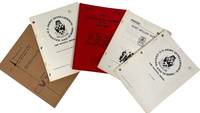
229591974. Cold War U.S. Defense Official U.S. Army intelligence and doctrinal publications on Soviet equipment and artillery produced at key Cold War moments when Soviet conventional forces missile technology and weapons systems were undergoing rapid modernization. These publications illustrate how American military institutions trained analysts and officers to identify Warsaw Pact weapons systems and to interpret Soviet organizational doctrine at a time when NATO planners were assessing conventional force balances and missile developments across Europe.<br /> <br /> Archive of 5 manuals from the 1970s-80s. Ranging from the immediate post-Vietnam period through the Reagan-era reintensification of U.S.-Soviet strategic competition these manuals document how American military institutions trained analysts intelligence officers and commanders to identify classify and counter Soviet equipment from tanks and artillery to missiles and aircraft using standardized imagery technical profiles and organizational analysis. Collectively the materials illustrate the evolution of U.S. threat perception as it moved from broad equipment identification toward increasingly specialized assessments of missile systems and advanced weapons platforms. Archive includes:<br /> 1 U.S. Army Missile Command. Technical Report RD-SS-86-10. Redstone Arsenal Alabama: U.S. Army Missile Command September 1986. Produced at Redstone Arsenal during the late Cold War missile buildup this technical report represents a shift toward highly specialized analysis of weapons and rocketry. This book demonstrates rigorous mathematical treatment of Rhode's theory of monopulse radar a foundational signal-processing method that enabled precise real-time tracking and guidance of missiles and aircraft during the Cold War.<br /> <br /> 2 U.S. Army Intelligence Center and School. Communist Weapons and Equipment Handbook. Fort Huachuca Arizona: USAICS January 1976. This handbook SupR 66152 explicitly marked as superseding earlier editions from 1971 and 1972 reflects the institutional updating of intelligence curricula in response to changing Communist bloc arsenals. Intended for classroom and field use it consolidates identification criteria hazards to identification and dichotomous keys revealing how U.S. intelligence sought to systematize recognition of Warsaw Pact weaponry during a period of détente.<br /> <br /> 3 Department of the Army Combined Arms Combat Developments Activity CACDA. Organization and Equipment of the Soviet Army. Fort Leavenworth Kansas: Headquarters Department of the Army 31 July 1978. Issued as Handbook HB 550-2 and distributed under special controls this striking red-covered manual analyzes Soviet ground force organization and equipment at a moment when NATO planners were reassessing conventional force balances in Europe. The text stresses its role in simulations and training exercises linking Soviet organizational structure directly to anticipated battlefield employment.<br /> <br /> 4 Department of the Army Soviet Artillery Doctrine. RB 30-3. Fort Leavenworth Kansas May 1976. This handbook corrects and updates specific technical and identification details within Organization and Equipment of the Soviet Army highlighting the dynamic nature of Cold War intelligence production and the continual need to revise assessments as new information about Soviet systems emerged.<br /> <br /> 5 U.S. Army Intelligence Center and School. Soviet Equipment. Fort Huachuca Arizona: USAICS March 1974. Issued as Supplemental Reading SupR 62810 this manual was designed as a study aid for intelligence students learning to identify Soviet equipment through imagery. The preface emphasizes mastery of visual recognition skills prior to classroom instruction with appendices organized by equipment type; tactical vehicles tanks artillery rocket launchers antiaircraft systems aircraft and electronic equipment; underscoring the centrality of imagery intelligence IMINT during the Cold War.<br /> Each manual shows light to moderate handling wear consistent with training and professional use including staple binding punched holes for binders minor edge wear toning and occasional marks; all text remains legible and intact. Overall very good condition. Together this archive offers a revealing primary-source record of how the U.S. Army studied taught and revised its understanding of Soviet equipment and missile capabilities across three decisive Cold War decades making it particularly relevant for collections focused on military intelligence history missile development and U.S.-Soviet strategic rivalry. unknown
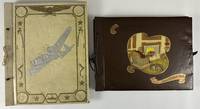
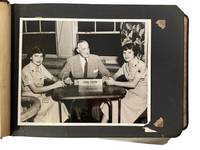
194512886Various locations mainly Texas Oklahoma and Arkansas 1945. Two albums. Album I: 24 leaves illustrated with twenty-four original photographs over two dozen postcards mostly photographic original letters and military documents and a large quantity of ephemeral items. Folio. Contemporary cream cloth decoratively stamped on front board in gilt and silver string tied. Album II: 11 leaves illustrated with ninety-eight photographs in mounting corners six loose photos and a couple of ephemeral items. Oblong folio. Contemporary brown cloth decoratively stamped on front board in gilt yellow and red string tied. Overall minor wear. Very good condition. A pair of annotated vernacular photograph album / scrapbooks compiled by Lt. Erma J. Frazier and her mother during her wartime service in the U.S. Army Nurse Corps. Frazier served in the Nurse Corps at various hospitals in the Trans-Mississippi West at Camp Swift in Bastrop Texas; Fort Sam Houston in San Antonio Texas; Okmulgee Oklahoma; and Camp Robinson Arkansas. Frazier hailed from East Brady Pennsylvania and worked as a Registered Nurse at the nearby Kittanning Hospital before she entered military service. She enlisted in early 1945 and served throughout the conclusion of the Second World War. The present albums record her service time in unusual detail with a mixture of original photographs picture postcards original military documents a few manuscript letters and various ephemeral items.<br /> <br /> The first album was compiled by Frazier's mother who inscribes the first page: "I dedicate this book to my daughter Erma Jean Eberhart Frazier who entered the Armed Services on March 17 1945 as a 2nd Lt. in the Nurse Army Corps a Camp Swift Texas." This album focuses mainly on Frazier's time at Camp Swift and Okmulgee Oklahoma. This album contains the lion's share of the ephemera including a patch the floral corsage she wore on the day she left for service military paperwork and forms and various newspaper clippings. The military paperwork includes enlistment documents including her "Application for Appointment" a manuscript postcard from the director of the Red Cross describing Frazier as a "professional qualified for military service" Army documents on qualifications for nurses and more. Other ephemera includes letters and cards received by her at Camp Swift a page of five pressed "Flowers from Texas" each preserved in a small plastic bag shipping tags from packages of clothing sent home by Frazier a couple of church programs a page of ten small postcards from her visit to Austin a menu from Brooke General & Convalescent Hospital at Fort Sam Houston some greeting cards and so forth. The photographs include portraits of Frazier from 1943 and 1944 while a nursing student; eight pictures of Frazier and other soldiers at Camp Swift; and eight shots of Frazier fellow soldiers and their barracks and administration buildings at Okmulgee Oklahoma.<br /> <br /> The second album was compiled by Frazier herself who provides a manuscript title on the inside front cover: "Memories of the Army Nurse Corps." There are also two photographs inscribed in the first person "Me on arrival at G.G.H." and "side entrance to my barracks G.G.H.". This album is almost entirely comprised of captioned photographs particularly valuable for identifying numerous fellow soldiers serving with Frazier. The images emanate from the last three locations at which Frazier served which she lists on the inside front cover: Brooke General Hospital at Fort Sam Houston Glennon General Hospital in Okmulgee and Regional Hospital at Camp Robinson Arkansas. Perhaps Frazier felt her mother's album largely focused on Camp Swift sufficiently memorialized here time there. The photographs are presented in chronological order and include portraits of dozens of men and women with whom Frazier served or patients served by Frazier often accompanied by informative and sometimes humorous manuscript captions on the album leaves or directly on the images. The photos also picture the hospitals themselves and include a handful of images taken during leisure time on base.<br /> <br /> A unusually informative pair of World War II-era albums and scrapbooks preserving the service of a highly-qualified Army nurse from Pennsylvania serving in the American West during the last year of the war. unknown
179332480London: Printed for J. Debrett 1793. The Second Edition with Considerable Additions. Three-quarter leather. Good. Octavo. 1 xvi 433 pages 1 page blank 19 page index 1 page errata 2 pages advertisements 1. Recased binding with three-quarter brown leather and marbled paper covered boards. Gilt title and five raised bands on the spine. Newer front and rear end papers and one front blank end sheet inserted. The original rear end sheet is present. The folding frontispiece map is toned on the verso with an old repair made also on the verso. Some light edge wear to the map. The folding view of the Rapids of the Ohio and the State Map of Kentucky are in very good condition with light toning. <br /> <br /> Pages 417-433 includes a "Report of the Secretary of State to the President of the United States of the Quantity and Situation of the Lands not Claimed by the Indians Nor Granted to Nor Claimed by Any Citizens Within the Territory of the United States. Read in the House of Representatives Nov. 10 1791" by Thomas Jefferson. <br /> <br /> Howes I 12; Howes Reference Filson - F 129; Sabin 34355; Streeter III 1523; Clark II 41 "An early account of the western country.which was produced by a man who left Kentucky without settling his obligations who seems to have been involved in efforts to organize a French expedition to take the lower Mississippi Valley and who treated Mary Wollstonecraft Shamelessly. This book was written in the form of letters from Kentucky to a friend in England. In all probability they were written in Europe. Printed for J. Debrett unknown
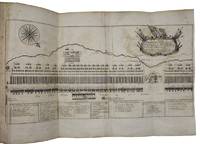
AQ22662London: Sold by J. Oliver.and J. Sellar junior s.d. c.1686 Single engraved sheet folded vertically and housed in modern blue paper wrappers. Some old folds with occasional minor tearing offsetting and browning - especially to gutter. Short tear to the head of spine of the enclosing wrappers. A rare survival of a choice engraved plan of the annual military review of King James II's troops at Hounslow Heath in July 1686. The Restoration settlement of Charles II provided the King with just a small defensive military; a standing army in name only. This was expanded greatly during the 1660s and 1670s largely as a result of the Anglo-Dutch - and Franco-Dutch - wars. But the accession of his brother James II himself intent on expanding his armed presence in part out of necessity given the threat of rebellion as demonstrated by the efforts of the Duke of Monmouth in 1685 led to significant expansion of the English armed forces. Annual military manoeuvres and reviews were hosted at Hounslow Heath each summer between 1685 and 1688 in order to train this enlarged and increasingly professional force and in no small part to demonstrate the substantial military support that the King - always in a politically precarious position in relation to the Church Parliament and landed gentry despite apparent popularity amongst his subjects - could muster. The English puritan minister and journalist Roger Morrice noted in his diaries that several thousand visited the camp - the early-modern equivalent of the earlier chivalric tournament - represented by this engraving. It is perhaps therefore unsurprising that a number of commercial opportunities from prostitution to printing arose from the impressive and novel gathering. Whilst ESTC locates a single copy Oxford of this plan finely engraved for English print and map-seller's John Seller 1668–1698 and John Oliver OCLC adds a further example at Cambridge and reproductions have supposedly been made from an 'original in the Huntington Library' which we have been unable to locate other editions of the same view are also known. A broadside version of this prospect 'printed for and sold by Richard Palmer' - with letterpress titling and woodcut illustration - was also issued. Another also in broadside format and with a variant title with an exact date specified An exact prospect of his Majesty's forces as they are encamped on Hounslow Heath 19 July 1686 London 1686 bears the imprint of 'Walter Davis in Amen-Corner' is recorded by ESTC at three location Ashmolean BL and Oxford. ESTC R25579. Wing R25579. Dimensions: Sheet - 490 x 310 mm; Engraved area - 462 x 230 mm. Sold by J. Oliver...and J. Sellar junior, [s.d., c.1686?] unknown
19692110502150414835Akita shoten 1969. Soft Cover. Fine. Number of books: 14 Akita shoten paperback
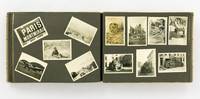
140779Very Good. A commercial photograph album 225 × 320 mm containing 163 snapshot photographs mainly 57 × 70 mm or 64 × 90 mm loosely mounted behind photo-corners on 24 leaves mainly on the rectos with captions regularly throughout the album. A postcard-format studio portrait of the compiler is attached to the front pastedown and he has identified himself in a number of photographs. In one snapshot he is standing with former German Olympic boxer Hans Schönrath 1902-1945 who has signed the photograph in ink. Cord-bound boards covered with coarsely-woven multi-coloured fabric; extremities a little rubbed and bumped with minor wear to some corners; patterned tissue-guards occasionally chipped and torn; minimal signs of age and use including a few loose snapshots - and only a handful appear to be no longer present; overall in excellent condition. The portrait has a personal inscription on the verso unfortunately not fully identifying the subject. The snapshots are basically in chronological order with the first group captioned 'R.A.D. 1937'. 'The Reichsarbeitsdienst RAD or National Empire Labour Service had its origins with the formation of a volunteer labour force that was created to off-set the high unemployment before the Nazis came to power. Work camps were set up to house these volunteers sponsored by the government administration in 1931. Under Hitler's leadership service in the RAD was obligatory for all males of 17-25 years of age for a period of six months from 26 June 1935' Imperial War Museum. Next follows a period of military training at Neuhammer; a number of photographs in this part of the album suggest the young man may have had training as a chef. There are about 40 photographs of the young man working or training in camps in barracks or at ease. <p>The majority of the photographs depict the unstoppable and destructive course of the German army as it embarks on the occupation of Czechoslovakia fortifications captured tanks and aircraft military parades in the presence of Herman Goering and Sudetenland the invasion of Poland deployed troops destroyed or burning buildings demoralised civilians and more military parades and finally the invasion of France massive destruction of buildings fortifications bridges French aircraft and tanks; a crashed Messerschmitt Bf 109; captured British soldiers. unknown
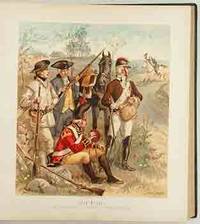
51-3684Washington D.C.: Quartermaster General of the United States under authority of the Secretary of War circa 18890. Folio. 16 x 15 inches. 42 x 38cm. Original gilt morocco expertly restored by the artisan bookbiner Sasha Mosalov. Gilt edges and dentelles on the inside of the cover. Marbled eps. Text followed by 44 color lithograph plates with tissue guards numbered I-XLIV illustrating uniforms worn between 1774 and 1889OCLC Numbers: 198503454; 6323880; not exactlythe same. Washington, D.C.: Quartermaster General of the United States, under authority of the Secretary of War, circa 18890. unknown
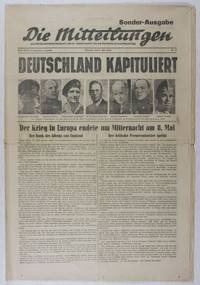
194539196Germany: The 21st Army Group 1945. First edition. Softcover. vg. Folio 12 1/2 x 18 1/2". 8pp. Published by the 21st Army Group this special issue of "Die Mitteilungen" Information announces in bold letters and across its front page the capitulation of Nazi Germany. Featured in two columns and above the b/w photographic portraits of Field-Marshal Alexander Marshal Koniev Field-Marshal Montgomery King George VI General Eisenhower Marshal Zhukov and General Bradley are the victory speeches pronounced by King George VI and Prime Minister Winston Churchill. Of special interests are the announcement of Joseph Goebbels' death Page 2; the liberation of some of Europe's political military and religious leaders such as Leon Blum Paul Reynaud Edouard Daladier General Weygand General Gamelin Dr. Kurt von Schuschnigg Pastor Niemöller Belgian King Leopold III etc. Page 2; Information on Hitler's suicide Page 4; The San Francisco conference Page 5 and 8; article with four gruesome photographs on the liberation of the Death Camps Page 6; five b/w photographic portraits of the following allied statesmen: General de Gaulle Marshal Stalin Winston Churchill President Franklin Delano Roosevelt who died less than a month before Germany's capitulation and President Harry Truman Page 8. 'The 21st Army Group newspaper "Mitteilungen" was distributed as follows: Laer 700 copies; Greven 560 copies; Wunsdorf and Neustadt 1000 copies; Basthorst 500 copies; Celle 3000 copies; Lübeck 4000 copies; Bergen-Belsen camp 2500 copies' Extracts from War Diary of 14 Amplifier Unit & 19 Leaflet Unit. Folding mark at center. Tiny closed tear along spine. Minor age-toning. Text in German. Newspaper in overall very good condition. The 21st Army Group was a World War II British headquarters formation in command of two field armies and other supporting units consisting primarily of British and Canadian forces. Established in London during July 1943 under the command of Supreme Headquarters Allied Expeditionary Force SHAEF it was assigned to Operation Overlord the Western Allied invasion of Europe and was an important Allied force in the European Theatre. The 21st Army Group operated in Northern France Luxembourg Belgium the Netherlands and Germany from June 1944 until the end of the war in Europe in 1945. After the German surrender 21st Army Group was converted into the headquarters for the British zone of occupation in Germany. It was renamed the British Army of the Rhine BAOR on 25 August 1945 and eventually formed the nucleus of the British forces stationed in Germany throughout the Cold War. The 21st Army Group unknown
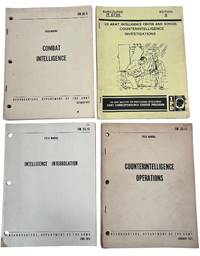
232441972. US Army manuals on counterintelligence interrogation and combat. FM 30-17 Counterintelligence Operations FM 30-15 Intelligence Interrogation FM 30-5 Combat Intelligence and the Fort Huachuca subcourse Counterintelligence Investigations trace the Army's printed intelligence doctrine from January 1972 to June 1989. The sequence begins after the Army established Military Intelligence as a distinct professional branch in 1962 and after the Military Intelligence Corps relocated its school to Fort Huachuca in 1971. By 1989 the printed curriculum had shifted from broad field doctrine toward formal professional instruction for Counterintelligence Special Agents at the U.S. Army Intelligence Center and School. FM 30-17 indexes topics including "Rights" "Witness" "Wiretapping" and the "U.S. Army Security Agency"; FM 30-15 appends the 1949 Geneva Conventions and states that coercion is neither acceptable nor effective.<br /> <br /> 1972-1989 Washington D.C. and Fort Huachuca Arizona. Archive of 4 military intelligence training publications: three Headquarters Department of the Army field manuals and one Army Intelligence Center and School correspondence-course subcourse all in original printed wrappers and stapled or punched for binder storage.<br /> 1 United States Department of the Army. FM 30-17 Counterintelligence Operations. Washington D.C.: Headquarters Department of the Army January 1972. Issued under the printed authority of General W. C. Westmoreland and Adjutant General Verne L. Bowers the manual sets out the Army's investigative framework for sworn statements interrogations surveillance audio surveillance surreptitious entry false documentation secret writing and polygraph procedure.<br /> 2 United States Department of the Army. FM 30-15 Intelligence Interrogation. Washington D.C.: Headquarters Department of the Army June 1973. Sets forth doctrine for Army intelligence interrogations of non-U.S. personnel prohibits physical or mental torture coercion and threats and reproduces the 1949 Geneva Conventions in Appendix E.<br /> 3 United States Department of the Army. FM 30-5 Combat Intelligence. Washington D.C.: Headquarters Department of the Army October 1973. Issued the year of final U.S. combat withdrawal from Vietnam the manual expands combat intelligence into "cold war" "limited war" "general war" and "stability operations" with sections on civilian sources insurgent intelligence collection rear-area sabotage and terrorist threats and counterintelligence planning.<br /> 4 United States Army Intelligence Center and School. Counterintelligence Investigations. Subcourse IT 0735 Edition 9. Fort Huachuca Arizona: Army Institute for Professional Development Army Correspondence Course Program June 1989. A six-credit-hour professional course for the Counterintelligence Special Agent covering doctrine for initiating CI cases procedures for selected CI investigations and techniques for handling physical evidence.<br /> The group follows the Army's post-1962 effort to professionalize intelligence as a branch and concentrate its training system at Fort Huachuca after the 1971 move from Fort Holabird. FM 30-15 1973 is the Army's printed official position that torture and coercion are prohibited with the Geneva Conventions reproduced in full. That manual was the governing interrogation doctrine on paper through the early 2000s. It's the document that the post-9/11 interrogation debates the 2002 OLC memos and Abu Ghraib were measured against. Owning the actual printed doctrinal manual that says "coercion is neither acceptable nor effective" is the headline. One booklet is missing its rear cover and one volume contains annotations throughout. Overall good condition. The 1972 and 1973 manuals set out combat collection interrogation surveillance evidence and counterintelligence support in cold war and stability operations; the 1989 Huachuca subcourse narrows that material into school-based instruction for case initiation and judicial-type investigations. unknown
1923215951923. African American MilitaryWWI Muller William G. The Twenty-Fourth Infantry 1923 documents the service of a Black regiment in the United States Army tracing its development from Reconstruction through the Mexican Border War. Written by Captain William G. Muller the volume situates the regiment's origins in the 1869 consolidation of the 38th and 41st Infantry regiments among the first post-Civil War units composed of Black enlisted men and follows its campaigns across the Western frontier Cuba during the Spanish American War and Mexico during the 1916 to 1917 Punitive Expedition. Produced at a time when Black military service was constrained by segregation the work offers insight into the service of Buffalo Soldiers in the decades preceding formal desegregation.<br /> <br /> Muller William G. The Twenty-Fourth Infantry. 1923. The text opens with a dedication "To those colored non-commissioned officers and soldiers whose unswerving loyalty and devotion of the regiment made possible these brilliant pages of history." Extensively illustrated with photographic portraits of senior Black noncommissioned officers among them Regimental Sergeant Major Walter B. Williams Color Sergeant Wm. G. Wilcox and Regimental Color Sergeant Abraham Hill identified as "one of the Army's great rifle shots." Additional images document encampments in New Mexico and Texas scenes from Mexico during the Punitive Expedition and regimental athletics including a football team that competed against historically Black colleges such as Tuskegee and Talladega. The narrative emphasizes the regiment's record of discipline and cohesion asserting that its "high character.unsullied for 54 years" reflected institutional stability amid shifting national racial politics.<br /> <br /> The history reflects an effort to commemorate the service record of Black soldiers at a moment when their contributions to westward expansion the Spanish American War and border conflicts were indispensable. The sustained attention to leadership merit marksmanship and athletic competition underscores the high professional standards Black soldiers were held to in the face of systemic discrimination. Minor edge wear and light rubbing to the binding; interior generally clean with occasional light toning; illustrations clear and complete. Overall very good. unknown
26996Middle East 1919-1926. 1.69 Envelopes "On His Majesty's Service" 13 x 10cm 1919 each containing at least one negative. Dowson writes the subject and place usually Iraq agricultural with other information. SEE IMAGE of composite photo.2.62 envelopes as above mainly "Basrah-Cairo Airmail" and "On His Majesty's Service" 13 x 10cm contents as 1.3.C.30 Glass negatives c.16 x 12.5cm incl. people eg. An apparent Sheikh- see Image.4.Small Box 11 x 17 x 3cm containing 10 glass plates labelled "Old Goerz. New Series 65-83 1926" and "Old Goertz Plates 1925 494-501". N.B. Goertz was manufacturer of photograph related items. See Wikipedia "Goertz Company".5.10 Envelopes 15.5 x 10cm containing multiple negatives dated 1926-7 one labelled "America Spring 1926" another "Pompei and Florence" another "factor"6.4 Envelopes 15.5 x 10cm containing multiple negative dated 1928-9 labelled C.P.F. in Construction China Petrol Store Ranjan "Wreckage from my Canberra wheat in Potatoes in ridge".7.Notebook Cover title "Army Book Correspondence Book FIELD SERVICE" poor condition interleaved with negatives people and scenes title on front cover "Negatives Old Goertz 519-562 Kut unreadable."8."Army Book Correspondence Book 152 FIELD SERVICE" so Notebook poor condition interleaved with negatives people and scenes title on cover "Negatives 393-518 Old Goertz 1923-4". Pencil note in different hand says "60 negs".9.Ibid. title front cover "Old Goertz 143-200 N.A. & Bd 1922". Additional note says "FROM 1918" and other title-notes. Notes in Dowson's hand obscured by adhering negatives but extensive agricultural notes dating from 1918. See Image reporting from 5/6/18 "Jinub" 10.Kodak Cardboard Box 15 x 10 x 5cm glass plates entitled ""Old Goertz. 1923 384-398 1924 399-413".11.Tin Box 18 x 125 x 8cms glass plates entitled "Old Goertz. 1923 384-398 1924 399-413.12.Notebook poor condition interleaved with negatives No annotation Cover/Spine Entitled "Negatives Old Goertz 1 to 142".13.Five loose glass plates first entitled "New Series 1926".14.Eight negatives 12 x 7cm WITH 10 negatives 14 x 10cms subjects plants people and scenes.15.Four envelopes "On His Majesty's Service" all "Amara" with one or more negatives labelled as follows: Battery of Pumpsat Dairy Farm; Servants dependents etc. of Shaikh Salim playing at Rowa; Young Sindi Stock Dairy Farm; Babaol sown March 19 Dairy Farm.16.Six Photographs 11 x 5.5cm mainly of people mainly in farmwork environment. See Image combined with 17. Below.17.Eleven Photographs 14.5 x 10.5cms plant orientated. See Image combined with 16.18.Five loose negatives people and plants.Sample subjects from Item One 1919 - mainly date related: Nursery; Donkey and foal; Minaret Bagdad; Koran Support; Cathedral Baghdad; Officer on Horseback; Ploughing BarleyKut - place appears many times; Boom landed for Kuwait; Well Cultivated Garden; Chibchab Tamar dates; Dates available in Baghdad market; Cotton.Item 2: Gardens in the Bank of the Husaini; small Japan ground nuts; 4 bunches dates in 10 year old Halawi; Araq factory Basra several; Kuwait photos/Abdar Rojah at Amir etc; view from water tower; factory construction; Ahwaz; Buch of Tmar Khadrhrawi on twelve year old palm many similar shots; Sindi Working bullocks Dairy Farm several = Amara; Servants dependents etc. of Shaikh playing Nowa; fish cooked; The ruined Mosque of Shabashia; From Notebook interleaved with negatives "Old Goerz 143-200" 1922 commences with manuscript notes by Dowson heavily annotated throughout see photographs even listing photos to be taken and interleaved with negatives. Middle East, [1919-1926] unknown
191959006401Washington: U.S. War Department - General Staff G-3 1919. Bound in one half brown leather over gray boards. five raised bands gilt still bright. Tabs for 93 divisions from 1917-1918 with 4-5 pp. per division. Lists no. of enlisted men officers headquarters generals casualties etc. Exceedingly rare. Approximately 400 leaves. Contains charts no maps in this volume. States Copy No. 41. First Edition. Hard Cover. Very Good /No Jacket. 4to - over 9¾" - 12" tall. U.S. War Department - General Staff G-3 Hardcover
1939192368Edinburgh: 1939-45. Digging for victory A small but evocative collection tracing the war work of the artist Mary Paton who served with the Women's Land Army in Scotland throughout the Second World War. The highlight of the collection is a pair of standard-issue corduroy breeches made by Redman Bros in January 1943. Other than a couple of small oil stains to the right inner thigh they are well-preserved and have been supplemented with non-standard leather reinforcing patches to the inner knees. Two certificates in the collection are addressed to "Frances M. R. Paton" the full name of Mary Paton 1920-1990 who studied at the Edinburgh College of Art before and after the war and later lived in Aberdeenshire. A letter of thanks records her service as having lasted from 11 October 1939 to 10 October 1945 while the two WLA armbands show her service at 3 1/2 and 5 1/2 years respectively. The collection also includes two enamelled WLA lapel badges and a silver gelatine photograph 86 x 57 mm showing a young woman with "Mave. Freiburg '37" inscribed on the verso. Together eight items. One certificate with storage folds overall in very good condition. hardcover
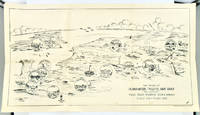
19452442Bad Wildungen Germany: Tac Echelon HQ 12th Army Group 1945. First Edition. Single Sheet Paper. Very Good Plus/4-mil clear mylar envelope. This is an ORIGINAL folded MAP showing the travels of the "Tac Echelon" Headquarters 12th Army Group in WWII through England France Luxenbourg Belgium and Germany from 15 July 1944 through 9 May 1945. On the verso of the map is the description of the "VICTORY IN EUROPE" Dinner Dance presented in honor of General Omar N. Bradley by the Officers of Tac Echelon Headquarters 12th Army Group at the Hotel Furstenhof in Bad Wildungen Germany on 12 May 1945; i.e. 4 days after the Surrender of Germany. The document is SIGNED in ink by General Omar Bradley "O N Bradley". The map measures 11 1/2" x 20" opened and 6 3/4" x 5 1/2" folded.<br /> <br /> One of the MOST REMARKABLE MAPS of WW2 the map was hand-drawn by an artist who signs his name RWD in the print. The document was produced by "Engr. Repro. Det. 12 A Gp." The map shows the various locations of the Headquarters 12th Army Group during its progress in combat in WWII from the "Staging Area" in England to Bad Wildungen Germany. Beverages are described for most of the locations ending in "V-E Specials" for Germany. We believe this map was distributed at the dinner dance celebrating the "Victory in Europe" just 4 days after the War in Europe ended and was signed by General Bradley at the dinner. The 12th Army Group was the largest military formation of the United States in the history of the Country. The 12th Army Group was deactivated shortly afterward on July 12 1945 upon General Bradley’s departure to become Director of the Veterans Administration. <br /> <br /> NOTE: This map will be accompanied by a CERTIFICATE OF PROVENANCE dated and signed by Debbie Chapman Luckinbill certifying that the map was brought home as a souvenir by her aunt the late Helen Chapman who was a member of Red Cross Clubmobile Group C which served in Europe during WW2. Red Cross Clubmobiles were large food trucks which were driven by Red Cross women to troop assembly areas where the women would open up the sides and serve doughnuts coffee and snacks to the fighting men. <br /> <br /> We have not found this map anywhere on the internet or other research. The map is foldedrubbed and lightly soiled from handling but is Very Good or better and now in a 4mil clear mylar protective envelope. Tac Echelon, HQ 12th Army Group unknown
19452080202102707404Not Available 1945. Soft Cover. Fine. The book is in fine condition. Not Available paperback
2009BRG-22_5_982Skyhorse 2009-06-23. paperback. Very Good. 6x0x9. Very Good condition.Crisp pages. Clean cover and pages. Book shows minimal shelf wear. No highlighting/marking. Not Satisfied Contact us to get a refund. Skyhorse paperback
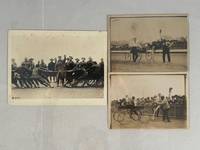
1918215381918. African African MilitaryWWI African American soldiers of the 811th Pioneer Infantry Regiment in France three original photographs circa 1918 documenting Black American troops during World War I. These images illuminate the racialized structure of the U.S. Army in which African American regiments were disproportionately assigned to labor and stevedore work while simultaneously participating in regimented recreational activities designed to sustain morale. The photographs support research in African American military history and racial segregation in the armed forces offering contemporaneous press documentation of Black soldiers' presence in France.<br /> <br /> Three original silver gelatin photographs. France: circa 1918. Versos with applied Brown Brothers New York credit labels and ink release stamps; one stamped as released by the Committee on Public Information April 17 1918. The photographs measure approximately 8.5 x 6.5 inches and 7 x 5 inches. One image captures a tug-of-war competition among African American infantrymen identified in the caption as members of an infantry regiment encamped "across the shore in France" with a captain of a machine gun company serving as referee. The men in mixed military and work attire strain collectively against the rope visually staging discipline and unity. The remaining two photographs depict ostrich-drawn cart races attended and handled by Black soldiers and civilians; one shows a uniformed rider seated in a two-wheeled cart drawn by an ostrich while another captures the animal rearing as a handler steadies it before a crowd. All three prints bear Brown Brothers agency attributions linking them to one of the earliest American stock photography firms supplying images to newspapers and public agencies.<br /> <br /> Produced at a moment when the federal government actively shaped public perception of the war through the Committee on Public Information these photographs participate in a broader visual narrative presenting African American troops as disciplined cooperative and integrated into the Allied war environment even as the U.S. military remained segregated and structured by racial hierarchy. The 811th Pioneer Infantry Regiment largely assigned to stevedore and labor duties in France exemplifies the constrained combat opportunities afforded Black units; yet these images foreground physical strength spectacle and communal recreation rather than manual labor alone. As press-distributed photographs they bridge military documentation and civilian consumption contributing to the visual archive of Black military service at a time when photographic representation of African American soldiers in non-combat settings was comparatively limited. Light edge wear minor surface creasing and scattered handling marks; versos with agency labels and ink stamps as issued. Very good. Collectively the group offers concentrated visual evidence of African American wartime service morale culture and state-mediated representation during World War I. unknown
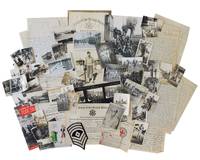
1944185601944. WWIIPhilippine Occupation Harwell Lee W. World War II military archive 1941-1945 recording the service of a North Carolina enlisted artilleryman from prewar mobilization through the American occupation of the Philippines following Japan's surrender. Harwell born in 1918 in Mooresville North Carolina enlisted in April 1941 and trained at Fort Bragg Camp Blanding Camp Shelby and Fort Sill before deployment overseas in August 1944 with the 694th Field Artillery Battalion. His unit participated in operations in New Guinea and the Philippines during the final year of the Pacific campaign. The archive's most historically concentrated materials consist of five letters written in September 1945 from Luzon where Harwell was assigned to guard Japanese prisoners of war north of Baguio in the immediate aftermath of surrender. These letters describe the logistics and atmosphere of POW stockades the movement of captured Japanese naval personnel civilian hostility toward prisoners in recently liberated areas and the conditions of sick and wounded detainees. Writing to his fiancée Louise Harwell records the daily realities of occupation duty including the presence of hundreds of prisoners under armed guard and the tensions surrounding their confinement. A sixth letter was written aboard the U.S.S. General Mitchell as he returned home closing the wartime sequence.<br /> <br /> Archive is comprised of approximately 150 photographs of varying sizes; six autograph letters totaling seventeen pages; and assorted military documents and ephemera 1941-circa 1946. Photographs depict stateside training camps in North Carolina Florida Mississippi and Oklahoma; artillery training operations; camp life; fellow enlisted men; scenes in New Guinea and the Philippines; images of indigenous civilians in the Pacific theater; and a substantial grouping of family photographs likely dating to Harwell's postwar life. Letters retain original folds and were written in ink to his fiancée. Ephemera include military paperwork a shoulder patch a Fort Sill pamphlet an American Red Cross pamphlet and related service materials. Many photographs were removed from a disbound album some trimmed with occasional captions on the verso or on surviving album fragments affixed to images.<br /> <br /> The letters from September 1945 are contemporaneous accounts of the transition from active combat to custodial and occupation responsibilities in the Pacific. Harwell describes passing large groups of surrendered Japanese personnel under military police supervision guarding stockades housing hundreds of prisoners and transporting detainees through Luzon towns where Filipino civilians attempted reprisals. His observations of disease exhaustion and discipline within the camps provide primary testimony to the conditions under which American forces processed surrendering Japanese units at war's end. Together with visual documentation from training through occupation the archive traces the trajectory of a Southern enlisted soldier from prewar expansion to Pacific victory and demobilization. Letters show minor wear and original creasing; photographs exhibit handling wear consistent with album removal some trimmed; documents with expected age toning; overall very good condition. Substantial Pacific Theater service archive centered on POW guard duty in the Philippines during the closing weeks of World War II. unknown
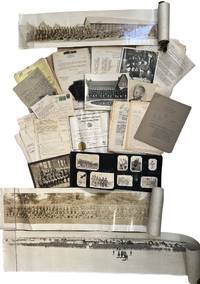
1917190211917. WWINational GuardWWII Primary-source archive documenting U.S. Army transportation command operations supporting Allied logistics following the Normandy landings centered on the development of Cherbourg as a critical supply hub. Assembled from the career of Lieutenant Colonel George C. Sullivan the collection spans World War I mobilization through World War II and into postwar reserve service with particular emphasis on mid-twentieth-century military infrastructure and coordination. The archive comprises hundreds of pages of official documents correspondence and service records alongside a substantial photographic component including large-format panoramic rolls depicting assembled training formations and unit organization at scale. Together the materials provide detailed evidence of the administrative and logistical systems that sustained Allied operations in Europe situating individual service within broader frameworks of wartime transportation supply distribution and postwar military restructuring.<br /> <br /> Archive comprises hundreds of pages of military documents dated primarily from the 1940s through the 1950s; three panoramic photographic rolls from World War I service; one photograph album containing 83 photographs from 1917-1918; four loose photographs; and three letters dated 1945-1948. The World War I album depicts training at Fort Sill Oklahoma mounted artillery drills including a three-inch field gun mounted cavalry movement across desert terrain doughboy uniformed infantry and a Peace Parade in Lawton Oklahoma in November 1918. Sullivan's own written service summary records his federal call-up transfers promotion to corporal commissioning and discharge in December 1918. The panoramic rolls measuring approximately 44 to 56 inches in length show large assembled formations at Camp Cody New Mexico and officer training at Camp Taylor Kentucky including the 25th Battery Central Officers Training School. World War II and postwar materials include commendations transfer requests rosters promotion records certificates and administrative correspondence. A 1949 silver gelatin photograph of Headquarters Company 371st Support Group summer training personnel includes a roster naming forty-eight officers among them First Lieutenant Catherine M. Henry documenting the integration of women officers in postwar reserve structures.<br /> <br /> Sullivan's World War II documentation centers on transportation command responsibilities essential to sustaining Allied operations in Normandy and the rapid development of Cherbourg as a logistical hub following D-Day. The archive traces the evolution of the United States Army from early twentieth-century National Guard mobilization to logistics work in World War II. Postwar papers reflect Sullivan's continued reserve duty into the mid-1950s and his civilian engagement in the sale of military surplus goods in Seattle Washington illustrating the reintegration of career officers into postwar commercial life. Documents generally clean and legible with occasional edge wear; panoramic photographs show some cracking but remain intact; photograph album well preserved; loose photographs with light handling wear. Overall very good condition. Extensive archive chronicling four decades of a United States Army officer's career. unknown
1950231531950. WACKorean War Women's Army Corps photo album compiled by Sgt. Elizabeth Adamek of Cairnbrook PA ca. early to mid 1950s extensively recording enlisted women in post-1948 U.S. Army administrative operations at Camp Zama Japan during the Korean War period. Elizabeth Adamek later Elizabeth Adamek Pierce 1932-2016 served approximately twenty years in the United States Army as an administrative assistant and instructor including service in Japan and the Korean Theater during the Korean War. Adamek is shown several times in uniform with her twin sister Cpl. Cristania Adamek indicating the sisters served in the WAC around the same time period. This album documents postwar U.S. Army overseas base administration showing how clerical labor recordkeeping and office management were carried out by WAC personnel during the Korean War. Images of Hill and fellow servicewomen engaged in office work reveal women's roles in the Army's daily bureaucratic and logistical functions while stationed abroad. A comprehensive primary-source documentation of the operational role of women within permanent peacetime Army structures following the formal establishment of the Women's Army Corps in 1948.<br /> <br /> Photo archive of approximately 240 silver gelatin photographs from Camp Zama Japan and the United States circa early to mid 1950s. The album is housed in a Japanese lacquer-style postbound binding with black paper leaves containing a mixture of small snapshot prints deckle-edge photographs and larger mounted images. The visual content centers on Hill frequently shown in WAC uniform posed in front of barracks administrative buildings and landscaped areas as well as inside office environments seated at desks surrounded by stacked files paperwork and card index systems. Several images explicitly depict clerical workspaces including a servicewoman operating a typewriter beside filing drawers reinforcing the administrative function of WAC personnel. A clearly legible building sign reads "Camp Zama 8030th Army Unit APO 50" situating the album within a specific military unit structure. Additional photographs include formal military reviews with officers and dignitaries group portraits of uniformed women before display walls and social scenes in dining facilities and clubs. Off-duty life is extensively documented through images of Japanese urban streets market stalls rail platforms commercial signage shrine gateways temple architecture zoo enclosures and landscaped gardens alongside recreational scenes such as swimming roadside travel and barracks exteriors collectively illustrating both the operational and social dimensions of overseas Army life. Adamek is posed throughout the album with a romantic partner one Sgt. Kidder whose service at Camp Zama is also documented extensively.<br /> <br /> The album captures the workings of U.S. Army overseas base administration demonstrating the process by which women in the Women's Army Corps sustained military infrastructure through administrative labor. Camp Zama functioned as a major logistical and support installation during the Korean War era and the photographs provide insight into the women that maintained its operations while also recording the social networks and cultural encounters experienced by American service personnel in postwar Japan.<br /> <br /> Elizabeth Adamek Pierce's obituary in The Oklahoman indicates she was honorably discharged from the US Army in 1971 after which she relocated to Oklahoma City and worked in an administrative role with the OKC Police Department. Adamek was a member of the Civil Air Patrol the VFW Post 1335 and a volunteer at Tinker Air Force Base in Oklahoma City. Light edge wear and chipping to album leaves occasional corner wear scattered fading and softness to prints and general handling wear to the binding; overall good condition. A cohesive and well-identified visual record of women's military service in the U.S. Army in East Asia. unknown
1919158France: Published by the Office of the American Expeditionary Forces 1919. Seven volumes folio each in original printed wrappers. Bound into this impressive set are several lithographic plates and numerous large folding maps prepared by the U.S. Army 29th Engineers. A well-preserved set from the Hoover Library with duplicate stamps to the front covers. Also bearing the old ownership signature of Lt.-Colonel R.H. Williams. Numbers 1 to 286 of field military intelligence reports prepared during the first war here printed collectively towards the close of the hostilities or shortly afterwards and arranged with continuous pagination. The reports cover the date range from January to November 1918.</p> <p>Also bearing the old ownership signature of Lt.-Colonel R.H. Williams. Published by the Office of the American Expeditionary Forces unknown
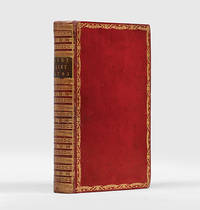
1783124569London: War-Office 28 April 1783. First edition compiled just a few months before the conclusion of the War of Independence. These eighteenth-century Army Lists are becoming increasingly elusive those with relevance to the American Wars being particularly desirable and especially so when as here they are printed on thick paper and presented in the style of binding which seems to have been reserved by the War Office for presentation copies. A very handsome piece indeed. Octavo 228 x 138 mm. Contemporary red morocco green morocco label flat spine elaborately gilt with gilt pentaglyph and metope stylised quatrefoil and plain reeded rolls gilt panel of swags and sunflowers to the boards gilt edge-roll all edges gilt palm branch and quatrefoil roll gilt to the turn-ins marbled endpapers Greek key roll to boards floral roll to turn-ins and all edges gilt. Lightly rubbed spine a touch sunned small chip from the lower edge of the label no loss of lettering corners just a little bumped but a very good copy. hardcover
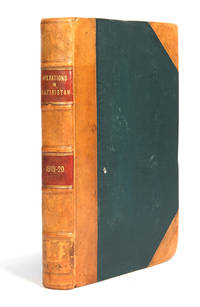
115601Calcutta Superintendent Government Printing India 1921. . First edition; 8vo 25 x 16.5 cm; complete with 32 photogravure plates including frontispiece 16 of which folding 4 of which large panoramic views 8 folding panoramas sketched on the spot 7 folding maps 3 of which loose in rear pocket 2 of which large coloured 75x92cm & 77x64cm previous ownership inscription to both endpapers with underlining to a few passages wide tear to margin of p97-8 not affecting text; typical contemporary half calf green cloth boards gilt morocco lettering pieces to spine remains of a shelf mark to spine extremities slightly rubbed from use binding tight due to quantity of maps and plates a very good copy; x 187 1pp.<br /> The scarce official account of the Waziristan campaign 19191920 and the preceding 1917 conflict with copious views and maps of the scarcely traversed terrain and landscape of Waziristan including Jandola Palosina Kotkai Kaniguram Barari Tangi Ahnai Tangi and Badergoi Valley. Also included are twelve Appendices detailing the units of the British forces in 1917 and 1919 the terms delivered to the Waziris and Mahsuds lists of British casualties and approximate numbers of the different specific tribes of the Mahsuds and Waziris involved in the conflict. <br /><br />In 1919 the short-lived Third Anglo-Afghan War concluded with the British ceding legal control of Afghan foreign affairs in return for the recognition by the Afghans of the Durand Line. Despite this a rumour spread amongst the Waziri and Mahsud tribesmen that the British intended to cede their territory to the British. They quickly conducted a series of raids against neighbouring settlements in the North-West Frontier in late 1919 causing over 400 casualties. <br /><br />Major-General Sir Andrew Skeen led the British response against the Tochi Waziris and Mahsuds in November of 1919. The campaign a took over 12 months due to the inexperience of the British units mainly comprised of light Indian divisions. The decisive eight-day battle of Ahnai Tangi involving the stand of the 2nd/5th Gurkhas immortalised in several paintings broke the Mahsud offensive and quickly resulted in a calming of violence and allowed the British to deliver their terms of control. <br /><br />Despite the apparent British victory the 1919-1920 campaign led to a change of policy in Waziristan. Britain decided to station permanent garrisons and have a much closer relationship with the irregular military units used. A large number of the locally raised troops had defected to the Waziris and Mahsuds during the campaign and it was hoped these measures would prevent further desertion. Britain also attempted a road construction effort in the region but this was seen as invasive and caused further conflict up to 1924.<br /><br />This copy was used by a member of the 1st Battalion of The Royal Scots during the time they were station in Secunderabad Hyderabad between 1922 and 1925.<br /> Calcutta, Superintendent Government Printing, India, 1921. hardcover
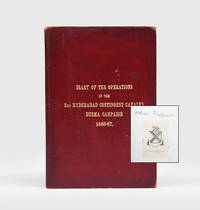
1889174435Bombay: Printed at the Times of India Steam Press 1889. Presented by the contingent's commander to his son Sole edition association copy inscribed to his son by Colonel Charles FitzGerald commander of the 3rd Hyderabad Contingent on the front free endpaper "To dearest Arthur from Father 1902." The recipient 1891-1967 was the author's son by his second wife. We have traced only the British Library copy of this account. Charles John Oswald FitzGerald 1840-1912 joined the Indian Army in 1857 and served in the Rebellion. He was appointed Adjutant 3rd Hyderabad in 1862 commanded the contingent during the Second Anglo-Afghan War and was promoted to colonel in 1883. The majority of the text comprises FitzGerald's reports on the course of the Burma campaign during which his cavalry had 27 separate encounters with enemy forces and is accompanied by extracts from brigade orders praising FitzGerald and his contingent: "the names of Colonel FitzGerald and the 3rd Hyderabad Contingent Cavalry will be remembered in Burma and I trust will be written in the history of the country" p. 37. Octavo. With folding 215 x 277 mm albumen group portrait bound in on card as issued. Original red roan boards front cover lettered in gilt. Leather retouched in places a few stains on boards albumen photograph somewhat yellowed: a very good copy. hardcover
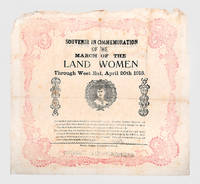
1918170820London: Sarah Burgess 1918. An ephemeral piece of wartime memorabilia A souvenir tissue napkin advertising a parade through London of the Women's Land Army intended to promote the organization and encourage agricultural volunteers. Napkins were commonly printed for large public ceremonies: "the most spectacular napkins were the souvenir issues of Mrs S. Burgess of London who created items for various historical and period events" Florey p. 108. The march was an enormous undertaking consisting of over 200 women and farmers: "the war has afforded many stirring spectacles in the streets but these processions could hardly be excelled for picturesqueness or the appeal they made to national gratitude" The Times p. 4. The focus of the procession was promoting agricultural pursuits; the women were flanked by a myriad farmyard animals hay-balers and tractors. Recruitment speeches were delivered imploring women to support troops abroad by ensuring that industry and agriculture were appropriately maintained at home. "The soldiers are giving their lives for England. All that we ask of you girls is to give one year of your lives in the Land Army in the same noble cause" ibid. Known as "Auntie" in the trade Sarah Burgess operated from premises in Bishopsgate and later off the Strand as here advertising as a "manufacturer of paper switches cut tissues lace paper and shelf trimmings & confetti and stationer wholesale and export" Crawford. The napkin squares were imported into London from Japan already printed with a decorative border in up to five colours and a blank central area. After being printed with the appropriate commemorative design they were sold for about one penny by street traders lining the route of the event. Burgess was particularly involved with producing commemorative napkins for the suffrage movement including for the march to the House of Commons on 29 June 1909 the Suffrage Coronation Demonstration on 17 June 1911 and Emily Wilding Davison's internment in Morpeth on 14 June 1913. However "the WSPU had mixed feelings about Burgess's efforts. Disturbed by her producing an 'unauthorized official programme' for the June 29 event they nevertheless pointed it out as an example of 'how the movement interests the public'. Mrs Burgess's products demonstrated quite clearly how important the concept of a suffrage 'souvenir' or collectible had become to suffrage sympathizers who wanted to retain a tangible memory of a major event that they might have participated in" ibid. Square of plain crepe paper 325 x 360 mm. Central printed illustration depicting a portrait of Queen Mary of Teck set within oak and laurel leaves and flanked by two scrollwork motifs surrounded by decorative floral border printed in red. Some nicks and creases at extremities mostly to top edge gently creased from folding and a couple of small damp stain patches offset from ink lettering; overall a very good and intact example of a fragile product. Elizabeth Crawford "Ephemera: Mrs Sarah Burgess Printer" Woman and Her Sphere blog 12 Sep. 2019 accessible online; Kenneth Florey Women's Suffrage Memorabilia: An Illustrated Historical Study 2013; "Women War Workers. Munition Makers at St. Paul's. Land Army Procession" The Times 22 Apr. 1918. unknown