WWII; US Army U SBiblio.com
30 331 résultats
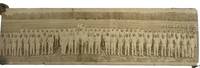
1942185261942. Panoramic photograph 1940s depicting an African American Quartermaster Corps unit during World War II with direct relevance to the study of segregated military organization logistical operations and the role of Black service troops in the war effort. The image shows three rows of Black soldiers in uniform assembled on a field with five white officers positioned in front reflecting the racial hierarchy characteristic of the U.S. Army during the period. A soldier at center holds a unit flag bearing an eagle insignia and the number "663" identifying the formation as part of a Quartermaster unit responsible for supply provisioning and support functions. During World War II the majority of African American soldiers were assigned to service branches rather than combat divisions and Quartermaster units played a central role in sustaining operations across multiple theaters. The photograph documents both the scale of military organization and the structural limitations placed on Black troops within the wartime army.<br /> <br /> Panoramic sepia photograph measuring approximately 8 x 16 inches showing the assembled unit in formation on a grassy field with additional soldiers visible in the background engaged in training or awaiting assembly. The composition emphasizes uniformed ranks command structure and the presence of the unit flag providing visual identification and context for the group.<br /> <br /> Photograph with creasing pinholes and tears consistent with handling; image remains clear; overall fair condition. A large-format visual record of African American service personnel in a logistical unit central to the operation of the U.S. Army during World War II. unknown
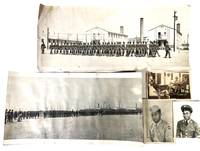
1941193561941. Partially identified Black Airmen photographs and Tuskegee Airmen signatures. African American airmen associated with the United States Army Air Forces during the World War II era document the struggle the struggle of entry into military aviation during a period when the armed forces remained racially segregated. This archive contains sixteen items including photographs of Black airmen in uniform and autographs of Tuskegee Airmen the pioneering African American pilots and support personnel trained beginning in 1941 after federal pressure forced the Army Air Corps to open limited aviation training opportunities to Black candidates.<br /> <br /> Five original photographs of African American airmen in Army Air Forces or early U.S. Air Force uniforms and nine signed note cards bearing the signatures of Tuskegee Airmen veterans. The archive also includes a contemporary pamphlet and photograph of a monument commemorating the Tuskegee Airmen. Signatures appear on white unlined cards measuring approximately 5 x 3 inches and include Claude Platt of the 301st Fighter Squadron and an Army primary flight instructor Charles A. Lane Jr. of the 99th Fighter Squadron Charles McGee of the 302nd Fighter Squadron Luther E. McIlwain Eldridge Williams of the 332nd Fighter Wing Leroy Bowman of the 301st Fighter Squadron Edward E. Tillman of the 477th Bombardment Group Utota Knox of the 302nd Fighter Squadron and Curtis C. Robinson of the 99th Fighter Squadron. The five photographs include two panoramic images measuring approximately 8 x 15 inches and 8 x 17.5 inches and three smaller photographs measuring roughly 3 x 5 inches. <br /> <br /> One panorama shows a large formation of troops assembled in ranks with a band and flag bearers present with African American personnel grouped separately from white soldiers and women within the formation. A second panorama shows approximately four dozen Black airmen marching in formation near a military installation. The smaller photographs depict African American airmen wearing service uniforms with airman caps and winged shoulder insignia; one image bears the inscription "To Mother - From Son in the service" while another real photo postcard shows a Black airman posing with a Black woman seated in a prop carriage behind a decorative mule annotated with "me" above the woman and the initials "T.B." above the man. <br /> <br /> The Tuskegee Airmen program began in 1941 when the U.S. Army Air Corps initiated training for African American pilots at Tuskegee Army Air Field in Alabama following federal directives requiring the military to allow limited Black participation in aviation roles. Units such as the 99th Fighter Squadron and the 332nd Fighter Group became the most visible African American flying units during World War II flying escort and combat missions in the European theater while operating within a segregated military structure. Their service challenged long standing claims that African Americans were unsuited for combat aviation and became a major milestone in the broader campaign for racial equality in the armed forces. The experience of these aviators and the public recognition of their accomplishments contributed to growing pressure for the desegregation of the military culminating in President Harry S. Truman's 1948 order ending official racial segregation in the armed forces. Five photographs ranging from approximately 3 x 5 inches to panoramic formats up to about 8 x 17.5 inches accompany nine signed note cards. One panoramic photograph shows slight water staining and a fold at the left corner; the remaining photographs and signatures remain well preserved. Overall condition very good. The material preserves visual documentation of African American participation in military aviation alongside signatures of several Tuskegee Airmen who served in fighter and bomber units during the war. unknown
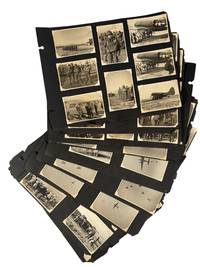
1943214541943. United States Army airborne training operations documented in photographs created during World War II at Laurinburg Maxton Army Air Base in North Carolina. The images record the preparation and execution of paratrooper training jumps carried out as part of the rapid expansion of American airborne forces during the war. Photographs show soldiers receiving equipment checks boarding transport aircraft deploying from the air and regrouping on the ground after landing illustrating the coordinated logistical and training processes required to prepare airborne infantry units for combat operations. Airborne training facilities such as Laurinburg Maxton served as major preparation sites where paratroopers and troop carrier crews rehearsed the procedures that would later be used in large scale combat operations across multiple theaters of the war.<br /> <br /> Photograph album consisting of 45 black and white photographs mounted on eight unbound album pages. The images depict paratroopers wearing standard issue M1 steel helmets jump boots and M42 paratrooper jump uniforms equipped with web gear. Several photographs show soldiers conducting pre flight checks and assembling near transport aircraft before boarding. Aircraft visible in the photographs include a Douglas C-47 Skytrain bearing markings associated with the 317th Troop Carrier a transport unit that trained at Laurinburg Maxton before deployment overseas during the war. Multiple photographs capture the moment of airborne deployment with paratroopers descending beneath round canopy parachutes consistent with the T-5 parachute used by U.S. airborne forces during most of the war. Ground level images document soldiers gathering after landing and coordinating recovery operations providing visual evidence of the training routines that prepared airborne units for operational deployment.<br /> <br /> During World War II the United States military rapidly expanded its airborne capabilities developing specialized training programs that combined parachute infantry units with troop carrier aviation groups responsible for delivering soldiers and equipment by air. Troop carrier units such as the 317th Troop Carrier Group later played an important role in Allied airlift and airborne operations in the Pacific theater transporting troops and supplies and participating in airborne missions during campaigns in New Guinea and the Philippines. Photographs documenting airborne training exercises therefore provide important evidence of the preparatory phase that preceded combat deployment of these units. Album pages remain unbound with photographs mounted to paper leaves. Minor edge wear and light handling marks visible on several prints; overall very good condition. The album preserves detailed visual documentation of American airborne training procedures during the Second World War. unknown
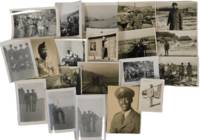
1951191891951. African American U.S. Army soldiers photographed during the early Korean War era document Black military service during the first years following the formal desegregation of the United States armed forces. Twenty photographs dating from approximately 1950 to 1952 depict African American soldiers in uniform at military bases and in field conditions associated with Korean War deployment. Several images also show Black and white soldiers posing together providing visual documentation of the Army during the first phase of racial integration ordered by President Harry S. Truman through Executive Order 9981 in 1948. Inscriptions on several photographs including one signed portrait reading "Joe Moddin 1951" identify individual servicemen and record personal messages written during active service.<br /> <br /> Twenty black and white photographs depicting African American soldiers in U.S. Army uniforms during the early 1950s. Photographs include scenes of soldiers standing with military trucks traveling along roads in Korea and posing with fellow servicemen at military installations where barracks structures are visible in the background. Several images show troops operating or stationed in rough winter terrain consistent with Korean War conditions. Three photographs contain extended inscriptions on the verso dated December 1951 and January 1952. Another photograph is a portrait image signed and dated "Joe Moddin 1951." The images collectively portray daily military life including group portraits transportation scenes and base environments during wartime deployment.<br /> <br /> The Korean War fought between 1950 and 1953 became the first major conflict in which the United States attempted to implement racially integrated military units following Truman's desegregation order. African American soldiers had served in segregated formations throughout World War II and their wartime service contributed to growing national pressure to dismantle racial segregation within the armed forces. By the early years of the Korean War the Army began integrating many units in training and field operations bringing together soldiers of different racial backgrounds in combat and support roles. Historians estimate that roughly 600000 African Americans served in the armed forces during the Korean War and Black servicemen accounted for a significant portion of U.S. casualties during the conflict. These photographs provide ground-level visual documentation of soldiers serving during the transitional period when formal military segregation was being dismantled but integration remained uneven in practice. Twenty photographs. Minor handling wear typical of mid twentieth century vernacular photographs. Overall condition very good. unknown
8vo., with tables in the text; black cloth, gilt back, a fine copy in unclipped dustwrapper. First published in 1920 by the United States War Office.
Oblong 4to., First Edition thus, with 16 coloured plates; printed wrappers, wire-stitched as issued, a near fine copy.
1980954359Heidelberg [u.a.]: v. Decker. 1980. 207 Seiten. 23,5cm. Zustand: Gut min. gebräunt (Innen); Einband (Außen) hat geringe bis leichte Gebrauchsspuren; Schnitt oben und unten min., seitlicher Schnitt ist geringfügig braunfleckig; Broschiert
Gutes Ex.; kl. Gebrauchs- und Lagerspuren; Seiten leicht nachgedunkelt; Einband mit kl. Läsuren. - In Frakturschrift. - INHALT / Kapitel: Deutschlands regierende Fürsten; Der Krieg von 1914; Karten des westlichen und östlichen Kriegsschauplatzes; Wehrpflicht; Kasernen- und Stubenordnung; Armee-Einteilung; Ehrenbezeigungen; Benehmen gegen Vorgesetzte; Militärrecht / Beschwerdeführung; Garnison-Wachtdienst; Aufziehen und Ablösen der Wache; Verhalten als Posten, Patrouille und in der Wachtstube; Einzelausbildung; Waffengebrauch; Die Kompagnie; Das Bataillon; Exerzierun und Gefecht; Schießen; Dienst im Felde; Angriff einer befestigten Feldstellung; Gelände und Zurechtfinden; Reisemärsche / Kriegsmärsche; Verpflegung im Felde; Der Soldat in der Schlacht; Kriegsbeute; Königs-Standarten und Kommandoflaggen; Die fremden Armeen; Familienzahlungen; Mannschaftsversorgungsgesetz; Feldgendamerie / u.v.v.a.
50 pages. Features: Let Them Be Canadians - encouragement for new Canadians to learn English so they may rise above manual labour jobs; Coming Up - The Light Metal Age - how aluminum, stainless steel and magnesium will change our world's face; Flying Circus in Africa (part 1 of 2) - article and photos of the 57th Fighter Group; What (Characteristics) Will Your Baby Inherit From You?; This is the Army - with eight photos from this wartime movie; King Solomon Knew Women; Soo-Flay; High Hook!; Wheel of Fortune - part 3; Colonel Stoopnagle's Fictionary; Liberty Goes to the Movies; Woman-Talk; and more. Colour ad for Mercury socks for men on back cover: Interesting ad (#7) by John Labatt Limited in comic-style encourages readers to support government price ceilings. RCAF recruiting ad for women. Center page loose but present, otherwise unmarked with moderate wear. A nice wartime issue. Book
67613Bruxelles, Etablissements Généraux d'Imprimerie, 1946. 16 x 25, 124 pp., broché, bon état (couverture défraîchie).
1970189694Fayard 1970 in8. 1970. Broché.
1882MILI0330Wien, Selbstvlg. d. militär-wiss. Vereines 1882. 93(2) S., OBr., klammergeh., stark staubig, an den Klammern durchgerostet rissig u. gebr., Bibl.-Et. am vord. Umschl., eine kl. Ecke fehlt, Innentit. gestemp., fingerfl., altersbed. schwach gebr.
1908MILI1833Leipzig, Göschen 1908. kl.-8°. 118(2) Seiten, 21 Abb. im Text, 2 Tabellen, 30 S. Anzeigen, OLn.120 S., mit 78 Abb. im Text u. 5 Übersichtstafeln, OPappband, gut erhalten. (= Sammlung Göschen 531). Literaturverz. mit einigen Anstr., ansonsten gut erhalten. [2 Warenabbildungen]
19972082702114603182Seishiosha fixed price 11000 yen 1997. Soft Cover. Fine. Number of books: 1 Seishiosha fixed price 11000 yen paperback
18942091502135202387Shibata Genzaburo 1894. Soft Cover. Fine. Size: 20cm Number of books: 1 Shibata Genzaburo paperback
19972091502135302240Aoshio-sha 1997. Soft Cover. Fine. Volume: 1 Aoshio-sha paperback
19812081002109001894Beppu and the Occupation Army Editorial Committee 1981. Soft Cover. Fine. Number of pages: 311p 15 plates Size: 21cm Beppu and the Occupation Army Editorial Committee paperback
19182083002117700143Imperial Military Association Headquarters 1918. Soft Cover. Fine. The book is in fine condition. Imperial Military Association Headquarters paperback
19192092902143901451Kinzashi Houryu-do Kanda district Tokyo 1919. Soft Cover. Fine. Number of books: 1 book Kinzashi Houryu-do (Kanda district, Tokyo) paperback
19192092902143801436Kinzashi Houryu-do Kanda district Tokyo 1919. Soft Cover. Fine. Number of books: 1 book Kinzashi Houryu-do (Kanda district, Tokyo) paperback
19212080202105600515Not Available 1921. Soft Cover. Fine. The book is in fine condition. Not Available paperback
38668London John Murray 1915. . Square 12mo. pp. xxviii260 brown cloth black lettering b/w illustrations fold-outs and tables advertisement pages to endpapers light toning and soiling to margins rubbed to extremities lightly creased to spine a very good copy. No dust-jacket. London, John Murray, 1915. hardcover
19432091502135700009Dainihon Educational Book 1943. Soft Cover. Fine. The book is in fine condition. Dainihon Educational Book paperback
19352091502135704160Army War Mountain College General School Assembly Hall 1935. Soft Cover. Fine. The book is in fine condition. Army War Mountain College General School Assembly Hall paperback