Wood Us Army (Retired), Col Billy RBiblio.com

30 333 résultats
1462027237.Ghardcover. Good. Access codes and supplements are not guaranteed with used items. May be an ex-library book. hardcover
2011SONG1462027237iUniverse 2011-08-16. First Edition. hardcover. Used: Good. 6.00x1.56x9.00. Buy with confidence. Excellent Customer Service & Return policy. iUniverse hardcover
189728899Londres, George Bell & Sons, 1897, in-12, xvi-260 pp, cartes dépliantes hors texte, index, cartonnage d'éditeur (légèrement défraîchi).
1947100109278Les deux sirènes 1947 in8. 1947. Broché.
1957RO30021869FLAMMARION, EDITEUR. 1957. In-8. Broché. Bon état, Couv. convenable, Dos satisfaisant, Intérieur frais. 248 pages.. Avec Jaquette. . . Classification Dewey : 359-Marine militaire
1932R300262987Payot. 1932. in-8. Broché. Etat d'usage, Couv. convenable, Dos satisfaisant, Intérieur frais. Paris, Payot, 1932, in 8, broché, 218 pp.. . . . Classification Dewey : 359-Marine militaire
199613985Diogenes Verlag, Zürich, 1996. 356(1) Seiten, OTaschenbuch, auf dem Titelblatt vom Autor signiert. Ein gutes Exemplar. Selten. Very rare. Good copy, signed by the author. Das Buch stammt aus der Bibliothek eines Autographensammlers.
xiii, [1], 129 pages. Footnotes. Glossary. Index. Maps. Many reproductions of archival black and white photos in text. Colour frontispiece illustration depicts logging equipment on shore of Loch Ness. "Covers the experiences of the thirty companies of the CFC from their mobilization across Canada to their operations throughout the Scottish Highlands and ultimate return to Canada." - back cover. Former library copy with usual markings. Average wear. Binding intact. A sound copy of this informative Canadian military history. Cooke [3e] p.278. Book
1939192368Edinburgh: 1939-45. Digging for victory A small but evocative collection tracing the war work of the artist Mary Paton who served with the Women's Land Army in Scotland throughout the Second World War. The highlight of the collection is a pair of standard-issue corduroy breeches made by Redman Bros in January 1943. Other than a couple of small oil stains to the right inner thigh they are well-preserved and have been supplemented with non-standard leather reinforcing patches to the inner knees. Two certificates in the collection are addressed to "Frances M. R. Paton" the full name of Mary Paton 1920-1990 who studied at the Edinburgh College of Art before and after the war and later lived in Aberdeenshire. A letter of thanks records her service as having lasted from 11 October 1939 to 10 October 1945 while the two WLA armbands show her service at 3 1/2 and 5 1/2 years respectively. The collection also includes two enamelled WLA lapel badges and a silver gelatine photograph 86 x 57 mm showing a young woman with "Mave. Freiburg '37" inscribed on the verso. Together eight items. One certificate with storage folds overall in very good condition. hardcover
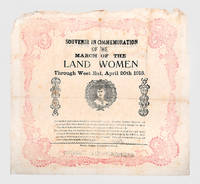
1918170820London: Sarah Burgess 1918. An ephemeral piece of wartime memorabilia A souvenir tissue napkin advertising a parade through London of the Women's Land Army intended to promote the organization and encourage agricultural volunteers. Napkins were commonly printed for large public ceremonies: "the most spectacular napkins were the souvenir issues of Mrs S. Burgess of London who created items for various historical and period events" Florey p. 108. The march was an enormous undertaking consisting of over 200 women and farmers: "the war has afforded many stirring spectacles in the streets but these processions could hardly be excelled for picturesqueness or the appeal they made to national gratitude" The Times p. 4. The focus of the procession was promoting agricultural pursuits; the women were flanked by a myriad farmyard animals hay-balers and tractors. Recruitment speeches were delivered imploring women to support troops abroad by ensuring that industry and agriculture were appropriately maintained at home. "The soldiers are giving their lives for England. All that we ask of you girls is to give one year of your lives in the Land Army in the same noble cause" ibid. Known as "Auntie" in the trade Sarah Burgess operated from premises in Bishopsgate and later off the Strand as here advertising as a "manufacturer of paper switches cut tissues lace paper and shelf trimmings & confetti and stationer wholesale and export" Crawford. The napkin squares were imported into London from Japan already printed with a decorative border in up to five colours and a blank central area. After being printed with the appropriate commemorative design they were sold for about one penny by street traders lining the route of the event. Burgess was particularly involved with producing commemorative napkins for the suffrage movement including for the march to the House of Commons on 29 June 1909 the Suffrage Coronation Demonstration on 17 June 1911 and Emily Wilding Davison's internment in Morpeth on 14 June 1913. However "the WSPU had mixed feelings about Burgess's efforts. Disturbed by her producing an 'unauthorized official programme' for the June 29 event they nevertheless pointed it out as an example of 'how the movement interests the public'. Mrs Burgess's products demonstrated quite clearly how important the concept of a suffrage 'souvenir' or collectible had become to suffrage sympathizers who wanted to retain a tangible memory of a major event that they might have participated in" ibid. Square of plain crepe paper 325 x 360 mm. Central printed illustration depicting a portrait of Queen Mary of Teck set within oak and laurel leaves and flanked by two scrollwork motifs surrounded by decorative floral border printed in red. Some nicks and creases at extremities mostly to top edge gently creased from folding and a couple of small damp stain patches offset from ink lettering; overall a very good and intact example of a fragile product. Elizabeth Crawford "Ephemera: Mrs Sarah Burgess Printer" Woman and Her Sphere blog 12 Sep. 2019 accessible online; Kenneth Florey Women's Suffrage Memorabilia: An Illustrated Historical Study 2013; "Women War Workers. Munition Makers at St. Paul's. Land Army Procession" The Times 22 Apr. 1918. unknown
194543502Recruiting Publicity Bureau United States Army 1945. 1st Edition. Cream paper printed in blue grey and white. Backed in linen with white paper coating to poster side. Fine condition. Broadside. Linen-backed. Large illustration of a woman in a blue WAC uniform carrying a surgical tray. Poster: 37-3/4" x 25-1/4". Backing: 39-1/2" x 27-1/4" <br/><br/>Although the U.S. Army Medical Department was one of the slowest to integrate women when over 5000 of its combat-ready men -- including many trained technicians and orderlies -- were forced to transfer to the Infantry in early 1944 the department began a major push to recruit women to fill the positions. The Female Medical Technician campaign as pictured here was hugely successful despite the high qualifications demanded of applicants many of whom were required to have advanced degrees and at least two years of experience in their fields. WACs also served as laboratory technicians psychiatric social workers medical stenographers and in a variety of other technical and/or skilled medical positions; by the end of the war the Medical Department employed approximately 20000 WACs nearly a fifth of the Corps. Treadwell United States Armies in WWII. Special Studies: The Women's Army Corps The poster reads in full: "Women . . . our wounded need your care! You can help to give it . . . The U.S. Army Medical Department is calling for help -- the help of WOMEN -- needed in Army hospitals to serve as medical technicians surgical technicians and in other important assignments. Assignments also available at Army Air Forces Ground Forces and Service Force Installations. Join a hospital company. For information apply at any U.S. Army Recruiting Station or ask your local Postmaster." Uncommon particularly in this fine of condition. Recruiting Publicity Bureau United States Army unknown books
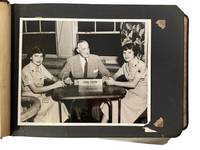
1950231531950. WACKorean War Women's Army Corps photo album compiled by Sgt. Elizabeth Adamek of Cairnbrook PA ca. early to mid 1950s extensively recording enlisted women in post-1948 U.S. Army administrative operations at Camp Zama Japan during the Korean War period. Elizabeth Adamek later Elizabeth Adamek Pierce 1932-2016 served approximately twenty years in the United States Army as an administrative assistant and instructor including service in Japan and the Korean Theater during the Korean War. Adamek is shown several times in uniform with her twin sister Cpl. Cristania Adamek indicating the sisters served in the WAC around the same time period. This album documents postwar U.S. Army overseas base administration showing how clerical labor recordkeeping and office management were carried out by WAC personnel during the Korean War. Images of Hill and fellow servicewomen engaged in office work reveal women's roles in the Army's daily bureaucratic and logistical functions while stationed abroad. A comprehensive primary-source documentation of the operational role of women within permanent peacetime Army structures following the formal establishment of the Women's Army Corps in 1948.<br /> <br /> Photo archive of approximately 240 silver gelatin photographs from Camp Zama Japan and the United States circa early to mid 1950s. The album is housed in a Japanese lacquer-style postbound binding with black paper leaves containing a mixture of small snapshot prints deckle-edge photographs and larger mounted images. The visual content centers on Hill frequently shown in WAC uniform posed in front of barracks administrative buildings and landscaped areas as well as inside office environments seated at desks surrounded by stacked files paperwork and card index systems. Several images explicitly depict clerical workspaces including a servicewoman operating a typewriter beside filing drawers reinforcing the administrative function of WAC personnel. A clearly legible building sign reads "Camp Zama 8030th Army Unit APO 50" situating the album within a specific military unit structure. Additional photographs include formal military reviews with officers and dignitaries group portraits of uniformed women before display walls and social scenes in dining facilities and clubs. Off-duty life is extensively documented through images of Japanese urban streets market stalls rail platforms commercial signage shrine gateways temple architecture zoo enclosures and landscaped gardens alongside recreational scenes such as swimming roadside travel and barracks exteriors collectively illustrating both the operational and social dimensions of overseas Army life. Adamek is posed throughout the album with a romantic partner one Sgt. Kidder whose service at Camp Zama is also documented extensively.<br /> <br /> The album captures the workings of U.S. Army overseas base administration demonstrating the process by which women in the Women's Army Corps sustained military infrastructure through administrative labor. Camp Zama functioned as a major logistical and support installation during the Korean War era and the photographs provide insight into the women that maintained its operations while also recording the social networks and cultural encounters experienced by American service personnel in postwar Japan.<br /> <br /> Elizabeth Adamek Pierce's obituary in The Oklahoman indicates she was honorably discharged from the US Army in 1971 after which she relocated to Oklahoma City and worked in an administrative role with the OKC Police Department. Adamek was a member of the Civil Air Patrol the VFW Post 1335 and a volunteer at Tinker Air Force Base in Oklahoma City. Light edge wear and chipping to album leaves occasional corner wear scattered fading and softness to prints and general handling wear to the binding; overall good condition. A cohesive and well-identified visual record of women's military service in the U.S. Army in East Asia. unknown
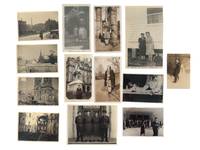
1945214301945. WWII era Women's Army Corps photo archive documenting servicewomen including two African Americansand four partially identified individuals. Creation of the WAC in 1942 marked the first permanent institutional incorporation of women into the U.S. Army placing female personnel into administrative communications intelligence and logistical roles across both domestic bases and overseas commands. One photograph identified on the verso as "Gynnie Polly Corsica '45" provides additional documentation of Black women serving overseas in segregated Army units during the final year of the war.<br /> <br /> Archive of 18 silver gelatin photographs from W.W.II. Photographs measure approximately 3 x 2 inches to 6 x 3.5 inches. The images depict American servicewomen in a range of wartime contexts including official uniform portraits informal snapshots and scenes taken in European cities damaged by combat. Several photographs show women wearing standard WAC dress uniforms with garrison caps and enlisted insignia while others depict personnel wearing British style battledress associated with American administrative units stationed in Europe. One photograph shows three uniformed personnel two women and one man standing at attention before a formal government building likely in Britain. Another image places a uniformed American servicewoman before the gilded equestrian statue of Joan of Arc in Paris a landmark associated with Allied presence in liberated France. Additional photographs depict ruined urban landscapes with bombed churches and collapsed structures suggesting scenes from Germany or France shortly after liberation. A photograph inscribed "Chattanooga Tenn." shows a woman standing in civilian clothing at the entrance of a home indicating a stateside context connected to the servicewoman's life before or after deployment. Another photograph labeled "Ann & Lillie Mother" shows two women standing outside a residence likely relatives of one of the servicewomen. <br /> <br /> Women's military service expanded rapidly during World War II as the War Department created organizations such as the Women's Army Corps and the Navy's WAVES to address labor shortages across the armed forces. Overseas deployments placed WAC personnel in newly liberated European cities and military headquarters throughout the Allied command structure. Light toning minor edge wear and occasional handling marks. Overall very good condition. Although African American women served within segregated units their participation in overseas assignments including Mediterranean theater postings marked a significant shift from earlier military policy which had typically limited Black women's service to domestic assignments within segregated support units. unknown
128p. Profusely illustrated with numerous photographs. Folio. Original worn cloth backed decorated paper boards. **PRICE JUST REDUCED! WWI 10
143p. + Full page photographs. 8vo. Original purple wraps decorated and lettered in gold. Small nick on spine otherwise a very nice copy. PA PAMPH 20_20 BX7
1851361712Leipzig, Wigand, 1851. VI, 311 S., CXXXVI S. Beilagen zu den Memoiren. Modernes Bibliotheksleinen.
British Archaeological Reports (B. A. R. ) British Series 459; 118 pages; The purpose of this book is to put the achievements of Agricolas navy, apparently understated by Tacitus, in their true perspective, with the proposition that the Roman fleet reached the furthest limit of the known world, Thule, or Mainland, Shetland, where it located a convenient anchorage, possibly in Lerwick harbour. To support this theory, firstly the identification of Thule as Shetland during the classical period from the time of Pytheas onwards is investigated through collation of geographical sources, secondly the earliest manuscript of Tacitus Agricola comes under closer scrutiny at the relevant points than ever before, and finally contemporary literature is reassessed to determine the significance of Caledonia and Thule in the Flavian propaganda machine and to suggest the first Roman presence in the Shetland Islands.
1982MI105065Marburg, Elwert, 1982. 24 cm 140, [28] S., Literaturverz. S. 137 - 140, Weitere Produktfotos erhalten Sie gerne auf Nachfrage. Sorgfältiger Versand in sicherer Verpackung. Schneller und zuverlässiger Kundenservice für alle Fragen und Anliegen. (Due to EPR, there is currently no delivery to these EU-countries: BG, CY, CZ, DK, EE, ES, FI, GR, HR, HU, IE, LT, LU, LV, MT, PL, PT, RO, SE, SI, SK).. kart.
199842358München ; Zürich: Diana-Verl., 1998. 351 S. Kt. 8°. Bibl.- Einbd.
199441812München: Ed. Ferenczy bei Bruckmann, 1994. 288 S. 8°. Bibl.- Einbd.
8vo., First Edition, with a coloured frontispiece, a coloured plate and 29 plates in monochrome; original printed wrappers, sewed as issued, a near fine copy. With the errata slip facing p.190. Collects three extended essays: 'The Likeness of Wolfe' (Kerslake), 'The Genealogy of James Wolfe' (Wagner), 'James Wolfe: A Chronology' (Shaw-Zambra). Includes several plates of uniform, pedigrees and comprehensive historical tables. Very scarce.
1996180009Pml 1996 in4. 1996. Broché.
238348Paris, Magimel, 1814 in-8, iv pp., 68 pp., dérelié. Rousseurs.
213827Paris, Baudoin et Cie, 1890 in-8, XVI-342 pp., broché.
1983R300262521SED4. 1983. In-8. Relié. Bon état, Couv. convenable, Dos satisfaisant, Intérieur frais. Paris, SED4, 1983, in 8 oblong, reliure éditeur, photos, 93 pp.. . . . Classification Dewey : 359-Marine militaire