Garret CharlesLivre Rare Book

30 332 résultats
199814809Addim 1998 2x23x16cm. 1998. Broché. Cet ouvrage de Charles Garret propose une synthèse des conflits menés par la France entre 1870 et 1962 en cherchant à comprendre les raisons des défaites et des errements nationaux. L'auteur met en lumière la part de responsabilité du caractère français jugé léger et suffisant par les étrangers et dresse un tableau destiné à éviter la répétition des mêmes drames
Madrid, P. Abienzo, 1872, 20 x 13,5 cm., bella encuadernación en marroquín rojo, con filetes, hilos dorados y adornos gofrados, lomo cuajado, cortes, cantos y contracantos dorados y guardas en seda , dedicatoria manuscrita del autor al General, historiador y Ministro de la Guerra D. Fernando Fernández de Córdoba, 506 págs. + 1 hoja blanca + 3 láminas y un croquis plegado de la batalla de Sedan en colores.
19143039100Bonn, Marcus & Weber, 1914. 318 S. Lwd.
197111958[Bonn] : Bundesregierung d. Bundesrepublik Deutschland, [1971]. 203, XVI, [160] S. : zahlr. Ill. (z. T. farb.), graph. Darst. 8°. OBroschur.
19972082702114603182Seishiosha fixed price 11000 yen 1997. Soft Cover. Fine. Number of books: 1 Seishiosha fixed price 11000 yen paperback
18972415Berlin, Ernst Siegfried Mittler und Sohn, 1897. Format 15 x 21 cm. Geprägtes rotes Leinen mit goldener Rückenbeschriftung und Deckelabbildungen. Ecken und Kanten etwas berieben und bestoßen. Bindung und Block fest. Seiten sauber und frisch. Drei-Seiten-Pfauenschnitt. Gutes Exemplar. 1282 Seiten. 1. Auflage. Leinen.
194573287Milan Italy: United States Fifth Army 1945. Presumed First Edition First printing. Wraps. Good. 2 90 4 pages. Illustrations. Maps. Cover has some wear tears chips and soiling. Color endpaper maps. Other illustrations in color. This was printed by Pizzi and Pizio in 1945 in Milan Italy. The Allies invaded mainland Italy in early September 1943 expecting a quick drive north through the Italian peninsula into the "soft underbelly" of Europe and on to the German heartland. Nineteen months later in March 1945 after hard fighting against the Gustav Line in the rugged mountainous spine of Southern Italy the landing at Anzio their advance up the Liri valley to capture Rome and more mountain fighting in the North Apennines the Allies were still south of the Po Valley and the Alps. On 14 April 1945 Truscott's Fifth Army ground attack began. They seized the Pra del Bianco basin and Reno River valley after intense fighting and pushed northward from ridgeline to ridgeline and from valley town to valley town with steady progress. American firepower superiority and aggressive infantry attacks slowly pushed back the Germans. Intense bombing was renewed on 17 April. By nightfall only a rapidly disintegrating Axis force and about thirty miles of relatively flat terrain stood between the IV Corps and the Po River. In the face of superior forces the Germans had little chance of containing the emerging American breakthrough. By 18-19 April the American advance accelerated. As Axis defenses cracked the bulk of the Fifth Army passed west of Bologna and units were repositioned for the final push out of the Apennines. What is now called U.S. Army-North started life as the Fifth Army on 1 December 1942 in Oujda French Morocco. Originally constituted of Army units that participated in Operation TORCH the invasion of North Africa it was the first of the seven field armies the United States organized during World War II. On 12 December 1942 the new Fifth Army was assigned to the the multi-national Allied Force North Africa and Lieutenant General Mark W. Clark wad designated its commanding general. At General Clark's direction at one minute after midnight Zulu Time 5 January 1943 the Fifth Army became an active unit. The Fifth Army's primary mission was to prepare itself for the amphibious invasion of Italy. On 9 September 1943 Fifth Army landed an invasion force on a 20-mile stretch of beach south of Salerno Italy becoming the first American force to invade mainland Europe. At the time of the invasion Fifth Army included the British X Corps and the U.S. 36th 45th and 82nd Divisions. With the objective of capturing Rome Fifth Army pushed northward from Salerno through Naples to the German line anchored on the town of Cassino. The French Expeditionary Corps including Moroccan and Algerian divisions joined Fifth Army doubling its strength. After four costly assaults known as the Battles of Monte Cassino the Fifth Army continued onward toward Rome linking up on the way with other Fifth Army units that had fought their way out of the coastal town of Anzio. Fifth Army entered Rome on 4 June 1944 becoming the first allied force to liberate a European capitol from Fascist control. Germans and Fascist Italians retreated north turning and holding their ground at the Arno River. The pursuing Fifth Army reached the Arno on 18 July and finally crossed it on 2 September. Now into their second winter in Italy the Fifth army got a new commander. Lieutenant General Lucian K. Truscott Jr. became Fifth Army's commanding general on 16 December 1944 and served in that position to the end of the war. By this time Fifth Army had become a truly multi-ethnic command. Besides the Brazilians there were British and French units whose members including New Zealanders Canadians Indians Gurkhas Jews and Arabs from the British Mandate in Palestine South Africans Rhodesians Moroccans Algerians and Sub-Saharan Africans. In smaller units were exiled forces from Poland Greece Czechoslovakia and anti-fascist Italians. From the United States itself came the segregated 92d "Buffalo" Division and the Japanese-American 442d Regimental Combat Team. General Truscott led this multi-national Fifth Army out's of its winter deadlock across the Italian Apennines and across the Po River valley. By the end of April Fifth Army had reached the foothills of the Alps and had captured the cities of Bologna Vicenza and Verona. On 29 April American and British units entered Venice and German representatives started negotiations for surrender. The battle for Italy came to an end on 2 May 1945 with the unconditional surrender of the German forces in Italy and the linkup between the Fifth Army and Seventh Army in the Brenner Pass. From 9 September 1943 to 2 May 1945 Fifth Army endured 602 days of steady battlefield combat. This fighting resulted in 188546 casualties among the 27 divisions and 7 corps that composed the Fifth Army. Fifth Army tied down at least 16 of Hitler's divisions and took 212112 of his men prisoner. The Fifth Army's units were assigned away and the Headquarters became non-operational on 9 September - two years to the day after the landing at Salerno. United States Fifth Army paperback
Fine Turkish Paperback. Demy 8vo. (21 x 14 cm). In Turkish. 296 p. 19. yüzyil baslarinda Avrupa dengesi ve Nizam-i Cedid ordusu. European diplomacy in the early 19th century and Turkish Nizam-i Cedid army. The Nizam-i Cedid Army refers to the new military establishment of the Nizam-i Cedid reform program. The Nizam-i Cedid army was largely a failure in its own time, but proved to be a much more effective infantry force than the Janissaries. After losing the Russo-Turkish War of 1787-92 in 1792 to Austria and Russia, Selim III concluded that Ottoman military was in serious need of reform if the empire was to survive. As a result, he began implementing a series of reforms aimed at reorganizing the military after the fashion of European militaries. This included the usage of European training tactics, weapons, and even officers. These reforms troubled the Janissaries, who were suspicious and unreceptive towards the reforms. To this end, Selim III created the Nizam-i Djedid in 1797 in order to develop a replacement for the Janissaries. By 1806 this new army stood 26,000 men strong, equipped with a French-style uniforms, European weapons, and a modern artillery corps. Due to their distinctly modern nature, the army was named Nizam-i-Cedid, which has the meaning, in Turkish, of 'New Order.'
19002417Berlin, Ernst Siegfried Mittler und Sohn, 1900. Format 15 x 21 cm. Geprägtes rotes Leinen mit goldener Rückenbeschriftung und Deckelabbildungen. Ecken und Kanten berieben und bestoßen. Bindung und Block fest. Seiten sauber und frisch. Besitzerstempel auf Vorsatz. Drei-Seiten-Pfauenschnitt. Längsseite mit Querstrich. Ca. 30 kurze rote Markierungsstriche unter Regimentsnamen. Sonst gutes Exemplar. 1368 Seiten. 1. Auflage. Leinen.
1912289870Washington: Government Printing Office 1912. Soft Cover. Very Good binding. With an intriguing folding diagram depicting the total strength of army war footing peace footing and data on the population and soldiers per capita of the Central and Allied Powers. Gray printed paperback in Very Good condition. Not found on OCLC. Very Good binding. Government Printing Office unknown books
19741082201974 Editions Stock, Presses de la Cité - Collection "Les Grandes Batailles" - 1974 - In-4, cartonnage toilé rouge sous jaquette illustrée en couleurs de l'éditeur - 232 p. - Très riche iconographie in, hors-texte et pleine page en couleurs et en N&B
1969xf367Esprit et Tradition Broché 1969 In-4 (22 x 28 cm), broché, 260 pages ; quelques frottements aux mors et bords des plats, pliures aux plats en queue, quelques traces au quatrième plat, par ailleurs intérieur frais, assez bon état général. Livraison a domicile (La Poste) ou en Mondial Relay sur simple demande.
56623Larousse poche. Sans date. broché.
n.p. Numerous photographs with text printed in English, French, Italian and Spanish. Slight old staining. Oblong 8vo. Original full printed wraps. Small loss to top of front and back wraps. Very scarce. **PRICE JUST REDUCED! WWI 12
258591Darmstadt, Theiss Verlag, 2016.
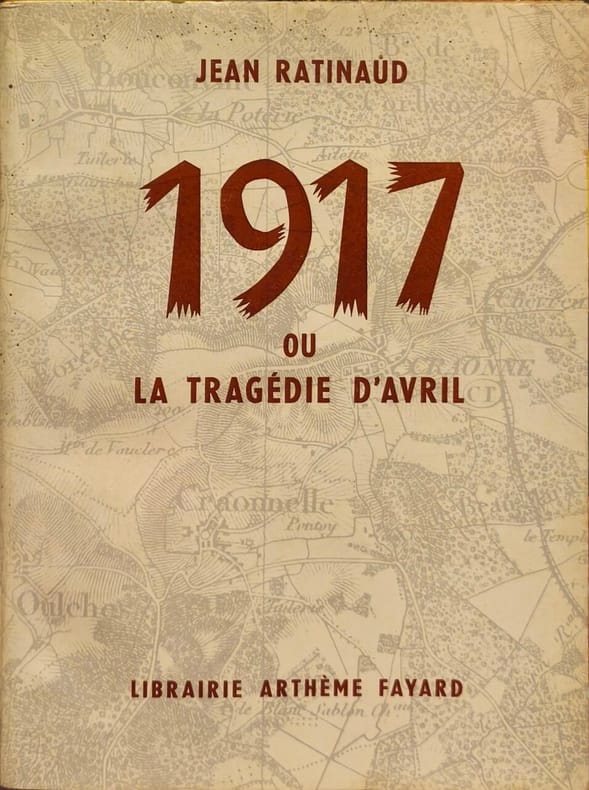
19604115Librairie Arthème Fayard 1960 318 pages in8. 1960. broché. 318 pages. Ce livre de Jean Ratinaud publié en 1960 analyse l'année cruciale de 1917 pendant la Première Guerre mondiale en se concentrant particulièrement sur la crise d'avril. L'auteur examine la dégradation matérielle et morale de l'armée française à cette période et les changements au Haut Commandement notamment le remplacement du général Nivelle par Pétain
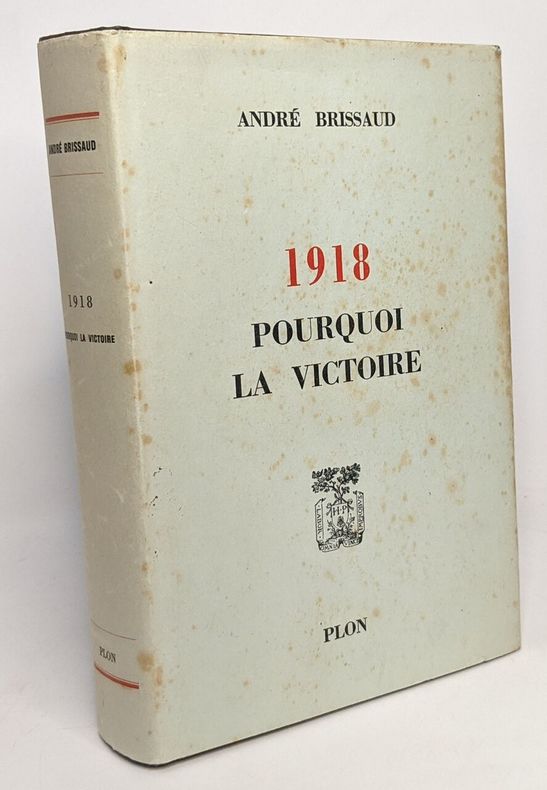
1968100063140Plon 1968 in8. 1968. Cartonné.
197810334Swan Verlag, Kehl, 1978. 159 Seiten, 30 x 22 cm (HxB), OLeinen m. OU, Einführung von Andre Kaspi. Durchgehend mit s/w-Abbildungen. Gutes Exemplar. NaV. Good copy.
4to., First and Sole Edition, with a mounted coloured plate, 2 sepia-toned plates, and very numerous illustrations, cartoons and plans (several full-page) in the text; original wrappers printed in red and black, additional colour plate mounted in frame on front wrapper, wire-stitched as issued, yapped edges, extremities lightly dust-soiled else a very good, clean copy. The 38th (Welsh) Division served with great distinction on the Western Front throughout WWI. Major engagements included Albert, Pilckem, Langemarck, Bapaume, Havrincourt and Cambrai (where the division captured Villers-Outreaux). The four plates (by Capt. A. St. John MacCall RBA) depict 'Rue Sadi Carnot, Armentieres', 'Albert, August 1918', 'St. Remy, Dieppe' and 'Street in Dieppe'. Essentially a collection of reminiscences, light-hearted anecdotes and articles, cartoons and poems (including a few in Welsh). A rare survival, especially in this condition.
2016100150902LES BELLES LETTRES 2016 384 pages in8. 2016. Broché. 384 pages. Le journaliste Nicolas Mingasson a recueilli pendant deux ans les témoignages de proches (conjointes mères pères enfants) de soldats français morts en Afghanistan. Le livre aborde avec pudeur et force le deuil de guerre au XXIe siècle donnant la parole à ceux qui restent
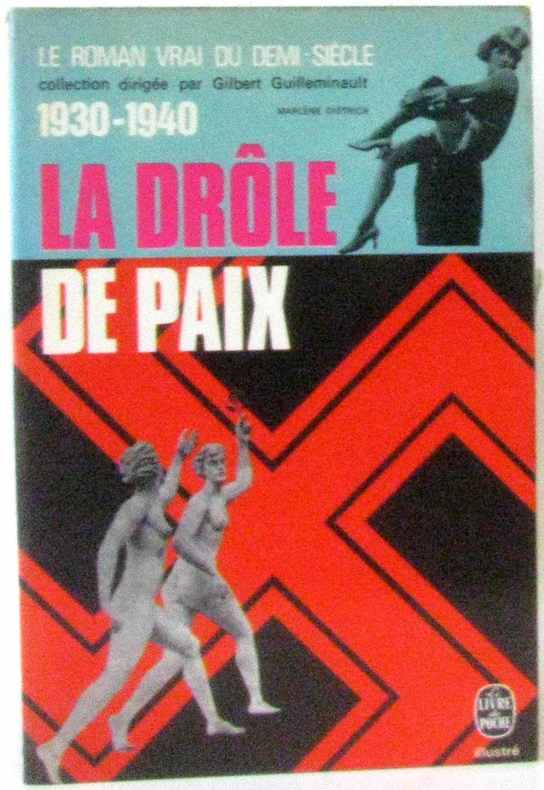
1969232957Le livre de poche 1969 415 pages in12. 1969. Poche - Broché. 415 pages. illustrations noir et blanc in et hors texte
1978756363PN. New. 1978. Soft Cover. Date is original print. This is a reprint edition. . PN paperback
1979759408PN. New. 1979. Soft Cover. Date is original print. This is a reprint edition. . PN paperback
1979759790PN. New. 1979. Soft Cover. Date is original print. This is a reprint edition. . PN paperback
1979759623PN. New. 1979. Soft Cover. Date is original print. This is a reprint edition. . PN paperback