Women's Army CorpsBiblio.com
30 333 résultats
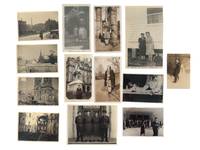
1945214301945. WWII era Women's Army Corps photo archive documenting servicewomen including two African Americansand four partially identified individuals. Creation of the WAC in 1942 marked the first permanent institutional incorporation of women into the U.S. Army placing female personnel into administrative communications intelligence and logistical roles across both domestic bases and overseas commands. One photograph identified on the verso as "Gynnie Polly Corsica '45" provides additional documentation of Black women serving overseas in segregated Army units during the final year of the war.<br /> <br /> Archive of 18 silver gelatin photographs from W.W.II. Photographs measure approximately 3 x 2 inches to 6 x 3.5 inches. The images depict American servicewomen in a range of wartime contexts including official uniform portraits informal snapshots and scenes taken in European cities damaged by combat. Several photographs show women wearing standard WAC dress uniforms with garrison caps and enlisted insignia while others depict personnel wearing British style battledress associated with American administrative units stationed in Europe. One photograph shows three uniformed personnel two women and one man standing at attention before a formal government building likely in Britain. Another image places a uniformed American servicewoman before the gilded equestrian statue of Joan of Arc in Paris a landmark associated with Allied presence in liberated France. Additional photographs depict ruined urban landscapes with bombed churches and collapsed structures suggesting scenes from Germany or France shortly after liberation. A photograph inscribed "Chattanooga Tenn." shows a woman standing in civilian clothing at the entrance of a home indicating a stateside context connected to the servicewoman's life before or after deployment. Another photograph labeled "Ann & Lillie Mother" shows two women standing outside a residence likely relatives of one of the servicewomen. <br /> <br /> Women's military service expanded rapidly during World War II as the War Department created organizations such as the Women's Army Corps and the Navy's WAVES to address labor shortages across the armed forces. Overseas deployments placed WAC personnel in newly liberated European cities and military headquarters throughout the Allied command structure. Light toning minor edge wear and occasional handling marks. Overall very good condition. Although African American women served within segregated units their participation in overseas assignments including Mediterranean theater postings marked a significant shift from earlier military policy which had typically limited Black women's service to domestic assignments within segregated support units. unknown
200868570np.: Periscope Film 2008. 1st ed. thus. As New. lge. octavo. stiff wrappers c.250pp. b/w pls. text ills. Facsimile edition of the 1943 edition Periscope Film unknown
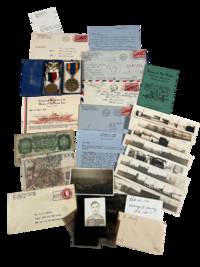
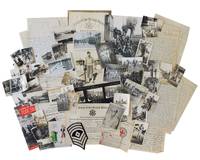
1945229161945. WWII Lt. Colonel Henry L. Hively U.S. Army Air Forces correspondence and war archive 1945 comprising medals letters documents photographs negatives and ephemera including Panama Canal Zone tourist booklet wartime train-journey photo strips through France namely Grenoble and Valence aerial transport photographs and extensive emotional correspondence from Oakland and San Francisco at the end of World War II. Archive includes 4 letters 5 envelopes two foreign currency bills a Panama tour guide a donation certificate six medals and ribbons and over 30 very small photographs. This substantial personal archive documents the long U.S. Army career of Lt. Colonel Henry L. Hively 1915-2010 beginning with his formative early-career service tied to the U.S. Army's border militarization and expeditionary presence in Mexico during the opening decades of the twentieth century when American forces pursued Pancho Villa and asserted federal authority along the U.S.-Mexico border. That experience-rooted in mobile warfare logistics and hemispheric military infrastructure-prefigures the global operational networks that would later define American power during World War II. Hively's career thus bridges early twentieth-century expeditionary service in Mexico with his later World War II service across the European and Pacific theaters and the immediate postwar demobilization period.<br /> The archive is anchored by an extraordinary run of intimate 1945 letters from Hively's girlfriend Mrs. Dorothy "Dottie" Rishel a civilian hospital worker at Green's Eye Hospital in San Francisco and later Oakland. Her correspondence chronicles daily life wartime anxiety women's labor Bay Area domestic arrangements and-most critically-the immediate civilian reaction to the atomic bomb and the end of the war. On August 10 1945 Rishel wrote: "I'm so confused over the state of affairs regarding the war and probable termination of it I don't know what to say. Without reservation Hank what's your personal opinion of this atomic bomb Its destructive power absolutely floors me." Only one day later as news of Japan's surrender became imminent she added "Allow me to say 'Happy V-J Day to you.' The war will absolutely be over tomorrow so the radio says. Golly I'm so thrilled I can't even concentrate on anything." These letters provide rare real-time reactions from a young working woman confronting the moral and emotional consequences of nuclear warfare.<br /> <br /> Materially the archive includes Hively's medals-among them a boxed Army of Occupation Medal ribbon bars and a boxed U.S. Air Medal-alongside his wartime photographic portrait labeled "Henry L. Hively 2nd Lt. Sig C." The photographic material consists of mostly very small vernacular silver-gelatin prints about 1' x 1" in rows of about 5 with a few larger images and a few negatives. several stamped on the verso "March 1945" showing Hively with other U.S. soldiers during the final months of the war including soldiers disembarking from U.S. Army aircraft traveling by rail through Europe gathering around Army jeeps and socializing outdoors. One image records a street-level view of a building in Grenoble France situating the archive geographically within southeastern France during the Allied occupation period. Additional prints show European landscapes rivers military encampments and aircraft on runways. Also present is the USO pamphlet Panama in Your Pocket: What to Do Where to Go While on the Isthmus reflecting the Pacific transit network anchored by the Canal Zone alongside foreign currency from France and England and photographic negatives documenting off-duty military life. A later handwritten note identifying "Ret Lt. Col. Henry L. Hively 1915-2010 - 94 yrs old" aligns with his published obituary confirming his long military career and postwar administrative service. The correspondence between Hively and Rishel forms the emotional core of the archive documenting female wartime labor emotional resilience and the uncertainty of demobilization. Rishel's account-"The work here in the hospital is absolutely fascinating. this hospital has been doing an awful lot of experimental work on cornea transplantation"-captures women's medical labor during WWII while her September 21 1945 letter reflects anxiety surrounding separation and discharge: "they have decided to send all eligible officers to their separation centers sometime in the next two months." Together these materials articulate the psychological and social transition from global war to fragile peace. Letters well preserved and legible with expected toning and folds; envelopes present with postmarks and Army Postal Service stamps. Photographs and negatives crisp some very good and a few over exposed. Medals well kept in original boxes with ribbons and devices. Overall very good condition. unknown
0981652697.Gperfect. Good. Access codes and supplements are not guaranteed with used items. May be an ex-library book. unknown
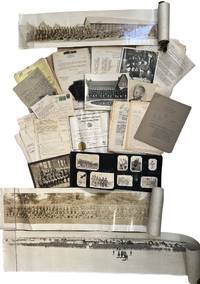
1917190211917. WWINational GuardWWII Primary-source archive documenting U.S. Army transportation command operations supporting Allied logistics following the Normandy landings centered on the development of Cherbourg as a critical supply hub. Assembled from the career of Lieutenant Colonel George C. Sullivan the collection spans World War I mobilization through World War II and into postwar reserve service with particular emphasis on mid-twentieth-century military infrastructure and coordination. The archive comprises hundreds of pages of official documents correspondence and service records alongside a substantial photographic component including large-format panoramic rolls depicting assembled training formations and unit organization at scale. Together the materials provide detailed evidence of the administrative and logistical systems that sustained Allied operations in Europe situating individual service within broader frameworks of wartime transportation supply distribution and postwar military restructuring.<br /> <br /> Archive comprises hundreds of pages of military documents dated primarily from the 1940s through the 1950s; three panoramic photographic rolls from World War I service; one photograph album containing 83 photographs from 1917-1918; four loose photographs; and three letters dated 1945-1948. The World War I album depicts training at Fort Sill Oklahoma mounted artillery drills including a three-inch field gun mounted cavalry movement across desert terrain doughboy uniformed infantry and a Peace Parade in Lawton Oklahoma in November 1918. Sullivan's own written service summary records his federal call-up transfers promotion to corporal commissioning and discharge in December 1918. The panoramic rolls measuring approximately 44 to 56 inches in length show large assembled formations at Camp Cody New Mexico and officer training at Camp Taylor Kentucky including the 25th Battery Central Officers Training School. World War II and postwar materials include commendations transfer requests rosters promotion records certificates and administrative correspondence. A 1949 silver gelatin photograph of Headquarters Company 371st Support Group summer training personnel includes a roster naming forty-eight officers among them First Lieutenant Catherine M. Henry documenting the integration of women officers in postwar reserve structures.<br /> <br /> Sullivan's World War II documentation centers on transportation command responsibilities essential to sustaining Allied operations in Normandy and the rapid development of Cherbourg as a logistical hub following D-Day. The archive traces the evolution of the United States Army from early twentieth-century National Guard mobilization to logistics work in World War II. Postwar papers reflect Sullivan's continued reserve duty into the mid-1950s and his civilian engagement in the sale of military surplus goods in Seattle Washington illustrating the reintegration of career officers into postwar commercial life. Documents generally clean and legible with occasional edge wear; panoramic photographs show some cracking but remain intact; photograph album well preserved; loose photographs with light handling wear. Overall very good condition. Extensive archive chronicling four decades of a United States Army officer's career. unknown
8vo., with numerous photographs and illustrations throughout; pictorial boards, a fine copy.
198114016Hoffmann und Campe Verlag, Hamburg, 1981. 79 Seiten, OLeinen m. OU, vom Autor datiert, gewidmet und signiert. ("Für Horst Bienek / Sehr herzlich / Ihr / Walter Helmut Fritz / 25.10.81"). Minimale Randeinrisse am Umschlag, Braunflecken am oberen Rand des Einbandes. Ein gutes Exemplar. Selten. Very rare. Good copy, signed by the author. Das Buch stammt aus der Bibliothek eines Autographensammlers. Horst Bienek (Schriftsteller, 1930-1990).
1962031907Fort Benning GA: U.S. Army Infantry School 1962. Paper Back. Very Good/No Jacket. 4to - over 9¾" - 12" tall. 99pp.; SC staple-bound w/5-holes&no title on spine; blue w/blk.; slight rub w/sun on edges; cleantight pgs. "This handbook covers the principles of clear logical effective writing. It contains specific information on how to apply these principles to the type of writing required in the preparation of staff papers and an aritlcle for publication." bttm.last pg.reads: "34606 Army-Ft.Benning Ga. 9 Jul 62 5500" rare. <br/> <br/> U.S. Army Infantry School unknown
199860685Gräfelfing : Resch 1998. 302 S. ; 22 cm Pp., gebundene Ausgabe, Hardcover/Pappeinband +++ auf Titelseite ein Buchhandelwerbung über dieses Buch eingeklebt und seitlich mit Rotstift markiert ++++ sonst Exemplar in gutem Erhaltungszustand
1997140639Gräfelfing : Resch, 1997. 302 S. ; 22 cm; gebunden, illustrierter Orig.-Pappband;
196814101Piper Verlag, München, 1968. 201(1) Seiten, OBroschur, signiert, gewidmet. ("Für Sebastian Haffner Hilde Domin Sept. 69"). Reihe: piper paperback. Das Papier an den Rändern etwas gegilbt. Gutes Exemplar. 6.-8. Tausend. Selten. Rare. Good copy, signed by the author. Das Buch stammt aus der Bibliothek eines Autographensammlers. Sebastian Haffner (bürgerlich: Raimund Pretzel; * 27.12.1907 in Berlin; 2.1.1999 ebenda) war ein deutsch-britischer Journalist, Publizist und Schriftsteller..
Faint foxing to top of textblock else book is fine. Very light shelfwear to DJ. Dustjacket is protected in mylar. ; W. H. Friedrich's "Verwundung und Tod in Der Ilias", originally published in 1956, discusses in detail the plausibility (or otherwise) of the wounds received on the Homeric battlefield and is therefore of considerable interest to historians of medicine. It also makes a serious and sustained effort to grapple with the question of style, and thus confronts an issue which oral theory has scarcely touched. Peter Jones adds a preface briefly locating the work within the terms of oral theory. A medical analyses in a full appendix is also added. ; 192 pages
1993264075PN. New. 1993. Soft Cover. Date is original print. This is a reprint edition . PN paperback
1976470766London: Macdonald and Jane's. 1976. 264;; Quer. 27,5x22cm. Zustand: Gut bis Sehr Gut min. bis gering gebräunt (Innen); Minischildchen (2x1cm) auf dem Vorsatzblatt, läßt sich wohl entfernen, mir gelang das einmal; Einband (Außen) hat geringe Gebrauchsspuren; Schutzumschlag hat Mängel - gemeint ist hier mehr als leichte Gebrauchsspuren; Ppbd.
199425995Santa Fe, New Mexico : Bear, 1994. XXXVI, 609 pp. Gr. 8°. Orig. half cloth with gold-printing, without DJ.
197792218Time-Life Books, 1977. 29 cm ; Pp.
Folio, with photographic title-spread, photographs and charts throughout, and diagrammatic endpapers; olive cloth, backstrip lettered in black, a fine copy in unclipped dustwrapper. Revised version of the original edition of 1984. VERY SCARCE.
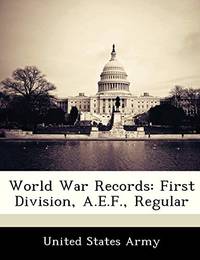
1919008941Washington D.C.: War Department Government Printing Office 1919. 437 pages with over 100 maps many fold-out photographs charts tables and plans. Near Fine cloth a bit dulled bottom edge of rear cover with paint smudges. With RARE errata slip laid in. Uncommon in such lovely collectible condition. . First Edition. Embossed Cloth. Near Fine/No Jacket As Issued. 8vo - over 7¾" - 9¾" tall. War Department, Government Printing Office Hardcover books
194312163Harrisburg PA: Army Air Forces Intelligence School 1943. Very good. Quarto unpaginated about 100pp. illustrated with 83 original tipped-in photographs and an envelope containing 13 more loose and unidentified images laid-in. Housed in the original cardstock clasped folder. Many of the pages have a bottom fold which does not fully open without the potential to tear though all of the contents can be read with some effort. Some pages a touch foxed and a few prints are loosened from their pages and laid-in in the right place. Overall in very good condition. A well-organized and illustrated military textbook for a wartime class on aircraft identification which was probably taught in many places but organized at the US Army Air Force base in Harrisburg. An introductory sheet in perfect bureaucratic fashion placed near the end of this textbook states: "The course in Aircraft Identification consists of ten hours spaced over a period of six weeks." It goes on to list a series of 42 aircraft--American German Italian French and Japanese--which will be easily identified by all successful students by the end of the course. <br /> <br /> The first few dozen pages consist of detailed folding charts with data on dimensions payloads etc. Another section of about 12pp. gives a background on various best practices when trying to identify aircraft as well as some of the principles behind the course. <br /> <br /> The course utilized the "WEFT" system wings engine fuselage tail to help individuals soldiers intelligence agents etc. identify planes in the field from various angles at different heights and in certain contexts. Most of the pages dedicated to individual planes contain two photographs from different angles and with different shading trying to mimic real battlefield conditions under which someone might try to identify an aircraft.<br /> <br /> An unusually engaging wartime military textbook appealing to photography aviation and military collectors alike. Not located in OCLC thus notably absent in the holdings of the Army War College Library which retains most technical manuals and course books. Army Air Forces Intelligence School unknown
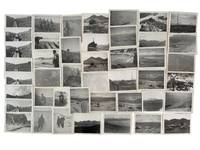
1945215781945. AArchive of 64 original black-and-white photographs documenting American military operations and engineering activities in the Aleutian Islands during World War II. Photographs measure approximately 4.5" x 3.5" and provide an extensive visual record of one of the most remote and environmentally challenging theaters of the war. The images chronicle the daily work of U.S. Army personnel and Army Engineers stationed across the Aleutian chain where military forces confronted not only the threat of enemy action but also some of the harshest conditions faced by American troops anywhere during the conflict. Soldiers appear throughout the archive wearing cold-weather gear field jackets heavy boots and M1 steel helmets while working patrolling and constructing infrastructure amid windswept volcanic landscapes.<br /> <br /> A significant portion of the collection documents the enormous logistical effort required to sustain military operations in the islands. Engineers are shown surveying terrain operating equipment cutting and processing timber and building facilities essential to maintaining isolated military outposts. Several striking photographs depict large timber-log chutes descending steep hillsides toward the shoreline apparently designed to move heavy equipment and supplies through terrain where conventional transportation proved difficult. Other images record lumber operations construction projects and the continual adaptation of military infrastructure to the rugged environment. The archive also contains numerous panoramic views of the Aleutian landscape itself. Snow-covered mountains barren volcanic ridges isolated coastlines glacial valleys and treeless tundra dominate many photographs illustrating why the campaign became as much a battle against geography and weather as against enemy forces. The Aleutian chain stretching deep into the North Pacific and containing dozens of active and dormant volcanoes represented one of the most isolated regions under American military control during the war.<br /> <br /> Naval and maritime operations are likewise represented. Several photographs show transport and supply vessels anchored offshore or approaching remote coastal installations highlighting the dependence of Aleutian bases upon sea-borne logistics. Military camps consisting of Quonset huts and tent encampments appear throughout the collection while one particularly notable image captures an aircraft flying above a military installation underscoring the importance of aerial reconnaissance and patrol operations in protecting the northern approaches to Alaska. Although often overshadowed by campaigns in Europe and the Central Pacific the Aleutian campaign held considerable strategic importance. Following the Japanese occupation of Attu and Kiska in 1942 American forces undertook a costly effort to secure the islands and maintain control of the northern Pacific. These photographs document the infrastructure manpower and determination required to operate in a theater where extreme weather isolation and difficult terrain shaped every aspect of military life. A substantial and visually compelling archive documenting the engineering logistical and environmental realities of America's northernmost front during World War II. Photographs remain in very good condition with minor surface wear and occasional light creasing. unknown
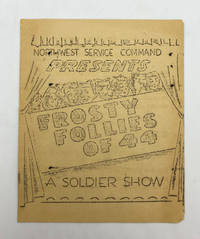
19447828no place given possibly Fairbanks AK: Northwest Service Command US Army 1944. First Edition. Folded sheet. Very good. Square quarto. 4pp. Folded handbill measuring about 6.5" x 8" 16.5cm x 20cm when folded. In very good condition with an inch-long closed tear at the spine and gentle creasing to extremities. Rare ephemeral document from the wilds of Alaska and Western Canada during World War II. US servicemen in the Army Corps of Engineers along with their Canadian counterparts were enlisted to construct a highway between the Yukon Territory and Fairbanks Alaska in the event of military engagements in Alaska during World War II. This handbill is an excellent primary source which documents how they spent their time outside of their daily work. The "Frosty Follies of 44" was a kind of revue featuring soldiers from the outfit along with some "USO girls." Included on the rear wrap are the full lyrics to "Song of the Highway" which must have been a kind of anthem for those constructing the thing. Highly ephemeral; we note no holdings in OCLC and presume it to be a lone survivor. Great piece of World War II Alaskiana. [Northwest Service Command, US Army] unknown
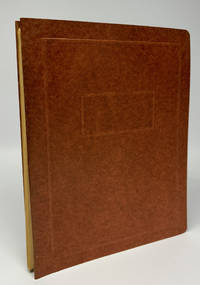
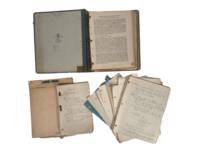
1945193511945. Witmer Richard L. Caribbean Coastal Artillery officer training archive circa 1940s documents the instructional framework and operational doctrine taught to U.S. Army Coast Artillery officers during World War II with particular emphasis on antiaircraft defense chemical warfare preparedness and logistical coordination in domestic coastal defense. This archive belonged to Captain Richard L. Witmer of York Pennsylvania an officer in the 87th Regiment of the Caribbean Coastal Artillery Command of the US Army during WWII. Its contents include 385 printed and manuscripts pages of notes lessons assignments and documents primarily from Witmer's education in officer academy.Witmer served as an officer in the 87th Regiment of the Caribbean Coastal Artillery Command a unit tasked with protecting Gulf Coast installations against aerial and maritime threats during a period of heightened concern over Axis attack on the continental United States. His notes record formalized military instruction alongside personal synthesis of tactical principles including his definition of tactics as the "Science of placing weapon so as to carry out mission" and his articulation of defensive priorities such as "Make provision to guard against a surprise" and "Take advantage of terrain for all round defense." The archive includes detailed engagement with antiaircraft gunnery where Witmer identifies primary targets as "Bombers Observation planes" and emphasizes the need for "continuous instantaneous and accurate data" and "volume of fire" demonstrating the technical and strategic demands placed on officers responsible for air defense.<br /> <br /> Witmer Richard L. Caribbean Coastal Artillery officer training archive. United States: U.S. Army Coast Artillery Corps circa 1940s. Archive comprises approximately 385 pages of manuscript and typed material primarily organized within a ring binder accompanied by three small notebooks and approximately fifteen loose leaves. Contents include notes instructional outlines assignments and technical summaries covering antiaircraft artillery ordnance ballistics supply systems transportation logistics and mess operations. Numerous pages feature hand-drawn diagrams graphs and marginal annotations. Sections devoted to weapons systems describe characteristics of artillery including "40 mm - Easily operated" "37 mm - Accurate fire" "50 cal - Rugged" and "30 cal - Simple & Rapid Min. of men." Additional material addresses chemical warfare including references to mustard gas and Lewisite with Witmer posing operational questions such as "Would the combat efficiency of my men remain high in the event of chemical attack" A formal evaluation included in the archive notes his promotion stating that he "has demonstrated outstanding ability and fitness for promotion by performing the duties of a gun battery officer" citing his leadership of an antiaircraft range section.<br /> <br /> Produced during the expansion of U.S. defensive infrastructure in World War II this archive aligns with the strategic role of the Coast Artillery Corps in safeguarding domestic installations prior to the consolidation of air defense under later Cold War military structures. The detailed instructional content reflects the Army's investment in technical specialization particularly in response to the increasing threat of aerial warfare and the lingering memory of chemical weapons deployment in World War I. Witmer's materials preserve the pedagogical methods used to train officers in integrated defense systems combining mechanical knowledge tactical planning and command responsibility. The subsequent dissolution of the Coast Artillery Corps in 1950 underscores the transitional nature of this material within the evolution of U.S. military organization. Light wear to covers with minor fading internal pages well preserved and legible with occasional handling wear; overall very good condition. unknown
1944185601944. WWIIPhilippine Occupation Harwell Lee W. World War II military archive 1941-1945 recording the service of a North Carolina enlisted artilleryman from prewar mobilization through the American occupation of the Philippines following Japan's surrender. Harwell born in 1918 in Mooresville North Carolina enlisted in April 1941 and trained at Fort Bragg Camp Blanding Camp Shelby and Fort Sill before deployment overseas in August 1944 with the 694th Field Artillery Battalion. His unit participated in operations in New Guinea and the Philippines during the final year of the Pacific campaign. The archive's most historically concentrated materials consist of five letters written in September 1945 from Luzon where Harwell was assigned to guard Japanese prisoners of war north of Baguio in the immediate aftermath of surrender. These letters describe the logistics and atmosphere of POW stockades the movement of captured Japanese naval personnel civilian hostility toward prisoners in recently liberated areas and the conditions of sick and wounded detainees. Writing to his fiancée Louise Harwell records the daily realities of occupation duty including the presence of hundreds of prisoners under armed guard and the tensions surrounding their confinement. A sixth letter was written aboard the U.S.S. General Mitchell as he returned home closing the wartime sequence.<br /> <br /> Archive is comprised of approximately 150 photographs of varying sizes; six autograph letters totaling seventeen pages; and assorted military documents and ephemera 1941-circa 1946. Photographs depict stateside training camps in North Carolina Florida Mississippi and Oklahoma; artillery training operations; camp life; fellow enlisted men; scenes in New Guinea and the Philippines; images of indigenous civilians in the Pacific theater; and a substantial grouping of family photographs likely dating to Harwell's postwar life. Letters retain original folds and were written in ink to his fiancée. Ephemera include military paperwork a shoulder patch a Fort Sill pamphlet an American Red Cross pamphlet and related service materials. Many photographs were removed from a disbound album some trimmed with occasional captions on the verso or on surviving album fragments affixed to images.<br /> <br /> The letters from September 1945 are contemporaneous accounts of the transition from active combat to custodial and occupation responsibilities in the Pacific. Harwell describes passing large groups of surrendered Japanese personnel under military police supervision guarding stockades housing hundreds of prisoners and transporting detainees through Luzon towns where Filipino civilians attempted reprisals. His observations of disease exhaustion and discipline within the camps provide primary testimony to the conditions under which American forces processed surrendering Japanese units at war's end. Together with visual documentation from training through occupation the archive traces the trajectory of a Southern enlisted soldier from prewar expansion to Pacific victory and demobilization. Letters show minor wear and original creasing; photographs exhibit handling wear consistent with album removal some trimmed; documents with expected age toning; overall very good condition. Substantial Pacific Theater service archive centered on POW guard duty in the Philippines during the closing weeks of World War II. unknown
1919008941Washington D.C.: War Department Government Printing Office 1919. Book. Near Fine. Hardcover. First Edition. 8vo - over 7¾" - 9¾" tall. 437 pages with over 100 maps many fold-out photographs charts tables and plans. Near Fine cloth a bit dulled bottom edge of rear cover with paint smudges. With RARE errata slip laid in. Uncommon in such lovely collectible condition. War Department, Government Printing Office Hardcover
B9781288235247Paperback / softback. New. paperback