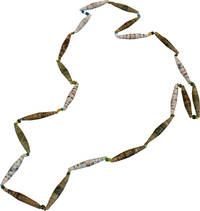
By a Wounded SoldierBiblio.com
1 160 résultats
191821085London: St. Thomas' Hospital 1918. Very Good. London: St. Thomas' Hospital ca. 1918. Original necklace of twenty-one hand-made wallpaper beads each approx. 4cm. in length interspersed with colored glass beads. Wallpaper beads a bit browned else a fine piece of vernacular jewelry. <br /> <br /> Slightly later manuscript card attached to necklace stating "Necklace made of wall paper by a wounded soldier / In St. Thomas' Hospital London. 1914 - 1918 War." The hospital located on London's South Bank would indeed have seen many convalescing soldiers though we have been unable to find mention of other similar examples of soldier-made wallpaper beads this example possibly made to be sold at a local fundraiser or bazaar. St. Thomas' Hospital unknown
1928052736N. p. ca. 1928 1928. Soft cover. Very Good. Original b/w photograph. 9x14 cm. It shows Erkilet and two other men and a woman sitting around a table. Erkilet was an officer of the Ottoman Army and the general of the Turkish Army. In the fall 1941 he along with General Ali Fuad Erden visited the occupied territories in Ukraine including Crimea on invitation of Gerd von Rundstedt. From there he and other Turkish officers flew to Rastenburg to meet Hitler in person. In 1943 he published his essays on that trip under title "What I Saw on the Eastern Front". Being a staunch Turanist he was briefly detained for Panturkic activities in 1948 together with some other prominent Turanists. <br/> <br/> N. p. [ca. 1928] paperback
1928052735N. p. ca. 1928 1928. Soft cover. Very Good. Original b/w photograph. 9x14 cm. It shows Erkilet and many women and men with a child around him. Probably it's taken during a travel. Erkilet was an officer of the Ottoman Army and the general of the Turkish Army. In the fall 1941 he along with General Ali Fuad Erden visited the occupied territories in Ukraine including Crimea on invitation of Gerd von Rundstedt. From there he and other Turkish officers flew to Rastenburg to meet Hitler in person. In 1943 he published his essays on that trip under title "What I Saw on the Eastern Front". Being a staunch Turanist he was briefly detained for Panturkic activities in 1948 together with some other prominent Turanists. <br/> <br/> N. p. [ca. 1928] paperback
Very Good German Original sepia-toned cabinet photograph taken by German photographer J. C. Schaarwachter (1847-1904). 17x11 cm. Moltke was a Prussian field marshal. The chief of staff of the Prussian Army for thirty years, he is regarded as the creator of a new, more modern method of directing armies in the field. He commanded troops in Europe and the Middle East, commanding during the Second Schleswig War, Austro-Prussian War, and the Franco-Prussian War. He is described as embodying "Prussian military organization and tactical genius.". He was fascinated with railways and pioneered their military usage. He is often referred to as Moltke the Elder to distinguish him from his nephew Helmuth Johann Ludwig von Moltke, who commanded the German Army at the outbreak of World War I. In 1835 on his promotion as captain, Moltke obtained six months leave to travel in south-eastern Europe. After a short stay in Constantinople he was requested by the Sultan Mahmud II to help modernize the Ottoman Empire army, and being duly authorized from Berlin he accepted the offer. He remained two years at Constantinople, learned Turkish, and surveyed the city of Constantinople, the Bosphorus, and the Dardanelles. He traveled through Wallachia, Bulgaria, and Rumelia, and made many other journeys on both sides of the Strait. In 1838 Moltke was sent as an adviser to the Ottoman general commanding the troops in Anatolia, who was to carry on a campaign against Muhammad Ali of Egypt. During the summer Moltke made extensive reconnaissances and surveys, riding several thousand miles in the course of his journey. He navigated the rapids of the Euphrates and visited and mapped many parts of the Ottoman Empire. In 1839 the army moved south to fight the Egyptians, but upon the approach of the enemy, the general refused to listen to Moltke's advice. Moltke resigned from his post of staff officer and took charge of the artillery. In the Battle of Nezib (modern-day Nisibis) on 24 June 1839, the Ottoman army was beaten. With great difficulty, Moltke made his way back to the Black Sea, and thence to Constantinople. His patron, Sultan Mahmud II, was dead, so he returned to Berlin where he arrived, broken in health, in December 1839. Once home Moltke published some of the letters he had written as Letters on Conditions and Events in Turkey in the Years 1835 to 1839. This book was well-received at the time. Early the next year he married a young English woman, Maria Bertha Helena Burt, the daughter of John Heyliger Burt Esq. of St. Croix in the Danish West Indies, who married his sister Augusta. It was a happy union, though there were no children.
1986MILI1219Ldn, Osprey Publ. zwischen 1979-1986. pro Heft ca 40 Seiten mit zahlr., tls. farb. Ill., ill. OKart., geringe Gebrauchsspuren, die Umschläge sind tlw. leicht angegilbt u. angestaubt. In Englisch - Nicolle, David and Angus McBride. The Armies of Islam 7th-11th Centuries./diess. Saladin and the Saracens./Turnbull, S.R. and Richard Hook. Samurai Armies 1550-1617./diess., Samurai Armies 1550-1615./Wise, Terence and Angus McBride. Ancient Armies of the Middle East.
P., Heimdal, 1991. In-4 catonné, 96 pages, abondamment illustré.
1897052752Istanbul: 1897 AH 1313 1897. No Binding. Very Good. Original berat given by Ottoman Ministry of War to Osman Nuri. 405x235 cm. In Ottoman script. Tapes on paper. Contemporary repair. Sealed. Dated 1325 1899 confirmation and script on verso. Well-calligraphed. <br/> <br/> 1897 [AH 1313] unknown
1334161135.Gpaperback. Good. Access codes and supplements are not guaranteed with used items. May be an ex-library book. paperback
191927238Grosset & Dunlop New York 1919 Inner DJ Flap Lists Thru Outdoor Girls at Spring Hill Farm HBDJ 1919 Early Printing PreText Lists thru Hostess House GOOD/GOOD. AS-IS Book and jacket are both in good condition with browning edgewear rubbing and soil. SMALL TEARS TO Front DUSTJACKET DJ Spine Small chips tears wear Jacket now in mylar. 218 pages 7.5 x 5. Hard Cover. Gray cloth with red/green/gray illustration on front cover of 3 girls tent canoe coffee pot at lakeside Back DJ Lists thru Spring hill Farm light wear Interior nice tight light wear Fox. Hardcover. Good/Good. Grosset & Dunlop New York, hardcover
19881153561988 Editions Bernard et Raymond Cima, collection "Côte d'Azur, Ligne Maginot" N° 7 / S.F.A.M. (Secteur Fortifié des Alpes Maritimes) - 1988 - In-4, broché - 48 pages - Nombreuses illustrations et reproductions photographiques en N&B in et hors texte
1331157854.Gpaperback. Good. Access codes and supplements are not guaranteed with used items. May be an ex-library book. paperback
0656348372.Ghardcover. Good. Access codes and supplements are not guaranteed with used items. May be an ex-library book. hardcover
Z35087SLWFayard Broché bon état + carte .Couverture jaunie . 1973. 455 pages .P. fayard, 1973 (Livre) ~ Faites Sauter la Ligne Maginot . Non, le Soldat Français de 40 N'a Pas Démérité . PHOTOS SUR DEMANDE
114 pages. Topics: The Indivisibility of Peace and the Inseparability of East and West; the Yosemite Conference and Japan; Some Implications of Anglo-Japanese Competition; The Powers and the Unity of China; Smuggler, Soldier, and Diplomat - smuggling in North China 1935-36; A critical Survey of Chinese Policy in Inner Mongolia; The Population Problems of Australia; Land and Sea in the Destiny of Japan; the Fall of the Manchu Dynasty. Clean and unmarked with average wear. Binding sound. Quality copy. Book
FR19298Couverture fort jaunie. Intérieur parfait état, pages à couper.
030103No Binding. Good. two letters two pages folio paper tanned some staining old folds some nicks and chips at edges with some minor loss separations at fold joints else in good legible condition. Inscribed on laid paper water-marked "OCR" a mark not found in Gravell. This pair of letters from General Philip Schuyler to Major Yates contains orders for the troops including preparations and various actions to be undertaken in the field issued in late June the week before the Siege of Fort Ticonderoga the first week of July 1777. The 1777 Siege of Fort Ticonderoga occurred between July second and sixth 1777 near the southern end of Lake Champlain in the state of New York. Lieutenant General John Burgoyne's 8000-man army occupied high ground above the fort and nearly surrounded the defenses. These movements forced the occupying Continental Army an under-strength force of 3000 under the command of General Arthur St. Clair to withdraw from Ticonderoga and the surrounding defenses. Some gunfire was exchanged and there were some casualties but there was no formal siege and no pitched battle. Burgoyne's army occupied Fort Ticonderoga and Mount Independence the extensive fortifications on the Vermont side of the lake without opposition on 6 July. Advance units pursued the retreating Americans. The uncontested surrender of Ticonderoga caused an uproar in the American public and in its military circles as Ticonderoga was widely believed to be virtually impregnable and a vital point of defense. General St. Clair and his superior General Philip Schuyler were vilified by Congress. Both were eventually exonerated in courts martial but their careers were adversely affected. Schuyler had already lost his command to Horatio Gates by the time of the court martial and St. Clair held no more field commands for the remainder of the war. Saratoga June 26 1777 "Sir As a body of the Enemy are encamped at Gilliland's creek on Lake Champlain from whence they will probably send parties to harass us I entreat you to keep a good Look out to send scouts continually Distance to the West and North West of your Garrison to make discoveries and lest an attempt should be made to burn our vessels on Lake George I have ordered Commodore Wynkoop to get the guns in the vessel already launched that he may be in a condition of Defence. Please to send the Letter to General St. Clair by the first Boat together with the Horses which the Bearer will deliver you to be forwarded to General Fermois. I am sir Your most obedient Humble servant Ph. Schuyler" Albany June 29 1777 "Sir The Necessity of forwarding any more Batteaus or provisions to Tyconderoga for the present being superseded you will please to desist from sending any until further orders from General St. Clair or me. Cause all the spades shovels axes & pick-axes to be helved and make as many cartridges as you possibly can - Continue to keep out scouts to the westward as to intersect the Road from Jesups towards Crown Point. I am Sir Your very humble Servant Ph Schuyler" Philip John Schuyler was born into the prominent family of New Yo <br/> <br/> unknown
030103No Binding. Good. two letters two pages folio paper tanned some staining old folds some nicks and chips at edges with some minor loss separations at fold joints else in good legible condition. Inscribed on laid paper water-marked "OCR" a mark not found in Gravell. This pair of letters from General Philip Schuyler to Major Yates contains orders for the troops including preparations and various actions to be undertaken in the field issued in late June the week before the Siege of Fort Ticonderoga the first week of July 1777. The 1777 Siege of Fort Ticonderoga occurred between July second and sixth 1777 near the southern end of Lake Champlain in the state of New York. Lieutenant General John Burgoyne's 8000-man army occupied high ground above the fort and nearly surrounded the defenses. These movements forced the occupying Continental Army an under-strength force of 3000 under the command of General Arthur St. Clair to withdraw from Ticonderoga and the surrounding defenses. Some gunfire was exchanged and there were some casualties but there was no formal siege and no pitched battle. Burgoyne's army occupied Fort Ticonderoga and Mount Independence the extensive fortifications on the Vermont side of the lake without opposition on 6 July. Advance units pursued the retreating Americans. The uncontested surrender of Ticonderoga caused an uproar in the American public and in its military circles as Ticonderoga was widely believed to be virtually impregnable and a vital point of defense. General St. Clair and his superior General Philip Schuyler were vilified by Congress. Both were eventually exonerated in courts martial but their careers were adversely affected. Schuyler had already lost his command to Horatio Gates by the time of the court martial and St. Clair held no more field commands for the remainder of the war. Saratoga June 26 1777 "Sir As a body of the Enemy are encamped at Gilliland's creek on Lake Champlain from whence they will probably send parties to harass us I entreat you to keep a good Look out to send scouts continually Distance to the West and North West of your Garrison to make discoveries and lest an attempt should be made to burn our vessels on Lake George I have ordered Commodore Wynkoop to get the guns in the vessel already launched that he may be in a condition of Defence. Please to send the Letter to General St. Clair by the first Boat together with the Horses which the Bearer will deliver you to be forwarded to General Fermois. I am sir Your most obedient Humble servant Ph. Schuyler" Albany June 29 1777 "Sir The Necessity of forwarding any more Batteaus or provisions to Tyconderoga for the present being superseded you will please to desist from sending any until further orders from General St. Clair or me. Cause all the spades shovels axes & pick-axes to be helved and make as many cartridges as you possibly can - Continue to keep out scouts to the westward as to intersect the Road from Jesups towards Crown Point. I am Sir Your very humble Servant Ph Schuyler" Philip John Schuyler was born into the prominent family of New Yo <br/> <br/> unknown books
19921134281992 Editions J.J. Fedorowicz Publishing Inc. - 1992 - In-4, cartonnage illustré de l'éditeur - 265 pages - Illustrations et reproductions photographiques en N&B in et hors texte - Ouvrage en anglais
186028204Partitions sur le Militaria HEU 1860 approx.
191829316Partitions sur la Première guerre Mondiale Salabert 1918
192831046Partitions sur les jouets et jeux,Partitions sur les Enfants Carisch 1928
192428104Partitions sur les jouets et jeux Francis Day 1924
191620579Partitions sur la Première guerre Mondiale de Ména R. 1916 approx.
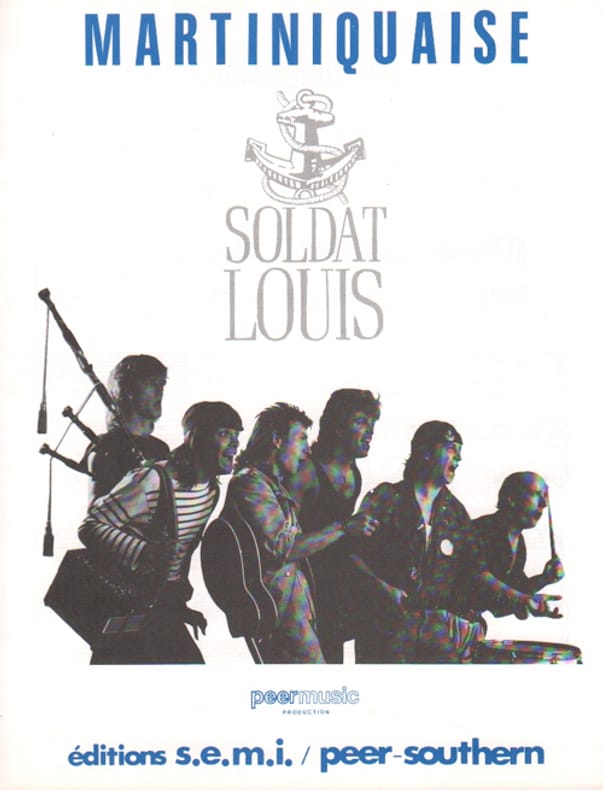
1990102749S.E.M.I 1990
1988111080S.E.M.I 1988