Missionaries of Western AfricaBiblio.com
606 résultats
1168963036.Ghardcover. Good. Access codes and supplements are not guaranteed with used items. May be an ex-library book. hardcover
B9781168963031New. unknown
116175749X.Ghardcover. Good. Access codes and supplements are not guaranteed with used items. May be an ex-library book. hardcover
1910mon0000028842The Foreign Christian Missionary 1910. Paperback. Acceptable. in x in x in. The Foreign Christian Missionary paperback
New English Paperback. Pbo. Roy. 8vo. (23 x 16 cm). In English. 593 p. "During the 38 years of its existence Bosphorus University has perpetuated the cultural traditions it inherited from Robert College, and it is generally considered to be one of the top undergraduate institutions in the world, with outstanding graduate programs in most fields other than medicine and law. Though it is a Turkish state university, the language of instruction in almost all courses is English; the majority of its faculty have doctorates from American universities and most of its outstanding students go on to do graduate studies at universities in the U. S. Our students come from every province of Turkey and from more than sixty other countries, for Bosphorus University is a cultural beacon that shines across national boundaries and internal political divisions, distinguished by the diversity of its student body and faculty and its tolerance of ethnic, religious, and cultural differences. And so my book will examine the ways in which Robert College and Bosphorus and Bosphorus University have been a bridge of culture between what orientalists have called East and West.
Very Good Turkish, Ottoman (1500-1928) Contemporary fine quarter leather binding. Five raised bands to spine, second gilt title as "Tarih-i seyyâh", others gilt decorations. Brown boards are embossed decoratively. Demy 8vo. (21 x 15 cm). In Ottoman script (Old Turkish with Arabic letters). [12], 194 p. Hegira: 1142 = Gregorian: 1729. Slightly wear on colophon and the first page. Otherwise a good copy. Extremely uncommon first Ottoman edition printed in the first printing house of the Islamic world as the third Islamic incunabula, of this eye witness and first-hand account, and one of the most important chronicles describing the history of late Safavid Iran in the 18th century, the Iranian invasion of Afghanistan and the siege and the fall of Isfahan in 1722 written by Kruzinski who was a Polish Jesuit missionary served in the Persia in the early 18th century. In 1720 he was nominated advocate general of the mission in Persia and became the secretary to the Bishop of Isfahan. Krusinski himself, however, claimed later on that he is not only the author but also the translator of this work. As a chronicle, this is a history of Iran under the Safavids from 1499 up to 1727 with a special focus on the 1722 Afghan invasion that terminated the Safavid dynasty. "His account of the conditions and events preceding and during the siege and the subsequent demise of the Safavids is unique. It also offers key insights into the workings of the late Safavid state and government as well as the functions of the royal harem." (Bloomsbury). Translated and expanded by Ibrahim Müteferrika of Kruzinski's Latin manuscript written in 1726 in Istanbul and entitled "Historia revolutionis monarchia Persica". The book was first published in Italian, French, and English translations, in Rome (1727), Paris (1728), and London (1728). The founder of the legendary first printing house in the Islamic world, Ibrahim Müteferrika (1674-1745), was the editor and translator of this book. Ceridehâne [i.e. Journal House] Printing House is the successor of the Müteferrika Press in the early 19th century. "The book is a Turkish translation of the history of Iran written in Latin by the Jesuit missionary Judas (Jan) Tadeusz Krusinski (1675-1751). The work, whose title can be translated as 'A voyager's description on the apparition of the Afghans and on the reasons of the Safavid Empire being undermined', focuses on the Afghan invasion of 1722 which led to the fall of the Safavid dynasty, but also offers an overview on the historical processes of early 18th-century Safavid Iran. The publication of this work was made actual not only by the vicinity of Iran to the Ottoman Empire but also by the historical turn reorganizing the relations of power in the region and triggering the intervention of the Ottomans as well. This may have been the reason that among the first Turkish incunabula this was the work published in the highest number of copies. This publication also offers an early example of copyright disputes, as Krusinski considered the Turkish translation as his own work, while Müteferrika, who does not mention his name in the printed version, suggests himself to be the translator". (Source: The Mysterious Printer Ibrahim Muteferrika and the Beginnings of Turkish Book Printing: Library of Hungarian Academy of Sciences Online). The workshop of Müteferrika began its historical mission in 1728. They published 17 works in 22 volumes. The printing house served as a means to the long-term goal of Müteferrika, his efforts to broaden the horizon and modernize the knowledge of Ottoman society and Islamic civilization. This is evidenced by the subjects of the books selected for publishing, the motivations put forth in the publisher's introductions, as well as by the documents illuminating the background of the publication of each book, also published in print. One of 1200 copies. OCLC: 312516053 (For printed copies: Two copies).; Özege: 19897.
19752412050448xbvkHoniara, British Solomon Islands Protectorate, printed by the Government Printer, 1971-1975. Detailed collation: I. Annual titlepage, v pages 'Index', 224 pages (Issue #1-#4 individually paginated [16 p. in total], Issue 5 starts with p. 17, then onwards to p. 224). / II. Annual titlepage, xiii pages 'Index', 245 pages. / III. Annual titlepage, xi pages 'Index', 200 pages. / IV. Annual titlepage, x pages 'Index', 245 pages. / V. Annual titlepage, xi pages 'Index', 196 pages. - 'Publisher's' titled greyblue halfcloth bindings with yellow thick cardboard-panels; 8vo.(ca. 20,5 x 14 x 9 cm; ca. 2,5 kg.).
Very Good Turkish, Ottoman (1500-1928) Original wrappers. Uncut and untrimmed copy. Demy 8vo. (21 x 14 cm). In Ottoman script (Turkish with Arabic letters). 31 p. Ali Bey was a playwright originally. He learned French in private lessons and firstly he worked at the Babiâli (The Sublime Port) Translation Office as a clerk, then he became a member of the Health Council and the first secretary of the Directorate of Quarantine. He went to Eastern Anatolia, Iraq, and Japan as an inspector of public debts (1855-88). After his duty as the Governor of Trabzon (1890-93), he became the director of the Office of Public Debts (1890-93), which would last to the end of his life. It is for this reason that he was called Direktör Ali Bey. His first work was published in Diyojen (1869-72), the first humorous review, published by Teodor Kasap. Ali Bey, who was one of the regular writers of this review, wrote plays for the Gedik Pasa Theater, which was founded by the Armenian Güllü Agop and his friends, and wrote scripts adapted from French plays. He gave Turkish diction lessons to the Armenian actors and participated in theater activities. His plays were performed under the authorship 'A Person' to hide his official identity. He explained the meanings of words satirically in his dictionary Lehçetü'l Hakayik (Language of Realities) which he wrote in 1897 and was the first work of its field; the faults of the 19th century Ottoman Empire were also criticized in this dictionary. He wrote his travel memoirs titled 'Seyahât jurnâli' including his voyages from Istanbul to India. This book includes his humorous short stories printed in Cairo. Özege 17946.; TBTK 3399.; Only one printed copy in OCLC 1030931636 (Orient Institut of Istanbul). Scarce. First and Only Edition.
Very Good Turkish, Ottoman (1500-1928) Contemporary handsome petrol green quarter leather, five raised bands to spine with decorative gilt edges, marbled boards. Roy. 8vo. (24 x 17 cm). In Ottoman script (Old Turkish with Arabic letters. 118 p., 14 unnumbered woodcut plates (one is full of two pages). Hegira: 1314 = Gregorian: 1896. Extremely rare first and illustrated edition of the journey of civil servant Ali Bey, who went from Istanbul to Baghdad and to India through his duty in Düyûn-u Umûmiye [i.e. Ottoman Public Debt Administration] covering the years 1885-1888, vividly describing Baghdad, Musul; and India. In 1884 Ali Bey started his journey as an ex-governor of Trabzon city and a new OPDA officer from Constantinople (Istanbul), and he arrived in Baghdad through Lesbos, Ayvalik, Smyrna (Izmir), Mersin, and Alexandretta (Iskenderun). On their way to Baghdad, they cross the Tigris River on rafts that local people call "Kelek". His descriptions of Baghdad city are very important and first-hand accounts of the region including the details of the walls of the city, hospitals, health organizations, industry, a transportation company on the river, a new settlement near the center of Kadhimiya with a tram line to through the city built. Ali Bey landed on the Indian continent in Karachi (today's Pakistan). He made a detailed description of the big cities that were the British Colony and states that he was influenced by these cities as a Reform period Turkish intellectual. He also describes Islamic India, Parsi traditions, costumes and funerals, Portuguese culture in India, Victoria Garden Zoo, silk weaving factories founded by David Sossoon, who came from Baghdad, architecture, music, theater, etc. List of ills.: General view from Ayvalik, the port of Smyrna (Izmir), the port of Mersin, two panoramas of Diyarbakir and Aleppo cities, the bridge of Musul, "Keleks" on the Tigris, a local woman of Aleppo, Famous water mill of Aleppo, Fortress of Aleppo, Eagles of Parsi people in Bombay, A Parsi family from Bombay, Arcadia ship in Bombay, Straight of Hormuz in Basra. Ali Bey was a playwright originally. He learned French in private lessons and firstly he worked at the Babiâli (The Sublime Port) Translation Office as a clerk, then he became a member of the Health Council and the first secretary of the Directorate of Quarantine. He went to Eastern Anatolia, Iraq, and Japan as an inspector of public debts (1855-88). After his duty as the Governor of Trabzon (1890-93) he became the director of the Office of Public Debts (1890-93), which would last until the end of his life. It is for this reason that he was called Direktör Ali Bey. His first work was published in Diyojen (1869-72), the first humorous review, published by Teodor Kasap. Ali Bey, who was one of the regular writers of this review, wrote plays for the Gedik Pasa Theater, which was founded by the Armenian Güllü Agop and his friends, and wrote scripts adapted from French plays. He gave Turkish diction lessons to the Armenian actors and participated in theater activities. His plays were performed under the authorship 'A Person' to hide his official identity. He explained the meanings of words satirically in his dictionary Lehçetü'l Hakayik (Language of Realities) which he wrote in 1897 and was the first work of its field; the faults of the 19th-century Ottoman Empire were also criticized in this dictionary. Özege 17900.; TBTK 3068.; OCLC 218189547 (One copy in Bayerische Staatsbibliothek), 602878049 (one copy in Universitatbibliothek), 879555766 (Four copies), 56944884.
1935R320071286ARLAUD G.L.. vers 1935. In-8. Broché. Bon état, Couv. convenable, Dos satisfaisant, Intérieur frais. 188 pages augmentées de nombreuses photos en noir et blanc dans et hors texte - Des points de rousseur sur la page de titre et les 1er et 2e plats -. . . . Classification Dewey : 904-Recueils de récits d'événements
500264787Edition O.L. Arlaud Sans date.
89634Louvain, Xaveriana, 1939. 10 x 16, 28 pp., broché, bon état (1 cachet du Collège jésuite Saint Stanislas à Mons).
020766[Vichy] Pose de la première pierre de la maison du Missionnaire en 1931. 2 cartes postales photographiques, 1931. Photographies originales au moment de la pose de la première pierre de cette maison religieuse, existant toujours, avec de nombreux religieux apparaissant sur les photos. Il est fortement probable que l'évêque sur les deux photos soit Augustin Gonon, alors évêque de Moulins. [500]
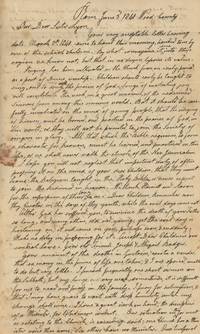
1840List2979Perrysburg Ohio 1840. Single three-page letter measuring 7 ½ x 12 ½ inches. Some stains folded with small tears at folds and tear at seal; overall near fine. Joseph Badger 1757–1846 was the first missionary to be sent to the Connecticut Western Reserve.1 He served in the Continental Army received a degree from Yale and was sent to Ashtabula County by the Connecticut Missionary Society in 1802. He retired in about 1833 after many years of organizing schools and churches around the Western Reserve plus a stint as a brigade chaplain during the War of 1812.<br /> <br /> Abigail Ely was Badger’s second wife; they married in 1819. The two write here to a widowed friend Harriet Lyon and her children in Gustavus Ohio. They discuss the importance of singing to religious work and of teaching children to sing and describe their living situation—on a farm nearby to some of their children who help them out. They also briefly complain about the quality of ministry in the area writing that the situation:<br /> <br /> “is exceedingly dark; one Church has a Minister worse than none; Six others have no Minister. . Much of the preaching that comes along occationally is calculated to excite the super-ficial affections of the mind without reaching the heart or enlightening the understanding.â€<br /> <br /> Of interest to historians of Ohio and religion in the Western Reserve.<br /> <br /> 1 “Badger Joseph†in Encyclopedia of Cleveland History accessed March 20 2025 https://case.edu/ech/articles/b/badger-joseph. unknown
80226Louvain, Xaveriana, 1929. 10 x 16, 30 pp., broché, bon état (1 cachet sur la couverture).
80218Louvain, Xaveriana, 1932. 10 x 16, 32 pp., broché, bon état (1 cachet sur la couverture).
80221Louvain, Xaveriana, 1939. 10 x 16, 27 pp., broché, bon état (1 cachet sur la couverture).
44372Toulouse, Editions de l'Apostolat de la Prière, 1946. 14 x 22, 127 pp., nombreuses illustrations en sépia, 2 cartes, broché, bon état (petit manque au dos).
80229Louvain, Xaveriana, 1928. 10 x 16, 31 pp., broché, bon état (1 cachet sur la couverture).
80216Louvain, Xaveriana, 1927. 10 x 16, 32 pp., broché, bon état (1 cachet sur la couverture).
80217Louvain, Xaveriana, 1927. 10 x 16, 32 pp., broché, bon état (1 cachet sur la couverture).
80223Louvain, Xaveriana, 1928. 10 x 16, 32 pp., broché, bon état (1 cachet sur la couverture).
80225Louvain, Xaveriana, 1930. 10 x 16, 30 pp., broché, bon état (1 cachet sur la couverture).
80224Louvain, Xaveriana, 1928. 10 x 16, 32 pp., broché, bon état (1 cachet sur la couverture).
80227Louvain, Xaveriana, 1929. 10 x 16, 32 pp., broché, bon état (1 cachet sur la couverture).