Livre Rare Book
mai 68
environs 400 tracts originaux, ronéotypés provenants de la fac de droit.
14 578 résultats
environs 400 tracts originaux, ronéotypés provenants de la fac de droit.
23026Norrkoeping, Eric Biornström, (below, on printed cover: En Commission - Londres, Trübner & Co), 1863. (2), iv, (2, blank), 96 pp. 8vo. Modern boards, original covers preserved. Anderson 302; Kilgour 436; Zaleski 197. First separate edition: Herzen's letters to Turgenev, which first appeared in My Past and Thoughts, published here with a new introduction. 'Herzen's renewed interest in Russia's past and future was closely linked to his bitter disappointment in the "old world". He was a discerning critic of bourgeois society, even if his strictures were not always fair. The modern reader is struck especially by certain far-sighted observations, that seem to anticipate criticism of a complex phenomenon we have come to refer to as "mass culture". Herzen's most interesting comments in this respect are to be found in a series of articles entitled Ends and Beginnings, in which he conducted a polemic with Ivan Turgenev, who had become the moral authority for liberal Westernizers in Russia' (Andrzej Walicki, A History of Russian Thought, Oxford, Clarendon Press, 1980, p. 170). Alexander Herzen (1812-70) was a prominent nineteenth-century Russian social thinker and is known as the 'father of Russian socialism.' Early in his intellectual development, Herzen was influenced by German idealist thinkers such as Schiller and Schelling. He believed in the autonomy and dignity of the individual and opposed forces, such as family and state, that oppressed the individual. Later, under the influence of French socialist thinkers such as Charles Fourier, Herzen's thought became more radical. Herzen projected his earlier concern for the oppressed individual onto society at large and he became a supporter of socialism. The socialism he envisioned was a loose federation of self-governing communes. Only in such a system could the ideal society be achieved- according to Herzen that society would be a free association of individuals which provided for the full flowering of each personality. Herzen initially placed his hopes for this future order in the European socialist movement. After the failure of the 1848 revolutions to achieve socialist principles, however, Herzen became disillusioned about European prospects and turned his attention to Russia. Herzen argued that socialist transformation would actually come first to Russia because communal institutions such as the peasant commune survived and bourgeois attitudes hadn't yet emerged. This sense of the advantages of Russian 'backwardness' was influential among the Populists in the 1870s. Herzen has been called a 'gentry revolutionary.' The illegitimate son of a wealthy landowner, Herzen viewed the gentry as a progressive class. The revolution he envisioned was for the people but not necessarily by them. Also, his socialism was a national destiny rather than a class one, and because he promoted the value of individualism in collectivist form--in other words, the full flowering of the individual could best be realized in a socialist order. Among Herzen's works are From the Other Shore (1848-50) and The Russian People and Socialism and his autobiography, My Past and Thoughts.He founded a periodical, the famous Kolokol, in whose pages the free word first appeared in the Russian language, unhampered by censor or police, exposing the government's secrets, criticizing bureaucratic abuses, approving the good intentions of the czar, the 'liberator', and trying to dictate to him a reform program.
200887351Gdansk City Office | Gda?sk 2008 | 15 x 21 cm | broché
236485S.l., s.d. (1944) in-4, titre, avec un tirage photographique (11,5 x 10 cm), 16 pp. dactylographiées, en feuilles, agrafé, sous couverture de papier bleuté.
233901Milan, Feltrinelli, 1963 in-8, VIII pp., 429 pp., un f. n. ch., 23 pp. de fac-similé de l'édition originale, avec un tableau dépliant hors texte, toile grise (reliure de l'éditeur).
194787712S. n. | s.l. (Paris) 1947 | 27.50 x 35 cm | agrafé
183636795Paulin et Perrotin | Paris 1836 | 13 x 21 cm | 4 volumes reliés
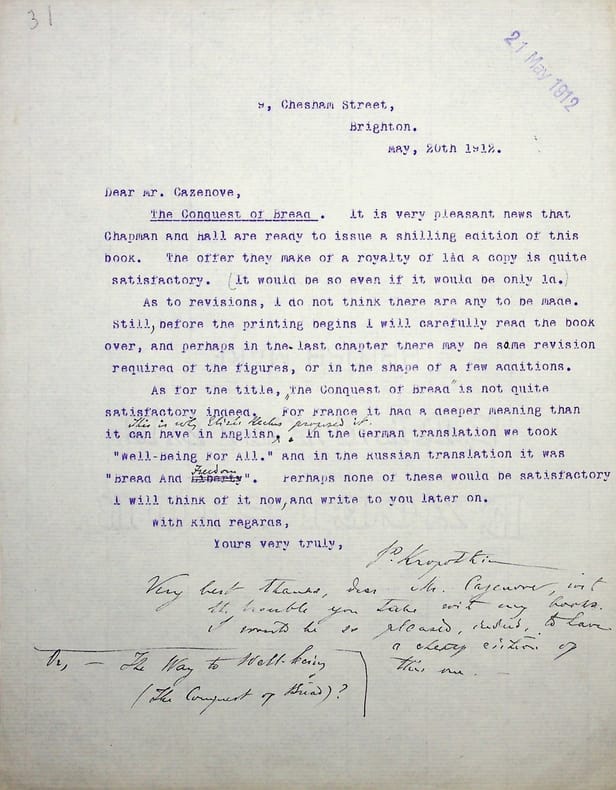
016248Pierre Piotr Kropotkine (1842-1921), prince russe, géographe, anarchiste, théoricien du communisme libertaire. L.S. avec corrections et large partie autographe, 20 mai 1912, 1p in-4 A Charles-François Cazenove (1870-1915), agent littéraire à Londres. « Dear Mr Cazenove, The Conquest of Bread. It is very pleasant news that Chapman and Hall are ready to issue a shilling edition of this book. The offer they make of a royalty of 1 œd a copy is quite satisfactory. It would be so even if it would be only 1d. As to revisions, I do not think there are any to be made. Still, before the printing begins I will carefully read the book over, and perhaps in the last chapter there may be some revision required of the figures, or in the shape of a few additions. As for the title, "The Conquest of Bread" is not quite satisfactory indeed. For France, it had a deeper meaning than it can have in English, this is why Elisée Reclus proposed it. In the German translation we took "well-Being for All" and in the Russian translation it was "Bread and Freedom". Perhaps none of these would be satisfactory. I will thing of it now, and write to you later on. Yours very truly, P Kropotkine. Very best thanks, dear M Cazenove, with the trouble you take with my books. I would be so pleased, indeed, to have a cheep edition of this one. Or - The Way to Well-being (The Conquest of Bread) ? ». Très intéressante lettre pour la nouvelle édition de son ouvrage. [135]
195888306Comité de défense des enseignants | Paris 1958 | 13.50 x 20.70 cm | agrafé
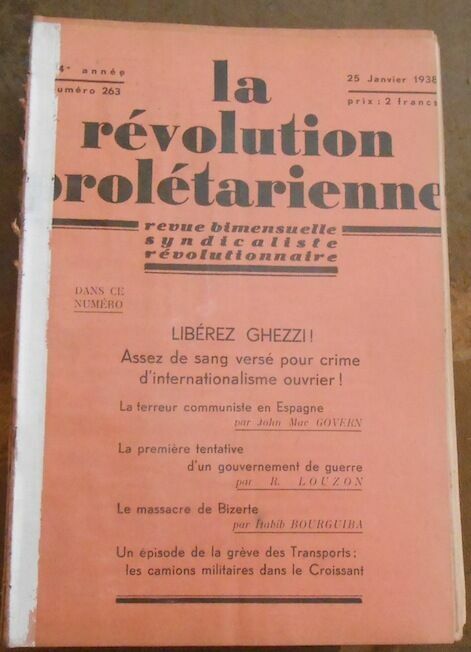
1938124141938. Paris La Révolution Prolétarienne du n°263 (25 janvier 1938) au n°300 (10 août 1939) dernier numéro paru avant la guerre - Brochés 18 cm x 26 5 cm 16 pages par numéro- Textes de Victor Serge Maurice Chambelland Robert Louzon Léon Jaloux J. Mesnil B. Giauffret Habib Bourguiba J. Barrué N. Lazarévitch Daniel Guérin J. Duperray E. Berth A. Ciliga R. Hagnauer Maurice Yvon Walter Krivitsky etc.. ; nombreux articles sur la Guerre Civile Espagnole - Etat correct tous ces numéros ayant été mal reliés avec une toile collée ! mais ils sont complets
"This book is the final and complete exposure of the notorious forgery which, under the name of The Protocols of the Wise Men of Zion, has been the central weapon in the anti-Semitic armory since 1870." - dust jacket of first edition (not included.) "Contains reprints of all the documents relating to the case." - copyright page. [VIII], IX-XXXII, 15-397, [11] pp. Reprint of the 1935 first edition with an informative new introduction by Norman Cohn. Clean, bright and unmarked with light wear to publisher's navy cloth. Brilliant gilt lettering upon front board and backstrip. Binding tight. Small clipping from top corner of front free endpaper. No dust jacket, presumably as issued. A quality copy of this fascinating work. Book
247 pages. Index. "...Explains the devious secret intent behind the Leninist strategy which the 'former' Communists are pursuing under the fake 'reform' and 'progress towards democracy''. Author served in the KGB before defecting from the Soviet Union to the USA in 1961. Contents clean, bright and unmarked. Moderate external wear. Crease to front cover. Binding tight. A sound copy of this important work. Book
140 pages. Footnotes. "Portrays what Time Magazine has aptly called 'history's most terrifying peace', a peace which fully explains why many Germans are ready to turn to communism, or worse." - from Introduction. Chapters include: War Devastation; Extermination by Overcrowding; Pulling Down the Pillar of Labor; The Attach Against German Capital; Bastardizing the German Race; The People Hunger; Economic Tribulation; Teaching Democracy in Reverse; The Kremlin's Program; Facts We Must Face. Prior owner's address label atop first blank leaf. Average external wear and soiling with short opening to top of front cover. Binding intact. Contents moderately age-toned. A sound first edition copy of this important work. Book
196 pages. Reproductions of dozens of black and white photos. Author documents the dramatic trip which saw her ripped her from her comfortable Polish home on her sixteenth birthday in 1940 and took her thousands of miles, eventually settling in England. Unmarked. Above-average but not excessive wear. Binding intact with some lean to spine. Small address labels inside each cover. A worthy copy of this important and unforgettable true story. Book
354 pages. Signed and inscribed by author upon front free endpaper. "Takes us behind the scenes to witness the forbidden maneuvering for Peter's crown and its worldly power. We learn why the sweeping changes of Paul 6, made - he was convinced - to assure the very survival of the church, have pushed the Cardinals to one of the most critical decisions in our history." - from dust jacket. Book clean and unmarked with light wear. Light foxing to top edge. Moderate wear to dust jacket which is now preserved in a clear protective sleeve. A sound copy. Book
144 pages. Features: China's 'Manhattan Project', or, How Mao Learned to Love - and build - the Bomb; Communists of the World, Unite? - Richard Lowenthal concludes that Communism cannot put it right even with Krushchev out of the way; The Kremlin Plays Russian Roulette - Krushchev's ouster points to the Soviet's inability to transfer power without a self-destructive power struggle; When Man Steps out into Space; The Case Against Goldwater's Economics; Cassius Clay, Cassius X, Muhammad Ali; How an Advertising Agency handles the White House Account; How Big is the Bloc Vote (Re: the LBJ vs. Goldwater election); Vision of a Crashproof car - as the slaughter on our highways mounts; The Negro's Middle-Class Dream; Scenes from Mao's Chinese movies; Japan's birth rate turns lower; The American Communist Party Still Functions; Nice colour Cadillac ad; Playwright John Osborne of England looks forward in Anger. Crossword completed in pencil. Moderate wear. A sound copy. Book
8vo., First Edition, with a portrait frontispiece and 7 plates; handsomely bound in burgundy full morocco, back with five raised bands, second and fourth compartments lettered and ruled in gilt, all other compartments tooled and ruled in gilt, black top, uncut, a most attractive copy ideal as a gift or for presentation. EXTREMELY SCARCE, ESPECIALLY IN THIS CONDITION.
- Au bureau du populaire, Paris 1845, In 12 (11x18cm), 600pp., relié. - Troisième édition, après l'originale parue en 1840. Un portrait au frontispice. Demi basane grise d'époque, dos lisse à filets et roulette en queue, frottements. Récit de voyage d'une utopie communiste dans lequel l'auteur expose ses théories pour refonder une société saine, juste et heureuse. L'auteur fut exilé durant cinq ans en Angleterre pour ses accusations envers le gouvernement, il revint converti au communisme, avec un livre écrit dans le goût des utopies du XVIIIe où un narrateur raconte et s'étonne de tout ce qu'il voit. [ENGLISH DESCRIPTION ON DEMAND]
- Paris 1908-1912, 12,5 X 19 cm, 6 volumes reliés. - Edition originale. Tête de collection de la revue, 84 livraisons reliées en cinq volumes, correspondant aux années 1908 à 1912, et un volume de supplément, La Vie syndicale, 1911-1913. Reliures en demi-basane vert sapin (bordeaux pour le volume de supplément), dos lisses ornés de triples filets dorés, dentelles et roulettes "dents-de-rat" en pied, plats de papier marbré, gardes et contre-plats de papier à la cuve, reliure de l'époque. Bel ensemble, agréablement établi, exempt de toute rousseur. Numéros thématiques consacrés à des portraits de personnalités et à diverses questions sociales, politiques, économiques, professionnelles, syndicales, culturelles, concernant aussi bien la France que l'étranger, dont : « La coopérative de consommation : Syndicat, Société, Association ??? », « Histoire du Cercle d'Etudes féminin de Saint-Jacques, à Pau », « Une caisse de prévoyance pour jeunes gens », « La ligue des Femmes catholiques d'Allemagne », « Le repos hebdomadaire », « Mouvement social catholique et modernisme », « L'évolution du roman social au XIXe siècle », « Contre le chômage », « Les petits verriers italiens en France », « Le relèvement des salaires féminins », « La question des races », « L'évolution sociale de l'Asie », « L'Internationale des jeunesses socialistes », « La désertion des campagnes », « Le rôle social de l'Eglise », « Manuel du conférencier antialcoolique », « Karl Lueger, sa vie. Son ?uvre », « La mutualité intellectuelle », « Le syndicalisme. Son origine. Son organisation. Son rôle social », « Les salaires », « Les qualités morales de la bonne ménagères », « Le théâtre social », « Le logement populaire. Idées et initiatives », « L'hygiène », « Le rôle de l'Etat dans l'organisation de l'enseignement professionnel », « L'action sociale catholique au cabaret », « La question sociale en Chine », « Un guide général de lecture. Romans-Revue et ses annexes », « Petites industries et petits élevages », « Le Technicum de Fribourg », « L'antimilitarisme socialiste », « La R.P. Scolaire. Où nous en sommes en France », « Les retraites ouvrières », etc. Chaque numéro propose en outre des documents, une « revue des revues » et une chronique littéraire. [ENGLISH DESCRIPTION ON DEMAND]
120 pages. Features: Colour-photo Parker Pen ad inside front cover shows writing on mousetrap; Editorial on the Penticton Vs who have just won the world hockey championship; Fascinating Canadair one-page photo ad entitled "Do We Really Know Where to Face Communism?" shows sparsely-attended church and encourages Canadians to re-affirm their Christian faith to battle Communism; Two-page Rexall ad lists lots of products and their microscopic prices; Nice one-page colour-photo Weston's ad shows stone mason eating lunch; The Man With the Coat - complete story by Morley Callaghan, profusely illustrated by Oscar Cahen; The Bitter, Tragic Battle Over Fluoridation; Marilyn Monroe look-alike Jackie MacDonald of Toronto wants to be the world's strongest woman - great photo-illustrated article on Jacqueline Donalda MacDonald, with coach Lloyd Percival appearing in one photo; How Brock Founded the Canadian Myth; The Canadian Guards - can we transplant that British spit and polish to Canada? (photo-illustrated article); Gordon Tamblyn - his gaslit store was turned into the biggest drugstore chain in the country - article with large photo of Kate Aitken with Tamblyn president Browne and store manager E.N. Thopmson in his store; Nice one-page colour-phot ad for 1955 Chrysler cars; Two-page colour ad for Deepfreeze fridges; Colour ad for Clover Leaf sockeye salmon; One-page colour ad for 1955 Dodge cars (Regent and Mayfair); Nice colour-photo CNR (Canadian National Railways) ad features scenes on trains; One-page recruiting ad for RMC and Royal Roads; Colour ad for the Canadian Wine Institute features endorsements by illuminaries in France; Interesting one-page colour ad for Massey-Harris-Ferguson looks over tractor steering wheel over field, with caption "How Steering Wheel Farming Took the Ache Out of Acres"; McCulloch chainsaw ad; Labatt's IPA ad features photo of Wexford, Ontario labourer Frederick Gilbert; Nice colour-photo ad for 1955 Studebaker cars inside back cover; Back cover Coke colour-photo ad shows formally-dressed adults seated in shag carpet listening to records; and more. Moderate wear. Unmarked. Several discrete archival-tape mends along coverfold. A worthy copy of this wonderful vintage issue. Book
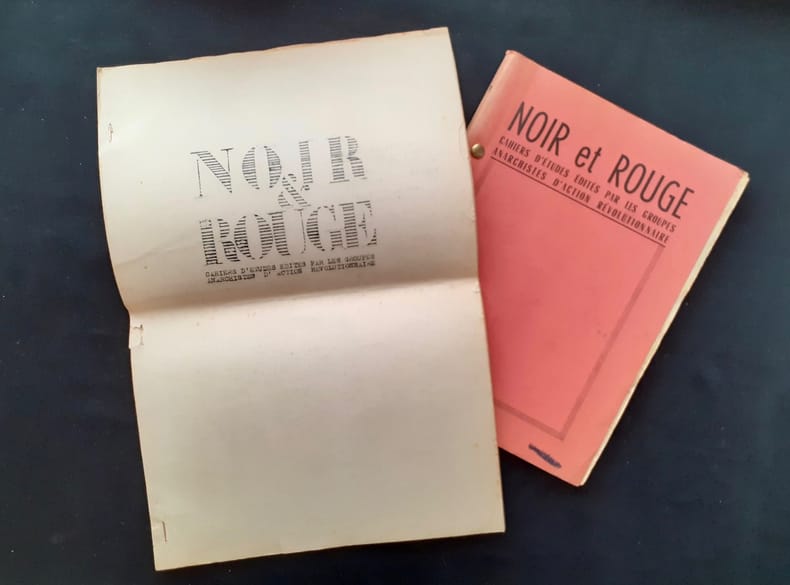
42786Edité par les groupes anarchistes d'action révolutionnaire. Directeur de publication : Christian Lagant. Collection quasi complète de 42 numéros (manque 4 numéros : 1, 11, 28 et 43). Brochure ronéotée et agrafée du numéro 3 au numéro 28 (21,3x16 cm) de 70 à 100 pages, puis imprimée par "La Ruche ouvrière" au format 24x16,5 cm de 30 à 40 pages. Le numéro 2 est en feuilles au format 31x21 cm agrafées et pliées en deux. Textes de Christian Lagant, Paul Zorkine, Errico Malatesta, Christo Botev, Paul Rolland, Bernard Prat-Cotter, Théo Lecomte, T. Duparc, Israël Renof, Pierre Vidal, Octave Alberola, etc. Manque la couverture du numéro 29 mais complet de son supplément de 16 pages, quelques couvertures passées, numéros inscrits au dos de 8 exemplaires. Tous les numéros sont complets et l'ensemble est en bon état de conservation.
Signed and inscribed by Robert Conquest to [Joseph D.] Joe Dwyer upon title page. Dwyer was an invaluable resource to Conquest and succeeded him as curator of the Russian collection at the Hoover Institution in 2002 . xvii, 346 pages. Black and white photographic plates. Index. Bibliographical Notes. "Robert Conquest [1917-2015], the foremost authority on the Stalinist period of Soviet history, focuses on Stalin's terrifying character, a monster let loose among humanity. Hitler called him a 'beast on the grand scale'. This book is the culmination of a lifetime's work, a masterly portrait of a man who 'perhaps more than any other determined the course of the twentieth century'." - back cover. "Conquest tells the tale with an informed hatred for his subject, and a fine sense of irony which makes the book indispensable reading'. - A.N. Wilson. Paul Johnson, close advisor to Margaret Thatcher, described Conquest as "our greatest living historian." - online reference. Clean and unmarked with moderate wear. Contents gently toning at edges. Tight and square. A special addition to the shelf of any serious sovietologist. Book
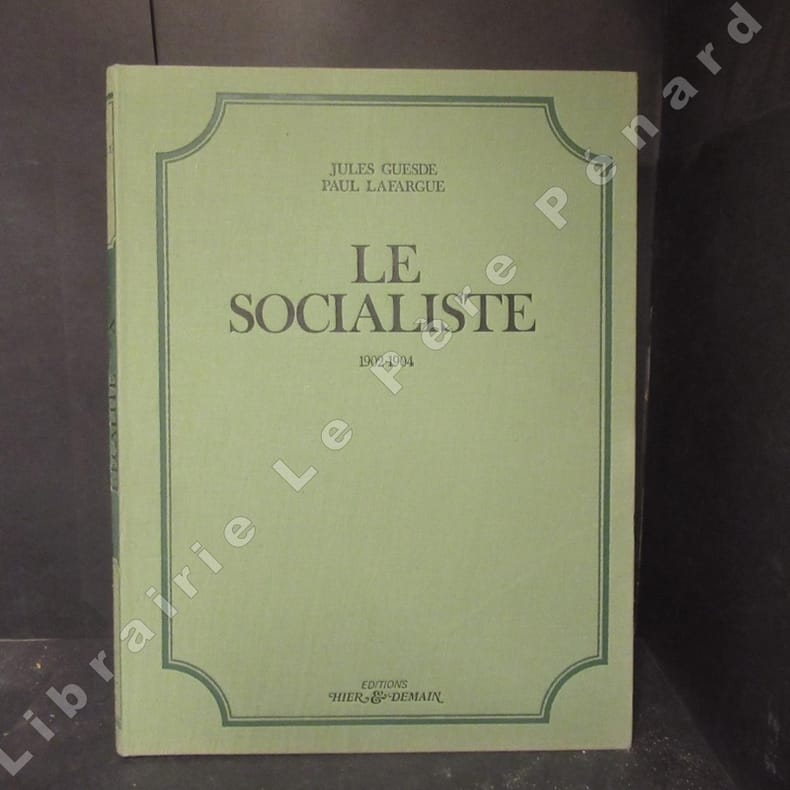
19741137421974 Editions Hier et Demain, Département éditions et rééditions d'oeuvres fondamentales - 1974 - 16 volumes cartonnage toilé vert avec pièce de titre au dos vert foncé dont 2 volumes (Tomes I et II) format in-4, 13 volumes (Tomes III à XV) in-folio et 1 volume (Tome XVI) in-6 - Sans pagination continue - Le tirage de la présente réimpression de la collection complète de l'Egalié et du Socialiste a été limité à sept cents exemplaies tus numérotés sur le volume un; exemplaire n°015.
Milano, Edizioni Dedalo. 1969 nasce “Il Manifesto”. Mensile diretto da Lucio Magri e Rossana Rossanda. Prima annata del 1969 completa (dal n. 1 giugno 1969 al n. 7 dicembre 1969). Seconda annata 1970 completa (dal n. 1 al n. 12). Axs
337881 page in8 - 15 lignes - trés bon état - au dos de la couverture du tome premier des "Communistes" dans le livre de poche -