LUDEWIG, Johann Peter vonAntiquariat.de

123 résultats
1730605365Halle, Waisenhaus, 1730. 1 Bl., XVI, XII, 803 S. Mit gestochenem Frontispiz, gestochener Titelvignette u. gestochener Kopfvignette. Leder d. Zeit (beschabt, Vorderdeckelbezug mit Fehlstelle durch Wurmfraß). [3 Warenabbildungen]
1723316747Leipzig, Lanckisch Erben, 1723. Folio. 7 Bl., 1095 S., 10 Bl. Mit 6 (3 gefalt.) typographischen Tabellen u. Stammtafeln. Leder d. Zeit (beschabt, Ecken bestoßen, oberes Kapital ausgefranst). [2 Warenabbildungen]
1735128407Langenheim, 1735. 3 Bl., 43 S., 3 Bl. Übliche Interimsheftung.
1776230861776 Paris c impr. de C. Simon d 1776 ,in 12 , XXIV-402 pages,pleine Basane marbrée , dos à nerfs richement orné . Reliure de l'époque . Très beau frontispice ( portrait du Frère Jean du Houssaie , mort en odeur de sainteté en 1609 ) .
1741450935Gotha, Mevius, (1741). 4to. 375 nn. Bl. (d.l.w.). Leder d. Zeit mit marmorierten Spiegeln (beschabt, Rückenbezug unten mit kurzem Einriß). [3 Warenabbildungen]
179116684reliées en un volume in-24 (91x56mm), veau marbré, dos lisse à faux nerfs, décors et titre dorés, roulette décorative d'encadrement, roulette sur les coupes, tranches jaunes (reliure du tout début du XIXe) ; 1- La Constitution Française, décrétée par l'Assemblée Nationale Constituante, aux années 1789, 1790 et 1791 ; acceptée par le Roi le 14 septembre 1791. Paris, imprimerie de Didot Jeune, chez Garnery, 1791 ; 160 pp. (Précedée de la Déclaration des Droits de l'Homme et du Citoyen ; en 17 articles). 2- Acte Constitutionnel, décrété par la Convention nationale de France, en 1793, et présenté à l'acceptation du Peuple Français ; précédé du Rapport fait sur ce sujet, par Hérault-Séchelles, membre du corps constituant. Paris, Lepetit, 1793 (imprimerie de Rochette) ; 96 pp. Contient le Rapport sur la Constitution du peuple français, la Déclaration des Droits de l'Homme et du Citoyen (en 35 articles), la Constitution Républicaine. 3- Constitution de la République Française. Paris, chez Et. Gidde, imp. de Crapelet, an IV (1795) ; 159 pp. 4- Constitution de la République Française, avec les lois organiques. Paris, imp. de Munier ; chez Lepetit, jeune, an VIII ; 63 pp.
1767105368Londres, MDCCLXVII 1767 Tome 1er seul. In-8 22,5 x 14 cm. Broché, couverture d’attente, VIII-426 pp. Etat correct.
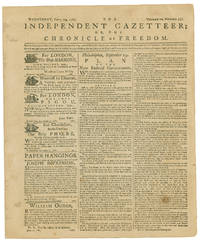
178721085.99<p>"<i>We the People of the United States…</i>"</p><p>This rare complete printing of the Constitution appeared on the first day it was publicly available Wednesday September 19 1787. That same morning the Constitution was published by four other papers the <i>Pennsylvania Packet and Daily Advertiser</i> <i>Pennsylvania Journal Pennsylvania Gazette</i> and <i>Freeman's Journal.</i> The <i>Independent Gazetteer</i>is unique in that it is the only one of the five first-day printings whose type was evidently not used to print another stand-alone edition.</p> <b>U.S. CONSTITUTION.</b>Newspaper. <i>The Independent Gazetteer or the Chronicle of Freedom</i>. Philadelphia: Eleazer Oswald September 19 1787. 4 pp.<p><b><br /></b></p><p><b>Historical Background</b></p><p>This issue of <i>The Independent Gazetteer and Chronicle of Freedom</i> a daily Anti-Federalist newspaper prints the "<i>Plan of the New Federal Government</i>" in full followed by the Federal Convention's resolution submitting the Constitution to Congress and the accompanying transmittal letter. All three are signed in type by George Washington as president of the Convention.</p><p>The Constitution was approved by the Convention on Monday September 17. The text of the official version was set that evening and a very limited number were printed for the use of the delegates. After being drafted in complete secrecy the Constitution was first made public on the morning of Tuesday September 18 when it was read before the Pennsylvania General Assembly. The next morning Wednesday September 19 the five newspapers mentioned above all published the Constitution. It is often assumed that the <i>Pennsylvania Packet</i> was the first public printing as the publishers Dunlap and Claypoole were the official printers to the Constitutional Convention. In fact there is no evidence that the <i>Packet</i> actually was published first or appeared on the streets of Philadelphia that day any earlier than its four rivals. All five are considered first editions with surviving copies of the <i>Packet</i> the most common.</p><p>The dissemination of the Constitution in newspapers is of considerable interest and importance as it was through this medium that most Americans became familiar with the new form of government proposed by the Convention. One careful researcher Leonard Rapport of the National Archives has identified four Philadelphia newspapers which also carried the text of the Constitution on the same day this was after all news of the highest importance and one the Philadelphia <i>Evening Chronicle</i> which may <i>hypothetically</i> have carried the text in an issue dated 18 September "Printing the Constitution" pp. 69-90. But to date no copy of the <i>Evening Chronicle</i> of that date is known to be extant see Rapport's other article "Newspaper Printings of the Constitution".</p><p>The <i>Pennsylvania Packet</i> printing has been accorded primacy for two principal reasons. First the <i>Packet</i>was printed by John Dunlap and David C. Claypoole official printers to the Convention itself. Together as partners or separately Claypoole may originally have been a junior partner they had printed nearly everything issued by Congress since 1775 including the 1776 Declaration of Independence. Second with the exception of the Constitution's six-line preamble "We the people…" the text is <i>entirely printed from the same setting of type used for the official Congressional printing.</i>As Rapport notes the 5000 words of the Constitution represented "nearly one man-day of composition time" for the printer so sensibly to make use of the wider margins of the <i>Packet's</i> larger sheets they reset the preamble in large type with a large capital "W" below the masthead and simply reimposed the rest of their standing type to fit onto the paper's four larger-size pages. The case might be summed up by emphasizing that the present <i>Pennsylvania Packet</i> text of the Constitution was struck from the identical setting of lead type that had printed the sheets of the official Congressional printings sheets that Jacob Shallus calligrapher used when he copied onto parchment the engrossed document to which the delegates signed their names.</p><p>"By October 6 only twenty days after the Federal Convention at least fifty-five of the approximately eighty newspapers of the period had printed the.Constitution." Rapport "Printing the Constitution" p.89. With the text of the Constitution before the people thanks to a free press the great debate on its ratification would begin a debate which continued until ratification by the original thirteen states was completed in 1790 and culminated in 1791 by the adoption of the Bill of Rights. Despite the tremendous changes since 1787 in the nation and the people governed by the Constitution Bernstein meaningfully notes "the evolution of American politics and society continues to be shaped by the Constitution and by the principles and doctrines built into it by the men who drafted it. That the Constitution has worked as well as it has is a tribute to its flexibility and to the foresight of those who created it. That it may still be defective or capable of improvement is a challenge to us to equal the courage imagination and versatility of the Revolutionary generation of Americans" <i>Are We To Be A Nation</i> p.272.</p> Eleazer Oswald books
170428809le croisic 1704 1 document de 4 pages (1 feuillet plié en deux) manuscrites à l'encre brune sur papier vergé ligné et filigrané " , format : 33 x 21 cm, signature in-fine : Chessée, Notaire royal à guerande) , QUITANCE DE FRANCHISSEMENT POUR LE SIEUR JULIEN RIELLE, MAITRE DE BARQUES, VEUF DE JEANNE RENEE LARAGON, PORTANT CONSTITUTION D'UNE RENTE AU PROFIT DE SES HONORABLES BELLE-FILLES : JEANNE ET CATHERINE MICHEL, DE CINQ CENT LIVRES DE PRINCIPAL, FAIT AU CROISIC, LE 30 OCTOBRE 1704,
1774125857(Rostock), 1774. 4to. 68 S. Rückenfalz.
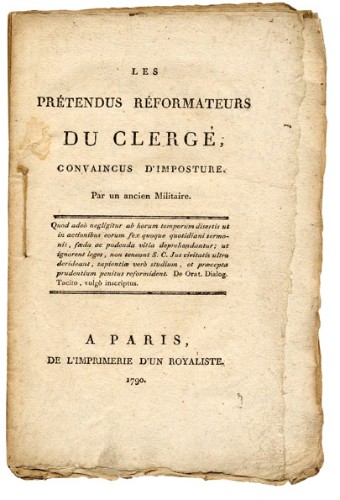
179011282Paris, Imprimerie d'un Royaliste, 1790 ; in-8, broché ; 59 pp.
175017161750 s.n., Brest (Amsterdam), 1750. In-12, plein veau porphire, dos orné.(xiv), 211 pages
17863327131Poson, Landerer, 1786. 3 nn. Bl., 122 S. Leder der Zeit.
1766631287Neapel, Pasquali, 1766. 383 S. Halbpergament d. 19. Jahrhunderts mit Rückenschild (etwas berieben). [2 Warenabbildungen]
1724CCC-17763. Edition Villefranche, Philalete Belhumeur, 1724. 2 tomes en 1 volume, in-8, demi-basane frottée, dos à 5 nerfs. Frontispice, 1 figure hors texte, il n y a pas de planche dépliante représentant le Jeu de la Constitution, photo possible
179111994RELIE ENSUITE : Opinion de M. Salle, député du département de la Meurthe, sur les événements du 21 juin 1791, prononcée à la tribune de l’Assemblée à la séance du 15 juillet. RELIE ENSUITE : Opinion de M. Barnave, prononcée à la séance du 15 juillet. Ensemble in-4, broché ; Bourg, Imprimerie C.C.G. Philipon, (1791) ; 16 ; 15, (1 bl.) ; 20 pp.
1737488323Leipzig, Lanckisch, 1737. 11 Bl., 534; 393 S. Mit gestochenem Frontispiz. Pergament d. Zeit mit goldgeprägtem Rückentitel (etwas fleckig). [3 Warenabbildungen]
1767309408Göttingen, Vandenhoeck, 1767. 8nn. Bl. 254 S. Neuer Pappband.
173576134Wittenberg u. Leipzig, Eichsfeld, 1735. 4to. 3 Bl., 194 S. Halbpergament d. Zeit mit handschriftlichem Rückentitel (leicht berieben). [2 Warenabbildungen]
1792G51643s.l., s.d. [1792] 3e deel (van 3): 248pp., titelblad (& voorwoord?) ontbreekt, 21cm., wat vlekjes, [bevat volgende hoofdstukken : Vereeniging der drie ordens des rijks in eene algemeene nationale vergadering, Beraadslagingen der Algemeene nationale vergadering over de daarstelling eener verbeterde constitutie, Vlugt der koninklijke familie met de gevolgen van dien, Vaststelling der Fransche constitutie met de plegtige aanneeming door den koning, en het scheiden der eerste nationale vergadering]
179124532Paris MERCURE DE FRANCE 1791 -in-12 broché un journal (original d'époque), broché bleu-gris in-douze Editeur (paperback duodecimo editor)(19 x 11,5 cm), dos muet, couverture imprimée en noir, brochure d'origine non rognée, texte imprimé sur papier velin, ligné et filigrané, sans illustrations (no illustration), mouillures anciennes, couverture fanée, pagination (17ff. chiffrées de la page 123 à la page 156 et 41 ff. chiffrées de la page 253 à la page 336), Journal du samedi 24 Septembre 1791 (n°39) Paris MERCURE DE FRANCE Editeur,
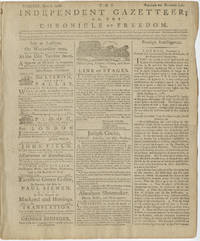
178830007.003Philadelphia PA 1788. No binding. Fine. Independent Gazetteer; or The Chronicle of Freedom. Newspaper. Independent Gazetteer; or The Chronicle of Freedom Philadelphia Pa. May 6 1788. 4 pp. 9 1/2 x 11 1/2 in. The Maryland ratifying convention suggests some amendments along with their approval of the Constitution. ExcerptsFrom page 3:""From the MARYLAND GAZETTE or April 29 1788. The CONVENTION of this state on Saturday last determined to ratify the proposed plan of Federal Government. -YEAS 63 NAYS 11-And then appointed a committee of thirteen members to consider and report amendments to be recommended to the people. -The following amendments were proposed by a member and referred to the committee who are now sitting-And it is hoped that the great and essential rights of the people will be declared and secured.- PROPOSED AMENDMENTS.Wherefore whenever the ends of Government are perverted and public liberty manifestedly endangered and all other means of redress are ineffectual the people may and of right ought to object to reform the old or establish a new Government-that the doctrine of nonresistance against arbitrary power and oppression is absurd slavish and destructive of the good and happiness of mankind. All imposts and duties laid by Congress shall be placed to the credit of the state in which the same be collected. That there shall be no national religion established by law; but that all persons be equally entitled to protection in their religious liberty. That the Supreme Federal Courts shall not admit to fictions to extend its jurisdiction; nor shall citizens of the same state having controversies with each other be suffered to make collusive assignments of their rights to the citizens of another state for the purpose of defeating the jurisdiction of the State Courts; nor shall any matter or question already determined in the State Courts be revived or agitated in the Federal Courts. That Congress have no power to lay a Poll-Tax. That the people have a right to freedom of speech of writing and publishing their sentiments and therefore that the freedom of the PRESS ought not to be restrained and the printing presses ought to be free to examine the proceedings of Government and the conduct of its officers.""From page 2: Protesting the Slave Trade by Boycotting West Indian Produce""A CAUTION.WHEREAS in the year 1787 some vessels were fitted out at the port of Philadelphia for the iniquitous purpose of stealing the inhabitants of Africa from all the endearments of domestic life; one of which vessels has succeeded in obtaining a number of poor blacks and has taken the to a port in the West Indies where they are under the iron hand of oppression. From this shameful traffic this horrid source the proprietors of the vessel have purchased some West India produce which after landing at Wilmington they have brought up to this city and offered for sale. It is a grateful circumstance to the supporters of the common rights of mankind that the virtuous inhabitants of the city reprobate the horrid idea.-A correspondent hopes that the citizens will further testify their disapprobation of the practice by turning with indignation from the purchase of any property thus basely procured by men so lost to the common feelings of humanity; notwithstanding the patriotic convention at which Washington presided have declared that this abominable traffic shall be continued for TWENTY years by the people of America.From page 1:An advertisement with engraving for a ""Line of Stages"" between Philadelphia and New York started by four partners who split off from an established stage line and promising better service. From page 4:An advertisement for another different ""New Line of Stages."" And a report on the creation of a Philadelphia committee for the relief of the nearly 100 Americans captured by Algerian corsairs and Barbary pirates. unknown books
178830007.003Philadelphia PA 1788. No binding. Fine. Independent Gazetteer; or The Chronicle of Freedom. Newspaper. Independent Gazetteer; or The Chronicle of Freedom Philadelphia Pa. May 6 1788. 4 pp. 9 1/2 x 11 1/2 in. The Maryland ratifying convention suggests some amendments along with their approval of the Constitution. ExcerptsFrom page 3:""From the MARYLAND GAZETTE or April 29 1788. The CONVENTION of this state on Saturday last determined to ratify the proposed plan of Federal Government. -YEAS 63 NAYS 11-And then appointed a committee of thirteen members to consider and report amendments to be recommended to the people. -The following amendments were proposed by a member and referred to the committee who are now sitting-And it is hoped that the great and essential rights of the people will be declared and secured.- PROPOSED AMENDMENTS.Wherefore whenever the ends of Government are perverted and public liberty manifestedly endangered and all other means of redress are ineffectual the people may and of right ought to object to reform the old or establish a new Government-that the doctrine of nonresistance against arbitrary power and oppression is absurd slavish and destructive of the good and happiness of mankind. All imposts and duties laid by Congress shall be placed to the credit of the state in which the same be collected. That there shall be no national religion established by law; but that all persons be equally entitled to protection in their religious liberty. That the Supreme Federal Courts shall not admit to fictions to extend its jurisdiction; nor shall citizens of the same state having controversies with each other be suffered to make collusive assignments of their rights to the citizens of another state for the purpose of defeating the jurisdiction of the State Courts; nor shall any matter or question already determined in the State Courts be revived or agitated in the Federal Courts. That Congress have no power to lay a Poll-Tax. That the people have a right to freedom of speech of writing and publishing their sentiments and therefore that the freedom of the PRESS ought not to be restrained and the printing presses ought to be free to examine the proceedings of Government and the conduct of its officers.""From page 2: Protesting the Slave Trade by Boycotting West Indian Produce""A CAUTION.WHEREAS in the year 1787 some vessels were fitted out at the port of Philadelphia for the iniquitous purpose of stealing the inhabitants of Africa from all the endearments of domestic life; one of which vessels has succeeded in obtaining a number of poor blacks and has taken the to a port in the West Indies where they are under the iron hand of oppression. From this shameful traffic this horrid source the proprietors of the vessel have purchased some West India produce which after landing at Wilmington they have brought up to this city and offered for sale. It is a grateful circumstance to the supporters of the common rights of mankind that the virtuous inhabitants of the city reprobate the horrid idea.-A correspondent hopes that the citizens will further testify their disapprobation of the practice by turning with indignation from the purchase of any property thus basely procured by men so lost to the common feelings of humanity; notwithstanding the patriotic convention at which Washington presided have declared that this abominable traffic shall be continued for TWENTY years by the people of America.From page 1:An advertisement with engraving for a ""Line of Stages"" between Philadelphia and New York started by four partners who split off from an established stage line and promising better service. From page 4:An advertisement for another different ""New Line of Stages."" And a report on the creation of a Philadelphia committee for the relief of the nearly 100 Americans captured by Algerian corsairs and Barbary pirates. unknown
178769121London: Sold by T. Wilkie 1787. UNITED STATES CONSTITUTION. The London Chronicle "The New Plan for the Constitution of the United States of America". Vo. LXII. No. 4834-4835. From Saturday October 27 to Tuesday October 30 1787 and From Tuesday October 30 to Thursday November 1 1787. Pages 409-424. London: Sold by T. Wilkie 1787.<br> <br> Likely the first public printing of the United States Constitution in England. This newspaper printing precedes the know first edition pamphlet published by Debrett as well as the first magazine printing in "The Gentleman's Magazine." It is broadly stated that news of the United States Constitution hit England early in November however the dates of the Chronicle precede this by a few days. This copy also contains the preliminary cover letter from George Washington to the president of Congress which is usually included with early printings of the Constitution and which states Washington's strong support of ratification. "The Plan" is printed in its entirety without comment or explanation from the publisher.<br> <br> Together two issues no. 4834 and 4834. Each issue self bound along left margin. 11 3/8 x 8 5/8 inches; 288 x 222 mm. Number 4834 is four leaves pages 409-416 and number 4835 is four leaves pages 417-424. The first part of the Constitution is printed on pages 413-414 of the first part with the end stating "To be concluded in our next" and the second part is printed on pages 420-421. Both issues very good with just some slight toning. Page 421-422 trimmed close at top margin just touching header. A small red stamp on verso of first leaf of each issue along bottom margin. Overall about fine. We could find no other copies of this or any earlier British newspaper containing the US Constitution on Rare Book Hub. We could not locate any copies on OCLC or ESTC. Housed in a custom quarter red morocco clamshell.<br> <br> At the time of the Constitutional Convention John Adams was living in England as a diplomat. In a letter to John Adams from Elbridge Gerry dated September 20th 1787 just one day after the first newspapers in America printed the Constitution he states "The proceedings of the Convention being this day published I embrace the Oppertunity of transmitting them by a Vessel which is to sail this morning for London." According to the National Archives "Gerry enclosed a copy of the new U.S. Constitution. Gerry likely sent this letter to John Adams via the Prince George Capt. Strong which departed New York City in late September and arrived in London on 3 Nov. New York Independent Journal 1 Sept. 1787 2 Feb. 1788." This shows that it would have been impossible for news of the Constitution to arrive in England much before this date of November 3rd. Lengthy searches turn up no indication that any other British publication has a copy of the US Constitution before this London Chronicle printing. The National Archives go on to state "The U.S. Constitution was adopted on 17 Sept. 1787 and British newspapers first published the text in late autumn. The London Chronicle printed the preamble and the first article in its 27-30 Oct. issue and the remaining articles and signatures in its 30 Oct. - 1 Nov. issue. "<br> <br> The London Chronicle was a thrice weekly newspaper also known for being " one of the first to break the news that the United States had declared independence from the British Empire reporting on the event in its 13 August 1776 edition. It was also one of the first to publish the declaration in its entirety in the 15-17 August 1776 edition but containing no explanation or comment as to what it was" Wikipedia. This holds true for their publication of the Constitution as well.<br> <br> United States Constitution now the longest continuing charter of a national government in the world and "the product of a revolution in political thought at least as important and far-reaching as the winning of American independence from Great Britain and the culmination of the intellectual ferment and political experimentation in the new republic" Richard B. Bernstein Are We to Be a Nation.<br> <br> HBS 69121.<br> <br> $20000. Sold by T. Wilkie unknown
179710214Paris, An V, in-16, 106 pp., 1 f., broché, couverture muette d’origine. (rousseurs). (C1).