Sington, Derrick; Weidenfeld, ArthurMareMagnum

4 064 résultats
260 pages. Index. List of main sources. Black and white photographic plates. Organizational chart of the German Broadcasting Company (RRG) in 1942 and its links to the Ministry of Propaganda. Organizational chart of the Ministry of Public Enlightenment and Propaganda in 1942. "The first complete account of the gigantic propaganda organization of the Third Reich. Reveals and describes: The inner workings of the Nazi propaganda organization; The network of Party speakers; The German radio's war effort; The Nazi press system; The German stage and screen in 1942; Propaganda for the armed forces; The men in control. Access to unique German documentary material and an intimate knowledge of German wartime broadcasting and of the Nazi press have enabled the authors to paint a full-length picture of Hitler's political warfare machine." - dust jacket. Printed to wartime standard, apparently without a front free endpaper. Unmarked with average wear and soiling to publisher's canary yellow cloth. Average wear and half-inch of loss to decorated orange dust jacket at top of spine. Binding sound. A quality vintage copy of this vital and incisive wartime study. KEHR & LANGMAID 2950. Book
32 pages. This issue is twice as long as previous issues due to its blockbuster treatment of "The Case of Belgium" with reproductions of documents incriminating to Belgium. Features: The (New York) "Times" in Despair; Irish Home Rule Bill; Government Control of Public Utilities, by Frank Koester; "I Protest", by Clara Viebig - one of the foremost novelists of Europe; We Demand Real Neutrality; What is an American German?, by Representative Richard A. Bartholdt of Missouri; The Case of Belgium - In the light of official reports found in the secret archives of the Belgium Government after the occupation of Brussels with facsimiles of the documents - a major article; cartoon shows a German dog being taken before an English firing squad; England's Embarrassment is Ireland's Opportunity; and more. Unmarked. Average wear. Binding intact. A sound copy. Magazine
316 pages. Published in cooperation with The Emergency Committee for Reappraisal of U.S. Overseas Policies and Programs, and The Overseas Press Club Foundation, Edward R. Murrow Memorial Fund. In light of the communications revolution of the last fifty years, this work addresses the urgent need for the U.S. Overseas Information Agency (USIA) to "be brought into line with changed political conditions, the new techniques of communication, and the findings of social scientists." - from Preface. Moderate wear. Binding intact. Usual library markings. A sound copy. Book
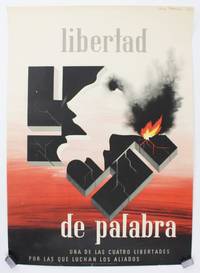
19424754Washington DC: El Coordinador de Asuntos Interamericanos 1942. Very good. Pictorial lithograph 20 x 14.25 inches printed in red gray yellow and black. Minor surface wear mild creasing light dust-soiling a few pinholes. A rare poster issued by the Office of the Coordinator of Inter-American Affairs CIAA during World War II attempting to sway public opinion in Latin America to the Allied side. The CIAA was established by executive order in July 1941 in order to distribute news advertising film reels and more to and from Latin America to counter Italian and German propaganda campaigns in the region. The text of the present poster translates from the Spanish as "Freedom of Speech. One of the four freedoms for which the Allies are fighting." The central image features an open-mouthed face breaking open a large swastika which is itself on fire. A mildly subtle message that free speech destroys fascism. The poster was designed by noted Russian-American graphic designer and photographer Alexey Brodovitch whose printed credit appears at top right; Brodovitch is most well-known for his art direction of Harper's Bazaar from 1934 to 1958. A powerful visual display with only one copy reported in OCLC at MOMA though we also find two other institutional holdings at the United States Holocaust Museum and the Hoover Institute. El Coordinador de Asuntos Interamericanos unknown
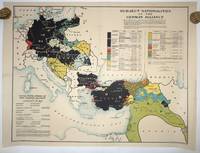
191728118London: Stanford's Geographical Establishment 1917. First printing. Map. Fine condition. A large format map illustrating the geopolitics of Europe after W.W.I. Intended to persuade viewers about the threat presented by the Central Powers of Germany Austro-Hungary Bulgaria and Turkey it color-codes them in black to emphasize the danger they might pose to the fledgling League of Nations. <br /> <br /> The solution is stated on the map which quotes from the Allies' war aims as articulated to President Wilson in 1916: "The civilized world knows that the aims of the Allies include-the reorganization of Europe guaranteed by a stable settlement based alike upon the principle of nationalities and on the right which all peoples whether small or great have to the enjoyment of full security and free economic development."<br /> <br /> The efforts to secure the peace in Europe dictated the division of nations cultures and tribes has continued to plague the world for over 100 years sellers' opinion. These groups include Greek pockets within Turkey Armenians in three pockets and Kurds Arabs which includes Jewish Colonies in Palestine. Also of note and marked on the map are the "Expropriations of the German Ansiedelungs Commission" an 1886 German proclamation that allowed Prussian settlers to appropriate Polish sovereign land. <br /> <br /> Printed at The Dangerfield Printing Co. Ltd. OCLC 9876563; Persuasive Maps: PJ Mode Collection #1188. Color lithograph 28" x 36 1/2". Backed on acid free linen supporting some tiny closed splits along the central & one other fold with one triangle of added margin not affecting the map. Very bright color and overall in very good condition. Stanford's Geographical Establishment unknown
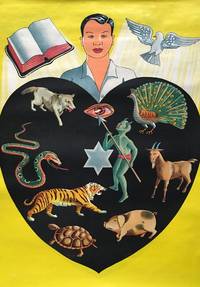
44944Kowloon Hong Kong: Christian Witness Press n. d. C. 1970s. Attached at the top-edge with maroon tape. A very good set still very bright with some minor occasional tears/creases and a faint spot of foxing here and there; overall a VG set. Seven broadsides printed in color. 30-1/4" x 21" <br/><br/>These posters were said to bring the viewer closer to God especially when viewed in sequence. Five of the posters depict a man's face with a different countanence affected by the large heart beneath him. "This wordless poster series builds entirely on symbols to communicate its message about human need struggle and salvation. The likely venue for use of the poster was in small church or evangelism meetings or on street corners. These and similar posters were used to explain the need for salvation Christian discipleship and sanctification" per Wheaton College bulletin 1610. The animals are likely representative of the seven deadly sins the book symbolizes the Bible the dove is the Holy Spirit the cross is Christ's sacrifice for mankind the six-pointed star representing God's Law. The placement of these symbolic images in or out of the heart in conjuction with the two posters that depict the death of a Christian vs. a non-Christian make for a highly affective and eye catching allegorical puzzle. Christian Witness Press unknown books
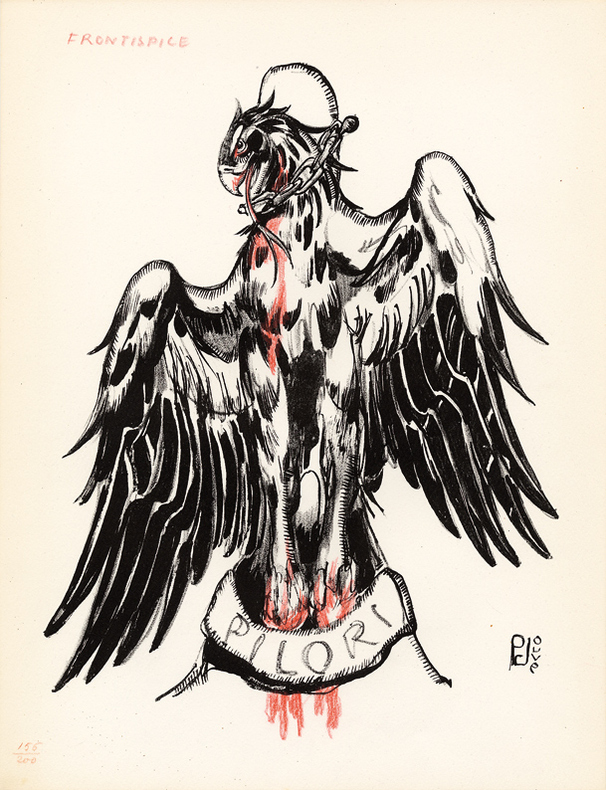
194514742Paris, La Lithographie, 1945 ; in-folio en ff., chemise caramel à rabats illustrée_; (4) pp. (texte de Jacques-Noir, poésie de René Fauchois et table) ; frontispice, couverture et 41 planches lithographiées sur vélin fort, numérotées à la main, la plupart avec titre manuscrit et signature autographe.
18674080S.l., s.n., s.d. ; in-16 (95 x 132 mm), 16 pp. imprimées sur papier pelure (poids : 3 grammes).
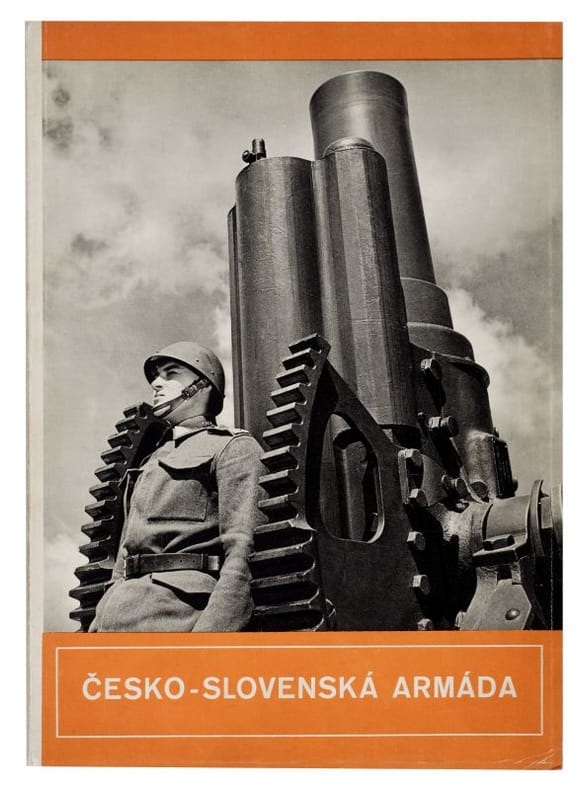
19381014111938 Prague, publié par le Ministère de la Défense, 1938, 295x210mm, pleine toile de l’éditeur, jaquette photographique, étui original en carton imprimé. Brochure originale d’hommage de l’éditeur au nom du Capitaine Kliment Bombera.Texte de Jiri Letov, Jiri Jenicek et Vladimir Pacak. L’illustration comprend 80 photographies pleine page reproduites en héliogravure ; légendes en tchèque, allemand, français et anglais. Photographies de Jiri Jenicek, conception graphique de Ladislav Sutnar. Formé avec le pictorialisme, Jiri Jenicek devient rapidement un ardent défenseur de la Nouvelle Photographie et collabore aux principaux mouvements d’avant-garde tchèques; de 1918 à 1948 il exerce dans l’armée ou il réalise de nombreux courts métrages et publie plusieurs ouvrages à thème militaire. Ladislav Sutnar, formé dans l’avant-garde tchèque des années 20 y apparaît d’emblée comme un graphistes des plus importants ; il participe aux expositions Pressa Cologne 1928, Barcelone 1929, Stockholm 1931, Milan 1936, Paris 1937 ; il émigre à New York en 1938 où il travaille pour la World’s Fair ; il y fonde une Ecole d’Arts Graphiques et la firme Sutnar and Hall, spécialisée dans le packaging. Birgus, Czech Photographic Avant-Garde p.295. Exemplaire neuf. (101411)
Very Good Turkish Original artwork in watercolor, Indian ink, and dry paint. 11,5x9,5 cm. This rare original artwork of Mary and Jesus comes along an exceptional provenance of Turkish cartoonist Semih Balcioglu (1928-2006), with his handwritten note on verso "Cemal Nadir'in bir kompozisyonudur" [i.e. It's composed by Cemal Nadir]. Signed on right lower as "C. N". Unpublished work. Cemal Nadir was a Turkish cartoonist. He was born in Bursa, Ottoman Empire on 13 July 1902. His father Sevket was a calligrapher (Turkish: Hattat) employed in courts. After finishing high school, he began working as a sign painter in Bursa. He also created cartoons, and his first cartoon appeared in Diken (literally: "The Thorn") periodical. Although he moved to Istanbul and tried to be a full-time cartoonist, he could not make it and he returned to Bursa. The Alphabet reform of 1929 gave Cemal Nadir a second chance to show his talent. When Turkey adopted the Latin alphabet replacing the Ottoman Turkish alphabet in Arabic script, all sign boards were necessarily changed, and he worked hard to meet the demand. The same year, he moved once more to Istanbul to work for the daily Aksam. Later, he also drew for the newspaper Son Posta, as well as for satirical magazines such as Akbaba. He also contributed to Yedigün. During this period, he published the satirical magazine Amcabey. During World War II, he drew anti-Nazism cartoons in the daily Cumhuriyet. In 1946, Republican People's Party (CHP) invited him to run for a seat in the parliament. However, he refused the invitation, he said that with political affiliation he would not be able to create cartoons.
Very Good Turkish, Ottoman (1500-1928) Contemporary (early 19th century) quarter brown cloth with marbled boards, "Yahudi ebrûsu" end-papers. Roy. 8vo. (23 x 16 cm). In Ottoman script (Old Turkish with Arabic letters). 90 p., numbered with Arabic numeric system in pencil, around seven illustrated schemes of magical diagrams. Written on a probably 17th-18th century European paper with "Crescent" watermark, naskh script with "harakât", black and red ink. Early and a rare posthumous manuscript copy of this 18th-century Islamic majmua, containing the treatment methods and drug compositions against physical and spiritual diseases, with material and magical suggestions, copied 32 years after the author's death by a "Hafiz" with an addendum of new drugs and treatments compiled from older annotations of this work. "In the first part of the work on spiritual medicine, verses, prayers, talismans, and magic formulas in the Islamic culture like "wafqs" that are believed to be treated; in the second part, on physical medicine, drug formulas from various material objects for physiological diseases are shown." (Çagrici). Harputî was an 18th-century poet and prose from Harput (Kharberd). In the introduction to the manuscript, he stated that he is not a doctor, but that he writes practices that can heal patients due to his experiences. Despite this, the text was widely used in Ottoman medicine in the 18th and 19th centuries.
Very Good English Paperback. Propaganda booklet. Demy 8vo. (21 x 15 cm). Bilingual edition in English and Turkish. 114, [2] p., fully b/w color ills., and one special sticker of National Japan Floating Fair '76. Shin Sakura Maru (IMO: 7129087) is a Passenger Ship that was built in 1972. She was set up as a floating trade fair, but also doubled as a cargo ship. She was used for propaganda and the progress of the Japanese industry worldwide. This propaganda booklet is printed in Japan and was distributed by her. This is an extremely rare Turkish Edition. It includes rich color illustrations showing the social life, industry, educational system, sports, tourism, and social collaboration in Japanese country. The narrator in the text conveys Japan through the mouth of 'I'. Not in OCLC.; Not in Japanese and Turkish National Libraries. Extremely rare.
Very Good Turkish Paperback. Propaganda booklet. 4to. (28 x 21 cm). Edition in Turkish. [12] p., full of color ills. Shin Sakura Maru (IMO: 7129087) is a Passenger Ship that was built in 1972. She was set up as a floating trade fair, but also doubled as a cargo ship. She was used for propaganda and the progress of the Japanese industry worldwide. This propaganda booklet is printed in Japan and was distributed by her. This is an extremely rare Turkish Edition. It includes rich color illustrations showing the social life, industry, educational system, sports, tourism, and social collaboration in Japanese country. The narrator in the text conveys Japan through the mouth of 'I'. Not in OCLC.; Not in Japanese and Turkish National Libraries. Extremely rare.
44942Kowloon Hong Kong: Christian Witness Press n. d. C. 1970s. Attached at the top-edge with maroon tape. A very good set still very bright with some minor occasional tears/creases and a faint spot of foxing here and there; overall a VG set. Five broadsides printed in color. 30-1/4" x 21" <br/><br/>These posters were said to bring the viewer closer to God. The images progress much like a graphic novel beginning with two figures at the edge of a cliff on the other side is paradise and at the bottom of the divide is a pit of flames. The male figure tries to build a wooden bridge but it fails and falls into the pit. After he glimpses a heavenly vision of the baby Jesus a red cross springs from the flames to bridge the divide into Paradise. Viewed in sequence they evoke a striking allegory for reaching paradise by accepting Christ into your heart. Christian Witness Press unknown books
1934259329München, Zentralverlag der NSDAP, Franz Eher, 1934.
In-8°, 30pp, una tavola ripiegata, legatura in carta semplice, intonso In-8°, 30pp, one folded plate, paper binding, uncut.
In-8°, XVI, 138, una tavola ripiegata, legatura in carta semplice, intonso In-8°, XVI, 138, one folded plate, paper binding, uncut.
219 pages. "When first published in 1923 this work became the first book-length discussion of the scope and function of professional public relations and of its practitioner, the counsel on public relations." - from Preface. Bernays has subsequently come to be known as the 'Father of Spin'. Light wear. Library markings upon each edge of text and title page. Pocket removal markings inside each board. Front endpaper removed. Front hinge open. Cole p.27, Larson 7, Lasswell, Casey & Smith p.32 Book
16 pages. Features: Are Hyphenated Citizens Good for American?; Who Are Americans?; A Congressman Who is Not Afraid - Representative Joseph Taggart of Kansas Assails Harper's Weekly for its abuse of Germans; Hartelpool Well Defended; Brave American Actress - Fern Rogers; Honesty is the Best Policy (Part 2 of 2), by Aleister Crowley - a remarkably forcible exposition of the hypocrisy of his countrymen; The Greatest Secret of German Progress, by Frank Koester; The Division of the Nation's Forces, by Dr. Hanns Heinz Ewers - a keen analysis of the actual condition and strength of the armies at war; English Schemes against German and German-American Insurance Companies; American "Neutrality Notes"; England's Note - Refusal to safeguard American seagoing commerce; England Decadent - Fair-Minded Englishmen and Americans in London express their disgust; Jerome K. Jerome Protests Against the Infamous Treatment of English Citizens of German Birth; Advertising Talk - persuading neutral companies to advertise in this 'publication of class'; The Turks at the Suez Canal; Violation of Property Rights of Foreigners in France; Back cover is a full-time request for readers to convert their spare time into dollars by working for this publication; and more. Unmarked. Average wear. Binding intact. A sound copy. Magazine
1960217261Circa1960s. Collection of five colour-printed Nianhua posters each of the central images onlaid within a stiff red paper border with a thin cream paper frame worn and discoloured and at the top of each a fine aqua paper border; the sheets a little creased two images with a visible tide-mark minor edge tears not affecting the images strengthened neatly on the verso with washi one with an early paper repair to the top margin all approx. 93 x 51.5cms sheet size in good condition. Five examples of "new" Nianhua posters dating from the Great Leap Forward all featuring babies and children symbolizing happiness prosperity and the promise of a thriving future. In one a sister braids her hair whilst minding her crawling toddler brother "Sweet Heart". On the wall a poster proclaiming the industrialisation of agriculture "Agriculture is the foundation of the national economy and grain is the foundation" caption; in another five toddlers dance in a circle their flags and lanterns captioned "The Great Leap Forward" and "Long Live Mao". Ephemeral examples of folk art and the use to which it was put for political purpose. . unknown
193554479[s. l.]: [s. n.] 1935. 77 S. ; 8° [Umschlagt.] Broschiert, Seiten alters- und papierbedingt gebräunt, sonst guter Zustand
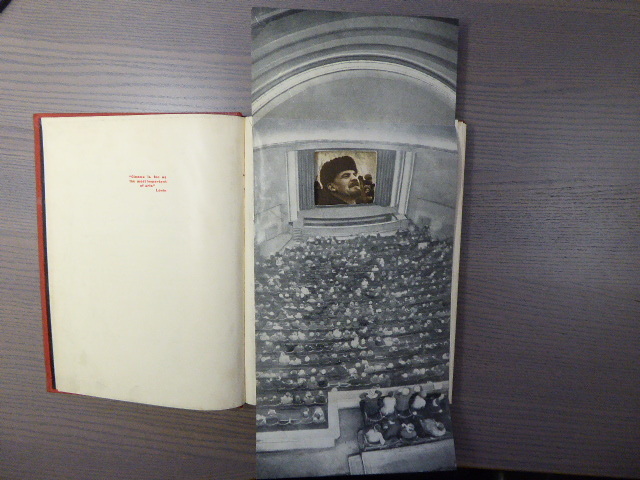
327878A. Arossev Moscou 1935 In-4 carré ( 270 X 200 mm ) de 306-XVI pages, demi-basane rouge et plats illustrés de l'éditeur. Très nombreuses photographies dans et hors-texte. Design et photographies par Alexandre RODCHENKO et Varvara STEPANOV. Texte en anglais. Bien complet de la célèbre image rempliée du public d'un cinéma devant un grand écran avec un découpage laissant apparaitre la tête de LENINE, ainsi que la fragile illustration de celluloïd légendée avec profil argenté de STALINE. Très bel exemplaire.. ' 8 .!"!>25BA:>5 :8=>. . @>AA52. $>B>3@0D88 8 >D>@< 5=85 @01>BK 5:A0=4@0 >4G5=:> 8 0@20@K !B5?0=>2>9. >A:20, 1935 3. 00=3 89A:>< O7K:5. 306 AB@., 27x20,5 c<, >@838=0 L=K9 ?> C:>60=K9 ?5@5? 5B :@0A=>3> F25B0. %>@.A>B.
1937148450Diessen, Raumbild Verlag Otto Schönstein, 1937.
Very Good Arabic Original creme bdg. HC. Folio. (32,5 x 27 cm). Texts in Arabic with a bilingual title on verso of the cover in English and Arabic. [18] p., [15] unnumbered full paged color plates of the buildings in Jeddah separately tissue papers. Signed and inscribed in Turkish by Cidde emini [i.e. The Lord Mayor of Jeddah] Mohamed Said Farsi, dated 8.5.1984 to Turkish architect Selim Sabuncuoglu as 'Sayin Selim Sabuncuoglu, en güzel temennilerimle Jedda'dan bir hatira. Jeddah emini, Sait Farisi'. Sealed "YÜTAS: Construction Production Industry and Trade Co.". Dr. Mohammed Said Farsi, (1937-2019), was a former Lord Mayor of Jeddah, and a man of such aesthetic integrity that he traveled the world to meet with sculptors, painters, and musicians before replanning the city according to his own meticulously constructed vision. (Source: The Rake). Dr. Farsi was a visionary civic leader and philanthropist who is widely considered to be the father of modern Jeddah. He presided over a five-fold increase in the city's population, led its transformation, including creating the famous Jeddah corniche - a unique public space and an open-air gallery. Dr. Farsi, a noted art lover, was also the first mayor to introduce Western art and sculpture to an Arab city. He is survived by his son Hani Farsi and former wife Naglaa Asaad. Born in Makkah in 1937, Dr. M S Farsi qualified as an architect in Alexandria and returned to Saudi Arabia in the early 1960s. He entered government service in 1963 and rose rapidly. Just two years later he was appointed to the post of Planning Officer for the Western Region of Saudi Arabia. Covering an area larger than the United Kingdom and having within its boundaries the port city of Jeddah and the Holy Cities of Makkah and Medinah, this territory was in effect Saudi Arabia's window to the world and it was under Dr. Farsi's aegis that plans for these three cities were drawn up; given the immense significance of this work, Dr. Farsi liaised with the very highest levels of government. In 1972, Dr. Farsi became Mayor of Jeddah, a city that had grown from the historic walled city of his childhood to a large modern conurbation of more than 300,000 people. Until the middle of the following decade, Dr. Farsi presided over a period of spectacular and unprecedented growth for the city, which saw its population increase five-fold. That chaos was averted in the face of such a population explosion was due in no small part to Dr. Farsi's enlightened leadership. It is remarkable that in the midst of creating much-needed infrastructure, Dr. Farsi found time to create a city that was as beautiful as it was functional; with a carefully preserved historic center, gracious boulevards, and charming parks. A collector of Islamic and Western art, Dr. Farsi's vision as a city planner was to integrate important contemporary art into public spaces, thus enriching the lives of the inhabitants and reflecting the on-going cultural significance of the city, and his mayoralty is today remembered for its artistic flowering and for being at the forefront of design. Dr. Farsi made use of local artists and materials as well as commissioning works from many great Western masters, including Henry Moore, Victor Vasarely, Alexander Calder, Arnaldo Pomodoro, Joan Miró, Cesar Baldaccini, Sylvestre Monnier, Jean Arp, and Jacques Lipchitz, among many other stellar names in the international art world. He was the first mayor to introduce Western art and sculpture to an Arab city, as well as the first to display art that depicted the physical human form. At the time he stepped down, in 1986, Jeddah boasted over 400 pieces of public art. When he retired in 1986, Dr. Farsi returned to one of his primary passions - education. Within just one year he successfully qualified for his doctorate, attaining a Ph.D. from the University of Alexandria. (Source: Pressat).