4 064 résultats
Very Good Turkish, Ottoman (1500-1928) Original chromo-lithograph map on cloth. 63x98 cm. In Ottoman script (Old Turkish with Arabic letters). Chipped on extremities, some wear on folds, foxing, and stains on margins and cloth with small holes. Overall a good/fair copy. First separate edition of this rare and attractive chromo-lithographic map of the Imperial Ottoman lands in Europe, as well as the Bosphorus and Crete in separate panels, drawn by Turkish infantry major El-Hac Nasrullah b. El-Hac Nâsir from Daghestan, during the last period of the rule of Sultan Abdulhamid II, with praise to the Sultan. The map gives detailed information on the lower left telegraph and postal codes of the Imperial vilayats such as Bosnia, Bulgaria, Algeria, Egypt, and Tunisia, etc. Additionally, on the lower right, demographic statistics and data of vilayats and some cities. This rare map shows the complete Ottoman Balkans according to the Ottoman administral system. West Anatolia and West Black Sea Coats on the east, Adriatic coasts on the east, and Ottoman Greece, Bulgaria, Albania, and Bulgaria are included on the map. These countries are separated by Selanik (Thessaloniki), Roumeli, Monastery, Ioannina, Kosovo, and Shkodra vilayats.
Fine Turkish, Ottoman (1500-1928) Original wrappers. Roy. 8vo. (23 x 16 cm). In Ottoman script (Old Turkish with Arabic letters). [iii], 182 p., richly illustrated. First and only edition of one of the earliest and extremely rare Ottoman Turkish book on electricity published after the proclamation of the Republic in Turkey. It's a complete guide to electricity including how to install power plants, generators, and their working principles, etc. One of the most important breakthroughs of the regime in the Republican period was the delivery of electricity to many cities and villages of Turkey after the proclamation of the Republic. The electricity question and energy policies were also reflected in the propaganda material of the Republican regime. After the Alphabet Revolution in 1928, after the very few electrical books written in Ottoman Turkish, many books, posters, brochures, and periodicals were published, especially in the 1930s... Hasan Enver Pasha was an Ottoman general. He was the son of Mustafa Celalettin Pasha a Polish convert to Islam and the daughter of Omer Pasha. Besides he was an avid defender of the belonging of the Turkish race to the European white races. He married Leyla Hanim, a daughter of Mehmed Ali Pasha (marshal). They had five children: Celile who became the mother of Nâzim Hikmet, Münevver who became the mother of Oktay Rifat, Mustafa Celalettin, Mehmet Ali, and Sara. In 1901, he led an expedition to deliver Islamic and pan-Islamic messages to the Muslims of China. Özege 15207.; TBTK 12692.; OCLC 850834945 (Only one copy worldwide).
Fine Fine English Original brown imitation leather bdg. Dust wrapper. In publisher's special slip-case. Folio. (31 x 26,5 cm). Texts in entirely English, bilingual title on the slipcase in English and Arabic. 143, [1] p., fully color and b/w photos. Signed and inscribed in Turkish by Cidde emini [i.e. The Lord Mayor of Jeddah] Mohamed Said Farsi, dated 8.5.1984 to Turkish architect Selim Sabuncuoglu as 'Sayin Selim Sabuncuoglu, en güzel temennilerimle Jedda'dan bir hatira. Jeddah emini, Sait Farisi'. Sealed "YÜTAS: Construction Production Industry and Trade Co.". Dr. Mohammed Said Farsi, (1937-2019), was a former Lord Mayor of Jeddah, and a man of such aesthetic integrity that he traveled the world to meet with sculptors, painters, and musicians before replanning the city according to his own meticulously constructed vision. (Source: The Rake). Dr. Farsi was a visionary civic leader and philanthropist who is widely considered to be the father of modern Jeddah. He presided over a five-fold increase in the city's population, led its transformation, including creating the famous Jeddah corniche - a unique public space and an open-air gallery. Dr. Farsi, a noted art lover, was also the first mayor to introduce Western art and sculpture to an Arab city. He is survived by his son Hani Farsi and former wife Naglaa Asaad. Born in Makkah in 1937, Dr. M S Farsi qualified as an architect in Alexandria and returned to Saudi Arabia in the early 1960s. He entered government service in 1963 and rose rapidly. Just two years later he was appointed to the post of Planning Officer for the Western Region of Saudi Arabia. Covering an area larger than the United Kingdom and having within its boundaries the port city of Jeddah and the Holy Cities of Makkah and Medinah, this territory was in effect Saudi Arabia's window to the world and it was under Dr. Farsi's aegis that plans for these three cities were drawn up; given the immense significance of this work, Dr. Farsi liaised with the very highest levels of government. In 1972, Dr. Farsi became Mayor of Jeddah, a city that had grown from the historic walled city of his childhood to a large modern conurbation of more than 300,000 people. Until the middle of the following decade, Dr. Farsi presided over a period of spectacular and unprecedented growth for the city, which saw its population increase five-fold. That chaos was averted in the face of such a population explosion was due in no small part to Dr. Farsi's enlightened leadership. It is remarkable that in the midst of creating much-needed infrastructure, Dr. Farsi found time to create a city that was as beautiful as it was functional; with a carefully preserved historic center, gracious boulevards, and charming parks. A collector of Islamic and Western art, Dr. Farsi's vision as a city planner was to integrate important contemporary art into public spaces, thus enriching the lives of the inhabitants and reflecting the on-going cultural significance of the city, and his mayoralty is today remembered for its artistic flowering and for being at the forefront of design. Dr. Farsi made use of local artists and materials as well as commissioning works from many great Western masters, including Henry Moore, Victor Vasarely, Alexander Calder, Arnaldo Pomodoro, Joan Miró, Cesar Baldaccini, Sylvestre Monnier, Jean Arp, and Jacques Lipchitz, among many other stellar names in the international art world. He was the first mayor to introduce Western art and sculpture to an Arab city, as well as the first to display art that depicted the physical human form. At the time he stepped down, in 1986, Jeddah boasted over 400 pieces of public art. When he retired in 1986, Dr. Farsi returned to one of his primary passions - education. Within just one year he successfully qualified for his doctorate, attaining a Ph.D. from the University of Alexandria. (Source: Pressat). Jeddah: 'Bride of the Red Sea'. This is a cosmopolitan city, ancient and modern hub, the unique seat of civilis[.]. R
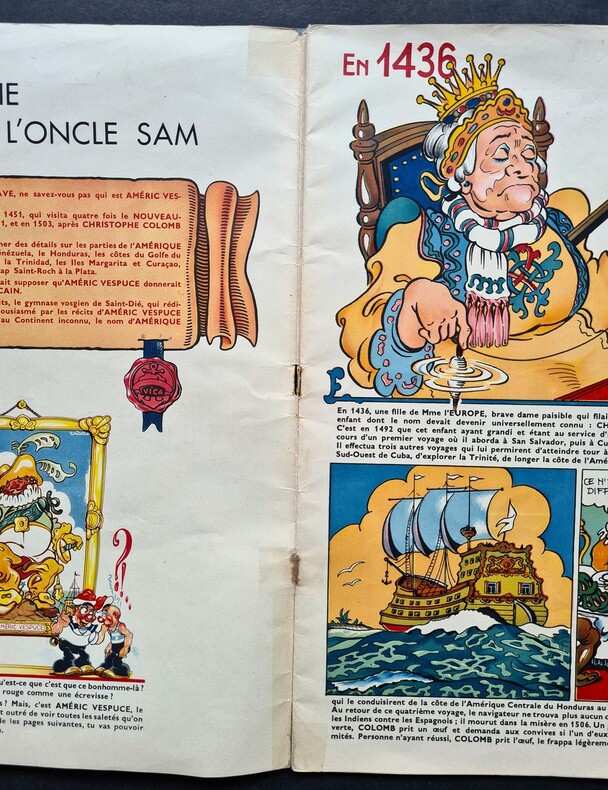
198720911Editions Coloniales et Métropolitaines 1942. In-8 agrafé de 28 pages au format 31,5 x 24 cm. Couvertures illustrées en couleur. Dos carré avec petits frottis. Plats et intérieur restés frais malgré des petits frottis et infimes plis aux bors et aux coins. Mors intérieur et bord du 1er plats avec rare renforcements au scotch invisible. Couverture, dessins en couleurs, photo-montages en noir et scénario de Vincent Krassousky dit Vica. Bel état génértal. Rarissime édition originale de cette bande dessinée de propagande pro-nazie. Vica, né a Kiev, de son vrai nom Vincent Krassousky, est le fils d’un officier de l’armée du Tsar, disparu en Bulgarie. Sa mère et sa soeur sont tués par les révolutionnaires bolcheviques, et lui, s’enrôle à l’âge de 16 ans, en 1918, dans l’Armée Blanche de Wrangel, où il participe, pendant 2 années, à la guerre civile russe avant de s’exiler en France. Vica est un dessinateur au trait coloré assez proche de Calvo. Il réalise des publicités pour " Yabon " et " Banania " et publie aussi des BD dans des illustrés pour la jeunesse autorisés par l’Occupant allemand. Il fait paraître en 1942, aux éditions Dompol, deux albums archétypaux de la propagande pro-nazie : Vica au paradis de l’U.R.S.S. et Vica contre les services secrets anglais, mais c’est à la Société des éditions Coloniales et Métropolitaines, toujours en 1942, qu’il fournit le plus rare de ces trois albums de propagande : Vica défie l’Oncle Sam. BD profondément anti-américaine et antisémite, l’album propose les aventures de son héros aux États Unis pendant la guerre, à grand renfort de caricatures et de photographies truquées. Certaines sources affirment que deux officiers allemands furent adjoints à Vica pour la réalisation de ces trois albums de propagande : l’un pour la correction des textes et l’autre pour la réalisation des photo truquées. À la fin de la guerre, Vica sera jugé, et condamné, pour ces activités de propagandiste, à un an de prison ferme, et à une amende de 1000 francs, ainsi qu' à l’indignité nationale. À sa sortie de prison, il reprendra son activité de dessinateur sous le pseudonyme de Tim dans le magazine Cadet Journal, jusqu’en 1946, date à laquelle on perd sa trace.
1944123391Signal 1944-1945 1 grand in 4 Pleine toile verte avec étiquette de titre en rouge 1 fort volume regroupant 15numéros se suivant de cette revue dans saversion italienne recouvrant les années 1944 et 1945 ( numéros rarissimes) jusqu'à la fin de la guerre. Reliure moderne en pleine toile verte avec étiquette de titre sur fond rouge - Importante documentation en reproduction jointe dans de nombreux numéros. Couvertures originales conservées
193358726ABBerlin-Schöneberg, NS-Druck und Verlag, (1933). 8° (21x15), 165 S., 1 Bl. mit 13 fotograf Aufnahmen auf Tafeln (fortlaufend in der Paginierung; 191 S. mit 16 fotograf Aufnahmen auf Tafeln und 19 Porträtaufnahmen mit Kurzbiographien im Schlußkapitel 'Jüdischer Bolschewismus in Deutschland', einheitl rote Olnbde mit TitelPrägung, 1. Aufl. die Rücken aufgehellt, an den Rückenenden berieben und mit Schatten/Abrieb von entfernten Etiketten, sonst sauber und gut,
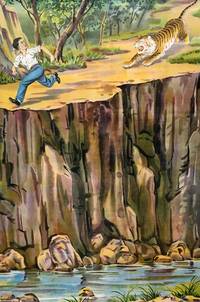
44943Kowloon Hong Kong: Christian Witness Press n. d. C. 1970s. Attached at the top-edge with maroon tape. A very good set still very bright with some minor occasional tears/creases and a faint spot of foxing here and there; overall a VG set. Four broadsides printed in color. 30-1/4" x 21" <br/><br/>These posters were said to bring the viewer closer to God. The images progress much like a graphic novel beginning with a figure running from a tiger along a cliff's edge his face contorted in horror he takes hold of a vine to lower himself from the cliff only to find an alligator with open jaws waiting at the bottom. When he tries to backtrack there is one black rat and one white rat crouched at the top of the vine. The final scene depicts the tiger and alligator turning away as the figure reaches for a glowing red cross on the cliffs edge just out of reach his face calm. Viewed in sequence they evoke a striking allegory the rats possibly signify a retreat from the literal jaws of sin through deceit the sinner turns from the rats at the last minute toward Christ his fate is unknown but his countenance suggests a peaceful resolve. Christian Witness Press unknown books
1958055782Cairo: The USSR Embassy Press Office in the United Arab Republic UAR 1958. 1st Edition . Hardcover. Very Good. 8vo - over 7¾ - 9¾" tall. Contemporary full green cloth in Egyptian style contemporary white endpapers gilt lettering of title on front board and gilt decorations on spine. Original pictorial cover saved inside. Roy. 8vo. 24 x 17 cm. In Arabic. 88 p. 12 b/w ills. including drawings and reproduced photographic plates. Extremely rare unrecorded first issue of this Soviet propaganda organ published in Cairo the centre of the UAR by the USSR Propaganda Press Office with a striking cover design depicting the Sputniks in space celebrating the third anniversary of the Kosmicheskaya programma SSSR. The content begins with a comparison between the Soviet and American satellites. A full-paged photograph shows the Muscovites reading newspapers about the launch of the third Soviet satellite into space. In the periodical many details such as the construction processes and technical specifications of the satellites are explained as well as a striking history of the Soviet Space Program. Relations between Russia and Egypt have a long history dating back to before the 16th century. In the 1950s Gamal Abdel Nasser's independent and anti-imperialist policy earned him enthusiastic support from the Communist government of the USSR. In 1955 Egypt made a major arm deal with the Soviet Union and from then teams of Egyptian officers were trained in Eastern Bloc countries. Czechoslovak instructors also came in 1956 to train Egyptian personnel in the use of Soviet weapons. When France attacked Egypt during the Suez Crisis the USSR threatened to use destructive weapons i.e. nuclear weapons for the defence of Egypt. The degree of the Soviet approval of the Egyptian leader's policies culminated rather controversially in the award of the highest Soviet decoration the star of the Hero of the Soviet Union with the Order of Lenin to Nasser during Nikita Khrushchev's visit to the country in 1964. Kosmicheskaya programma SSSR i.e. The Soviet Space Program was the national space program of the Union of Soviet Socialist Republics USSR active from 1955 until the dissolution of the Soviet Union in 1991. After WWII the Soviet and US space programs both utilized German technology in their early efforts. Eventually the program was managed under Sergei Korolev who led the program based on unique ideas derived by Konstantin Tsiolkovsky sometimes known as the father of theoretical astronautics. Contrary to its American European and Chinese competitors who had their programs run under a single coordinating agency the Soviet space program was divided and split among several internally competing design bureaus led by Korolev Kerimov Keldysh Yangel Glushko Chelomey Makeyev Chertok and Reshetnev. The Soviet space program served as an important marker of Soviet claims to its global superpower status. Wikipedia. As of May 2024 not in OCLC and KVK. <br/> <br/> The USSR Embassy Press Office in the United Arab Republic (UAR) hardcover
1087851928-32. Stor 8vo. Flere pagineringer. Rikt illustr. annonser bilag noen i farger. Bundet i fire samtidige fine helsjirtingb. med en del av de originale for- og bakomslagene medbundet særlig for 1928 de øvrige årgangene kun sporadisk. Fin rekke. Propaganda ble utgitt frem til 1960. . unknown
193925066(Bln, Scherl, 1939). Programm 1939/40. Hrsg. vom Terra-Werbedienst durch Günter Zöllner unter Mitarbeit von Alfred Bauer, Hans Boht, Wilhelm Busch, Rosemarie Clausen, Hans Liska, Bruno Skibbe, u.a.. Texte: Erich Knauf Mit zahlreichen, meist ganzseitigen Abbildungen. 38/30,4 cm. 90 Bl. in 2 verschraubten Leisten in Ill. OLeinenmappe mit Druckknopfverschluss. Die beiden Schrauben aus dem hinteren Deckel gebrochen, minimal gebraucht. Inhalt sehr schön.
In-8°, XXVIII, 100pp, 8 tavole numerate, 1 non numerata (tutte fuori testo), legatura in carta semplice, intonso In-8°, XXVIII, 100pp, 8 numbered plates, 1 plate not numbered (all inset plates), paper binding, uncut.
16 pages. Features: The War of 1920, being the fictional diary of Gustav Bauerfeldt, War Correspondent of the Berliner Rundschau - Part 1; What we Demand of President Wilson In the Spirit of 'Seventy-Six'; Behind the Scenes in Warring Germany with Edward Lyell Fox; The Eliots and the Parkhursts, a poem by Stephen Oland; "To See Ourselves as Others See Us", by Dr. Edmund von Mach; Mr. Bryan and the German-Americans; The Worm Turns - at last American manufacturers are making an energetic protest to President Wilson against England's strangulation of American commerce; Why Franklin Knight Lane, Secretary of the Interior, and William Bauchop Wilson, head of the Department of Labor, Should Resign; Why They Are Against Peace - one of the most virulent pro-Ally newspapers in New England is owned by interests manufacturing war supplies for the Allies; Swiss View on our "Neutrality"; News from Germany; and more. Unmarked. Average wear. Three-inch opening to bottom of coverfold otherwise a sound copy. Magazine
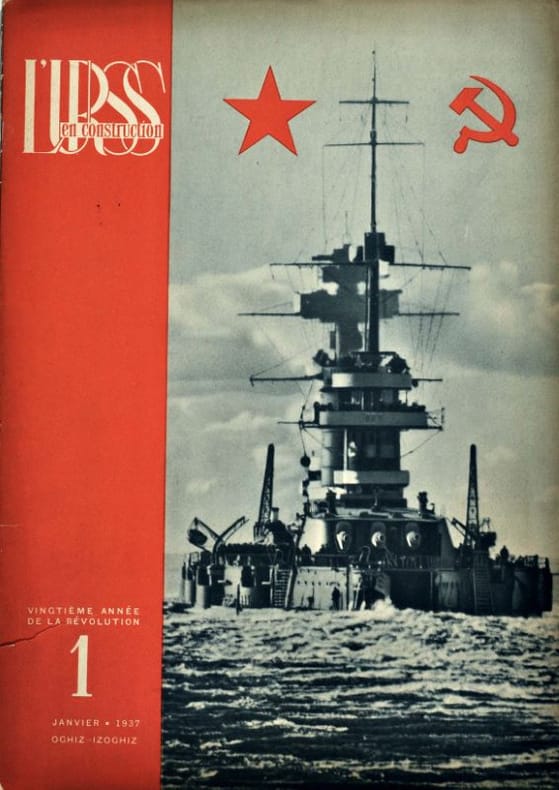
19371047201937 Moscou, Isoghis , 1937, 416x300mm, 48p., un hors-texte, broché sous couverture photographique.
1945103007BBPraha (Prag), Svet v Obrazech, (1945). 4°. [44] Bl. mit 18 (17 ganzs.) Foto-Montagen, meist in Rot und Schwarz. Farbig illustr. OKart.
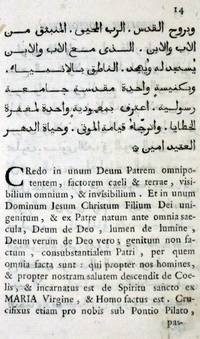
1797100416<p>1797. Rome Propaganda Fide 1797. 15pp. Unbound. Woodcut vignette on titlepage and one vignette in the text. One of the rare publications of the Propagande Fide that was established in 1626 for propaganda among the Eastern peoples. Ferdinand II presented Illyrian types for a missal and the Mediciean and other Oriental types from the Stamperia Vaticana were added to its stock while Stefano Paolini engraved others. It continued its existence throughout the seventeenth and eighteenth centuries: Bodoni received his early training here. In 1789 most of the types were taken to Paris where in 1805 an edition of the Lord's Prayer in 150 languages was printed as a compliment at the time of Napoleon's coronation. Much of the type still remains at the Imprimerie Nationale. Not in Birrell & Garnett Smitskamp PO 216; Brunet I 197.</p>
xiv, 384 pages. "The first authoritative book about the wartime use of radio in the United States. What fundamental policies should govern creative Radio in wartime? How effective are such broadcasts? What skills and techniques are most useful in the writing, producing and directing of American Radio in wartime? This book will open your eyes - and ears. It will tell you, the radio listener, how to detect propaganda - and how to create and put effective propaganda on the air! Author was Director of Radio Productions for the University of Chicago and of the world-famous University of Chicago Round Table, to which tens of millions listened each week." - dust jacket. Prior owner's name stamped inside each board, otherwise unmarked with moderate wear to red cloth-covered boards. Binding tight. Above-average wear to dramatically-illustrated, price-clipped and mylar protected dust jacket, the back panel of which promotes the purchase of U.S. War Bonds and Stamps, featuring a message from and photo of business analyst Merryle Stanley Rukeyser. COLE p.258, LARSON 42. Book
191520076Hamburg, Gräfe, 1915. Mehrfach gefalt. farblithographierte Landkarte. Ca. 70 cm x 55 cm. Ohne Einband, verso der vorderer OU aufgeklebt).
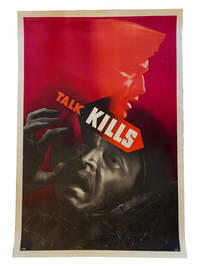
1943004937London 1943. Printed poster approximately 530mm x 775mm in size. Once folded now backed with linen one or two tiny amounts of colour loss to surface otherwise quite bright and clean. Designed by Abram Games 1914-1996 and printed by Henry Hildesley Limited. Games designed many British wartime propaganda and information posters over the course of his military service with the Royal Engineers. In 1942 he was appointed Official War Poster Artist. He produced two versions of this poster showing the possible consequences of disclosing sensitive information about the war - one coloured green that suggested a death at sea and another coloured red which suggested a death on land From the National Army Museum website. First Edition. Unbound. Good. Illus. by Games A.bram. Double Elephant. Poster. Paperback
181954848Washington D.C.: Army Air Forces. 10-18- 1943. Color poster / map 47 x 35 1/2 inches 120 x 90 cm folding as issued now professionally mounted on linen backing. Wear and a little paper loss along the fold lines has been infilled light toning to lower centrefold; the poster presents very well with bright color. Stunning image of a hemispherical view with Japan at the centre encompassing the area from Iran in the west Australia in the south and as far as the west coast of the U.S. at the east of the map. The map maker is F.E. Manning one of the distinguished news illustrators of the war in a style very similar to that of Richard Edes Harrison. There is a scale along the lower edge which was intended to be clipped and used to measure distances of places on the map from Tokyo. Text reads: "This map is a photographic view of the world with the center at Tokyo. Thus with the detachable scale distances can be measured along any line running thru Tokyo. It should be noted that an inch at the center represents less mileage than an inch closer to the edges. The detachable scale has been designed to compensate for this and should be used only with the center at Tokyo. The photographic process used in making this map makes all distances measured with the tape approximate only. Distances are shown in statute miles. Lines between key cities do not represent regular air routes in all cases. They show distances between points that do not fall on a line going thru the center of the projection." The Newsmap posters were displayed in offices and factories to keep the American public updated with news of the war and to encourage their participation in the winning of it. . Army Air Forces. unknown books
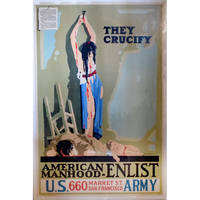
19172999<p>27 x 41 inch broadside backed with linen 29 x 43 inches. Color lithograph printed in green blue black and red. Three semicircles of loss to upper margin not affecting image; pinholes to corners of linen backing. Very Good.</p><p>A gruesome WWI recruitment poster depicting German wartime atrocities in Belgium specifically the crucifixion and possible rape of a woman and the killing of her husband and baby. Prominently displayed below this image is the address of San Francisco's Army recruitment office located at 660 Market St.</p><p>According to the explanation printed in the upper corner "'They Crucify' portrays an actual incident of the war witnessed by Sergeant Albert Goad formerly of the Seaforth Highlanders but since stationed with the British recruiting Mission in San Francisco. The atrocity was perpetrated in Blegium in a shell shattered cottage where Sergeant Goad found a murdered husband a mother nailed to the wall and a babe mutilated by bayonet. The Sergeant told of this experience to the artist M. Hoyle of San Francisco who in turn painted it for the San Francisco Army Recruiting District adhering conscientiously to the facts."</p><p>We note holdings at UC Berkeley the Imperial War Museum the Hoover and the Canadian War Museum.</p> Louis Roesch Co, Lith.
Very Good Persian Original wrappers. Folio. (33 x 25 cm) and some different sizes. In Persian with bilingual titles in English and Persian. A lot including 124 issues, published between July 30, 1991, to 1999. A lot including 124 issues of this rare Iranian satyric magazine "Gol Agha", which was the first such publication in post-revolutionary Iran, maintaining its dominance for more than two decades after its debut, adding monthly and annual editions as well as producing new generation of satirists and cartoonists. Kioumars Saberi Foumani, (1941-2004), also known by his pen name Gol-Agha, was an Iranian satirist, writer, and teacher. Saberi was born during the Second World War in Souma'eh Sara a city in Gilan Province. His father, originally from Rasht, worked for the Ministry of Economic Affairs and Finance. He was transferred to Souma'eh Sara in 1938 and then to Fuman in 1942 where he died a few months later. His mother, who was the daughter of a respected cleric and one of the few educated women in the city, taught the Quran after the death of her husband. His brother, who was 14 years older, had to leave school at the age of 15 to work to help with the family expenses. Education for Saberi was hard because of his family's poverty and he had to start working in a tailor shop after finishing his elementary education. He also worked in his brother's bicycle repair shop during elementary school and high school. He started high school education at his mother's insistence. At the age of 16, he gained entry to Sari's Agriculture teacher's college which only accepted one student from Fuman each year. He continued his college education and graduated in 1959. He worked as a teacher from 1959-1961. At the age of 20, he took his high school exams and received his high school diploma. He continued his education at the University of Tehran while working as a teacher. He achieved his bachelor of science degree in political science in 1965. He spent most of the 1970s reading and teaching and in 1978 he obtained his master's degree in comparative literature from the University of Tehran. Saberi got married in 1966 and he had a daughter and a son. His son died in a car accident in 1985 but this sad incident did not stop him from reaching his goal, which was to make people smile. Kioumars Saberi Foumani died on April 30, 2004. During his first year at university, Saberi was arrested for participating in student demonstrations and started to write political satire in Towfigh magazine. Towfigh magazine was Iran's most respected pro-democracy political satire magazine, with the highest circulation in Iranian history. Its editor-in-chief was Hossein Towfigh who, along with his brothers Hassan and Abbas, turned Towfigh magazine into the most influential journal in Iranian history. Saberi became one of the many staff writers of Towfigh magazine. After the Iranian Revolution, he became the cultural advisor for Mohammad Ali Rajai. One of his other political posts was as the counselor to the minister of Housing and Urban Development of Iran. Following the Revolution, Saberi worked in different political positions before deciding to leave politics. He was in charge of Roshde-Adabe-Farsi magazine and sometimes he wrote for the Ettelaat newspaper. He started a column called "Do-Kalame-Harfe-Hesab" in Ettelaat in 1984 which was a starting point for political satires after the revolution. He continued writing for this column for six years until he started his own magazine called Gol-Agha in 1990. His courageous and powerful writings were appreciated by many famous authors such as Mohammad Ali Jamalzadeh. Saberi received first prize in the press exhibitions of 1992 and 1994 and second prize in 1993. He stopped writing for Ettelaat in 1993. The main characters in his writings are Gol-Agha, Shagholam, Mamasadegh, Kamineh, The wife of Mamasadegh), Mash-Rajab, and Ghazanfar. In 2003 in his last editorial in Gol-Agha, Saberi announced that publishing Gol-Agha will be stop
20 pages. Features: The Trade in the Tools of Death, by George Sylvester Viereck - an account of the tremendous development of the manufacture of munitions of war in the United States showing how this country, allegedly neutral, is helping to prolong the European conflict by furnishing firearms and explosive to the British Allies; Cartoon by A. Staehle shows the Prince of Peace coming out of Bethlehem, Palestine, and hell going out of Bethlehem, Pennsylvania in the form of munitions on railcars; White List - A list of some companies what have refused to manufacture arms and ammunition and ammunition-related manufacturing machinery; Money From Death - a partial list of American companies engaged in the manufacture of munitions of war; Victory - In Battle and in Balkan Diplomacy; The War of 1920 - 2nd Instalment; The Ocean Travelers' Suicide Club; Arm the German Ships in New York Harbor; The Cleveland Automatic Company and the New York Times - poison shrapnel being provided to the Allies; Mr. Pulitzer in Looking-Glass Land - he seems to exist in a land where everything is the reverse of the truth; The Verdict - Guilty! - England on the Witness Stand; Spring's Awakening in Berlin, by Louis Viereck; Ad for Kaffee Hag on back cover; and more. Unmarked. Average wear. Covers loose but present, otherwise a sound copy. Magazine
20 pages. Features: The Next Step of President Wilson; Friends of Peace, Organize! Organize!; The Trust of the Red Death - Article III - Premonitions of the Future - George Sylvester Viereck discusses how capital is diverted from peaceful employment to the establishment of a trust that will ean the fomenting and making of wars for profit; News from Austria-Hungary, by Dr. Ervin Acel-Starhemberg; German Week at the San Francisco Exposition; Famous English Preacher Pleads for Arms Embargo - Rev. Dr. Aked and Prof. Rauschenbusch Protest Against National Dishonor; The War of 1920 (continued); Russia as a Publisher Duplicates her Failure in Military Affairs; The London Morning Post Fears the Fatherland; Mr. Ochs's (of the New York Times) Fate?; Chip in for the Dernburg Fund; Henry James has done something; Full-page fascimile of letter to George Sylvester Viereck from Mrs. Carl L. Schurz asking him to be Editor of the English edition of "Weltkrieg" called World-War; A hint for the "American Machinist" - a publication which promotes the sale of poison shrapnel; Poultney Bigelow Again - an amusing clown; If The Fatherland were published in Germany - an interesting quotation from the Cedar Rapids Republican; Prof. Burgess's Book "The War of 1914" Boycotted by some of the leading book stores in New York; Facsimile of Mr. Viereck's reply to Mrs. Schurz - in the affirmative; The German Aims of Peace; - and more. Unmarked. Average wear. Openings/creases to upper corner of back cover at backstrip. This issue noteworthy in that for the first time we find a full-page back cover ad for Budweiser -with a George Washington theme. Until this issue, most advertisers in this publication had been of the smaller, local (New York City) variety. Magazine
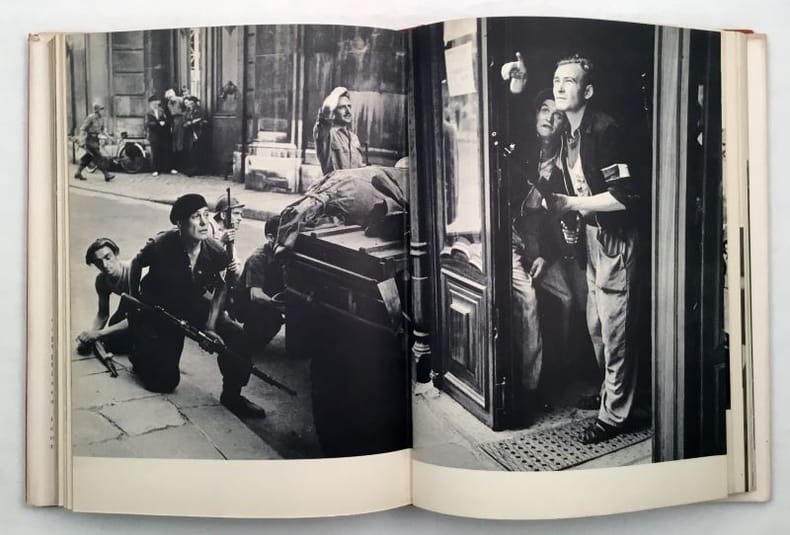
19471033901947 New York, Henry Holt and Company,1947, 242x185mm, 244p., pleine toile orange de l’éditeur, jaquette illustrée.118 illustrations photographiques de la deuxième guerre mondiale en noir et blanc imprimées en héliogravure.Textes et images de Robert Capa.Défauts minimes à la jaquette. Auer 324.(103390)
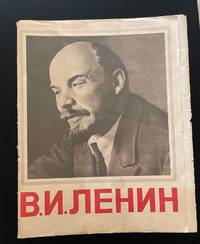
1969013792Moscow 1969. Soft cover. Very Good. Printed in the former USSR in 1969. Paper portfolio with cover photograph of Lenin measuring approx. 17.5 x 22" containing 31 pictures of various sizes on 18 sheets depicting all aspects of Lenin's life as student father one of the people and founder of the republic. Images presumably "suitable for framing" to be used in offices public buildings schools etc both as government issued "art" and history lessons. Some wear to paper portfolio along edges; sheets fine. unknown