"GUNNERUS, JOHANN ERNST.Livre Rare Book

429 résultats
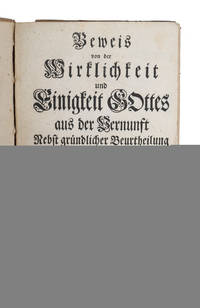
174862323Jena, Woitwe, 1748. 8vo. In contemporary half calf. Binding with wear. A few holes to spine. Hinges a bit weak. Previous owner's name to title-page and lower outer corner of title-page with loss of paper (not affecting text), otherwise internally nice and clean. (16), 533, (1) pp.
174862323Jena Woitwe 1748. 8vo. In contemporary half calf. Binding with wear. A few holes to spine. Hinges a bit weak. Previous owner's name to title-page and lower outer corner of title-page with loss of paper not affecting text otherwise internally nice and clean. 16 533 1 pp. <br/><br/><em>First edition of this exceedingly rare philosophical treatise aiming to demonstrate the existence and unity of God through rational argumentation – a fine early example of Scandinavian Enlightenment philosophy. In this work Gunnerus critiques and builds upon traditional arguments for God's existence such as those by Anselm and Descartes. He uses a logical method referencing thinkers like Wolff Leibniz Darjes and Descartes as well as critics of Wolffian philosophy including Joachim Lange and Christian August Crusius. “Although recognized by scholars of eighteenth-century Danish-Norwegian cultural and political history as an influential figure in the Norwegian Enlightenment with impressive transnational connections Johan Ernst Gunnerus 1718– 1773 receives scant mention outside the Norwegian discourse in discussions on the siècle des lumières. His influence and accomplishments especially in the context of eighteenth-century ecclesiastical politics as well as his scholarly explorations in diverse disciplines distinguish him as one of the founding fathers of modern Norwegian culture. Born in Christiania the son of a physician Gunnerus’ intellectual preoccupation extended beyond theology.2 In line with the decree issued by King Christian VI in 1741 that all Danish-Norwegian theology students study at the University of Halle Germany which was a centre of multiple influences such as the Protestant Reformation Pietism and German Enlightenment Gunnerus also attended lectures on natural history and law upon enrolling at the university in 1742. In 1744 he moved to Jena where he graduated worked as a tutor and eventually in 1753 became an adjunct there at the Department of Philosophy. However within a year he left for Denmark where he first became a pastor then appointed professor in Copenhagen and eventually bishop in Norway at a time when the entire country had a total of only four bishops and 480 pastors.3 From 1758 to 1773 Gunnerus served as bishop in Trondheim and became in 1760 one of the founders of the Royal Norwegian Society of Sciences and Letters. In all these areas he maintained close contact with diverse circles of Continental scholars and not just with those he had known during his time in Halle and Jena. As such he can be considered an important agent of cultural transfer between Norway and mainland Europe and vice versa.†Stengel Johan Ernst Gunnerus and the Quest for the Soul in the Eighteenth Century. Exhibited as no. 40 in the Danish Bibliophile Association's 60s Anniversary Exhibition. </em> unknown
KART0256Wien 1802. Wien - Ca 495 x 66 cm Maßstab ca 1:3328. Kol. Kupferstich in 18 Segmenten auf Leinen montiert. Mit 2 Nebenkarten: Erster Grundriss der Stadt Vien oder Vindobona. Grundriss der Stadt Wien zur Zeit der ersten türkischen Belagerung im Jahr 1529. In Orig.-Pappschuber mit Titelschildchen Karte mit nur wenigen kleinen Stockflecken der Schuber etwas berieben. Erste Ausgabe. Mit Gebäudekennzeichnung u. Erläuterungen zur Stadtentwicklung. - Dörflinger S. 404. Wien 1802. unknown
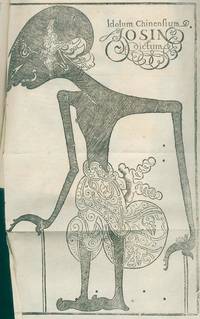
16803358Jenae Jena: Sumtibus Johannis Jacobi Bauhoferi Bauhöfer Johann Jacob 1680. Second edition first published in 1667. Four works bound in one volume. Contemporary vellum binding with title inked on the spine and a faint shelfmark vignette. Contemporary owner’s inscription on the first title page. Handwritten content on the final blank leaf of the last work. Rear free endpaper is missing. Tiny wormholes throughout with more noticeable effects toward the rear including the rear binding panel. Rear panel slightly stained. Despite the wormholes overall in fine condition. Illustrated with five large almost full-page and full-page woodcuts and five smaller woodcut illustrations and a large folding plate. Illustrated with five large almost full-page and full-page woodcuts and five smaller woodcut illustrations and a large folding plate. Second edition first published in 1667. Four works bound in one volume. Contemporary vellum binding with title inked on the spine and a faint shelfmark vignette. 8 196 p. and 1 folding plate. <p><br /> A scarce and early illustrated comparative study on global religions including American and Asian beliefs through a Lutheran lens—is bound alongside three foundational Lutheran texts.<br /> <p><p><br /> Umbra in Luce or Shadow in Light: Agreement and Disagreement of Profane Religions with Christian Truth originally presented in 1667 as an academic disputation at the University of Jena is a comparative theological study authored by Christian Hoffmann under the guidance of Johann Ernst Gerhard. This work examines Judaism Islam Samaritanism as well as Chinese Hindu and Mongolian beliefs uniquely incorporating references to indigenous American and Mexican religions. Hoffmann describes these American beliefs as “shadowed†reflections of divine truth presenting them through a distinctly Lutheran lens.<br /> <p><p><br /> The text with its Samaritan title Ṭelal be-nahar "shadow in light" features a diverse set of typefaces—Arabic Hebrew and Greek—and includes exotic woodcut inserts a folding plate and text illustrations of various coins. The larger illustrations depict figures such as a flaming bronze idol of Moloch associated with ancient child sacrifice along with artifacts from Gerhard’s collection including a Hindu Bhairava statuette and an Indonesian shadow puppet. Notably Hoffmann mistakenly labels this statuette as a "Chinese idol" underscoring the era’s limited understanding of Asian religions.<br /> <p><p><br /> While many images are borrowed from Athanasius Kircher’s Oedipus Ægyptiacus others directly depict Gerhard’s artifacts like the Bhairava statuette a fierce incarnation of Shiva obtained through the Dutch East India Company by Johann Schelhammer a Lutheran pastor in The Hague.<br /> <p><p><br /> These visual and textual elements combined with Hoffmann’s commentary on Mexican religious practices and a depiction of Huitzilopochtli—the Aztec god of war and the sun symbolizing protection and sacrifice—create a vivid portrayal of 17th-century efforts to interpret global religions within a Christian framework. Additionally an intriguing feature of Hoffmann’s text is its engagement with Asian linguistic elements including a passage in Tamil reflecting his interest in Eastern languages and cultures.<br /> <p><p><br /> Bound with Umbra in Luce are three additional theological works: In Canonicam & Catholicam Jacobi Epistolam Commentarius by Caspar Erasmus Brochmand Trifolium Verae Religionis by Wilhelm Leyser and Harmonia Evangelistarum organized by David Klug. These works were likely compiled together to offer a comprehensive suite of Lutheran scholarship that addresses both scriptural exegesis and comparative theology. While Umbra in Luce examines global religions through a comparative lens the others provide detailed doctrinal guidance for Lutheran clergy reflecting an integrated approach to defending and elucidating Lutheran theology against both external and internal religious perspectives.<br /> <p><p><br /> Literature: Ben-Tov A. 2021. Johann Ernst Gerhard 1621–1668: The life and work of a seventeenth-century orientalist. Brill.<br /> <p>. Sumtibus Johannis Jacobi Bauhoferi [Bauhöfer, Johann Jacob] unknown