17th Century Antiphonary artistBiblio.com
8 059 résultats
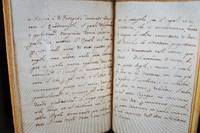
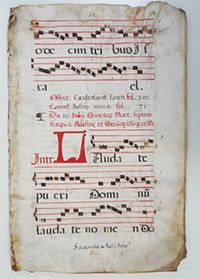
51-6313France: 17th Century. Extract from a liturgical manuscript of the 17th century. Large format.6 leaves written on both sides. large folio 59 x 39 cm on vellum skin partially stitched.11 pp. of music in square neumatic notation of 5 or 6 staves of 5 red lines. The text below is enameled with large red initials.Small marginal tears marginal waterstains wrinkled.ANTIPHONAIRE. Extrait d'un manuscrit liturgique du XVIIe siècle.6 ff. grand in-folio 59 x 39 cm sur peau de vélin partiellement brochées.11 pp. de musique en notation neumatique carrée de 5 ou 6 portées de 5 lignes rouges. Le texte en dessous est émaillé de grandes initiales rouges.Petites déchirures marginales mouillures marginales ff. gondolés.L France: 17th Century hardcover
1441Italy 17th Century. <p>127 x 98 mm. 5 x 3 ¾ inches.  16 p. including final blank. Italy 17th century.                                      <br /> A handwritten guide to the drawing of the human head the most important element of any figure drawing and frequently the starting point for early modern drawing manuals. The manuscript appears to be unpublished and we have been unable to trace the text anywhere in the vast digitized corpus.</p> <br /> <p>The content is divided into five brief sections the first explaining how to draw a head in profile. Our scribe focuses on the triangle method in which the profile is anchored by three primary points: the top of the forehead cima della fronte beneath the nostrils sotto le narici and the well of the chin and the beard pozzetta del mento ò barbuccio. The author then explains how to connect these points how to form the nose place the mouth and lips draw the eye etc. Our scribe closes this section with the kind of aspirational promise endemic to manuals of this time namely that if you simple follow my instructions you’ll be able to do this easily. “without much confusion and effort†senza tante confusion et fatiche.</p> <br /> <p>The second section explains how to draw the head “in majesty†Della testa in scurcio by which the author appears to mean ‘head-on’ in such a way to convey power and authority he elsewhere refer to this position as prospetto e.g. on p. 9. Here the author likewise focuses on a simple method of drawing lines between different features of the face. The third section covers drawing the head in shadow Della testa in scurcio which the author admits is alquanto più difficle than the first two exercise and so he won’t be sticking to such geometrical rules. But then he goes on to provide a single very simple rule una regola facile assai namely to start with drawing rounded oval l’ovato cirolare and continues with guidelines that sound awfully geometric to us. The fourth section is on drawing a child’s head in profile la testa del fanciullo in profilo where he again starts with the triangle method adding other geometric principles and referencing the point of a compass. The fifth and final section is on drawing a child’s head in maestà wherein the author cites earlier discussion and further expounds on geometric advice. The author then closes with a general comment on the excellence and nobility of the art of drawing.</p> <br /> <p>The focus throughout is on lines and contours and proportions always guided by geometric rules for producing an accurate but relatively basic sketch. There is only brief passing reference to elements like “hair or other ornament according to the need and what is most pleasing†pelli or altro ornamento secondo che porfarà il bisogno e che più in piacerà . Despite the brief section on drawing the head in shadow there is nothing on rendering value or otherwise on capturing the subtleties that give a drawing depth and feeling.</p> <br /> <p>Like its spine title the Fairfax Murry catalogue calls this 17th-century and we tend to agree based on the script. While we haven’t traced our particular “bird†watermark Heathwood records a few similar marks used in the 17th century and Briquet finds many in the 16th especially in Italy.</p> <br /> <p>No less absorbing than the manuscript is a pair of 16th century Italian binding covers here preserved as doublures both heavily decorate in blind. The front doublure carries an arabesque motif and center Alexander the Great in profile. The rear appears to have been impressed with a single panel stamp also arabesque both doublures betraying the Islamic influence that characterized many Italian bindings of the period. </p> <br /> <p>Provenance: Lot 237 in the second Fairfax Murray sale his label on the inside rear board and perhaps then to Robert Tunstill his bookplate on the front fly-leaf. To us from a fellow ABAA bookseller who purchased it from a UK dealer in the 1990’s.</p> <br /> <p>Condition: Written in a cursive hand in dark brown ink on laid paper watermarked with a bird within a circle. Rebound in the late 19th century or early 20th century in cream pigskin tooled in black preserving as doublures the decorated covers of a 16h-century Italian binding described above title in gilt on spine Del disegno. Ms. Saec XVII. Following the manuscript are four additional blank leaves saved for scanning old pen trials early but the paper is different than the manuscript proper. Additionally six more modern fly leaves have been added at both front and back presumably at the time of rebind. A little loss since filled to the upper outer corner of the manuscript leaves and the four earlier blank leaves affecting just a word or two on each page; a few old pen trials over the text though it remains legible. Binding extremities lightly worn.</p> <br /> References: Catalogue of the Second Portion of the Library of C. Fairfax Murray 1918 p. 42 no. 237 “Manuscript on paper Italian hand 16 pp. repaired white morocco extra the cover of an old stamped vellum binding used as a double. 12mo. Saec. xviiâ€. Alexandra Arvilla Greist Learning to Draw Drawing to Learn: Theory and Practice in Italian Printed Drawing Books 1600-1700 PhD Dissertation UPenn 2011 p. vii “Italian printed drawing books libri da disegnare comprise an important body of evidence for our knowledge of artistic training in Italy during the early modern period. . . Intended for both professional and amateur audiences these printed sources were soon copied throughout Europe where they influenced drawing education for the next 400 yearsâ€. C. M. Briquet. Les Filigranes v. 3 # 12202- 12232 similar watermarks mostly 16th century. Edward Heawood Watermarks Mainly of the 17th and 18th Centuries 1950 # 179 183 similar watermarks 17th century. Anthony Hobson Humanists and Bookbinders 1989 p. 220-21 recording a few 16th century Italian bindings with Alexander the Great plaquettes. Thanks to Patrick Olson for help with this description. unknown
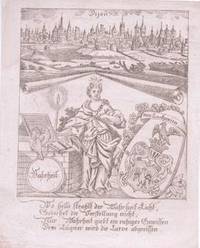
71-6367Germany: German Publisher circa 1688. Engraving. 20 x 16 cm sheet. Very Good minor surface soiling. [Germany: German Publisher, circa 1688]. unknown
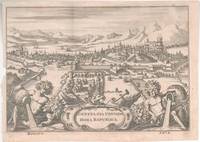
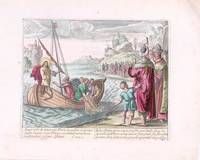
71-2991Amsterdam: Pietro & Abramo van Someren 1686. Steel engraving. 15.2 x 21.5 cm. sheet. Very Good four worm holes sheet folded in thirds sheet toned missing small section of left margin. Amsterdam: Pietro & Abramo van Someren, 1686. unknown
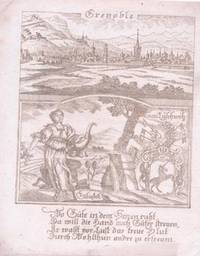
71-6365Germany: German Publisher circa 1680. Engraving. 19.5 x 16 cm sheet. Very Good small hole at upper right sheet edge minor surface soiling. [Germany: German Publisher, circa 1680]. unknown
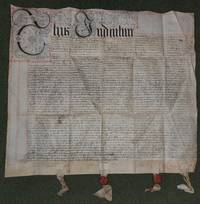
46663Kent 1663 . Large 17th century velum document with two horizontal folds and 5 vertical folds plus 3 of the original wax seals. 55cm length x 64cm width. Vellum lightly soiled and worn along the creases. Document begins with a large initial "C". English text in a contemporary hand rubbed in places. The document states that Henry Hills and Edward Gray are at Cliffords Inn London. Also that Harry Welles and Ralph Blundell are from East Greenwich Kent. Also that Ralph Blundell is a Chandler. Notes to verso of the document include an amendment in Latin dated 1664 and signed by "John Walker". Also another note in English signed by Robert Cheke; "Gills Master"; and "Thomas Bosboke Jn." Family history records show a Ralph Blundell was a churchwarden of East Greenwich in 1679. Kent, 1663 . hardcover
45375Kingston upon Hull: 24th December 1667 . Folded vellum ducument. 26" x 22". Between: John Legard Kingston upon Hull; George Newman Kingston upon Hull; & Christoper Bacon. With 3 old wax seals chipped and rubbed to base. Kingston upon Hull: 24th December, 1667 . hardcover
453861695. Small rubbed vellum document. 7.25" x 8.25". 25 lines of neat text rubbed on one side .Names identified include John Gladman and John Swichatt of Watford. On the verso is a further 7 lines of text dated 1695 and signed: "Samuell Anderson". 1695 hardcover
71-5597Paris: French Publisher 17th century. Original hand colored engraving. 17.5 x 22 cm sheet. Very Good light foxing in the margins. [Paris: French Publisher, 17th century]. unknown
45414c. 1640. Original 17th century paper document. the date is estimated from consulting family history records for the Benton family. 10.75" x13.0". Paper is fragile with numerous small holes. 4 horizontal folds and two vertical folds. Now laid flat. 'Norff.' to left margin. The text is not easy to read but includes the names: John Benton the elder; Timothy Clarke; John Benton the younger gent.; Dorothy Lynne widow; John Marham gent. Elizabeth Baron. Cocerning land at Milton Magna. The document is signed Baron. c. 1640. unknown
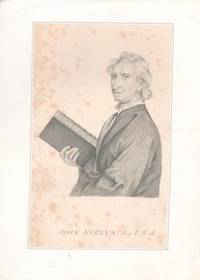
71-3544London: British Publisher circa 1700. Wash drawing. 26 x 19 cm. sheet. Good. Foxing in the image. [London: British Publisher, circa 1700]. unknown
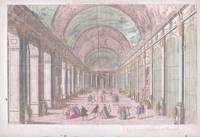
71-7049Paris: French Publisher circa 1680s. Hand-colored etching. 33 x 47.5 cm sheet. Good staining along margins sheet fold in quarters short tears along sheet edges.Provenance: ancienne galerie Vandevoorde 22 rue Vignon Paris. Paris: French Publisher, circa 1680s. unknown
71-9722Paris: French Publisher circa 1600. Engraving. 13 x 18.5 cm sheet. Good light specks foxing throughout minor surface soiling print affixed to a support sheet. [Paris: French Publisher, circa 1600]. unknown
71-5598Paris: French Publisher 17th century. Original engraving. 16 x 18.5 cm sheet. Very Good light soiling in the margins. [Paris: French Publisher, 17th century]. unknown
68-0059Paris France: ca. 1660. Engraving. 4to. Very Good with minor staining. Paris, France: [ca. 1660?]. unknown
71-6386Paris: French Publisher circa 1673. Hand-colored engraving. 23.5 x 35.5 cm sheet. Very Good light surface soiling light specks of foxing small tears at sheet edges. [Paris: French Publisher, circa 1673]. unknown
71-6385Paris: French Publisher circa 1673. Hand-colored engraving. 23.5 x 35.5 cm sheet. Very Good light surface soiling light specks f foxing small tears at sheet edges. [Paris: French Publisher, circa 1673]. unknown
71-3503Amsterdam: W. Blaeu 1645. Engraving. 31 x 34 cm. sheet. Very Good sheet in two panels. Tears along sheet edges with toning. Amsterdam: W. Blaeu, 1645. unknown
71-6391Paris: French Publisher circa 1643. Engraving. 27.5 x 35 cm sheet. Very Good light surface soiling small pin holes along left edge of plate. [Paris: French Publisher, circa 1643]. unknown
19762082502113900953Kinseido 1976. Soft Cover. Fine. Number of books: 1 Kinseido paperback
71-6366Germany: German Publisher circa 1680. Engraving. 20 x 21.5 cm sheet. Very Good minor surface soiling. [Germany: German Publisher, circa 1680]. unknown
71-6372France: French Publisher circa 1668. Engraving. 14.5 x 46 cm sheet. Very Good light specks of foxing four light vertical creases/folds. [France: French Publisher, circa 1668]. unknown
697483676Genealogical Publishing Company Incorporated pp. 318 . Papeback. New. Genealogical Publishing Company, Incorporated unknown
71-3562Italy: Italian Publisher circa 1633. Steel engraving. 19.5 x 14 cm. sheet. Very Good. Sheet affixed to paper support at corners. [Italy: Italian Publisher], circa 1633. unknown
71-3688Paris: Chez Denys Thierry circa 1683. Stipple and line engraving. 17 x 11.5 cm. sheet. Very Good. Trimmed to the image. Text in French on verso. [Paris: Chez Denys Thierry, circa 1683]. unknown