8 059 résultats
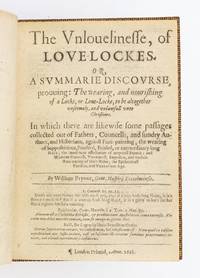
1628ST17855London: n.p. 1628. FIRST EDITION the issue with "needes" in the second line on D2. 184 x 137 mm. 7 1/4 x 5 3/8". 12 p.l. including the initial blank 63 1 pp. pp. 41-48 misnumbered 33-40. <br/> Red crushed morocco by Riviere stamp-signed on front turn-in title and date on front cover raised bands titling in two spine panels gilt edges front joint rather noticeably repaired. In a custom-made folding cloth box with leather label and fleece lining. Front pastedown with book label of Arbury Library; blank with contemporary inscription of Julian Leigh see below for both. STC 20477; ESTC S115447. Rear joint cracked with consequent slight looseness leaves probably washed and resized because extremely fresh and at the same time a shade less than white.<br/> <br/> This is an early work by the Puritan lawyer and indefatigable pamphleteer William Prynne 1600-69 who had a very great deal of advice mostly unsolicited and unwelcomed for the fair sex. In the text here he rails against many things including "face-painting; the wearing of supposititious poudred frizled or extraordinary long haire; the inordinate affectation of corporall beautie; and womens mannish unaturall impudent and unchristian cutting of their haire." While the work can be viewed as a moral diatribe to us it is illuminating as social history talking as it does about the dress and grooming of persons of quality and the responses these evoked in the first half of the 17th century. Prynne graduated from Oriel College Oxford in 1621 became a student at Lincoln's Inn and before long began producing pamphlets that occupy more than 250 entries in STC and Wing. Our work is a forerunner to one of his most infamous and ill-timed works "Historio-mastix" in which he vigorously denounced female actors appearing on the stage--at the same moment Queen Henrietta Maria was preparing a masque to present at court. This misstep led to a conviction for sedition and his sentence included a £5000 fine life imprisonment and the removal of his ears. His later pamphlets were not noticeably less inflammatory and these led to a further sedition charge as well as more disfigurement including a slit nose and a brand on his cheek announcing him as a seditious liar. Our copy is recorded as lot #271 of Sotheby's "Catalogue of Rare and Valuable Books Selected from the Ancient & Celebrated Library at Arbury Hall Warwickshire the Property of Sir Francis Newdigate-Newdegate" 1920. The earliest recorded owner however is an ancestor of Sir Francis: the 17th century gentlewoman whose name is variously given as Juliana or Julian Leigh bap. 1610 d. 1685. She was the daughter of Sir Francis Leigh of Newnham Regis Warwickshire and the granddaughter of Thomas Egerton Viscount Brackley who was Lord High Chancellor of England. In 1632 she married Sir Richard Newdigate 1st Baronet 1602-1678 of Arbury Hall who became Lord Chief Justice. Notably Newdigate was an exact contemporary of Prynne at Oxford and they were both admitted to the bar in 1628 the year our "Love-Lockes" was printed. It is certain that Newdigate and Prynne were well acquainted as together on behalf of the crown they famously prosecuted leaders of the Irish rebellion in 1644 and 1645 resulting in multiple executions for high treason. n.p. unknown
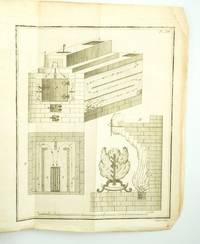
1792ST20535-05Paris: L'imprimerie de Valade fils aîné 1792. 210 x 130 mm. 8 1/4 x 5 1/4". xviii 3 22- 152 pp. Translated by J. Goy. <br/> Publisher's blue paper wrapper flat spine with paper label hand-lettered in ink edges untrimmed three quires UNOPENED. With 14 folding engraved plates. First section with an attractive woodcut headpiece of a pastoral landscape; floral woodcut tailpieces throughout. VD18 11592109 first edition. Front joint cracked joints and spine with apparent chipping first quire thinking about detaching but the volume still intact and retaining much of its fragile antique appeal. The text clean and fresh with the plates being crisp and well preserved.<br/> <br/> In its original paper wrappers this is an exceptionally well-preserved copy of a scarce work on stoves heating and saving wood first printed in Quedlinburg in 1790. Our author Johann Heinrich Sachtleben writes in the introduction that he composed this book on efficient and economical heating in response to increasing wood prices throughout Europe. The 14 engraved plates done in imitation of those in the German edition are particularly appealing. The technical depictions of chimneys and cooking apparatuses are joined by illustrations of stylish heating stoves with artistic decorative elements. This is quite a rare book: OCLC finds no copies in American institutions. And we have been unable to trace any copies of this French edition at auction and only two copies of the German edition. Our copy is distinguished by the state of preservation of its original wrappers assembled by the publisher as a temporary binding using unmatching endleaves repurposed from other volumes never intended to have lasted as the book's binding for well over two centuries. L'imprimerie de Valade, fils aîné unknown
1922206370New York: Dutton 1922. Second. hardcover. near fine. Fronitspiece many b/w plates. 140pp. 4to blue cloth spine ends very slightly frayed. New York: E.P. Dutton 1922. A near fine copy.<br/> <br/> Printed by D. B. Updike at the Merrymount Press.<br/> <br/> Dutton unknown
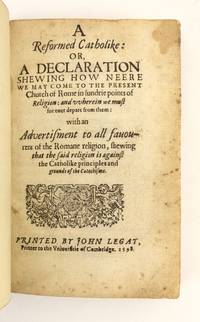
1598ST16441Cambridge: John Legat 1598. Second Printing. 153 x 98 mm. 6 x 3 7/8". 4 p.l. 375 1 pp. <br/> Modern sprinkled calf blind-ruled covers raised bands flanked by double gilt rules brown morocco label remnants of paper library shelf label at tail of spine. Printer's device on title page. Front pastedown with bookplate of the Fox Pointe Collection; rear pastedown with deaccession stamp of Bradford City Libraries. STC 19736; ESTC 19736. ◆Spine just faintly sunned leaves lightly browned due to paper quality and trimmed a bit close at head grazing headline on a couple of leaves isolated marginal stains or tiny rust spots but an excellent copy fresh and clean in a sympathetic binding with few signs of wear.<br/> <br/> This was an important work in establishing distinctions in liturgy and doctrine between the Catholic Church and the Church of England written by a moderate puritan whom DNB considers "perhaps the most significant English theologian of his age." Perkins 1558-1602 was one of the most popular voices of his time speaking from a Calvinist puritan point of view; while he could be virulently anti-Catholic he did not believe in repudiating the English church only in reforming it. According to DNB "The genius of Perkins's work did not lie in its originality—his theology represents a conventional recital of Calvinist scholasticism in virtually every respect. His gift lay rather in bringing to a broad audience a variety of theological and moral issues popularizing essentially technical discussions and therefore as Fuller observed humbling 'the towering speculations of philosophers into practice and morality.'" The present work spread his polemical influence beyond England to the Continent; even the Catholic bishop William Bishop admitted he had "not seene any book of like quality published by a Protestant to contain either more matter or delivered in better method." Both the 1597 first edition and our 1598 second printing are rare: no other copies of either edition are recorded at auction by RBH or ABPC in the past 50 years. John Legat unknown
188115969Philadelphia: Lippincott 1881. First edition. Hardcover. Fair. Green cloth boards gold stamped lettering on front and spine. Frontis and other portraits of officers have tissue guards and some tanning. Previous owner sticker on front pastedown. Front endpapers starting to crack but binding is tight. Green cloth is rubbed on spine and folds and frayed at top and bottom of spine. <br/><br/> Lippincott hardcover
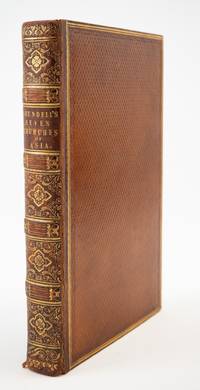
1828ST20535-01London: John Rodwell 1828. FIRST EDITON. 217 x 138 mm. 8 1/2 x 5 1/4". iv 339 1 pp. <br/> Contemporary diced russia raised bands spine attractively gilt in an arabesque style gilt-rolled turn-ins pink moiré endpapers all edges gilt. With a folding map of the travel routes and 23 pages reproducing inscriptions three of these folding. Front flyleaf inscribed in ink: "Juliana Calvert / from A. C. / 1838." Blackmer 48; Weber I 159. Joints and extremities a little rubbed tiny crack just beginning at top of front joint two tiny chips to foot of spine very minor offsetting and foxing to map a couple of patches of marginal foxing but INTERNALLY AN ESPECIALLY FINE COPY--unusually clean fresh and surprisingly bright--in a good-looking well-preserved binding.<br/> <br/> In especially desirable condition this is quite a scarce travel account by the English antiquary explorer and clergyman Francis Vyvyan Jago Arundell 1780-1846 who visited the so-called Seven Churches of Asia also called the Seven Churches of the Apocalypse and the Seven Churches of Revelation locations in present-day Turkey of central importance to St. John and the Book of Revelation. In that book John who was a threat to Roman officials as leader of the new Christian religion in Asia had been banished to Patmos where he was visited by an apocalyptic vision directing him to write to the churches at Ephesus Smyrna Pergamum Thyatira Sardis Philadelphia and Laodicea commending their successes pointing out their failures and prevailing upon them to repent. These seven Turkish churches reflect a surprisingly significant role in the region's early Christian history with some scholars maintaining that as many as 18 of the 27 New Testament books were written there--and Arundell's narrative would have helped to raise the popular understanding of this importance. Following his marriage to the daughter of the British consul-general at the Levant Company in Constantinople Arundell became chaplain to the company's trading center in Smyrna now Izmir in 1822. From there he embarked on a series of tours through Asia Minor including places that according to DNB "until then had for the most part not been described by any European traveller." The present work is the product of the author's first tour which included two separate excursions between March and September of 1826. Despite being a clergyman Arundell's interest in these sites was primarily archaeological and historical and this work includes his firsthand descriptions of the ruins he encountered facsimiles of Greek inscriptions found there and narratives of the arduous journeys between sites that were well off the beaten path. This work is surprisingly scarce in commerce suggesting that copies were often read with avidity. John Rodwell unknown
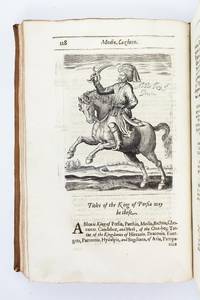
1634ST20186London: printed by William Stansby and Jacob Bloome 1634. FIRST EDITION. 290 x 195 mm. 11 1/2 x 7 3/4". 6 p.l. 225 15 pp. <br/> Contemporary sprinkled calf raised bands traces of old paper label to spine pastedowns lifted to reveal leather bands and manuscript document fragments used as sewing guards all edges sprinkled red expert repair to rear joint. With additional engraved title page featuring two figures of Persian dignitaries and three small travel vignettes signed at foot by William Marshall and 36 engravings in the text the majority vignettes but one full-page and nine more than half a page tall. Front endpaper with ink armorial stamp of Sir Walter John Trevelyan 8th Baronet of Nettlecombe and High Sheriff of Cornwall. Price inked in a contemporary hand to the front endpaper. Sabin 31471; STC 13190.3; ESTC S92948. Front board a bit splayed covers with three old dampstains and a few scars and tiny wormholes but a very pleasing original binding with almost no wear to the joints. A very few marginal smudges made during printing other quite trivial imperfections but AN ESPECIALLY FRESH BRIGHT AND CLEAN COPY INTERNALLY with rich impressions of the engravings.<br/> <br/> This is a contemporary copy in remarkably fresh internal condition of an important and entertaining account of the travels of a 17th century Englishman in exotic Asian and African territories particularly Persia. It is significant both for the ways it is accurate and for the ways it is fictitious. Sir Thomas Herbert 1606-82 left for Persia on a diplomatic mission to Shah Abbas in 1626 as part of the entourage of Sir Dodmore Cotton. The mission was not successful: Cotton and the mission's other leader Sir Robert Shirley both died in 1628 leaving their retinue at loose ends with the increasingly unimpressed Shah. Herbert made a slow return to England traveling through a large portion of Asia and Africa and even sailing up the coast of North America. He finally returned to England in 1630; four years later he published this account of his adventures. The text describes meetings with people of many cultures as well as encounters with exotic animals including the dodo flamingoes and flying fish. Herbert's accounts are of great importance for their details of early Asian travel by Westerners. At the same time the author was unable to resist the urge to embellish a good story and according to DNB gave implicitly first-person accounts of places he had not in fact visited. One such detour into the fanciful comes in the chapter involving the author's apparent visit to America. In it Herbert discusses the belief that the mythical Welsh king Madoc ap Owen-Gwyned had settled in North America in the 9th century for which he provides linguistic evidence that Sabin calls "entirely fanciful." DNB tells us that "this segment was apparently included to please the earl of Pembroke's own Welsh nationalist fancies. It also continued to help fuel various theories about Madoc's colonies and Welsh Indians in North America until the early years of the nineteenth century." Herbert's tale is profusely illustrated by William Marshall fl. 1617-49 with engravings that are sometimes more imaginative than accurate see for example the depiction of the shark on page 6 or the penguin on page 13. Despite these rather amusing inaccuracies the illustrations are lively and detailed providing a sense of the awe the early readers must have felt when imagining foreign places. Our copy in a period binding with part of a manuscript ledger used in the binding process visible is from the library of Walter John 1866-1933 8th baronet Trevelyan who as his inkstamp suggests served as High Sheriff of Cornwall from 1906-07. printed by William Stansby, and Jacob Bloome unknown
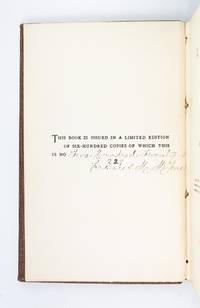
1895ST19567-179Buffalo: Charles Wells Moulton 1895. FIRST EDITION. No. 229 OF 600. 155 x 195 mm. 6 1/8 x 4 3/4". 79 1 pp. <br/> Publisher’s illustrated brown cloth binding edges beveled front board stamped in gilt flat spine top edge gilt. Photograph of the author mounted on page 6 facing the half title. SIGNED BY THE AUTHOR on the limitation page; title page printed in red and black. Cloth with just the slightest hint of wear and soiling; internally fresh and clean.<br/> <br/> This is an excellent copy of a very personal collection of poetry by a female writer of the late 19th century offered in a signed limited edition. Born in Northern Ireland Frances Margaret Milne 1846-1910 spent most of her life in San Luis Obispo California where she worked as a librarian and volunteered tirelessly for social causes. Much of her writing was political in nature: the 1893 publication "A Woman of the Century" a collection of biographies of "leading American women in all walks of life" said she had "made a profound study of economic and political questions and with pen and voice . . . and had aided in extending the discussion of the relations of progress and poverty and of individuals and society." She also published a number of fictional and poetic works; this was her second collection of poems. They primarily deal with themes of love and loss and while the poems have some of the formulaic gentility one would expect from a writer of this period and background the genuine emotions behind them are clear. By turns ebullient and poignant the text has works—such as the poem "To My Beloved at rest May 11th 1804"—that reflect the grief and joy of Milne's intense personal experiences. Copies of the book are not so readily available especially in the condition seen here. Charles Wells Moulton unknown
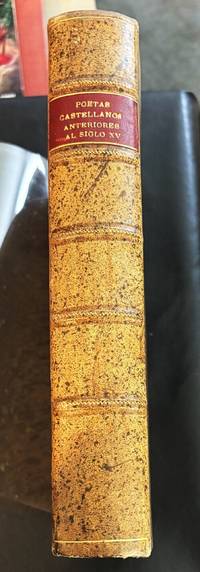
192584809Madrid: Librería y Casa Editorial Hernando S.A. 1925. ### What the book is<br /> It's Volume 57 of the Biblioteca de Autores Españoles titled:<br /> <br /> _Poetas Castellanos Anteriores al Siglo XV_ <br /> Castilian Poets Prior to the 15th Century<br /> <br /> Published in Madrid 1925 by Librería y Casa Editorial Hernando S.A.<br /> <br /> Bookplate. Owner signature.<br /> <br /> ### What this volume contains<br /> It's a curated anthology of early Castilian poetry-material from before the 1400s-drawn from medieval manuscripts. The editorial lineage is notable:<br /> <br /> - Tomás Antonio Sánchez began the original collection in the late 18th century. <br /> - Pedro José Pidal a major 19th‑century statesman and scholar continued the project. <br /> - Florencio Janer expanded and annotated it using direct manuscript comparison.<br /> <br /> So this isn't just a reprint; it's part of a long scholarly tradition of recovering Spain's earliest vernacular literature.<br /> <br /> ### Why it matters<br /> The Biblioteca de Autores Españoles series is one of the foundational national editions of Spanish literature-massive authoritative and historically important. This particular volume is especially valued because:<br /> <br /> - It preserves pre‑Renaissance Castilian verse much of it otherwise scattered in archives. <br /> - It reflects early philological methods comparing codices and manuscript variants. <br /> - It helped define the canon of medieval Spanish poetry for modern scholarship. Librería y Casa Editorial Hernando (S.A.)** unknown
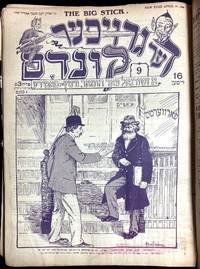
190942930New York: Ferlag "Kibets 1909. 1st Edition. Original publisher’s binding Folio newspaper. Complete first volume Starting with Vol I Nr 1 of “Der Kibitser†Dec. 15 1908 renamed and renumbered first as Vol I Nr 1 Jan 22 1909 of “Der Groyser Kibetser The big kibetzer†with the following issue of Feb 5 numbered as "3" to correctly follow from the first issue and then with Vol I Nr 6 March 19 1909 onward as “Der Groyser Kundes The Big Stick†or “The Big Prankster.†Incidentally the other set of this volume we examined also did not have a Nr 2 so we are confident this is complete as issued. <br> One centerfold cartoon by Zuni Maud see image features "Der Kaptialistisher Tayfel"--the Capitalist Devil–holding back a "mother" by the hair to stop her from interfering as "baby's milk-bottle" is drained off by the "milk-trust" cat. <br> The caption reads "The Capitalist Devil: - to the mother: Never mind madam all in English in Hebrew letters you go to the factory the milk-trust will take good care of your baby."<br> This cartoon-laden periodical was a New York City Yiddish language satirical bi- weekly which ran from 1908 until 1927.<br> The humor paper was issued biweekly this volume for its first 20 months and then weekly after that. OCLC also references another Vol I Nr 1 from April 15 1908 a special S´imhes` Toyreh Simchas Torah issue but this may have been a one-off. <br> Founded by the humorist Yosef Tunkel or Der Tunkeler his pen name meaning 'The Dark One' the paper was taken on by Jacob Marinoff when Tunkel left to work for an established paper in Warsaw. The paper consciously set itself up in opposition to the serious Yiddish-language press of the time such as the socialist Forverts.Naturally more traditional religious Judaism did not escape its satire: The later 1915 "Christmas" edition included a parodic conversation between Jesus and the prophet Elijah. <br> Despite its irreverent attitude to everything it also published poetry by Di Yunge "The Young Ones" poets such as Moyshe-Leyb Halpern and Zuni Maud. At its height it had a circulation of 35000 but folded in 1927 due to flagging sales. Der Groyer Kunds is highlighted in this recent talk by Yiddish comics scholar Eddie Portnoy on the reactions in the Yiddish press to restrictions on Jewish immigration to the US: https://www.yiddishbookcenter.org/collections/archival-recordings/recorded- programs/ybcr-nybc-ybcr-1048/door-slams-shut-reactions-yiddish-press-immigr ation .<br> SUBJECTS: Yiddish wit and humor -- Periodicals. OCLC: 28297536. Most holdings appear to be fragmentary and do not include these issues. Issue 18 with torn cover. In final issue the bottom margin suffers some loss to the final leaves none to the dramatic front cover though. Damaged boards are loose and most issues are coming loose though the quality paper used has remaind strong and bright much better than standard newsprint would have. Important graphic Yiddish humor from the great migration period. Dramatic and displayable! BK5 YID-43-9A-LEX. [New York]: Ferlag "Kibets unknown
19932092902141900084Tokyo Do 1993. Soft Cover. Fine. Size: 22cm Tokyo Do paperback
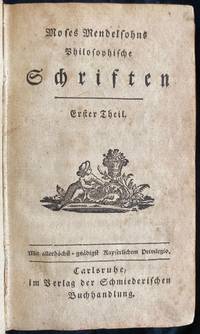
178043258Carlsruhe: im Verlag der Schmiederischen Buchhandlung 1780. No Date 1780s. Period laquered boards with leather spine label. 12mo. XXIV 278; 283 pages. In German. Title translates as “Writings.†Includes 2 different title vignettes 1 on each title page.<br> <br> Goedeke IV 1 488 6. Meyer 108; Dorn 105-107; Holzmann/Bohatta Deutsches Anomymen-Lexikon IV no. 1559. <br> <br> Early printing of Mendelssohn’s second work in which he "began his formulation of a new psychological theory that stressed the autonomy of aesthetics logic and ethics relative to each other." Merriam-Webster's Encyclopedia of World Religions p. 710. <br> <br> Contents:<br> <br> Vol. 1. Vorrede. <br> I. Ueber die Empfindungen.<br> II. Gespräche; <br> <br> Vol. 2. I. Rhapsodie oder Zusätze zu den Briefen über die Empfindungen. <br> II. Ueber die Hauptgrundsätze der schönen Künste und Wissenschaften. <br> III. Ueber das Erhabene und Naive in den schönen Wissenschaften. <br> IV. Ueber die Wahrscheinlichkeit. <br> <br> Also includes bibliographical references.<br> <br> Included within these is a series of writings on aesthetics which influenced Lessing and Schiller with Lessing noting“We have to thank him Mendelssohn for the true theory of mixed sensations.â€<br> <br> Moses Mendelssohn Moses of Dessau; 1729–1786 was a philosopher of the German Enlightenment in the pre-Kantian period early Maskil and a renowned Jewish figure in the 18th century. Mendelssohn was fluent in German and Hebrew and learned Latin Greek English French and Italian. His early teachers were young broadly educated Jews and he met the writer and dramatist G.E. Lessing 1754 and a deep and lifelong friendship developed between them. Throughout his life he worked as a merchant while carrying out his literary activities and widespread correspondence in his free time. In 1754 Mendelssohn began to publish – at first with the assistance of Lessing – philosophical writings and later also literary reviews. <br> He also started a few literary projects for example the short-lived periodical Kohelet Musar in order to enrich and change Jewish culture and took part in the early Haskalah. In 1763 he was awarded the first prize of the Prussian Royal Academy of Sciences for his work Abhandlung über die Evidenz in metaphysischen Wissenschaften "Treatise on Evidence in Metaphysical Knowledge". However when the academy elected him as a member in 1771 King Frederick II refused to ratify its decision. <br> <br> In 1769 he became embroiled in a dispute on the Jewish religion and from then on he confined most of his literary activity to the sphere of Judaism. His most notable and enduring works in this area included the translation into German and commentary on the Pentateuch Sefer Netivot ha-Shalom "Book of the Paths of Peace" 1780–83 and his Jerusalem: oder Ueber religiöse Macht und Judenthum "Jerusalem or On Religious Power and Judaism" 1783 this work the first polemical defense of Judaism in the German language and one of the pioneering works of modern Jewish philosophy. <br> <br> An active intermediary on behalf of his own people in difficult times and a participant in their struggle for equal rights he was at the same time a forceful defender of the Enlightenment against the opposition to it which gained strength toward the end of his life. In the midst of a literary battle against one of the leading figures of the counter-Enlightenment he died in 1786 EJ. <br> <br> SUBJECTS: Philosophy -- Early works to 1800. Philosophie -- Ouvrages avant 1800. Philosophy. OCLC: 1352546328. <br> <br> Light wear to original boards more so at spine but solid and attractive light spotting as expected About Very Good- Condition an attractive 18th Century copy. B KH-10-31. Carlsruhe: im Verlag der Schmiederischen Buchhandlung unknown
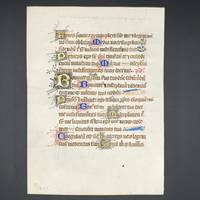
145013201450. Very Good. Leaf from Psalter likely Low Countries early 15th century. Single leaf on parchment 210 x 150 mm; text block 130 x 100mm 16 lines in Latin of Gothic textualis in somewhat browned ink. Employs decorative hairlines crossed tironian et bifurcations on ascenders Two 2-line initials in blue with red penwork decoration and gold with dark blue penwork decoration. Twenty single-line initials in alternating shell gold with blue penwork decoration and dark blue with red penwork decoration. Six line fillers in blue and shell gold. Rubricated psalm-section beginnings. Multiple corrections from a second still- contemporary campaign in darker black ink including signe-de-renvoi palimsests/strikethrough and interlinear insertion. The scribe of this mansucript produced a very technically proficient product-- the letters have decorative hairlines thorns bifurcations and feet. Each line begins with an illuminated initial richly decorated by ornate penstrokes. Every indication that this manuscript was a high-end production. However another hand in a darker ink with a less formal script has had to come through and make multiple significant corrections. On the third line of the recto we see the use of a signe-de-renvoi similar to our modern footnotes-- a symbol next to the line corresponds with a in the top margin adding in an entire line of text that the original scribe skipped. Throughout we see the use of 'carrot' symbols inserting a word or two that our scribe omitted between the lines-- this correcting hand has gone into the margins on the verso to add possessive pronouns. We also see three examples of palimsets the scraping off of words to create blank parchment on the verso two of which the corrector has emphatically struck through to ensure the correction is registered. It's impossible to know if this single leaf happens to be where an otherwise competent scribe lost focus or if it represents an illiterate scribe essentially blind-copying to the best of their ability without comprehension. Either way it's a remarkable moment of human error demonstrating the difficulty of producing a handwritten work of several hundred pages and the indvidual labouring behind the scenes. unknown
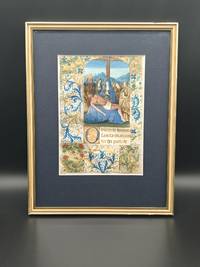
1359Very Good. Leaf from Book of Hours near Ghent-Bruges Belgium late 15th century. 180 x 130 mm Single leaf on parchment. Three lines of text of the Obsecro te Marian prayer in Latin executed in Gothic textualis. Single three-line initial in blue on red-gold field with shell gold ornamentation overlaid. Border separated into six sections: top section in strewn border style with blue flowers and pink roses on gold background; middle two sections with blue and gold acanthus leaves and blue flowers; bottom left section with red roses or strawberry flowers on gold background; bottom centre section with blue and gold acanthus leaves; bottom right section with blue and white iris. Blue flowers indicating production location close to Brugges. Central scene shows the Pieta with Mary clothed in royal blue and highlighted in shell gold holding Christ after the crucifixion surrounded by four other women with nimbs one of whom holds a book and one man in a 16th century hat. Artist has used forgrounding effect with city on a hill in the background. Leaf is framed in late 20th century frame misattributed on back as "Book of Hours English -1390". Mounting unknown but unlikely to be fully mounted. Verso not visible. hardcover
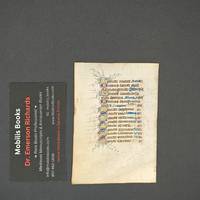
145013211450. Very Good. Leaf from Book of Hours late 14th or early 15th century likely FranceSingle leaf on parchment 140 x 90 mm; textblock 75 x 50 mm 16 lines in Latin of Gothic bâtarde script from Book of hours. 9 single-line intials in purple with white decorations on gilt background colored with dark rose gesso outlined in black. Abbreviations for antiphoner and psalm in rubricated letters. 20th century penciled numbers in bottom margin of recto 48486 and number 2 in top margin. Overall VERY GOOD condition. unknown
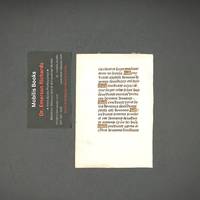
145013221450. Near Fine. Single leaf of Book of Hours 15th century likely Low Countries. Leaf on parchment 110 x 75 mm; textblock 60 x 40 mm. 16 lines of Latin in Gothic textura libraria. Single line intials in alternating blue and gilt with ornate penwork decorations in alternating red and blue. Pen decorations appear to have been trimmed by being tucked in gutter. Line fillers in gilt and blue terminating with ora pro nobis abbreviations. Standard list of saints with no significant local/regional deviations. Overall VERY GOOD condition. unknown
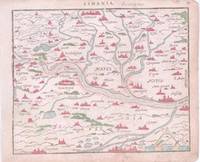
71-6384Paris: French Publisher circa 1588. Hand-colored woodcut. 16 x 19 cm sheet. Very Good light surface soiling text in French on verso. [Paris: French Publisher, circa 1588]. unknown
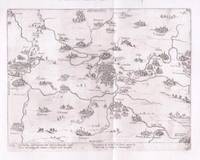
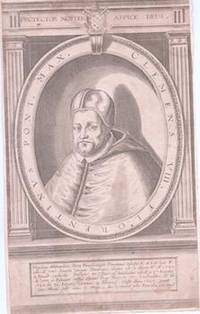
71-6388Paris: French Publisher circa 1590. Engraving. 30 x 35.5 cm sheet. Very Good center crease fold light surface soiling light specks of foxing small tears along sheet edges. [Paris: French Publisher, circa 1590]. unknown
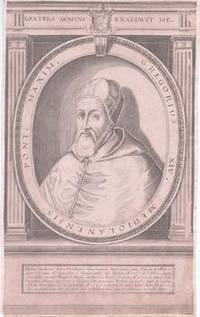
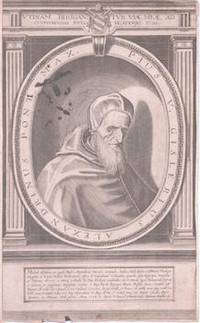
71-7372London: British Publisher circa 1603. Engraving. 31 x 19 cm sheet. Very Good sheet trimmed to the plate mark light specks of foxing throughout. [London: British Publisher, circa 1603]. unknown
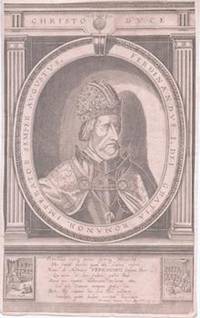
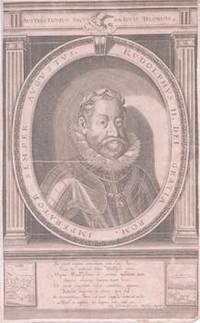
71-7370London: British Publisher circa 1603. Engraving. 31 x 19 cm sheet. Very Good sheet trimmed to the plate mark light specks of foxing throughout. [London: British Publisher, circa 1603]. unknown
71-7374London: British Publisher circa 1603. Engraving. 31 x 19 cm sheet. Very Good sheet trimmed to the plate mark light specks of foxing throughout. [London: British Publisher, circa 1603]. unknown
71-7373London: British Publisher circa 1603. Engraving. 31 x 19 cm sheet. Good sheet trimmed to the plate mark light specks of foxing throughout short tears along sheet edges black soiling in upper left quadrant of image. [London: British Publisher, circa 1603]. unknown
71-7371London: British Publisher circa 1603. Engraving. 31 x 19 cm sheet. Very Good sheet trimmed to the plate mark light specks of foxing throughout a horizontal crease in center of image. [London: British Publisher, circa 1603]. unknown
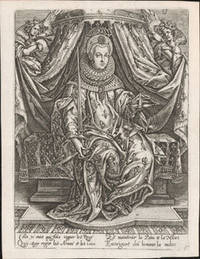
16-633116th or 17th Century. . Engraving. 19.5 x 15cm. Bedecked queen seated on a throne holding the scales of justice.Provenance:Né en 1906 à Lezay Deux-Sèvres Jacques Cathy a exercé d’abord la profession de caricaturiste à l’hebdomadaire « Le Rire ». Il a rejoint vers 1927 l’équipe du Cabaret « La Vache Enragée » conduite par Roger Toziny. Jacques Cathy poursuit sa carrière de chansonnier après le décès de Toziny en 1939 et après la guerre il conduit parallèlement une carrière d’acteur dans le cinéma. Jacques Cathy était le 3ème Maire de La Commune Libre de Montmartre à partir de l’élection en 1949.Final provenance: Les Collections Aristophil - 164 bis avenue Charles-de-Gaulle 92200 Neuilly-sur-Seine. 16th or 17th Century. unknown
68-0169Paris France: ca. 1650. Engraving mounted on backing paper. 4to. Very Good. Text in French. Paris, France: [ca. 1650.] unknown