2 166 résultats
1900165264Mainz, Kirchheim, 1900. VIII, 402 S. Hübscher dekorativer Hldrbd. d. Zt. m. Rverg., goldgepr. Rtit. u. Goldschnitt. Sehr schönes Exemplar.
185094437Hildburghausen, Bibliographisches Institut, [ca. 1850]. 287 (1) S. (= National-Bibliothek der deutschen Classiker, Band 87). Kl.-8vo. 15,5 cm. OLn. mit Blind- und Goldprägung und dunkelsilbrigem Schnitt.
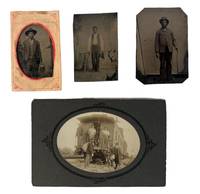
1870202721870. Early photographs of African Americans produced during the decades following emancipation provide important visual documentation of Black life during the Reconstruction and early Jim Crow eras. Portrait photographs and vernacular images from the late nineteenth century capture African Americans navigating newly won freedoms while confronting the economic and social constraints that defined the post slavery United States. Such photographs often record moments of labor travel and self presentation reflecting both the aspirations and realities of African American life during a period of profound social transformation. This small photographic archive dating from the 1870s through the 1890s preserves rare images of African American men during the generation immediately following the end of slavery.<br /> <br /> Archive of four original photographs including two tintypes and one albumen print measuring approximately 2.25 x 3.25 inches to 4.5 x 6.5 inches. The most visually complex image an albumen photograph dating from the late 1890s depicts a Black man and a young boy standing on railroad tracks behind a caboose where four white men are also present. The African American man wears a hat and carries a large sack across his back while the boy holds a basket filled with produce suggesting a scene connected to travel commerce or railroad labor in the expanding transportation networks of the late nineteenth century. The presence of the caboose and railroad workers situates the photograph within the rapidly developing rail infrastructure that reshaped the American economy during the post Civil War period. The remaining photographs consist of tintype portraits of African American men dressed in the formal attire of the late nineteenth century including bowler hats vests and tailored suits. One sitter is photographed wearing a three piece suit and holding a cane while another poses beside a table while holding his hat in hand.<br /> <br /> Portrait photography played an important role in African American communities during the decades after emancipation as newly freed individuals asserted dignity respectability and personal identity through formal portraiture. At the same time vernacular photographs such as the railroad scene record the economic realities and labor environments in which many African Americans worked during the late nineteenth century. Together these photographs document African American presence within both public labor landscapes and private studio portraiture during a formative period in the history of Black life in the United States. Four original photographs including tintypes and an albumen print measuring approximately 2.25 x 3.25 inches to 4.5 x 6.5 inches. One photograph with clipped corners; otherwise images clear and well preserved. Overall condition very good. unknown
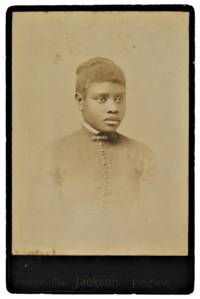
1880188841880. African American Photography Cabinet card photograph depicts an attractive young African American woman in formal dress. She wears a high collar with a golden brooch and has a serious expression. Circa 1880s. Photography studio is C. Jackson's located in Hannibal Missouri. 6.5" x 4." Card bears front gilt caption: "Hannibal Mo. Jackson. Pittsfield MS." On the back is the photography studio's address and logo printed in ornate gilt. Very good condition. unknown
182657029Paris. Arthus Bertrand Libraire. 1826. Zwei Bände. Je Band mit gestochenen Fronttafel; 246 Seiten u. 267 Seiten. Schöne Halbleder-Einbände auf 4 Bünden mit Rückenvergoldung u. marmorierten Deckeln (Einbände etwas berieben. Papier teils etwas fleckig) 18x10 cm
18161110543Wien, Wallishausser, (1816). Kl.-8vo. Gestochener Titel, 7 Bl., 248 S., 1 Bl., 6 gest. Taf. v. F. John nach del Sarto, Guercino, Füger, Reni u.a. Neuer Ppbd m. pergamentverstärkten Kapitalen, Rsch. u. allseitigem Goldschnitt (durchg. Wasserrand an der unteren Kante, S. 159-162 fehlen).
18191110553Wien, Wallishausser, (1819). Kl.-8°. Gestochener Titel, 7 Bl., 310 (recte 304) S., 6 Kupfer v. F. John nach Carracci, Correggio, C. Dolce, Domenichino, Füger u.a. OPpbd m. gestochener Einbdillustr. nach Loder sowie allseitigem Goldschnitt. Etwas berieben u. begriffen.
18281124932Wien, Wallishausser, (1828). Kl.-8vo. Gestochener Titel, 7 Bl., 281, (1) S., 6 Kupfertaf. von F. John nach Schefer, Rafael Urbino, del Sarto, Correggio u. da Vinci. OPpbd m. verg. Randleisten u. allseit. Goldschnitt (Rücken fehlt, Deckel fast lose, durchg. etwas braunfl.).
1828627054Wien, Wallishausser, (1828). Kl.-8vo. 7 Bl., 281 S. Mit gestochenem Titel u. 6 Kupfertafeln von F. John nach Schefer, Rafael Urbino, del Sarto, Correggio u. da Vinci. Grauer Pappband d. Zeit mit Deckel- u. Rückenvergoldung sowie Goldschnitt in Pappschuber (Einband mit kurzen Gelenkeinrissen, Schuber gering berieben u. mit kurzem Einriß). [2 Warenabbildungen]
181977836Leipzig, F. A. Brockhaus, 1819. 8 Bll., 272 S. Kl.-8vo. 17,5 cm. Pp. d. Zt.
18221123793Wien, Wallishausser, (1822). Kl.-8vo. Gestochener Titel, 6 (st. 7) Bl., 298 S. OPpbd m. gestochener Einbdillustration von Passini nach L. F. Schnorr von Carolsfeld u. allseit. Goldschnitt (angestaubt, Buchblock gebrochen, Vorderdeckel u. ersten Bll. lose.- Ohne die 6 Kupfertaf.).
18231123723Wien, Wallishausser, (1823). Kl.-8vo. Gestochener Titel, 3 (st. 7) Bl., 288 S., 1 Bl. OPpbd m. gestochener Einbdillustration von Passini nach L. F. Schnorr von Carolsfeld sowie allseitigem Goldschnitt (Einbd begriffen u. etwas braunfl.- Es fehlen die 6 Kupfertaf. sowie die dazugehörigen Erklärungen).
18251204904Wien, Wallishausser, (1825). Kl.-8vo. Gestochener Titel, 6 Bl., 290 S., 6 Kupfertaf. von F. John nach Correggio, Caraccio, Guercino, Albani u.a. OPpbd m. gestochener Einbdillustr. nach L. F. Schnorr von Carolsfeld u. allseit. Goldschnitt. Einbd. etwas angeschmutzt, Rücken etwas angerissen. Buchblock gebrochen, Papier gebräunt.
18261110567Wien, Wallishauser, 1826). 2 Bl., 273, (1) S., 1 (st. 6) Kupfertaf. v. F. John nach Domenichino. Ppbd d. Zeit m. schlichter Rverg. (beschabt, durchg. gebräunt bzw. braunfl., einige Bl. etwas knickspurig.- Es fehlen 5 Kupfertaf. m. den dazugehörigen Textblättern sowie das Titelbl.).
18291123742Wien, Wallishausser, (1829). Kl.-8vo. Gestochener Titel, 7 Bl., 328 S., 6 Kupfertaf. v. F. John nach Reni, Correggio, Dolce u.a. OPpbd m. gestochener Einbdillustr. u. allseitigem Goldschnitt (Einbd angestaubt, Kanten etwas bestoßen, vord. Innengelenk gelockert).
18301110569Wien, Wallishausser, (1830). Kl.-8vo. Gestochener Titel, 7 Bl., 309 S., 4 (st. 6) Kupfertaf. von F. John nach Rembrandt, Mengs u.a. Ppbd d. Zeit m. schlichter Rverg. (beschabt, flieg. Vorsatz m. Ausschnitt, 1 Taf. m. Knickspur.- Es fehlen 2 Kupfertaf.).
18311123721Wien, Wallishausser, (1831). Kl.-8vo. Gestochener Titel, 7 Bl., 218 S., 6 Kupfertaf. v. F. John nach Reni, Correggio, Domenichino u.a. Neuerer Ppbd m. aufgez. OUmschl. u. allseitigem Goldschnitt in neuerem Schuber.
18341123730Wien, Wallishausser, (1834). Kl.-8vo. 8 Bl., 290 S., 6 Kupfertaf. v. F. John nach Corregio, Carracio, Guercino u.a. Neuerer Ppbd m. aufgez. illustr. OUmschl. u. allseit. Goldschnitt in neuerem Schuber (gebräunt).
18341123737Wien, Wallishausser, (1834). Kl.-8vo. 8 Bl., 281 S., 6 Kupfertaf. v. F. John nach Schefer, Rafael Urbino, del Sarto, Corregio, da Vinci u.a. OPpbd m. gestochener Einbandillustr. nach L. F. Schnorr v. Carolsfeld u. allseit. Goldschnitt (berieben, Vordergelenk locker, durchg. leicht braunfl.).
18341123734Wien, Wallishausser, (1834). Kl.-8vo. 8 Bl., 309 S., 6 Kupfertaf. v. F. John nach Reni, Rembrandt, Mengs u.a. OPpbd m. gestochener Einbandillustr. u. allseit. Goldschnitt (Einbd angestaubt).
18361123712Wien, Wallishausser, (1836). Kl.-8vo. 8 Bl., 328 S., 6 Kupfertaf. v. F. John nach Corregio, Reni, Dolce u.a. Neuerer Ppbd m. aufgez. OUmschl. u. allseit. Goldschnitt (etwas braunfl.).
18371124192Wien, Wallishausser, (etwa 1837). Kl.-8vo. 8 Bl., 270 S., 6 Kupfertaf. v. F. John nach Correggio, del Sarto, Reni u.a. Ppbd d. Zeit m. verg. Randleisten allseit. Goldschnitt in Schuber (etwas braunfl.- Es fehlt der Vortitel = S. 1/2).
18371123806Wien, Wallishausser, (etwa 1837). Kl.-8vo. Titel, 292 S., 2 Bl., 6 Kupfertaf. v. F. John nach Correggio, van Dyk u.a. Neuer Ppbd (etwas braunfl., es fehlt der Vortitel = S.1/2).
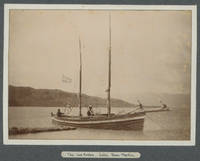
1890List01108Mostly Patagonia 1890. Printing-out paper prints the images measuring 3 1/4x4 1/2 to 4 1/4x6 inches and the reverse each with a caption written on a label affixed to the mount below the prints. 4to blue pictorial cloth. 1890s. In this bound photo album forty-six photographs document a group traveling from pastoral locations in northern Argentina to breathtaking views at the southern tip of the continent. The photographs were taken by an accomplished photographer and handwritten captions in English provide brief descriptions of the locations and people documented. Apparently a member of an exploration commission the photographer and his team travel first from Bahia Brazil to Buenos Aires and La Pláta then on to the southern tip of the continent and back up the continent through remote lakes and mountains on both sides of the Chilean/Argentinian border.<br /> <br /> While the photographer’s name and nationality are not clear from the album there are two photographs with a Sr. Moreno who is likely the Argentinian explorer Francisco ‘Perito’ Moreno. The photographs of “Sr. Moreno†bear a clear resemblance to photographs of Francisco Moreno and they are taken in La Plata which is where Moreno was the first director of the natural history museum Museo de La Plata. On the album page following the one with photographs of Sr. Moreno there are photographs of the Museo de La Plata building and grounds. Museo de La Plata was established in 1884 and Moreno’s personal collection of 15000 pieces formed the core of the original collections Farro. In order to fill the exhibit rooms he sought more materials and carried out collecting campaigns in Patagonia. At times he hired naturalists to travel into remote parts of Patagonia to gather samples of flora fauna geology and artifacts of indigenous people’s culture Farro. Museo de la Plata was exhibiting anthropological remains and indigenous material culture at the same time that Argentina was expanding into indigenous territory Farro. In this way Museo de la Plata was not just a natural history museum it was also a force of colonialism. <br /> <br /> Not only was Argentina in the process of colonizing Patagonia but also it sought to claim and maintain territory in relation to Chile. A sixty year boundary controversy between Argentina and Chile resulted in the Treaty of 1881 in which the two countries agreed for the first time on the boundaries in Patagonia Perry. Even after 1881 vague language in the treaty that the boundary be “the most lofty peaks that divide the waters†extended the dispute until 1902 Perry. Because Patagonia had not been colonized extensively scientific exploration of the region was tied with nation-building and establishing these borders. In 1896 the Argentinean government appointed Moreno as the Expert Representative in the border dispute with Chile. He led commissions of naturalists and surveying engineers through the disputed border regions along the Andes Mountains Museo de La Plata n.d. Moreno’s work had parallels in Chile’s attempts to establish borders too: “Through the work of these explorers the state was able to.draw up laws and decrees regarding environmental destruction and more effectively defend its position in the limits conflict with Argentina†Etchegaray 2018. <br /> <br /> We do not know whether the exploration commission in this photo album was affiliated with Moreno the collections of Museo de la Plata or the boundary controversy. However given the route to the tip of the continent and the back up along the newly established border it seems possible that this commission could have played some role – whether directly or indirectly – in the process of exploration and nation building occurring at that time. <br /> <br /> References<br /> <br /> Etchegaray J. L. 2018. Cataloging the nation: Explorations and the incorporation of North Patagonia into the Chilean National Ordering 1856-1902 Thesis San Francisco State University. In AS36 2018 HIST .E83. http://dspace.calstate.edu/handle/10211.3/213510<br /> <br /> Farro Máximo E. n.d. The Business of Museums: Towards a History of Collections in La Plata’s Museum 1888-1906 – World Archaeological Congress. Retrieved June 15 2021 from https://worldarch.org/world-archaeological-bulletin/the-business-of-museums-towards-a-history-of-collections-in-la-platas-museum-1888-1906/<br /> <br /> Ryan C. 2011. Indigenous possessions: Anthropology museums and nation-making in Argentina 1862–1943 Ph.D. The University of Wisconsin - Madison. Retrieved June 15 2021 from http://www.proquest.com/pqdtglobal/docview/885379045/abstract/E55A419FE8D54C0DPQ/1<br /> <br /> Museo de La Plata. n.d. Retrieved July 2 2021 from https://www.museo.fcnym.unlp.edu.ar/museo. unknown
18531319294Leipzig, C. F. Amelang, 1853. Gr.-8vo. Illustr. Titel, 8, 152 S. mit zahlr. Textholzschnitten. Neuer Hldrbd unter Verwendung des goldgeprägten Orig.-Rückenbezuges u. m. allseit. Goldschnitt (Vorderdeckel außen teils verblichen, innen m. Stempel, Papier gebräunt (Ränder stärker), einige Lagen stärker braunfleckig).