3 186 résultats
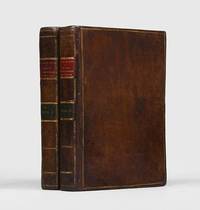
1797152774Paris: Chez H. J. Jansen 1797. Presented to Napoleon First edition presentation copy to Napoleon inscribed on each half-title verso "au Général Bonaparte; l'auteur". The work gives Saint-Fond's 1741-1819 account of his travels to Britain in the year 1784 with important observations on the geology of northern England and Scotland most notably his recognition that Fingal's Cave was a volcanic formation which had gone unnoticed by Joseph Banks. The work also includes anecdotes of Banks Adam Smith John Whitehurst and the Royal Society. The work was issued in octavo and the present large paper printing on quarto sheets; an English translation followed in 1799. At the time of publication Saint-Fond was professor of geology at the Jardin des Plantes; he was later involved in the extraction to French institutions of scientific materials across Napoleonic Europe. As one of the travelling commissaires of the clumsily but explicitly named Commission du gouvernement pour la recherche des objets scientifiques et artistiques dans les pays conquis par les armées de la République française established under the Directory for the purposes of pillage directed by connoisseurship and scientific expertise Saint-Fond certainly interacted with Napoleon who himself had refined the process by inserting clauses into peace treaties ensuring that governments would hand over the items selected. One of Saint-Fond's greatest triumphs was securing the fossil skull of the Monster of Maastricht a massive aquatic reptile from its home in Belgium. His 1799 account whereby the piece was retrieved by twelve grenadiers in exchange for an offer of 600 bottles of wine helped elevate the fossil to wide cultural fame but current informed opinion considers the narrative to be somewhat exaggerated. At publication Napoleon was leading French forces to repeated victories against the Austrians in northern Italy building his reputation as a national hero. It is well known that Napoleon was much taken with the myth of Ossian - he presumably read with particular attention the passages in the book relating to Fingal's legendary cave vol. II p. 454. So too he may have paid particular attention to Saint-Fond's account of his meetings with Adam Smith where Smith praised Rousseau and Voltaire and took Saint-Fond to a bagpipe competition much to his displeasure II pp. 277-283. Napoleon read the Wealth of Nations as a young man responding enthusiastically to the text though later affecting disdain for the economist. 2 vols quarto 255 x 196 mm. With 7 folding engraved plates. Contemporary calf rebacked with original spines laid down and later twin red and green labels spine compartments and covers ruled in gilt new endpapers. Housed in a brown solander cloth box by the Chelsea Bindery. Book label of 20th-century French collector Hubert Heilbronn to front pastedowns transposed from earlier endpapers when they were replaced. Extremities restored and gilt retouched. Contents with general soiling spotting and occasional rippling short closed tear in gutter of vol. II sigs. L-N 5.5 cm closed tear at foot of vol. II 2E3 not affecting text. A good copy. For Saint-Fond's role as a commissaire see Pierre-Yves Lacour La République naturaliste 2014. hardcover
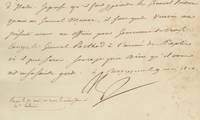
18103642009/05/1810. <blockquote><p>""I approve the slate of officers you propose to use for the Army of Italy. I think you should add General Bissonin. Regarding General Menou the Vice Roy must first present to me an officer for Governor of Venice. Send General Pacthod to the Army of Naples where he can serve.""</p></blockquote><p>In May 1810 Napoleon was at the high-water mark of his empire strengthening and intensifying his Continental System against Britain. Napoleon focused then on restricting British commerce and enhancing his alliance with Austria. His mind was also much on the Netherlands. On May 13 1810 it was announced that the Netherlands were formally annexed to France further consolidating Napoleon’s control over Europe. Bergen op Zoom a fortified city in the Netherlands was a key stronghold for French forces during Napoleon’s empire.</p><p>By 1810 Napoleon controlled most of the Italian peninsula acting as King of Italy crowned 1805 with his stepson Eugène de Beauharnais as viceroy. The region was restructured into the Kingdom of Italy in the north and the Kingdom of Naples in the south introducing modern law abolishing feudal rights and improving infrastructure while by 1810 the Italian army achieved parity with French units.</p><p>The War of the Fifth Coalition was Austria’s final attempt to challenge Napoleon Bonaparte after earlier defeats but it ended decisively with French victories at Battle of Wagram and the Treaty of Schönbrunn which stripped Austria of further territory and influence in northern Italy and the Adriatic. In the aftermath Napoleon moved to tighten and rationalize his control over the region reinforcing the authority of his Italian client state under Eugène de Beauharnais and integrating Venice more fully into a centralized military-administrative system. Though already under French rule Venice’s strategic importance—as a fortified lagoon city naval arsenal and forward position facing Austria—meant that after 1809 it became a focus of consolidation rather than conquest with garrisons reviewed command structures regularized and trusted officers installed to ensure the city’s security and readiness in anticipation of future conflict.</p><p>Napoleon was at Bergen op Zoom in May 1810. The Duc de Feltre was an officer diplomat and statesman who served as Minister of War under Napoleon.</p><p><strong>Letter signed</strong> Bergen-op-Zoom May 9 1810 to the Duc de Feltre assigning officers to the army and government of Italy. <em>""I approve the slate of officers you propose to use for the Army of Italy. I think you should add General Bisson. Regarding General Menou the Vice Roy must first present to me an officer for Governor of Venice. Send General Pacthod to the Army of Naples where he can serve.""</em></p><p>In 1810 General Baptiste-Pierre-François Bisson was given a command at Verona where he remained until his death in 1811. General Jacques-François de Menou served as the administrator and Governor of Venice in the Kingdom of Italy. After a notable career including commanding the Egyptian campaign he died on August 13 1810. In 1810 General Michel-Marie Pacthod was rewarded as a Knight of the Iron Crown and then given a division in the Army of Naples.</p><p>Here we see Napoleon exercising control over his occupied territories.</p><p><img class=""alignnone wp-image-25018 size-post-window"" src=""https://cdn.raabcollection.com/wp-content/uploads/20231204144051/Folder-site-11-1600x1327.jpg"" alt=""historical memorabilia dealer"" width=""1600"" height=""1327"" /></p> unknown
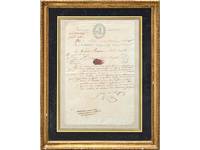
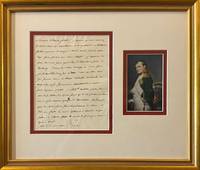
180084Palace of the Republic 16 Pluviôse An IX 4 February 1801 at the latest. French Terror Egyptian plague This letter is an important document from the French occupation of Egypt written in the aftermath of one of the outbreaks of plague which devastated the country between 1799 and 1801. It is in the hand of the chief surgeon of the French oriental army Dominique Jean Larrey 1766-1842 is addressed directly to Napoleon Bonaparte and has also been signed and further initialled by Bonaparte in the left margin. Larrey's letter is the covering note for a petition from Antoine Guirard administrator in chief of the Egyptian quarantine stations. Larrey asks Napoleon to assent to the petition and remove Guirard from the list of émigrés on the watchlists instituted by the revolutionary Reign of Terror citing Guirard's support for two orphans whose mother had died of the plague as evidence of his moral fibre. Guirard is identified as the head of the quarantine station at Bulaq in the republican almanac of An VIII. A Jacques François Antoine Guirard is named as an émigré from the Départment of the Var in the republican lists preserved at the French National Archives. If Guirard had hoped to return to France his inclusion on the watchlists may have endangered him. Bonaparte's added note reads: 'J'envoye au Ministère de la police pour me faire un rapport dans le 9 Ventôse an 10. Le 1er Consul Bonaparte' 'I am sending to the Minister of Police for him to make me a report; on 9th Ventôse Year X Bonaparte'. The quarantine stations Fr. lazarets which Guirard administered were integral to the system of healthcare that the French developed in the Middle East and are commemorated in Antoine-Jean Gros's famous painting Bonaparte Visits the Plague Victims of Jaffa. In his memoirs Larrey describes the great station on the island of al-Rawda in the middle of the Nile where patients were kept in cells made of reeds to avoid contaminating one another. Napoleon's army also imposed strict protocols for dealing with outbreaks in Egypt's cities involving sealing off whole streets and quarters when plague was detected. These practices were heavily criticized by the contemporary chronicler Abd al-Rahman al-Jabarti who lamented how families were unable to bury the bodies of their loved ones with due ceremony in fear of retaliatory punishment. Letter 340 x 225 mm laid down on card framed and glazed with verre églomisé border. Original annotations in the left margin red sealing wax to centre ink stamp dated Ventôse 14 to right margin contemporary handwritten transcription on lined paper pasted to rear of frame. Frame a little chipped letter creased when folded edges somewhat worn leaf toned inks oxidized. Very good. unknown
1937126722Cleveland: The Ralston Society 1937. Rare first edition of this classic bestseller which has sold over 100 million copies. Octavo original cloth. Near fine in a very good dust jacket ownership name to the front free endpaper. Rare in the original dust jacket. Think and Grow Rich was written in 1937 by Napoleon Hill promoted as a personal development and self-improvement book. Hill writes that he was inspired by a suggestion from business magnate and later philanthropist Andrew Carnegie. While the book's title and much of the text concerns increased income the author insists that the philosophy taught in the book can help people succeed in any line of work to do and be anything they can imagine. First published during the Great Depression at the time of Hill's death in 1970 Think and Grow Rich had sold more than 20 million copies and by 2015 over 100 million copies had been sold worldwide. It remains the biggest seller of Napoleon Hill's books. BusinessWeek magazine's Best-Seller List ranked it the sixth best-selling paperback business book 70 years after it was published. The Ralston Society paperback
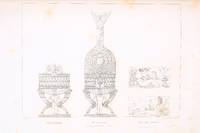
181190504Paris: de l'imprimerie Ballard 1811. Fine. de l'imprimerie Ballard Paris 1811 27.8 x 40.5 cm Relié First illustrated edition with 5 plates cf. Coll. Émile Brouwet II 2 168.Half black shagreen binding smooth spine decorated with gilt and blind fillets title lettered lengthwise in gilt joints and caps rubbed title repeated on the upper cover paper labels pasted to the lower left corner of the upper cover and the upper left corner of the inside back cover bookplate pasted to the inside back cover original front wrapper preserved corners worn mid-19th-century binding.Some light foxing.The five finely line-engraved plates by Cavelier and Pierron after drawings by Pierre-Paul Prudhon bring together a selection of pieces of imperial furniture.The first set a firescreen a dressing table with its mirror an armchair and a washstand was executed in vermeil with lapis inlays and presented to Empress Marie-Louise on 15 August 1810. This important commission was the joint work of the chaser-founder Thomire awarded a gold medal at the Exhibition of 1806 and the silversmith Odiot. The three plates devoted to it preserve its memory as the ensemble was largely melted down in 1832.The final two plates depict the celebrated cradle of the King of Rome in vermeil mother-of-pearl and burgau shell the fruit of the same two craftsmen which was presented by the City of Paris on 5 March 1811 before the arrival of the imperial child and is now preserved in Vienna.Thomire alone later produced a second example in elm burr and gilt bronze following the same design and faithfully reproducing certain elements such as the two bas-reliefs of the Seine and the Tiber. This second cradle is now at the Château de Fontainebleau.Provenance: from the library of Prince Demidoff San Donato stamp then from that of Prince Roland Bonaparte with his bookplate and label N. de l'imprimerie Ballard unknown
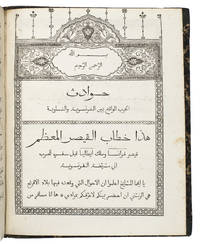
1806ABC_49310Paris 1806. Small 4to. Imprimerie impériale Mid-19th-century gold-tooled quarter brown calf with a brown morocco title label lettered in gold on the spine and the initials "P. T." lettered in gold at the foot of the spine marbled paper sides marbled edges marbled endpapers. With a woodcut decorative border on the title page and a woodcut Islamic headpiece at the start of the work. 306 pp. First edition of a rare Arabic work celebrating Napoleon's victories during the Battle of Austerlitz 1805. It describes the battle which is seen as one of Napoleon's tactical masterpieces and the aftermath until the Peace of Pressburg 1805. The work was printed using an early 17th-century Arabic type which is sometimes considered the most beautiful ever created Conidi.After the French campaigns in Egypt and Syria between 1798 and 1801 Napoleon Bonaparte 1769-1821 remained a famous figure in the Arab and Ottoman Worlds. The present work was printed in Arabic in order to present his victories of 1805 to the Middle East. It makes use of the bulletins written during the battle either by Napoleon himself or under his supervision which offer important military information as well as fascinating political and social commentary. The end of the text contains the Arabic translation of the Peace of Pressburg signed on 26 December 1805 by Charles Maurice de Talleyrand for France as well as Johann I Joseph Prince of Liechtenstein and the Hungarian Count Ignác Gyulay for the Austrian Empire. The Arabic type used for the present work was created in the early 17th century with the support of François Savary de Brèves 1560-1628 a French ambassador in Istanbul and an orientalist who had the ambition to establish a polyglot printing press. He was finally able to do so when he was dispatched to Rome for a diplomatic mission between 1608-1614. He called his press the Typographia Savariana and ordered the cutting of new Arabic types based on the calligraphic scripts found in the manuscripts he had brought from the Middle East. These new types were well received and he printed many publications with them until his printing press unfortunately ran out of business in 1618. After the death of Savary de Brèves his types were acquired by Cardinal Richelieu for the Kingdom of France to promote the spread of Catholicism in the Levant. They were then kept in the royal library until 1692 after which they were handed to the Imprimerie Royale and fell into disuse. They were rediscovered and identified by the French Orientalist Joseph de Guignes 1721-1800 in 1787. Napoleon then used these elegant Arabic typefaces as the foundation for his new printing press in Egypt the Imprimerie Nationale which was the first modern printing press in the Arab world. They were used among others things for the first editions of the newspapers Courier and Décade. The types were brought back to Paris when the French were driven out of Egypt in 1801 and given to the new Imprimerie impériale in 1804 that used them for the present work.The edges and corners of the boards are very slightly scuffed. Barely noticeable foxing on some of the leaves the head margin has been cut slightly short with the loss of a small portion of the decorative headpiece. Otherwise in very good condition.l Schnurrer C. F. von Bibliotheca Arabica 1811 p. 497 no. 429; WorldCat 1472886006 85092075 1356910650 57018842 13021778 7 copies; Zenker Th. J. Bibliotheca orientalis vol. 1 no. 948; cf. Conidi E. Arabic type in Europe and the Middle East 1514-1924 pp. 397-412 the present Arabic type. hardcover
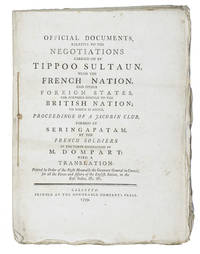
1799ABC_45147Calcutta: Honorable Companys Press 1799. Never bound but side stitched through 3 holes. Super Royal 4to 33.5 x 25 cm. A British propaganda publication printed in Calcutta transcribing secret documents that the British supposedly found in the palace of Seringapatam: primarily Tipu Sultans correspondence with the French considered a betrayal of the British. Tipu Sultan 1750-1799 ruler of the Kingdom of Mysore in southern India took part in a long-standing military feud with the British but made peace with them in 1792. When the French under Napoleon made a push for India in 1798 the British attacked Tipus forces once again starting the Fourth Anglo-Mysore War and eventually killing Tipu Sultan in the attack on Seringapatam. He had a fearsome reputation as the Tiger of Mysore and the present publication attempts to discredit him as a traitor. His supposed affiliation with the French Jacobin Club would have especially concerned British readers. Most of the correspondence between Tipu Sultan the French and their allies including Zaman Shah Durrani ruler of what was to become Afghanistan is printed in parallel columns in English and French. Also included is the text of a letter from Tipu Sultan printed letterpress in Persian in the nastaliq script: 9 lines of type apparently set in the nastaliq type cut under the direction of Charles Wilkins 1749-1836 who served the East India Company in India and became their leading orientalist. It was first used at Calcutta in 1781. The only earlier type for the script that has been clearly documented is thought to have been cut in the 1590s for the Propaganda Fide in Rome who used it around 1633. Neil Benjamin Edmonstone translated the Persian and G.G. Keble the French. Although the book is a true very large quarto point holes along the fold at the head and deckles at the foot and fore-edge the chainlines are vertical though one would not expect sheets this large to be made in double moulds the usual reason for chainlines parallel to the long axis of the sheet.In good condition. Wholly untrimmed and with most bolts unopened and the point holes present.l Shaw Printing in Calcutta 359; Shaw SABREB sab00086; not in Cat. East-India Comp. Honorable Companys Press, unknown
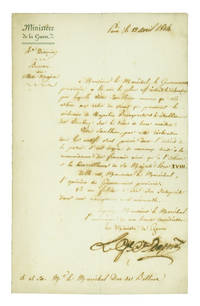
1814247420N.p. Paris 1814. 1 p. on letterhead of "Ministère de la Guerre". Folio. Some very slight waterstaining affecting a few letters otherwise very good handsomely mounted and framed. 1 p. on letterhead of "Ministère de la Guerre". Folio. An extraordinary letter of historic significance written a mere two days after the Treaty of Fontainebleau of April 11 1814 which set the terms of Napoleon's abdication and ended an era. Dupont had been one of Napoleon's most distinguished generals but his surrender in the disastrous Spanish campaign led to disgrace and imprisonment. After the fall of Napoléon Dupont became Minister of War for Louis XVIII and in just such letters as this to Marshal Victor - one of Napoleon's most trusted generals - negotiated the acquiescence of Napoléon's military leaders: in translation "Monsieur le Maréchal; - The provisional government has read with intense interest the declaration in which your Excellency has announced his adherence to the act of the Senate pronouncing the abdication of Napoleon Buonaparte and the restoration of the Bourbons on the throne on their ancestors. By this declaration taken in the interest of the country your Excellency has established anew a claim to the gratitude of the French people as well as the respect and good will of His Majesty Louis XVIII. Such is the opinion sir of the provisional government - and I am more than happy to be its messenger on this memorable occasion". unknown
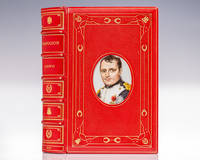
1927150488London: George Allen & Unwin Ltd. 1927. Elaborately bound Cosway style first edition in English of Emil Ludwig's biography of Napoleon Bonaparte. Octavo bound by Bayntun-Riviere in full Cosway style scarlet morocco with gilt titles and tooling to the spine in six compartments within raised gilt bands inset ivorene hand-painted portrait of Napoleon depicting him with medals to the front panel gilt fleuron corner-pieces withing double gilt ruling to the front and rear panels all edged gilt gilt turn-ins and inner dentelles red watered silk endpapers illustrated with engravings. In fine condition. During the 1920s German-Swiss author Emil Ludwig became achieved international fame for his popular biographies of historical "greats" which combined historical fact and fiction with psychological analysis. As Ludwig's biographies were popular outside of Germany and were widely translated he was one of the fortunate émigrés who had an income while living in the United States. George Allen & Unwin, Ltd. unknown
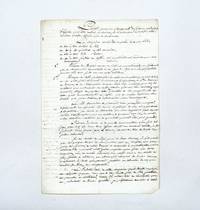
1798154713Cairo: 27 Fructidor An 6 13 September 1798. A proposal to break the British blockade A covert commercial scheme devised by an elusive French agent proposing the export of Egyptian cargo by sea for sale at Smyrna or Thessaloniki drafted shortly after Nelson's decisive victory at the Battle of the Nile left the French army stranded and deprived of supply. The postscript is secretarial while Napoleon's signature is likely autograph though not provably so. The document concludes with his instruction to Jean-Baptiste Étienne Poussielgue administrateur général of finances to report on the feasibility of the plan. The proposal outlines shipment of rice ammonium chloride incense and coffee intended to mislead the English into assuming Egyptian mercantile origin since local traders were unlikely to risk capital in a single commodity. Greek agents had already been placed in the Levant to secure stocks of ammonium chloride and anticipated profits were to be reinvested in wine and oil from Santorini and Naxos; failing this the agent proposed travelling to Constantinople to acquire drugs or dried fruits from Russian merchants unlikely to suspect Egyptian destination. He stresses his suitability through 14 years' residence in the Levant linguistic competence and appropriate dress and names a trusted associate Hajji Andrea of Psara to command the vessel from Damietta. Napoleon's Egyptian expedition of 1798 sought to challenge British power in the eastern Mediterranean. After departing Toulon seizing Malta and defeating Mamluk forces at the Battle of the Pyramids French control of Egypt was swiftly undermined when Nelson destroyed the fleet at Aboukir in August isolating the army. Napoleon departed secretly in August 1799 leaving his forces behind; Poussielgue and Kléber soon reported that he had carried off 2 million francs on quitting Egypt. Bifolium page size 337 x 225 mm manuscript in French on three pages watermark to right side. Soft creases from old folds light toning short split at head bottom fore-corners both minimally clipped small ink burn: a very good example. Marie Joseph L. Adolphe Thiers Thiers' History of the Consulate and Empire of Napoleon 1846. unknown
16-4077Paris : Perrotin 1853. Large folio. 51 x 40 cm. Original qtr. roan and percaline restored.16pp. and 45 color lithograph plates. most lightly foxed and a few more heavily foxed. Provenance: Collector's mark of Gaston Courtois Costumier Paris. His collection sold at auction in Paris Décembre 1894.OCLC Number: 457516951 Paris : Perrotin, 1853. unknown
1945145872Los Angeles: The Willing Publishing Company 1945. First edition of Napoleon Hill's classic work. Octavo original cloth. Boldly signed by Napoleon Hill on a half-title page. Very good in a good dust jacket name to the half-title page. Rare and desirable signed. Based on the Andrew Carnegie's formula for money-making The Master Key To Riches describes in step-by-step detail today's greatest practical philosophy of success. This philosophy culled from the success experiences of hundreds of the world's most powerful and wealthy men will show you how to succeed in any walk of life. The Willing Publishing Company hardcover
18113323101811. framed. near fine. NAPOLEON I. Letter Signed Nap one page quarto Paris March 20 1811. To the minister of war General Henri Jacques Guillaume Clarke the Duke of Feltre. The text in the hand o Meneval. Napoleon orders the purchase of arms in preparation for his Russian campaign: "I approve that you purchase the 18000 weapons belonging to private parties in Holland. I want you to send them to Wesel with the 76000 others. This will come to 94000 arms assembled at Wesel. I approve the seizure of 3000 rifles which Prince d'Eckmiihl Davout carried out in Hamburg. Give him the order to send these 3000 rifles via Mecklenburg to Stettin as well as all those which may be in Bremen Lubeck Osnabrock & other cities of his government belonging to the English military rifles that is. Gen Molitor speaks in one of his letters of 35000 rifles which he says are in one of the bad sections of Amsterdam. I take it that these 35000 rifles do not include the 18000. If that is so have them also sent to Wesel which will bring the number of rifles we will have in Wesel to 133000. " A note indicates that this letter was "Received March 20 and sent the 21st to M. Gassendy. " From 1810 to 1813 Marshal Gabriel Jean Joseph Molitor held commands in the Hanseatic towns Hamburg and Holland. Matted in red and cream and framed in a gold gilt frame with scroll detail dimensions measure 17 3/4 inches wide by 15 1/4 inches high.<br/> <br/> Napoleon Bonaparte born Napoleone di Buonaparte later known by his regal name Napoleon I was a French general and statesman who rose to prominence during the French Revolution and led a series of military campaigns across Europe during the French Revolutionary and Napoleonic Wars from 1796 to 1815. He led the French Republic as First Consul from 1799 to 1804 then ruled the French Empire as Emperor of the French from 1804 to 1814 and briefly again in 1815. He was King of Italy from 1805 to 1814 Protector of the Confederation of the Rhine from 1806 to 1813 and Mediator of the Swiss Confederation from 1803 to 1813.<br/> <br/> unknown
18233596128/05/1823. <blockquote><p>“I beg you to have them copied for me as diligently as possible.I desire that the departure of Mr. Jay Peter Augustus be deferred until next Wednesday…â€</p></blockquote><p>The French ratification of the Louisiana Purchase treaty and conventions was dated May 22nd and signed by Bonaparte Foreign Minister Talleyrand Minister of the Treasury Barbé de Marbois and Hugues Bernard Maret who as the secretary of state was responsible for promulgating laws and decrees. It was delivered to the representatives of the United States Robert R. Livingston and James Monroe who acknowledged receipt of the paperwork to be sent to President Thomas Jefferson ""without delay.""</p><p>It is interesting to note that Barbé de Marbois who played a key role in negotiating the Louisiana Purchase Treaty and delivered the signed ratification was former ambassador to the United States who had lived in the U.S. for years spoke English and married an American. He was well connected in the U.S. and was elected a Foreign Honorary Member to both the American Academy of Arts and Sciences John Hancock and John Adams were also members and the American Philosophical Society Thomas Jefferson was also a member and the two dealt extensively. He was a logical choice to negotiate the treaty.</p><p>Five days after delivery of the signed ratified treaty Marbois contacted the U.S. ministers to ask for the return of copies of the treaty or even the treaty itself so that official copies could be made.</p><p><strong>Letter signed</strong> by Marbois on French Public Treasury letterhead Paris May 28 1803 to <em>""the Ministers of the United Statesâ€</em> in which he asks Livingston and Monroe to either send him copies of the First Consul's ratifications or else lend their own official copy to his office so that additional record copies could be made from it. He requested further that Peter Augustus Jay the son of John Jay who was assigned to carry the treaty back to President Jefferson delay his voyage by a few days to give time for Talleyrand to prepare official instructions for Louis A. Pichon the French minister in Washington D.C. <em>""I am in need of the ratifications given by the First Consul to the Treaty and the two conventions. I beg you to have them copied for me as diligently as possible or to have sent to me the acts themselves so that I might have them copied. I desire that the departure of Mr. Jay Peter Augustus be deferred until next Wednesday and if you might also notify Talleyrand he will thereby request you to deliver the packages to Mr. Pichon.""</em></p><p>On June 2 Livingston sheds some light on the request. ""You know that the ratifications have been delivered & that we were to send them directly to you we have accordingly applied for a passport for Mr Jay the bearer. To our note on this subject we received no answer. I called this day on Mr Talleyrand to accelerate it; he was at St Cloud I called on the Minister of the Treasury. They have been these two days past in Council and principally basting Mr. Marbois on the subject of the Treaty for it seems that the Consul is less pleased with it since the ratification than before and I am persuaded that if he could conveniently get off he would.""</p><p>Livingston further explains that Napoleon felt it was not proper that Marbois delivered the ratifications that it ought to have been Pichon and that Marbois in a fit to try to appease the Consul was throwing in objections and slowing the process of allowing Jay to leave with the Treaty.</p><p>Jay's trip was indeed postponed resulting in not merely in the brief delay requested by Marbois but additional delays mainly resulting from the fact that war had again broken out between Great Britain and France and Jay’s ship was repeatedly stopped by British frigates. Jefferson did not see the treaty and conventions until early July. Jefferson was then in a quandary. He had always advocated strict adherence to the letter of the Constitution yet there was no provision empowering him to purchase territory. Given the public support for the purchase and the obvious value of Louisiana to the future growth of the United States however Jefferson decided to ignore the legalistic interpretation of the Constitution and forgo the passage of a Constitutional amendment to validate the purchase. This decision contributed to the principle of implied powers of the federal government.</p><p>Because the treaty stipulated that the American ratification must be concluded by October 30th Jefferson hurriedly convened a special session of Congress on October 17th. The United States Senate consented to ratification of the treaty with a vote of 24 to 7 on October 20th. On the following day October 21 1803 the Senate authorized Jefferson to take possession of the territory and establish a temporary military government.</p><p><img class=""alignnone wp-image-25018 size-post-window"" src=""https://cdn.raabcollection.com/wp-content/uploads/20231204144051/Folder-site-11-1600x1327.jpg"" alt="""" width=""1600"" height=""1327"" /></p> unknown
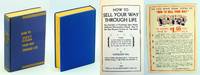
1939448h6114Meriden Conn.: The Ralston Society. Very Good with no dust jacket. 1939. First Edition. Hardcover. Rare first edition copy of this magnificient Napoleon Hill title. "Includes a complete analysis of the stupendous achievements of the man who has 'sold his way' into more millions of dollars than any other man who ever lived." - subtitle. One-page black and white photo of Hill's famous "Castle-On-The-Hill" overlooking Lake Dora Florida. p. 4 2-371 1 2 ads. Bright gilt lettering and decoration upon publisher's blue cloth. Clean tight and unmarked with light external wear. No dust jacket. Bonus: Laid-in is an original 7.5" x 5.3" two-color promotional advertising slip for this book. A superior copy.; 8vo . The Ralston Society hardcover
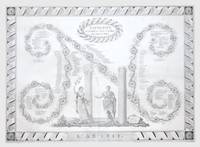
1824133273Leipzig: lithographed by William Herz for Leopold Voss 1824. Napoleon in the garb of Caesar A superb lithograph depicting Napoleon in the costume of a Roman emperor crowned with laurel wreath and with the globe in his hand between the pillars of Hercules. Napoleon is surrounded by his titles and names of his family members with the border listing the names of his senate generals and council of state. Opposite him the goddess of peace holds out an olive branch while at his feet his peace treaties are carved on a stone. An overarching passion-flower and banner thread to form a large "N". A wonderfully evocative image highlighting Napoleon's pretensions to the Roman Empire and his place in history alongside emphasizing his centrality to the state. The lithograph bears the date of 1812 the height of Napoleon's empire but was produced in Leipzig as a memorial in 1824 a few years after Napoleon's death. The print was perhaps aimed at old German members of his army or administration - Napoleon had elevated Saxony to a kingdom and members of its army served in his campaigns including the invasion of Russia in 1812. It is curious to note that the publisher Leopold Voss had fought against Napoleon in the German Wars of Liberation. The print was advertised for 1 thaler 12 groschen see Intelligenzblatt der Zeitung für Die elegante Welt 12 October 1824. Lithograph broadside 79 x 58 cm presented in wooden and gilt frame with conservation glazing. Neat Leipzig blindstamp at foot. Very faint foxing minor peripheral short closed tears repaired on verso but not visible on recto. In very good condition. unknown
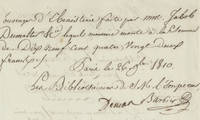
18102472226/10/1810. <p>In 1808 Napoleon formed the idea of having a traveling library in order to make his hours of intellectual recreation independent of the exigencies of a campaign or the delays of a courier. More importantly during times of battle he ordered books that taught him the topography of the countries he was invading and gave him other information to help toward victory. Obviously such a collection of books would have to be selected with great care that the library might be a portable one; and consequently the minute instructions as to its care are as it were a picture of his mind.</p><p>To create this library he turned principally to three men.</p><p>Abbe Denina: In 1782 he had served as historian under Frederick the Great; he became under Napoleon the imperial librarian.</p><p>Antoine-Alexandre Barbier: It was in 1808 that he was put in charge of Napoleon's personal libraries at Compiègne Rambouillet and Trianon and given the primary role in managing the travel libraries that Napoleon took with him whilst on campaign. Barbier was also expected to keep the French Emperor constantly supplied with reading material along with reports analyses and commentaries regarding each publication.</p><p><img class=""alignnone size-post-window wp-image-29132"" src=""https://cdn.raabcollection.com/wp-content/uploads/20231204110006/nt-1600x677.jpg"" alt="""" width=""1600"" height=""677"" /></p><p>Jacob Desmalter: He was responsible for the creation of the library itself the boxes into which the books went along with the decorations worthy of an imperial library.</p><p>This is the first known travel library of a head of state and general. Napoleon seems to have looked forward with expectation to the use of this traveling library while in the field; and when he was preparing for the great campaign which culminated at Wagram he wrote somewhat impatiently from Malmaison March 20 1809 through Méneval his private secretary “The Emperor wants to know if his traveling library is ready. I advised M. Barbier to choose it with care and to put some excellent books in it.†Then the secretary adds: “His Majesty wishes to have something very distinguished and has a preference for books characterized by the beauty of the printed page and by elegance of binding.†Finally comes the admonition “If you have not found the epics do not lose a moment of time in getting them.â€</p><p>His first portable library was ordered in 1808 and reached him in 1809 but was soon replaced by one that suited his interests more and that would last him longer. In replacing the 1809 delivery a second mahogany library of 6 boxes was ordered from Desmalter along with two of oak lined with blue silk. The cost from Desmalter was 1982 francs. These were likely used by Napoleon for the first time in 1810 during visits to Normandy and Holland.</p><p>As tensions with Russia heated however Napoleon supplemented this portable library with books on Russian geography and topography to prepare for his Russian invasion.</p><p>The fate of this traveling library was the fate of his entire army of 1812: it was lost. The books and boxes of the Emperor became firewood for a faltering army in the snow drifts of Russia.</p><p><strong>Document signed</strong> Paris October 26 1810 the original order for one of the most famous travel libraries in history the very library that heated the dying French outside Moscow signed by all three men that created it.</p><p><em>""Memo for his Majesty the Emperor and King executed by the order of Mr. Barbie librarian of his Majesty by Jacob Desmalter.</em></p><p><em>""Six boxes of pure mahogany to serve as portable libraries the top opening and hinged the interior being fitted with copper such that it can remain open the back decorated with a copper hinge. 1440.</em></p><p><em>""One box made of oak from the Vosges mountain range lined with wool. 150</em></p><p><em>""One box of oak. 140</em></p><p><em>""Restore and repair three mahogany boxes and refit the interiors with blue silk. 234</em></p><p><em>""Repair and polish one mahogany box. 18</em></p><p><em>TOTAL 1982.""</em></p><p>This account is verified at the bottom by Jacob Desmalter the builder of the boxes.</p><p>It is witnessed on the verso by Barbier and Denina who write ""Verified the present memo of the woodworkers Jacob Desmalter.""</p><p><img class=""alignnone wp-image-24670 size-post-window"" src=""https://cdn.raabcollection.com/wp-content/uploads/20231204145810/Folder-site-9-1600x1327.jpg"" alt="""" width=""1600"" height=""1327"" /></p> unknown
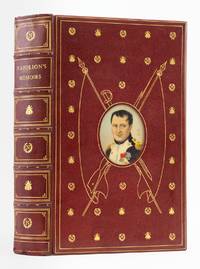
1945ST17640qWaltham St. Lawrence: Golden Cockerel Press 1945. No. 412 OF 500 NUMBERED COPIES. 317 x 190 mm. 12 1/2 x 7 1/2". 422 2; 78 2 pp. Two volumes bound in one. Translated and edited by Somerset de Chair. <br/> HANDSOME RED MOROCCO BY BAYNTUN RIVIERE stamp-signed in gilt on rear turn-in covers with double gilt rule surrounding a field of alternating gilt tools a bee and the letter "N" encircled by a wreath upper board with inset WATERCOLOR OVAL PORTRAIT OF NAPOLEON with two flags a gun and a saber outlined in gilt appearing to cross behind it lower cover with large gilt armorial device raised bands compartments ruled in gilt with bee or "N" tool at the center gilt lettering thick turn-ins with gilt rules and decorative cornerpieces blue watered silk endleaves top edge gilt others untrimmed original map endpapers bound in. Volume I with a frontispiece portrait of Napoleon volume II with a black and white photograph of a modern sculpture of the general title page of each volume with a woodcut design of an eagle clutching a flag among other accoutrements of war. Title page of volume one SIGNED BY THE EDITOR in ink. Chanticleer 167; Cave & Manson 167. Small nick to head of spine and some minor damage along the tail two small stains and a couple of dings to covers but still a beautiful binding in very pleasing condition. Small repair to edge of one of the map endpapers one or two isolated trivial smudges elsewhere but the contents nearly pristine.<br/> <br/> This is a finely bound copy of an innovative version of the memoirs that were based on conversations between Napoleon and Emmanuel-Augustin-Dieudonné-Joseph Comte de Las Cases 1766-1842. The count accompanied the defeated emperor into exile on Saint Helena as an informal secretary took a great many notes about Napoleon's life inserted his own impressions colored his account to the point of favorable misrepresentation and published the work as the celebrated "Mémorial de Ste. Hélène" from which he made a substantial amount of money. Our translator and editor Somerset de Chair has turned the text into a first-person narrative and rearranged the pieces so that events are recalled in chronological order. The first volume covers the general's career from Corsica to Marengo and the second is devoted to Waterloo. The so-called "Cosway" binding featuring handsome morocco inset with one or more painted miniatures apparently originated with the London bookselling firm of Henry Sotheran about 1909. It was in that year that G. C. Williamson's book entitled "Richard Cosway" dealing with the British miniature painter of that name 1742-1821 was remaindered by Sotheran and presumably given this special decorative treatment. The name "Cosway" was then used to describe any book so treated whoever its author. Other prominent binderies chiefly Sangorski & Sutcliffe and Bayntun produced their own versions of the popular style. The Bayntun firm founded in Bath in 1894 is now the last of the great Victorian trade binderies still in family ownership. Among the great English workshops of the Edwardian "golden age" of lavish bindings Bayntun has the distinction of being the only one located outside London's West End to be sought after by bibliophiles. In 1939 Bayntun took over the esteemed Riviere firm founded in 1829. The oval portrait on the present work is especially pleasing because it communicates something of Napoleon's character: he appears smug and in control yet expressing some of the famous charisma that contributed to his success. The miniature bears the monogram "WMB" quite likely the initials of William Mineard Bennet 1778-1858 a painter and miniaturist who studied under Thomas Lawrence. According to Benezit he went to Paris in 1835 "where he was extremely well received enjoying the patronage of both the Duke de Berry and King Louis-Philippe.". Golden Cockerel Press unknown
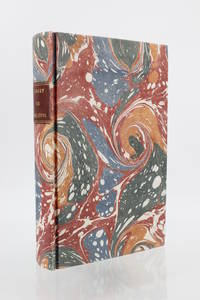
180187628Paris: Chez Fauvelle imprimeur des Tribunaux place circulaire du Palais de justice à ParisEt Patris imprimeur-libraire quai Malaquais près le pavillon des Quatre-Nations n° 2 1801. Fine. ""The French nation having conquered liberty by the sword shall preserve and strengthen it through the law"" Preliminary Address Chez Fauvelle imprimeur des Tribunaux place circulaire du Palais de justice à Paris Et Patris imprimeur-libraire quai Malaquais près le pavillon des Quatre-Nations n° 2 Paris s. d. 1801 20.4 x 13.2 cm relié Extremely rare printing by Fauvelle official printer for the Tribunaux de la Seine contemporary and textually identical to the octavo and quarto editions by the Imprimerie de la République. Only four copies with Fauvelle's imprint in OCLC BnF National Library of Spain Royal Danish Library Stadtbibliothek Worms. Bradel-style binding in full marbled paper boards flat spine with red roan label light foxing to the first three leaves. First version of the Napoleonic Code presented by the four members of Bonaparte's commission appointed to draft the civil code. Also contains the important Preliminary Address to the First Draft of the Civil Code outlining the influences and objectives behind this landmark work - the first modern legal code to be widely adopted in Europe which influenced the codes of jurisdictions all over the world. Under Bonapartes authority the legislative commission led by Tronchet president Portalis Bigot de Préameneu and Maleville completed this draft civil code in just four months presented in Frimaire Year IX of the Republican Calendar January 1801. The structure of the text mirrors that of the Civil Code which came into effect in 21 March 1804. There are however both technical and philosophical differences: this project contains a Preliminary Book On Rights and Laws comprising six titles which would later be reduced in the Code to a single introductory article. Most sections in this version begin with explanatory comments many of which were later removed particularly in the first half of the code. As the Allgemeine Literatur Zeitung observed ""It can often be very useful to consult both the draft and the final code even in matters of legal dogmatics for the general principles and explanations provided by the commission are typically still valid for the code not because they were rejected as incorrect but rather deemed unsuitable for inclusion in the final version"" 25 March 1810. This first version of the Code was published for the Court of Cassation and appellate courts to collect their amendments. Fauvelle printer of this edition likely intended for Parisian magistrates was among the publishers of judicial commentaries submitted in response to the government's request. The courts delivered their remarks within six months of this editions release. After three years of debate and some one hundred sessionshalf chaired by Bonaparte himselfthe Civil Code was adopted in the form of 36 legislative bills and soon became known as the Napoleonic Code. This edition also includes the only appearance at the time of a Preliminary Address in essence the statement of purpose for the draft Civil Code by the four-member governmental commission between August 1800 and January 1801. . The Preliminary Address is in fact the work of Portalis whose spirit of moderation guided the drafters of the code. The legislator must remain modest Portalis maintained: a code should not seek to say everything; it must leave room for interpretation by the courts and jurists which leads to the famous phrase: The codes of nations evolve with time; properly speaking they are not made. The Preliminary Address is also a brilliant piece of propaganda outlining pacification by the Consulate after the Revolution and presenting the future code as a synthesis of the legal tradition from the French monarchy and new revolutionary principles. Canadian Ministry of Justice May 2004. This rare speech would not appear again until 1836 in Fenets Recueil complet des travaux préparatoires du Code civil vol. I p. 436. Rare copy of the only published Chez Fauvelle, imprimeur des Tribunaux, place circulaire du Palais de justice à ParisEt Patris, imprimeur-libraire, quai Malaqu hardcover
19529122St Helena: Unpublished 1952. An extensive collection of diaries photographs blueprints letters and documents - and even a painted sample sheet of Longwood's famous wallpaper from the 1920s - which together record the rescue and rebuilding of Napoleon Bonaparte's dilapidated home on St Helena. Longwood housed Napoleon from December 1815 to his death in 1821 was bought by the French government but fell into disastrous disrepair by the time Basil Lennox Hart took charge of its renovation in the 1950s. His - this - archive includes his St Helena personal diaries blueprints and plans for the building works and a large number of his photographs of Longwood before during and after its semi-demolition and rebuilding. Informing this process is a series of otherwise unknown copy photographs from the 1850s which were given to Hart by a grandson of his predecessor as Commissioner on St Helena John Charles Mellis. These otherwise unknown images add significantly to the visual record of Longwood. The decision to rebuild Napoleon's last home was prompted by the visit of King George VI to the island; he summoned the French Ambassador on his return to London prompting a joint effort by Britain which controlled St. Helena as a Crown Colony and France which had owned the French Domains of Saint-Helena since 1858 to restore the buildings. The archive includes reports on the disastrous state of Longwood House with further plans made for reconditioning the residence of the French Consul and the area around Napoleon's Tomb. Hart's pocket diaries from 1952 1953 and early 1954 c10000 words record his arrival in St Helena in February 1952 and the process of surveying producing plans hiring workmen and the minutiae of the reconstructive works: 'Longwood started stripping Old House Roof Library & dining R.' 'Longwood all day men cutting concrete curb away around rafters Library & Dining R. & concrete gutters & East Dormer down had consul up about concrete trusses' 'Longwood pulling down N. wall Library completed & new concrete foundations to be put in.' Hart records delays to wages endless rain and the liberal application of Rentokil to combat termites. Most revealing are Hart's photographs of the process which have been mounted on sheets as if for display purposes; alongside these is a small group of photographs from a century earlier which were submitted to him by John Charles Mellis's grandson. One final evocative item is a painted replica of the wallpaper inside Longwood reproduced by a French official in the 1920s and submitted to Hart to help inform his restoration project. Are we looking at an image of the wallpaper that killed Napoleon Alongside these items are copies of monthly accounts with tabulated material costs rates of pay and day-to-day expenses towards final reopening in 1955. The archive comprises: 1. Application and Acceptance Letters 1951: Correspondence between Hart and the Crown Agents for the Colonies. 2. Collection of 10 Government Publications 1951- 1952: Documents on passport application inoculation insurance and living conditions in St. Helena. 3 Diaries 1952-1954: Written on an almost daily basis documenting his work on the project detailing the progress incidents visits and problems as the work progressed. 4 Employment Agreement 1952: Copy of the employment agreement between Hart and the ViceConsul of St. Helena. 5 Reconstruction Report April 1952: Report on the work necessary for the reconstruction of Longwood 'Old House. 6 Letter from H.J. Melliss 1952: Enclosing copies of photographs taken of Longwood House in 1858 when his father as consul handed the site over to the French government. 7 RSVP Group 1952-1954: A collection of RSVP responses from various islanders tickets to events press cuttings and releases. 8 Brochures and Documents on Termites 1953 and later: A collection of brochures and advice documents on killing and preventing termites. 9 7 Extensive Typed Copies 1954: Addressed to Mons G.E. Peugent the French Vice-Consul at St. Helena detailing the progress of ongoing work payments for materials subsistence costs weekly employment of local workmen together with their names and countersignatures on receipt of their wages. 10 2 Blueprints 1952: Blueprints of the 'French Domain St. Helena Island New House adjacent to Emperor Napoleon's tomb 11. Sample Sheet of Wallpaper: Reproduced from fragments of the original by the French Government in the 1920s. 12. Collection of 11 Income Tax Documents 1952-1954: Related to St. Helena and the United Kingdom. 13. 56 Postcard-Size Photographs 1952-1954: Mounted on album sheets depicting various views of the work being carried out on the site captioned in French. These were possibly produced for official and important visitors to the site to help explain the ongoing work. Please contact Christian White Rare Books Ltd for more information or images of this item 1952 Unpublished unknown
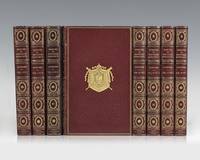
1836109608London: Richard Bentley 1836. Finely bound extra-illustrated edition set of de Bourrienne's Memoirs of Napoleon Bonaparte. Octavos eight volumes bound in full 19th century crimson morocco by Riviere and Son with gilt titles and tooling to the spines in six compartments within raised gilt bands central gilt Napoleonic coats of arms and double gilt ruling to the front panels gilt turn-ins and inner dentelles all edges gilt illustrated with engravings including frontispieces to each volume. In near fine condition. Based on years of intimate friendship and professional association with Napoleon Bonaparte Louis Antoine Fauvelet de Bourrienne's Memoirs of Napoleon gained the author fame upon publication for its vivid and detailed account of his interactions with Napoleon and his extended family. Invigorated by many dialogues not only in which the author participated but even of conversations that he was only told about by others the narration offers an intimate portrait of its subject: his brilliance skill at governance and military prowess. Richard Bentley unknown
1937140946381Meriden CT: The Ralston Society 1937. First Edition. Near Fine. First edition first printing. Bound in publisher's maroon cloth stamped in gilt lacking the dust jacket. Near Fine with trivial wear and light soiling to cloth. Light foxing to all edges contents tanned minor offsetting to endsheets and a small pinhole to the front free endpaper. A great copy of this hugely popular self-help book. The Ralston Society unknown
1937140947305Meriden CT: The Ralston Society 1937. First Edition. Near Fine. First edition first printing. ii 381 pp. Bound in publisher's maroon cloth stamped in gilt. Near Fine with light wear to cover extremities and light soiling foxing and shallow nicks to textblock edges. Contents tanned endsheets foxed. A scarce first printing of a book Hill claimed was inspired by a suggestion from Andrew Carnegie with unusually bright and clean covers. The Ralston Society unknown
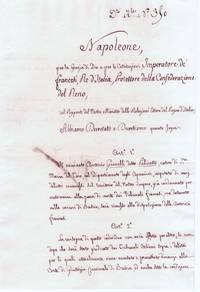
55524as Emperor of the French King of Italy and Protector of the Confederation of the Rhine in Italian with translation saying that "on the Report of Our Minister of Foreign Relations of the Kingdom of Italy" Ferdinando Marescalchi 1754-1816 Foreign Minister of the Republic of Italy 1802-1805 of the Napoleonic Kingdom 1805-1814 Count 1809 "Antonio Granelli called Palinetto native of Santa Maria del Taro in the Department of the Appennines accused of various crimes committed in the territory of Our Empire previously condemned for contempt of court to the penalty of death by the French Tribunals and now detained in the prison of Brescia shall be placed at the disposal of the French Authorities" but only after being tried by the Italian "Court of Criminal Justice at Brescia" any non-capital punishment by the French not to exceed what the Italian courts would have stipulated headed Royal Decree No. 350 2 sides folio and conjugate blank Imperial Palace of the Tuileries 12th April crisp Marescalchi was an early supporter of Napoleon. As Foreign Minister he resided in Paris and in 1803 supported by the Bishop of Orléans drew up a concordat for the Kingdom of Italy parallel to that between France and Pius VII of July 1801. After Napoleon's fall in 1814 Empress Marie-Louise was given the Duchies of Parma and Piacenza and chose Marescalchi as Governor 1814-1816. unknown
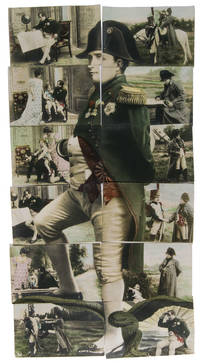
1910ABC_487091910. All postcards ca. 9 x 14 cm. In a 20th-century ring binder with the title "Postzegelmapje van Nederland" lettered in gold on the spine and the front underneath a gold embossed coat-of-arms of the Netherlands. The postcards are loosely inserted in 21 translucent plastic covers. With 81 hand-coloured or black-and-white photographic picture postcards including 9 duplicates. Three remarkable sets of early 20th-century French picture postcards which form a large image of French Emperor Napoleon Bonaparte 1769-1821 when laid side-by-side. This type of photographic collage is known as "instalment puzzle postcards". The three sets consist of 12 10 and 12 postcards respectively and are partly coloured by hand. They show Napoleon Bonaparte in a classic pose with bicorne hat and one hand in his waistcoat surrounded by various scenes from his domestic and military life. Also included are nearly 40 postcards composed of scenes with actors and montaged reproductions of historical engravings relating to Napoleon.Two of the puzzle postcard sets are published in the series "Croissant" referring to the address "Rue du Croissant" in Paris where the publisher Charles Fontane was located at the beginning of the 20th century. Fontane is also known as director of the French magazine "Le Cartophile" and president of the "Cartophile-Club".Two sets with "carte postale" printed on the verso the third set with "made in France" printed on the verso. A fourth set of Napoleon puzzle postcards is incomplete missing one postcard. All postcards are unused with only signs of minor wear. Overall in very good condition. unknown