Hill, NapoleonBiblio.com

17 087 résultats
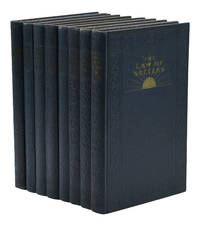
1928140945092Meriden CT: The Ralston University Press 1928. First Edition. Very Good. First Edition. Complete eight volume set bound in dark blue variant cloth decorated in blind and stamped in gilt. Ranging from Very Good to Near Fine with light soiling and light wear to covers light worming to textblock edges former owner name to front endhseet of several volumes marking to text in several volumes though pages mostly clean one long tear to top edge of page 21/22 in Volume 3. A rare set which has become increasing hard to obtain. The Ralston University Press unknown
1937150615Meriden Conn.: The Ralston Society 1937. Rare first edition of this classic bestseller which has sold over 100 million copies. Octavo original cloth. Boldly signed by Napoleon Hill on the front free endpaper. Near fine in a very good dust jacket with various original ephemera relating to the original release of this title. Rare and desirable in the original dust jacket and signed. Think and Grow Rich was written in 1937 by Napoleon Hill promoted as a personal development and self-improvement book. Hill writes that he was inspired by a suggestion from business magnate and later philanthropist Andrew Carnegie. While the book's title and much of the text concerns increased income the author insists that the philosophy taught in the book can help people succeed in any line of work to do and be anything they can imagine. First published during the Great Depression at the time of Hill's death in 1970 Think and Grow Rich had sold more than 20 million copies and by 2015 over 100 million copies had been sold worldwide. It remains the biggest seller of Napoleon Hill's books. BusinessWeek magazine's Best-Seller List ranked it the sixth best-selling paperback business book 70 years after it was published. The Ralston Society paperback
1937140943908Meriden CT: The Ralston Society 1937. First Edition. Near Fine/Near Fine. First edition first printing. Bound in publisher's maroon cloth stamped in gilt. Near Fine with slight dulling to spine cloth slight rubbing to gilt slight wear to extremities. Light pencil marking throughout text and repair to rear inner hinge. In a Near Fine unclipped dust jacket with light edge wear. The Ralston Society unknown
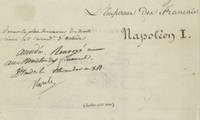
18042327822/08/1804. <blockquote><p>This is earliest document we found having reached the market bearing the title ""Napoleon I"" Emperor of the French on it; it was signed just weeks after he gave himself the title and months before his coronation in front of the Pope.</p></blockquote><div dir=""ltr""><span style=""color: #3366ff;""> </span></div><p><span style=""color: #3366ff;""><em>Reference for research publication and institutions: Raab B</em>13.105</span></p><p>The Corsican-born Napoleon one of the greatest military strategists in history rapidly rose in the ranks of the French Revolutionary Army during the late 1790s. By 1799 France was at war with most of Europe and Napoleon returned home from his Egyptian campaign to take over the reigns of the French government and save his nation from collapse. After becoming first consul in February 1800 he reorganized his armies and defeated Austria. In 1802 he established the Napoleonic Code a new system of French law and in 1804 he established the French empire.</p><p>On May 18 1804 Napoleon proclaimed himself emperor and made Josephine Empress. His coronation ceremony took place on December 2 1804 in the Cathedral of Notre-Dame in Paris with incredible splendor and at considerable expense. Napoleon even paid for Pope Pius VII who had signed the Concordat of Rome defining the status of the Roman Catholic Church in France and ending the breach caused by the church reforms and confiscations enacted during the French Revolution to travel to France for the occasion believing that his presence would imbue the event with a solemn religious feeling. Pius agreed to come hoping to win Napoleon's goodwill towards Rome and the Papal States.</p><p>As a perfect reflection of the time in which he lived Napoleon was “obsessed with history."" He would draw references symbols and examples from it to justify his position and his politics and thus give his reign its place in the history of France from the Gauls right up to his immediate predecessors including the Bourbons. Of all the references wielded by the French Emperor Charlemagne is if not one of the most important then at least one of the most consistent. During the same period the Russian Ambassador Markov wrote to his government saying that in his opinion Bonaparte would soon take the title of “Emperor of the Gauls †whilst the Prussian Lucchesini sent word to Berlin that the Consul wanted to “be a second Charlemagne †but “enlightened by the geniuses of our century †adding “No-one doubts he has a plan; it is just the timing that has yet to be decided."" On becoming emperor Napoleon thought it time to visit his “predecessor â€. This pilgrimage had become virtually a tradition with the kings of France then the Germanic emperors. So he went to Aix-la-Chapelle to tie his historical legitimacy with the memory of Charlemagne – as Thiers put it the old emperor had been “awakened by Napoleon with ill-disguised intent â€.</p><p>On July 18 the new Emperor began a great inspection tour from Boulogne to Treves through Calais Dunkirk Ostend Arras Mons Aachen Cologne and Mainz. It was to end in Aix and cement his position of Emperor. He would return from this and receive the crown.</p><p><strong>Autograph document signed</strong> with a very early example of his new title the head reading <em>""To his Majesty the Emperor of the French Napoleon I""</em> August 22 1804 Ostend granting a senior civil position to a resident of Ostend on his great tour by endorsing the request <em>""Agreed. Returned to the Ministry of Finance Ostend 6 Thermidor in the 12th August 22 1804.â€</em> The approval its in response to an appeal from citizen Michel Jean Pruyssenaere resident of Ostende to serve as collector of that area.</p><p>We have found just one other document of Napoleon during this grand tour having reached the public market and that was part of the great Sang Collection. That did not have his new letterhead as Emperor. This must be one of the earliest with his ""Napoleon I"" letterhead.</p><p><img class=""alignnone wp-image-23121 size-post-window"" src=""https://cdn.raabcollection.com/wp-content/uploads/20231204155902/Folder-site-3-1600x1327.jpg"" alt="""" width=""1600"" height=""1327"" /></p> unknown
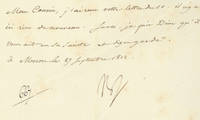
18123546227/09/1812. <p>In 1812 Napoleon was still at the height of his fortunes. The Peninsular War in Spain against Britain he believed would soon end in triumph. All that remained to complete his “Continental Systemâ€â€“a unilateral European blockade designed to economically isolate Britain and force its subjugation–was the cooperation of Russia. Czar Alexander I kept a tenuous peace but was unwilling to submit to the Continental System which would be ruinous to the Russian economy. To intimidate Alexander Napoleon massed his forces in Poland in the spring of 1812 but still the Czar resisted.</p><p>Napoleon determined to act. On June 24 Napoleon commenced his famed campaign in Russia ordering his Grande Armée the largest European military force ever assembled to that date into Russia. The enormous army featured more than 500000 soldiers and staff and included contingents from Prussia Austria and other countries under the sway of the French empire. The campaign would be characterized by the massive toll on human life: in less than six months Napoleon lost near half of his men because of the extreme weather conditions battle disease and hunger. On both sides nearly a million soldiers and civilians died.</p><p>Napoleon’s military successes traditionally lay in his ability to move his armies rapidly and strike quickly but he was instead forced to pursue the Russian army which was refusing to give in and was falling back. The fleeing Russian forces adopted a “scorched earth†strategy seizing or burning any supplies that the French might utilize as they pillaged from the countryside. Meanwhile Napoleon’s supply lines became overextended as he advanced deeper and deeper into the Russian expanse.</p><p>Many in Russia were critical of the Russian army’s refusal to engage Napoleon in a more direct confrontation. Under public pressure in late August Alexander named General Mikhail Kutuzov supreme commander but initially the veteran of earlier defeats against Napoleon continued the retreat. Finally Kutuzov agreed to halt at the town of Borodino about 70 miles west of Moscow and engage the French. The Russians built fortifications and on September 7 the Grande Armée attacked. Napoleon was uncharacteristically cautious that day; he didn’t try to outflank the Russians and he declined to send much-needed reinforcements into the fray. His exhausted Grand Armée was unable to encircle and destroy the opposing force as it had done in Napoleon’s earlier campaigns. Instead Napoleon’s direct attacks against entrenchments resulted in heavy losses. He failed to destroy the Russian army and as a result he was not in the position of overwhelming superiority he had hoped to achieve. After the battle Kutuzov decided not to defend Moscow but to launch a general withdrawal to save the Russian army.</p><p>Napoleon was sure that once Moscow was taken Alexander would be forced to capitulate. On September 14 the French entered Moscow only to find it abandoned. All but a few thousand of the city’s 275000 people were gone. Napoleon retired to a house on the outskirts of the city for the night but two hours after midnight he was informed that a fire had broken out in the city. He went to the Kremlin where he watched the flames continue to grow. Reports began to come in telling of Russians starting the fires and stoking the flames. Suddenly a fire broke out within the Kremlin apparently set by a Russian military policeman who was immediately executed. With the firestorm spreading Napoleon and his entourage were forced to flee down burning streets to Moscow’s outskirts and narrowly avoided being asphyxiated. When the flames died down three days later more than two-thirds of the city was destroyed.</p><p>On September 18 Napoleon wrote Jean-Jacques Régis de Cambacérès his trusted advisor who was constantly consulted for advice saying the fires were calming down and “I have taken up lodging in the residence of the Tsars the Kremlin…â€</p><p>Nine days later he updated his advisor. <strong>Letter signed</strong> Moscow September 27. 1812 to Jean-Jacques Régis de Cambacérès. <em>“My cousin I have received your letter. There is nothing new at present. I pray that God keeps you in his holy and worth guard.â€</em></p><p>A very uncommon letter of Napoleon in Moscow during the great invasion.</p><p><img class=""alignnone wp-image-25018 size-post-window"" src=""https://cdn.raabcollection.com/wp-content/uploads/20231204144051/Folder-site-11-1600x1327.jpg"" alt="""" width=""1600"" height=""1327"" /></p> unknown
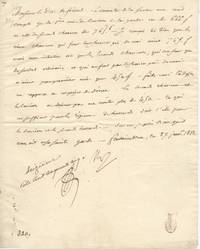
39568Géraud-Christophe-Michel Duroc 1772-1813 General and Diplomat one of Napoleon's closest advisers saying that he has been told that the wages of "the Lancers of the Guard is 666. f. and that of the second infantrymen of 765. f. - I understand very well that the old infantrymen who do their service by me have 765. f but my intention is that the second infantrymen who are only ordinary soldiers who do not do the service by me have for first wage only 450. f. - would you draft for me a report and a project of decree. Second infantrymen and spearmen should not cost me more than 450. What is sufficient for hussar regiments should be for lancers and second hussars as well." 1 side 4to. Fontainbleau 27th January With the stamp of the Bibliotheca Lindesiana which had been planned by Alexander LINDSAY 25th Earl of Crawford 1812-1880 and his eldest son James 1847-1913 Astronomer Politician Ornithologist Bibliophile and Philatelist. He was a member of the Royal Society president of the Royal Astronomical Society and a prominent Freemason. Father and son were instrumental in building the library up to such an extent that it was one of the most impressive private collections in Britain at the time both for its size and for the rarity of some of the materials it contained. In 1796 Napoleon took Duroc as his aide and made him a major in Egypt a colonel in Syria and then senior aide-de-camp. From 1804 he was a grand marshal and was often sent on diplomatic missions and he signed the treaties of Fontainebleau and Bayonne 180708 determining the French intervention in Spain. He led a division at the Battle of Austerlitz and was in all the campaigns. He was usually consulted by Napoleon on questions of promotion and became the best channel by which Napoleon's lieutenants could approach him. On his journey back from Russia in 1812 the emperor chose Armand de Caulaincourt as his immediate companion and Duroc followed in another sledge. Back in France Duroc was made a senator in 1813. He was heavily involved in the organisation of the new French army and was with it at the battles of Lützen and Bautzen. Only a couple of months after this letter he was in the outposts in Silesia and came under artillery fire and was killed. Napoleon's invasion of Russia has been described as among the most lethal military operations in world history and this letter was written only months after the retreat. Transcription Monsieur le Duc de Frioul Le ministre de la Guerre me rend compte que la 1ère mise des lanciers de la garde est de 666. f. et celle des seconds chasseurs de 765. f. - Je conçois très bien que les vieux chasseurs qui font leur service près de moi aient 765. f mais mon intention est que les seconds chasseurs qui ne sont que des soldats ordinaires et qui ne font pas le service près de moi n'aient pour première mise que 450. faites-moi là de plus un rapport et un projet de décret. Les seconds chasseurs et les lanciers ne doivent pas me coûter plus de 450. Ce qui est suf sant pour les régiments de hussards doit l'être pour les lanciers et les seconds hussards. - Sur ce je prie Dieu qu'il vous ait en sa sainte garde. -Fontainebleau le 27. janvier 1813. Seizième Cote cent cinquante cinq Translation The Duke of Friuli The Minister of War makes me informed that the 1st wage of the Lancers of the Guard is 666. f. and that of the second infantrymen of 765. f. - I understand very well that the old infantrymen who do their service by me have 765. f but my intention is that the second infantrymen who are only ordinary soldiers who do not do the service by me have for first wage only 450. f. - would you draft for me a report and a project of decree. Second infantrymen and spearmen should not cost me more than 450. What is sufficient for hussar regiments should be for lancers and second hussars as well. - Then I pray to God that he keeps you in his holy guard. - Fontainebleau January 27 1813. unknown
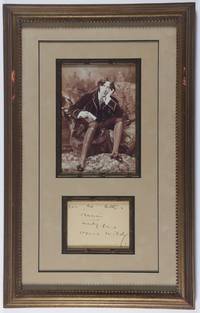
188255660NP: Napoléon Sarony 1882. Framed. Very good to fine. Fine photo-mechanical image of Oscar Wilde after the original by photographer Napoléon Sarony 1821-1896. With brief inscription signed Oscar Wilde. Photo and note framed behind glass within larger frame 19 5/8 12 5/8". <br /> <br /> Portrait of Oscar Wilde 7 x 5" in decorative gilt frame: Frontal of Oscar Wilde seated clothed in jacket and knee breeches leaning forward with elbow resting on knee head supported by left hand holding a book in right hand with elbow resting on armrest. <br /> <br /> The six word inked note 3 x 4 1/8" also in decorative gilt frame both matted within larger wooden gilt frame with decorative inside border. Gilt frame with two scuffs 4 1/4" below top of frame one on each side. Napoléon Sarony unknown
010941[Battle of the Little Bighorn, Bataille de Little Bighorn, Felice Orsini, Attentat contre Napoléon III en 1858, Charles Camillo De Rudio], Recueil de 9 autographes des 4 protagonistes dont Charles DeRudio qui devint officier lors de la fameuse bataille de Little Bighorn le 25 juin 1860, y survécut et dont le témoignage fut publié dès le 30 juin 1860. Reliés dans un volume in-8 avec une brochure du docteur Rougean, L'Attentat d'Orsini - étude de psychi-pathologie historique (Paris, Le François, 1934). L'attentat eut lieu le 14 janvier 1858. Felice Orsini (1819-1858), G Pieri (1808-1858), Charles de Rudio (1832-1910) & Antoine (Antonio) Gomez (né en 1825). Les trois premiers furent condamnés à mort le 26 février 1858 et Gomez aux travaux forcés à perpétuité. La peine de Rudio fut commuée en travaux forcés elle-aussi et il s'évada peu après alors qu'Orsini et Pieri furent exécutés le 13 mars 1858. Si on perd la trace de Gomez (probablement mort au bagne), Rudio arriva à Londres puis émigra à New-York. Il s'engagea dans l'armée et fait partie des survivants de la fameuse bataille de Little Bighorn (25 juin 1860). Son témoignage a été publié dès le 30 juin dans New York Herald. On compte ainsi : -2 autographes d'Orsini : une feuille de comptes et une L.A.S. à « M. Leveille, directeur de la conciergerie », en réalité Jean-François Lebel, datée du 2 mars 1858. -3 autographes de Pieri : une L.A.S., probablement jamais arrivée, au procureur général pour solliciter un rendez-vous, datée du 22 février 1858, et 2 reçus A.S. datés des 12 et 13 février 1858. -2 autographes de Gomez : 2 reçus A.S. datés des 9 février et 1er mars 1858. -2 autographes de Rudio : 2 reçus A.S. datés des 12 et 13 février 1858. Reliure demi-chagrin. Exceptionnel ensemble, extraordinaire même par la réunion des 4 protagonistes de l'attentat et par la présence même d'autographe d'un des protagonistes de Little Bighorn, évènement d'une importance capitale dans l'histoire des USA.
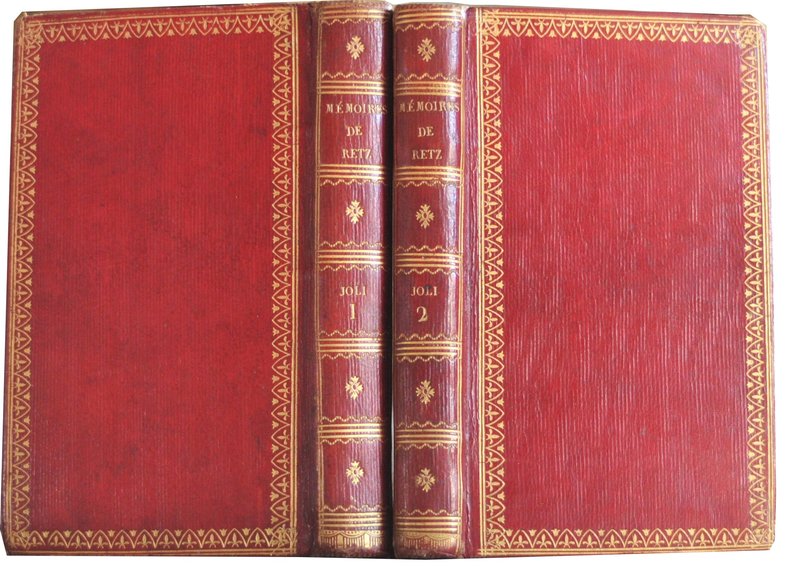
171846405266Amsterdam, chez Jean Frédéric Bernard, 1718 ; 2 vol. in-12, plein maroquin à longs grains, encadrement dentelles dorées, dos lisses XXIV pp., 191 pp. - Titre, 234 pp.ÉDITION ORIGINALE publiée par l’éditeur de la seconde édition des Mémoires du Cardinal de Retz auxquels ces deux volumes font suite. Tchémerzine IX, p. 395.Exemplaire provenant d’une des bibliothèques de Napoléon, avec sur les deux titres le petit cachet ovale avec l’aigle couronné et la mention Cabinet de l’Empereur.Il a ensuite appartenu au bibliophile A. Barbet (ex-libris manuscrit), les pages de garde portent une note manuscrite de ce dernier : “Les mémoires du Cardinal de Retz dont le ms original appartenait aux moines de Saint Mihiel en Lorraine venaient d’être publiés à Nancy, mais avec beaucoup de lacunes (...) suit un extrait de la notice en-tête de l’édition des Mémoires de Retz de 1820 et un extrait d’une lettre de J. B. Rousseau au sujet des Mémoires de G. Joli “plus mauvais que ceux de son maître, je conclus qu’ils ne valent rien du tout et sur ce pied là, je ne les lirai point.”
242411Paris, Paulin et Lechevalier, 1848-1850 7 vol. in-8 et 1 atlas in-folio, 3 tableaux repliés, portrait et 16 cartes à l'atlas, tables des planches, veau blond, dos à nerfs orné de caissons dorés, filets dorés en encadrement sur les plats, tranches marbrées bleutées, dentelle intérieure, demi-veau blond, dos à nerfs, filets dorés (atlas) (reliures de l'époque). Qqs rousseurs, dos un peu passé, début de fente au mors de l'atlas avec manque à la coiffe inférieure.
1797152774Paris: Chez H. J. Jansen 1797. Presented to Napoleon First edition presentation copy to Napoleon inscribed on each half-title verso "au Général Bonaparte; l'auteur". The work gives Saint-Fond's 1741-1819 account of his travels to Britain in the year 1784 with important observations on the geology of northern England and Scotland most notably his recognition that Fingal's Cave was a volcanic formation which had gone unnoticed by Joseph Banks. The work also includes anecdotes of Banks Adam Smith John Whitehurst and the Royal Society. The work was issued in octavo and the present large paper printing on quarto sheets; an English translation followed in 1799. At the time of publication Saint-Fond was professor of geology at the Jardin des Plantes; he was later involved in the extraction to French institutions of scientific materials across Napoleonic Europe. As one of the travelling commissaires of the clumsily but explicitly named Commission du gouvernement pour la recherche des objets scientifiques et artistiques dans les pays conquis par les armées de la République française established under the Directory for the purposes of pillage directed by connoisseurship and scientific expertise Saint-Fond certainly interacted with Napoleon who himself had refined the process by inserting clauses into peace treaties ensuring that governments would hand over the items selected. One of Saint-Fond's greatest triumphs was securing the fossil skull of the Monster of Maastricht a massive aquatic reptile from its home in Belgium. His 1799 account whereby the piece was retrieved by twelve grenadiers in exchange for an offer of 600 bottles of wine helped elevate the fossil to wide cultural fame but current informed opinion considers the narrative to be somewhat exaggerated. At publication Napoleon was leading French forces to repeated victories against the Austrians in northern Italy building his reputation as a national hero. It is well known that Napoleon was much taken with the myth of Ossian - he presumably read with particular attention the passages in the book relating to Fingal's legendary cave vol. II p. 454. So too he may have paid particular attention to Saint-Fond's account of his meetings with Adam Smith where Smith praised Rousseau and Voltaire and took Saint-Fond to a bagpipe competition much to his displeasure II pp. 277-283. Napoleon read the Wealth of Nations as a young man responding enthusiastically to the text though later affecting disdain for the economist. 2 vols quarto 255 x 196 mm. With 7 folding engraved plates. Contemporary calf rebacked with original spines laid down and later twin red and green labels spine compartments and covers ruled in gilt new endpapers. Housed in a brown solander cloth box by the Chelsea Bindery. Book label of 20th-century French collector Hubert Heilbronn to front pastedowns transposed from earlier endpapers when they were replaced. Extremities restored and gilt retouched. Contents with general soiling spotting and occasional rippling short closed tear in gutter of vol. II sigs. L-N 5.5 cm closed tear at foot of vol. II 2E3 not affecting text. A good copy. For Saint-Fond's role as a commissaire see Pierre-Yves Lacour La République naturaliste 2014. hardcover
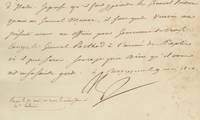
18103642009/05/1810. <blockquote><p>""I approve the slate of officers you propose to use for the Army of Italy. I think you should add General Bissonin. Regarding General Menou the Vice Roy must first present to me an officer for Governor of Venice. Send General Pacthod to the Army of Naples where he can serve.""</p></blockquote><p>In May 1810 Napoleon was at the high-water mark of his empire strengthening and intensifying his Continental System against Britain. Napoleon focused then on restricting British commerce and enhancing his alliance with Austria. His mind was also much on the Netherlands. On May 13 1810 it was announced that the Netherlands were formally annexed to France further consolidating Napoleon’s control over Europe. Bergen op Zoom a fortified city in the Netherlands was a key stronghold for French forces during Napoleon’s empire.</p><p>By 1810 Napoleon controlled most of the Italian peninsula acting as King of Italy crowned 1805 with his stepson Eugène de Beauharnais as viceroy. The region was restructured into the Kingdom of Italy in the north and the Kingdom of Naples in the south introducing modern law abolishing feudal rights and improving infrastructure while by 1810 the Italian army achieved parity with French units.</p><p>The War of the Fifth Coalition was Austria’s final attempt to challenge Napoleon Bonaparte after earlier defeats but it ended decisively with French victories at Battle of Wagram and the Treaty of Schönbrunn which stripped Austria of further territory and influence in northern Italy and the Adriatic. In the aftermath Napoleon moved to tighten and rationalize his control over the region reinforcing the authority of his Italian client state under Eugène de Beauharnais and integrating Venice more fully into a centralized military-administrative system. Though already under French rule Venice’s strategic importance—as a fortified lagoon city naval arsenal and forward position facing Austria—meant that after 1809 it became a focus of consolidation rather than conquest with garrisons reviewed command structures regularized and trusted officers installed to ensure the city’s security and readiness in anticipation of future conflict.</p><p>Napoleon was at Bergen op Zoom in May 1810. The Duc de Feltre was an officer diplomat and statesman who served as Minister of War under Napoleon.</p><p><strong>Letter signed</strong> Bergen-op-Zoom May 9 1810 to the Duc de Feltre assigning officers to the army and government of Italy. <em>""I approve the slate of officers you propose to use for the Army of Italy. I think you should add General Bisson. Regarding General Menou the Vice Roy must first present to me an officer for Governor of Venice. Send General Pacthod to the Army of Naples where he can serve.""</em></p><p>In 1810 General Baptiste-Pierre-François Bisson was given a command at Verona where he remained until his death in 1811. General Jacques-François de Menou served as the administrator and Governor of Venice in the Kingdom of Italy. After a notable career including commanding the Egyptian campaign he died on August 13 1810. In 1810 General Michel-Marie Pacthod was rewarded as a Knight of the Iron Crown and then given a division in the Army of Naples.</p><p>Here we see Napoleon exercising control over his occupied territories.</p><p><img class=""alignnone wp-image-25018 size-post-window"" src=""https://cdn.raabcollection.com/wp-content/uploads/20231204144051/Folder-site-11-1600x1327.jpg"" alt=""historical memorabilia dealer"" width=""1600"" height=""1327"" /></p> unknown
180084Palace of the Republic 16 Pluviôse An IX 4 February 1801 at the latest. French Terror Egyptian plague This letter is an important document from the French occupation of Egypt written in the aftermath of one of the outbreaks of plague which devastated the country between 1799 and 1801. It is in the hand of the chief surgeon of the French oriental army Dominique Jean Larrey 1766-1842 is addressed directly to Napoleon Bonaparte and has also been signed and further initialled by Bonaparte in the left margin. Larrey's letter is the covering note for a petition from Antoine Guirard administrator in chief of the Egyptian quarantine stations. Larrey asks Napoleon to assent to the petition and remove Guirard from the list of émigrés on the watchlists instituted by the revolutionary Reign of Terror citing Guirard's support for two orphans whose mother had died of the plague as evidence of his moral fibre. Guirard is identified as the head of the quarantine station at Bulaq in the republican almanac of An VIII. A Jacques François Antoine Guirard is named as an émigré from the Départment of the Var in the republican lists preserved at the French National Archives. If Guirard had hoped to return to France his inclusion on the watchlists may have endangered him. Bonaparte's added note reads: 'J'envoye au Ministère de la police pour me faire un rapport dans le 9 Ventôse an 10. Le 1er Consul Bonaparte' 'I am sending to the Minister of Police for him to make me a report; on 9th Ventôse Year X Bonaparte'. The quarantine stations Fr. lazarets which Guirard administered were integral to the system of healthcare that the French developed in the Middle East and are commemorated in Antoine-Jean Gros's famous painting Bonaparte Visits the Plague Victims of Jaffa. In his memoirs Larrey describes the great station on the island of al-Rawda in the middle of the Nile where patients were kept in cells made of reeds to avoid contaminating one another. Napoleon's army also imposed strict protocols for dealing with outbreaks in Egypt's cities involving sealing off whole streets and quarters when plague was detected. These practices were heavily criticized by the contemporary chronicler Abd al-Rahman al-Jabarti who lamented how families were unable to bury the bodies of their loved ones with due ceremony in fear of retaliatory punishment. Letter 340 x 225 mm laid down on card framed and glazed with verre églomisé border. Original annotations in the left margin red sealing wax to centre ink stamp dated Ventôse 14 to right margin contemporary handwritten transcription on lined paper pasted to rear of frame. Frame a little chipped letter creased when folded edges somewhat worn leaf toned inks oxidized. Very good. unknown
1928140938609Meriden CT: The Ralston University Press 1928. First Edition. Very Good. First Edition complete eight volume set bound in dark blue variant cloth with volumes ranging from Very Good to Near Fine. Rubbing to gilt stamping and to cloth at tips. Foxing to edges heaviest at top edge; pages toned. Several volumes show faintly soiled cloth. A beautiful set. The Ralston University Press unknown books
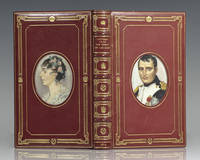
1891122635London: Printed for James Ridgway 1891. First edition of Napoleon's biographer Emmanuel Comte de las Cases' collected letters. Octavo bound in full morocco by Bayntun-Riviere in an elaborate Cosway-style binding with hand painted miniature ivorene portraits of Napoleon Bonaparte and Marie Louise Duchess of Parma set under glass within a gilt borders to the front panel and rear panels gilt titles and tooling to the spine in six compartments within raised gilt bands elaborate gilt ruling to the panels gilt turn-ins and inner dentelles marbled doublures and endpapers all edges gilt. In fine condition. Exceptionally rare. Cosway bindings named for renowned 19th-century English miniaturist Richard Cosway were popularized if not invented in the early 1900s by the renowned London bookselling firm of Henry Sotheran. The earliest Cosway bindings were created by Miss C.B. Currie who faithfully imitated Cosway's detailed watercolor style of portraiture from designs by J.H. Stonehouse Sotheran's manager. These delicate miniature paintings often on ivory were set into the covers or doublures of richly-tooled bindings and protected by a thin pane of glass. Printed for James Ridgway unknown books
1937126722Cleveland: The Ralston Society 1937. Rare first edition of this classic bestseller which has sold over 100 million copies. Octavo original cloth. Near fine in a very good dust jacket ownership name to the front free endpaper. Rare in the original dust jacket. Think and Grow Rich was written in 1937 by Napoleon Hill promoted as a personal development and self-improvement book. Hill writes that he was inspired by a suggestion from business magnate and later philanthropist Andrew Carnegie. While the book's title and much of the text concerns increased income the author insists that the philosophy taught in the book can help people succeed in any line of work to do and be anything they can imagine. First published during the Great Depression at the time of Hill's death in 1970 Think and Grow Rich had sold more than 20 million copies and by 2015 over 100 million copies had been sold worldwide. It remains the biggest seller of Napoleon Hill's books. BusinessWeek magazine's Best-Seller List ranked it the sixth best-selling paperback business book 70 years after it was published. The Ralston Society paperback
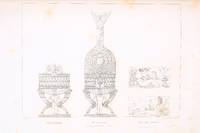
181190504Paris: de l'imprimerie Ballard 1811. Fine. de l'imprimerie Ballard Paris 1811 27.8 x 40.5 cm Relié First illustrated edition with 5 plates cf. Coll. Émile Brouwet II 2 168.Half black shagreen binding smooth spine decorated with gilt and blind fillets title lettered lengthwise in gilt joints and caps rubbed title repeated on the upper cover paper labels pasted to the lower left corner of the upper cover and the upper left corner of the inside back cover bookplate pasted to the inside back cover original front wrapper preserved corners worn mid-19th-century binding.Some light foxing.The five finely line-engraved plates by Cavelier and Pierron after drawings by Pierre-Paul Prudhon bring together a selection of pieces of imperial furniture.The first set a firescreen a dressing table with its mirror an armchair and a washstand was executed in vermeil with lapis inlays and presented to Empress Marie-Louise on 15 August 1810. This important commission was the joint work of the chaser-founder Thomire awarded a gold medal at the Exhibition of 1806 and the silversmith Odiot. The three plates devoted to it preserve its memory as the ensemble was largely melted down in 1832.The final two plates depict the celebrated cradle of the King of Rome in vermeil mother-of-pearl and burgau shell the fruit of the same two craftsmen which was presented by the City of Paris on 5 March 1811 before the arrival of the imperial child and is now preserved in Vienna.Thomire alone later produced a second example in elm burr and gilt bronze following the same design and faithfully reproducing certain elements such as the two bas-reliefs of the Seine and the Tiber. This second cradle is now at the Château de Fontainebleau.Provenance: from the library of Prince Demidoff San Donato stamp then from that of Prince Roland Bonaparte with his bookplate and label N. de l'imprimerie Ballard unknown
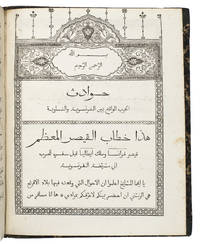
1806ABC_49310Paris 1806. Small 4to. Imprimerie impériale Mid-19th-century gold-tooled quarter brown calf with a brown morocco title label lettered in gold on the spine and the initials "P. T." lettered in gold at the foot of the spine marbled paper sides marbled edges marbled endpapers. With a woodcut decorative border on the title page and a woodcut Islamic headpiece at the start of the work. 306 pp. First edition of a rare Arabic work celebrating Napoleon's victories during the Battle of Austerlitz 1805. It describes the battle which is seen as one of Napoleon's tactical masterpieces and the aftermath until the Peace of Pressburg 1805. The work was printed using an early 17th-century Arabic type which is sometimes considered the most beautiful ever created Conidi.After the French campaigns in Egypt and Syria between 1798 and 1801 Napoleon Bonaparte 1769-1821 remained a famous figure in the Arab and Ottoman Worlds. The present work was printed in Arabic in order to present his victories of 1805 to the Middle East. It makes use of the bulletins written during the battle either by Napoleon himself or under his supervision which offer important military information as well as fascinating political and social commentary. The end of the text contains the Arabic translation of the Peace of Pressburg signed on 26 December 1805 by Charles Maurice de Talleyrand for France as well as Johann I Joseph Prince of Liechtenstein and the Hungarian Count Ignác Gyulay for the Austrian Empire. The Arabic type used for the present work was created in the early 17th century with the support of François Savary de Brèves 1560-1628 a French ambassador in Istanbul and an orientalist who had the ambition to establish a polyglot printing press. He was finally able to do so when he was dispatched to Rome for a diplomatic mission between 1608-1614. He called his press the Typographia Savariana and ordered the cutting of new Arabic types based on the calligraphic scripts found in the manuscripts he had brought from the Middle East. These new types were well received and he printed many publications with them until his printing press unfortunately ran out of business in 1618. After the death of Savary de Brèves his types were acquired by Cardinal Richelieu for the Kingdom of France to promote the spread of Catholicism in the Levant. They were then kept in the royal library until 1692 after which they were handed to the Imprimerie Royale and fell into disuse. They were rediscovered and identified by the French Orientalist Joseph de Guignes 1721-1800 in 1787. Napoleon then used these elegant Arabic typefaces as the foundation for his new printing press in Egypt the Imprimerie Nationale which was the first modern printing press in the Arab world. They were used among others things for the first editions of the newspapers Courier and Décade. The types were brought back to Paris when the French were driven out of Egypt in 1801 and given to the new Imprimerie impériale in 1804 that used them for the present work.The edges and corners of the boards are very slightly scuffed. Barely noticeable foxing on some of the leaves the head margin has been cut slightly short with the loss of a small portion of the decorative headpiece. Otherwise in very good condition.l Schnurrer C. F. von Bibliotheca Arabica 1811 p. 497 no. 429; WorldCat 1472886006 85092075 1356910650 57018842 13021778 7 copies; Zenker Th. J. Bibliotheca orientalis vol. 1 no. 948; cf. Conidi E. Arabic type in Europe and the Middle East 1514-1924 pp. 397-412 the present Arabic type. hardcover
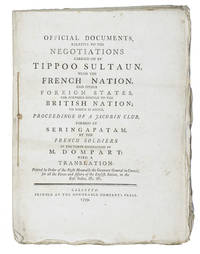
1799ABC_45147Calcutta: Honorable Companys Press 1799. Never bound but side stitched through 3 holes. Super Royal 4to 33.5 x 25 cm. A British propaganda publication printed in Calcutta transcribing secret documents that the British supposedly found in the palace of Seringapatam: primarily Tipu Sultans correspondence with the French considered a betrayal of the British. Tipu Sultan 1750-1799 ruler of the Kingdom of Mysore in southern India took part in a long-standing military feud with the British but made peace with them in 1792. When the French under Napoleon made a push for India in 1798 the British attacked Tipus forces once again starting the Fourth Anglo-Mysore War and eventually killing Tipu Sultan in the attack on Seringapatam. He had a fearsome reputation as the Tiger of Mysore and the present publication attempts to discredit him as a traitor. His supposed affiliation with the French Jacobin Club would have especially concerned British readers. Most of the correspondence between Tipu Sultan the French and their allies including Zaman Shah Durrani ruler of what was to become Afghanistan is printed in parallel columns in English and French. Also included is the text of a letter from Tipu Sultan printed letterpress in Persian in the nastaliq script: 9 lines of type apparently set in the nastaliq type cut under the direction of Charles Wilkins 1749-1836 who served the East India Company in India and became their leading orientalist. It was first used at Calcutta in 1781. The only earlier type for the script that has been clearly documented is thought to have been cut in the 1590s for the Propaganda Fide in Rome who used it around 1633. Neil Benjamin Edmonstone translated the Persian and G.G. Keble the French. Although the book is a true very large quarto point holes along the fold at the head and deckles at the foot and fore-edge the chainlines are vertical though one would not expect sheets this large to be made in double moulds the usual reason for chainlines parallel to the long axis of the sheet.In good condition. Wholly untrimmed and with most bolts unopened and the point holes present.l Shaw Printing in Calcutta 359; Shaw SABREB sab00086; not in Cat. East-India Comp. Honorable Companys Press, unknown
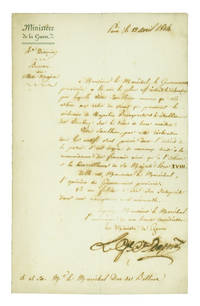
1814247420N.p. Paris 1814. 1 p. on letterhead of "Ministère de la Guerre". Folio. Some very slight waterstaining affecting a few letters otherwise very good handsomely mounted and framed. 1 p. on letterhead of "Ministère de la Guerre". Folio. An extraordinary letter of historic significance written a mere two days after the Treaty of Fontainebleau of April 11 1814 which set the terms of Napoleon's abdication and ended an era. Dupont had been one of Napoleon's most distinguished generals but his surrender in the disastrous Spanish campaign led to disgrace and imprisonment. After the fall of Napoléon Dupont became Minister of War for Louis XVIII and in just such letters as this to Marshal Victor - one of Napoleon's most trusted generals - negotiated the acquiescence of Napoléon's military leaders: in translation "Monsieur le Maréchal; - The provisional government has read with intense interest the declaration in which your Excellency has announced his adherence to the act of the Senate pronouncing the abdication of Napoleon Buonaparte and the restoration of the Bourbons on the throne on their ancestors. By this declaration taken in the interest of the country your Excellency has established anew a claim to the gratitude of the French people as well as the respect and good will of His Majesty Louis XVIII. Such is the opinion sir of the provisional government - and I am more than happy to be its messenger on this memorable occasion". unknown
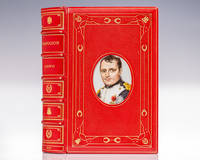
1927150488London: George Allen & Unwin Ltd. 1927. Elaborately bound Cosway style first edition in English of Emil Ludwig's biography of Napoleon Bonaparte. Octavo bound by Bayntun-Riviere in full Cosway style scarlet morocco with gilt titles and tooling to the spine in six compartments within raised gilt bands inset ivorene hand-painted portrait of Napoleon depicting him with medals to the front panel gilt fleuron corner-pieces withing double gilt ruling to the front and rear panels all edged gilt gilt turn-ins and inner dentelles red watered silk endpapers illustrated with engravings. In fine condition. During the 1920s German-Swiss author Emil Ludwig became achieved international fame for his popular biographies of historical "greats" which combined historical fact and fiction with psychological analysis. As Ludwig's biographies were popular outside of Germany and were widely translated he was one of the fortunate émigrés who had an income while living in the United States. George Allen & Unwin, Ltd. unknown
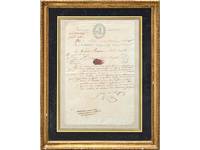
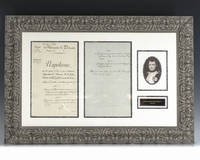
120531Rare Imperial Decree boldly signed by French Emperor Napoleon Bonaparte. Two pages partially printed in Italian the decree outlines a proposal for the construction of a bridge over the Sesia River in Vercelli to be financed by the Kingdom of Italy as part of Napoleon's civic improvement plan initiated during his administration of Ital. Dated April 12 1809 the decree reads in part "<span class="match">Napoleon</span> by the grace of God & by the Constitution French Emperor King of Italy Protector of the Rhine Confederation have decreed and decree what follows: Art. 1. Our Kingdom of Italy will contribute the certain sum of 150000 lire to the expense of building the Vercelli bridge on the Sesia. Art. 2. The payment will be made in installments at the rate of 50000 lire per year starting from the current year. Art. 3. This expense will be carried into the budget of the Minister of the Interior and to the head of the extraordinary works of water and roads. Art. 4. The Minister of the Interior is in charge of the execution of this decree. Given at our Imperial Palace of the Tuileries this day April 12 1809". Signed by Napoleon Bonaparte at the conclusion the decree "Napole". Double matted and framed with a portrait of Napoleon. The entire piece measures 31.5 inches by 21.25 inches. Napoleon Bonaparte was a French military and political leader who rose to prominence during the French Revolution and led several successful campaigns during the Revolutionary Wars. As Napoleon I he was Emperor of the French from 1804 until 1814 and again in 1815. Napoleon dominated European and global affairs for more than a decade while leading France against a series of coalitions in the Napoleonic Wars. He won most of these wars and the vast majority of his battles building a large empire that ruled over continental Europe before its final collapse in 1815. One of the greatest commanders in history his wars and campaigns are studied at military schools worldwide. He also remains one of the most celebrated and controversial political figures in human history. unknown books
1814247420N.p. Paris 1814. 1 p. on letterhead of "Ministère de la Guerre". Folio. Some very slight waterstaining affecting a few letters otherwise very good handsomely mounted and framed. 1 p. on letterhead of "Ministère de la Guerre". Folio. ". dans une circomstance . mémorable". An extraordinary letter of historic significance written a mere two days after the Treaty of Fontainebleau of April 11 1814 which set the terms of Napoleon's abdication and ended an era. Dupont had been one of Napoleon's most distinguished generals but his surrender in the disastrous Spanish campaign led to disgrace and imprisonment. After the fall of Napoléon Dupont became Minister of War for Louis XVIII and in just such letters as this to Marshal Victor - one of Napoleon's most trusted generals - negotiated the acquiescence of Napoléon's military leaders: in translation "Monsieur le Maréchal; - The provisional government has read with intense interest the declaration in which your Excellency has announced his adherence to the act of the Senate pronouncing the abdication of Napoleon Buonaparte and the restoration of the Bourbons on the throne on their ancestors. By this declaration taken in the interest of the country your Excellency has established anew a claim to the gratitude of the French people as well as the respect and good will of His Majesty Louis XVIII. Such is the opinion sir of the provisional government - and I am more than happy to be its messenger on this memorable occasion". unknown books
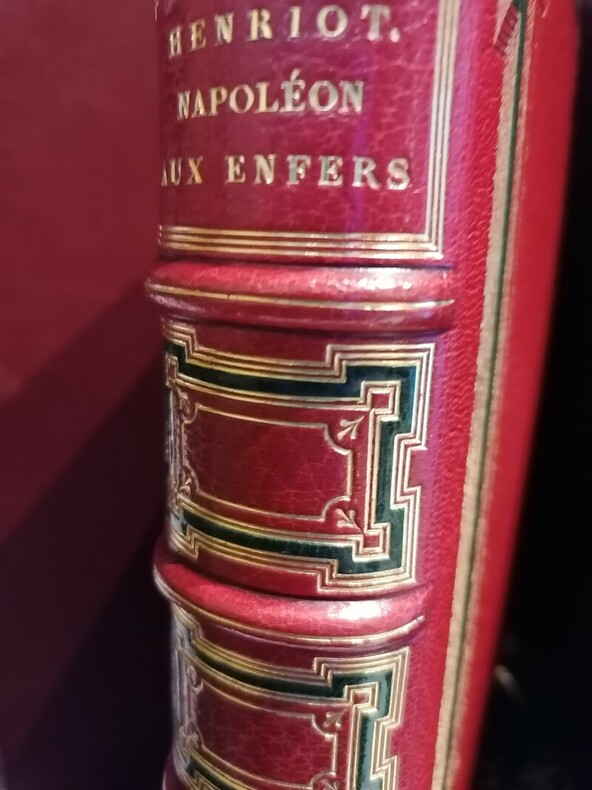
46299Librairie Conquet.1895.In-4 dans une reliure de Mercier,successeur de Cuzin.Exemplaire unique composé du manuscrit de Henriot et de tous les dessins originaux exécutés à l'encre de Chine.Lettre autographe d'Edouard Pailleron se rapportant au texte.Reliure en maroquin rouge avec chemise et étui.Plats ornés d'un listel vert empire entre deux jeux de cinq filets dorés avec palmettes dorées.Dos à 5 nerfs en harmonie.Doublures de maroquin La Vallière richement ornées d'un encadrement de deux listels vert empire,avec 8 filets dorés et une très belle frise de palmettes et de motifs Empire mosaiqués,en maroquin vert,rose,rouge,jaune,corail,dorés aux petits fers.Gardes de soie brochée vert bronze,doubles gardes,tranches dorées.Couverture illustrée conservée. Magnifique exemplaire de la Bibliothèque Adolphe Bordes.
1798154713Cairo: 27 Fructidor An 6 13 September 1798. A proposal to break the British blockade A covert commercial scheme devised by an elusive French agent proposing the export of Egyptian cargo by sea for sale at Smyrna or Thessaloniki drafted shortly after Nelson's decisive victory at the Battle of the Nile left the French army stranded and deprived of supply. The postscript is secretarial while Napoleon's signature is likely autograph though not provably so. The document concludes with his instruction to Jean-Baptiste Étienne Poussielgue administrateur général of finances to report on the feasibility of the plan. The proposal outlines shipment of rice ammonium chloride incense and coffee intended to mislead the English into assuming Egyptian mercantile origin since local traders were unlikely to risk capital in a single commodity. Greek agents had already been placed in the Levant to secure stocks of ammonium chloride and anticipated profits were to be reinvested in wine and oil from Santorini and Naxos; failing this the agent proposed travelling to Constantinople to acquire drugs or dried fruits from Russian merchants unlikely to suspect Egyptian destination. He stresses his suitability through 14 years' residence in the Levant linguistic competence and appropriate dress and names a trusted associate Hajji Andrea of Psara to command the vessel from Damietta. Napoleon's Egyptian expedition of 1798 sought to challenge British power in the eastern Mediterranean. After departing Toulon seizing Malta and defeating Mamluk forces at the Battle of the Pyramids French control of Egypt was swiftly undermined when Nelson destroyed the fleet at Aboukir in August isolating the army. Napoleon departed secretly in August 1799 leaving his forces behind; Poussielgue and Kléber soon reported that he had carried off 2 million francs on quitting Egypt. Bifolium page size 337 x 225 mm manuscript in French on three pages watermark to right side. Soft creases from old folds light toning short split at head bottom fore-corners both minimally clipped small ink burn: a very good example. Marie Joseph L. Adolphe Thiers Thiers' History of the Consulate and Empire of Napoleon 1846. unknown