HOUGHTON (Major) et PARK (Mungo). FOLLIÉ (Louis-Guillaume).Livre Rare Book
64 résultats
1798PHO-2264Paris, Tavernier, An VI [1798)]. In-8° de [4], 343 pp. 3 cartes dépliantes & Paris, Directeurs de l'Imprimerie du Cercle Social, 1792, l'an premier de la République Française. 171 pp. Basane fauve racinée, dos long orné, p. de t. en maroquin rouge, filet doré sur les coupes, tranches citron (Reliure de l'époque). Annotations anciennes dans les marges. Accident à la coiffe de tête, usure aux coins, frottements au dos.
1732PHO-1798Paris, Veuve Delormel et René Josse, 1732. In-12, plein veau, dos orné, pièce de titre rouge, tranches rouges (Reliure de l'époque). Ex-libris et ex-dono manuscrits anciens au titre, frottements et épidermures, coiffe sup. accidentée, 1 coin usé, manque le plan de Troie.
1742177261Guillame Cavalier A Paris, chez Guillaume Cavalier, 1742. 6 volumes sur 8, manquent tomes V et VIII, In-12 reliés pleine basane brune, dos à nerfs très ornés, pièces de titre et de tomaison, tranches rouges, gardes de papier marbré. Tome I : 472 pages, portrait gravé en frontispice et 20 planches dont 11 dépliantes - Tome II : 444 pages, 17 gravures dont 3 dépliantes et une dont il manque une partie, une page présente un trou avec manque de texte. Tome III : 475 pages, 31 gravures dont 14 dépliantes - Tome IV : 533 pages, 12 gravures dont 4 dépliantes. Une page présente une déchirure sur cinq centimètres sans perte de texte - Tome V : Manquant - Tome VI : 502 pages, 6 gravures en bon état, une gravure manquante et 7 gravures avec manques importants - Tome VII : 516 pages et 4 gravures dont une dépliante. Soit un total de 88 gravures en bon état et, comme décrit ci-dessus d'autres avec manques. Reliures un peu frottées, 4 coiffes arasées avec petits manques de cuir, coins un peu émoussés, corps des volumes en état très correct, sauf le tome VI qui a souffert des affres du temps et de la manipulation. Marque d'appartenance du temps contrecollée dans chaque volume "Monsieur Castel, Receveur de la Chambre à sel et Entreposeur du Tabac, au Mur de Baret " (actuellement Barrez). Mention, en page de titre, de nouvelle édition augmentée considérablement et enrichie de figures en tailles-douces. Bibliographie Brunet.
174923232Paris Didot 1749 In-12 ( 4 Volumes ) Du tome IX au tome XII, 478 pp et 2 cartes , 486 pp , 3 gravures et 5 cartes , 429 pp 1 carte et 5 gravures et 508 4 cartes et 3 gravures
1794126550London no printer 1794 or later. First edition variously dated by ESTC and WorldCat between 1794 the date given at the end of the preliminary "Short Account of the origin and present state of the charitable fund" and 1823. The short account dated March 1794 is followed by a tipped in leaf reporting on the first meeting of the society which took place on Thursday April 3 1794 electing the Lord Bishop of London as president. The Charter of the Society 18 pages in length is dated at Westminster "this thirtieth Day of October in the thirty-fourth Year of our Reign" which again falls in 1794. Octavo 190 x 123 mm pp. ix 18. Sometime in a pamphlet vol. now disbound. Spine shows evidence of earlier binding sometime folded vertically; title lightly dust soiled page ix trimmed down and tipped onto p. viii; a good copy. Sabin 85881. unknown
1793106470<p>12 lines in brown ink with paper seal on sheet of paper 34x21 cm 13½x8¼". Signed by Thomas Hamilton clerk. Remnant of seal old folds with splitting along them normal aging and browning some offsetting very good overall. Amazing little document relating to the enforcement of Pennsylvania's groundbreaking effort to begin the abolition of slavery "An Act for the Gradual Abolition of Slavery" passed by the Pennsylvania legislature in 1780. The Act prohibited further importation of slaves into the state required Pennsylvania slaveholders to annually register their slaves with forfeiture for noncompliance and manumission for the enslaved and established that all children born in Pennsylvania were free persons regardless of the condition or race of their parents. Those enslaved in Pennsylvania before the 1780 law entered effect remained enslaved for life. The present document seems to reveal non-compliance with the law by Hugh Neilly in part: "I hereby certify on application of Ralph Cherry that a careful search hath been made by me among the Records of Negro's sic entered on the Records of Westmoreland County and that on such search it doth not appear that any Negro's hath been registered in the name of Peter or any other name as his property by Hugh Neilly of Westmoreland County aforesaid under the laws passes for the gradual abolition of slavery. Thomas Hamilton clerk." Docketed on the back "Certificate that no Negro's hath been registered in Westmoreland as the property of Hugh Neilly." </p> books
179010775A Paris, chez Demonville, 1790. 2 parties en 1 vol. In-8 de (4)-166 pp. 1 f. blanc 141 pp., demi-toile bleue, couverture imprimée conservée, non rogné (reliure du XIXe siècle).
1730PHO-1965Paris, Saugrain, 1730.4 vol. in-12 de I. xxiv-[2]-381 pp., 14 pl. ; II. [4]-364 pp. 11 pl. ; III. [4]-350 pp., 4 pl.; IV. [4] pp., pp. 345-682, [36] pp., 1 pl., veau brun époque, dos usés avec manque, 1 carte volante, 1 carte avec déchirure sans manque. De la bibliothèque de Sir William Geary, 2nd baronnet (1756 –1825) homme politique conservateur anglais avec son ex-libris
1743PHO-1218La HAYE ,Jean Neaulme, 1743, deux volumes in 4° (260x210mm) reliés plein veau marbré, dos orné à 5 nerfs, pièce de titre, tranches rouges ,(2 plats détachés),coiffes arasées, coins usés, papier bruni ,Épître à Frédéric roi de Prusse imprimé en rouge et noir, XLIV-414pp./IV-192 pp., à la suite extraits de plusieurs auteurs anciens et autres pièces ,178 pp. ,orné de 12 cartes dont 9 dépliantes et 21 planches dont 5 dépliantes, une planche de musique et un fragment de la célèbre carte de Peutinger , ex-libris de Charles Kettaneh Première édition en français,
17810042251781 Genève, Pellet, 1781. Dix volumes in-8 (130 X 207 mm) basane fauve marbrée, dos lisse orné à la grotesque de motifs dorés, pièces de titre et de tomaison grenat et vert, coupes ornées d'une guirlande dorée, coiffes filetées, tranches jaspées (reliure de l'époque). Tome I : portrait, XVI pages de faux-titre, titre, avertissement et table, 348 pages, (1) f. d'errata, (2) tableaux dépliants ; Tome II : frontispice, XII pages de faux-titre, titre et table, 378 pages, (1) f. d'errata, (4) tableaux dépliants ; Tome III : frontispice, VII pages de faux-titre, titre et table, 372 pages, (1) f. d'errata ; Tome IV : frontispice, XII pages de faux-titre, titre et table, 308 pages, (1) f. d'errata, (3) tableaux dépliants ; Tome V : frontispice, VII pages de faux-titre, titre et table, 259 pages, (1) f. d'errata, (1) tableau dépliant ; Tome VI : frontispice, XII pages de faux-titre, titre et table, 308 pages, (1) f. d'errata ; Tome VII : frontispice, XVI pages de faux-titre, titre et table, 359 pages, (1) page d'errata, (5) tableaux dépliants ; Tome VIII : frontispice, XII pages de faux-titre, titre et table, 352 pages ; Tome IX : frontispice, VIII pages de faux-titre, titre et table, 262 pages, (1) f. blanc, (1) f. d'errata, (9) tableaux dépliants ; Tome X : frontispice, V pages de faux-titre, titre et table, 348 pages, (1) f. d'errata. Quelques petites restaurations à la reliure.
1775PHO-1053A Genève, chez les libraires associés, 1775 3 tome in-4 (26 x 20 cm) de (4) -IV-III-VIII-719, (4) -VIII-662 et (4) -VIII-658 pages. L'illustration comprend un portrait de l'Auteur gravé par Legrand d'après Cochin, 7 planches hors texte non signées, 4 cartes repliées aux contours colorés époque et 3 vignettes en-tête de Marillier. , relié plein veau blond, dos à nerfs ornés avec titre, tomaison et « rel. par Langlois à Lyon »en pied, filets sur les plats, tranches marbrées, coins usés, coiffes T1 et 3 un peu usés Première édition publiée au format in-4 établie sur la deuxième édition originale.
1774PHO-1474La Haye, Gosse et s.e., 1774-1781,11 volumes in 8°et 1 Atlas in-4, texte; XII-585, XII-386, XIII-586, XII-508, XII-407, VI-375 (1), XI-430 pages ,chaque volume comporte une gravure en frontispice d'après Eisen et une grande carte dépliante, et pour le supplément; XVI-604pp.,XV-574pp.,XV-492pp.,VIII-434pp.,avec un titre séparé Tableaux pour l’intelligence … 2ff. Et 23 tableaux dépliants ,reliure d'époque en plein veau ,dos lisse ornés,filets aux plats et roulettes à l’intérieur, tranches rouges , quelques coiffes usées, petits trous de ver,un tableau déchiré et son Atlas in-4 , 23pp. Et 50 cartes , relié pleine basane racinée époque, dos lisse avec pièce de titre et tomaison, petits frottements , coins usés
179928145London: Printed by George Eyre and Andrew Strahan Printers to the King's most Excellent Majesty 1799 1799. ESTC N60288 Lincoln's Inn Library and Wellcome Institute. Fine. 4to disbound paginated 637-652 untrimmed. An act passed by Parliament in the summer of 1799 delineated in 39 paragraphs that regulated the slave trade beginning in August 1800 - an act no doubt intended to placate the growing voices of opposition to the English slave trade. The act stipulates how many slaves could be stowed in a ship by mathematical formula according to the size of the ship but never more than 400; that slaves must be separated from other cargo; and that the space for the slaves "be full and complete perpendicular height of five feet." Nothing is said about their treatment other than that the ship's surgeon was required keep a log of illnesses and deaths of both slaves and crew. Much of the act is taken up with its enforcement and the penalties and fines for violations; it also regulates the conditions and treatment of the crew. The acts of Parliament were usually published separately and later issued in collections of the Public General Statutes; this one was issued as part of the collection of statues Passed in the Thirty-Ninth Year of the Reign of His Majesty King George the Third: Being the Third Session of the Eighteenth Parliament of Great Britain. This copy is disbound from such a volume. (London: Printed by George Eyre and Andrew Strahan, Printers to the King's most Excellent Majesty, 1799) unknown
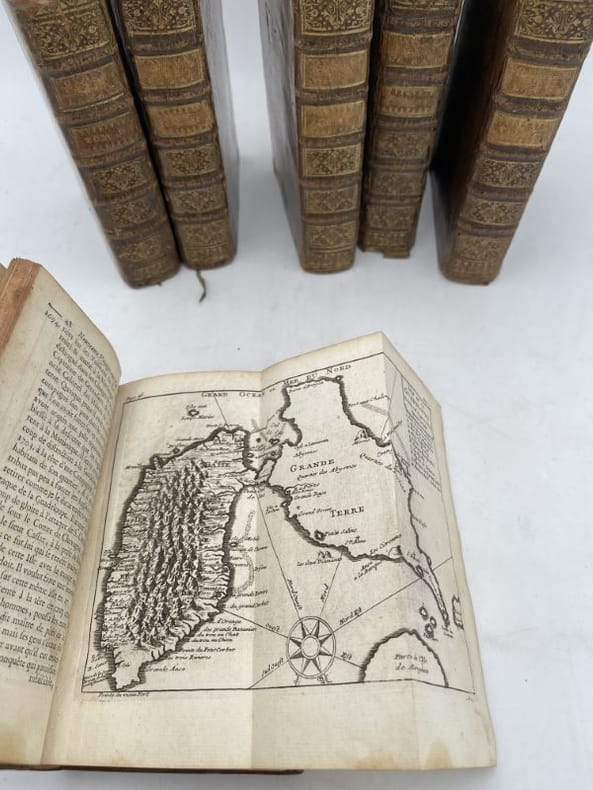
1722PHO-2275Guillaume Cavelier, Paris, 1722, 5 volumes (6) in-12 (17x10cm), T1 ; xxxvi-5ff.-522pp., 21 planches, T2 ; 3ff.-598pp., 20 planches, T3 ; iv-549pp., 31 planches, T4 ; vi-558pp., 14 planches, T5 ; vi-524pp., 6 planches, 90 planches et cartes. Veau époque, dos à nerfs orné avec pièces de titre et tomaison en maroquin rouge, filets aux coupes. Frottements, 3 planches avec manques au tome 1, déchirure sans manque carte de la Martinique Édition Originale.
1798PHO-1492Paris, chez Buisson, an VII (1798),4 volumes ; Texte 3 volumes in-8 demi percale et un Atlas in-4, demi cuir époque, dos lisse avec auteur et titre ,44 planches, certaines en double page ou dépliantes, gravées par Antoine-François Tardieu d'après John Gabriel Stedman, la planche 25 détachée, mouillure claire en marge sur 4 planches, frottements coins et coupes usés, exlibris Aldo Maffey, journaliste et écrivain italien.
1730PHO-1650Paris, Saugrain, 1730.4 vol. in-12 de I. xxiv-[2]-381 pp., 15 pl. ; II. [4]-364 pp. 12 pl. ; III. [4]-350 pp., 4 pl.; IV. [4] pp., pp. 345-682, [36] pp., 1 pl., les tomes I à III reliés en basane brune, dos à nerfs ornés, p. de titre en mar. rouge, p. de titre en veau blond ; le tome IV reliés en veau brun, dos à nerfs ornés, p. de titre et de tomaison en mar. grenat (reliures de l'époque).
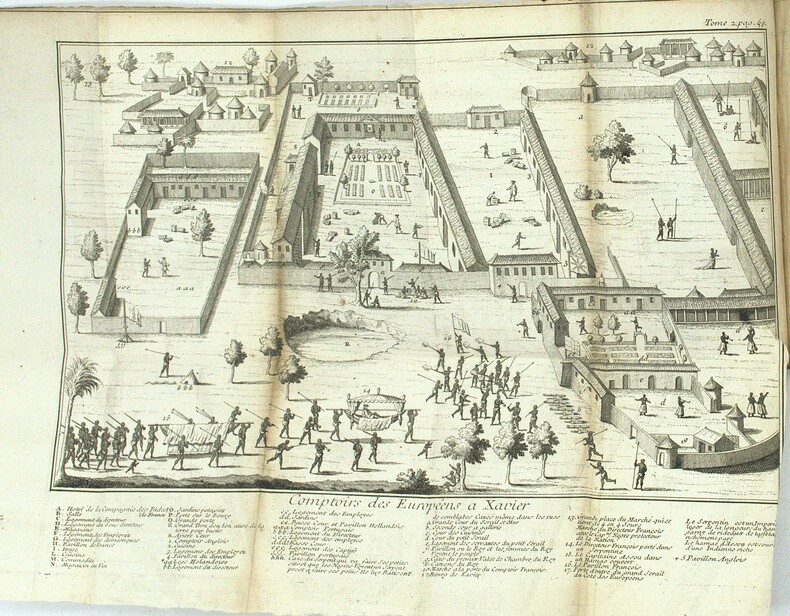
17101200341710. First Edition. SLAVERY ANONYMOUS. A True State of the Present Difference Between the Royal African Company and the Separate Traders. London: No publisher 1710. Slim octavo period-style full tan sheep gilt red morocco spine label raised bands; pp. 40. $1650.First edition of this argument against providing a monopoly over the British slave trade to the Royal African Company with tipped-in diagram of one of the Royal African Company's forts.This work attempts to highlight the irregularities of the business practices of the Royal African Company and to argue for the superiority of open trade in Africa particularly as a means of supplying slaves to the American plantations. Founded in 1660 by the royal Stuart family and the City of London the Royal African Company was founded to exploit natural resources like gold along the west coast of Africa. While the Royal African Company did participate heavily in the gold trade the majority of their income came from slave-trading. The Royal African Company was part of a concerted effortfully elaboration in the Navigation Actsto establish dominance in the slave trade since the Dutch had been the leading slave-traders prior to the Restoration. To that end the Royal African Company established a brutal and highly efficient slave-trading system eventually providing more slaves to the West Indies than any other company or state. The slaves were branded with the initials of the company or its longtime governor the Duke of York. Children were included in the transports. Between 1662 and 1731 the Company transported approximately 212000 slaves a fifth of whom died enroute. While the Company formally gave up slave-trading in 1731 they remained involved in the trade of ivory and gold dust industries dependent on labor exploitation and slavery. Goldsmiths 4605. Kress 2677. Early ink underlining and marginal notations.Small paper repair to diagram text and diagram trimmed close affecting portion of imprint and scattered catchwords not affecting readability. A very good copy. hardcover
179928145London: Printed by George Eyre and Andrew Strahan Printers to the King's most Excellent Majesty 1799 1799. ESTC N60288 Lincoln's Inn Library and Wellcome Institute. Fine. 4to disbound paginated 637-652 untrimmed. An act passed by Parliament in the summer of 1799 delineated in 39 paragraphs that regulated the slave trade beginning in August 1800 - an act no doubt intended to placate the growing voices of opposition to the English slave trade. The act stipulates how many slaves could be stowed in a ship by mathematical formula according to the size of the ship but never more than 400; that slaves must be separated from other cargo; and that the space for the slaves "be full and complete perpendicular height of five feet." Nothing is said about their treatment other than that the ship's surgeon was required keep a log of illnesses and deaths of both slaves and crew. Much of the act is taken up with its enforcement and the penalties and fines for violations; it also regulates the conditions and treatment of the crew. The acts of Parliament were usually published separately and later issued in collections of the Public General Statutes; this one was issued as part of the collection of statues Passed in the Thirty-Ninth Year of the Reign of His Majesty King George the Third: Being the Third Session of the Eighteenth Parliament of Great Britain. This copy is disbound from such a volume. <br/><br/> (London: Printed by George Eyre and Andrew Strahan, Printers to the King's most Excellent Majesty, 1799) unknown books
17730034671773 Amsterdam, et se trouve à Paris, Chez Merlin, 1773. Deux volumes in-8 (134 X 205 mm) veau fauve marbré, encadrement de filet à froid sur les plats, dos cinq nerfs, caissons dorés avec fleuron central, large dentelle en queue et tête, coupes et coiffes ornées, pièces de titre et de tomaison maroquin rouge, tranches rouges (reliure de l'époque). Tome I : (1) f. blanc, faux-titre, frontispice, titre, 328 pages, 3 planches et 4 tableaux dépliants, (1) f. blanc ; Tome II : faux-titre, titre, 278 pages, 2 planches, (1) f. blanc. Notice ancienne collée sur le premier contreplat du tome I. Les planches de Moreau sont brunies.
179712434Paris, Du Pont, 1797. In-8 de XXIV-237 pp., 1 planche dépliante, veau raciné, dos lisse orné, pièce de titre en mariquin rouge, tranches mouchetées (reliure de l'époque).
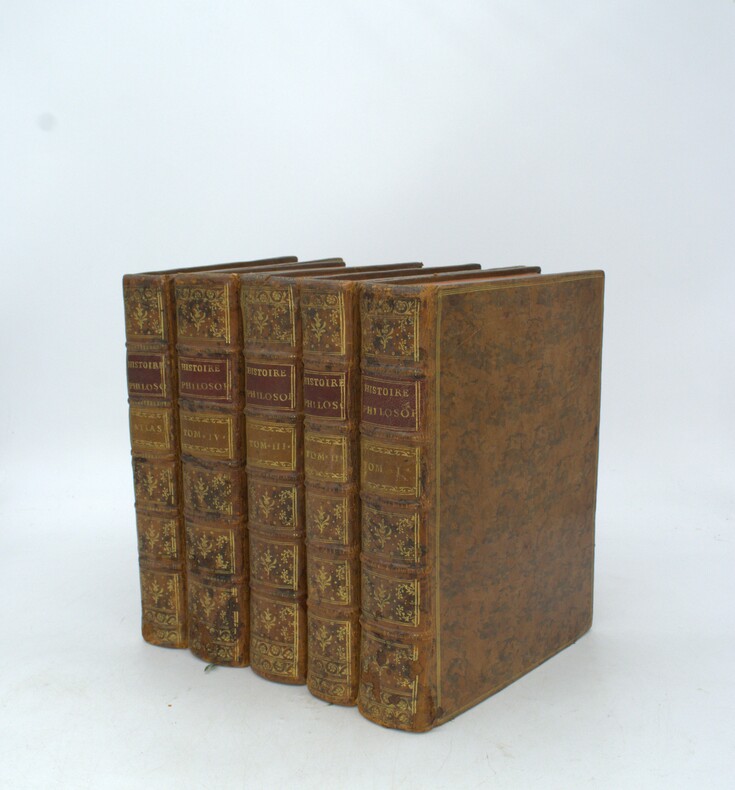
1780PHO-2003Genève, Jean-Léonard Pellet, 1780. 5 volumes in-4, 4 volumes de texte (25,5x20cm) et 1 Atlas (25,5x22cm), portrait, XVI, front.,741 pp., front., (2 ff.), VIII, 485 pp.; front., XV, 629 pp.; front., (2 ff.), VIII, 770 pp., (1 f.); 22 pp., (1 f. bl.), 50 cartes (49+17bis) et 23 tableaux. Relié plein veau marbré époque, dos à nerfs orné avec tomaison et pièce de titre grenat, filets aux plats, tranches rouges, frottements aux charnières, petites épidermures au dos, qlqs feuillets légèrement brunis. Bel exemplaire en reliure uniforme
17921262151792. HAITI SLAVERY. A Particular Account of the Insurrection of the Negroes of St. Domingo Begun in August 1791: Translated from the French caption title as issued. London: 1792. Slim octavo modern green cloth; pp. 32. $1800.Fourth edition published one year after the very rare first of this sensationalistic account of the early months of the Slave Rebellion in Haiti the beginnings of the Haitian Revolution which ultimately led to the establishment of the first independent black state in the New World. The publishers of this polemic hoped to frighten the British public and turn them away from the abolitionists Wilberforce and Clarkson who were trying to put and end to slavery in the British colonies in the West Indies.Translated into English this is a speech to France's National Assembly ""by the Deputies from the General Assembly of the French part of St. Domingo."" The tract provides a frightening and grisly account of the August 1791 Slave Rebellion the result of ""a plot to set fire to the plantations and to murder all the whites."" The start of the insurrection by its ""perfidious"" leaders resulted in a catalogue of horrors and atrocities as the rebels ""spread over the plain with dreadful shouts set fires to houses and canes and massacred the inhabitants."" The ""fury of the cannibals"" is recounted in gory detail. The Speech is signed at the bottom of page 19 by six Deputies who call the insurrection ""the greatest calamity that has visited the human race in the course of the eighteenth century."" An Appendix records Letters and Speeches concerning the Rebellion. ESTC T110428. Goldsmiths' 15167. See Sabin 58932 1791 first edition; LCP 7460 2nd edition 1792; Work 349 1832 printing. First and last leaf slightly darkened text quite clean. Trimmed irregularly along upper margin affecting page numbers on two leaves but not any text. A very good copy of this scarce item. hardcover
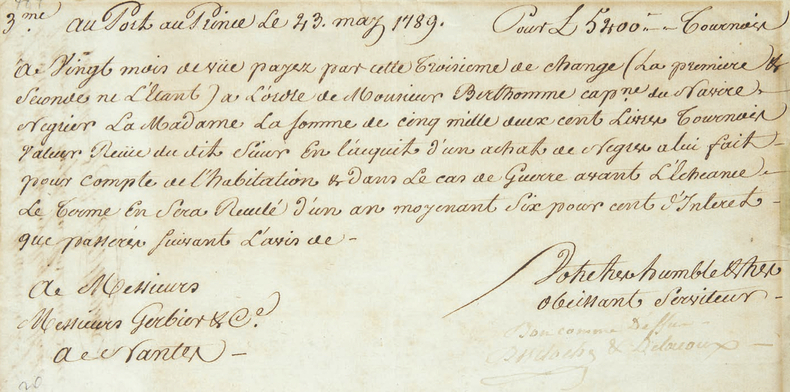
1789YQV-13Port-au-Prince, 23 mars 1789 Un billet in-8 oblong (128 × 243 mm), manuscrit à la plume au recto (11 lignes) et au verso (4 lignes), encre noire.
1728100536<p>Pamphlet 8vo modern full calf in the style of an 18th century Cambridge binding 32 pp.Very slight aging; in excellent condition. This is a rare first edition of a work that presents a complaint by British planters in the West Indies concerning the Assiento or agreement with Spain that gave Britain a virtual monopoly on the African slave trade. This agreement came out of the Treaty of Utrecht which ended the War of the Spanish Succession. This pamphlet indicates that the planters feared as a result of this agreement British slavers might be required to provide African slaves to the Spanish colonies which could result in insufficient numbers available for the West India plantations. The Assiento with Spain would mark the beginning of the Atlantic slave trade as a very powerful economic growth engine. Unfortunately this would translate into millions of Africans being taken from their homes.</p> H. Whitridge
1730PHO-2325Paris, Guérin, 1730-1731. 2 volumes in-4 (25,5 × 20 cm). XXVIII, 482 p., 29 ff. ; XIV, 506 p., 30 ff., reliures postérieures en demi-veau, pièces de titre et tomaison, coins et coupes légèrement frottés et émoussés, petits manques aux coiffes. Légèrement bruni, légères galeries de vers et traces d’humidité dans la marge intérieure au début du tome I ; les pages 17-20, 221/222, *19/*20 du tome I ainsi que les plans « Plan de la ville de San-Domingo » (tome I) et « Plan du Cap François » (tome II) sont déreliés ; petit déchirement restauré au pli de la garde de la « Carte de l’Isle de Saint-Domingue » (tome II). Ex-libris Jack Grout.