STEDMAN (Capitaine Jean-Gabriel)Livre Rare Book
64 résultats
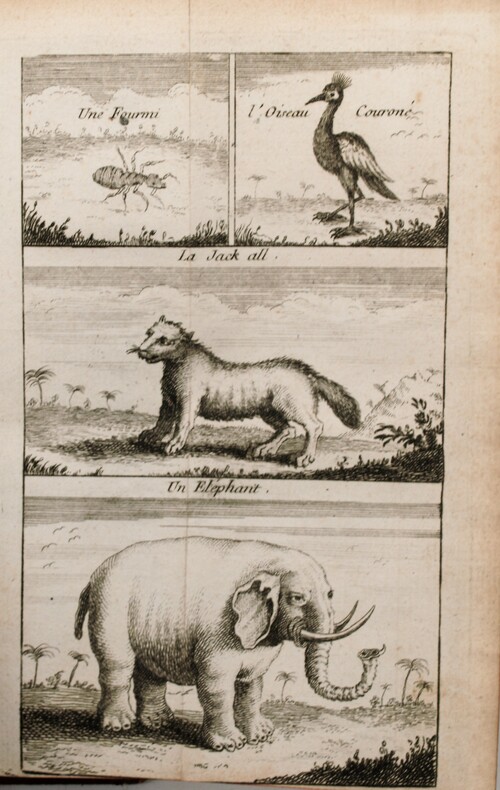
1798PHO-1492Paris, chez Buisson, an VII (1798),4 volumes ; Texte 3 volumes in-8 demi percale et un Atlas in-4, demi cuir époque, dos lisse avec auteur et titre ,44 planches, certaines en double page ou dépliantes, gravées par Antoine-François Tardieu d'après John Gabriel Stedman, la planche 25 détachée, mouillure claire en marge sur 4 planches, frottements coins et coupes usés, exlibris Aldo Maffey, journaliste et écrivain italien.
1751PHO-1113A Paris, chez Durand et Pissot, 1751. 2 volumes in-12, X -258 pages ; (2 ff), 313 p. Plein veau raciné époque (Coiffes endommagées, coins, coupes et mors épidermés. Infime galerie de ver n'affectant pas le texte aux pages 57 à 64 du tome I)
1793106470<p>12 lines in brown ink with paper seal on sheet of paper 34x21 cm 13½x8¼". Signed by Thomas Hamilton clerk. Remnant of seal old folds with splitting along them normal aging and browning some offsetting very good overall. Amazing little document relating to the enforcement of Pennsylvania's groundbreaking effort to begin the abolition of slavery "An Act for the Gradual Abolition of Slavery" passed by the Pennsylvania legislature in 1780. The Act prohibited further importation of slaves into the state required Pennsylvania slaveholders to annually register their slaves with forfeiture for noncompliance and manumission for the enslaved and established that all children born in Pennsylvania were free persons regardless of the condition or race of their parents. Those enslaved in Pennsylvania before the 1780 law entered effect remained enslaved for life. The present document seems to reveal non-compliance with the law by Hugh Neilly in part: "I hereby certify on application of Ralph Cherry that a careful search hath been made by me among the Records of Negro's sic entered on the Records of Westmoreland County and that on such search it doth not appear that any Negro's hath been registered in the name of Peter or any other name as his property by Hugh Neilly of Westmoreland County aforesaid under the laws passes for the gradual abolition of slavery. Thomas Hamilton clerk." Docketed on the back "Certificate that no Negro's hath been registered in Westmoreland as the property of Hugh Neilly." </p> books
17981244831798. First Edition. SMITH Elihu.Hubbard. A Discourse Delivered April 11 1798 At the Request of and Before the New-York Society for Promoting the Manumission of Slaves and Protecting Such of Them as Have Been or May Be Liberated. New-York: T. & J. Swords 1798. Slim octavo original tan self-wrappers string tied uncut; pp. 1-5 6-30 2. $3500.First edition of Smith's scathing attack on American slavery declaring it a betrayal as ""thousands of your fellow-beings children of the same father and inheritors of the same destiny writhe under the lash of cruelty"" an exceptional 18th-century abolitionist work published barely ten years after ratification of the Constitution exceedingly rare uncut in original wrappers.Trained as a physician under Benjamin Rush ""Smith was an early abolitionist a member and Recording Secretary of the New York Manumission Society and trustee of the city's African Free School"" Stevenson Litchfield Native. ""Passionately committed to the improvement of the fledgling nation through the acquisition and circulation of information"" Smith's analysis of slavery in this very rare work published the same year as his early death at 27 expresses his and the Society's commitment ""to ideals of human perfectibility which they combined with the practical labor of achieving change"" Kelly on Kaplan Men of Letters. Here he takes aim at leaders and nations where the ""spirit of despotism multiplied and extended the evil"" of slavery and ""wrought it into a system."" Noting the influence of renowned abolitionists John Woolman and Anthony Benezet he asserts that it is those in slave trade who particularly ""opened a new field for every baneful enterprise"" when they became ""the first to violate the noble principles by which they had been guided."" Smith especially speaks to American leaders and slaveholders who concede ""slavery is unjust"" but claim ""it is entailed upon us by our fathers; it is interwoven with every part of our social organization."" In reply he declares that it is ""strange reasoning"" to endorse slavery simply because it exists. Arguing ""the laws of our country authorized the possession in human flesh"" he asks: ""Shall the legislators of a great nation be denied the power of acknowledging their errors and laboring to correct them Encumbered as we are with this mighty evil"" Smith proclaims: ""You yes you the Legislators of America you are the real upholders of slavery you foster and protect it you immortalize injustice while thousands of your fellow-beings children of the same father and inheritors of the same destiny writhe under the lash of cruelty."" Evans 34554. Sabin 82502. Dumond 103. ESTC W37980. Not in Blockson. Text quite fresh with only faintest foxing to original wrappers. An excellent about-fine uncut copy in original wrappers. unknown
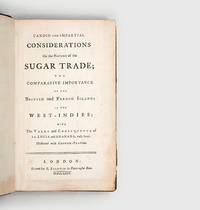
1763132583London: R. Baldwin 1763. A classic of in the field of colonial and Caribbean literature First edition of the first-named fourth of the second which was first published in Antigua 1750 under the pseudonym of "An Old Planter". John Campbell 1708-1775 was a highly successful historian and miscellaneous author Johnson thought well of him and praised the usefulness of his knowledge also describing him as "the richest author that ever grazed the common of literature" ODNB. The present work was commissioned by Lord Bute to rebut criticism of the Treaty of Paris by demonstrating "the value of colonial holdings in general and of sugar islands in particular" Ragatz. That is was felt to have done its job is perhaps confirmed by Campbell's appointment in 1765 as king's agent to Georgia. Considered by Ragatz to be a "classic of in the field of colonial and Caribbean literature embodying as it does one of the clearest statements of eighteenth-century philosophy regarding the relations that should exist between the metropole and its outlying possessions". This copy has additional material bound in: Bew's map of St Christopher's a 2-page manuscript index and bound at the rear a copy of Martin's practical essay on plantation management. Samuel Martin 1694/5-1776 had been born on Antigua but spent some considerable time thereafter in Britain on his full-time return to the island he found the family estates much run down and "embarked on a rigourous policy of reconstruction. Although he helped to pioneer improvements at most of the key stages in sugar-making and rum distillation his interests focused mainly on the non-manufacturing side of production. He was a firm advocate of crop rotation followed by marling in order to improve soil fertility. He was also instrumental in developing more effective systems of drainage and utilising windmills rather than animals for crushing the cane. By the standards of his contemporaries Martin was an enlightened slave owner. He advocated the provision of adequate supplies of food clothing shelter and medical facilities for slaves and ground for the cultivation of their own food" ODNB. His methods made him Antigua's leading and most progressive planter and during his own lifetime he certainly "succeeded in making sugar production a moderately profitable enterprise on his own estates". Both titles are moderately well-represented institutionally but neither appear with any great frequency at auction just a handful of copies of Campbell in the last fifty years and no copy of the Essay upon Plantership in any edition has passed through the rooms since 1951. Two works bound in a single vol. octavo 196 x 120 mm. Both bound without half-titles. 4 folding maps to the first-named 3 as called for; Caribbee Islands and Guyanna coloured in outline; The Harbour of Calivenie. Island of Grenada. Drawn by John Powell Topographer; and Plan of Fort Royal in the Island of Grenada and additionally a map of St. Christophers by J. Bew dated 1782 coloured. Contemporary streaked calf flat spine ruled gilt red morocco label single gilt rule to board edges Dahlia marbled endpapers. A little rubbed particularly on the joints label chipped no loss of lettering corners through small patch of insect damage to the lower board pastedowns lifting at the lower corners front free endpaper torn without loss slight erosion at the lower corner of the text-block for the first thirty pages or so mild worming to the fore-margin pp. 39-176 some small splits and closed tears to the maps no losses; overall very good. Campbell: ESTC T65879; Ragatz p. 284; Kress 6081; Sabin 10232. Martin: ESTC T81835; Sabin 44920 hardcover
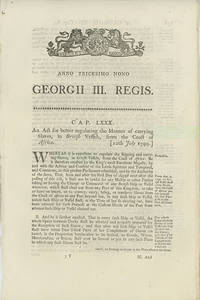
179928145London: Printed by George Eyre and Andrew Strahan Printers to the King's most Excellent Majesty 1799 1799. ESTC N60288 Lincoln's Inn Library and Wellcome Institute. Fine. 4to disbound paginated 637-652 untrimmed. An act passed by Parliament in the summer of 1799 delineated in 39 paragraphs that regulated the slave trade beginning in August 1800 - an act no doubt intended to placate the growing voices of opposition to the English slave trade. The act stipulates how many slaves could be stowed in a ship by mathematical formula according to the size of the ship but never more than 400; that slaves must be separated from other cargo; and that the space for the slaves "be full and complete perpendicular height of five feet." Nothing is said about their treatment other than that the ship's surgeon was required keep a log of illnesses and deaths of both slaves and crew. Much of the act is taken up with its enforcement and the penalties and fines for violations; it also regulates the conditions and treatment of the crew. The acts of Parliament were usually published separately and later issued in collections of the Public General Statutes; this one was issued as part of the collection of statues Passed in the Thirty-Ninth Year of the Reign of His Majesty King George the Third: Being the Third Session of the Eighteenth Parliament of Great Britain. This copy is disbound from such a volume. <br/><br/> (London: Printed by George Eyre and Andrew Strahan, Printers to the King's most Excellent Majesty, 1799) unknown books
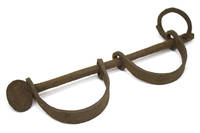
18003062751800. Wrought iron two semicircular wrist pieces approx. 4 inch in diameter attached to an 11-inch long bar. Oxidization consistent with age and material. Wrought iron two semicircular wrist pieces approx. 4 inch in diameter attached to an 11-inch long bar. A set of shackles of the type used in the Middle Passage slave route from Africa to the Americas in the 18th century. An illustration of this type of shackle appears on page 16 of Lydia Maria Child's Appeal in Behalf of that Class of Americans Called Africans Boston 1833 where she notes that these shackles were used to secure the ankles of adjacent slaves. "Yet even thus secured they do often jump into the sea and wave their hands in triumph at the approach of death unknown books
17921262151792. HAITI SLAVERY. A Particular Account of the Insurrection of the Negroes of St. Domingo Begun in August 1791: Translated from the French caption title as issued. London: 1792. Slim octavo modern green cloth; pp. 32. $1800.Fourth edition published one year after the very rare first of this sensationalistic account of the early months of the Slave Rebellion in Haiti the beginnings of the Haitian Revolution which ultimately led to the establishment of the first independent black state in the New World. The publishers of this polemic hoped to frighten the British public and turn them away from the abolitionists Wilberforce and Clarkson who were trying to put and end to slavery in the British colonies in the West Indies.Translated into English this is a speech to France's National Assembly ""by the Deputies from the General Assembly of the French part of St. Domingo."" The tract provides a frightening and grisly account of the August 1791 Slave Rebellion the result of ""a plot to set fire to the plantations and to murder all the whites."" The start of the insurrection by its ""perfidious"" leaders resulted in a catalogue of horrors and atrocities as the rebels ""spread over the plain with dreadful shouts set fires to houses and canes and massacred the inhabitants."" The ""fury of the cannibals"" is recounted in gory detail. The Speech is signed at the bottom of page 19 by six Deputies who call the insurrection ""the greatest calamity that has visited the human race in the course of the eighteenth century."" An Appendix records Letters and Speeches concerning the Rebellion. ESTC T110428. Goldsmiths' 15167. See Sabin 58932 1791 first edition; LCP 7460 2nd edition 1792; Work 349 1832 printing. First and last leaf slightly darkened text quite clean. Trimmed irregularly along upper margin affecting page numbers on two leaves but not any text. A very good copy of this scarce item. hardcover
1728100536<p>Pamphlet 8vo modern full calf in the style of an 18th century Cambridge binding 32 pp.Very slight aging; in excellent condition. This is a rare first edition of a work that presents a complaint by British planters in the West Indies concerning the Assiento or agreement with Spain that gave Britain a virtual monopoly on the African slave trade. This agreement came out of the Treaty of Utrecht which ended the War of the Spanish Succession. This pamphlet indicates that the planters feared as a result of this agreement British slavers might be required to provide African slaves to the Spanish colonies which could result in insufficient numbers available for the West India plantations. The Assiento with Spain would mark the beginning of the Atlantic slave trade as a very powerful economic growth engine. Unfortunately this would translate into millions of Africans being taken from their homes.</p> H. Whitridge
1728100536Pamphlet 8vo modern full calf in the style of an 18th century “Cambridge†binding 32 pp.Very slight aging; in excellent condition. This is a rare first edition of a work that presents a complaint by British planters in the West Indies concerning the Assiento or “agreement’ with Spain that gave Britain a virtual monopoly on the African slave trade. This agreement came out of the Treaty of Utrecht which ended the War of the Spanish Succession. This pamphlet indicates that the planters feared as a result of this agreement British slavers might be required to provide African slaves to the Spanish colonies which could result in insufficient numbers available for the West India plantations. The Assiento with Spain would mark the beginning of the Atlantic slave trade as a very powerful economic growth engine. Unfortunately this would translate into millions of Africans being taken from their homes. H. Whitridge unknown books
1713370449London: Printed for John Baskett 1713. 2 48pp. printed in English and Spanish in parallel columns. Without the Privilege leaf preceding the title. Quarto. Trimmed and inlaid into folio sheets and bound within a folio volume of treaties between Great Britain and Spain assembled by the British Foreign Office Library approx. 850pp in total. 19th century half roan and marbled paper boards worn some restoration at joints. Provenance: British Foreign Office Library bookplate on the front pastedown. 2 48pp. printed in English and Spanish in parallel columns. Without the Privilege leaf preceding the title. Quarto. First edition in English of one of the most important documents in the history of slavery in the Americas and in the political and financial history of Europe and the Americas in the early 18th century. <br /> <br /> Though the term "assiento" could refer to any number of Spanish contracts "the Assiento" almost always refers to the "Assiento de Negros": a monopoly contract granted by the Spanish crown between 1528 and 1779 for the sole right to import slaves from Africa into the Spanish colonies. Normally granted to individual companies the 1713 Assiento was granted directly to the British crown as part of negotiations for the Treaty of Utrecht which ended the War of Spanish Succession. In the decades following this 1713 Assiento an estimated 200000 enslaved Africans were transported across the Atlantic.<br /> <br /> The document grants sole privilege for the trade to the British crown for a period of thirty years expiring in 1743. The agreement consisting of forty-two articles allows for a maximum of 4800 slaves to be introduced to the colonies each year with a provision for increasing that annual amount each year by paying an added duty places limits on sale prices sets the cost of the duty to be paid for each enslaved person allows for the use of British or Spanish ships and mariners in the slave trade provides for the French Guinea Company's extraction from the colonies and establishes the details of precisely where British ships would be allowed to travel and trade. The British were also granted the unique privilege to send one vessel with a cargo of up to 500 tons of other trade goods to the Spanish colonies each year. <br /> <br /> While the Assiento seemed a lucrative deal most Assientists over the years saw considerable losses due to the difficulty of cross-Atlantic trade and the duties paid to the Spanish king. The real benefit to its grantees was not profits from the slave trade but rather the illegal ability to send other contraband on board their vessels to the otherwise closed-off Spanish markets in the New World. Britain was eager to get their own products overseas and to deny this revenue stream to the French who had held the Assiento since 1701 thereby preventing them from refilling their coffers too quickly and upsetting the balance of power in Europe after the costly War of the Spanish Succession. <br /> <br /> Queen Anne delegated the Assiento privilege to the South Sea Company which had recently been established to pay off Britain's considerable national debt. The privilege was largely granted to them as an encouragement to investors in order to allow the Company to achieve its original purpose more readily. Ultimately however it proved to be a costly and unprofitable endeavor for the South Sea Company who were able to import only about one-third of their allowed quota of slaves each year were frequently interrupted by war and were required to render twenty-five percent of their profits to King Philip V of Spain. <br /> <br /> The present example comes from the British Foreign Office Library inlaid and bound into a folio volume of other treaties between Great Britain and Spain arranged chronologically by treaty date. Over the course of many years the library of the Great Britain Foreign Office inlaid copies of nearly every treaty involving Great Britain to folio size and bound them together by region. The library was dispersed in the late 20th century with most of the volumes and particularly the American volumes broken up and sold by the William Reese Company.<br /> <br /> Most of the other treaties with Spain within this volume are clippings or extracts from larger works or true copies in manuscript of treaties dated between the years 1176 and 1739. Included in the volume however is a separately-printed English edition of the Treaty between Great Britain and Spain as part of the Treaty of Utrecht 1713: Tractatus pacis & amicitiæ . Treaty of peace and friendship between The most Serene and most Potent Princess Anne by the Grace of God Queen of Great Britain France and Ireland Defender of the Faith &c. and the most Serene and most Potent Prince Philip the Vth the catholick King of Spain concluded at Utrecht the 2/13 day of July 1713. London: Printed by John Baskett 1714. 115 1pp. ESTC T51509.<br /> <br /> There are two issues of the Assiento treaty; this is the issue with a semicolon after "Assiento" and no punctuation after "or" on the titlepage. A crucially important document in the history of colonial trade Spanish-British relations English finances and slavery in the Americas. Sabin 2227; European Americana 713/85; Hanson 1896; Sperling 34; JCB 1III:175; ESTC T4476 Printed for John Baskett unknown
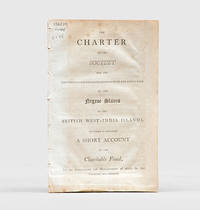
1794126550London no printer 1794 or later. First edition variously dated by ESTC and WorldCat between 1794 the date given at the end of the preliminary "Short Account of the origin and present state of the charitable fund" and 1823. The short account dated March 1794 is followed by a tipped in leaf reporting on the first meeting of the society which took place on Thursday April 3 1794 electing the Lord Bishop of London as president. The Charter of the Society 18 pages in length is dated at Westminster "this thirtieth Day of October in the thirty-fourth Year of our Reign" which again falls in 1794. Octavo 190 x 123 mm pp. ix 18. Sometime in a pamphlet vol. now disbound. Spine shows evidence of earlier binding sometime folded vertically; title lightly dust soiled page ix trimmed down and tipped onto p. viii; a good copy. Sabin 85881. unknown
1743PHO-1218La HAYE ,Jean Neaulme, 1743, deux volumes in 4° (260x210mm) reliés plein veau marbré, dos orné à 5 nerfs, pièce de titre, tranches rouges ,(2 plats détachés),coiffes arasées, coins usés, papier bruni ,Épître à Frédéric roi de Prusse imprimé en rouge et noir, XLIV-414pp./IV-192 pp., à la suite extraits de plusieurs auteurs anciens et autres pièces ,178 pp. ,orné de 12 cartes dont 9 dépliantes et 21 planches dont 5 dépliantes, une planche de musique et un fragment de la célèbre carte de Peutinger , ex-libris de Charles Kettaneh Première édition en français,
1791PHO-884Paris, Gueffier jeune, 1791. In-8, viii-341p. Plein veau blond époque , dos lisse avec titre , filet sur les plats, tache sur le plat, petites griffures
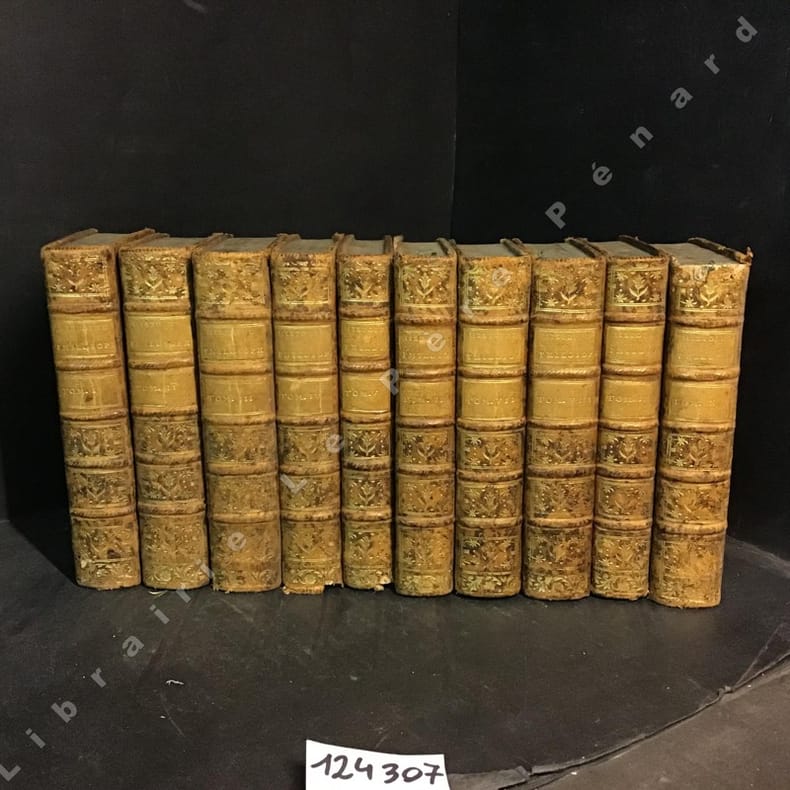
17801243071780 A Genève, Chez Jean-Léonard Pellet, Imprimeur de la Ville & de l'Académie - M. DCC. LXXX. (1780) - Dix volumes In-12, reliures pleine peau marbrée d'époque, dos à 5 nerfs avec pièce de titre et de tomaison sur fond marron clair, caissons ornés de fleurons en doré, toutes tranches marbrées, signet vert - xij-571 + 624 + 608 + 500 + 425 + 511 + 589 + 599 + 431 + 564 pages - Sans le volume d'Atlas
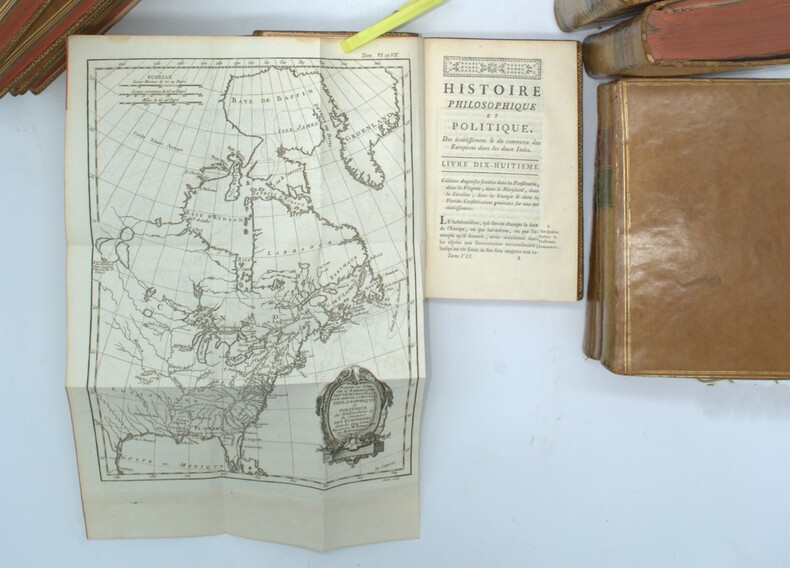
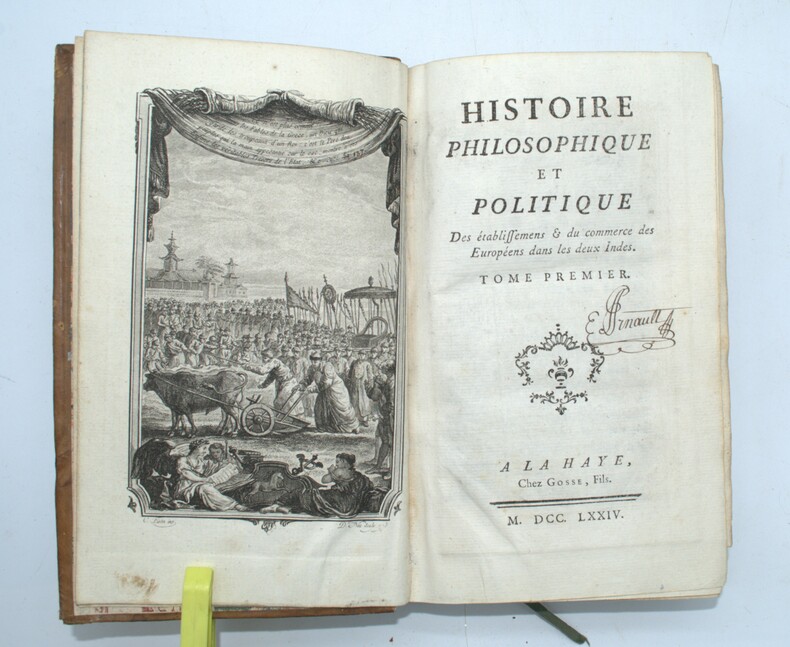
1774PHO-1474La Haye, Gosse et s.e., 1774-1781,11 volumes in 8°et 1 Atlas in-4, texte; XII-585, XII-386, XIII-586, XII-508, XII-407, VI-375 (1), XI-430 pages ,chaque volume comporte une gravure en frontispice d'après Eisen et une grande carte dépliante, et pour le supplément; XVI-604pp.,XV-574pp.,XV-492pp.,VIII-434pp.,avec un titre séparé Tableaux pour l’intelligence … 2ff. Et 23 tableaux dépliants ,reliure d'époque en plein veau ,dos lisse ornés,filets aux plats et roulettes à l’intérieur, tranches rouges , quelques coiffes usées, petits trous de ver,un tableau déchiré et son Atlas in-4 , 23pp. Et 50 cartes , relié pleine basane racinée époque, dos lisse avec pièce de titre et tomaison, petits frottements , coins usés
1774PHO-1489La Haye, Gosse, 1774, 7 volumes in 8°, XII-585, XII-386, XIII-586, XII-508, XII-407, VI-375 (1), XI-430 pages, chaque volume comporte une gravure en frontispice d'après Eisen et une grande carte dépliante, relié plein veau tacheté époque, dos à nerfs ornés avec pièce de titre rouge et tomaison noire, tranches tachetées bleues, exlibris manuscrit aux titres, quelques coins usés, petits accrocs, reliure en bel état, texte seul.
1775PHO-1037Genève, Libraires associés, 1775. 2 volumes in-4 (sur 3) relié plein veau marbré époque , dos à nerfs orné avec pièce de titre rouge et tomaison verte ,tranches rouge , IV- VIII- 719pp- VIII- 662 pp- Portrait de l'auteur dessiné par Cochin , 4 figures gravées hors-texte, 2 vignettes d'en-tête par Marillier et 3 cartes dépliantes (golfe du Mexique, Amérique méridionale, Océan Indien et mer du Sud avec les Philippines et la Nouvelle Hollande).Manque le 3eme tome , coiffes usées ,manque aux dos, qlqs feuillets légèrement brunis , tome 2 mouillure marginale sur les 20 premières pages , traces de vieille humidité en fin d’ouvrage.
177531351A Paris, chez Berry, 3ème année de l'ère Républicaine [1795]. 8 vol. au format in-8 (203 x 130 mm) de 2 ff. n.fol., 1 frontispice gravé n.fol., iv, iv - 500 pp. ; 1 frontispice gravé n.fol. et 548 pp. ; 2 ff. n.fol., 1 frontispice gravé n.fol. et 536 pp. ; 2 ff. n.fol., 1 frontispice gravé n.fol. et 447 pp. ; 2 ff. n.fol., 1 frontispice gravé n.fol. et 383 pp. ; 1 frontispice gravé n.fol. et 456 pp. ; 1 frontispice gravé n.fol. et 531 pp. ; 2 ff. n.fol., 1 frontispice gravé n.fol. et 516 pp. Reliures uniformes de l'époque de plein veau flammé blond, double filet doré et frise dorés encadrant chacun des plats, dos lisses ornés d'un double filet d'encadrement doré, filets gras dorés, doubles filets maigres dorés, entrelacs de filets gras et maigres dorés formant croisillons, fleurons dorés, semis de petits fleurons trapézoïdaux dorés, entrelacs de filets maigres dorés formant chaînettes, pièces de titre de maroquin vieux-rouge, pièces de tomaison de maroquin émeraude, titre doré, tomaison dorée, palette dorée en queue, filet doré sur les coupes, tranches jaspées.
1776PHO-2265La Haye ; Libraires Associés, 1776, 7 volumes In-8°(200x12,5cm), Portrait-frontispice- xii-482pp.- 1 carte, frontispice-viii-448pp.- 1 carte, frontispice-xii-468pp., frontispice-viii-311pp.- 1 carte, frontispice-311pp.-1 carte, frontispice-viii-290pp.-1 carte, frontispice-iv-331pp.-1 carte, demi basane époque, dos lisse avec pièce de titre brune et tomaison verte. Petits frottements, 2 feuillets détachés, déchirure sans manque (page 468 tome 3), petite fente et petit accroc au dos. 7 frontispices gravés majoritairement d'après Eisen et 6 grandes cartes dépliantes gravées.
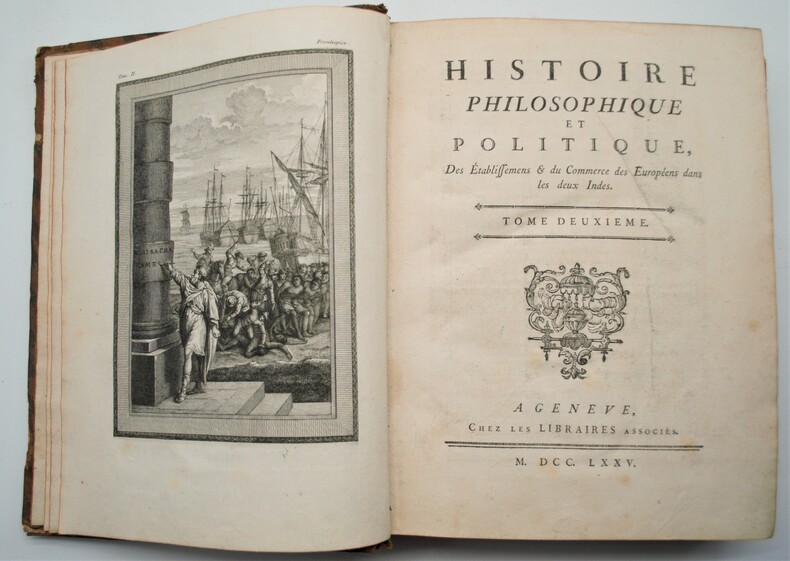
1775PHO-1053A Genève, chez les libraires associés, 1775 3 tome in-4 (26 x 20 cm) de (4) -IV-III-VIII-719, (4) -VIII-662 et (4) -VIII-658 pages. L'illustration comprend un portrait de l'Auteur gravé par Legrand d'après Cochin, 7 planches hors texte non signées, 4 cartes repliées aux contours colorés époque et 3 vignettes en-tête de Marillier. , relié plein veau blond, dos à nerfs ornés avec titre, tomaison et « rel. par Langlois à Lyon »en pied, filets sur les plats, tranches marbrées, coins usés, coiffes T1 et 3 un peu usés Première édition publiée au format in-4 établie sur la deuxième édition originale.
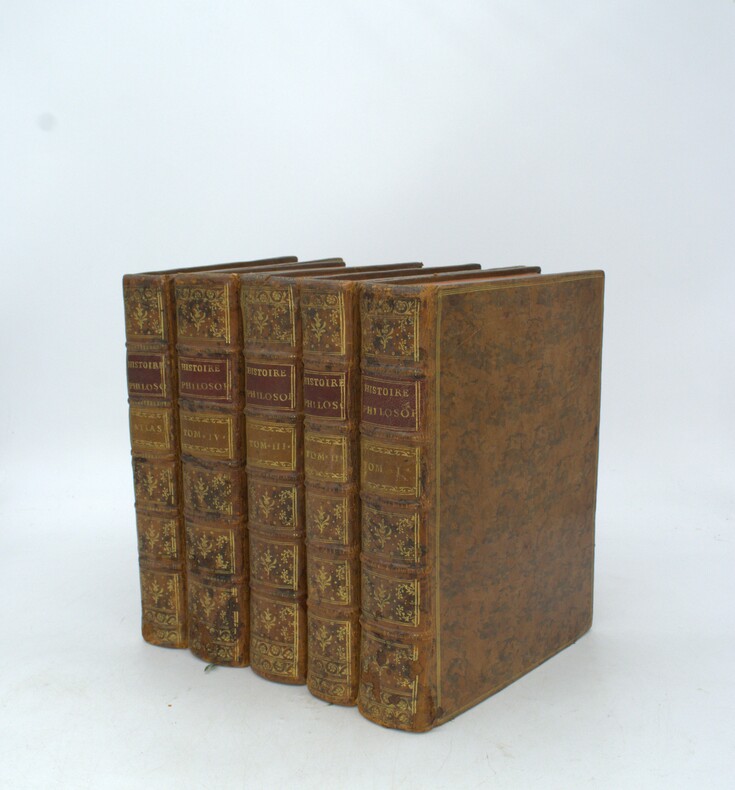
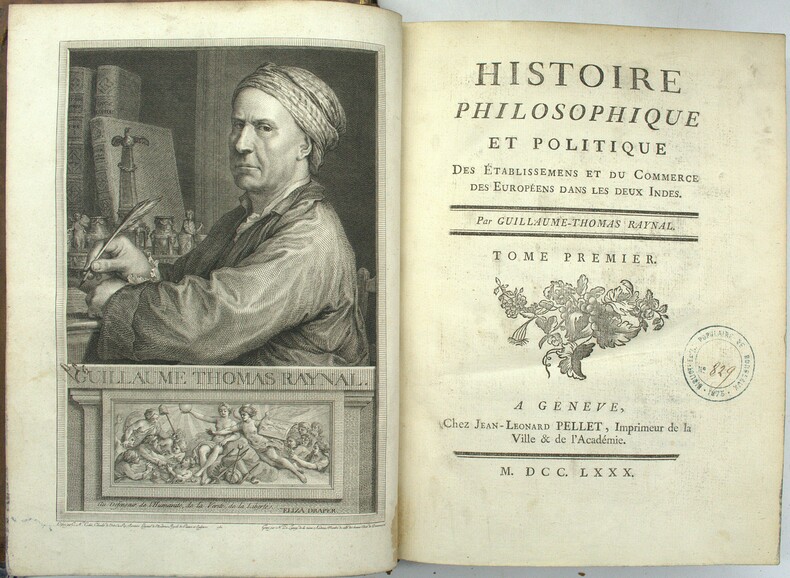
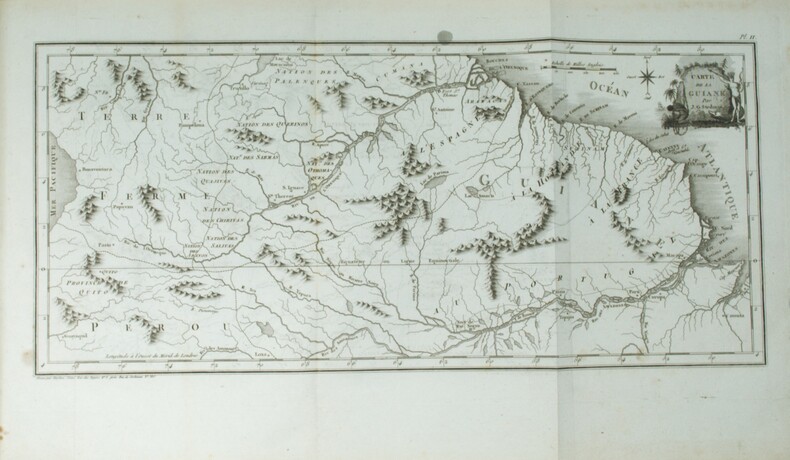
1780PHO-2003Genève, Jean-Léonard Pellet, 1780. 5 volumes in-4, 4 volumes de texte (25,5x20cm) et 1 Atlas (25,5x22cm), portrait, XVI, front.,741 pp., front., (2 ff.), VIII, 485 pp.; front., XV, 629 pp.; front., (2 ff.), VIII, 770 pp., (1 f.); 22 pp., (1 f. bl.), 50 cartes (49+17bis) et 23 tableaux. Relié plein veau marbré époque, dos à nerfs orné avec tomaison et pièce de titre grenat, filets aux plats, tranches rouges, frottements aux charnières, petites épidermures au dos, qlqs feuillets légèrement brunis. Bel exemplaire en reliure uniforme
17810042251781 Genève, Pellet, 1781. Dix volumes in-8 (130 X 207 mm) basane fauve marbrée, dos lisse orné à la grotesque de motifs dorés, pièces de titre et de tomaison grenat et vert, coupes ornées d'une guirlande dorée, coiffes filetées, tranches jaspées (reliure de l'époque). Tome I : portrait, XVI pages de faux-titre, titre, avertissement et table, 348 pages, (1) f. d'errata, (2) tableaux dépliants ; Tome II : frontispice, XII pages de faux-titre, titre et table, 378 pages, (1) f. d'errata, (4) tableaux dépliants ; Tome III : frontispice, VII pages de faux-titre, titre et table, 372 pages, (1) f. d'errata ; Tome IV : frontispice, XII pages de faux-titre, titre et table, 308 pages, (1) f. d'errata, (3) tableaux dépliants ; Tome V : frontispice, VII pages de faux-titre, titre et table, 259 pages, (1) f. d'errata, (1) tableau dépliant ; Tome VI : frontispice, XII pages de faux-titre, titre et table, 308 pages, (1) f. d'errata ; Tome VII : frontispice, XVI pages de faux-titre, titre et table, 359 pages, (1) page d'errata, (5) tableaux dépliants ; Tome VIII : frontispice, XII pages de faux-titre, titre et table, 352 pages ; Tome IX : frontispice, VIII pages de faux-titre, titre et table, 262 pages, (1) f. blanc, (1) f. d'errata, (9) tableaux dépliants ; Tome X : frontispice, V pages de faux-titre, titre et table, 348 pages, (1) f. d'errata. Quelques petites restaurations à la reliure.
1780PHO-1926Genève, Pellet, 1780, 5 volumes in-4, 4 de texte et un atlas in-4, Texte ; portrait, XVI, 741 pp., 1 pl.; front., (2 ff.), VIII, 485 pp.; front., XV, 629 pp.; front., (2 ff.), VIII, 770 pp., (1 f.), Atlas ; 2f., 28pp. ; illustré complet des 50 cartes (chiffrées 1-49 et 17 bis) ; quelques cartes mal chiffrées et 23 tableaux de statistiques in fine, la plupart dépliants. Rousseurs éparses, feuillets légèrement brunis par places. Tampons humides "Bibliothèque populaire de Bordeaux". Reliure Texte ; Basane fauve marbrée de l'époque, dos à nerfs ornés, triple filet doré encadrant les plats, Atlas ; veau brun marbré de l'époque, dos à nerfs orné, fleurons tulipes entre caissons, tranches marbrées, filet à froid encadrant les plats, double filet doré sur coupes 2 coiffes arasées, une arrachée, petits chocs à 2 autres, frottements et épidermures, coins très émoussés, mors fendillés aux entrées, coins émoussés, tranches marbrées (atlas).
174923232Paris Didot 1749 In-12 ( 4 Volumes ) Du tome IX au tome XII, 478 pp et 2 cartes , 486 pp , 3 gravures et 5 cartes , 429 pp 1 carte et 5 gravures et 508 4 cartes et 3 gravures