111 résultats
182532015London: Knight and Bagster 1825. One of several editions issued in 1825. Folio 4pp. Self wraps some marginal soiling and nicks bent at folds a very good copy. Library Company Afro-Americana 4293. OCLC lists just the Library Company copy; not in Dumond or Work. Formed because the 1807 Act to abolish the slave trade had failed to diminish "the prevalence of the very evils which it was one great object of the Abolition to remedy" the Society reviews the stranglehold that West Indian slavery is gaining. Its proceedings examine conditions in each of the West Indian colonies including "the threat of Jamaica to renounce her allegiance" to Britain. Information is also presented concerning Haiti and the effect of that country's upheavals on the British colonies. Knight and Bagster unknown books
163143 handwritten documents in ink regarding the sale of slave girls in Cuba. The documents are written in Spanish and include details such as purchase price age and names of the girls being sold. Large size Documents 12 ½ x 8 ¾ in. Some shadows from storage with other documents paper acidification from ink. Some losses from ink acidification and wormholes. Marks from previous binding along left edge. Sale documents are numbered at bottom of pages with signatures and all have stamp from Cuban government. Good condition. One of the documents includes the year 1875 dating some of these papers to the dwindling years of the slavery in Cuba which was officially outlawed in 1886. unknown books
14476SAUGNIER Mess. and Brisson. London G.G. J. and J. Robinson1792. First edition in English after the French first edition of 1791. Voyages to the Coast of Africa: Containing an Account of Their Shipwreck on Board Different Vessels and Subsequent Slavery and Interesting Details of the Arabs of the Desert and of the Slave Trade as Carried on at Senegal and Galam. 12mo 21.5 x 14 cm; i viii 500 pp three parts and a narrative First Voyage - To Senegal; The Second Part - Voyage to Galem and Return to France; The Third Part- Commerce of Senegal and Galam; Narrative of the Shipwreck and Captivity of M De Brisson bound in one volume lacking the map recent blue cloth with gilt spine title lettering.<br/>Saugnier was shipwrecked on January 17 1784 near Cape Leven and Brisson in July 1785 at Cape Blanco both in the Spanish zone of Rio del Oro. A fascinating account of shipwreck and slavery from a first hand account including details on the economic aspects of slavery. Faded spine page 31 misnumbered 13 page 85 has an ink stain to it and pages 460 and 461 are misnumbered 444 and 445 although the text is confirmed correct; good solid copy. unknown books
163153 handwritten documents in ink regarding the sale of slave girls in Cuba. The documents are written in Spanish and include details such as purchase price age and names of the girls being sold. Documents are large: 12 ½ x 8 ¾ in. Some shadows from storage with other documents paper acidification from ink. Some losses from ink acidification and wormholes. Marks from previous binding along left edge. Sale documents are numbered at bottom of pages with signatures and all have stamp from Cuban government. Good condition. One of the documents includes the year 1875 dating some of these papers to the dwindling years of the slavery in Cuba which was officially outlawed in 1886. unknown books
12584Group of two partly-printed tax receiptstwo receipts collected by Sheriff Farrar of Mecklenburg County and Aylor Sheriff of Madison. Both receipts are dated 1861. 1 is for "Slaves and money $6.80" and "War Tax of $1.36." Dated August 23 1861 and signed by Sheriff Farrar. The other is signed by Sheriff Aylor. In excellent condition. A nice group of slave tax receipts. unknown books
1854CAT0114New York: H. Long 1854. First Edition. 8vo publisher's brown cloth 259 pp. Good Plus. The Vermont-born Chase moved to Tennessee in 1838. He was elected as a member of the Democratic Party to the Twenty-ninth and Thirtieth Congresses serving from 1845-1849 before returning north to New York City to practice law. In this work of fiction which is mostly intended as a diatribe against the hypocrisy of the English he proposes that "The African adopts him-self with greater readiness than the white man." In his view wage slavery in the North and in England was worse than the slavery in the South. An uncommon first edition copy. Some wear and tears to boards some light marginal foxing to contents but still sound and usable good plus condition overall. H. Long unknown books
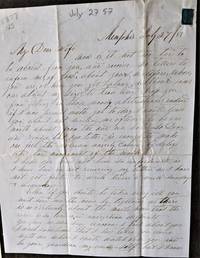
1857708Memphis 1857. 4to. letter sheet. 250 x 195 mm. 9 ¾ x 15 ½ inches. 4 pp. about 840 words. Folded in thirds. Written in black ink faded brown in very legible hand. Jesse McCallum was a hay dealer from Cincinnati Ohio who travelled away from his family on business forays. In this case he writes from Memphis Tennessee complaining about the heat and commenting on the "darkies" as follows: ". the sun is scorching from 10 am to 4 pm the difference is very perceptible I think the heat is greater on account of the drought the ground is parched up and dry.the streets are deserted in the middle of the day but the darkies will be down in the hottest part of the day in the sun and sleep with the sun shining full in their face and appear to enjoy it as much as a white man would in the shade what a difference collar sic makes.the south could not get along well without its black population one months work in the sun of the south would cure the bitterest abolitionist of the north of his bitter oposition sic to institutions of slavery and come over without a groan to be a slave owner if compelled to earn his living by cultivating the soil." McCallum thinks "we will do well on this load of hay.as hay is advancing" and also comments about his wife's lack of correspondence and reminds her that he writes twice a week. The last page is particularly affectionate--he remarks about being a "bachelor husband" and adds ; ". the only true enjoyment I have had was when I recd your letter since I left you and now Elly if you wish me to enjoy myself write often." Jesse McCallum often spelled Mc Collum in historical records was born in Ohio in 1819. In 1850 he was working as a stone cutter. By 1860 he was living with wife Eleanor Welsh and  six children in Marysville Yuba California. In the Civil War he was a Union Corporal 81st Illinois Infantry Company A. In 1870 he was making "gas machines". He died in Marysville in 1880. unknown books
1836WRCAM46521Pittsburgh: Alexander Jaynes 1836. 8pp. Dbd. Lightly and evenly tanned. Very good. "The question of Slavery being before the General Assembly of 1836 on petition from many members of the church that the Assembly would bear their testimony against the practice of slaveholding as a SIN it has been thought proper to reprint the testimonies and acts of former Assemblies on the same subject from the official Minutes without note or comment." Only three copies located in OCLC at Princeton Oberlin and the Library Company of Philadelphia. Alexander Jaynes unknown books
1836WRCAM46520Pittsburgh: Alexander Jaynes 1836. 36pp. Dbd. Light foxing and toning contemporary pencil notations. About very good. A discourse given on the great evils of slavery and the polarization it is causing among the northern and southern states. Relatively scarce though the titlepage indicates that it was printed "For Gratuitous Distribution." Alexander Jaynes unknown books
182919216Albany: Printed by Websters and Skinners 1829. First edition. Some wear to the untrimmed edges; long closed tear to one leaf from the upper edge no loss; some light soiling and a few small stains; a very good copy. Unbound pamphlet stitched as issued 6 x 9.13 inches untrimmed 24 pages. When therefore the fetters whether gradually or suddenly shall be stricken off and stricken off they will be from those accumulating millions yet to be born in bondage it is evident that this land unless some outlet be provided will be flooded with a population as useless as it will be wretched. . . . Whether bond or free their presence will be for ever a calamity." The organizational proceedings of the first iteration of the New-York State Colonization Society intended to help the national organization settle free blacks in Africa. Lib. Co. Afro-Americana 7116; American Imprints 39836. Printed by Websters and Skinners, unknown books
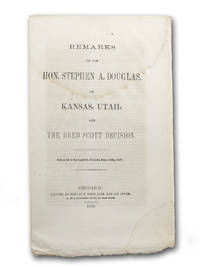
185718536Chicago: Printed at the Daily Times Book and Job Office 1857. First Chicago edition. Light damp-stain to the upper third of the sheet small stain to the lower outer corner; a very good copy. Original self-wrappers 10.25 x 6 inches 15 pages untrimmed. Unopened. Per Byrd "This speech was the first public expression of his views on the Dred Scott decision. In it he accepted the decision and insisted that 'the whole principle of Popular Sovereignty and self-government is sustained and firmly established by the authority of this decision.' " Byrd also notes this pamphlet was intended to lay the groundwork for his 1858 re-election. An edition printed in Springfield and an 8-page edition without an imprint also appeared the same year as well as an edition in German. Flake Mormon Bibliography 2985; Ante-Fire Imprints 250; Byrd 2635. Printed at the Daily Times Book and Job Office, unknown books
186223579<p><i>"It is a fact that the enslavement of human beings has so far infused its insidious poison into the very hearts of the Southern people that they have come to believe and declare the evil of slavery to be a good and to require the power of Government to be exerted to maintain extend and perpetuate an institution that enables thousands to sell their own children to be enslaved with all their posterity into hopeless bondage." </i></p><p>The founder of New York City's Cooper Union for the Advancement of Science and Art echoes the language and logic of the Emancipation Proclamation as well as citing some Southern pro-slavery arguments to demonstrate their ridiculousness in this open letter to President Lincoln. Cooper and the Cooper Union had long been advocates of abolition and both Lincoln and Frederick Douglass had famously lectured at the institution.</p> <b>PETER COOPER. SLAVERY.</b>Pamphlet. <i>Letter of Peter Cooper on Slave Emancipation</i> Loyal Publication Society New York 1862 8pp. disbound.<p><b><br /></b></p><p><b>Excerpts:</b></p><p><i>"It is a fact that the enslavement of human beings has so far infused its insidious poison into the very hearts of the Southern people that they have come to believe and declare the evil of slavery to be a good and to require the power of Government to be exerted to maintain extend and perpetuate an institution that enables thousands to sell their own children to be enslaved with all their posterity into hopeless bondage." </i></p><p><i>"In the original formation of that Constitution it became absolutely necessary to make a compromise with that great and all pervading interest which had then already entered into the very life-blood of the nation rendering the formation of an union of States hopeless without such a compromise."</i></p><p><i>"The constitutional requirement to return fugitive slaves on their being demanded by Southern men having been acknowledged and performed by the States has been reaffirmed by an almost unanimous vote in Congress.These honest efforts on the part of the North to maintain peace and friendship were met by a relentless war waged for the destruction of the Constitution and the dissolution of the Union.<i>"</i></i></p><p><i>"The time has now come when Southern men must know that the Union must be preserved and it is for them to determine whether they will persevere in their rebellion until the North shall be compelled in the most reluctant self defence to render contraband of war the slaves and property of all persons found in arms against the laws and Government of the country."</i></p><p><b>Condition</b></p><p>Fine. Disbound and lacking front wrap.</p> books
1827213910London: John Hatchard and Son 1827. Illustrated by 9 etchings. viii 464 pp. 1 vols. 8vo. Full calf spine gilt. Upper board missing 8 leaves damp-stained else Near Fine. Illustrated by 9 etchings. viii 464 pp. 1 vols. 8vo. John Hatchard and Son unknown books
1855CAT0116Peterboro: Self-Published 1855. First Edition. Single sheet folded 10 x 10 inches. Very Good. One of several public letters by Smith to Seward this one discussing the Fugitive Slave Law. Smith by the mid-1850s had grown increasingly frustrated by the abolitionist movement's willingness to compromise. Seward an early figure in the Republican party sought more gradual measures. Smith writes: "Instead of interpreting constitutions and statutes in the light of human rights you interpret human rights in the light of constitutions and statutes. I own that you stand as an antislavery man very far above most of our statesmen. but I would have you stand farther above them." Smith's growing impatience with the compromising nature of the abolitionist movement would later lead him to support the efforts of John Brown and the free-state movement in Kansas. "When most Liberty party leaders agreed to merge with more moderate antislavery factions to form the Free Soil party in 1848 Smith balked at what he regarded as abandonment of the abolitionist commitment to immediate emancipation." - ANB. A very good copy with a light stain to margin else near fine. Six copies in OCLC. Self-Published unknown books
1864106405<p>Single 8vo sized sheet 5 1/2" x 8 1/2" duplicate receipt signature printed and hand written some aging; but very good or better. This receipt is signed by A.M. Kennedy for John D. Kennedy. Printed and Handwritten Document Signed. Columbia South Carolina. Jan. 18 1864 "Duplicate Receipt" for $2000 paid by the state to Confederate commander John D. Kennedy as "compensation for his slave named Robert lost by reason of the employment of said slave by the authorities of the Confederate Government upon the military fortification in this State." John Doby Kennedy was born on January 5 1840 in Camden South Carolina the son of a Scots immigrant. John was a student at South Carolina College. He was a wealthy man and reportedly owned 60 slaves. On the day this receipt was issued to his brother 24 year-old John Doby Kennedy was on the battlefield commanding his South Carolina Infantry regiment having fought in the battles of Chancellorsville and Gettysburg and that year in the Shenandoah Campaigns after which he was given the rank of Brigadier General. Opposing General Sherman's advance until the bitter end he did not surrender until two weeks after Lee met Grant at Appomattox. civilwarintheeast website. </p> books
183419536Boston: Russell Odiorne & Metcalf et al. 1834. First edition. Stitching evidently renewed at an early date; some wear and soiling light chipping and foxing; a good sound copy. Stitched pamphlet lacking wrappers 8.88 x 5.38 inches 80 pages. The notorious privateer and slave trader Pedro Gibert operating out of Colombia attacked the Salem brig Mexican off the coast of Florida in 1832 and set the American ship on fire. Captured off the coast of Africa by the Royal Navy in 1833 Gibert and his crew were brought to America for trial making him and two of his crew that last men to be hanged for piracy in the United States. It is interesting to note that one of the defense attorneys was David Lee Child 1794-18874 the abolitionist journalist and husband of Lydia Maria Child. Child had fought on the liberal side in Spain in 1823 as was fluent in Spanish which may have been the reason he was given the job of working with the Spanish-speaking prisoners--though the question of whether his liberal principles guided him to provide adequate counsel to defendants whose numb er included black sailors despite the fact that the Panda was a slave ship seems an open or at least under-explored question not addressed in any of the standard biographical sketches. This first edition of the Russell Odiorne and Metcalf edition of the trial did not include portraits; so-called second and third editions were published the same year had added plates. Sabin 69915. Traces of the original wrappers present. Russell, Odiorne & Metcalf [et al.], unknown books
1858714Jefferson County State of Mississippi 1858. 4to. 315 x 200mm. 12 ½ x 8 inches. 2 pp. Docket on verso. Blue legal paper; folds edges browned and slightly frayed; top page cut 2 inches shorter no loss. The first page dated July 27 1858 shows the value of two slaves Juda and Emma owned by the named wards to be valued at $40 together. The three appraisers of the above slave property signed their names on the first page. The second page is an application of Mary Shaw dated April 9 guardian of the four Killingsworth wards to appoint the appraisers for the slaves. It is signed by Albert N. Ford clerk. There is an interesting story behind these records. William Anderson Killingsworth owner of about thirty slaves was born 1821 in Tennessee. He married Nancy Ann Shaw who was born 1820 in Mississippi and died 23 June 1853 in Jefferson County MS. Their children were Francis Horace Valencia William and Albert. On July 19 1854 William Killingsworth was murdered by two of his slaves named Jesse and Albert. Two more slaves Bill and Charles were accused of torching the house. Unnamed slaves retrieved William's body and his three children from the burning house. The slaves' trial was in the fall of 1854. Jesse and Albert were hung November 21 1854. Jesse confessed that he alone committed the murder. This information is recorded in a diary written by Susan Sillers Darden which began in January 1854.  Darden was thirty-eight years old when she wrote the diary. The diary reads in part; "July 20 1854: There was an awful murder committed at Killingsworth's last night. He was murdered by his negroes and the house burned down; he had four children but the house was discovered and taken out." "November 21 1854: Our negroes went to Fayette to see Jesse and Albert hung for murdering their master W. Killingsworth. Jesse confessed that he had done it all that no one helped to do it; exhorted his fellow servants to be faithful and do their duty." Since both parents were deceased the Killingsworth children were the wards of their grandmother Mary Shaw and Uncle William Shaw. Frances Chalmers Killingsworth 1842-1910 was the oldest child.  See The Diary of Susan Sillers Darden on-line at the Mississippi Department of Archives and History Jackson Mississippi. . unknown books
D16245London: Printed for Harvey and Darton Gracechurch-Street. 1827. Hardcover. Good. 8vo 185 x 115mm. Pagination: xi 88pp. Signatures: 4-b2 B-D12 E8. Title page with four-line excerpt of poem The Negroes Complaint by William Cowper written in 1788 and printed in an English anti-slavery pamphlet: Fleecy looks and black complexion Cannot forfeit natures claim: Skins may differ but affection Dwells in white and black the same. Contemporary possibly original boards backed with modern cloth edges uncut; title with loss at top some light marginal staining mostly at front and rear leaves and to covers; otherwise good. <br/><br/>Anonymously published signed only A lover of Africa the Anecdotes of Africans expressed the human identity of African slaves through a selection of stories and travels which largely related to the slavery at the Cape of Good Hope. Throughout the late 18th and early 19th-centuries an increasingly vocal anti-slavery sentiment rippled through both sides of the Atlantic. Authors who published anti-slavery works - hymns poems and anecdotes - believed that by arousing the feelings of human fellowship they could win the argument for racial equality. This book is exceedingly rare OCLC locates scarce print copies at Drew University Library Haverford College Library and the source library for widely held digitized copies is Goldsmiths Library University of London. See Goldsmiths-Kress Library of Economic Literature no. 25379. Printed for Harvey and Darton hardcover books
18732024Cuba 1873. About very good. 3 folio leaves. Light wear at edges a couple of small chips at lower left edge of each leaf. Light tanning and foxing. Accomplished in a neat legible script. Scarce manuscript listing of slaves and indentured servants from a Cuban sugar plantation. The present list was made in January 1873 on the Ingenio Tartesio east of Havana near the small village of Las Pozas. On two separate sheets nine Chinese and twenty-eight African or Criollo men are listed as rented to the farm; on a third sheet eighteen slave births for 1873 and 1874 are recorded giving names mothers and dates of birth. The Chinese men are identified simply by first name and owner; the African and other slaves are listed with additional details such as nationality age owner. A section for additional observations notes which slaves have run away and at least one death. A fascinating document of slave hires on an isolated Cuban plantation during the 1870s. unknown books
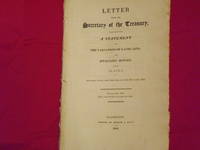
1816100537Pamphlet formate folio disbound first pamphlet 3 leaves printed on recto only second 7pp. third 6 pages and folding chart. Pamphlet extracted from larger volumne chipping along spine and edges not affecting text second papmple completely disbound paper browned and somewhat dry These pamphlets are rare and represent an important source of information on the numbers and values of slaves in early 19th century America. The first title presents the value assigned to slaves in 11 states including New York. The second lists the number and values of slaves in the various counties in the state of Maryland. The final pamphlet presents real estate values and values on dwellings including slaves in the counties of Pennsylvania. The information in these reports was compiled by Alexander James Dallas 1759-1817 who was the Secretary of the Treasury. Dallas born in Kingston Jamaica settled in Pennsylvania and practiced law there. Eventually he would become Secretary of the Treasury in 1814 when the nation was almost bankrupt. He managed to reorganize the department get the country out of debt created a surplus and even helped promote what would become the Second Bank of the United States. ANB. William A. Davis, books
182719400Mount Vernon Alabama April 20 '27 i.e. 1827. Separating at spots along old folds; some staining browning and light soiling; in good condition legible. One page on a lined bifolium 9.75 x 7.75 inches approx. 250 words. A prelude to flush times in Alabama and representative bit of evidence of the growth of the internal slave trade from the soon-to-be commander of the Mount Vernon Arsenal authorized by Congress in May 1828. Harding appears to have had roots in Montgomery County Maryland; this letter includes references to inheritance complications and to Maria's recent misfortunes: "I recd. a letter some days ago from Mr. R. Burdine communicating the disturbing intelligence at the loss of yr. house & effects by fire and by this days post I enclose here a draft on the Bank of the Metropolis for $100 for yr. benefit. ñ this amount althoà small is all I can well afford ñ I have four children to educate who are at very expensive schools and their Mother is now abroad in Pennsylvania superintending their education. . . . I think those who have surreptitiously obtained possession of your Grandfathers property ought to contribute liberally to yr. relief. ñ From that estate you know I have nothing but 5 Negroes the land left me by my father and which I shall ever believe my children were swindled out of. I have long since abandoned the idea of ever being able to recover." Harding notes further "I suppose you are aware my brother H. purchased for me last fall Old Sall and her daughter who joined me in December last. They with the rest of the Negroes are around me & doing well." Maria Queen appears in public records petitioning for compensation in May 1862 for the emancipation of the enslaved Ellen Hanson freed under the Washington D. C. compensated emancipation act: "Said Ellen was given to Me at the age of Ten years by My Grand father Edward Harding of Montgomery County Md Said Ellen has been in my immediate service ever since." Franked by Harding as the postmaster of Mount Vernon. With a preliminary transcript. April 20, '27, [i.e.,] unknown books
181619598Winchester Va.: J. Foster Printer 1816. First edition. Fragile sheep rubbed but sound; some light foxing and spotting; front joint just a trifle tender; a good sound copy of a moderately crude American book. Small 8vo original sheep red leather label gilt lettering 219 1 pages. An eccentric book-length poem from Elder Joseph Thomas 1791-1835 the wide-ranging charismatic North Carolina itinerant preacher known as the White Pilgrim for his habit of attiring himself in white apparel in all seasons and climes. Thomas includes a fairly lengthy and graphic section here leveled against slavery and its e suggesting those who endorse slavery might "Let them be bound and torn away / From wives and friends to Africa. / Let them be starv'd and beat one year / Then say 'tis right I'll say 'tis queer; / Or whip their wives before their eye-- / Is that all right O no they cry." Thomas also suggests abstaining from the product of slave labor "In sugar works where Negroes toil / A leg and arm they often boil; / They grind them up and mix the sweet / Of all that luxury we eat. / O temp'rate man use not that food / That's stain'd or mix'd with negro blood! / That taste luxur'ous now forego / Which causes human gore to flow." Stoddard & Whitesell 1148; Sabin 63639. Early ink autograph ownership signatures to the front free endpaper and to a rear blank and endpapers. Small tear from the lower margin of one leaf with loss of a few letters but no loss of sense. J. Foster, Printer, unknown books
185519759N. p.: Jan. 4th 1855. Autograph address in ink on an unbound fascicle of 15 folia 30 leaves stitched. These arguments it is believed fairly prove that a man can be at the same time both a slave-holder and a Christian or stated in the abstract that the particular relation of superior & inferior known as slavery is not in itself necessarily sinful." An extensive detailed legal and ethical apology for American slavery arguing that a reciprocal relationship exists between the enslaver and the slave; the speak tentatively argues that Congress does have power to regulate slavery in the territories and had words against the doctrine of Popular Sovereignty. The anonymity of this argument and the popular setting of the lyceum stage perhaps as a student production seems altogether fitting as a reflection of the widespread currency of legalistic equivocation over chattel slavery in America prior to the Civil War. With revisions and interpolations and corrections to the text throughout. Jan. 4th, books
1818568111818. Calhoun signed the Revolutionary War pension claim of Robert Hamilton of Massachusetts who had been a Lieutenant in the Army of the Revolution. Some marginal chiping and tears at the fold affecting the "J" in the signature of J.C. Calhoun. A good copy. Wikipedia: "John Caldwell Calhoun:March 18 1782 - March 31 1850 was an American statesman and political theorist from South Carolina who is best remembered for his strong defense of slavery and for advancing the concept of minority rights in politics which he did in the context of defending Southern values from perceived Northern threats. He began his political career as a nationalist modernizer and proponent of a strong national government and protective tariffs. By the late 1820s his views reversed and he became a leading proponent of states' rights limited government nullification and opposition to high tariffs-he saw Northern acceptance of these policies as the only way to keep the South in the Union. His beliefs and warnings heavily influenced the South's secession from the Union in 1860-61. Calhoun began his political career with election to the House of Representatives. As a prominent leader of the war hawk faction Calhoun strongly supported the War of 1812 to defend American honor against Britain. He then served as Secretary of War under President James Monroe and in his position reorganized and modernized the War Department. In the 1824 presidential election he was the overwhelming choice of the electoral college for Vice President of the United States. He served under John Quincy Adams and continued under Andrew Jackson who defeated Adams in 1828. unknown books
1850106404<p>Folio manuscript legal sheets 11 pp. plus docketing on final back sheet. Traces of wax in some margins. Paper is browned and aged some minor creasing at folds margin hole on a couple of pages not affecting text; otherwise very good. This is a very complex legal case about the ownership of two slaves. These manuscript documents are signed by the three Constables deposed as witnesses. The testimony is taken at the law offices of Lysander G. Gordon. It seems that an individual who owed people money was forced to give the slaves to a sheriff and were then sold to William Knox in Southern Tennessee. However it appears that the slaves actually belonged to someone else. These documents try to sort though this mess. </p> books