111 résultats
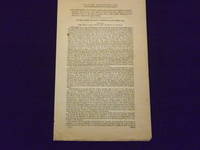
183612488New York September 1836. Used; Like New/Used; Like New. Folio. 4 pp printed in four columns per page. Tears around edges creased and with significant toning to the upper front half and extensive foxing throughout. <br><br><br />This rare monthly an organ of the American Anti-Slavery Society began in July 1835 and ended with the February 1839 issue. Among other interesting features the present issue prints a "Form of a Petition for the Abolition of Slavery in the District of Columbia. To The Congress of the United States." Not in Lomazow Mott Sabin. OCLC records copies from all the other years but no copies of this issue. <br><br><br />While there was opposition to slavery in the nation's capital the greater forces against slavery came from the outside through newspapers and petitions. Many petitioned Congress to end slavery in the nation's capital and the organizing efforts in the District included the Washington Abolition Society which was organized in 1827. But the opposition to ending slavery and the slave trade in the District was such a contested issue that a gag rule instituted in 1836 prohibited a discussion of slavery on the floor of Congress. Though Abolitionists including John Quincy Adams vehemently opposed the gag rule standard-bearers of slavery in the District fought tirelessly for it. Eventually in 1848 the House of Representative passed a resolution to prohibit the slave trade in the District of Columbia. Although the resolution did not gain enough traction to end the slave trade in the District it played an influential role in the congressional debates over slavery and the slave trade. The Compromise of 1850 admitted California in the Union as a free state; the former Mexican territories were admitted as part slaveholding states and part free soilers states; and the slave trade in the District of Columbia was abolished. The 1850 Compromise provided the necessary momentum for the enactment of the District of Columbia Compensated Emancipation Act of April 16 1862 that abolished slavery in the Nation's Capital. unknown books
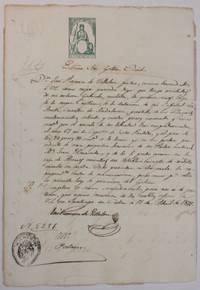
18772027Havana 1877. Very good. 1p. on a bifolium. Removed from a a bound volume with unobtrusive stabholes at gutter margin. Light wear at edges; light dust soiling and damp staining. Remarkable bidsheet submitted by a Cuban business in response to a newspaper advertisement for an auction of slaves for hire held in Havana during November 1877. The firm Jado Sarasúa y Compañia writes that "Enterada del anuncio publicado en la Gaceta fecha 9 del corriente para el arrendamineto en publica subasta de los esclavos existentes en el Asilo de San Jose pertenecientesa Bienes Embargados y sujentadose en un todo al pliego de Condiciones inserto en la misma Gaceta hace la siguente proposicion." Below is a list of fourteen slaves mostly women and the prices that the company is willing to offer for the slaves being rented ranging from ten to seventeen pesos per month. Signed and dated at the bottom "Habana Noviembre 14 de 1877. unknown books
1836WRCAM52765N.p. likely Augusta 1836. 62pp. Folded sheets stitched. Minor foxing and toning. Very good. Untrimmed. A rare Maine slip-bill document resolving that the citizens from Maine and other states should not interfere with the issue of slavery in slave-holding states. The legislature writes: "Any interference therefore of a State or the inhabitants of a State with the domestic concerns of another State is dangerous as having a direct tendency to create jealousies between the States and thereby weakening the attachment to the Union which is our only security against domestic dissensions and foreign aggressions." <br> <br> This is a somewhat surprising position for the state of Maine to have taken at the time. Maine came into the Union in 1820 as a free state to balance the admission of the slave- owning state of Missouri. Also Maine opposed the admission of the Republic of Texas in 1836 the same year the present document was printed on the basis of Texas' position on slavery. It is curious that they would take two seemingly opposite positions in the same year. Still the legislature printed the resolution and authorized copies to be sent to the four southern slave-owning states mentioned in the title. unknown books
1842106407<p>Folded letter sheet four pages and remnant of wax seal. Creases at folds normal aging; otherwise very good or better. The letter is to Henry J. Carter Stockbridge Mass. from his brother. An unemployed 20 year-old Massachusetts teacher who had left home the year before in "exceeding hard times" Edward had gone to Baltimore – where some 50 teachers were out of work – and taken a job working for a wealthy man who had 4 acres of farm land worked by slaves. "…he has given me the office of overseer to look after the blacks in their work. O but you ought to see me walk over the lot with my cane in my hand to see how my work is going on. Then you ought to see the darky when he wants anything of me come up and take off his hat before he speaks…" Praising the "fine folks live in this beautiful part of the world" Carter proves that even a Massachusetts Yankee could quickly adapt to Southern culture and make peace with slavery. The letter is unsigned. </p> books
18361691Boston: Isaac Knapp 1836. About very good. xvi13-238pp. 12mo. Original publisher's blue boards with black sheep spine gilt. Boards rubbed corners and spine moderately worn. Text lightly foxed. Scarce work addressing the anti-slavery work of George Thompson following his visit to America. Thompson 1804-1878 was British lecturer and reformer who worked as a commercial clerk.<br/><br/>"Thompson first came to prominence in 1831 when he was recruited by the London Anti-Slavery Society's Agency Committee as an itinerant lecturer. In the run up to the Emancipation Act of 1833 he became the most effective British anti-slavery lecturer since Thomas Clarkson. With the struggle against British slavery apparently won Thompson was instrumental in reorienting anti-slavery effort towards the Americas and particularly the United States. . In 1834 he encountered the charismatic American abolitionist William Lloyd Garrison. Recognizing Thompson's talent Garrison invited him to travel to the United States with his growing family to labour there on behalf of the enslaved people of America" - DNB. Thompson employed sarcasm and vitriol in his orations attacking anti-abolitionist sentiment across the northern states. In the process he failed to make very many friends or converts and alienated those with more moderate views.<br/><br/>"Opponents attacked him as a foreign interloper and an anti-American agitator. They also discovered a scandal in Thompson's past alleging that in 1829 he had absconded with £80 embezzled from his employer. His supporters angrily rejected this charge though Thompson later privately admitted it was true he eventually repaid the sum in full. Hostility increasingly turned violent and in fear of his life he was smuggled out of the country in October 1835 returning to a hero's welcome in Britain" - DNB.<br/><br/>This work is a rebuttal made by Thompson's American supporters aggregating information from British sources to defend his good name and abolitionist efforts after fleeing America for his homeland. It includes some of Thompson's speeches on slavery in America given before audiences in Scotland and England and discusses his work with the American Anti-Slavery Society. Though there are a handful of institutional copies the work is scarce on the market and does not appear in auction records over the pasty forty years.<br/> Sabin 9324. American Imprints 36449. Isaac Knapp unknown books
17680Used; Like New/Used; Like New. Rare pair of Anti-Slavery tokens produced for the Society for Effecting the Abolition of the Slave Trade established by Granville Sharp and Thomas Clarkson in 1787. The first shows the society's emblem of a chained African man naked and kneeling "Am I not a Man and a Brother" around the perimeter on obverse "May Slavery & Oppression Cease Throughout the World" around the perimeter and clasped hands in print formats generally one is black and one white in the center on reverse. The other example shows a kneeling woman and "Am I not a Woman & a Sister" 1838" on obverse "United States of America" with backwards "N" olive wreath with "Liberty / 1838" in center on reverse. These were commissioned by the American Anti-Slavery society to evoke pity for enslaved women as well as to foster equal rights for women.  Bronze. Diam. 1 5/16 inches 30 mm.  First somewhat worn and the "Sister" is slightly worn on recto just a few high points and the date below "Liberty" on the verso; the "Brother" with a loss on the recto. Not formally "graded" but overall very good.<br>Josiah Wedgewood 1730-1795 a dedicated abolitionist and close friend of Thomas Clarkson designed the "logo" of the kneeling slave for the Society for the Abolition of Slavery in 1787. This was taken up by the American abolitionists and in 1835 Patrick Reason a young black engraver created a version of a kneeling woman that bore the caption "Am I not a Woman and a Sister" This image together with that of the infamous slave ship's hold are without question the most iconic of the anti-slavery movement on both sides of the Atlantic. unknown books
184137610Boston: J.A. Collins 1841. Original printed and illustrated green wrappers ink stain along half the front wrapper's blank inner margin with engraving of Lady Liberty surrounded by slaves and freedom-loving white people. Stitched. 36pp. Title page and text illustrations. Lightly foxed. Very Good. <br/><br/> A scarce Almanac also appearing with a publication date of 1840. The Almanac is noteworthy for its excellent content on the Amistad incident including portraits of Cinque and others. <br/> "Things for Abolitionists to Do" recommends working to establish schools for free children of color. Also included are "Hints to Anti-Slavery Debaters;" an "Ecclesiastical Roll of Infamy" listing northern clergy of the Methodist Episcopal Church who voted for a resolution prohibiting "colored persons to give testimony against white persons;" and a "Congressional Roll of Infamy" of Northern congressmen who voted for the Gag Rule prohibiting Congress from entertaining petitions to abolish slavery in Washington D.C. As to the presidential campaign the authors say "President Van Buren and General Harrison have both publicly taken the side of the oppressor against the oppressed and the God of the oppressed. Both of them glory in it." <br/>Dumond 83 this imprint. Drake 4222. J.A. Collins unknown books
1877CAT0113J.A. Brush: Minnesota 1877. 2 ¼ x 4 inch image on slightly larger mount. Fine. Chambers a seven-year-old boy at the time of the Civil War followed the soldiers Jasper Dickey and David Scofield from Georgia back to their homes in Minnesota. The two soldiers raised him. He died in 1936 at the age of seventy-eight. Inscription on album page from which photograph was removed reads "Samuel Chambers / Zumbrota Minnesota. / Born a slave but followed northern troops to Minnesota at close of war." Verso identifies the photographer as J.A. Brush of 223 Nicollet Av. Minneapolis. A fine example. Minnesota unknown books
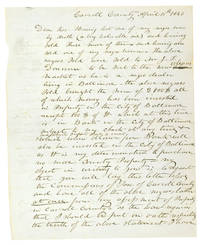
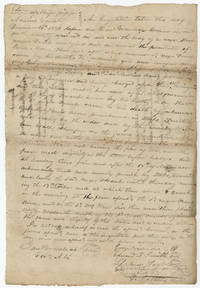
1848262219Carroll County Maryland 1848. 2 pp. pen and ink on signle sheet. 4to. Light creasing from prior folding. 2 pp. pen and ink on signle sheet. 4to. Reading in part: "Having lost one of my negro men by death a big valuable one and having sold three more of them and having also sold one of my negro women - the above negros were sold to Mr. Joseph S. Donovan to be sent to the New Orleans market as he is a negro dealer living in Baltimore - the above negroes sold brought the sum of $2800 all of which money has been invested in property in the city of Baltimore . My object in writing to you is to request that you will lay this letter before the Commissioner of Tax of Carroll County and have all of the above negroes taken at once from my assets .". unknown books
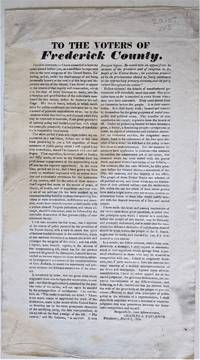
1833713Winchester Va. 1833. Broadside 4to. 290 x 160 mm. 11 ¼ x 6 ¼ inches.  Printed in two columns signed in type by Charles J. Faulkner at Winchester dated March 8 1833 at conclusion. Lightly dust-soiled pale stain affecting perhaps one-third of the left-hand margin and column of text. Neatly silked on verso. Withal about very good. Following the August 1831 Nat Turner rebellion in Southampton County a last effort was made by moderate Virginians to gradually abolish slavery. Faulkner a 26-year-old lawyer and assemblyman along with Thomas Jefferson Randolph sponsored legislation to free all children born of slave parents after July 4 1840. His speech emphasized the evil of slavery for Southern white labor noting that slavery "converts the energy of the community into indolence--its power into imbecility--its efficiency into weakness.Shall society suffer that the slave-holder may continue to gather his crop of human flesh" As the Assembly was malapportioned in favor of the Tidewater slaveocracy the proposal lost rather narrowly and nearly thirty years later the Confederacy was assured of Virginia's succession. It is perhaps not surprising that Faulkner "comparatively a stranger" to the county but a member of the Virginia House of Delegates at this time 1831-34 was not successful in his campaign to represent Virginia in the U.S. Senate. However Faulkner was elected to three terms in Congress from Virginia in the 1850s. He was elected to Congress from West Virginia after the Civil War. In the interim he served as Minister to France during the Buchanan administration and on the staff of Stonewall Jackson. Dictionary of American Biography.  Not in Hummel. Not found in American Imprints for 1833 and not in the 1830-1839 title index. OCLC records four copies at The Library of Virginia University of Virginia Virginia Historical Society and American Antiquarian Society. unknown books
28345Confidant of Missouri pioneer Jonathan Bryan 1759-1846 of the noted St. Charles family whose relatives included their neighbor Daniel Boone. DS 1p 7½" X 12" St. Charles County MO 1847 February 2. Near fine. Acknowledgment that Tuter who signs himself as "Administrator of the Estate of Johnathan Bryan" has had a writ of replevin made out and issued to the St. Charles sheriff Edward C. Cunningham 1809-65 for delivery to an unnamed offender. The writ seeks to recover the following property apparently wrongfully taken from Jonathan Bryan's estate: "one negro man a Slave named Heney one Two horse waggon and one pair of Briches Two Black horses one Lorrel horse with bold face one walnut Cupboard one clock one Bureau one bedstead and bedding one walnut Table one Trunk one Bible." In other words everything but the kitchen sink. Signed at the conclusion by Tater in his definitely untutored hand. Tales of slaves are found in the Bryan family lore such as: "Mrs. Jonathan Bryan a kinswoman of Daniel Boone was working in her yard with a slave woman when a boy slave screamed. She saw an Indian warrior heading for them with a tomahawk in one hand and a gun in the other. The women ran for the house. Just as they were slamming the door they caught the warrior's head and right arm between the door and facing. The slave woman grabbed the hatchet from his hand and killed him with a sharp blow. The women had barely recovered from their fright when the boy shouted again." Could the slave boy in this old family legend by none less than the "Slave named Heney" whose return is demanded in this replevin suit Quite unusual slavery item with an intriguing history. unknown books
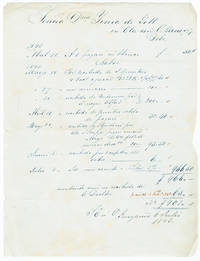
1843WRCAM55715Guayama Puerto Rico 1843. 1p. Quarto. Old folds a few short closed tears minor wrinkling. About very good. A record of a slave sale in Puerto Rico during the late Spanish colonial period. The document records various expenditures for "Senora Dna Yrma de Gott" for the spring and summer of 1843. Along with other expenditures from April to July 1843 the present manuscript document includes a line item from March 30 reading "recibido de Antonini por el negro Alfred." Apparently the señora received 200 Spanish dollars or pesos for Alfred the slave. The Spanish brought slavery to the island of Puerto Rico during the early colonial period. Slave labor fueled sugar production on the island reaching its peak in the early to mid-19th century. Slavery was finally abolished in Puerto Rico 1873 after years of slave revolts against Spanish colonial rule which began in 1868. Despite its long history of slavery records of slave sales from Puerto Rico are rarely encountered in the market. unknown books
1793106470<p>12 lines in brown ink with paper seal on sheet of paper 34x21 cm 13½x8¼". Signed by Thomas Hamilton clerk. Remnant of seal old folds with splitting along them normal aging and browning some offsetting very good overall. Amazing little document relating to the enforcement of Pennsylvania's groundbreaking effort to begin the abolition of slavery "An Act for the Gradual Abolition of Slavery" passed by the Pennsylvania legislature in 1780. The Act prohibited further importation of slaves into the state required Pennsylvania slaveholders to annually register their slaves with forfeiture for noncompliance and manumission for the enslaved and established that all children born in Pennsylvania were free persons regardless of the condition or race of their parents. Those enslaved in Pennsylvania before the 1780 law entered effect remained enslaved for life. The present document seems to reveal non-compliance with the law by Hugh Neilly in part: "I hereby certify on application of Ralph Cherry that a careful search hath been made by me among the Records of Negro's sic entered on the Records of Westmoreland County and that on such search it doth not appear that any Negro's hath been registered in the name of Peter or any other name as his property by Hugh Neilly of Westmoreland County aforesaid under the laws passes for the gradual abolition of slavery. Thomas Hamilton clerk." Docketed on the back "Certificate that no Negro's hath been registered in Westmoreland as the property of Hugh Neilly." </p> books
186062260Atlanta: Printed at the Daily Locomotive Job Office 1860. 47 pp. 1 vols. 8vo. Original blue printed wrappers. Wrapper a bit chipped else Fine. 47 pp. 1 vols. 8vo. Printed at the Daily Locomotive Job Office unknown books
1852100540<p>Letterpress braodsheet 10 3/4 x 6 1/4 text on both sides. Margins trimmed on both sides a little uneven on the left side close to words on reverse but not affecting text a few small stains in text. Indiana was for many years a site of refuge for escaping slaves. With this joint resolution the document declares that the only real way to do away with the injustice of slavery was to advocate emigration and colonialization of Africa.</p> books
184537320Havana 1845. Each document 8-1/2" x 12-1/2" entirely in ink manuscript with decorative official printed ornamentation at head of each and signature "O'Donnell" in the left margins. Some toning and a few holes not affecting text. Good. <br/><br/> Leopoldo O'Donnell y Jorris 1st Duke of Tetuán 1809-1867 was a Spaniard of Irish ancestry from Tenerife. He went to Cuba as Captain General in 1843 and later served three separate stints as prime minister of Spain. He approved each of these requests for travel. The named Cuban Slaves are of "Lucumi" ancestry originally from the Yoruba tribes of Benin and Nigeria. The documents all dated in October 1845 refer to the slaves Joaquin Garcia de Angarica and Florentino Armenteroy Regidor.<br/> These requests were made to transfer the slave from one hacienda to another for work purposes the terms of work engagement frequently stated here. unknown books
18562026Remedios 1856. About very good. 4pp. on a large bifolium. Printed form completed in manuscript. Separated at fold repaired with tissue. Light wear at edges. Light tanning and foxing. Rare Cuban population census form listing the number of residents in and around the town of Remedios located on the northern central coast of Cuba in 1856. The present document completed in manuscript lists the population according to various categories such as ethnicity and race age range occupations marital status location of residence and several others. The census includes slaves of African origin newly arrived Chinese indentured servants "colonos Asiaticos" immigrant laborers from Yucatan freedmen and free white residents "Blancos". In all there are just over 2000 people living in and around Remedios at this time comprising just over 1300 free whites over 300 free people of color 460 slaves and 19 Chinese laborers. One of the most interesting sections records the population by place of residence which shows that the great majority people in the area lived on estancias with a good part of the remaining population living on livestock farms and sugar plantations. On the final page are two additional sections which enumerate the types of property farms and other enterprises in the regions and provide statistics on agricultural and industrial production and land usage along with some manuscript notes with the signatures of the census takers or local magistrates. An interesting document of slavery agriculture and population in rural Cuba during the mid-19th century. unknown books
1834100531<p>Single small folio leaf printed on both sides. Faint creases whee originally folded probably removed modest aging and browning a couple of very small spots or stains; overall very good. Over forty years after William Wilberforce presnted evidence of the brutality of slavery to Parliament and following Thomas Clarkson's tireless efforts the crown finanlly put an end to salvery in the West Indies and her colonies. The act included a provision that all slaves above the age of six were to present themselves for apprenticeship. The crown also set aside 20 million pounds to compensate the slave owners who could retain their workforce for a modest sum.</p> Ordered by the House of Commons, books
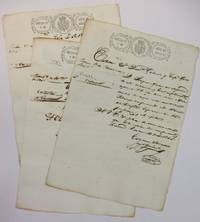
37208Each document a single manuscript page 8-1/2" x 12-1/2." Each with official stamp one also has a decorative illustrated green stamp at the head. Light wear and toning Good.<br/><br/> Each document names the slaveholder and the enslaved person granted "libertad" and the cost in escudos or pesetas of that liberty. The slaves liberated here are Saturnia "morenita criolla" age 14; Gabriela "esclava mulata" age 15; and Dolores "parda criolla" age 16. unknown books
1842313227Philadelphia: stereotyped by L. Johnson 1842. First edition. 140 pp. 1 vols. 8vo. Original brown ribbed cloth rebacked with original spine laid down titled in gilt. Marginal dampstaining throughout scattered foxing some wear to boards good. First edition. 140 pp. 1 vols. 8vo. First edition of this report of this monumental Supreme Court decision regarding escaped slaves preceding by 15 years and rivaling in importance the Dred Scott case of 1857. "In Prigg the Court identified slavery as a core constitutional commitment with which states could not interfere. In this case the Court struck down northern states' 'personal liberty laws' established to protect alleged fugitive slaves from recapture without due process of law. When the professional 'slave catcher' Edward Prigg tried to remove Margaret Moran an alleged runaway he was unable to meet the burden of proof set out by Pennsylvania's 1826 Personal Liberty Law and failed to obtain the legal certificate permitting him to remove her. When Prigg proceeded to ignore this and removed Moran illegally to Maryland Pennsylvania convicted him of kidnapping. The US Supreme Court however overwhelmingly overturned Prigg's conviction 8-1 and pronounced state laws interfering with the return of alleged runaways a violation of the Fugitive Slave Clause." Beaumont The Civic Constitution 2014 p. 128. Blockson 9905; Dummond p. 140; Sabin 61207 stereotyped by L. Johnson unknown books
1858WRCAM53597Charleston 1858. 16pp. Original printed wrappers. Spine perished held together with brass tacks; light chipping and soiling. Paper lightly and evenly toned. Good. Report submitted to the South Carolina Senate which concludes that slavery is essential to the agricultural production of the South. Additionally the committee felt that the slave trade helped relieve Africa from "the pressure of a redundant population as might be afforded by emigration in the only form in which its benefits can be extended to them." unknown books
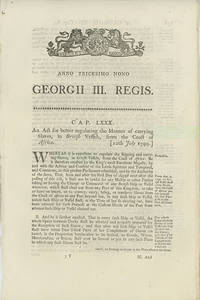
179928145London: Printed by George Eyre and Andrew Strahan Printers to the King's most Excellent Majesty 1799 1799. ESTC N60288 Lincoln's Inn Library and Wellcome Institute. Fine. 4to disbound paginated 637-652 untrimmed. An act passed by Parliament in the summer of 1799 delineated in 39 paragraphs that regulated the slave trade beginning in August 1800 - an act no doubt intended to placate the growing voices of opposition to the English slave trade. The act stipulates how many slaves could be stowed in a ship by mathematical formula according to the size of the ship but never more than 400; that slaves must be separated from other cargo; and that the space for the slaves "be full and complete perpendicular height of five feet." Nothing is said about their treatment other than that the ship's surgeon was required keep a log of illnesses and deaths of both slaves and crew. Much of the act is taken up with its enforcement and the penalties and fines for violations; it also regulates the conditions and treatment of the crew. The acts of Parliament were usually published separately and later issued in collections of the Public General Statutes; this one was issued as part of the collection of statues Passed in the Thirty-Ninth Year of the Reign of His Majesty King George the Third: Being the Third Session of the Eighteenth Parliament of Great Britain. This copy is disbound from such a volume. <br/><br/> (London: Printed by George Eyre and Andrew Strahan, Printers to the King's most Excellent Majesty, 1799) unknown books
1863101890Letterpress broadside 18 7/8" x 11 3/4" bold black type for highlighted words. Paper evenly toned some wrinkling considerable archival conservation and restoration with archival paper repair; despite the imperfections it is still a decent copy with a nice impression. This appears to fall into the political dirty tricks department in an election between John Brodhead and Henry Bumm for city treasurer in Philadelphia. The broadside is supposed to highlight a letter from John Brodhead to Jefferson Davis in 1860. It has strong racist overtones as Brodhead supposedly requests a position in Nicaragua so he can "help open it up to civilization and Niggers." He goes on to state he is "tired of being a white slave at the North and long for a home in the sunny South." These kinds of political tricks were not uncommon during the Civil War period perhaps that's still true today and the racist overtones would certainly not help one's chances in a Northern election. books
182122479<p>A Mississippi inquest holds a slave overseer accountable for killing a slave.</p> <b>SLAVERY.</b>Manuscript Document Signed by George Newman Edward T. Smith Sheppard Taylor Elijah Norman Hezekiah Kibbee David Collins and Daniel Greenleaf. Adams County Mississippi December 16 1821 1p. 8 5/8 x 12 3/8 in.<p><b><br /></b></p><p><b>Partial Transcript:</b></p><p><i>"the sd negro Frank came to his death by inhuman treatment and severe punishment in stocks starvation and lashes by the order and by the hand of William Wall.and so the sd Wm. Wall did then and there feloniously cause the death of the sd Negro Frank against the peace and dignity of the state and so we say all."</i></p> books
1728100536Pamphlet 8vo modern full calf in the style of an 18th century “Cambridge†binding 32 pp.Very slight aging; in excellent condition. This is a rare first edition of a work that presents a complaint by British planters in the West Indies concerning the Assiento or “agreement’ with Spain that gave Britain a virtual monopoly on the African slave trade. This agreement came out of the Treaty of Utrecht which ended the War of the Spanish Succession. This pamphlet indicates that the planters feared as a result of this agreement British slavers might be required to provide African slaves to the Spanish colonies which could result in insufficient numbers available for the West India plantations. The Assiento with Spain would mark the beginning of the Atlantic slave trade as a very powerful economic growth engine. Unfortunately this would translate into millions of Africans being taken from their homes. H. Whitridge unknown books