224 résultats
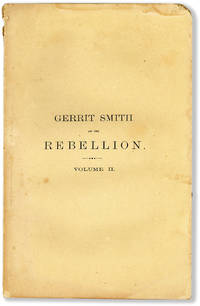
185633708Philadelphia 1856. 24pp disbound three small binding holes in blank left margin. Two early signatures of Wm. Thompson Shafer on title page. Light spotting throughout. About Good. <br /> <br /> This scarce pamphlet says the "great issue" is whether "Slavery shall be allowed to overspread a territory of greater extent than that of the whole United States" and "whether the policy of our government is to continue to be that of Slavery Extension or Slavery Restriction." All the power of the presidency is "being used to force the withering and blighting scourge of Slavery upon the National domain." Pursuing this tyrannical course our government "shall lend its aid in striking a deathblow to the freedom of speech the liberty of the press and the security for life personal liberty possession and peace." <br /> LCP 4300. OCLC 22829199 4- LCP No. IL U Haverford Detroit Pub. Lib. as of April 2017. unknown
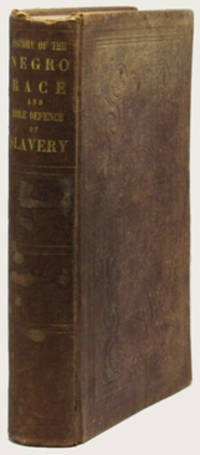
185234901Glasgow Kentucky: W.S. Brown 1852. Early edition being a reprint of the 1851 Louisville edition. Each page printed within a decorative chain-line frame the stereotyped title-page makes reference to engravings but none are called for in this edition. Tall 8vo in the publisher's original brown cloth the covers with decorative embossing retaining the emblem of the Louisville publishers in blind the spine lettered in gilt and with flat bands ruled in blind powder-blue endpapers. xiii 569 8 8 ads pp. A sound copy the text-block well preserved and complete a bit of expected age toning to the paper and light foxing here and there as usual the binding with some age-wear but still very sturdy strong and tight. ONE OF THE MOST NOTORIOUS PRO-SLAVERY BOOKS PUBLISHED IN THE UNITED STATES BEFORE THE CIVIL WAR. The author stylized himself as "the Rev. Josiah Priest" but was not ordained in any denomination.<br> The present Louisville text evolved from an earlier version titled "Slavery As It Relates to the Negro or African Race" published in 1843. It went through numerous editions and title changes during the 1840s and 1850s reflecting the growing sectional controversy over slavery. The popularity of the work exploded <br>in 1852 as it was viewed as a counter-argument to Stowe's pro-abolitionist epic UNCLE TOM'S CABIN.<br> The work's central claim is that slavery is fully sanctioned and approved of by the Bible. Among his arguments are: people of African descent were descendants of Ham and therefore subject to a divine curse; the racial differences were ordained by God; that slavery was beneficial or natural for Black people; and that abolitionism was a dangerous fanaticism threatening the social order and status quo.<br> Although repugnant to many modern readers the book is historically significant because it demonstrates how slavery's defenders tried to answer the growing abolitionist movement. The title also accurately states that the issue of slavery was going to divide the Republic thus predicting the Civil War. W.S. Brown hardcover
185723389.07<p><strong>Rare New York Senate Print of Proposed State Law to Combat the <em>Dred Scott</em> Decision</strong></p><p>"<em>Every slave … who shall come or be brought or be involuntarily in this state shall be free.</em>"</p><p>SLAVERY AND ABOLITION—NEW YORK STATE.</p><p>New York Senate. "An Act To secure Freedom to all persons within this State" Edward M. Madden April 9 1857 Passed the Assembly on April 17; failed in the Senate. Printed with numbered lines for the use of the Senate. 1 p. 6.5 x 11.5 in. </p><p><strong>Excerpts</strong></p><p>"<em>Neither descent near or remote from an African…nor color of skin shall disqualify any person for being or prevent any person from becoming a citizen of this state; nor deprive such person of the rights and privileges of a citizen thereof.</em>"</p><p>"<em>Every person who shall hold or attempt to hold in this state in slavery…under any pretence or for any time however short shall be deemed guilty of felony and on conviction thereof shall be confined in the state prison at hard labor for a term not less than two nor more than ten years.</em>"</p><p><strong>Historical Background</strong></p><p>In 1799 the New York legislature passed "An Act for the gradual abolition of slavery" that indentured and would eventually free slave children born after July 4 1799. In 1817 it passed a law freeing those slaves in 1827. But non-residents and part-time residents could still bring their slaves into the state temporarily.</p><p>On March 14 1857 New York Assemblyman Samuel A. Foot introduced resolutions declaring that the U.S. Supreme Court through its decision in <em>Dred Scott v. Sanford</em> "has in effect declared slavery to be national" and calling for the creation of a joint committee of three senators and five assemblymen to "consider and report what measures if any the Legislature of this State ought to adopt to protect the constitutional rights of her citizens." The resolution passed by a vote of 49-24 and the Senate concurred on April 2.</p><p>On April 9 Edward M. Madden introduced this bill in the Senate. Simultaneously Foot introduced this bill #24129 and three resolutions #23389.08 in the Assembly. Eight days later the Assembly with 81 Republicans 38 Democrats and 8 American Party members passed the bill 72 to 38. In the Senate with 17 Republicans 9 American Party members Know Nothings and 4 Democrats attempts to move the bill to the Committee of the Whole were evenly divided. Lacking the two-thirds majority required for this procedure the bill died.</p><p>Very similar language appeared in an 1859 bill which also failed; New York passed no new Personal Liberty Law during the decade before the Civil War.</p><p>The New York Senate had thirty-two members in 1857 so it is likely no more than fifty copies of this bill were printed for Senate consideration. We can find no evidence that any other copies have survived.</p><p><strong>Edward M. Madden</strong> 1818-1885 was born in Orange County New York and began work at a cotton factory at age nine. He worked as a merchant and then opened a saw factory in Middletown. He entered politics as a Democrat and was a delegate to the 1852 Democratic state convention. He joined the new Republican Party and served as a member of the New York Senate in 1856-1857 1872-1873 1875 and 1880-1881. He also served as a delegate to the 1864 and 1876 Republican National Conventions.</p>
1863101890Letterpress broadside 18 7/8" x 11 3/4" bold black type for highlighted words. Paper evenly toned some wrinkling considerable archival conservation and restoration with archival paper repair; despite the imperfections it is still a decent copy with a nice impression. This appears to fall into the political dirty tricks department in an election between John Brodhead and Henry Bumm for city treasurer in Philadelphia. The broadside is supposed to highlight a letter from John Brodhead to Jefferson Davis in 1860. It has strong racist overtones as Brodhead supposedly requests a position in Nicaragua so he can "help open it up to civilization and Niggers." He goes on to state he is "tired of being a white slave at the North and long for a home in the sunny South." These kinds of political tricks were not uncommon during the Civil War period perhaps that's still true today and the racist overtones would certainly not help one's chances in a Northern election.
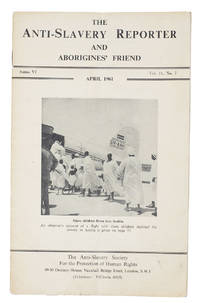
1961ABC_45244London: Anti-slavery and Aborigines Protection Society 1961. Original pictorial wrappers. Vol. 2 no. 7 April 1961. Pamphlet journal which includes obituaries articles reports news and reviews. Cover photo shows Nigerian children boarding a plane for Saudi Arabia where a story on page 73 states that they are to be sold as slaves to cover the costs of pilgrimage. A vertical crease some slight wear. Otherwise in good condition. Anti-slavery and Aborigines Protection Society, unknown
188452888Boston: Printed by the Order of the City Council 1884. First Edition. Small quarto 26.5cm; marbled paper over navy blue calf spine in seven compartments with six raised bands leather labels titling and decorative elements stamped in gilt on spine; marbled endpapers; engraved portrait frontispiece1011-70 with an additional 31 leaves bound in. Armorial bookplate of Walter Merriam Pratt on front pastedown. Re-backed with the original spine laid down; light wear to upper and lower board edges with some touch-up to leather at crown and heel; Very Good. A grangerized copy containing 22 ANS and ALS ca.1-4pp one autograph sentiment a 4.25" x 6.5" cabinet card signed by Phillips and several clipped portraits of various sizes depicting Phillips his wife and his son in uniform. Most prominent among the letters are those written to G.W. Putnam 6 H.G. Denny 2 R.L. Winthrop 2 John Boyle O'Reilly 1 and an October 8 1853 ALS to abolitionist and social reformer Gerrit Smith in which he claims to have mislaid his letter but is available to come to Brooklyn either on 15 December or 5 January 1854 and that his fee would be fifty dollars. Handsome volume memorializing American abolitionist and orator Wendell Phillips 1811-1884 commissioned by the City of Boston in an edition of 5000 copies. Nearly half the text is comprised of the eulogy by George William Curtis and includes extensive remarks by city council members and aldermen a prayer by Rev. Minot J. Savage an address by the Mayor and a poem by Mrs. Mary E. Blake. A proud son of Boston Phillips abandoned a career in law after being converted to the cause of abolitionism by William Lloyd Garrison in 1836. He was a frequent speaker at meetings of the American Anti-Slavery Society active in the free-produce movement a member of the Boston Vigilance Committee and an early advocate of women's rights. Later in life he turned considerable effort towards gaining equal rights for Native Americans and together with Helen Hunt Jackson and Massachusetts Governor William Claflin helped found the Massachusetts Indian Commission. cf.BAL 4347. Printed by the Order of the City Council unknown
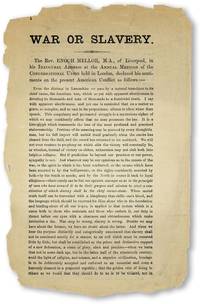
186346597Manchester: Union and Emancipation Society n.d. ca. 1863. First Edition. Original broadsheet handbill 22x13.5cm.; extremities chipped with shallow losses not approaching text the whole rather dust-soiled and unevenly toned else Good or better overall. Text reproduces an address delivered by the Rev. Enoch Mellor of Liverpool "in his INAUGURAL ADDRESS at the ANNUAL MEETING of the CONGREGATIONAL UNION held in London" in which he "declared his sentiments on the present American Conflict." Mellor 1823-1881 was the life-long minister of the non-conformist Square Congregational Church in Halifax West Yorkshire with the exception of a five-year period coinciding with this address when he succeeded the abolitionist Congregational minister Thomas Raffles 1788-1863. Mellor's argument begins with reference to the Lancashire Cotton Panic an economic depression caused by a dearth of baled cotton imports following the start of the American Civil War. Mellr goes on to say that "War /may/ be wrong slavery /is/ wrong" comparing its presence on the American continent with that of the propagation of polygamy "carefully and resolutely laid as a foundation-stone in the territory of Utah. Union and Emancipation Society unknown
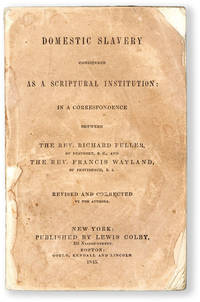
184554623New York: Lewis Colby 1845. First Edition. Wrappered Issue. 18mo. 15cm; original peach wrappers with titles printed in black on front cover; viii2541pp. Modest wear front wrapper split along lower half of front joint with shallow loss to right corners of same; old faint tide-mark along lower edge of textblock with creasing to upper and lower corners of first and last few pages; terminal blank present though lacking rear wrapper; Good. Uncommon wrappered issue of this significant debate between two 19th century Baptist leaders over the Bible's teachings on slavery which went through at least four subsequent editions between 1847-1860. "The chapters were originally letters published in a Baptist newspaper in Boston Massachusetts. Southern pastor Richard Fuller and Northern educator Francis Wayland were each able defenders of their respective positions. These men were also good friends who believed that a difference of opinion about slavery should not necessiatate a breaking of Christian fellowship. Unfortunately these two Baptist leaders proved naive in this regard. Just weeks after the publication of the correspondence in book form Fuller's Southern Baptist Convention broke away from the larger Baptist denomination and formed a new ecclesiastical body. A number of issues factored into the division though the slavery debate was what ultimately led to the creation of a separate Baptist denomination in the South" from the Mercer University Press edition 2008. SABIN 26170; LCP AFRO-AMERICANA 3944. Lewis Colby unknown
183384791Lexington KY: Abraham Skillman 1833. First Edition. First printing. 12mo 18.5cm; original brown cloth-covered boards; viii207pp. Respined to style with facsimile printed spine label; Bookplate of the Young Men's Christian Institute New Haven to front pastedown; bookseller's ticket Williams' Bookstore Under the Old South Meeting House Boston at base of front flyleaf; pencil signature faded and illegible to front endpaper. Complete sound and Good. <br /> <br /> One of a tiny number of pre-Civil War abolitionist texts to have been written by a Virginia author. Paxton 1784-1868 was a Presbyterian minister born in Rockbridge County Virginia and educated at Princeton Theological Seminary; it is likely his mentorship there under Charles Hodge helped develop Paxton's antislavery sentiments. In 1826 after publishing an essay asserting the institution of slavery to be incompatible with the teachings of the Bible Paxton was expelled from his pastorship of Cumberland Presbyterian Church near Farmville in south-central Virginia. The present text addressed to his former congregation recounts the events of his expulsion reprints the essay in question and adds a series of epistolary essays supporting his theological position in oppostion to slavery. <br /> <br /> The existence of any abolitionist sentiment during this period in Virginia's history is remarkable in itself. For a native-born minister to willfully preach the gospel of antislavery even the relatively conservative version of abolitionism professed by Paxton before a congregation whose sentiments on the subject would have been diametrically opposed - and which doubtless included a number of slaveholding families - must have amounted to apostasy in some congregants' eyes. By publishing the present work Paxton essentially doubled down on his unpopular beliefs making him in this cataloguer's eyes a rather remarkable figure. We find it surprising that so little biographical information exists regarding Paxton. His name barely appears in the scholarly literature on the period; perhaps because no mention of abolition is made in either the title nor the sub-title of his book the work is rarely discussed in articles on the antebellum southern antislavery movement. Though reasonably available institutionally Letters on Slavery is perenially scarce in commerce having appeared at auction only three times in the current century. This a quite decent copy in a discreetly restored binding. SABIN 59264. DUMOND Antislavery Bibliography p.89. LCP AFRO-AMERICANA 7501. Abraham Skillman unknown
186581012New York: American News Company 1865. First Edition. First printing. Octavo. Sewn printed wrappers; 76pp. Brief closed tear to title page margin; bit of wear at upper fore-corner of text block well away from text else a clean fresh copy in the original printed wraps; Very Good or better. Includes text of letters written to various colleagues in the antislavery ranks including Elizabeth Cady Stanton Charles Sumner and others. The first volume taking in the year 1863 was printed a year earlier. SABIN 82664. American News Company unknown
198115264Princeton: Princeton University Press 1981. First Edition. Octavo. Cloth boards; dustjacket; 262pp; Removed from a non-circulating private library with ink ownership markings to front flyleaf and accompanying black ink elisions from de-accession on front endpaper. Very mild rubbing to jacket; else clean and unmarked copy. Princeton University Press unknown
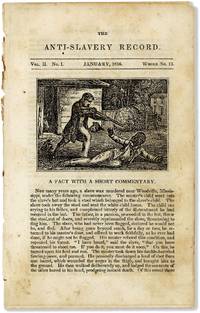
183682919New York: American Anti-Slavery Society 1836. 12mo 19cm. Stitched self-wrappers; pp.1-12. Removed; first and final leaves detached but present; light soil scattered faint foxing; tear to bottom inch of bound edge away from text; complete and Good. Woodcut decoration at head of text a strikingly violent image depicting the murder of a Black man by his enslaver in Woolville Mississippi.<br /> <br /> Single issue of this monthly abolitionist periodical that ran from 1835 to 1837 published by the American Anti-Slavery Society under the direction of Elizur Wright. It was "a small magazine with excellent woodcuts containing principally extracts from other publications" that was "distributed freely without charge" and "found its way into the schools and colleges everywhere" Dumond p.267. Wright stated that in September 1835 the Society published 25000 copies of the Record p.267. BLOCKSON 9174. LCP AFRO-AMERICANA 622. American Anti-Slavery Society unknown
186063532New York: Published and for sale at 5 Beekman Street 1860. First Edition. 12mo. 20th-c. binding of tan calf over paper-covered boards; marbled page edges; 951pp. About fine and complete; the pamphlet appears to have been offered without cover wrappers in any case not noted by Blanck.<br /> <br /> Uncommon first edition of this late tract by the important abolitionist and feminist Lydia Maria Child 1802-1880. Child's intention with this work was to make a direct case to southern slaveholders based not on any moral grounds but purely on business hoping that the Caribbean example would convince southerners that abolition could be achieved without wrecking their economy. "Child suggested to Samuel B. May the publisher .that the title page omit any mention of the American Anti-slavery Society giving only an address but no publisher. She even considered issuing the tract anyonymously but decided that her notoriety would probably help rather than hinder its circulation" see Karcher The First Woman in the Republic: a Cultural Biography of Lydia Maria Child. Durham 1994; p.428ff. Blanck notes two editions in 1860 as well as a reissue in 1862; this with verso of the final leaf unprinted is the first. Rarely encountered in commerce. BAL 3189. Published and for sale at 5 Beekman Street unknown
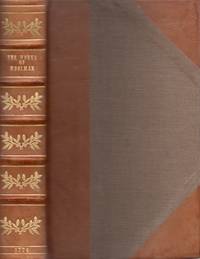
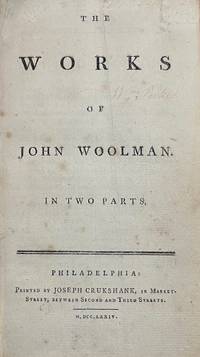
177434482Philadelphia: Joseph Crukshank 1774. First Edition. Three-quarter leather. Good. Octavo. 1 xiv 2 436 pages 1. Rebound in three quarter leather with tan cloth covered boards. Raised bands gilt decorations and title on the spine. Two title pages but continuos pagination. Inscription by the previous owner on the front blank end sheet. Front blank end sheet has some holes upper corner partly affecting the inscription. Moderate toning to the contents. Small worm hole lower back foredge not affecting the text. Pages 407-428 also has a small worm hole top edge not affecting the text. Chapter in part 2 pages 279-311 is titled "Considerations On the Keeping of Negroes."<br /> <br /> This first edition was published after the death of Woolman 1720-1772. Several later editions have been published. John Woolman was a Quaker minister and early abolitionist. He traveled to England in 1772 to promote the abolition of Slavery but died soon after arriving in England. He is buried in York. <br /> <br /> <br /> Howes W 669; Sabin 10524. Joseph Crukshank unknown
177435034Philadelphia: Joseph Crukshank 1774. First Edition. Leather bound. Fair. Octavo. 1 xiv 2 436 pages 1. Polished calf leather covers. Chipped title on the spine. Missing a section of leather bottom spine and another section is coming loose. Front cover is detached. Text lightly toned with scattered light brown stains. <br /> <br /> Two title pages with continuos pagination. Chapter in part 2 pages 279-311 is titled "Considerations On the Keeping of Negroes." This first edition was published after the death of Woolman 1720-1772. Several later editions have been published. John Woolman was a Quaker minister and early abolitionist. He traveled to England in 1772 to promote the abolition of Slavery but died soon after arriving in England. He is buried in York. <br /> <br /> Howes W 669; Sabin 10524. Joseph Crukshank unknown
186135341Philadelphia: William W. Moore 1861. Hardcover. Fair. Quarto. 1 viii 832 pages. Marbled paper covered boards with leather corners. Leather spine with title. The boards are very worn. Most of the paper on the back cover is missing. Leather spine is rotted dried and cracked. Light toning and scattered foxing to the contents. Last few pages are damp stained and soiled. Fair only. <br /> <br /> Contents include 52 issues covering parts of 1860 and 1861. Article headings include Africans in Key West recaptured from the Slavers; Cotton Spinning; The Slave Trade; A Journal of the Life of John Gratton; Thoughts on Emigration; Origin and Introduction of Railroads Into America; Slave Statistics; and much more. William W. Moore hardcover
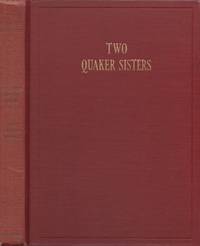
193736016New York: Liveright Publishing Corporation 1937. First Edition. Hardcover. Fair. Octavo. xxx 1 Burgundy cloth hardcover with gilt title on the front cover and spine. Frontispiece photograph of the two sisters. Illustrated. Map illustrated front end papers. Genealogical chart for "Arnoll Buffum m. Rebecca Gould." on the rear papers. Light shelf and edge wear to the hardcover. Interior contents clean. <br /> <br /> Inscribed by the author on the half title page: "To Winthrop W. Aldrich With my very sincere regards Malcom Read Lovell 1937. Contents include anti slavery reminiscences by Elizabeth Buffum Chace pages 110-183. Liveright Publishing Corporation hardcover
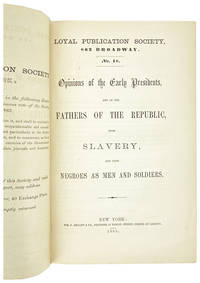
186330221New York: Wm. Bryant & Co. Printers 41 Nassau Street Corner of Liberty 1863. Very Good. New York: Wm. Bryant & Co. Printers 41 Nassau Street Corner of Liberty 1863. First Edition. Octavo. 19 pp. Printed wraps. Housed in more recent marbled paper wraps with brown backstrip staples noticeable beneath. Abrasions and glue remnants to front wraps with loss to text; light creasing to edges; a few smudges. Binding sound and interior unmarked; Very Good. Includes excerpts from Presidents Washington to Jackson as well as quotations from Benjamin Franklin John Jay and Alexander Hamilton.<br /> <br /> Sabin 57406. Wm. Bryant & Co., Printers, 41 Nassau Street, Corner of Liberty unknown
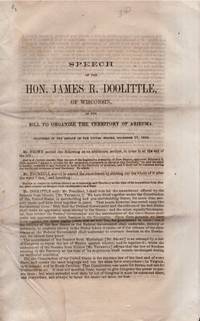
186035032Washington D.C.: W.H. Moore Printer 1860. First Edition. Wraps. Good. Folded uncut wraps. 16 pages. A single sheet of paper 24" x 19" printed on both sides with 8 folds. Light damp stain and toning to the contents. This speech centers around the debate of allowing Slavery in the western territories. W.H. Moore, Printer unknown
178940544Hempfield Westmoreland County Pennsylvania 1789. Folio leaves folded to oblong 7.5" x 9." Plain wraps with manuscript title detached but present. 44 pp including: 1-title 35 hand-paginated with entries 1-tally page and 1-assessors' certification 6 blank. Toned some splitting along spine folds light chipping at edges. Good. <br /> <br /> In March 1780 Pennsylvania enacted "An Act for the Gradual Abolition of Slavery" requiring "That all persons as well Negroes and Mulattoes as others who shall be born within this state from and after the passing of this act shall not be deemed and considered as servants for life or slaves; and that all servitude for life or slavery of children in consequence of the slavery of their mothers in the case of all children born within this state from and after the passing of this act as aforesaid shall be and hereby is utterly taken away extinguished and for ever abolished." Persons born in Slavery before the date of the Act would remain as slaves. <br /> This inventory of taxable property is a Who's Who of Hempfield Township in western Pennsylvania consisting of an alphabetical list of the heads of households for the township. Each entry includes the number of servants under columns headed "Negro & Mulatto Slaves" or "Negroes"; land by deed warrant or location; improvements; number of horses horned cattle mills stills houses/lots and outlots; and value of the property in pounds shillings and pence. <br /> Several entries have "Single Man" written across the first few columns. The total taxable property in this return is £12850.3.9. Five entries have a "1" under the "Negroes" column including: William Perry Esq.; James Guthry who notes F 30; Alexander McDowall; David D.P. Marchant; Christian Rhodabough who notes 1-30. Other entries have an "X" in the "Negroes" column. The assessor is listed on the last page as Robert Flemman; Robert McKee 1771-1850 and Robert Taylor are his assistants.<br /> "Hempfield's early settlers were Germans from southeastern Pennsylvania. The name Hempfield was taken from Hempfield Township in Lancaster County which was formed in 1729 as an English place name. Hempfield Township in Lancaster County derived their name from the production of hemp. In 1818 Lancaster County divided Hempfield Township into East and West Hempfield. The settlers from Lancaster County that came to this area gave the same name to our Township where some of the early settlers had resided. Agriculture was the base for the settlers in the early days. The Township was known for the stills and distilleries where farmers refined the substantial grain output." "Naming & Establishing Hempfield Township" accessed at official website of Hempfield Township 25 February 2025. <br /> Two notable individuals listed are Henry Aleshouse 1757-1837 and Michael Huffnagle 1753-1819. Aleshouse was Captain of the Continental Army from 1776-1780 and prisoner of war during his service; Major in the Pennsylvania Militia in 1783; member of the Pennsylvania State House of Representatives from 1802-1805 1812-15 1817-1818; and Pennsylvania State Senate from 1819-1826. Huffnagle was prothonotary for Westmoreland County Captain in the 8th Pennsylvania Regiment during the Revolutionary War one of the first lawyers admitted to the Westmoreland County bar Judge of the Court of Common Pleas Clerk of the Court of Quarter Sessions and Clerk of the Orphan's Court and Agent for Forfeited Estates. <br /> Of the slave owners Dr. David Marchant Marchand 1746-1809 was a Captain in the American Revolution local doctor and founder of the first hospital west of the Allegheny Mountains; William Perry Esq. 1745-1793 was a sheriff of Westmoreland County from about 1777-1789 Treasurer of Westmoreland County from 1783-1788 County Sheriff in 1779 and Captain of a company of rangers with the Westmoreland Militia.<br /> Some of the surnames listed are: Alesworth Aultman Berger Brisby Beer Barnheart Bell Campbell Condon Cough Crookshank Clingahsmith Davison Errit Fullerton Jenkins Kimble McCurdey Russell Robison Shotts Shull Taylor Turner Wagley Waterson Yokey and others. unknown
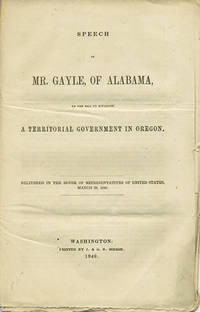
184837646Washington D.C.: J. & G.S. Gideon printers 1848. First edition. Removed. A very good unopened uncut and intrimmed copy with a mail fold. 14 pp. 8vo. Against Oregon admittance over the slavery issue: "The position I shall assume and attempt to maintain is that Congress has no power to organize what is called a territorial government by ordinance or otherwise; nor has Congress the power to pass laws for the people of the territories of the United States.The speech of the honorable member from Ohio Mr. Root delivered on the 15th of the present month. That speech breathes nothing but hostility to Southern institutions. It was uttered in a tone of defiance and in such language of menace as left the impression that the honorable speaker thought that empty threats were quite sufficient to intimidate what he was pleased to call “Southern chivalry.What does the gentleman from Ohio mean by this haughty and vainglorious boasting Does he think that the South are to be frightened from their duty to their country and themselves by these empty menaces The proposition to exclude slave labor from the territories of the United States is a proposition to degrade the slave States—to render them inferior to the free States."<br /> <br /> John Gayle 1792-1859 "was Alabama's seventh governor and also served as a U.S. congressman state legislator and jurist. Gayle was a fervent champion of states' rights and his advocacy laid the foundation for that movement in Alabama in the 1850s and for the realignment of state political parties." Sarah Woolfolk Wiggins: John Gayle Encyl. of Alabama. Sabin 26798. J. & G.S. Gideon, printers unknown
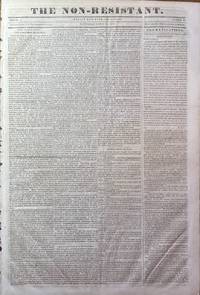
183936794Boston: N. E. Non Resistant Society 1839. Newspaper. Very good. Newspaper. 4 pages. Complete. Approximately 11.75" x 17". Slightly irregular at the blank spine. <br /> <br /> Several articles and letters inside pertaining to "Consequences of War" with Great Britain and other similar pieces. This paper was also an anti-Slavery paper. <br /> <br /> From wikipedia: The New England Non-Resistance Society was an American peace group founded at a special peace convention organized by William Lloyd Garrison in Boston in September 1838.1 Leading up to the convention conservative members of the American Anti-Slavery Society and the American Peace Society expressed discomfort with Garrison's philosophy of "non-resistance" and inclusion of women in public political activities. After conservative attendees opposing Garrison walked out of the convention in protest those remaining formed the New England Non-Resistance Society.citation needed<br /> <br /> The Society condemned the use of force in resisting evil in war for the death penalty or in self-defense renounced allegiance to human government and because of the anti-slavery cause favored non-union with the American South.citation needed The New England Non-Resistance Society was one of the more radical of the many organizations founded by William Lloyd Garrison adopting a Declaration of Sentiments of which he was the principal author pledging themselves to deny the validity of social distinctions based on race nationality or gender"2 refusing obedience to human governments and opposing even individual acts of self-defense.3 In the Society's Declaration of Sentiments Garrison wrote "any person without distinction of sex or color who consents to the principles of this Constitution may become a member and be entitled to speak at its meetings."1 The Society rejected loyalty to any human government; one historian has described the Non-Resistance Society's "basic outlook as that of philosophical anarchism".45. N. E. Non Resistant Society unknown
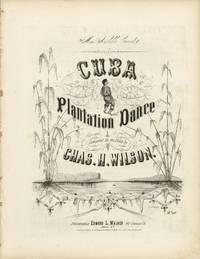
1855List3682Philadelphia: Edward L. Walker 142 Chestnut St. above 6th 1855. Folio sheet music pictorial lithographed cover approximately 13.5 × 10.5 inches. Light edge wear and minor toning; very good with a strong impression of the cover illustration. An antebellum piano dance reflecting the plantation imagery that circulated widely in mid-nineteenth-century American popular music. “Cuba Plantation Dance†was composed by Chas. H. Wilson a little-documented composer whose name appears chiefly in connection with this work and issued in Philadelphia during the early 1850s by Edward L. Walker the predecessor firm to the major publishing house Lee & Walker. A copy is recorded in the Levy Collection at Johns Hopkins which dates the publication to 1855.<br /> <br /> The cover presents a stylized plantation landscape framed by tall stalks of sugar cane with a small central vignette of a dancing Black figure. The use of Cuban plantation imagery reflects contemporary American fascination with the Caribbean sugar economy and with plantation life beyond the United States. During the 1850s Cuba was one of the largest slave societies in the Atlantic world. By the midcentury the island’s sugar plantations relied on hundreds of thousands of enslaved Africans and the enslaved population of Cuba was estimated at roughly 400000 people in the 1840s–1850s working primarily in the rapidly expanding sugar industry. Although Spain formally agreed to end the Atlantic slave trade in 1820 illegal importations of enslaved Africans into Cuba continued for decades supplying labor for the island’s plantations well into the 1850s. American publishers frequently borrowed such imagery for plantation-themed dance music marketed to the parlor trade. Pieces labeled “plantation dances†or “Ethiopian dances†formed part of the broader culture of minstrel and plantation entertainment. The title page bears a dedication to “Miss Arabelle Conrad†typical of mid-century sheet music addressed to amateur pianists. Along with the aforementioned copy in the Levy collection we find copies at Michigan and Temple. Edward L. Walker, 142 Chestnut St., above 6th unknown
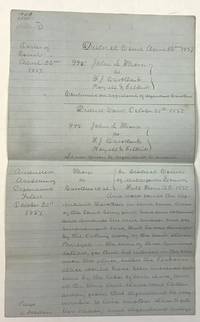
185740346Matagorda County Texas 1857. Six pages in neat ink manuscript on lined pale blue legal paper. Fine. The document is probably the record for Carothers' appeal of the Court's judgment in favor of Thorn.<br /> <br /> The parties having waived a jury trial the Court found in favor of Thorn the Plaintiff. In addition to the failure to pay Thorn for the hire of Taswell Thorn claimed that Carothers had failed to pay $100 rent to Thorn for farming on Thorn's property. <br /> Carothers said that the slave Bridget upon whom Carothers had relied for performing work on the property had been "taken away" apparently by Thorn during the term of the agreement. Bridget's absence Carothers said caused his nonperformance and thus excused his failure to pay. The Court disagreed and ordered Carothers to pay the amount of the notes plus costs and interest. unknown
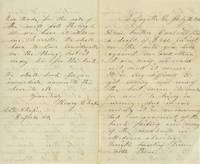
1861Cat338Lafayette Ohio 1861. Autograph letter signed 2 pp. Addressed to D. T. Chapin of Enfield Connecticut. Good condition with normal folds and light wear. A concise but revealing early Civil War letter combining financial anxiety agricultural reporting and clear-eyed political commentary on slavery and the future course of the conflict. Writing amid the first months of the American Civil War Chapin opens with the immediate purpose of the letter—forwarding “a draft of $240 for int. on the noteâ€â€”before situating the payment within a deteriorating economic landscape: “It is very difficult to get money now even of the best men.†He describes a local economy under strain noting “no market for wool to bring in money†compounded by regional instability “on account of the bank failing and many of the merchants in Medina closing†concluding bluntly: “Terrible bursting times with them.†Even the act of sending funds carries uncertainty as he cautions that “in these times I consider there is a risk in the best of banks.†Alongside these concerns Chapin provides a snapshot of agricultural conditions: “Corn is very backward and short wheat nearly middling grass rather below middling†summing up the situation as “rather tight times as well as troubled times.â€<br /> <br /> The most significant portion of the letter however turns to the war itself and the unresolved question of slavery. He writes:<br /> <br /> “We hope the end will be well but our nation will have to be humbled. It is well to put down rebellion but it is rather queer that the cause of the trouble must be let entirely alone. The nation will get their eyes open after a while. The President possesses the war power to abolish slavery and Congress possess the power also in my humble opinion and the time will come when they will have to do it unless the south run their heads so hard against the rock as to do it themselves.â€<br /> <br /> The letter closes with a brief note on a failed business transaction—“our trade for the sale of the mill fell throughâ€â€”underscoring the economic uncertainty of the moment before returning to family matters. Overall an evocative early Civil War letter by a merchant expressing fears and anxiety for the pending conflict. unknown