[Slavery]: [United Kingdom]Biblio.com
224 résultats
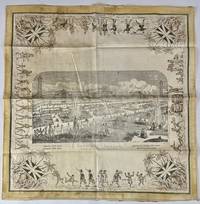
189012893N.p. likely London 1890. Lithograph on silk handkerchief approximately 24 x 24 inches with additional lithographed scene printed around the outer margins in brown and blue ink. Previously matted and framed with resultant edge wear and adhesive staining around margins. Old folds some foxing and staining in image area. Overall good plus condition. A very rare and impactful 19th-century British lithograph-on-lithograph the original a view of London's Crystal Palace with the addition of a satirical scene detailing the history of British colonialist activities in Africa. The overall scene is presented in four linear parts one across each mostly blank margin of the Crystal Palace scene; interestingly the two lithographs overlap each other at a few places along the short edge. The scene seems to begin with the part labeled "African Slave Trade" picturing two slave traders leading a chained procession of African slaves men women and children. The next edge is labeled "The Rescue" and shows three British soldiers including one bagpiper freeing the slaves who are pictured free of their chains and dancing and now detaining the two slave traders in chains. <br /> <br /> The third panel pictures two groups of Africans -- one group running to a rum dealer and another group listening to a man holding a book presumably a missionary preacher. This scene seems to allude to British activities in the West Indies. The final panel labeled "Civilization" is the most varied. It pictures a couple of British railway agents under the banner "Change for Timbuctoo;" a group of African men in Western garb one holding a sign reading "African Times;" an African man riding a bicycle; and a family scene of a man kneeling in front of a seated woman while he kisses her hand and a young man in the background sells matches. How civilized indeed. Each corner of the work is emblazoned with a British lion and the Union Jack amidst a field of African foliage and West Indian palm trees. The scene seems to celebrate the effects of British colonialism while ignoring the country's own history as slaveholders and traffickers the previous century.<br /> <br /> "The border panels of this printed cotton handkerchief caricature the impact of British colonial policy on Africa. It was probably produced at the end of the 19th century at a period when European colonial rule led to increasing social and political intervention in African societies. It illustrates the rescue of a group of slaves by a British military detachment and their subsequent 'westernization' through the introduction of European goods and commodities." This description comes from the online description of the only other example of this scene we can find which resides at the National Maritime Museum NMM at Greenwich London. The NMM example is printed on a blank cotton handkerchief in brown and red and is slightly smaller on one side than our example. Their dating is likely correct if for nothing else because of the depiction of a chain-driven bicycle which became popular in the UK in the 1890s. unknown
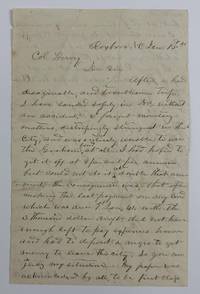
18605563Roxboro N.C.: January 15 1860. Good. 2pp. Wrinkled previously folded. A few minor losses at folds not affecting text. Two half-inch closed tears from edges. Light toning and foxing. After arriving in Roxboro North Carolina in mid-January 1860 planter J.C. Barnett writes to his friend and business partner a Colonel Henry to complain about the tight money situation in the state which has forced him essentially to pawn a slave in order to raise cash: "I found monetary matters distressingly stringent in the City and was entirely unable to use the Graham bond at all. I had hoped to get it off at 8 per cent per annum but could not do it at double that amount the consequence was that after making the last payment on my land which was due 1st Jan 61 with the 3 thousand dollar draft I did not have enough left to pay expenses home and had to deposit a negro to get money to leave the city. So you can judge my situation." Furthermore he has other unpaid debts that he hopes to settle with future cotton sales: "I gave R.H. Williams a draft for 93 dollars also Messrs Lea & Cheatham of Louisville one for 111 dollars and owing to the circumstances just mentioned was unable to meet them. You will do me a favor when you see these gentlemen to explain the reason. When you sell my cotton after paying Mr. Batt and yourself the expenses if there is a remainder please apply it to my Louisville and Williams debt. Also Mr. Gratiot has a claim of an hundred dollars. I will write to these gentlemen and tell to apply to you when you sell my cotton." Interesting detail on economic difficulties in the south just prior to the Civil War. January 15 unknown
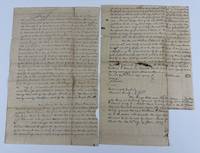
18393013Washington D.C. 1839. Fair. 3pp. Large folio. Separated into six pieces with a very small section of the final attestation lacking altogether. Still highly readable. A wounded but important document. A rare and historically-important document relating to slavery in the District of Columbia which was outlawed on April 16 1862 nearly nine months before the issuance of the Emancipation Proclamation. The present document is an indenture made between William G. Howison and Alexander Hunter Esquire both citizens of Washington D.C. associated with property conveyed to Hunter by the deceased Joseph Birch. In 1824 Birch conveyed to Hunter land "and also a negro man slave for life named Lewis - another named George - two horses - 4 cows - 3 calves." The document indicates that Lewis was subsequently sold for four hundred dollars and George was sold to Birch in his lifetime. Documents recording the movement of slaves within the District especially among two citizens of the city are rare in the market. unknown
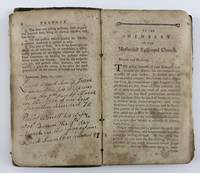
18353546Southampton Va 1835. Fair. 8pp. of manuscript plus a loose sheet of manuscript measuring 12.5 x 4 inches written within a book on family medicine. Book disbound lacking title page and first text leaf some gatherings and leaves loose or detached. Some age toning to manuscript leaves. A unique manuscript family genealogy for the Worrell family of Virginia as recorded by several hands in the margins and blank portions of two middle pages and on a few terminal and end leaves of a contemporary copy of a sammelband of two early American imprints -- The Family Adviser 1793 and John Wesley's Primitive Physic 1795 revised and corrected and on a single folded sheet folded and laid into the book. The entries within the book detail the births of the children of Josiah and Alice Worrell and sometimes their in-laws. An example of the former: "Lewis Worrell Son of Josiah Worrell & Alice his wife was born March 7 / 1774." And an example of the latter: "Polley Worrell wife of the said Lewis Worrell was born March the 9th / 1781." The entries continue much the same with the latest-dated entry reading: "Benj. Eldridge Worrell Son of Lewis Worrell & Temperance his wife was born June 21st 1835." Sometime presumably in the 1790s a member of the family also listed out a long accounting of the births of Josiah Worrell's children on a longer piece of paper folded into the present work. Titled in manuscript "Ages of Josiah Worrell's children" this sheet again begins with Lewis Worrell and lists a total of six members of the Worrell family.<br /> <br /> Most interestingly the bottom of this sheet also contains the births of four family slaves. This listing reads as follows: "Negro Ages. Ben was born the 8th day of June 1783. Solomon was born Dec. 20th 1785. Simon was born Feby. the 14th 1790. Isam was born the 20th Dec. 1792." The inclusion of the birth dates of four slaves is highly unusual in a family record of this type but remains valuable information on the lives of these four enslaved men owned by the Worrell family. unknown
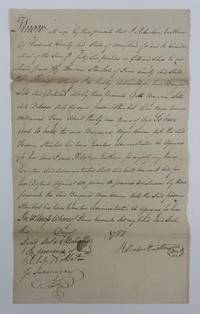
17884111Frederick County Md: March 7 1788. About very good. 1p. folio docketed on verso. Old folds short splits along a couple of fold lines minor toning. An impactful manuscript document from the early national period in Maryland formalizing the sale of a slave woman in Frederick County. The sale was made by Robertson Eastburn whose family emigrated from England to Maryland in the early 18th century. The document reads in part: "In consideration of the sum of forty six pounds in Gold and Silver to me in hand and paid by Frederic Strombol.I do hereby Acknowledge have Bargain'd Sold and Delivered and by these presents doth Bargain Sell and Deliver Unto the said Frederic Strombol One Negro Woman named Torry about thirty years of age To Have and to hold the said Bargained Negro woman unto the said Frederic Strombol."<br /> <br /> Slavery in Maryland lasted over 200 years from its beginnings in 1642 when the first Africans were brought as slaves to St. Mary's City to its end following the Civil War. In 1664 under the governorship of Charles Calvert 3rd Baron Baltimore the Assembly ruled that all enslaved people should be held in slavery for life and that children of enslaved mothers should also be held to the same standard of law. 19th-century American slave sale documents are growing increasingly scarce in the market. March 7 unknown
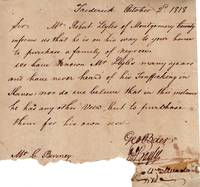
181812956Frederick MD: October 2 1818. 1p. docketed on verso. Roughly torn along bottom edge minor foxing and spotting. Good condition. An uncommon document in Maryland slave history in which George Baer the future mayor of Frederick and a few other men attest that another local citizen named Robert Lyles is not a slave trader. The document reads in part: "Lyles is on his way to your house to purchase a family of negroes. We have known Mr. Lyles many years and have never heard of his Trafficking in Slaves nor do we believe that in this instance he has any other view but to purchase them for his own use." Baer served as mayor of Frederick from 1820 to 1823; his correspondent "C. Burney" is perhaps Clotworthy Birney 1765-1845 a farmer and real estate trader living near Taney Town. An unusual Maryland slave document concerning a slave owner who just wants to buy slaves for his own use not traffic in them because that's somehow better. October 2 unknown
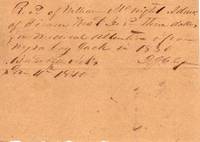
184012966Batesville AR: January 11 1840. 1p. 4 x 5.5 inches docketed on verso. Old horizontal fold toning. Very good. An interesting manuscript record of slave care in Arkansas in the 1830s. The short but impactful document reads in full: "Recd of William McNight Admin. Of Hiram West Decd three dollars for medical attention upon negro boy Jack in 1836. Batesville Ark. Jan 11 1840 DJ Chipman." Such documents are increasingly rare in the market and more uncommon than slave sale documents from the same period. Arkansas has just achieved statehood four years before the presetn document was written. January 11 unknown
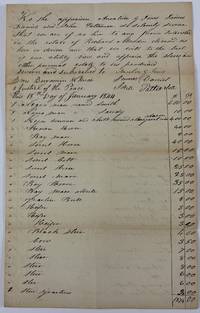
184413105St. Genevieve County MO: January 18 1844. 4pp. on a single folded sheet. Original folds minor wear. Very good condition. A sobering manuscript inventory from the estate of Richard Maddin following his death in Missouri in 1843 detailing his "slaves and other personal" property. The inventory begins by listing the enslaved persons by name along with an assignation of value for each of them as such: "1 Negro man named Smith $600. 1 Negro man named Sandy $10. 1 Negro woman and child named Margaret and Jason $400." The inventory then goes on to list the other property beginning with a long list of livestock followed by equipment household goods and so forth. The document is certified and witnessed by a number of local citizens who attest to the "full and perfect inventory of the goods chattles and personal estate" of the deceased Mr. Maddin. The reasoning is unclear why the second listed slave Sandy was worth only $10. January 18 unknown
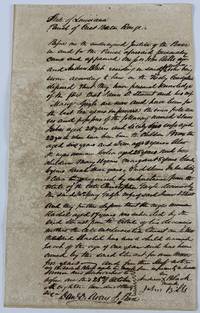
183613107East Baton Rouge Parish LA: October 25 1836. 1p. on a single folded sheet integral blank docketed on verso. Old folds moderate toning and foxing short closed tear along one fold line a few small instances of ink burn. Overall good condition. An interesting document of legal testimony involving numerous named slaves in Louisiana in 1836 ranging in age from one year to almost thirty years of age and including seven children. According to the docketing the document is effectively a "Title to Slaves." The deponents were two local citizens John Bills and Andrew Black who had "personal knowledge of the fact that James D. Stuart and his wife Mary Gayle are now and have been for the last ten years & upwards the bona fide owners and possessors of the following named slaves: Juba Aged 25 and Sicily his wife aged 22 to whom have been born the children Braxton aged six years and Dan aged 3 years. Also the negro woman Celia aged 28 years and her children Mary 11 years Margaret 8 years Charley 6 years Sarah three years which slaves Juba Sicily & Celia were acquired by inheritance from the estate of Christopher Gayle. And they further depose that the negro woman Rachel aged 17 years was inherited by the said Stuart from the estate of his deceased mother.and that the said Rachel has now a child named Jacob of the age of one year." The document is signed by Black Bills and the Justice of the Peace Daniel D. Avery. Documents involving slave inheritance of and subsequent ownership by not one but both members of a marriage are exceedingly rare. October 25 unknown
186413103Quincy FL: January 1 1864. 1p. of manuscript docketed on verso. Old crease minor staining. Very good. A short but impactful and somewhat unusual document memorializing the inheritance of a young slave named "Anderson aged about twenty years" from a Florida estate in the penultimate year of the Civil War. Anderson was formerly owned by Daniel Love of Gadsden County and is here inherited by "John Shaw for Margaret E. Shaw" by Love's executor and likely brother Edward Love. The document is dated New Year's Day 1864. An unusual occurrence of a Florida slave being transmitted to a woman through inheritance. January 1 unknown
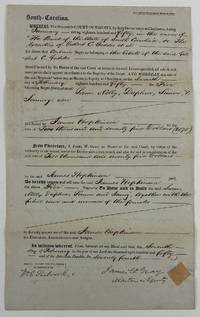
185012963Charleston SC: Printed by Walker & Burke February 7 1850. Partially-printed document completed in manuscript 13 x 8 inches. Old folds minor toning and offsetting. Very good. A very rare pre-printed form from antebellum South Carolina designed specifically for documenting the sale of slaves in Charleston in the mid-19th century. The document emanates from the Court of Equity and directs the estate of Gilbert C. Geddes to sell five named slaves to James Hopkinson for $2075. The names of the slaves are Sam Nelly Daphne Simon and Jenny. The document is signed by James W. Gray Master in Equity in the case of "Bank of the State of South Carolina vs. the Executrix of Gilbert C. Geddes et al" and by William E. Seabrook as witness. Gray adds a particularly insidious note near the bottom of the document when he writes that Hopkinson is entitled to "have and hold" the aforementioned five slaves "together with the future issue and increase of the females." Geddes 1806-1848 a wealthy Charleston resident owned more than a hundred enslaved people when he died; his father John Geddes served as governor of South Carolina 1818-1820. This is the first example of this document we have seen and a unique record of the transference of five slaves and particularly interesting for granting the new slaveowner the rights to future slave children. Printed by Walker & Burke, February 7 unknown
18224276Howard County Mo 1822. Good. Three documents totaling 3pp. folio the two earliest documents written on each side of the same leaf with an integral blank and attached to the third document with sealing wax each document docketed on verso. Some short separations along folds minor spotting two short tape repairs. A series of three documents recording a case of slave theft in Missouri. The plaintiff in the case George W. Hardin sues a man named Urial Bailey for stealing three slaves from the Hardin estate in Howard County Missouri. The first document is a sworn oath dated May 23 1822 by George Hardin stating that "He was lawfully possessed of the negroes.and that the same were unlawfully taken by Urial Bailey.from his properties and with out his consent within one year last past and that he is now lawfully entitled to the possession of the said negroes." The document is attested by the clerk and signed by Hardin.<br /> <br /> The second document is executed by Hardin's lawyers on the verso of his oath dated the same day and constitutes an order from the court to the Sheriff of Howard County informing him that "George W. Hardin hath come into the Circuit Court held in the town of Franklin and found sufficient sureties as well as his clamour to prosecute for a certain woman called Dolly about the age of twenty eight years also one negro boy of about the age of nine years named Nathan also one negro girl called Eliza about the age of three years all the property of the said Plaintiff.which a certain Uriel Bailey.hath taken and unjustly detains. You are hereby commanded that the said goods.be delivered to the said George W. Hardin and that.Uriel Bailey appear before the said Circuit Court to be held at the town of Franklin."<br /> <br /> The third document is executed by Hardin's lawyers on the verso of his oath dated September 1822 and lays out the facts of the case. It reads in part: "George W. Hardin by his Attorney Tompkins & French complains of Urial Bailey that he took the previously named slaves of great value. To wit of the value of fifteen hundred dollars.where fore the said Plaintiff saith that he is injured and hath sustained damages to the value of five hundred dollars and therefore he brings suit." Interestingly in this document Hardin's lawyers refer to the youngest slave Eliza as a "mulatto girl." Docketing on the integral blank attached to the oath and lawyer's document dated May 23 1822 indicate that Hardin was seeking "Replevin Damages" of $500 which the court seems to grant. <br /> <br /> The motive behind Urial or Uriel Bailey's thefts are not recorded here but the issue of slave stealing was not uncommon and had been going on in the American colonies and the fledgling United States for a long time. According to Timothy F. Reilly in "Slave Stealing in the Early Domestic Trade as Revealed by a Loyal Manservant" published in Louisiana History: The Journal of the Louisiana Historical Association Vol. 55 No. 1 Winter 2004 pp.5-39: "Slave stealing plagued domestic slaveholders as far back as the colonial period when those who would unlawfully deprive a property owner of human chattel were detested as 'Negro jockeys.' Whether operating in the northern or southern colonies a 'man-stealer' lurking about either as a piratical thief or as a high-minded abolitionist was guilty of one of the worst crimes against the sanctity of property. By the 1830s man stealing reached epidemic levels in parts of the South."<br /> <br /> Despite the seeming prevalence of slave theft for a long period of time in the United States primary source records of court cases are very scarce. unknown
1837101441Pamphlet small 8vo removed dbd 11 pp. Removed some minor foxing normal aging and browning; otherwise very good. This pamphlet was prepared for the New York chapter of the Religious Society of Friends Quakers for their annual meeting to oppose slavery. Not surprisingly this tract encourages people to help end "this stain upon our national character." While there are religious sentiments in this work much of the discussion relates to social injustice and morality. Mahlon Day (and New York Quakers),
183331599England: Elliott Cresson 1833. Bi-folded folio. 3 pp. 12 1/3 x 7 1/2 inches. Important autograph letter from Elliott Cresson one of the foremost proponents of the American Colonization Society and its colony in Liberia to Member of Parliament Benjamin Hawes presenting a resolution to found the British African Colonization Society. Discusses the famed abolitionist William Lloyd Garrison's opposition to the colonization movement.<br/> <br/> The letter begins with the two-page text of a resolution to establish the British African Colonization Society under the patronage of the Duke of Sussex: "That Colonies composed of fair settlers of African race established on judicious principles on the Coast of Africa appear calculated beyond any other plan to put an effectual stop to the slave trade . . . Resolved that a Society be formed to be called the British African Colonization Society and that its objects be to cooperate with the American Colonization Society and with the several missionaries and other religious and charitable societies in Great Britain and the United States of America in such measures as may promote the total abolition of the slave trade and the establishment of Christianity and Civilization among the Natives of Africa chiefly by the employment of Free Persons of African birth or descent . . ." In the letter which follows Cresson writes of William Lloyd Garrison's opposition to the colonization movement: "I send the list of officers as far as accepted several others have not yet answered but I trust we shall present a bold front. I have just heard thru his Chaplain from the Duke. Garrison has written to poison his mind and probably will annoy our meeting. I trust that as the notice has been so short our friends will bring many with them . . . My letter to the Times in answer to Garrison they have not yet noticed so that it will be put in the Globe whose Editor has offered it a place in his columns." Cresson a noted Philadelphia businessman and philanthropist was among the most ardent supporters of colonization the movement to relocate formerly enslaved people and free black Americans to colonies in Liberia. In 1832 he traveled to England to promote international support for the movement. The following year Cresson and the Philadelphia Young Men's Colonization Society a branch of the American Colonization Society founded Port Cresson in Liberia. However the colony was attacked in 1835 by Bassa tribesmen incited by Spanish slave traders and destroyed. Although initially in favor of colonization William Lloyd Garrison changed his mind and decried the efforts of the American Colonization Society as a perpetuation of slavery. For Garrison's 28 June 1833 letter to the Duke of Sussex referenced above see The Letters of William Lloyd Garrison I:107. Elliott Cresson unknown
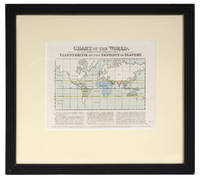
94420London Joseph Cross n.d. but c. 1825. . Hand coloured engraved map. The map shows the extent 30° north and south of the Equator in which sugar is grown. Australia is still shown as New Holland. 29.8 cm x 23.7 cm 11¾" x 9¼". Framed and glazed.<br /> Scarce colour-coded map concerning the sugar trade and its link to slavery.<br /><br />The section shaded yellow is the appropriate climate for the growing of sugar. The section shaded red is the area from which Britain may obtain sugar cheaply parts of South America and the West Indies under British rule. The blue section shows where Britain is unable to obtain sugar due to the devastating effects of the slave trade. The pink and green areas are those from which the sugar trade is limited by high duties and restrictions. The argument is that the duties and restrictions are there to protect the slave trade and ultimately damage the British economy.<br /><br />James Cropper was a successful and wealthy Quaker merchant philanthropist and disciple of Adam Smith. A major force in the anti-slavery movement he believed that eliminating tariff protections would lead to the end of slave labour in the West Indies. Cropper himself had interests in East Indian sugar and therefore stood to benefit from the reduction of tariffs which colored his role in the abolition movement. Nevertheless 'in Cropper's mind the intensity of Quaker Quietism had fused with the economic optimism of Adam Smith. Anti-slavery confirmed this union endowing laissez-faire with an immediate moral and spiritual purpose and enriching his faith in the inevitability of human progress' Davis James Cropper and the British Anti-Slavery Movement 1961.<br /> London, Joseph Cross, n.d. [but c. 1825]. unknown
1859017039Washington DC: Gales and Seaton 1859. Tabloid. Good. Side folding large tabloid newspaper. A single issue of this long running newspaper published in Washington DC first published in 1800 and publishing until 1870 with an eventual bias toward conservative Whig policies. Besides the usual ads and political news this issue contains two "Was Committed" notices last page bottom right one pertaining to Mary Norris George Park and Sally King the other pertaining to Lewis West. All four were African-Americans with Mary Norris George Park and Lewis West being enslaved people from enslaver Robert E. Lee. According to the US National Park Service website devoted to Robert E. Lee's Arlington House Memorial Mary Norris George Parks and another man Wesley Norris believed they were free based on a provision in the will of George Washington Custis. Based on this knowledge the three emancipated themselves traveling to Pennsylvania. They were all captured in Maryland. According to contemporary newspaper accounts New York Tribune in June 1859 Lee had the re-captured African-Americans whipped. Wesley Norris himself wrote an article in the Anti-Slavery Standard in 1866 which provides his account of the whipping. Early historians and biographers dismissed both accounts considering them to be accounts used for anti-slavery propaganda. Lee himself was silent on the subject with many of his contemporaries and historians taking his silence as a denial. However modern research suggests the accounts of Wesley Norris and others were true dispelling the myth of Lee as benevolent enslaver perpetuated by earlier historians. The first notice states that Norris Park and West were committed to jail on May 26th and that "George and Mary say they belong to Col. Robert Lee of Fairfax County Virginia." The complexion and height of all three are given as well as descriptions of the clothing they wore. Sally King asserted that she was free living in Washington with a Mrs. D. Bread. According to the piece they all initially left Washington on May 22nd 1859. The second notice contains the same information as the first although it appears Lewis West was jailed on May 27th but also asserted he "belongs to Col. Robert Lee." Both notices request that the "owner or owners" come forward and pay all charges due. Also present is a notice of "young servants for sale" indicating the availability of several girls from ages 11 to 15 as well as young men from 21 to 25 years old. All were apparently located in Georgetown. The newspaper is in GOOD condition. Paper split chipped and deteriorating along the spine with very slight loss of letters to some of the "was committed" ads. Horizontal and vertical fold creases present. Moderate toning along the spine edge. Small hole worn through at the intersection of the fold creases. Some wrinkling and creasing to the paper. Several small tears along the extremities. Gales and Seaton unknown
1840100899Pamphlet leaflet 8vo 4 33-36 pp. Some aging and browning and a small stain at the bottom let margin; otherwise very good plus. Basically this short pamphlet provides "abridged selections" of various slave statutes from states around the country prior to the Civil War .The statutes consistently explain that a slave should be considered a thing not a person and of course has no right to own property. It also outlines various punishments such as 25 lashes for riding a horse without permission 21 lashes if more than six slaves meet together and death for striking a white person 3rd offense. The Anti-Slavery Bugle,
1850106404<p>Folio manuscript legal sheets 11 pp. plus docketing on final back sheet. Traces of wax in some margins. Paper is browned and aged some minor creasing at folds margin hole on a couple of pages not affecting text; otherwise very good. This is a very complex legal case about the ownership of two slaves. These manuscript documents are signed by the three Constables deposed as witnesses. The testimony is taken at the law offices of Lysander G. Gordon. It seems that an individual who owed people money was forced to give the slaves to a sheriff and were then sold to William Knox in Southern Tennessee. However it appears that the slaves actually belonged to someone else. These documents try to sort though this mess. </p>
1418106697<p> Letter Signed 2 pp. folio letter sheet stampless address leaf. Two full pages of text. Folds with a couple of small tears or holes at folds normal aging and browning; otherwise very good.The letter is by Caroline F.R. Morgan to A.J.Walker in Milton North Carolina. Probably written in another hand but apparently her own verbiage with underlinings for emphasis and corrections. A strong legal statement by the widow Morgan of her rights as administrator of the Estate of her "late lamented husband" and his father responding to a Doctor's claim in a property sale in Milton North Carolina. Stating equivocally that "I administered his estate" with "Double powers of attorney if I may so express myself" and refusing to send a copy of her husband's will which "I consider a foolish request" and "would not do…for only the small amount of property in Milton but not for the whole of Milton."Most slave-owning women in the antebellum South were the widows of slave plantation owners who relied on overseers to manage often distant estates. A very few were more actively involved in the business affairs of the estates they had inherited. In Yalobusha County Mississippi two widows owned plantations with hundreds of slaves. One of these was Sarah Childress Polk of Tennessee widow of the 11th President of the United States. But her slave-holdings were exceeded by those of 42 year-old Caroline Fitz Randolph Morford Morgan of Lynchburg Virginia. Born in New Jersey to the grandson of a Quaker founder of Princeton University she had married a Virginia medical student whose father owned much of the city of Lynchburg as well as having real estate and slave holdings throughout the South. When he died in March 1847 she was left with three children and vast property in which she took an active interest not common "for a woman of her time and station." While she had many charitable interests – she was a charter member of a Female Missionary Society – records indicate that she personally bought and sold slaves both for the Morgavin Plantation in Mississippi and for her Virginia properties owning more than 100 African-American men and women including one "Aunt Sally" aged 104. She remained a widow for two years until she re-married to a younger man a Doctor who had come to Lynchburg to treat her family and slaves during an epidemic of yellow fever. That marriage ended contentiously in the 1850s and by the start of the Civil War she resumed her legal status as an independent woman ahead of her time. Apparently impoverished by the War she died in 1883. gavegarden.org</p>
1864106752<p>9 leaves of blue lined paper written in ink on rectos only. 31.5x20 cm 12¼x8" set in custom-made half cloth folder .Minor aging old folds; near fine. Official court document from Bexar County Texas summarizing the case of "Jim Owen a free person of African descent thirty years of age a resident of said county and state" who "desires to choose an owner and mistress and has selected for his mistress Sephrony Kerr…" Owen states that "he was brought from the State of Illinois to his state in 1850 before he was of lawful age by one John H. Burrus… who has since said time assumed a kind of guardianship over your petitioner without lawful authority…" All seemed on track until John H. Burrus filed suit stating that he was the "owner of said petitioner Owen" and "proof was not made that said petitioner is a free man of African descent" and "the negro Jim Owen… is his slave that he was brought to this State by the respondent in January 1850 as is slave and has been so held and owned up to the present time…" A new trial was granted and Kerr and Owen's petition denied. An appeal was allowed contingent on paying to Burrus a surety bond of $1500. A fascinating glimpse into the legal morass surrounding slavery as the Civil War raged and the "peculiar institution" of slavery was soon to be ended by force of arms.</p>
1842106407<p>Folded letter sheet four pages and remnant of wax seal. Creases at folds normal aging; otherwise very good or better. The letter is to Henry J. Carter Stockbridge Mass. from his brother. An unemployed 20 year-old Massachusetts teacher who had left home the year before in "exceeding hard times" Edward had gone to Baltimore – where some 50 teachers were out of work – and taken a job working for a wealthy man who had 4 acres of farm land worked by slaves. "…he has given me the office of overseer to look after the blacks in their work. O but you ought to see me walk over the lot with my cane in my hand to see how my work is going on. Then you ought to see the darky when he wants anything of me come up and take off his hat before he speaks…" Praising the "fine folks live in this beautiful part of the world" Carter proves that even a Massachusetts Yankee could quickly adapt to Southern culture and make peace with slavery. The letter is unsigned. </p>
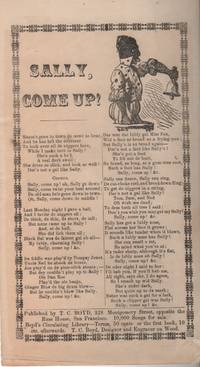
186043380San Francisco: T.C. Boyd 1860. Near fine. Racist slavery-era broadside printed and designed by one T.C. . Boyd featuring a drawing and lyrics to a ballad which begins: "Massa's gone to town de news to hear / And he has left the overseer / To look over all de nrs here / While I make love to Sally!" Boyd notes he had 10000 such sheets for sale at his shop. Broadside 8.5" by 4.5". Printed from type and wood engraving. Very near fine with trivial crease to edges. T.C. Boyd unknown
1839106839<p>Pamphlet 8vo original blue wrappers 40 viii 7 1 pp. Very slight edgewear normal aging otherwise excellent condition. The Massachusetts Anti-Slavery Society was founded in 1835 but it appears to be the successor to the New England Anti-Slavery Society founded a few years earlier in 1831. This installment gives a glimpse of the organization's membership and finances. The pamphlet also presents some of the group's resolutions including their strong rejection of the Colonization Society which wanted to send slaves back to Africa. Interestingly the society discusses "the women question" which appears to have been settled by a vote to include women as members.</p> Isaac Knapp,
191055667The Hague Netherlands: Martinus Nijhoff 1910. Thick 8vo. xx 474 pp. Title in red & black 1 large folding colour map at rear. Quarter-black cloth over printed boards textblock reinforced w/ gray linen foxing & spotting to endpapers & first few leaves minor worming to gutter margin of first leaves edgewear rubbing still G reference copy from the library of Andrew W. Lind. Second edition substantially revised & expanded of this seminal work on the history of slavery in primitive societies from ethnological and economic viewpoints. Nieboer 1873-1920 argues that slavery in primitive societies such as among Pacific Northwest Coast Indians other North American Indian tribes Eskimos Australian aborigines Polynesian cultures Melanesia and others not only established that slaves were not just the physical property of their owners but that they also could be commanded to perform labors and that their status was recognized by the society of the slave holder. Martinus Nijhoff, hardcover
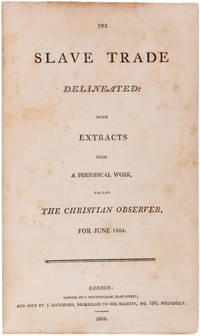
180521055261805. London: Whittingham for Hatchard. 1805. 8vo. Recent marbled wrappers; pp. 20 printed in two columns; one corner of title-page clipped light browning; a good copy of a great rarity.This combined offprint opens with a first-hand report by 'Leo Africanus' of a journey recently made on a slave ship from West Africa to the West Indies. On board the ship the Captian told the visitors and traveller 'that a slave ship was a very different thing from what it had been represented. We should find the slaves rejoicing in their happy state' p. 3. The truth however showed the sheer horror of this crime against humanity at high sea. This is followed on page ten by a discussion of a Hatchard-published pamphlet on the abolition of the slave trade. The present pamphlet is concluded by the refutation of the printed Letter to the Right Honorable W.Pitt containing some new Arguments against the Abolition of the Slave Trade in which the author Britannicus had argued 'if we give freedom to the negroes we shall ourselves indubitable become slaves of Bonaparte' p. 13. Post-truth over two hundred years ago. unknown