[Cuba]. [Slavery]Biblio.com
224 résultats
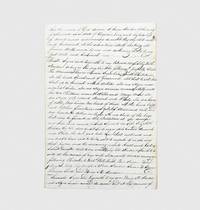
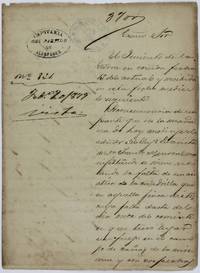
18792090Cuba 1879. About very good. 3pp. on a small bifolium. Contemporary ink stamps; accomplished in a fairly legible hand. Minor wear. A few small wormholes. Light tanning and dust soiling. Brief but very interesting manuscript report on the case of a missing Chinese indentured servant in the district of Alagranes near Matanzas. On February 18 1879 the owner of the plantation Juanita reports the missing person stating that there was a fire in his sugar cane field and it is thought that the laborer might have been burned. It seems that the present document serves to register the case with regional authorities in Matanzas and is a good record of the bureaucracy controlling indentured servitude in Cuba at this time. unknown
1864106752<p>9 leaves of blue lined paper written in ink on rectos only. 31.5x20 cm 12¼x8" set in custom-made half cloth folder .Minor aging old folds; near fine. Official court document from Bexar County Texas summarizing the case of "Jim Owen a free person of African descent thirty years of age a resident of said county and state" who "desires to choose an owner and mistress and has selected for his mistress Sephrony Kerr…" Owen states that "he was brought from the State of Illinois to his state in 1850 before he was of lawful age by one John H. Burrus… who has since said time assumed a kind of guardianship over your petitioner without lawful authority…" All seemed on track until John H. Burrus filed suit stating that he was the "owner of said petitioner Owen" and "proof was not made that said petitioner is a free man of African descent" and "the negro Jim Owen… is his slave that he was brought to this State by the respondent in January 1850 as is slave and has been so held and owned up to the present time…" A new trial was granted and Kerr and Owen's petition denied. An appeal was allowed contingent on paying to Burrus a surety bond of $1500. A fascinating glimpse into the legal morass surrounding slavery as the Civil War raged and the "peculiar institution" of slavery was soon to be ended by force of arms.</p>
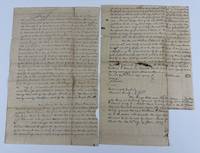
18393013Washington D.C. 1839. Fair. 3pp. Large folio. Separated into six pieces with a very small section of the final attestation lacking altogether. Still highly readable. A wounded but important document. A rare and historically-important document relating to slavery in the District of Columbia which was outlawed on April 16 1862 nearly nine months before the issuance of the Emancipation Proclamation. The present document is an indenture made between William G. Howison and Alexander Hunter Esquire both citizens of Washington D.C. associated with property conveyed to Hunter by the deceased Joseph Birch. In 1824 Birch conveyed to Hunter land "and also a negro man slave for life named Lewis - another named George - two horses - 4 cows - 3 calves." The document indicates that Lewis was subsequently sold for four hundred dollars and George was sold to Birch in his lifetime. Documents recording the movement of slaves within the District especially among two citizens of the city are rare in the market. unknown
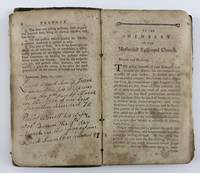
18353546Southampton Va 1835. Fair. 8pp. of manuscript plus a loose sheet of manuscript measuring 12.5 x 4 inches written within a book on family medicine. Book disbound lacking title page and first text leaf some gatherings and leaves loose or detached. Some age toning to manuscript leaves. A unique manuscript family genealogy for the Worrell family of Virginia as recorded by several hands in the margins and blank portions of two middle pages and on a few terminal and end leaves of a contemporary copy of a sammelband of two early American imprints -- The Family Adviser 1793 and John Wesley's Primitive Physic 1795 revised and corrected and on a single folded sheet folded and laid into the book. The entries within the book detail the births of the children of Josiah and Alice Worrell and sometimes their in-laws. An example of the former: "Lewis Worrell Son of Josiah Worrell & Alice his wife was born March 7 / 1774." And an example of the latter: "Polley Worrell wife of the said Lewis Worrell was born March the 9th / 1781." The entries continue much the same with the latest-dated entry reading: "Benj. Eldridge Worrell Son of Lewis Worrell & Temperance his wife was born June 21st 1835." Sometime presumably in the 1790s a member of the family also listed out a long accounting of the births of Josiah Worrell's children on a longer piece of paper folded into the present work. Titled in manuscript "Ages of Josiah Worrell's children" this sheet again begins with Lewis Worrell and lists a total of six members of the Worrell family.<br /> <br /> Most interestingly the bottom of this sheet also contains the births of four family slaves. This listing reads as follows: "Negro Ages. Ben was born the 8th day of June 1783. Solomon was born Dec. 20th 1785. Simon was born Feby. the 14th 1790. Isam was born the 20th Dec. 1792." The inclusion of the birth dates of four slaves is highly unusual in a family record of this type but remains valuable information on the lives of these four enslaved men owned by the Worrell family. unknown
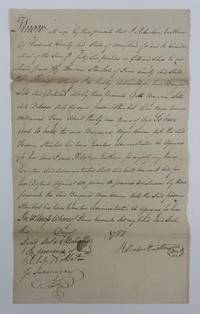
17884111Frederick County Md: March 7 1788. About very good. 1p. folio docketed on verso. Old folds short splits along a couple of fold lines minor toning. An impactful manuscript document from the early national period in Maryland formalizing the sale of a slave woman in Frederick County. The sale was made by Robertson Eastburn whose family emigrated from England to Maryland in the early 18th century. The document reads in part: "In consideration of the sum of forty six pounds in Gold and Silver to me in hand and paid by Frederic Strombol.I do hereby Acknowledge have Bargain'd Sold and Delivered and by these presents doth Bargain Sell and Deliver Unto the said Frederic Strombol One Negro Woman named Torry about thirty years of age To Have and to hold the said Bargained Negro woman unto the said Frederic Strombol."<br /> <br /> Slavery in Maryland lasted over 200 years from its beginnings in 1642 when the first Africans were brought as slaves to St. Mary's City to its end following the Civil War. In 1664 under the governorship of Charles Calvert 3rd Baron Baltimore the Assembly ruled that all enslaved people should be held in slavery for life and that children of enslaved mothers should also be held to the same standard of law. 19th-century American slave sale documents are growing increasingly scarce in the market. March 7 unknown
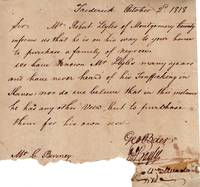
181812956Frederick MD: October 2 1818. 1p. docketed on verso. Roughly torn along bottom edge minor foxing and spotting. Good condition. An uncommon document in Maryland slave history in which George Baer the future mayor of Frederick and a few other men attest that another local citizen named Robert Lyles is not a slave trader. The document reads in part: "Lyles is on his way to your house to purchase a family of negroes. We have known Mr. Lyles many years and have never heard of his Trafficking in Slaves nor do we believe that in this instance he has any other view but to purchase them for his own use." Baer served as mayor of Frederick from 1820 to 1823; his correspondent "C. Burney" is perhaps Clotworthy Birney 1765-1845 a farmer and real estate trader living near Taney Town. An unusual Maryland slave document concerning a slave owner who just wants to buy slaves for his own use not traffic in them because that's somehow better. October 2 unknown
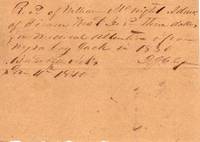
184012966Batesville AR: January 11 1840. 1p. 4 x 5.5 inches docketed on verso. Old horizontal fold toning. Very good. An interesting manuscript record of slave care in Arkansas in the 1830s. The short but impactful document reads in full: "Recd of William McNight Admin. Of Hiram West Decd three dollars for medical attention upon negro boy Jack in 1836. Batesville Ark. Jan 11 1840 DJ Chipman." Such documents are increasingly rare in the market and more uncommon than slave sale documents from the same period. Arkansas has just achieved statehood four years before the presetn document was written. January 11 unknown
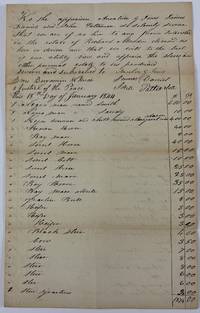
184413105St. Genevieve County MO: January 18 1844. 4pp. on a single folded sheet. Original folds minor wear. Very good condition. A sobering manuscript inventory from the estate of Richard Maddin following his death in Missouri in 1843 detailing his "slaves and other personal" property. The inventory begins by listing the enslaved persons by name along with an assignation of value for each of them as such: "1 Negro man named Smith $600. 1 Negro man named Sandy $10. 1 Negro woman and child named Margaret and Jason $400." The inventory then goes on to list the other property beginning with a long list of livestock followed by equipment household goods and so forth. The document is certified and witnessed by a number of local citizens who attest to the "full and perfect inventory of the goods chattles and personal estate" of the deceased Mr. Maddin. The reasoning is unclear why the second listed slave Sandy was worth only $10. January 18 unknown
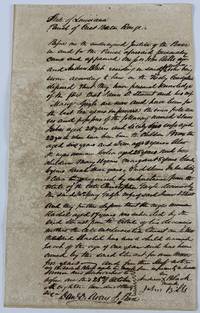
183613107East Baton Rouge Parish LA: October 25 1836. 1p. on a single folded sheet integral blank docketed on verso. Old folds moderate toning and foxing short closed tear along one fold line a few small instances of ink burn. Overall good condition. An interesting document of legal testimony involving numerous named slaves in Louisiana in 1836 ranging in age from one year to almost thirty years of age and including seven children. According to the docketing the document is effectively a "Title to Slaves." The deponents were two local citizens John Bills and Andrew Black who had "personal knowledge of the fact that James D. Stuart and his wife Mary Gayle are now and have been for the last ten years & upwards the bona fide owners and possessors of the following named slaves: Juba Aged 25 and Sicily his wife aged 22 to whom have been born the children Braxton aged six years and Dan aged 3 years. Also the negro woman Celia aged 28 years and her children Mary 11 years Margaret 8 years Charley 6 years Sarah three years which slaves Juba Sicily & Celia were acquired by inheritance from the estate of Christopher Gayle. And they further depose that the negro woman Rachel aged 17 years was inherited by the said Stuart from the estate of his deceased mother.and that the said Rachel has now a child named Jacob of the age of one year." The document is signed by Black Bills and the Justice of the Peace Daniel D. Avery. Documents involving slave inheritance of and subsequent ownership by not one but both members of a marriage are exceedingly rare. October 25 unknown
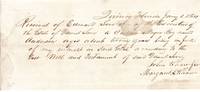
186413103Quincy FL: January 1 1864. 1p. of manuscript docketed on verso. Old crease minor staining. Very good. A short but impactful and somewhat unusual document memorializing the inheritance of a young slave named "Anderson aged about twenty years" from a Florida estate in the penultimate year of the Civil War. Anderson was formerly owned by Daniel Love of Gadsden County and is here inherited by "John Shaw for Margaret E. Shaw" by Love's executor and likely brother Edward Love. The document is dated New Year's Day 1864. An unusual occurrence of a Florida slave being transmitted to a woman through inheritance. January 1 unknown
1819190417Albemarle County VA: 1819-1823. A revealing survival from early 19th-century Virginia: the last will and testament of Isaac Hardin a prominent citizen and first legal owner of the land now known as the Greenwood historic district in Albemarle County. The will transfers ownership of 13 enslaved persons. In his will written in June 1819 and notarized and effected in May 1823 the ailing Hardin leaves the vast majority of his possessions to his wife Elizabeth. This includes the mansion house and plantation along with a number of enslaved persons: Juber Milly Milly's children Willis and Mary Ann and two girls named Hannah and Pheby. The enslaved people are mentioned in the will after Hardin's property and before the listing of his livestock. Later in the will he also transfers legal ownership of a man named Anderson to his oldest son Berry M. Hardin and of six other enslaved people to his daughter Lucinda Scott. The will was signed by Hardin with his mark and witnessed by four individuals on June 26 1819 and was later notarized on May 31 1823. We can assume that Hardin's will was carried out upon his death in 1820 and advertisements for a trust sale in 1830 tell us that much of this same property was later auctioned off including all of the enslaved men and women left to Elizabeth except for Hannah and Pheby who were singled out as Elizabeth's "to have and to hold and to dispose of as she may think proper". Bifolium handwritten on three pages docketed and with remnants of wax seal on fourth page. Old folds some damage to second leaf from where seal was removed not touching text. Very good. unknown
1842106407<p>Folded letter sheet four pages and remnant of wax seal. Creases at folds normal aging; otherwise very good or better. The letter is to Henry J. Carter Stockbridge Mass. from his brother. An unemployed 20 year-old Massachusetts teacher who had left home the year before in "exceeding hard times" Edward had gone to Baltimore – where some 50 teachers were out of work – and taken a job working for a wealthy man who had 4 acres of farm land worked by slaves. "…he has given me the office of overseer to look after the blacks in their work. O but you ought to see me walk over the lot with my cane in my hand to see how my work is going on. Then you ought to see the darky when he wants anything of me come up and take off his hat before he speaks…" Praising the "fine folks live in this beautiful part of the world" Carter proves that even a Massachusetts Yankee could quickly adapt to Southern culture and make peace with slavery. The letter is unsigned. </p>
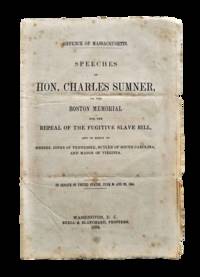
1854176351854. Abolition African Americana SUMNER Charles. Defence of Massachusetts. Speeches of Hon. Charles Sumner on the Boston Memorial for the Repeal of the Fugitive Slave Bill and in Reply To Messrs. Jones of Tennessee Butler of South Carolina And Mason of Virginia in the Senate of the United States June 26 and 28 1854. Washington D.C.: Buell & Blanchard Printers 1854. At the time that this description is being written just three copies are recorded in American institutions. OCLC search results are at best an estimate and can vary over time. The Memorial referred to in the title was a request by 2900 undersigners chiefly men of Boston Mass. to repeal the Fugitive Slave Bill of 1850. What follows is a transcription of Massachusetts Senator and famous abolitionist Charles Sumner's speeches in the ensuing debate: "Mr Jones. asks 'Can anyone suppose that if the Fugitive Slave Act be repealed this Union can exist' To which I reply at once that if the Union in any way be dependent on an Act-- I cannot call it a law-- so revolting in every regard as to that which he refers then it ought not to exist." Sumner goes on to argue amongst other things that the Fugitive Slave Act is parallel to the hated Stamp Act that sparked the Revolutionary War as well as to make spirited rebukes against the pro-slavery Senators Butler Mason and Jones: "The veteran Senator from Virginia Mr. Mason complained that I had characterized one of his "constituents" a person who went all the way from Virginia to Boston in pursuit of a slave as a Slave-Hunter. Sire I choose to call things by their right names. White I call white and black I call black. And where a person degrades himself to the work of chasing a fellow man who under the guidance of the north star has saught a freeman's home far away from the cofle and the chain that person whomsoever he may be I call a Slave-Hunter." Eight sheets folded to make one sixteen-page signature which is stitched along the left edge. Foxing throguhout pages chipped along margins. Dampstaining along two page edges. Delicate but in good condition. <br /> <br /> Charles Sumner January 6 1811 - March 11 1874 was an American statesman and United States Senator from Massachusetts. As an academic lawyer and a powerful orator Sumner was the leader of the anti-slavery forces in the state and a leader of the Radical Republicans in the U.S. Senate during the American Civil War. During Reconstruction he fought to minimize the power of the ex-Confederates and guarantee equal rights to the freedmen. During the war he was a leader of the Radical Republican faction that criticized President Lincoln for being too moderate on the South. Sumner specialized in foreign affairs and worked closely with Lincoln to ensure the British and the French refrained from intervening on the side of the Confederacy during the Civil War. As the chief Radical leader in the Senate during Reconstruction Sumner fought hard to provide equal civil and voting rights for the freedmen on the grounds that "consent of the governed" was a basic principle of American republicanism and to block ex-Confederates from power so they would not reverse the gains made from the Union's victory in the Civil War. unknown
1817SLAVERY005957W. Alexander York. 1817. First U.K. edition with additions to the Philadelphia printing. 12mo. 156 pages including 4 pages of adverts. Frontispiece. Original boards with paper backstrip and title label. Anthony Benezet 1713-1784 was a leading abolitionist.Early nameplates Thomas Marsh and Robert Langdon on front pastedown. Some foxing to prelims. Cup ring to front cover. Backstrip defective label rubbed. Very good. Scarce in original state. W. Alexander, York. hardcover
0267513542.Ghardcover. Good. Access codes and supplements are not guaranteed with used items. May be an ex-library book. hardcover
182634337Washington: Printed by Gales & Seaton 1826. 181 pp. 1 vols. 8vo. Disbound some browning to title page else a good tightly sewn copy. 181 pp. 1 vols. 8vo. John Quincy Adams' brief memorandum transmits Secretary of State H. Clay's report; a detailed list of slave owners and the names of their slaves comprises the bulk of this document. <br/><br/> Printed by Gales & Seaton unknown
186062260Atlanta: Printed at the Daily Locomotive Job Office 1860. 47 pp. 1 vols. 8vo. Original blue printed wrappers. Wrapper a bit chipped else Fine. 47 pp. 1 vols. 8vo. Printed at the Daily Locomotive Job Office unknown
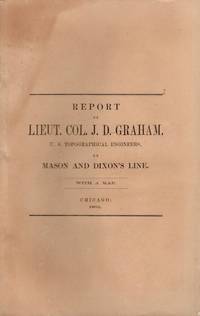
186234999Chicago: Steam Presses of F. Fulton & Co 1862. Second Edition. Wraps. Very good. Wraps. 95 pages. Folding frontispiece map. Tan colored stitched wraps with printed title on the front cover. Light toning to the front wrap. The Mason Dixon line history goes back to the 18th century involving property lines between Maryland Pennsylvania and Delaware familes. Pre Civil War the line was better known for the demarcation between free states and the Slave states from the South.<br /> <br /> A pre-Chicago fire imprint. Chicago Ante Fire imprints 641; Sabin 45089. Steam Presses of F. Fulton & Co unknown
186335430New York: Carleton 1863. First Edition. Hardcover. Good. 12mo. 1 308 pages 1 page advertisement 1 page blank 1 page advertisement 1 page blank 1. . 4pp ads. Brown pebble cloth hardcover stamped in blind on the covers. Gilt stamped title on spine. Edge wear to the cloth head and base of the spine. Toning to the end papers. Light to moderate scattered foxing to the contents. Previous owners name on the front paste down. Civil War era stories revolve around treatment of Slaves with some stories of white southerners. Good only. Carleton hardcover
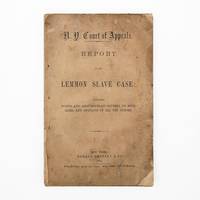
1860372448New York: Horace Greeley & Co 1860. 146pp. 8vo. Stitched self wrappers. Toned title a bit tattered at edges scattered minor staining. 146pp. 8vo. In 1852 the Lemmon family took a ship from Virginia to New York along with eight enslaved people planning to embark immediately on another ship for New Orleans. With slavery abolished in New York the slaves were freed by a writ of habeas corpus. Chief Justice Paine upheld the writ and in 1860 the case went to the court of appeals where the original judgment was overturned to preserve peace in the Union. The case would likely have been considered by the Supreme Court if not for secession and the outbreak of the Civil War.<br /> <br /> "The fullest legal examination of slave transit and comity before the Civil War . One of the most extreme examples of hostility to slavery in Northern courts . pushed the nation one step closer to Civil War" Finkelman Slavery in the Courtroom pages 56-57. Cohen 11900; Library Co. Afro-Americana 7104; Sabin 40003; Work page 346 Horace Greeley & Co unknown
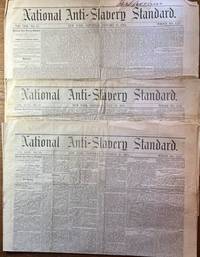
186536786New York: American Anti-Slavery Society 1865. Newspaper. Good. Newspapers. Approximately 27" x 18.5". 4 pages each. Several folds. Some light creases and several closed edge tears to the papers not affecting the print. Previous owner name written in the upper right corners of the front page first three issues. Light toning and foxing to the papers.<br /> <br /> 5 issues:<br /> <br /> New York: Saturday November 3 1855. Vol. XVI. No. 24. Lead article "The Boston Mor"<br /> New York: Saturday December 29 1855. Vol. XVI. No. 32. Lead article "Mr. Channing on American Slavery."<br /> New York: Saturday January 11 1862. Vol. XXII. No. 35. Lead article "The Emancipated South Carolinians."<br /> New York: Saturday July 29 1865. Vol. XXVI. No. 12. Lead article "Pro-Slavery South Carolina Loyalty. A "Union" Speech from Provisional Governor Perry."<br /> New York: Saturday November 18 1865. Vol. XXVI. No. 28. Lead article "Pro-Slavery Negro Suffrage Extract from the Message of Gov. Marvin of Florida to the State Convention. American Anti-Slavery Society unknown
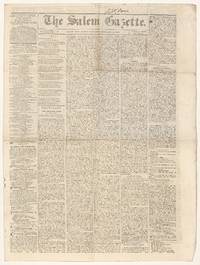
1850515519Salem Mass: Published by C. Foote 1850. Unbound. Very Good. First edition. Folio. 4pp. Printed self-wrappers. Owner's contemporary ink name on front cover in upper margin. Text is folded lightly creased few spots of faint soiling very good. Text includes: "The Beloved Tune" by Lydia Maria Child three full columns and a thirty-six line announcement about the pending publication of Nathaniel Hawthorne's The Scarlet Letter. Also includes a brief article entitled "Mr. Clay on Slavery" printing extracts from a debate between Senator Clay and General Cass; also prints a three-line announcement about the liberation of fourteen slaves: "Fourteen slaves belonging to Dr. John Casson of Mississippi have been taken to Cincinnati and liberated by their owner. Published by C. Foote unknown
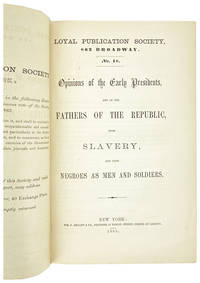
186330221New York: Wm. Bryant & Co. Printers 41 Nassau Street Corner of Liberty 1863. Very Good. New York: Wm. Bryant & Co. Printers 41 Nassau Street Corner of Liberty 1863. First Edition. Octavo. 19 pp. Printed wraps. Housed in more recent marbled paper wraps with brown backstrip staples noticeable beneath. Abrasions and glue remnants to front wraps with loss to text; light creasing to edges; a few smudges. Binding sound and interior unmarked; Very Good. Includes excerpts from Presidents Washington to Jackson as well as quotations from Benjamin Franklin John Jay and Alexander Hamilton.<br /> <br /> Sabin 57406. Wm. Bryant & Co., Printers, 41 Nassau Street, Corner of Liberty unknown
1862127191862. Front Page Headline reads "The Bill Abolishing Slavery in the District of Columbia Passed the House." Newspaper "The Detroit Free Press" April 12 1862. 19" x 26" 2 pages. Has a blow by blow account of the debate among the members of the House and the various amendments associated with the bill. It concludes "The bill was passed 93 agains 39." Also includes local national and international news as well as "News From the South." Some small tears at the left hand margin not affecting text. A diagonal crease runs across the top half of the paper and a small piece of yellow tape has adhered to the top margin. Overall in very good condition. unknown
1805369285London 1805. 309; 4 46pp. Uncut. 2 vols. Folio. Disbound. 309; 4 46pp. Uncut. 2 vols. Folio. Two British Parliamentary papers on the slave trade issued in the midst of the debates for its abolition. The first paper organized by West Indian island includes the correspondence between the British government and their West India colonies regarding slavery from the period 1797 to 1800 and includes the text of the Leeward Island Amelioration Act of 1798. The paper includes a wealth of statistical information on the enslaved populations of each island as well as the names of plantation owners and their holdings. The second paper continues the correspondence from 1804-1805 with updated statistics. unknown