Slavery; United StatesBiblio.com

224 résultats
1858660371858. Dividing Prize Money After the Capture of a Slave Ship Slavery. United States. In the Senate of the United States. February 21 1858-Ordered to Be Printed. Mr. Polk Made the Following Adverse Report To Accompany Bill S. C. of C. 108.: The Committee of Claims To Whom was Referred the Opinion of the Court of Claims in the Case of O.H. Berryman and Others Report: The Claimants in this Case are the Officers and Crew of the United States Schooner "On-Ka-Hy-E" drop-head title. Washington DC: S.n. 1858. 13 pp. Octavo 9" x 5-1/2". Disbound light rubbing to extremities some toning and light foxing. $100. 35th Congress 1st Session Senate Rep. Com. No. 33. This speech disputes the distribution of prize money between the Federal government and the crew that captured the slave ship Laurens. unknown
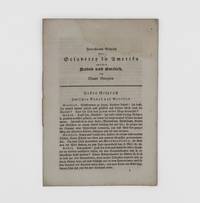
1845332998United States 1845. 16pp. 8vo. Self-wrappers dampstaining. 16pp. 8vo. An anti-slavery work in German written in the form of a dialogue between Gottlieb who argues that the slave trade is a sin and Nabob who begins by arguing in defense of slavery but is swayed by Gottlieb's arguments. unknown
184618128London; Chapman Brothers. 1846. The True 1st Edition. Hardback. Very good copy in the original blind-blocked fine-ribbed cloth. Minor nick to the spine crown with the usual dust-dulling to the bands and panel edges. Remains an uncommonly well-preserved example of a scarce and seminal title; 296 pages; Physical desc. : 296 p. ; 22 cm. Intended by the publisher as the first in a 'Library' of political and literary importance for discerning readers. Subject: Slaves - United States - Social conditions. The Clarke Family Narrative - Witness accounts - Jonathan Walker's Trial - etc. London; Chapman Brothers. hardcover
18161138361816. First Edition. SLAVERY. The Interference of the British Legislature in the Internal Concerns of the West India Islands Respecting Their Slaves Deprecated. London: J. Mawman 1816. Slim octavo modern blue-gray paper wrappers; pp. 58. $1800.First edition of this defense of the West Indian slave trade arguing against emancipation.Cloaked in pro-abolition language and anonymously written by a person claiming to be an abolitionist this work is actually a zealous condemnation of British interference in the slave trade of the West Indies. After briefly discussing the abolition movement the 1807 act abolishing slavery in britain and prominent anti-slavery organization the author sets out to make his main argument: that a bill requiring registry of slaves in the West Indies would infringe on the rights of those colonies. The author swiftly aligns himself with the interests of the West Indian Planters arguing that abolishing slavery is a different cause from emancipating people of African descent. He points out that this bill is merely the first in a projected series of measures meant to emancipate the Black population of the West Indies. Set in the awkward period between 1807 and 1833 when slavery in Britain was illegal but the slave trade still thrived abroad this work makes sense of obvious hypocrisy by arguing that slavery was permitted by God and that Blacks of African descent were better off as slaves than in Africa. The will of those against slavery proved stronger and complete abolition eventually became the law of the land. Sabin 34904. Kress 21649. This work last appeared at auction over 25 years ago; prior to that it had not been seen since the 1940s.Interior quite clean with only slight pressure offsetting toning to spine of modern wrappers. A beautiful copy in fine condition. unknown
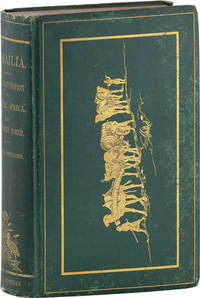
187561084New York: Harper and Brothers 1875. First American Edition. Octavo 24cm. Green cloth stamped in gilt; brown coated endpapers; 542pp; steel-engraved frontispiece 2 wood-enraved frontispieces 2 color maps 1 folding and 48 wood-engraved plates all with tissue guards. Inscribed "Charles V. Payne from his friend M. R. E. Christmas 1874" on front free endpaper; the same inscription is repeated with the date 1875 on a front flyleaf. A sound copy externally rubbed with superficial silverfishing to both boards internally clean with two central gatherings pulled but not fully detached short tear to folding map at gutter: just Very Good. <br /> <br /> Samuel Baker 1821-1893 was a noted British explorer of Africa. In 1860 he was appointed "governor-general of the equatorial Nile basin" by the Khedive Ismail of Egypt with duties including "annexing the equatorial Nile basin establishing Egyptian authority over the region south of Gondokoro suppressing the slave trade" and more ODNB. His success was mixed: he successfully annexed Gondokoro and did suppress the slave trade but failed to establish secure control of the region ODNB. This account published after his return to England details how he "raised and trained a fighting force.to crush" the slave trade Czech. CZECH p.11. Harper and Brothers unknown
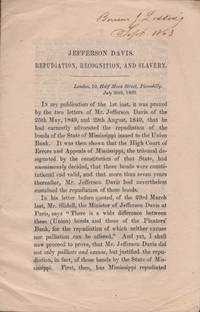
186335488London: R. J. Walker 1863. First Edition. Wraps. Fair. Wraps. 12 pages. Title on page 1. Tissue and glue patch repairs made to pages 11 and 12. Inscribed and signed top of page 1 by historian and author Benson J. Lossing. The author R. J. Walker was a Democrat Senator from Mississippi in the years 1835-45. He was a staunch pro-Union advocate during the Civil War. Fair condition due to the reapirs. R. J. Walker unknown
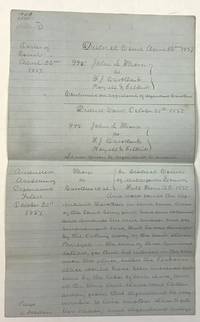
185740346Matagorda County Texas 1857. Six pages in neat ink manuscript on lined pale blue legal paper. Fine. The document is probably the record for Carothers' appeal of the Court's judgment in favor of Thorn.<br /> <br /> The parties having waived a jury trial the Court found in favor of Thorn the Plaintiff. In addition to the failure to pay Thorn for the hire of Taswell Thorn claimed that Carothers had failed to pay $100 rent to Thorn for farming on Thorn's property. <br /> Carothers said that the slave Bridget upon whom Carothers had relied for performing work on the property had been "taken away" apparently by Thorn during the term of the agreement. Bridget's absence Carothers said caused his nonperformance and thus excused his failure to pay. The Court disagreed and ordered Carothers to pay the amount of the notes plus costs and interest. unknown
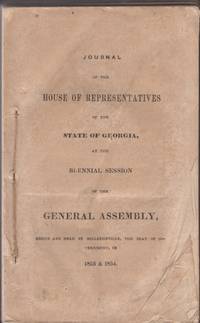
185335359n.p.: Georgia 1853. Wraps. Fair. String bound wraps. 1011 pages 1 page blank 1 37 page Index 1 page blank 1. Title page is page 1. Page 1 is toned and creased. Rear wrap is lightly toned with a few spots. Text block is not trimmed and the pages are uncut at the top edge. Moderate toning and foxing to the contents. <br /> <br /> Contents include a section on Slave and Free Persons of Color laws. Printer information or location not provided on the title page. A similar copy held by Emory University states the 1853 & 1854 Journal was printed in Savannah by S. T. Chapman. Emory's copy is has 904 pages while this copy has 1011 pages. Also Emory's copy does not have the hyphen in the word Biennial on the printed title page. Georgia unknown
18651260191865. First Edition. CONSTITUTION. Journal of the House of Delegates of the State of Virginia. for the Session of 18645. Alexandria: D. Turner 1865. Octavo original front printed wrapper respined renewed rear wrapper original string stitching; pp. 1-3 4-83 1. Housed in a custom chemise and clamshell box. $4500.First edition one of 500 copies of the momentous Journal featuring its February 9 1865 entry on the Alexandria Virginia government's passage of the 13th Amendment mere days after the U.S. Congress the first of the four Unionist southern states to pass the Amendment also featuring the governor's Message noting: ""though we have in inherited from our fathers of the revolution the blessings of a great nation yet they also left to us an inheritance of African slavery which has proved a bitter dreg in our cup of freedom"" a vital record of forces for constitutional change near the end of the Civil War.Soon after the 1860 election amidst southern secession ""the great questions of union or disunion war or peace hung in the balance. Probably the crucial weight on the scale was Virginia as long as the federal government did not seek to coerce the states Virginia secessionists were unable to achieve a majority. When Lincoln responded with force to the attack on Fort Sumter however the vote in Virginia went in favor of secession."" Subsequently a Virginia convention ""met in Wheeling on May 13 1861 it elected as Governor Francis Pierpont a western Virginian and ardent Unionist and arranged for the creation of a legislature to replace the body sitting in Richmond in July 1861 the new legislature met at the 'Restored Virginia' capital of Wheeling in a special session called by Pierpont."" Against its ""claim to represent a majority of Virginians"" a new state of West Virginia was created in 1863 and Pierpont's government moved to Alexandria to govern areas of Virginia under Union occupation Harrison Lawfulness of the Reconstruction Amendments 380-83.Scholars observe that the 13th Amendment its fellow amendments and Reconstruction as ""both a political process made possible by military successes and constitutional thought grew from wartime as well as post-Appomattox developments"" Hyman and Wiecek Equal Justice 247. This rare first edition of Journal of the House of Delegates substantiates that in documenting passage of the 13th Amendment by Pierpont's Virginia government mere days after the U.S. Congress passed the Amendment on January 31 1865. With that Virginia became the first of the four Unionist southern states that ratified the 13th Amendment. Of those Louisiana followed on February 17 with Arkansas and Tennessee that April. The 13th Amendment is the focus of the Journal's entry for February 9 1865 which states: ""Mr. Brownley called up Senate bill No. 12 entitled 'An Act to ratify the joint resolution of Congress passed January 31 1865 proposing an amendment to the Constitution of the United States.' The bill was read the first and second time and the rules were suspended and the bill read the third time and the bill passed."" Also notable herein is the complete printing of Governor Pierpont's opening Message where he notes: ""though we inherited from our fathers of the revolution the blessings of a great nation yet they also left to us an inheritance of African slavery which has proved a bitter dreg in our cup of freedom."" He speaks at length of the rights due people of color and the abolition of laws such as those that prohibit ""negro testimony"" or proscribe a ""different punishment for persons of African dissent"" from that of ""white persons.""""The legislature met for its second session on December 5 1864 The governor's message was a long and important document and indicated the changes of opinion that the war was bringing about. Pierpont gave his views upon the all-important negro question. He congratulated the constitutional convention which had met in the spring on the abolition of slavery in Virginia and advocated sweeping changes in the laws concerning negroes. The act prescribing different punishments for blacks should he said be altered in accordance with the amended constitution as well as the law for apprenticing them. The law prohibiting the education of negroes should be abolished His language was on the whole very moderate. He advised the legalizing of the marital relations of negroes and most important the establishment of public schools Notwithstanding the governor's advice no acts of great importance passed the legislature On February 9 1865 the assembly ratified the 13th Amendment to the Constitution of the United States. It adjourned on March 7"" Eckenrode Political History of Virginia During the Reconstruction. Faint ""U.N.C. Duplicate"" stamp to front wrapper.Text fine; just a bit of faint soiling and a tide line to fragile front wrapper. An excellent copy of this elusive item. unknown
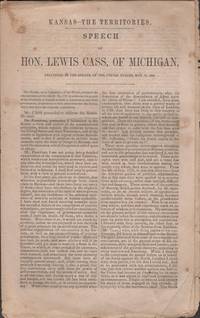
185634806Washington D.C.: Printed at the Office of the Congressional Globe 1856. First Edition. Wraps. Fair. Single sheet folded wraps. 8 pages. Light toning to the paper. Small holes at the fold intersections margins and edges. No loss of print. Light edge wear to the paper with minimal loss of a couple of letters. Speech covers recent violence and Kansas becoming a free State. Fair condition. Printed at the Office of the Congressional Globe unknown
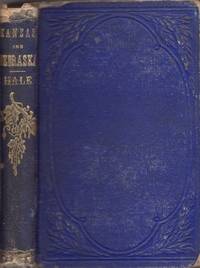
185435390Boston: Phillips Sampson and Company 1854. 1854. Hardcover. Fair. Small octavo. 1 viii 9-256 pages 4 pages advertisements 1. Folding frontispiece map. Blue cloth hardcover with blind stamped covers. Gilt title and decoration on the spine. Folding map has some wrinkling and creases. Cloth hardcover is shelf worn rubbed at the extremities and chipped at the head and base of the spine. Lean to the binding. Light scattered toning and foxing to the contents. Fair. <br /> <br /> Graff 1079. Phillips, Sampson and Company hardcover
1850106404<p>Folio manuscript legal sheets 11 pp. plus docketing on final back sheet. Traces of wax in some margins. Paper is browned and aged some minor creasing at folds margin hole on a couple of pages not affecting text; otherwise very good. This is a very complex legal case about the ownership of two slaves. These manuscript documents are signed by the three Constables deposed as witnesses. The testimony is taken at the law offices of Lysander G. Gordon. It seems that an individual who owed people money was forced to give the slaves to a sheriff and were then sold to William Knox in Southern Tennessee. However it appears that the slaves actually belonged to someone else. These documents try to sort though this mess. </p>
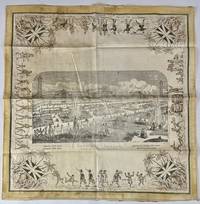
189012893N.p. likely London 1890. Lithograph on silk handkerchief approximately 24 x 24 inches with additional lithographed scene printed around the outer margins in brown and blue ink. Previously matted and framed with resultant edge wear and adhesive staining around margins. Old folds some foxing and staining in image area. Overall good plus condition. A very rare and impactful 19th-century British lithograph-on-lithograph the original a view of London's Crystal Palace with the addition of a satirical scene detailing the history of British colonialist activities in Africa. The overall scene is presented in four linear parts one across each mostly blank margin of the Crystal Palace scene; interestingly the two lithographs overlap each other at a few places along the short edge. The scene seems to begin with the part labeled "African Slave Trade" picturing two slave traders leading a chained procession of African slaves men women and children. The next edge is labeled "The Rescue" and shows three British soldiers including one bagpiper freeing the slaves who are pictured free of their chains and dancing and now detaining the two slave traders in chains. <br /> <br /> The third panel pictures two groups of Africans -- one group running to a rum dealer and another group listening to a man holding a book presumably a missionary preacher. This scene seems to allude to British activities in the West Indies. The final panel labeled "Civilization" is the most varied. It pictures a couple of British railway agents under the banner "Change for Timbuctoo;" a group of African men in Western garb one holding a sign reading "African Times;" an African man riding a bicycle; and a family scene of a man kneeling in front of a seated woman while he kisses her hand and a young man in the background sells matches. How civilized indeed. Each corner of the work is emblazoned with a British lion and the Union Jack amidst a field of African foliage and West Indian palm trees. The scene seems to celebrate the effects of British colonialism while ignoring the country's own history as slaveholders and traffickers the previous century.<br /> <br /> "The border panels of this printed cotton handkerchief caricature the impact of British colonial policy on Africa. It was probably produced at the end of the 19th century at a period when European colonial rule led to increasing social and political intervention in African societies. It illustrates the rescue of a group of slaves by a British military detachment and their subsequent 'westernization' through the introduction of European goods and commodities." This description comes from the online description of the only other example of this scene we can find which resides at the National Maritime Museum NMM at Greenwich London. The NMM example is printed on a blank cotton handkerchief in brown and red and is slightly smaller on one side than our example. Their dating is likely correct if for nothing else because of the depiction of a chain-driven bicycle which became popular in the UK in the 1890s. unknown
1418106697<p> Letter Signed 2 pp. folio letter sheet stampless address leaf. Two full pages of text. Folds with a couple of small tears or holes at folds normal aging and browning; otherwise very good.The letter is by Caroline F.R. Morgan to A.J.Walker in Milton North Carolina. Probably written in another hand but apparently her own verbiage with underlinings for emphasis and corrections. A strong legal statement by the widow Morgan of her rights as administrator of the Estate of her "late lamented husband" and his father responding to a Doctor's claim in a property sale in Milton North Carolina. Stating equivocally that "I administered his estate" with "Double powers of attorney if I may so express myself" and refusing to send a copy of her husband's will which "I consider a foolish request" and "would not do…for only the small amount of property in Milton but not for the whole of Milton."Most slave-owning women in the antebellum South were the widows of slave plantation owners who relied on overseers to manage often distant estates. A very few were more actively involved in the business affairs of the estates they had inherited. In Yalobusha County Mississippi two widows owned plantations with hundreds of slaves. One of these was Sarah Childress Polk of Tennessee widow of the 11th President of the United States. But her slave-holdings were exceeded by those of 42 year-old Caroline Fitz Randolph Morford Morgan of Lynchburg Virginia. Born in New Jersey to the grandson of a Quaker founder of Princeton University she had married a Virginia medical student whose father owned much of the city of Lynchburg as well as having real estate and slave holdings throughout the South. When he died in March 1847 she was left with three children and vast property in which she took an active interest not common "for a woman of her time and station." While she had many charitable interests – she was a charter member of a Female Missionary Society – records indicate that she personally bought and sold slaves both for the Morgavin Plantation in Mississippi and for her Virginia properties owning more than 100 African-American men and women including one "Aunt Sally" aged 104. She remained a widow for two years until she re-married to a younger man a Doctor who had come to Lynchburg to treat her family and slaves during an epidemic of yellow fever. That marriage ended contentiously in the 1850s and by the start of the Civil War she resumed her legal status as an independent woman ahead of her time. Apparently impoverished by the War she died in 1883. gavegarden.org</p>
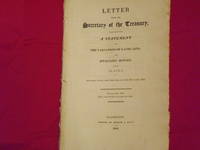
1816100537Pamphlet formate folio disbound first pamphlet 3 leaves printed on recto only second 7pp. third 6 pages and folding chart. Pamphlet extracted from larger volumne chipping along spine and edges not affecting text second papmple completely disbound paper browned and somewhat dry These pamphlets are rare and represent an important source of information on the numbers and values of slaves in early 19th century America. The first title presents the value assigned to slaves in 11 states including New York. The second lists the number and values of slaves in the various counties in the state of Maryland. The final pamphlet presents real estate values and values on dwellings including slaves in the counties of Pennsylvania. The information in these reports was compiled by Alexander James Dallas 1759-1817 who was the Secretary of the Treasury. Dallas born in Kingston Jamaica settled in Pennsylvania and practiced law there. Eventually he would become Secretary of the Treasury in 1814 when the nation was almost bankrupt. He managed to reorganize the department get the country out of debt created a surplus and even helped promote what would become the Second Bank of the United States. ANB. William A. Davis,
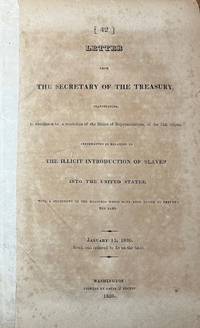
182035023Washington D.C.: Printed by Gales & Seaton 1820. First Edition. Wraps. Fair. Disbound wraps. Approx. 9" x 4". 12 pages. Toning to the paper. First 4 pages have a small edge chip not affecting the print. Wraps spine backed with later tissue paper. Pages 3-6 are loose. Scarce. 10 copies located in OCLC. The Act Prohibiting Importation of Slaves promoted by President Thomas Jefferson was passed in 1807 and took effect in 1808.<br /> <br /> From the 1820 letter submitted by the Treasury Department Spain and individuals were responsible for the illegal importation of Slaves into the United States. Secretary of Treasury William Crawford writes "From information recently received by this Department there is just reason to believe that Sir Gregor MacGregor has taken military possession of Amelia Island Florida in the name of the Spanish Patriots" Continued on the same page "In addition to the circumstances already communicated the disposition which has been manifested by the vessels of Spain engaged in the African Slave Trade to introduce illicitly into that section of the Union the persons who in the prosecution of their traffic have been subjected to their control seems to require the presence of a force sufficient to enforce the due execution of the laws against the introduction of slaves into the United States." The Treasury Department recommends "To guard against the unlawful introduction of slaves and to repress any attempt that may be made by the foreign belligerent force collected in that neighborhood to excite domestic insurrection among the blacks it appears to me to be absolutely necessary that a land and naval force be stationed at St. Mary's." <br /> <br /> Soon after this letter was published Florida was ceded to the United States by Spain in 1821. Florida was a territory until 1845. Printed by Gales & Seaton unknown
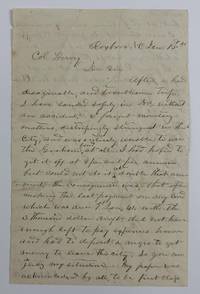
18605563Roxboro N.C.: January 15 1860. Good. 2pp. Wrinkled previously folded. A few minor losses at folds not affecting text. Two half-inch closed tears from edges. Light toning and foxing. After arriving in Roxboro North Carolina in mid-January 1860 planter J.C. Barnett writes to his friend and business partner a Colonel Henry to complain about the tight money situation in the state which has forced him essentially to pawn a slave in order to raise cash: "I found monetary matters distressingly stringent in the City and was entirely unable to use the Graham bond at all. I had hoped to get it off at 8 per cent per annum but could not do it at double that amount the consequence was that after making the last payment on my land which was due 1st Jan 61 with the 3 thousand dollar draft I did not have enough left to pay expenses home and had to deposit a negro to get money to leave the city. So you can judge my situation." Furthermore he has other unpaid debts that he hopes to settle with future cotton sales: "I gave R.H. Williams a draft for 93 dollars also Messrs Lea & Cheatham of Louisville one for 111 dollars and owing to the circumstances just mentioned was unable to meet them. You will do me a favor when you see these gentlemen to explain the reason. When you sell my cotton after paying Mr. Batt and yourself the expenses if there is a remainder please apply it to my Louisville and Williams debt. Also Mr. Gratiot has a claim of an hundred dollars. I will write to these gentlemen and tell to apply to you when you sell my cotton." Interesting detail on economic difficulties in the south just prior to the Civil War. January 15 unknown
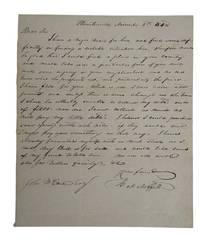
1842209651842. Slavery North Carolina Letter signed offering a "negro man" to settle debts. Letter signed by "H.M. Moffett" of Huntersville Virginia now West Virginia. Dated November 8th 1842. Measures 9.5" by 7.75". The letter reads in full: "Dear Sir I have a negro man for hire and find some difficulty in finding a suitable situation here therefore would be glad that I could find a place in your country and would take in as a particular favor if you will make some inquiring in your neighborhood and let me know what the prospects are and particularly the price- I have $200 for you which is all I can raise at present and unless their is some change in the times I shall be utterly unable to collect my debts of $1600 now due. I can't collect as much as will pay my little debts. I believe I could purchase some young cattle with notes if they would . I might pay you something in that negro sic. I have already furnished myself with as much stock as I need my Bull is for sale and would like some of my friends to take him. We are all well also Jan sic Millers family - . -- your friend H.M. Moffett." The letter was likely penned by Henry Hiller Moffett second Clerk of Pocahontas county Virginia present day West Virginia. Moffett is listed in the 1850 census with eight enslaved persons. Original folds some minor foxing. Overall very good condition. unknown
183384791Lexington KY: Abraham Skillman 1833. First Edition. First printing. 12mo 18.5cm; original brown cloth-covered boards; viii207pp. Respined to style with facsimile printed spine label; Bookplate of the Young Men's Christian Institute New Haven to front pastedown; bookseller's ticket Williams' Bookstore Under the Old South Meeting House Boston at base of front flyleaf; pencil signature faded and illegible to front endpaper. Complete sound and Good. <br /> <br /> One of a tiny number of pre-Civil War abolitionist texts to have been written by a Virginia author. Paxton 1784-1868 was a Presbyterian minister born in Rockbridge County Virginia and educated at Princeton Theological Seminary; it is likely his mentorship there under Charles Hodge helped develop Paxton's antislavery sentiments. In 1826 after publishing an essay asserting the institution of slavery to be incompatible with the teachings of the Bible Paxton was expelled from his pastorship of Cumberland Presbyterian Church near Farmville in south-central Virginia. The present text addressed to his former congregation recounts the events of his expulsion reprints the essay in question and adds a series of epistolary essays supporting his theological position in oppostion to slavery. <br /> <br /> The existence of any abolitionist sentiment during this period in Virginia's history is remarkable in itself. For a native-born minister to willfully preach the gospel of antislavery even the relatively conservative version of abolitionism professed by Paxton before a congregation whose sentiments on the subject would have been diametrically opposed - and which doubtless included a number of slaveholding families - must have amounted to apostasy in some congregants' eyes. By publishing the present work Paxton essentially doubled down on his unpopular beliefs making him in this cataloguer's eyes a rather remarkable figure. We find it surprising that so little biographical information exists regarding Paxton. His name barely appears in the scholarly literature on the period; perhaps because no mention of abolition is made in either the title nor the sub-title of his book the work is rarely discussed in articles on the antebellum southern antislavery movement. Though reasonably available institutionally Letters on Slavery is perenially scarce in commerce having appeared at auction only three times in the current century. This a quite decent copy in a discreetly restored binding. SABIN 59264. DUMOND Antislavery Bibliography p.89. LCP AFRO-AMERICANA 7501. Abraham Skillman unknown
180158147<p>ELOQUENT ARGUMENT FOR ABOLITION OF THE SLAVE TRADE BY A WEST INDIES SLAVE OWNER - WITH A DESCRIPTION OF SUGAR PLANTATIONS</p><p>Full title: 'Letters on the Cultivation of the Otaheite Cane; the Manufacture of Sugar and Rum; the Saving of Molasses; the Care and Preservation of Stock; with the Attention and Anxiety which is due to Negroes. To these Topics are added a few other Particulars analogous to the Subject of the Letters; and also Speech on the Slave Trade the most important Feature in West Indian Cultivation.'</p><p>first edition 8vo. xvi 248 248 1 blank 249-290 291-301 prospectus with detailed contents for book on Leeward Islands 1 blankpp large folding table at p.247 modern quarter rich tan calf spine panelled by raised bands with the panels richly gilt tooled red morocco title label marbled sides scattered foxing some light old water staining to lower and fore margins most noticeable in gatherings B and L and never obtrusive else a nice copy in a very handsome binding.</p><p>SABIN 9850 Goldsmiths'-Kress no. 18156.4 Rare Books Hub records none at auction. <br />Clement Caines d. 1817-1822 trained as a barrister in London inherited his family's sugar plantations in St. Kitts around 1778 and became the largest slave owner in the island. In the General Assembly of the Leeward Islands in 1798 he advocated the abolition of the slave trade better treatment for enslaved workers and an end to the slave trade. He wrote extensively on the desirability of humane treatment for plantation slaves and the abolition of the slave trade as well as political topics including his support for the Embargo. <br />The first part of this book effectively a detailed description the workings of a West Indian sugar cane plantation benefits from Caines's first hand experience of the topic. The second part p.249-288 contains his 'Speech on the Slave Trade' delivered to the General Assembly of the Leeward Islands in March 1798 which was discussing a resolution that the abolition of slave trade 'would be oppressive to the British planter destructive to the sugar colonies and consequently to the British Revenue and of no benefit to the Africans themselves'. Caines unambiguously stated "the slave-trade ought to be abolished. It ought to be abolished immediately. It ought immediately to be abolished for the sake and benefit of the planter". Caines argued that the slave trade was injurious not only to the slaves but to their owners. Having observed the death rates from exposure overwork and disease involved in forest clearing he bluntly stated that slave labour "cements with blood the walls of every sugar-work that is raised where forests grew". He stated that his business had "never been delegated to others. The slaves who were committed to my care performed their work under my own eyes. My time was passed with them and my attention devoted to them and their condition. I could not fail then to become acquainted with their wants and sufferings - to remark their sickness disability and premature decay: - the diseases among their men the sterility of their women and the death among their children". He directly challenged his hearers for their calculation "that a hardy African can be purchased for less than a Creole infant can be reared" and their consequent failure to provide adequate housing for mothers and children. He reports that about a quarter of newly arrived slaves on discovering their situation "pine and droop linger rather than live and shortly sink into the grave". Only an end to the importation of new slaves could disrupt the planters' callous calculation that they could "run our Negroes for two or three years" in the certainty that they could be then be replaced. Caines's familiarity with the actuality of slave life and his eloquent and direct illustration of it give this work an especial power.</p><p><br />Interestingly in 1811 Caines wrote to both Thomas Jefferson and James Madison sending copies of his publications vide https://founders.archives.gov/documents/Jefferson/03-03-02-0394 .</p> Printed for Messrs Robinson hardcover
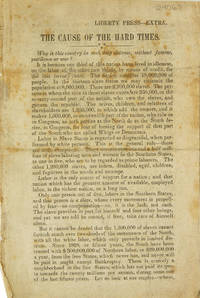
184324068Utica 1843. 4pp. 1 vols. 8vo. Disbound spotted and soiled separated along spine else a good copy of this rare piece. 4pp. 1 vols. 8vo. Rare. An "Extra" to the "Liberty Press" relating to slavery and the "deep distress" and idleness caused by slavery. The author signed "Truth-Teller" attributes most of the labor problems and many of the economic ones to the instution of slavery. He recommends allowing Florida a place in the Union as a free state and Congress guaranteeing each state a republican form of government which he feels would bring about the end of slavery. <br/><br/> unknown
24264ONE: ‘Coloured Emigrants from United States’ Downing Street 16 October 1850. TWO: ‘Immigration’ Downing Street 30 October 1850. Two interesting items from the period leading up to the American Civil War. Both items are scarce: no other copy of either traced. In good condition lightly aged. Extracted from a volume of Parliamentary Circulars with the ownership signature "Frederick Peel" Member of Parliament from Feb. 1849 dated 1839-1851 very good condition. The context makes it plain that this Circular was sent to all Colonial Governors a gap in the text indicating where the name of a specific Governor would appear in MS. Disbound from a volume and paginated in manuscript.Both printed in copperplate font. ONE: Printed ‘Circular’ dated from Downing Street 16 October 1850. Headed in manuscript ‘Colonial Emigrants from United States’. In manuscript at end not in Grey’s hand ‘/sd/ Grey’. 2pp 8vo. Paginated in manuscript 239-240. Begins: ‘Sir / I have to acquaint you that it has been suggested to me that a desirable Class of Emigrants for the West India Colonies might be induced to come to them from among the Black and Colored Population of the United States whose arrival and location if they chose to come would I have no doubt be advantageous to themselves and to the Colonies.’ TWO: Printed ‘Circular’ dated Downing Street 30 October 1850. Headed in manuscript ‘Immigration’. In manuscript at end again not in Grey’s hand: ‘/sd/ Grey’. 7pp 8vo. Not paginated in type; paginated in manuscript 239-245. Divided into eleven numbered sections the first of which reads: ‘In the course of the long correspondence which it has devolved upon me to conduct with the Governors of the Sugar Colonies and others on the subject of the Immigration of Labourers it has been my endeavour to promote the establishment of such laws and regulations respecting Immigrants introduced at the public expence as should make the Immigration most conducive to the well being of the Immigrants themselves of the Colonists by whom their labour was required and of the Populations at large of the Colonies in which they were to be placed.’ The chief ‘descriptions of Immigrants’ discussed in the correspondence are: ‘1st Coolies brought or about to be brought from the East Indies to some of the West Indian Colonies by the aid of Colonial Revenues or Loans raised by the Colonies and guaranteed by this Country. - 2nd. Kroomen or Africans from Sierra Leone and those parts of Africa where Slavery does not exist brought to the West Indies by the same means. - 3rd. Africans taken from captured Slavers liberated under sentences of the Mixed Commission Courts and brought to the West Indies at the sole cost of this Country.’Printed ‘Circular’ dated from Downing Street 16 December 1842. Headed in manuscript ‘Crime in the high Seas’. At bottom in manuscript not Stanley’s hand: ‘/sd/ Stanley’. Twenty-nine lines in copperplate font. The first of four paragraphs reads: ‘The attention of Her Majesty’s Government has been recently called to various Laws enacted in the British Colonies for the prevention regulation or punishment of acts done in the High Seas as on the Seas within one League of the Shore of the Colonies in which such Laws have originated. After consultation with the Queen’s Advocate and the Attorney and Solicitor General Her Majesty’s Government have adopted the following conclusions on the subject.’ ONE: ‘Coloured Emigrants from United States’, Downing Street, 16 October 1850. TWO: ‘Immigration’, Downing Street, 30 Oc unknown
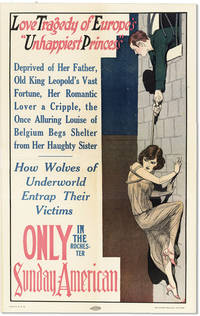
190415411Rochester: Office of the American 1904. Broadside extra lithographed in colors; 18" x 11". Single fold else fine. Colorful graphic depicting Princess Louise escaping from her asylum cell with the help of her illegitimate lover Geza Mattattich. The caption tempts readers with a White Slavery theme suggesting that Princess Louise has been lured to her ruin by a "Wolf of the Underworld." Unlocated. Office of the American unknown
1836216961836. Slavery & Abolition CHILD Lydia Marie. An Appeal in Favor of That Class of Americans Called Africans. New York: Published by John S. Taylor 1836. Second edition. Illustrated with 2 plates. Coleridge quote on title page. In original blue cloth boards with embossing and gilt to spine. 8vo 216 pages. Child was a vocal abolitionist women's rights activist anti-American expansionist and proponent of racial equality amongst African and Native Americans. An Appeal in Favor of That Class of Americans Called Africans was the first written by a white woman in support of the immediate emancipation of slaves without compensation to their enslavers. Child begins by writing about the history of the slave trade as well as harrowing stories on it's detrimental and immoral faculties in order to engage readers to action. One illustrated plate showcases shackles and chains used on enslaved individuals. First published in 1833 Child's work was a prominent contribution to the abolitionist movement and her writing influenced many notable figures including Harriet Beecher Stowe and Frederick Douglass. Missing frontispiece some foxing to pages some wear to covers. Small tear affecting a few words in the fist first sentence on page 127. Binding is tight and text is clean and legible. Overall very good condition. unknown
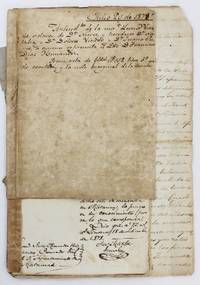
18784011Various places in Cuba 1878. Overall good. 29 leaves varying sizes. In contemporary ad hoc selfwrappers loosely stitched. Rear wrap tattered. Varying degrees of toning and wear. Scattered offsetting throughout. Fascinating gathering of documents and letters that present several cases of Cuban slaves applying for their own freedom in 1878. The gradual abolition of slavery on the island was enacted by Spain in 1880 but prior to this there were several bureaucratic mechanisms by which enslaved people could apply for or purchase their own manumission. The most interesting case amongst the present manuscript documents is the claim of a male slave that states he was born free in Puerto Rico but was somehow included in an inheritance as a young boy transported to Cuba and sold into slavery:<br /> <br /> "Un individuo que hoy se encuentran en la Cárcel del Alacranes y que dice nombrase Juhan ó José Julian Quintana y ser esclavo actualmente de Dn. Serapio Hernandez dueño de los ingenios Escorial ubicado en Colon y Sta. Rosa en Limonar y vecino de esa Ciudad calle del Rio ha solicitado se le restituyan un derechos de libertad por haber nacídolibre en Puerto Rico de donde á la edad de 5 ó 6 años le trajeron à esta Ysla y vencieron como esclavo."<br /> <br /> Interesting for the study of manumission in late-colonial Cuba and certainly worthy of further research. unknown