1 561 résultats
Rilegato con “De usu antiquae locutionis libri duo” (Anversa, 1606) e con “De operis servorum liber” (Anversa, 1608). In -8°, pp. (4), 336, 158, 107, (3); piena pergamena con titolo manoscritto al dorso. Popma è teorico della sinonimia, fra i più citati nella prima edizione del Dizionario dei sinonimi del Tommaseo (1830), che fa riferimento proprio al “De differentiis verborum”. Popma was a theoric of synonyms, one of the first scholars facing this question.
7809traduit de l’anglais par pierre François CAILLE.In 8 demi-cuir lie de vin à nerfs et à bandes.Titre,roulette,fers dorés,petit rehaut de rouge.Filets dorés sur les plats. Faux-titre,carte de l’Est des Etats Unis au moment de la guerre de sécession,titre,735 pages.Gallimard Février 1939. Copyright by librairie Gallimard 1938.Premier plat de couverture illustré,conservé.Edition originale de la traduction française, très bon état
1827213910London: John Hatchard and Son 1827. Illustrated by 9 etchings. viii 464 pp. 1 vols. 8vo. Full calf spine gilt. Upper board missing 8 leaves damp-stained else Near Fine. Illustrated by 9 etchings. viii 464 pp. 1 vols. 8vo. John Hatchard and Son unknown
1827213910London: John Hatchard and Son 1827. Illustrated by 9 etchings. viii 464 pp. 1 vols. 8vo. Full calf spine gilt. Upper board missing 8 leaves damp-stained else Near Fine. Illustrated by 9 etchings. viii 464 pp. 1 vols. 8vo. John Hatchard and Son unknown books
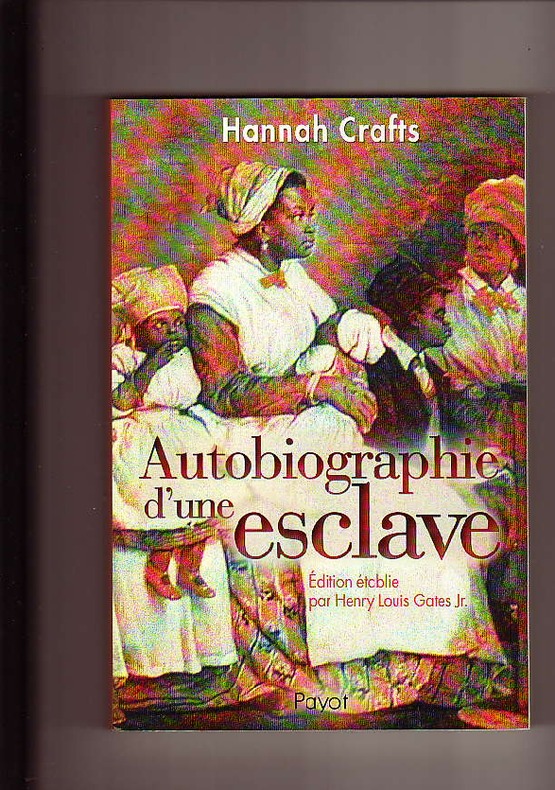
2005AMERIQUE3333713Paris, Payot, 2005, 15,5 x 23,5, 335 pages sous couverture illustrée. Edition établie par Henry Louis Gates Jr..
1861Cat338Lafayette Ohio 1861. Autograph letter signed 2 pp. Addressed to D. T. Chapin of Enfield Connecticut. Good condition with normal folds and light wear. A concise but revealing early Civil War letter combining financial anxiety agricultural reporting and clear-eyed political commentary on slavery and the future course of the conflict. Writing amid the first months of the American Civil War Chapin opens with the immediate purpose of the letter—forwarding “a draft of $240 for int. on the noteâ€â€”before situating the payment within a deteriorating economic landscape: “It is very difficult to get money now even of the best men.†He describes a local economy under strain noting “no market for wool to bring in money†compounded by regional instability “on account of the bank failing and many of the merchants in Medina closing†concluding bluntly: “Terrible bursting times with them.†Even the act of sending funds carries uncertainty as he cautions that “in these times I consider there is a risk in the best of banks.†Alongside these concerns Chapin provides a snapshot of agricultural conditions: “Corn is very backward and short wheat nearly middling grass rather below middling†summing up the situation as “rather tight times as well as troubled times.â€<br /> <br /> The most significant portion of the letter however turns to the war itself and the unresolved question of slavery. He writes:<br /> <br /> “We hope the end will be well but our nation will have to be humbled. It is well to put down rebellion but it is rather queer that the cause of the trouble must be let entirely alone. The nation will get their eyes open after a while. The President possesses the war power to abolish slavery and Congress possess the power also in my humble opinion and the time will come when they will have to do it unless the south run their heads so hard against the rock as to do it themselves.â€<br /> <br /> The letter closes with a brief note on a failed business transaction—“our trade for the sale of the mill fell throughâ€â€”underscoring the economic uncertainty of the moment before returning to family matters. Overall an evocative early Civil War letter by a merchant expressing fears and anxiety for the pending conflict. unknown
183331599England: Elliott Cresson 1833. Bi-folded folio. 3 pp. 12 1/3 x 7 1/2 inches. Important autograph letter from Elliott Cresson one of the foremost proponents of the American Colonization Society and its colony in Liberia to Member of Parliament Benjamin Hawes presenting a resolution to found the British African Colonization Society. Discusses the famed abolitionist William Lloyd Garrison's opposition to the colonization movement.<br/> <br/> The letter begins with the two-page text of a resolution to establish the British African Colonization Society under the patronage of the Duke of Sussex: "That Colonies composed of fair settlers of African race established on judicious principles on the Coast of Africa appear calculated beyond any other plan to put an effectual stop to the slave trade . . . Resolved that a Society be formed to be called the British African Colonization Society and that its objects be to cooperate with the American Colonization Society and with the several missionaries and other religious and charitable societies in Great Britain and the United States of America in such measures as may promote the total abolition of the slave trade and the establishment of Christianity and Civilization among the Natives of Africa chiefly by the employment of Free Persons of African birth or descent . . ." In the letter which follows Cresson writes of William Lloyd Garrison's opposition to the colonization movement: "I send the list of officers as far as accepted several others have not yet answered but I trust we shall present a bold front. I have just heard thru his Chaplain from the Duke. Garrison has written to poison his mind and probably will annoy our meeting. I trust that as the notice has been so short our friends will bring many with them . . . My letter to the Times in answer to Garrison they have not yet noticed so that it will be put in the Globe whose Editor has offered it a place in his columns." Cresson a noted Philadelphia businessman and philanthropist was among the most ardent supporters of colonization the movement to relocate formerly enslaved people and free black Americans to colonies in Liberia. In 1832 he traveled to England to promote international support for the movement. The following year Cresson and the Philadelphia Young Men's Colonization Society a branch of the American Colonization Society founded Port Cresson in Liberia. However the colony was attacked in 1835 by Bassa tribesmen incited by Spanish slave traders and destroyed. Although initially in favor of colonization William Lloyd Garrison changed his mind and decried the efforts of the American Colonization Society as a perpetuation of slavery. For Garrison's 28 June 1833 letter to the Duke of Sussex referenced above see The Letters of William Lloyd Garrison I:107. Elliott Cresson unknown
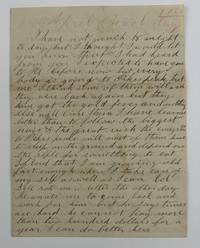
18604105Missouri: April 1 1860. Very good. 4pp. on a single folded sheet. Original mailing folds minor toning. An informative letter written by Charles H. Cram in Missouri to a friend in New England dated "April Fools Day 1860" in red pencil at the top of the first page. Cram mentions hoop skirts Pike's Peak and slavery while trying to decide whether to continue westward during the latter years of the California Gold Rush. Cram's letter reads in part: "Everybody is going to Pikes Peak but me. I think some of them will wish they were back again but they have got the gold fever and nothing else will cure them. I have learned better than to follow the biggest nois and the great rush. The emigrants to Pikes Peake will most of them will have to sleep on the ground and depend on the rifle for something to eat. I may start for Santa Fe about the first of June. I can git 15 dollars a month to drive a teem to Santa Fe. If I do cross the plains I shall go to California but if I have good health I shall stay here though I do not like to live in a slave state."<br /> <br /> In another portion of his letter Cram addresses his correspondent's question of whether slaves and freedpersons wore hoop skirts in Missouri. Cram writes: "You wanted to know if niggers wore hoops. Some do and some don't some slaves in broadcloth and silk and some go nearly naked. Slaves have there stent to do so much & if they do more they are payed for it. Most of them have a piece of ground that they call their own. What time they get they work on it. That is how they git their fine cloths. There is not a nigger in Missouri that works as hard as I do but I have consolation that I can work only when I am a mind to. You tell Albert not to start out among strangers as I did for he will find the people different in the country from them in New England."<br /> <br /> Cram then speaks to the emigrant populations he encounters out west as well as the agricultural bounty and animal life of Missouri: "The greatest difficulty I had was to learn the French and German language. I have been for weeks where I could not understand a word but now I can understand anything that comes along. But now for something else. The peach trees are in flower and the woods look green. Cattle and horses pick their living here the year round. I have not seen a barn in the country. The way to feed a horse is to tie him up to a tree and throw him a few ears of corn on the ground. I cannot rite to day much for there is half a dozen in the room talking about pikes peak or some young lady and how many negroes her father owns etc."<br /> <br /> Cram ends his letter with some advice for his friends back east: "Tell Mr. Bosworth that if he can rais $500 that he had better go to Cansas Kansas and go to farming. If you can persuade Andrew Marshall to go west it will be a good lesson for him."<br /> <br /> A mid-19th century manuscript letter with informative observations on the clothing of slaves and with notable observations of western life in Missouri. April 1 unknown
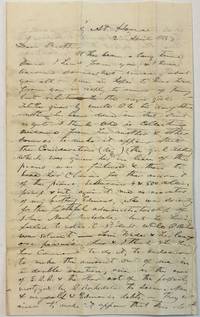
184740201Stewartsboro TN 1847. Folio 15" x 12-3/4" sheet folded to 7-1/2" x 12-3/4". 4 pp. Completely in ink manuscript integral address leave bearing Stewartsboro Tennessee April 3 1847 manuscript postal marking. mailing address on last page. The initials of the writer's name are difficult to decipher; this is our best guess. Old folds two short fold splits and a few tiny holes at fold corners. Wax seal remnant with tear at edge loss of a few letters some toning. Good to Very Good. <br /> <br /> The writer is concerned that Thomas had not responded to his letter "relating to the negro girl Tabitha given by Uncle R. to his daughter- nothing has been done in that suit as yet. I think she is collecting evidence from her mother & other sources to make it appear that the consideration viz the girl Tabitha which was given her in lieu of the piano was a failure & then to base her claim for the amount of the piano between 4 and 500 dollars princp. & int. against me as executor of my brother Edmond who was security for the faithful administrationship of John Nash Barksdale but he having failed to collect sd. debt while R. Barksdale was solvent. Levi Wade & her lawyer are persuading her. . . " He gives Thomas permission to "calculate on receiving a portion of the money for which Paulina sold. . . Negroes have advanced within 3 or 4 months but I fear one diseased as your boy Phil will command but a small price."<br /> Dr. Thomas Hill Read 1798-1874 of Tennessee settled in Macon County Illinois in 1831. He was the brother-in-law of Capt. David L. Allen one of the most prominent early citizens having married his sister. Dr. Read became known for his success in the treatment of children's ailments and was considered an expert in cholera infantum. He had a reputation for honesty and was said to have acted as administrator of more estates than anyone else in Macon County. Dr. Read was a member of the Decatur Board of Trustees in 1839 1841 1846 and 1847; County Treasurer from 1845-1846 and County Probate Judge from 1846-1849.<br /> John Nash Barksdale 1818-1844 Thomas Read's maternal cousin was born in Tennessee graduated from the University of North Carolina and became a lawyer. He practiced law in Tennessee for a few years and then moved to Columbus Mississippi and entered the law firm of his cousin Gen. William Barksdale. The Columbus bar announced that its members would wear the badge of mourning for thirty days following his death. "Death of John N. Barksdale" Republican Banner Nashville TN Dec. 6 1844 Page 2.<br /> Uncle R was likely Randolph Barksdale 1795-1844 Thomas H. Read's maternal uncle and John Nash Barksdale's father. Randolph settled in Tennessee with his father in 1808 and later established his own plantation. He was married three times and became the owner of a large estate and several slaves in Rutherford County Tennessee thanks to the wealth of his first wife. He also owned an estate near Chulahoma in Marshall County Mississippi. unknown
183431598Philadelphia 1834. 3pp. Later annotation at head of first page. Scarce letter on the Liberian colonization movement by one of its founders.<br/> <br/> Writing to Hawes a member of Parliament and a committee member of the Society for the Extinction of the Slave Trade Cresson wishes for success in the British anti-slavery action off the coast of Sierra Leone writing "I hope that you may yet enjoy the satisfaction of crushing one of the worst & most unacceptable of the slave markets in existence that at Gallinas." After mentioning the travels of the colonial governor of Liberia he writes: ". I have been gratified to learn from several highly respectable sources that such a Colony as you propose located either at the mouth of the Cape Mount River or even a little more to the Northward say at Sugaree & provided with a good supply of trade goods to exchange with the natives would have a powerful tendency to break up the monopoly now enjoyed by the Spanish Slavers. My letters from Africa state that the demand is so great in Cuba from the ravages of Cholera among their ill-fed human cattle as to have rendered the shipments from the Gallinas during the past year almost unprecedented. It appears that the benevolent efforts of your Govt. are not likely to extirpate the evil until commercial & agricultural colonies shall be substituted for cruisers." The letter continues with news from their consul at Liberia before turning to American politics: ". political affairs engrossing the entire energies of the nation. The excitement is painfully great . Our military chieftan Jackson by his acts of unauthorized assumption has called forth a burst of indignation which cannot subside until we get rid of the offender." The letter concludes with an introduction for Gerard Ralston. Cresson a noted Philadelphia businessman and philanthropist was among the most ardent supports of colonization the movement to relocate former slaves and free African Americans to colonies in Liberia. In 1833 Cresson and the Philadelphia Young Men's Colonization Society a branch of the American Colonization Society founded Port Cresson in Liberia. However the colony was attacked in 1835 by Bassa tribesmen incited by Spanish slave traders and destroyed. unknown
15313Birmingham 3/13 1852. 1-page 8vo tipped on to part of an album page. He regrets that he is unable "to lodge at your home at the Quarterly Meeting" as "My dear Hannah is expecting to be confined almost daily and I cannot.leave home at all.". Birmingham 3/13 1852. unknown
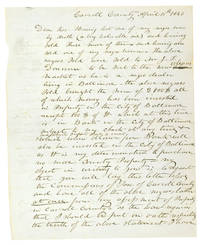
1848262219Carroll County Maryland 1848. 2 pp. pen and ink on signle sheet. 4to. Light creasing from prior folding. 2 pp. pen and ink on signle sheet. 4to. Reading in part: "Having lost one of my negro men by death a big valuable one and having sold three more of them and having also sold one of my negro women - the above negros were sold to Mr. Joseph S. Donovan to be sent to the New Orleans market as he is a negro dealer living in Baltimore - the above negroes sold brought the sum of $2800 all of which money has been invested in property in the city of Baltimore . My object in writing to you is to request that you will lay this letter before the Commissioner of Tax of Carroll County and have all of the above negroes taken at once from my assets .". unknown books
184045421Mobile AL Aug. 10 1840. Autograph letter signed on first and second panels of single bifolium sheet 25.5cm.; approx. 370 words. Previous folds the whole rather wrinkled postally used on rear panel else Very Good. Letter from Jesse Bemis 1808-1843 a Mobile transplant to his brother David of Spencer Worcester Co. Massachusetts where Jesse was born. The author thanks his brother for some fly nets sent him "I have sold about half of them at some profit" later noting that "they are not only worn on horses but they are used to spread over the cradles of the Negro Children as a screen the Negro women also wear them to Church & on dressy occasions. I hope the Abolition Missionarys wont find it out before I can dispose of all that I have for frear that they will glut the market." Bemis goes on to describe the election of 1840 "the tightes sic election in the State that ever was it took place the 3d of this month in this County we elected the whig ticket throughout" and goes so far to mention that "The women say out with Van Buren & give us the credit system." Indeed the women had their way as Van Buren lost to Harrison in large part thanks to the efforts of the Whig Party. unknown books
46418Liverpool: 1843. Quarto sheet folded once to make 4pp. Signed in three places "Emily Taylor"; marked "Private;" and "for Mrs. Chapman." Mild cover soil; small loss at right margin from opening; slight fading to ink. Very Good. Includes brief introductory followed by an anti-slavery poem of 67 lines "For the Liberty Bell" submitted for publication in the American gift annual of that name. Numerous ink corrections to the text in the author's hand. English poet and hymnist Emily Taylor 1795-1872 was the author of more than twenty books including the book-length anti-slavery poem The Vision of Las Casas 1825. Though best-known as an author of historical works for children she was also a prolific hymnist contributing more than a dozen works to various Unitarian hymnals in the first decades of the 19th century possibly providing her connection to Follen also a well-known hymnist. The present letter is addressed to the prominent abolitionist author Eliza Lee Follen of Boston and opens: "My dear Madam Our mutual friend Harriet Martineau assures me of a kind reception from you and accordingly I transcribe for you a few lines written immediately on reading your Liberty Bell for 1843. If you are to enroll my name among those which I hold so holy & dear as your contributors in the Abolition cause please to accept them." The substantial 67-line poem which follows begins with the prologue: "To a friend who asked the author's aid and prayers for the slave;" and continues: "Pity & prayers and pleading for the Slaves! / Them thou didst ask and soon as ask'd I gave." The poem goes on to extend the by-then familiar argument that the institution of slavery makes slaves not only of its subjects but of its perpetrators as well. Taylor concludes as a postscript on the final leaf: "Would you dear Mrs. Follen forward the enclosed to Mrs. Chapman Maria Weston Chapman editor of The Liberty Bell .I am sorry but do not know Mrs. C's address." <br/><br/>The poem was in fact published without revisions as "To A Friend" in the 1844 edition of Chapman's important anti-slavery gift annual The Liberty Bell; other contributors to this edition included James Russell Lowell Lydia Maria Child Harriet Martineau Amasa Walker William Llloyd Garrison and others. The recipient of the letter Eliza Lee Cabot Follen was herself a prominent and prolific abolitionist author scion of the Cabots of Boston and part of the Boston social circle that included William Ellery Channing Henry Ware George Ticknor and other patrician intellectuals of the period. An excellent and representative letter and manuscript involving three key women figures in the abolitionist movement during a particularly heady period for the cause. unknown books
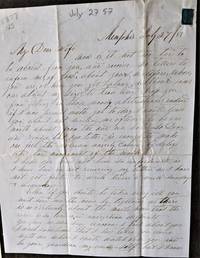
1857708Memphis 1857. 4to. letter sheet. 250 x 195 mm. 9 ¾ x 15 ½ inches. 4 pp. about 840 words. Folded in thirds. Written in black ink faded brown in very legible hand. Jesse McCallum was a hay dealer from Cincinnati Ohio who travelled away from his family on business forays. In this case he writes from Memphis Tennessee complaining about the heat and commenting on the "darkies" as follows: ". the sun is scorching from 10 am to 4 pm the difference is very perceptible I think the heat is greater on account of the drought the ground is parched up and dry.the streets are deserted in the middle of the day but the darkies will be down in the hottest part of the day in the sun and sleep with the sun shining full in their face and appear to enjoy it as much as a white man would in the shade what a difference collar sic makes.the south could not get along well without its black population one months work in the sun of the south would cure the bitterest abolitionist of the north of his bitter oposition sic to institutions of slavery and come over without a groan to be a slave owner if compelled to earn his living by cultivating the soil." McCallum thinks "we will do well on this load of hay.as hay is advancing" and also comments about his wife's lack of correspondence and reminds her that he writes twice a week. The last page is particularly affectionate--he remarks about being a "bachelor husband" and adds ; ". the only true enjoyment I have had was when I recd your letter since I left you and now Elly if you wish me to enjoy myself write often." Jesse McCallum often spelled Mc Collum in historical records was born in Ohio in 1819. In 1850 he was working as a stone cutter. By 1860 he was living with wife Eleanor Welsh and  six children in Marysville Yuba California. In the Civil War he was a Union Corporal 81st Illinois Infantry Company A. In 1870 he was making "gas machines". He died in Marysville in 1880. unknown books
183331599England 1833. 3pp. Scarce letter on the Liberian colonization movement by one of its founders.<br/> <br/>The letter begins with the 2-page text of a resolution to establish the British African Colonization Society: " . that Colonies composed of fare settlers of African race established on judicious principles on the Coast of Africa appear calculated beyond any other plan to put an effectual stop to the slave trade . Resolved that a Society be formed to be called the British African Colonization Society and that is objects be to cooperate with the American Colonization Society and with the several missionaries and other religious and charitable societies in Great Britain and the United States of America in such measures as may promote the total abolition of the slave trade and the establishment of Christianity and Civilization among the Natives of Africa chiefly by the employment of Free Persons of African birth or descent." The proposed Society was to be established under the patronage of the Duke of Sussex. In the letter which follows Cresson writes of William Lloyd Garrison's opposition to the colonization movement: " . I send the list of officers as far as accepted several others have not yet answered but I trust we shall present a bold front. I have just heard thro his Chaplain from the Duke. Garrison has written to poison his mind and probably will annoy our meeting. I trust that as the notice has been so short our friends will bring many with them . My letter to the Times in answer to Garrison they have not yet noticed so that it will be put in the Globe whose Editor has offered it a place in his columns." Cresson a noted Philadelphia businessman and philanthropist was among the most ardent supports of colonization the movement to relocate former slaves and free African Americans to colonies in Liberia. In 1832 he travelled to England to promote international support for the movement. The following year Cresson and the Philadelphia Young Men's Colonization Society a branch of the American Colonization Society founded Port Cresson in Liberia. However the colony was attacked in 1835 by Bassa tribesmen incited by Spanish slave traders and destroyed. Although initially in favor of colonization William Lloyd Garrison would change his mind decrying the efforts of the American Colonization Society as a perpetuation of slavery. For Garrison's 28 June 1833 letter to the Duke of Sussex referenced above see The Letters of William Lloyd Garrison I:107. unknown books
183431598Philadelphia 1834. 3pp. Later annotation at head of first page. Scarce letter on the Liberian colonization movement by one of its founders.<br/> <br/>Writing to Hawes a member of Parliament and a committee member of the Society for the Extinction of the Slave Trade Cresson wishes for success in the British anti-slavery action off the coast of Sierra Leone writing "I hope that you may yet enjoy the satisfaction of crushing one of the worst & most unacceptable of the slave markets in existence that at Gallinas." After mentioning the travels of the colonial governor of Liberia he writes: ". I have been gratified to learn from several highly respectable sources that such a Colony as you propose located either at the mouth of the Cape Mount River or even a little more to the Northward say at Sugaree & provided with a good supply of trade goods to exchange with the natives would have a powerful tendency to break up the monopoly now enjoyed by the Spanish Slavers. My letters from Africa state that the demand is so great in Cuba from the ravages of Cholera among their ill-fed human cattle as to have rendered the shipments from the Gallinas during the past year almost unprecedented. It appears that the benevolent efforts of your Govt. are not likely to extirpate the evil until commercial & agricultural colonies shall be substituted for cruisers." The letter continues with news from their consul at Liberia before turning to American politics: ". political affairs engrossing the entire energies of the nation. The excitement is painfully great . Our military chieftan Jackson by his acts of unauthorized assumption has called forth a burst of indignation which cannot subside until we get rid of the offender." The letter concludes with an introduction for Gerard Ralston. Cresson a noted Philadelphia businessman and philanthropist was among the most ardent supports of colonization the movement to relocate former slaves and free African Americans to colonies in Liberia. In 1833 Cresson and the Philadelphia Young Men's Colonization Society a branch of the American Colonization Society founded Port Cresson in Liberia. However the colony was attacked in 1835 by Bassa tribesmen incited by Spanish slave traders and destroyed. unknown books
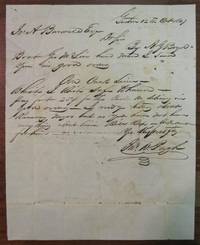
18472183421847. unbound. The writer Mr. Pugh also mentions that he has received a letter concerning a runaway slave and will keep a look out in part: ".I rec'd your letter about a Runaway Negro but as yet have not heard anything about him. Will keep a look out. Yours Respectfully." 1 page 8vo light water-staining 9.25 x 7.5 inches. No place October 12 1847. Very good- condition.<br/><br/> unknown books
RO80212991Julliard. Non daté. In-12. Broché. Etat d'usage, Couv. défraîchie, Dos frotté, Intérieur frais. 220 pages. Rousseurs sur la couverture.. . . . Classification Dewey : 326-Esclavage
2008R100067479Editions l'Ancre de Marine. 2008. In-8. Broché. Bon état, Couv. convenable, Dos satisfaisant, Intérieur frais. 240 pages.. . . . Classification Dewey : 326-Esclavage
1992R110026125INSTITUT COOPERATIF DE L'ECOLE MODERNE. 1992. In-8. Broché. Bon état, Couv. convenable, Coiffe en tête abîmée, Intérieur frais. 64 pages richement illustrées de photos et dessins en noir et blanc et en couleur.. . . . Classification Dewey : 326-Esclavage
INSTITUT COOPERATIF DE L'ECOLE MODERNE. 1992. Bon état. Couv. convenable. Intérieur frais. 64 pages richement illustrées de photos et dessins en noir et blanc et en couleur.
Biography, Autobiography Paperback nonfiction - trade size. NEW
319p., illus. Hardcover Very good condition Edited Frances Smith Foster