1 561 résultats
1989R240117726SYLVIE MESSINGER. 1989. In-8. Broché. Bon état, Couv. convenable, Dos satisfaisant, Intérieur frais. 343 pages - frontispice noir et blanc - quelques illustrations noir et blanc hors texte. . . . Classification Dewey : 326-Esclavage
1989lr1121Sylvie Messinger Les pas de Mercure Broché 1989 In-8 (15,2 x 20,1 cm), broché, 343 pages ; pliure au dos, rousseurs sur la tranche supérieure, importante épidermure papier au quatrième plat, en l'état. Livraison a domicile (La Poste) ou en Mondial Relay sur simple demande.
5221Paris, Sylvie Messinger, éditrice, Les Pas de Mercure, 1989, broché, couverture illustrée , 15x20 cm, 343 pages. Gravures.
1377493Paris: Editions Demi-Lune & ASA Editions, 2005 in-4, 189-(3) pages, riche illustration. Glossaire, chronologie, bibliographie, discographie, filmographie. Cartonnage illustré d'éd., très bon état. Collection "Danses du monde".
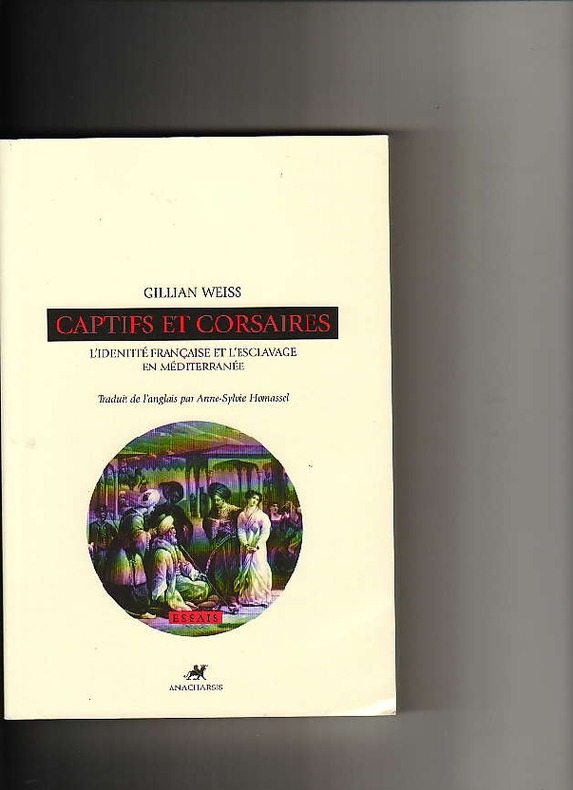
2014ESCLAVAGE58614Toulouse, Anacharsis, "Essais - Série Histoire", 2014, 14,5 x 21,5, 411 pages sous couverture illustrée. Traduit de l'anglais par Anne-Sylvie Homassel.
1877CAT0113J.A. Brush: Minnesota 1877. 2 ¼ x 4 inch image on slightly larger mount. Fine. Chambers a seven-year-old boy at the time of the Civil War followed the soldiers Jasper Dickey and David Scofield from Georgia back to their homes in Minnesota. The two soldiers raised him. He died in 1936 at the age of seventy-eight. Inscription on album page from which photograph was removed reads "Samuel Chambers / Zumbrota Minnesota. / Born a slave but followed northern troops to Minnesota at close of war." Verso identifies the photographer as J.A. Brush of 223 Nicollet Av. Minneapolis. A fine example. Minnesota unknown books
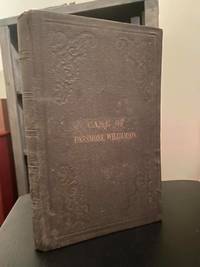
1856218<b>First edition of "the most complete record available" of the controversial Pennsylvania case on fugitive slaves establishing a "precedent set in federal and state courts… and important cause célèbre for the antislavery movement" crucial in asserting a clear path for the following year's Dred Scott decision and provoking a "legal crisis… that led to the Civil War" elusive in original cloth. An overall clean text with soiling on top of pages 1-16 & pgs. 161-191 and contemporary ink marginalia by Strawbridge on a few pages. John Strawbridge is inscribed in old ink on page prior to title page. A book which has become difficult to find in the original cloth.</b> Uriah Hunt & Son hardcover
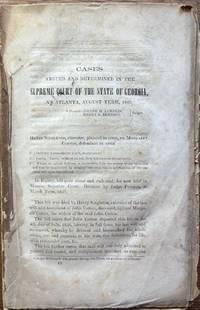
185736729Atlanta: State of Georgia 1857. Wraps. Fair. Stitched wraps. Pages 261-465. Missing the outer front cover that identifies the printer and location. Rear wrap missing. Rest of contents present. Untrimmed wraps lightly soiled on the front cover. Interior contents clean. Contents include a lengthy case regarding the American Colonization Society versus Lucius J. Gartrell administrator will of Francis Gideon deceased in the county of Fulton pages 448-465. State of Georgia unknown
5806Londres. Catalogue de vente publique chez Sotheby's & Co. Février 1958. Grand in-8° broché. 55 pages. 141 numéros.
2007500080749POCHE JEUNESSE 2007 256 pages 12 6x1 4x17 6cm. 2007. pocket_book. 256 pages.
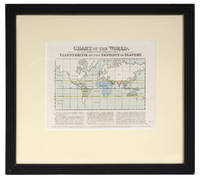
94420London Joseph Cross n.d. but c. 1825. . Hand coloured engraved map. The map shows the extent 30° north and south of the Equator in which sugar is grown. Australia is still shown as New Holland. 29.8 cm x 23.7 cm 11¾" x 9¼". Framed and glazed.<br /> Scarce colour-coded map concerning the sugar trade and its link to slavery.<br /><br />The section shaded yellow is the appropriate climate for the growing of sugar. The section shaded red is the area from which Britain may obtain sugar cheaply parts of South America and the West Indies under British rule. The blue section shows where Britain is unable to obtain sugar due to the devastating effects of the slave trade. The pink and green areas are those from which the sugar trade is limited by high duties and restrictions. The argument is that the duties and restrictions are there to protect the slave trade and ultimately damage the British economy.<br /><br />James Cropper was a successful and wealthy Quaker merchant philanthropist and disciple of Adam Smith. A major force in the anti-slavery movement he believed that eliminating tariff protections would lead to the end of slave labour in the West Indies. Cropper himself had interests in East Indian sugar and therefore stood to benefit from the reduction of tariffs which colored his role in the abolition movement. Nevertheless 'in Cropper's mind the intensity of Quaker Quietism had fused with the economic optimism of Adam Smith. Anti-slavery confirmed this union endowing laissez-faire with an immediate moral and spiritual purpose and enriching his faith in the inevitability of human progress' Davis James Cropper and the British Anti-Slavery Movement 1961.<br /> London, Joseph Cross, n.d. [but c. 1825]. unknown
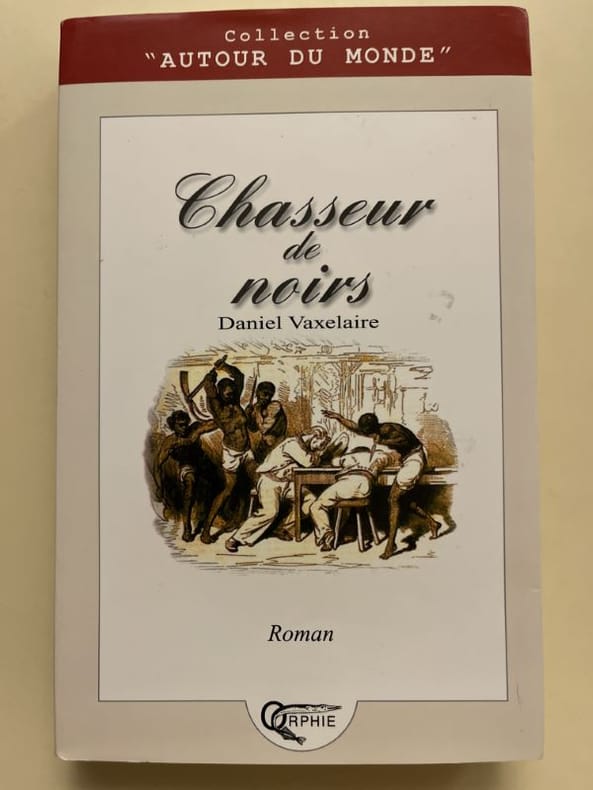
Orphie, 2002. In-8 broché sous jaquette, 376 pages. Parfait état
2002168505Orphie Orphie, 2002. In-8 broché sous jaquette, 376 pages. Parfait état
198315288Princeton: Princeton University Press 1983. First Edition. Octavo. Cloth boards; dustjacket; 515pp; illus; includes bibliography. Removed from a non-circulating private library with ink ownership markings to front endpaper and accompanying black ink elisions from de-accession. Light rubbing to boards; otherwise bright copy in near fine dustwrapper with unmarked text. Princeton University Press unknown books
2017151003Pluriel Paris, Pluriel, 2017. Fort in-12 broché de 567 pages. Très bon état
18680Paris, Hachette, 1892. xvi, 352 pp. 8vo. Sewn, original printed covers, uncut. Du Peloux 76. Original edition. Etienne-François de Choiseul (1719-1785), French statesman. He gained the protection of Madame de Pompadour and was given the appointment of ambassador to Rome in 1753, where he was entrusted with the negociations concerning the disturbances called forth by the bull Unigenitus. He acquitted himself skilfully in his task and in 1757 he was transferred to Vienna, where he was instructed to cement the new alliance between France and Austria. His succes in this mission opened the way to even higher offices and in 1758 he became minister of foreign affairs and directed French foreign policy during the Seven Years' War. He continued to control the policy of France untill 1770, holding most of the other important offices of state in that period. Coming to power in the midst of the demoralization consequent upon the defeats of Rossbach and Crefeld, by boldness and energy he reformed and strengthened both army and navy, and although too late to prevent the loss of Canada and India, he developed French colonies in the Antilles and San Domingo, and added Corsica and Lorraine to the crown of France. His management of home affairs in general satisfied the philosophes, he allowed the Encyclopédie to be published, and brought about the banishment of the Jesuits and temporary abolition of the order by Pope Clement IV.
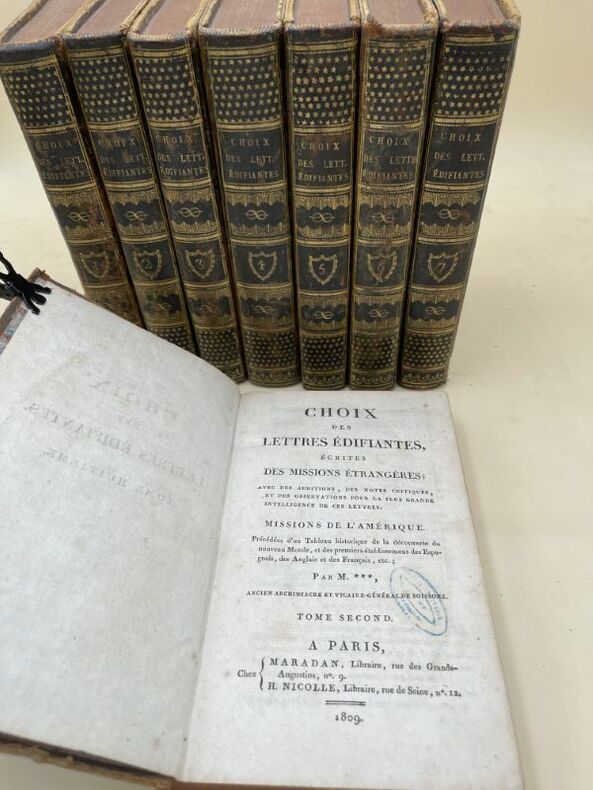
180899912953Maradan A Paris, chez Maradan, 1808 - 1809. 8 volumes In-8 relié pleine basane marbrée, dos lisses très ornés. cviii + 400 + 451 + 458 + 568 + 427 + 507 + 487 + 514 pages. Reliures frottées, coins émoussés. Intérieurs en très bon état. Edition originale. Ouvrage contenant d'innombrables articles, entre autres : Sur l'Afrique et l'esclavage, le Mexique, la Turquie, la Syrie, le commerce dans le Levant, la Perse, l'Empire Birman, la Chine, le Tonkin ainsi qu'un très grand nombre de renseignements sur les moeurs et coutumes, les métiers etc. Malgré les défauts signalés bon exemplaire.
64818Saint-Maurice, Saint-Augustin 2007, 210x140mm, 399pages, broché. Très bel exemplaire.
14552Paris, Maurice Dreyfous, s.d. [1885] ; grand in-8. XVIII-696 pp. 2 frontispices hors-texte - 3 cartes dépliantes en deux couleurs - 1 grande carte en couleurs imprimée sur deux feuilles repliées in fine. Déchirures sans manque à la grande carte. Pleine toile noire.
1864WRCAM53096Richmond 1864. Broadside 18 x 12 inches. Printed in three columns. Previously folded with a couple small separations along old fold lines. Light toning and foxing. About very good. A very scarce and quite interesting broadside circular printing of the act which allowed slaves and free blacks to be used in certain tasks by the Confederate Army during the Civil War as well as instructions for the conscription and induction of those men into the armed forces. The Confederacy was loath to arm any of its slave population but by 1864 could not spare any further manpower from their infantry to perform menial tasks and the government therefore passed a law allowing slaves to be used "in certain capacities" such as the construction of fortification the production of arms and the transport of materiel. The first column of this broadside comprises a full printing of that law while the remainder sets forth the rules for the impressment of slaves into military service for their care while in service and for the compensation of their owners. <br> <br> A fascinating piece that lays bare the desperation of the Confederacy for labor and supplies in early 1864. Not in Parrish & Willingham. unknown books
19682090502113717692Not Available 1968. Soft Cover. Fine. The book is in fine condition. Not Available paperback
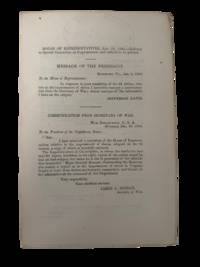
1865231171865. Civil War Black Military Slavery Virginia Confederate government imprint documenting one of the clearest bureaucratic efforts to formalize the use of enslaved labor in direct support of the Confederate war effort at the very moment of institutional collapse. Issued in Richmond Virginia in January 1865 and printed by the Confederate House of Representatives. The document responds to a congressional inquiry into the impressment of enslaved people explicitly acknowledging state-directed seizure of enslaved men for military labor. Within the text the Confederate state attempts to regulate this extraction noting limits such as "no more than one out of five male slaves between the ages specified. from any one owner" while simultaneously confirming large-scale requisitions including "5000 slaves from the State of Virginia for service with the army of Northern Virginia." The language reveals both the administrative reach of the Confederate state and its dependence on enslaved labor as a logistical backbone in the war's final phase.<br /> <br /> Octavo pamphlet measuring 9.5" x 6" 5 pages printed in Richmond Virginia January 1865. The text includes titled sections "Message of the President" "Communication from Secretary of War" "Resolution of House of Representatives" and "Response of Superintendent of Conscription" along with dated correspondence from December 1864 through January 1865. The imprint corresponds to Parrish and Willingham 2298. As a primary source the pamphlet holds substantial institutional value for collections in African American history Civil War studies and the history of slavery particularly for research into the transition from plantation labor systems to militarized coercion and the administrative mechanisms of late Confederate governance.<br /> The pamphlet is especially significant for how it exposes internal contradictions within Confederate ideology. While the Confederacy had long resisted arming or formally incorporating enslaved people in ways that might destabilize slavery this document demonstrates a late-war shift toward coercive mobilization framed as "employment" to "increase the efficiency of the army." Additional correspondence from Brig. Gen. Jno. S. Preston and Major Gen. J. L. Kemper details the mechanics of requisition emphasizing proportional seizure across slaveholders and acknowledging prior errors in impressment including the improper inclusion of enslaved people outside prescribed categories. Condition shows light toning minor spotting and edge wear consistent with age; paper remains stable with clear legible text throughout; faint institutional stamp present on front. Overall very good condition. This document underscores how the Confederate war effort relied on systems of exploitation applied to enslaved African American men. unknown
1376292Paris: Centre d'études et de recherches marxistes, 1974 in-4, 43 pages. Bibliographie. Agrafé, bon état. Cahiers du Centre d'Etudes et de Recherches Marxistes n° 114.
183094792Circa 1830s. 1830s. Good . - The close of a letter on a 3-1/4 inch high by approximately 6 inch wide piece of note paper is signed "Geo Thompson". The paper is darkened with some staining not affecting the signature. The paper is mounted on a sheet of yellow paper and has been folded twice for mailing. Good. <p>The British antislavery orator and activist George Donisthorpe Thompson 1804-1878 worked toward the abolition of slavery through lecture tours and by introducing legislation while serving as a member of Parliament. An able orator he was hired by the London Anti-Slavery Society in 1831. While in Scotland in 1832 where he became interested in abolishing slavery in the United States as well as other parts of the world he met William Lloyd Garrison and the African-American abolitionist Nathaniel Paul. Invited to visit New England by Garrison he traveled to the US in 1834 where he drew the attention of pro-slavery supporters and was forced to flee for his life. The Hobart Town Courier later printed a letter in which Thompson stated that he had ".left the United Sates to escape the assassins knife." the editor noting that attempts had been made to "burn and murder" him in several US towns. He returned to the US following the passing of the Fugitive Slave Law in 1850. By then the abolitionist movement having substantially grown and gained in influence Thompson found a warmer welcome. Returning to London he and his son founded the London Emancipation Society which supported the Union during the Civil War. Returning to America he allied himself with William Wells Brown and met President Abraham Lincoln. Throughout his life Thompson was a powerful voice for emancipation. He supported East Indian reform free trade Chartism non-resistance and the peace movement often protesting legislation that offered only limited restrictions on slavery.<p>RARE. Circa [1830s]. unknown
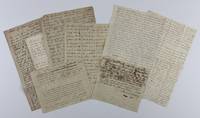
182012624Virginia and Alabama 1820. Eight manuscript documents totaling sixteen pages. Typical mailing folds and handling wear. Very good. Manuscript records from an extraordinary court case in modern-day West Virginia in which a free person of color named Caesar Freeman also known as Ceasar Cesar or Black Cesar and his family defended themselves and then sued to re-establish their own freedom over twenty years after being manumitted by their owner who had attempted to use them as collateral for a loan after their manumission. The case took place in Greenbrier and Pocahontas counties in West Virginia. Pocahontas County is located on the Virginia-West Virginia border and at the time of these documents was located in Virginia; Greenbrier County is a bit further west. A few of these documents emanate from or relate to Franklin County Alabama where one of the deponents had moved by the time of the legal proceedings.<br /> <br /> The case is detailed in a small pamphlet entitled Ceasar Mountain: Slavery and Freedom in Western Virginia by John Cohassey published in 2016. The opening paragraphs of said pamphlet provide excellent background on the case: “In Pocahontas County West Virginia lore tells of an 18th century legal feud between landowners George Massingbird and Thomas McCarty. In 1796 Massingbird secured a loan from McCarty. Thirty-two days after entering the contract and in need of collateral Massingbird claimed that his freed slaves – Cesar and family – were still his property. Nearly two decades later Massingbird remained indebted to McCarty who demanding final payment sought ownership of the Ceasar Freeman family. From the outset of this financial arrangement the Freemans served as collateral for a loan that Massingbird had intended to pay without likely expecting that the transaction would jeopardize the family’s freedom. When legally threatened to make the final payment Massingbird stated truthfully in a deposition that he had freed Caesar and family after the date of his initial loan. A Virginia statute stipulated that any slave manumitted after the date of a contract was not subject to reenslavement. But at this point Massingbird’s motivation for changing his story likely had more to do with his preventing McCarty‘s claim over the Freemans than to settle a debt that threatened him with serious legal consequences. Without money to pay McCarty upon the deadline of the debt Massingbird changed his story once again – that Cesar and family had not been freed after the contract. This untruthful claim as in the initial loan now placed the burden on the Freemans to prove their status as free persons of color. Assisted financially by local whites Ceasar and family won their case. Learning that Massingbird had on two occasions claimed them as collateral the Freemans sued both Massingbird and McCarty. Victorious in court the Freemans were awarded land in a region where they once were slaves – while the name of a nearby mountain was reputedly taken from their respected patriarch.†The mountain referred to here is known as Caesar Mountain in Pocahontas County.<br /> <br /> The present documents emanate from the case in 1819-20.  Two of the earliest documents dated in October and November 1819 relate to McCarty’s suit against Massingbird and mainly pertain to making sure Caesar and his family remain in the state. This included the jailing of Caesar and Sarah’s daughter Nancy Ware whom Massingbird apparently still claimed as a slave. One chief aspect of the importance of these documents lies in the fact that Caesar and his entire family are listed by name as such: “Caesar Sarah his wife Nancy Adam Zachariah John Esther Jim Sally Abraham Elizabeth Martha & Rebecca Children of Caesar and Sarah who are persons of colour.†Also of particular interest is that one of the documents appears to be signed by both Caesar and his daughter Nancy with their marks the day after Nancy was released from jail.<br /> <br /> In the remaining six documents Caesar and his family as well as defendant McCarty work through the Virginia and Alabama courts to secure a deposition from James J. Mayers a trustee of the Massingbird-McCarty agreement which supposedly still held the Freeman family in bondage. These documents are dated between July 1819 and February 1820. The earliest of these documents is a summons for Massingbird McCarty and Mayers to appear in Greenbrier County court “to answer a bill exhibited against them by Caesar and Sarah his wife as well as their adult children…who are permitted to sue in forma pauperis.†This is an extraordinary document encapsulating the right of free persons of color to sue their former owners and others in court in Virginia in 1819 and representing the Freemans’ fight for their continued freedom. The next document dated October 29 1819 contains testimony from George Massingbird confirming that “the Petitioners the Freemans were emancipated by your respondent Massingbird prior to the contract made by your respondent with his codefendant McCarty….†Finally the truth from Massingbird. In the third document dated the same day the trustee James Mayers asks to be dismissed from the case agreeing to all that was said by Massingbird in court.<br /> <br /> This was not enough for the courts or perhaps for one of the defendants Thomas McCarty. The final three documents dated between February and April 1820 further pertain to securing testimony from Mayers in the case. On February 21 1820 Virginia clerk John A. North addresses a one-page partially-printed form completed in manuscript to “any two Justices of the Peace for Franklin County State of Alabama.†The document was sent “on behalf of Thomas McCarty Defendant as of Caesar & other persons of colour Plaintiffs who are permitted to sue in forma pauperis.†The intentionof the document was to seek the help of Alabama officials in “examining whatever witnesses†they might have in the case. The next document is dated two days later and sent from McCarty to Caesar. Here McCarty informs “Black Caesar†that he intends to depose Mayers in Alabama on April 24 and that the deposition shall “bee red as evidence in the Chancery Court in a suit where you are plaintiff and myself and others are defendants.†Again a rare instance in which a white defendant writes to a Black plaintiff in the antebellum South involving the freedom of the latter.<br /> <br /> The final document chock full of detail on four folio pages contains the substance of Mayers’ deposition indeed given on April 24 1820. Here Mayers discloses all he knows of Massingbird’s contrary claims involving the case including the fact that Massingbird told him two contradictory stories about the Freeman’s manumission. Mayers professes that after Massingbird told him the whole truth of the matter he was “no little surprized at this declaration after what had taken place when application was made to draw the trust deed.†Sadly these four pages constitute the majority of Mayers’ testimony but seem to end mid-sentence leaving the remainder of his testimony to the vagaries of time. Still the most important part of the story is told here: Massingbird emancipated Caesar and then lied about it when he couldn’t pay his debts endangering the freedom of an entire family in the interest of cold hard cash.<br /> <br /> According to Cohassey’s 2016 pamphlet this testimony was “read aloud in court†and “no doubt revealed Massingbird’s duplicity in the matter.†Eventually Caesar and his family won the court case. Afterwards Massingbird deeded over 400 acres of land in Pocahontas County to the Freemans which apparently included Caesar Mountain. The Freemans lived out their remaining years as free people recorded in local tax lists between 1825 and 1843. unknown