1 561 résultats
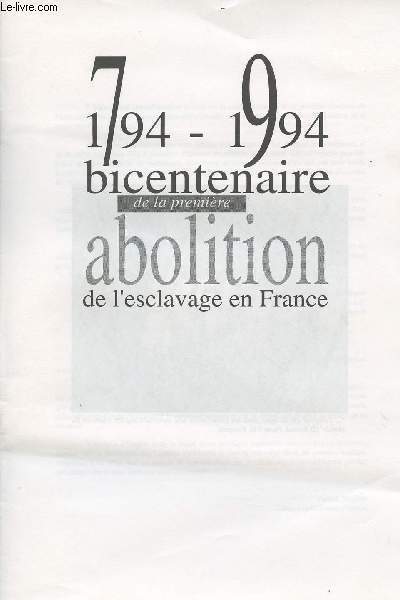
1994RO20182838OFFICE MUNICIPAL LOISIRS CULTURE DE VILLENAVE D'ORNON. 1994. In-8. Broché. Bon état, Couv. convenable, Dos satisfaisant, Intérieur frais. 16 pages - quelques photos en noir et blanc dans et hors texte.. . . . Classification Dewey : 326-Esclavage
R240149473Office Municipal Loisirs Culture de Villenave d'Ornon. Non daté. In-8. Broché. Bon état, Couv. convenable, Dos satisfaisant, Intérieur frais. 16 pages agrafées augmentées de quelques photos en noir et blanc dans le texte. Non daté.. . . . Classification Dewey : 326-Esclavage
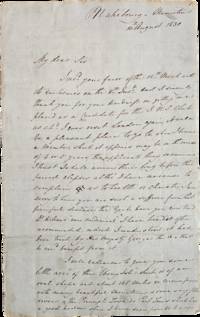
1830List2931Mahébourg Mauritius 1830. Single unsigned fourteen-page letter measuring 8 x 12 ¾ inches. Folded with some stains and pencil marks. Overall near fine. In 1830 Mauritius was a British colony captured from the French in 1810 during the Napoleonic Wars. It was originally a Dutch colony and the Dutch had introduced enslaved labor to the islands. Enslaved people were imported from Madagascar India and Southeast Asia to harvest the valuable ebony trees and later to farm sugarcane. It became a French colony in 1715 and among other provisions the French government awarded upper-class colonists large land grants each with twenty enslaved people to work them. Slavery was abolished in 1835 under British rule after which the planters still farming sugarcane turned to indentured servant labor from India and China alongside illegal slavery.1<br /> <br /> Offered here is a lengthy single letter written by an unknown author to an unknown recipient from Mahébourg in 1830 shortly before this radical change. The letter describes the lives and economic circumstances of the planters and merchants and of the non-white population particularly Malabar people and free and enslaved Black people.<br /> <br /> Noting that “every inch of ground that will produce sugar cane is planted with it†including “the former fine gardens to some of the Habitations†the author reports on the situation for sugar planters:<br /> <br /> “The price of sugar here is not more than 20/per Cwt. for the best quality which does not now remunerate the Planter as his expenses are becoming every day more heavy in consequence of their slaves diminishing . The want of Slaves induced many of the Planters to send for Chinese Labourers and several hundreds were imported at a great expense but unfortunately they did not answer and were obliged to be reshipped for their native Country again at the charge of those who sent for them.â€<br /> <br /> The author later notes that “nearly everyone of the Planters have heavy mortgages on their Estates and are obliged to pay this immense Interest which keeps them poor and will I fear ultimately ruin themâ€. In fact the planters in British Mauritius had extra duties on their sugar exports compared with their Caribbean counterparts. The shopkeepers on the other hand “calculate on retiring with a fortune in five years– therefore you will fancy what must be their prices also their profits.â€<br /> <br /> Though writing from Mahébourg the author describes the capital city of Port Louis at length especially its Malabar Indian and free Black residents—the lives of the latter particularly the free Black women seem especially grim. They write:<br /> <br /> “The Centre of Port Louis is inhabited by all the respectable people and many most excellent houses buildings– the Catholic Chapel the English Church amongst the number. The Suburbs to the West is the part occupied by about 3000 Malabars called ‘Malabar Town.’ – They are dressed mostly in white with Turbans ear rings c c and the females with ornaments in their noses and on their Toes as they generally go bare foot. – Once a year they have what is called a ‘Yamsee’ or a festival in honor of Mehomet which lasts for about a fortnight during which time they seem to get no sleep a continual beating of tom toms – jingling of bells – carrying pagodas which are made of various coloured paper and most richly ornamented followed by all the population of their Caste with their faces daubed with red white c and which has a most ludicrous appearance. The Suburbs to the South is called ‘black Camp’ – the Houses being very small and poor and inhabited by all the free blacks as well as many Mulattoes. – Also a certain class of females of the population of colour – who are visited immediately on the Arrival of a Ship the Crews soon enquiring the way to the ‘Camp.’â€<br /> <br /> As regards relations between the races the author recounts an incident that followed the 1828 abolition of the color bar which would ostensibly give the free non-white population the same rights as the whites:<br /> <br /> “The Theatre is a very good one but has been closed for several months past the Actors Actresses gone to Bourbon in consequence of the promulgation of the act ‘causing all free people of the population of Colour’ to have the same laws – the same privileges as the Whites’ fearing they ought come to the Theatre which they had hitherto been forbidden thereby cause disturbances as the French Whites detest them wd. not sit in the same box it was considered best to shut the Theatre which is a great loss to the Place it being the chief public amusement and indeed the only one we have here.â€<br /> <br /> Overall a detailed letter giving insight into life in a slave colony at a time when significant changes were on the horizon. Of interest to scholars of the colonial history of Mauritius and the second wave of British colonialism.<br /> <br /> 1 Truth and Justice Commission Report of the Truth and Justice Commission Vol. 1 Mauritius: Government Printing 2011. unknown
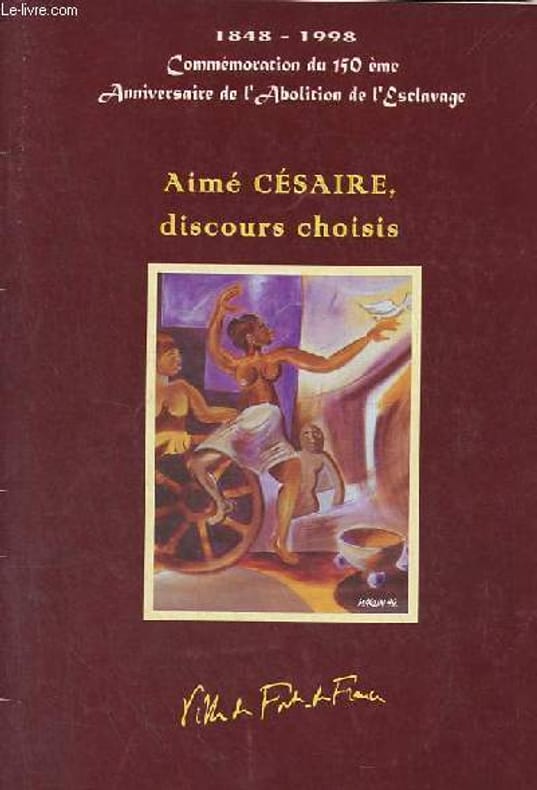
R100071930Ville de Fort de France. 19998. In-4. Broché. Bon état, Couv. convenable, Dos satisfaisant, Intérieur frais. 37 ages agrafées - nombreuses illustrations en monochrome dans et hors texte.. . . . Classification Dewey : 326-Esclavage
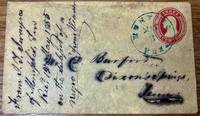
185536035Memphis: n.p. 1855. Paper. Fair. Paper envelope. Approximately 6" x 3". No letter with the envelope. A stamped three cent envelope with postal mark dated May 8 location not clear. Paper is toned with small thin tear located under the address from use of the pen. <br /> <br /> Written on the front side is "From J. T. Swayne of Memphis Ten Rec'd 12 May 1855 on the subject of a Negro from Weaver." This was addressed to Mr. C. Burford of Dixon's Springs Tennessee. J. T. Swayne was a former Mayor of Memphis during the reconstruction. There are references to the Burford family in Dixon Springs Smith County Tennessee online. n.p. unknown
96405-JB09134274
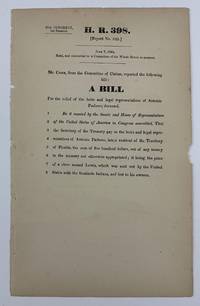
18445887Washington DC: June 7 1844. Very good. Broadside 12.25 x 7.75 inches. Light tanning shallow marginal chips and some fraying to left and right edges. An unrecorded slip-bill printing of a House Resolution with a phenomenal back story involving an erudite elusive and resourceful Florida slave. The slip bill authored by Howell Cobb U.S. Representative from Georgia stipulates that the Secretary of the Treasury pay the sum of five hundred dollars to the heirs and representatives of Antonio Pacheco a former resident of Florida the sum "being the price of a slave named Lewis which was sent out by the United States with the Seminole Indians and lost to his owners." That's where the plot thickens. The slave is now known to history as Luis Fatio Pacheco born in 1800 to enslaved parents on the "New Switzerland" plantation in Florida which was surrounded by a mix of Europeans Africans and Native Americans. As such Luis became fluent in several languages including Seminole which later made him a valuable asset.<br /> <br /> After a conflict with his owner Luis attempted to escape slavery in 1824 by fleeing to Spanish fisheries on Florida's Gulf Coast but he was captured by U.S. military authorities the following year. Skilled as he was in languages and literacy by the military Luis was sold in 1832 to Antonio Pacheco a Cuban merchant. After Antonio's death Luis became the property of Pacheco's widow. When tensions began to ratchet up again between American military forces and the Seminole tribe a U.S. Army officer made a deal to rent Luis from the Pacheco estate at the rate of $25 a month to take advantage of his services as an interpreter. In December 1835 Luis was accompanying a troop detachment led by Major Frances L. Dade in a march to reinforce Fort King near the present-day city of Ocala Florida. Evidently that day Luis was assigned as a scout; he has said to have attempted to warn Dade of a possible ambush by the Seminoles which went unheeded by the commander. The result is today known as the Dade Massacre in which Dade and most of his men were killed.<br /> <br /> According to the narrative provided by Luis who spoke Seminole he explained to the warriors that he was a slave and successfully pleaded for his life. Luis lived with the Seminoles as a captive for nearly two years before again managing to escape. In September 1837 Luis surrendered to the U.S. Army at Fort Peyton near St. Augustine. Soon after he was accused of collaborating with the Seminoles in the Dade Massacre. In 1841 negotiations between the US government and Seminole leader Coacoochee the Native American leader claimed Luis as his property captured in war. Coacoochee was permitted to take Luis together with other Black Seminoles to Oklahoma for resettlement. This event led to the claim by Anthony Pacheco‘s heirs for restitution of a lost slave. The Joint Committee on Claims approved the claim. Luis's story eventually became a focal point in the abolitionist argument against slavery and in 1858 Ohio representative Joshua R. Giddings published a book portraying Luis as a hero against the system. In any case the question of whether or not Luis betrayed Dade has never been completely resolved. June 7 unknown
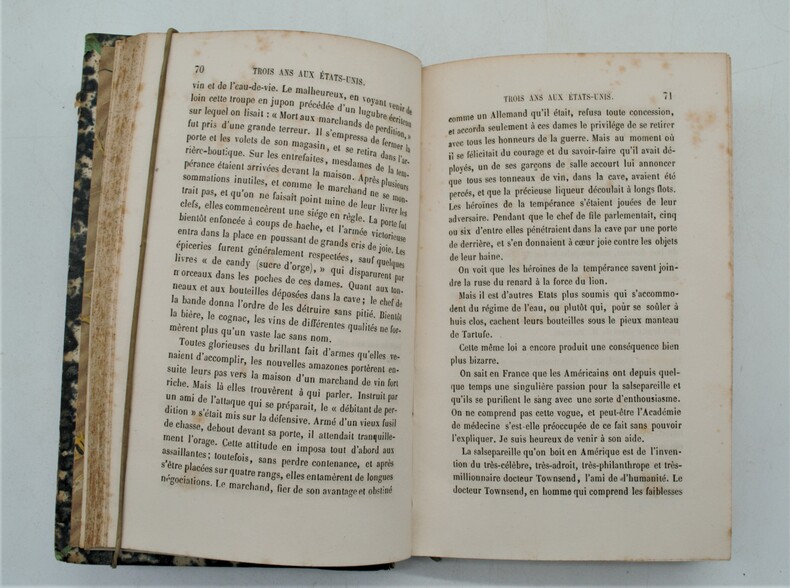
1858PHO-1208Paris , chez Pagnerre , 1858 , un volume in-12 , 389pp-2ff , demi cuir époque , dos à nerfs avec auteur et titre , coiffe usée , petites rousseurs
163143 handwritten documents in ink regarding the sale of slave girls in Cuba. The documents are written in Spanish and include details such as purchase price age and names of the girls being sold. Large size Documents 12 ½ x 8 ¾ in. Some shadows from storage with other documents paper acidification from ink. Some losses from ink acidification and wormholes. Marks from previous binding along left edge. Sale documents are numbered at bottom of pages with signatures and all have stamp from Cuban government. Good condition. One of the documents includes the year 1875 dating some of these papers to the dwindling years of the slavery in Cuba which was officially outlawed in 1886. unknown books
163153 handwritten documents in ink regarding the sale of slave girls in Cuba. The documents are written in Spanish and include details such as purchase price age and names of the girls being sold. Documents are large: 12 ½ x 8 ¾ in. Some shadows from storage with other documents paper acidification from ink. Some losses from ink acidification and wormholes. Marks from previous binding along left edge. Sale documents are numbered at bottom of pages with signatures and all have stamp from Cuban government. Good condition. One of the documents includes the year 1875 dating some of these papers to the dwindling years of the slavery in Cuba which was officially outlawed in 1886. unknown books
in-8°, 182 pp., broche, couverture illustree à rabats. Bon etat. [NV-5]
1992ROD0023672Plon. 1992. In-8. Broché. Bon état, Couv. convenable, Dos satisfaisant, Intérieur frais. 199 pages. hotos noir et blanc hors-texte au centre de l'ouvrage.. . . . Classification Dewey : 326-Esclavage
18762754Paris, Imprimerie Nationale, 1876. In-8 broché de 226 pp., couverture bleue imprimée.
18752755Paris, Imprimerie Nationale, 1875. In-8 broché de 207 pp., couverture bleue imprimée.
18772756Paris, Imprimerie Nationale, 1877. In-8 broché de 268 pp., couverture bleue imprimée.
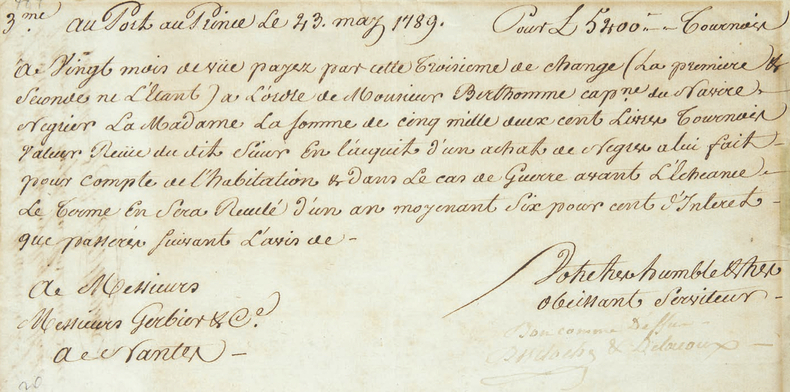
1789YQV-13Port-au-Prince, 23 mars 1789 Un billet in-8 oblong (128 × 243 mm), manuscrit à la plume au recto (11 lignes) et au verso (4 lignes), encre noire.
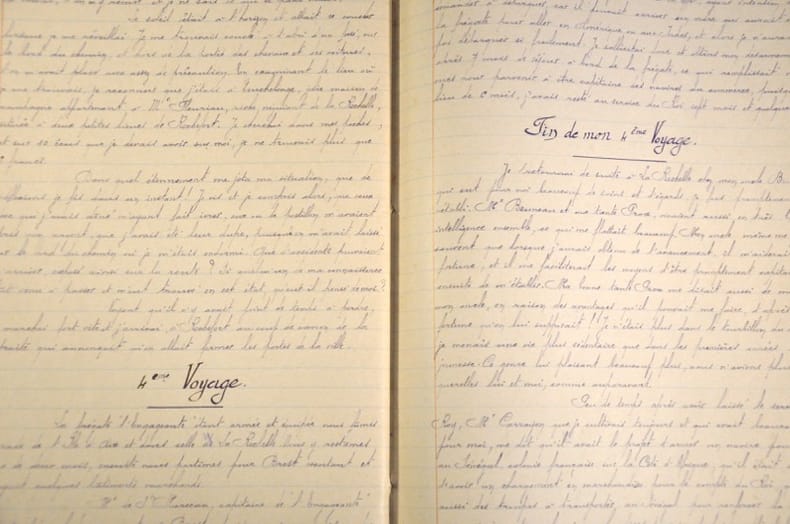
3042Vers la fin du XVIIIe siècle Cahier In 4 en couverture souple, « J.J Proa _ Mes mémoires » écrit à l’encre brune sur le plat supérieur. Manuscrit rédigé au net, certainement par un membre de la famille de J.J. Proa vers la fin du XVIIIe siècle. Manuscrit rédigé à l’encre violette très joliment calligraphiée. 1bl, 113ff, 2bl
181158Paris, 1796 in-8, 2 p., (une gravure et une notice biographique) en feuille.
Very Good French In contemporary 1/3 black leather bdg. Demy 8vo. (24 x 17 cm). In French and Turkish. 46, 31 p., x numerous b/w plates of Ottoman registers. 46 p. in Turkish (Modern); 31 p. in French. "Les metayers-serfs et quelques centres d'exploitation sous le regime du etayage servile: Quelle a ete l'importance de la main d'oeuvre servile sous l'Empire Ottoman, surtout aux epoques ou, selon toutes les apparences, le continengt d'esclaves introduits a ete le plus eleve dans les diverses branches de l'activite economique en particuler et en general dans la vie politique et militaire du pays?...". From the first etude: "The sharecroppers and some exploitation centers under the regime of servile shoring: What was the importance of servile labor under the Ottoman Empire, especially at times when, in all appearances, the continence of slaves introduced was highest in the various branches of economic activity in Europe particularly and in general in the political and military life of the country?...". Signed and inscribed by Barkan, (1903-1979) in Ottoman script, to Ibrahim Fazil Pelin, (1886-1944), as "Hocamiz Fazil Beyefendiye saygilarimla". Barkan was a Turkish economical historian, also one of the most important economist. Barkan, is primarily a scientist who has brought innovation to the understanding of history and examination in Turkey. He noticed more with his researches in the field of Turkish economic history; The 'Tahrir registries' were first studied systematically by him. He has revealed their importance in terms of agricultural, social and demographic. His researches were usually on the 16th century. First and Only Edition.
130002Very Good. Quarto 4 pages a bifolium comprising 3 pages of text with the last page used for address purposes. Creased where folded for posting; slight loss to the leading edge of the second leaf where torn open removing one word of text; overall in excellent condition. The letter dated 10 December 1791 and carried privately by ship from Kingston is addressed to 'Messrs Newton Gordon & Murdoch Merchants Madeira'. A number of lesser matters are touched upon but the letter deals primarily with the importation of wine: 'I cannot at present ascertain what quantity of wine I shall be able to dispose of next year as I have 20 pipes on hand and sales are slow from the great quantity at market; however you will please ship me twenty pipes of York market wine Barbadoes Gauge & 12 Iron hoops at first convenient opportunity'. As often with letters of any age the first paragraph contains an apology for the tardy response: 'I have first to beg your excuse for my silence and then to explain how it happen'd. The beginning of March last I set out in haste for the Havana with a small cargo of negroes and expected to sell them immediately but was detain'd there till the end of July'. unknown
243664Ann Arbor, The University of Michigan press, 1967 in-4, [2] ff. n. ch., 119 pp., texte sur deux colonnes, toile Bradel brune sous jaquette illustrée (reliure de l'éditeur).
244117New York, H. W. Wilson company, 1928 fort vol. in-8, xxii pp., un f. n. ch., 698 pp., texte sur deux colonnes, percaline Bradel verte (reliure de l'éditeur).
2013R100051516Seuil. 2013. In-8. Broché. Bon état, Couv. convenable, Dos satisfaisant, Intérieur frais. 548 pages - quelques planches en noir et blanc.. . . . Classification Dewey : 326-Esclavage
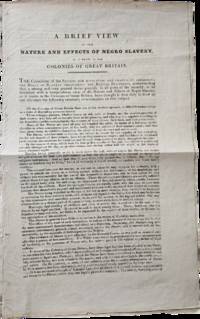
1823List3302London England: Ellerton and Henderson 1823. Three page document measuring 8 ½ x 13 ¼ inches. Folded with some small wrinkles at edges else Near Fine. A document produced by the Society for Mitigating and Gradually Abolishing the State of Slavery throughout the British Dominions better known as the Anti-Slavery Society. The group was founded in London in 1823 by a group of politicians philanthropists and businessmen including William Wilberforce Joseph Sturge and Zachary Macaulay. The document discusses the horrors of enslavement—even unfavorably comparing the British colonies’ conditions with those in the US—and decries the fact that after the 1807 Slave Trade Act essentially nothing more had been done to put “an end to a condition of society which so grievously outrages every feeling of humanityâ€. We find a single copy of the Ellerton and Henderson edition in physical format listed in OCLC as accession number 83930673. Ellerton and Henderson unknown
1823423251London: Printed by Ellerton and Henderson Gough Square 1823. Near Fine. Folio 21.5 x 33 cm / 8½" x 13â€. pp. 1 2-3 4 blank. Light vertical and horizontal center folds three short tears at the horizontal fold near fine with a contemporary drawing of a few survey lines and diagrams very lightly sketched in ink and pencil on the final blank page. The Society states its case against slavery in the Colonies of Great Britain where "there are at this moment upwards of 800000 human beings in a state of degrading personal slavery." It provides a brief but detailed description of "the immoral inhuman and unjust" nature of the slave trade and of the absolute power of slave owners. Printed by Ellerton and Henderson, Gough Square unknown