(BENJAMIN FRANKLIN PRINTINGS). (ABOLITION OF SLAVERY). (QUAKER PAMPHLETS). BENEZET, ANTHONYBiblio.com

1 561 résultats
1759ST19900Philadelphia and Germantown: Benjamin. Franklin and David. Hall or Christopher Sower 1759-60. 192 x 130 mm. 7 1/2 x 5". 1 p.l. collection title 47 1 71 4 76-168 iv 5-43 1 55 1 64 16 pp. <br/> Contemporary blind-ruled sheep nicely rebacked to style raised bands. Verso of front flyleaf inscribed in ink in the recipient's hand: "This Book is the Gift of Mr. Anthony Benezett sic to William Anderson October 14th 1760"; front pastedown with ink inscription: "The holy Book To Be Read"; title page with signature of William Anderson dated 1760; front flyleaf and both free endpapers with additional 19th century owner inscriptions. Miller 730; Smith Friends' Books I p. 240. For "Observations": Sabin 4676; Evans 8542. Boards a little dried and scuffed with a couple of small stains text variably toned because of colonial paper quality perhaps a fifth of the text rather browned dampstaining in the upper margin in the middle part of the volume mostly unobtrusive but darker and extending downward on a few leaves. The texts in the kind of problematic condition expected with early American imprints but the binding much better than is normally seen.<br/> <br/> This is a presentation copy of an important published collection of Quaker texts that includes four works printed by Benjamin Franklin as well as an early significant abolitionist tract that delivers a powerful condemnation of the slave trade. The collection title page lists nine tracts in total six of which were issued with separate title pages comprising: "An Extract from the Spirit of Prayer" by W. Law; "A Discourse on Mistakes concerning Religion" by Thomas Hartley; "Christ's Spirit or a Christian's Strength" "The Stumbling Stone" "The Doctrine of Baptism" and "The Trial of Spirits" all by William Dell; "The Liberty of Flesh and Spirit Distinguished" by J. Rutty; and "Observations on Enslaving Importing and Purchasing of Negroes &c." followed by "The Uncertainty of a Death-bed Repentance" both by Anthony Benezet. Miller asserts that "the first fifth sixth and seventh had previously been printed by Benjamin Franklin and David Hall all in Caslon type. The remainder had been printed by Christopher Saur who owned no Caslon letter." The volume title also in Calson type is attributed to the press of Franklin and Hall for the same reason. According to Miller Anthony Benezet put together this collection of Quaker material in the spring of 1760 in an edition of 500 copies with the hope of reaching those living "in ye back Parts of Maryland Virginia & N. Carolina . . . and Connecticut." First printed in 1759 Benezet's forceful denunciation of the slave trade is notable for using eyewitness accounts from people actually involved with the trade recounting the horrific practices and conditions that were realities of the system. Citing various lines of scripture Benezet argues that slavery runs contrary to Christian teachings and Mosaic law and that those who purchase and keep slaves bear as much guilt as the traders themselves. Born in France to Huguenot parents Benezet 1713-84 was a Quaker abolitionist educator and writer who became one of the earliest and most outspoken advocates against slavery in colonial America. He emigrated to Philadelphia by way of Rotterdam and London in 1731 where he founded Pennsylvania's first secondary school for girls and later opened one of the first schools to welcome black students. ANB says that "Although Benezet is recognized as the most prolific antislavery propagandist of the eighteenth century throughout his lifetime he supported and wrote about a wide variety of causes and topics including assistance for Acadian refugees temperance peace fair treatment of Native Americans religion educational reform and poor relief." His wife Joyce Benezet d. 1786 née Marriott was a preacher in the faith herself. According to Waldstreicher Franklin maintained a "lifelong friendship with Quaker politicians merchants and scientists. . . . He admired Quakerism because of its affirmation of simplicity frugality anti-slavery and humanitarianism." Franklin also saw the possibility of profit in printing for the considerable Quaker population of his colony. Hall 1714-72 came to Philadelphia from London in 1744 to work for Franklin and became a partner in the firm in 1748. As a considerable mark of his regard for Hall Franklin drew up a contract whereby his partner would over an 18-year period buy him out. It is a further sign of Franklin's regard for Hall that the printer is buried beside Franklin and his wife. As to contemporaneous provenance we can speculate with some degree of certainty that our William Anderson was the person of that name who was a Quaker preacher from Haverford near Philadelphia. His wife Margaret--like Benezet's wife Joyce--was also a preacher and these two husband-and-wife teams are dealt with in Rebecca Larson's "Daughter of Light: Quaker Women Preaching and Prophesying in the Colonies and Abroad 1700-1775" 1999 Appendix 2. . B[enjamin]. Franklin and D[avid]. Hall or Christopher Sower unknown
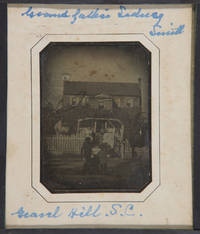
184542820850<p><strong>A unique survival.</strong> This important collection of largely identified photographs documents the home and family of Dr. Sidney Smith and those he enslaved at Gravel Hill his South Carolina plantation. The collection includes an extraordinary daguerreotype depicting Dr. Smith his two daughters and his brother posed together with two enslaved African American men. This is <strong>one of the earliest known images—if not the very earliest photograph—of an identified plantation owner posing with enslaved African Americans. </strong></p><p><strong> The photographs :</strong></p><p>1. Quarter plate daguerreotype 4 x 3 1/8 in. of Gravel Hill Plantation near Robertville St. Peter's Parish Beaufort District South Carolina. Ca. mid-to-late 1840s. Manuscript notation on passe-partout mat "Grandfather Sidney Smith Gravel Hill S.C." The image shows the plantation house with various figures engaged in an unidentified activity with a horse tied to a picket fence. The two girls in white may be Sidney Smith's daughters Arabella b. 1832 and Julia b. 1837 and the others may be enslaved African American children. An enslaved African American subject stands on the steps in the background. In the foreground are two figures with an unknown object perhaps a dog cart or a bone-shaker bicycle. In front of the house is a heavily-vined grape arbor presumably connected with Smith's efforts in viniculture.</p><p>2. A quarter plate tintype copy of the above daguerreotype.</p><p>3. Sixth plate daguerreotype of Sidney Smith his daughters Arabella and Julia his brother James Laurens Smith and two unidentified African American men almost certainly enslaved men. Ca. mid-1840s-1850. One of the girls is blurred because she is hold a struggling dog. Accompanied by the envelope in which the daguerreotype was discovered with penciled notation about the subjects as well as a tentative date of "1850 or thereabout."</p><p>4. Sixth plate daguerreotype of Smith's daughters Arabella and Julia pointing to a book and an unidentified object. Ca. mid-1840s-1850.</p><p>5. Sixth plate daguerreotype of Sidney Smith. Ca. 1845. Smith appears to be wearing a mourning band on his coat suggesting that the image was made following the death of his first wife Eliza in March 1845.</p><p>6. Sixth plate tintype copy of the above portrait.</p><p>7. Sixth plate tintype portrait of Maria King Smith second wife of Sidney Smith with an infant possibly William King Smith. A period copy image.</p><p>8. Sixth plate ambrotype of William King Smith son of Sidney and Maria Smith possibly as a cadet. Ca 1850s.</p><p>9. Quarter plate ambrotype of Sarah Smith sister of Sidney and James Laurens Smith aunt to Arabella and Julia. Ca 1850s-1860s.</p><p>10. Sixth plate ambrotype of Rosa Nicholes sister of Maria Smith with "Eddie" Postell possibly the Edward Postell who was killed in action in 1863 at Fort Wagner. Ca 1850s.</p><p><strong> Dr. Sidney Smith</strong></p><p>Sidney Smith was born in 1805 in or near Beaufort SC the son of William Smith a man of moderate wealth and Elizabeth Wilson Smith of Philadelphia reportedly a Quaker. Sidney was sent to Yale College and subsequently studied medicine in Ohio. His younger brother James Laurens Smith b. 1809 studied law but he apparently never practiced devoting himself instead to agriculture. Sidney Smith married Eliza Lawton in 1829. The two had several children including daughters Arabella and Julia. Smith was apparently practicing medicine in the vicinity of Robertville South Carolina as well as trying his hand at being a planter. In 1831 he appears in the Lawton Family Papers as having been paid two dollars for "expirating a Fungus Tumor from the head of Little Negro Shiloh" Inabinett 1963. His name appears in several land transactions in the upper St. Peter's Parish in Beaufort District where he experimented with various crops.</p><p>Smith's experiments with wine received wide-ranging coverage in the press. A notice in the Boston Daily Atlas of 28 December 1844 printed a report from a Savannah newspaper: "This editor of the Savannah Republican has samples of eight kinds of wine made by Dr. Sidney Smith of Robertville Beaufort District S.C. They are pure juice of the grape without the addition of any spirits whatever. One of the specimens is from the vintage of 1833 another from that of '38 and the other six from that of the present year. They differ in flavor according to the species of grape from which they were expressed … Dr. S. has on hand some 800 gallons of those wines which he finds useful for all medicinal and culinary purposes."</p><p>Smith's first wife Eliza died in 1845 at the age of 37 possibly explaining her absence from the group portrait. In 1846 Smith married Maria Ann King with whom he would have two children who survived into adulthood William King Smith b. 1846 and Walter Watson Smith b. 1849.</p><p>By 1850 Smith and most of his family had left Gravel Hill and relocated to Marietta Georgia where he acquired another plantation Rockford near Marietta. By this time Smith had acquired 74 slaves according to the 1850 Slave Schedules of the United States Census. He continued to run Gravel Hill as an absentee owner from Georgia.<br />In 1853 Smith sold Gravel Hill then comprising 700 acres and his other plantation properties in the Robertville area to John Goldwire Lawton in 1853 according to genealogical records at the Heritage Library Foundation. Smith's Gravel Hill home appears to have been on the site of present-day Gravel Hill Plantation the ca. 1910 hunting preserve near Robertville on the National Register of Historic Places. The elaborately decorated center-hall plan home as well as the town of Robertville was burned by W.T. Sherman's troops in 1865.</p><p>After the war the land was sold to Northern buyers. Newer structures were apparently built on the foundations of the original Gravel Hill around 1910 when it was refashioned as a gentleman's hunting plantation. Dr. Smith and his wife Maria died in 1856. Their sons Walter and William became wards of Smith's brother James who himself apparently died in 1865. Walter Smith was a student at the Georgia Military Institute when it closed at the time of W. T. Sherman's approach in 1864. At the age of 14 he and the other cadets were sent to guard the river crossings in the approaches to Atlanta. With his brother William Walter served in Confederate units until the end of the Civil War. Sidney Smith's sister Sarah known as "Aunt Sarah" to Walter and William Smith wrote vivid letters describing the evacuation of Marietta and her flight to Atlanta.</p><p>While no documentary evidence of the Smith family's views on slavery has been found Susan E. Geoffrey claims in her academic paper "A Southern Family in Transition 1830-1865" that Sidney and his siblings were "reasonably humane to their slaves according to the standards of their society." Geoffrey adds that Sidney's sisters Sarah and Hannah developed an interest in educating their brothers' enslaved children. Dexter's biographical sketch of Smith notes that Smith "opposed strenuously the act of nullification in South Carolina and by his personal efforts retarded the action of that State." Smith's brother James provided in his 1853 will that every tenth! child born into slavery in the estate should at age eighteen be granted freedom to be facilitated by the Colonization Society.</p><p><strong>The photographers</strong></p><p>The photographers of these images are unidentified but it appears that Smith himself may have made two of the daguerreotypes. <em>Biographical Sketches of the Graduates of Yale College with Annals of the College History</em> vol. 7 1913 notes of Smith: "He was a man of unusual mental gifts an earnest student and devoted to the community and mankind. When the art of the daguerreotype was first introduced he was a pioneer in cultivating it in the South."</p><p>Based on his interest in the "art of the daguerreotype" it is possible that Smith created the daguerreotypes himself perhaps with the aid of an assistant so he could be included in certain images most notably the group portrait. The informal group portrait shows a relaxed family posing together. Smith appears to have moved into the frame at the last moment after setting up the shot. Likewise the subjects in the Gravel Hill daguerreotype are in casual poses as if they are in a Daguerreian snapshot of the family rather than formally arranged portraits.</p><p><strong>Dating</strong></p><p>The approximate dating of the featured images has been determined based on the estimated ages of Smith's daughters Arabella and Julia who are pictured in two or perhaps three of the daguerreotypes. Arabella b. 1832 and Julia b. 1837 appear to be around the ages of twelve/thirteen and eight/nine respectively. The girls appear together in a sixth plate daguerreotype portrait and in the sixth plate group portrait of Dr. Sidney Smith his brother and two unidentified African American men almost certainly enslaved subjects. The sisters may also be the two girls in white dresses on the steps of the house in the quarter plate daguerreotype.</p><p>This dates those daguerreotypes to the mid-1840s and no later than 1850 thus making them among the very earliest photographs of a slave-holding antebellum plantation.</p><p><strong> A rare opportunity</strong></p><p>It is evident that Dr. Sidney Smith wanted to use the new art of photography to create a visual record of his plantation home at Gravel Hill and of his family and the enslaved individuals who worked for him. The daguerreotypes offered here most notably the group portrait of Smith with his brother daughters and two Black men are unique in depicting enslaved subjects posed together with their owner especially in a relatively informal setting. We are not aware of comparable images dating from the mid-to-late 1840s.<br />This exceptional collection of photographs from an identified family in the antebellum South is worthy of further research.</p><p><strong>References </strong></p><p>Dexter Franklin Bowditch. <em>Biographical Notices of Graduates of Yale College</em> 1913</p><p>Geoffrey Susan E. "A Southern Family in Transition 1830-1865" 1982 Accessed online through the Heritage Library History and Research Center in Hilton Head SC September-October 2024. Background on the Smith family is derived from this academic paper although the research center's copy is incomplete lacking numerous footnotes and bibliography. Some but not all of Geoffrey's sources have been located in the William King Smith Papers Wilson Special Collections Library UNC Chapel Hill.</p><p>1845-1850 four daguerreotypes and ca. 1855-1860 three ambrotypes plus three early tintype copy images. 10 items.</p>
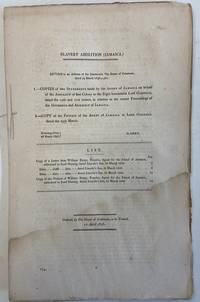
1836175381836. This pamphlet is a return to an Address of the House of Commons from March 25 1836 whereby the Agent of Jamaica William Burge protests against the unilateral abolition of slavery in the British Empire. Ordered to be printed by the House of Commons in London April 1836. 13 pages. 13" x 8.25" inches. Included within is a copy of three letters from the Agent to Lord Glenelg the British colonial secretary as well Burge's protest to Glenelg. Burge states: He is desirous that His Majesty's Government should understand that this Protest is made not as the performance of a formal act of official duty but from his conviction that the proposed legislation for Jamaica is a direct violation of the constitutional rights of that Colony rights coeval with its establishment and which have hitherto been respected." The Agent was a colonial official who was the official representative of a British colony who was based in London and acted as lobbyists and trade negotiators for the affairs of the colony. While Burge had at other times claimed to "hate" slavery he employs the British analogue of the "states rights'" argument that many moderate politicians in the United States used to signal personal distaste for slavery but to nonetheless protect the institution's existence on the basis of constitutionality. When the institution of slavery died out in the British Empire after 1836 the abolitionist movement in the US gained tremendous momentum despite the protests of our own William Burge's. This piece is overall in very good condition. unknown
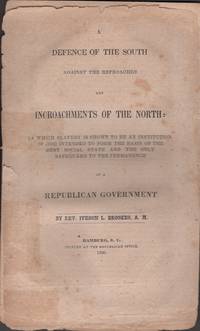
185036089Hamburg South Carolina: Printed at the Republican Office 1850. Wraps. Fair. Wraps. 48 pages. Covers are detached and stitching mostly removed leaving several loose pages. Small edge tears to a few pages. Toning to the contents. Pages 47 and 48 has an old tape repair with slight loss of print. This is pro Slavery and religious defense of the institution from a Southern Minister. Fair only. From the North Carolina Encyclopedia ncpedia dot org:<br /> <br /> "Iveson Lewis Brookes Baptist clergyman planter and Southern sectionalist was the eldest of five sons of Jonathan and Annie Lewis Brookes and was born in Rockingham County. His father was a veteran of the Revolution. His parents had only recently moved to North Carolina from Spotsylvania County Va. where many of his relatives continued to live; soon after his birth his parents moved permanently to Caswell County. Educated in a local academy during his early years in 1812 Brookes enlisted in the American army. After seeing only limited action during the War of 1812 he entered The University of North Carolina. He was graduated in 1819 after developing what proved to be a lifelong acquaintance with both James K. Polk and Thomas Hart Benton. In his commencement address entitled "Is the State of the World Better in the Present Age Than at Any Former Period" Brookes expressed an optimism and an enmity to slavery that were totally antithetical to his later positions. Undecided about his future he spent a year as a teacher in Greensboro"."Although he had opposed slavery as a student at The University of North Carolina Brookes became a staunch defender of slavery and a rabid southern sectionalist. During the Nullification controversy he was made a minuteman by Governor James Hamilton of South Carolina. In 1861 at the age of sixty-eight he offered himself for service in the Confederate Army. From the first appearance of abolitionism he feared for the future of southern society. From 1835 he wrote dozens of defenses of slavery most of them in the form of letters to northern antislavery periodicals. His most famous defenses were two pamphlets written during the crisis of 1850: A Defence of the South against the Reproaches and Incroachments of the North 1850 and A Defence of Southern Slavery against the Attacks of Henry Clay and Alexander Campbell 1851 the latter written at the behest of Governor James Henry Hammond of South Carolina. The productions of an enraged slaveholder revealing little of the optimistic and balanced thinking of his youthful years those two documents stood as the most characteristic statements of a die-hard southern sectionalist who had learned to love the life of a slaveholding planter. Printed at the Republican Office unknown
263 p. 12mo. 20 cm. Some damp stain. Foxed. Contemporary cloth backed boards binding, worn. Marryat started his tour of the U.S. in New York, crossed that state and went as far as Sault St. Marie, across Upper Canada, and back to Montreal. He also visited Washington and Kentucky. His comments on American habits, language, and institutions (including slavery) were widely read and of great influence. Howes M300; Clark III:204; Sabin 44696. W145Rt
1968121898New York, The Citadel Press, 1968, in-8°, vi-410 pp, paginé vi-(533)-942, index, broché, couv. illustrée, bon état. Texte en anglais
14476SAUGNIER Mess. and Brisson. London G.G. J. and J. Robinson1792. First edition in English after the French first edition of 1791. Voyages to the Coast of Africa: Containing an Account of Their Shipwreck on Board Different Vessels and Subsequent Slavery and Interesting Details of the Arabs of the Desert and of the Slave Trade as Carried on at Senegal and Galam. 12mo 21.5 x 14 cm; i viii 500 pp three parts and a narrative First Voyage - To Senegal; The Second Part - Voyage to Galem and Return to France; The Third Part- Commerce of Senegal and Galam; Narrative of the Shipwreck and Captivity of M De Brisson bound in one volume lacking the map recent blue cloth with gilt spine title lettering.<br/>Saugnier was shipwrecked on January 17 1784 near Cape Leven and Brisson in July 1785 at Cape Blanco both in the Spanish zone of Rio del Oro. A fascinating account of shipwreck and slavery from a first hand account including details on the economic aspects of slavery. Faded spine page 31 misnumbered 13 page 85 has an ink stain to it and pages 460 and 461 are misnumbered 444 and 445 although the text is confirmed correct; good solid copy. unknown books
244190Washington, Government printing office, 1932 fort vol. in-8, VIII pp., 725 pp., percaline Bradel bleue (reliure de l'éditeur). Exemplaire un peu déboîté.
ix, 164 p. 25 cm. Hardcover Very good condition, spine ends chipped, inner hinges appear to be reglued Howes G353
188452888Boston: Printed by the Order of the City Council 1884. First Edition. Small quarto 26.5cm; marbled paper over navy blue calf spine in seven compartments with six raised bands leather labels titling and decorative elements stamped in gilt on spine; marbled endpapers; engraved portrait frontispiece1011-70 with an additional 31 leaves bound in. Armorial bookplate of Walter Merriam Pratt on front pastedown. Re-backed with the original spine laid down; light wear to upper and lower board edges with some touch-up to leather at crown and heel; Very Good. A grangerized copy containing 22 ANS and ALS ca.1-4pp one autograph sentiment a 4.25" x 6.5" cabinet card signed by Phillips and several clipped portraits of various sizes depicting Phillips his wife and his son in uniform. Most prominent among the letters are those written to G.W. Putnam 6 H.G. Denny 2 R.L. Winthrop 2 John Boyle O'Reilly 1 and an October 8 1853 ALS to abolitionist and social reformer Gerrit Smith in which he claims to have mislaid his letter but is available to come to Brooklyn either on 15 December or 5 January 1854 and that his fee would be fifty dollars. Handsome volume memorializing American abolitionist and orator Wendell Phillips 1811-1884 commissioned by the City of Boston in an edition of 5000 copies. Nearly half the text is comprised of the eulogy by George William Curtis and includes extensive remarks by city council members and aldermen a prayer by Rev. Minot J. Savage an address by the Mayor and a poem by Mrs. Mary E. Blake. A proud son of Boston Phillips abandoned a career in law after being converted to the cause of abolitionism by William Lloyd Garrison in 1836. He was a frequent speaker at meetings of the American Anti-Slavery Society active in the free-produce movement a member of the Boston Vigilance Committee and an early advocate of women's rights. Later in life he turned considerable effort towards gaining equal rights for Native Americans and together with Helen Hunt Jackson and Massachusetts Governor William Claflin helped found the Massachusetts Indian Commission. cf.BAL 4347. Printed by the Order of the City Council unknown
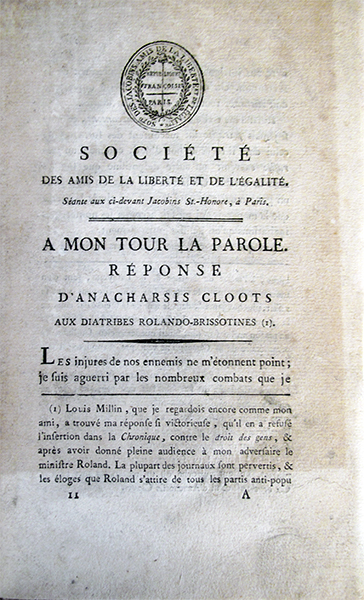
In-8, cartonnage marbré moderne à la Bradel, 8 p. Edition originale et unique de cette importante et virulente intervention de Cloots qui marque sa rupture avec les Girondins. "Soumis au feu de critiques, Cloots va riposter au cours d'une séance mémorable du club des Jacobins, le 26 novembre, où l'on procède à la première séance d'épuration en radiant Roland, Lanthenas... Cloots demande la parole pour se justifier et confondre les 'Rolando-Brissotins' (…)". Il évoque son repas avec Roland qui l'a traité de "parasite", rappelle son itinéraire politique et oppose sa droiture à la fourberie "d'espions gagés par la police". Il aborde également la question de son opposition au "cabinet de St James" à Saint-Domingue et justifie son soutien à l'abolition immédiate de l'esclavage, position qui lui fut violemment reprochée (cf. R. Mortier, 'A. Cloots', p. 347-348). (Martin & Walter, I, 7774. Tourneux, 9338). Papier bruni. Bon exemplaire.
36853In-8, cartonnage marbré moderne à la Bradel, 8 p. [Paris], de l'imprimerie de L. Potier de Lille, (1792).
Backstrip tape-repaired, lacks 1 page, otherwise Good Condition; 8vo; 377 pages; Thompson and the others were arrested in 1841 and imprisoned at Palmyra, MO (frontis illus) for helping slaves escape. He was later pardoned. Thompson had become enamored with the anti-slavery ideas of Theodore Weld while a student at Oberlin College in 1835. Not in Howes or Sabin. A nice abolitionist piece despite the flaws listed above (MX14-11)
191225858New York: The MacMillan Company 1912. First edition. Hardcover. Very Good. Hardbound 8vo. 219 pp plus ads at rear of volume. Gentle ex-libris copy with handsome Hartwick College Library illustrated bookplate afixed to thie inside front pastedown and a couple of tiny inked number notations to the copyright page. Otherwise a handsome very good copy. Book discusses the problems associated with "white slavery" and the treatment of young women of lesser means. The MacMillan Company hardcover books
181619598Winchester Va.: J. Foster Printer 1816. First edition. Fragile sheep rubbed but sound; some light foxing and spotting; front joint just a trifle tender; a good sound copy of a moderately crude American book. Small 8vo original sheep red leather label gilt lettering 219 1 pages. An eccentric book-length poem from Elder Joseph Thomas 1791-1835 the wide-ranging charismatic North Carolina itinerant preacher known as the White Pilgrim for his habit of attiring himself in white apparel in all seasons and climes. Thomas includes a fairly lengthy and graphic section here leveled against slavery and its e suggesting those who endorse slavery might "Let them be bound and torn away / From wives and friends to Africa. / Let them be starv'd and beat one year / Then say 'tis right I'll say 'tis queer; / Or whip their wives before their eye-- / Is that all right O no they cry." Thomas also suggests abstaining from the product of slave labor "In sugar works where Negroes toil / A leg and arm they often boil; / They grind them up and mix the sweet / Of all that luxury we eat. / O temp'rate man use not that food / That's stain'd or mix'd with negro blood! / That taste luxur'ous now forego / Which causes human gore to flow." Stoddard & Whitesell 1148; Sabin 63639. Early ink autograph ownership signatures to the front free endpaper and to a rear blank and endpapers. Small tear from the lower margin of one leaf with loss of a few letters but no loss of sense. J. Foster, Printer, unknown books
183419536Boston: Russell Odiorne & Metcalf et al. 1834. First edition. Stitching evidently renewed at an early date; some wear and soiling light chipping and foxing; a good sound copy. Stitched pamphlet lacking wrappers 8.88 x 5.38 inches 80 pages. The notorious privateer and slave trader Pedro Gibert operating out of Colombia attacked the Salem brig Mexican off the coast of Florida in 1832 and set the American ship on fire. Captured off the coast of Africa by the Royal Navy in 1833 Gibert and his crew were brought to America for trial making him and two of his crew that last men to be hanged for piracy in the United States. It is interesting to note that one of the defense attorneys was David Lee Child 1794-18874 the abolitionist journalist and husband of Lydia Maria Child. Child had fought on the liberal side in Spain in 1823 as was fluent in Spanish which may have been the reason he was given the job of working with the Spanish-speaking prisoners--though the question of whether his liberal principles guided him to provide adequate counsel to defendants whose numb er included black sailors despite the fact that the Panda was a slave ship seems an open or at least under-explored question not addressed in any of the standard biographical sketches. This first edition of the Russell Odiorne and Metcalf edition of the trial did not include portraits; so-called second and third editions were published the same year had added plates. Sabin 69915. Traces of the original wrappers present. Russell, Odiorne & Metcalf [et al.], unknown books
376p. Addressed to Rt. Rev. Alonzo Potter. Hardcover Good condition. hinges chipped, top of spine missing (1")
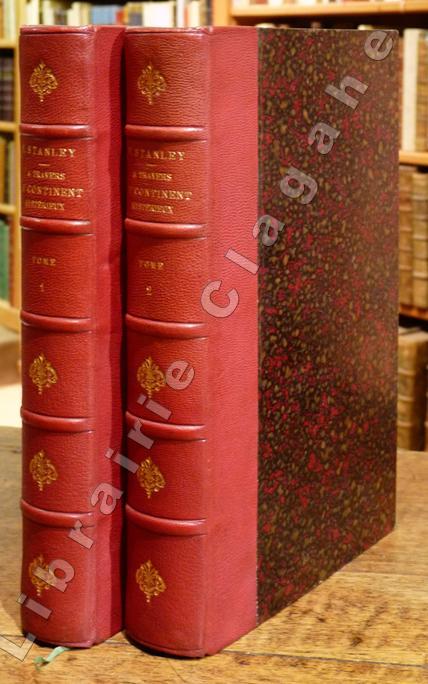
187912907Paris, Hachette, 1879 ; 2 tomes in-8 ; demi-chagrin rouge-cerise, fleurons décoratifs et titre dorés (reliure de l'époque) ; (12), IV, 496 ; (4), 544 pp., 2 frontispices, 9 cartes en couleurs dont 2 très grandes dépliantes en fin de chaque volume et 2 dépliantes, dont celle du fleuve Lingstone (Congo) et de ses chutes.
9248Philadelphia, William Brown, 1824. In 8 de 69 pp. (sous couverture), (rousseurs).
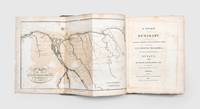
8vo [22 x 14 cm]; [iv], 106 pp, complete with map and 6 engraved aquatint plates, includes the advertisement leaf sometimes removed. later brown cloth with printed title label on spine, leaning a bit, map has very light stain in corner, slightly foxed on few margins, interior is clean, unmarked and near fine. A picture of this book is available upon request by email. A narrative of the author's travels in Barbados, Surinam, Santa Cruz, and other islands in West Indies with comments on life their, condition of slaves, etc. Ragatz, Guide For The Study Of British Caribbean History 1763-1834, p. 235: 'The author was a surgeon assigned to the naval hospital in Barbados in 1807 and later to a war vessel cruising through the islands. He spent about four years in Caribbean service and became thoroughly familiar with colonial society. His book presents an interesting picture of the rushing business conducted by the slave traders in Barbados on the eve of abolition and gives accounts of encounters with the Spanish and French during the course of the Napoleonic wars. The author . . . was greatly shocked by the general prevalence of immorality'. Cundall 2150. Sabin 101114. The map is of the Caribbee or Leeward Islands, with South America shown at bottom. The detailed and attractive plates include: Carlisle Bay and Bridge Town Baradoes, showing harbour, boats, buildings; Slaves in Barbadoes; A Spanish Planter of Porto Rico; City of Paramarino, Surinam, showing fort, boats, etc; Indian Implements, showing 14 items including spears, musical instruments, etc; A Chief of the Bosjesmans or Bush Negroes on a Visti to the Governor of Paramaribo.
1807177680London: Richard Phillips 1807. First edition of this account of the British colonies within modern-day Guyana. Bolingbroke was a staunch supporter of the Transatlantic slave trade which he discusses in Chapter Five and dedicated this work to the colonial secretary William Windham. Henry Bolingbroke 1785-1855 was a Norfolk merchant who first visited Demerara in 1798. This region had been under the control of the French and Dutch until it was captured by the British in 1796. Bolingbroke remained in the colony until 1805; he then travelled to Surinam in Dutch Guiana to become Deputy Vendue Master in 1807 responsible for public sales and auctions including those of enslaved people. He was one of the 16 MPs who voted against the abolition of slavery in March 1807. In Chapter Five Bolingbroke writes about slavery and what he viewed as its economic importance. In his dedication to Windham 1750-1810 he praised him for relaxing monopoly restrictions and "resisting the abolition of a liberty essential at new settlements of importing additional labourers" p. iii. Quarto pp. xii 400. Folding engraved map. Original green paper-covered boards rebacked modern spine label edges untrimmed. Signature of one George Atkinson on front pastedown a few pencil notes internally. Spine head stabilized boards marked foxing and toning to map and contents two small closed tears to map repaired offsetting to title page: a very good copy. Sabin 6182. hardcover
Second Edition, with additions, 12mo, [5], 6-100pp., folding engraved map of the town of Leicester, 5 nineteenth-century mounted actual photographs tipped-in, and 6 engraved plates tipped, modern cloth, uncut, spine faded. Susanna Watts was born in Leicester and was dedicated to bringing about the immediate abolition of slavery. She started one of the first fair trade campaigns, wrote hymns and pamphlets and even locked horns with William Wilberforce. When her father died, her wealthy family's finances became tight and she had to find a way to support herself and her mother. At the age of 15 or 16 she began writing to earn money, and as well as penning the first guide to Leicester, she wrote poetry to promote the emancipation of slaves. To be a young woman and a published author in the late 18th Century would not have been an easy task, so the fact that she prevailed shows how passionate Susanna was in her desire to make her antislavery views known. "They dared to stand up in front of all these men and say what they thought was right ? two women from the provincial town of Leicester." According to Shirley Aucott, a local historian and author, Susanna worked on a periodical called 'The Hummingbird', which brought together different ideas on the antislavery moment, and she organised what must have been one of the first fair trade campaigns! She visited local households and shops to persuade them not to use sugar produced in the Caribbean, claiming that, "abstinence from sugar would sign the death warrant of West Indian slavery."
1998cg243Conseil Général de la Réunion Dos carré collé 1998 In-4° dos carré collé, couverture illustrée, 110 pages, nombreuses illustrations en couleurs, mise en page originale, rencontre internationale de mail art pour célébrer l'anniversaire de l'abolition de l'esclavage, catalogue de l'exposition organisée à l'Artothèque du département de la Réunion de décembre 1998 à janvier 1999 ; couverture très légèrement frottée, très bon état Livraison a domicile (La Poste) ou en Mondial Relay sur simple demande.
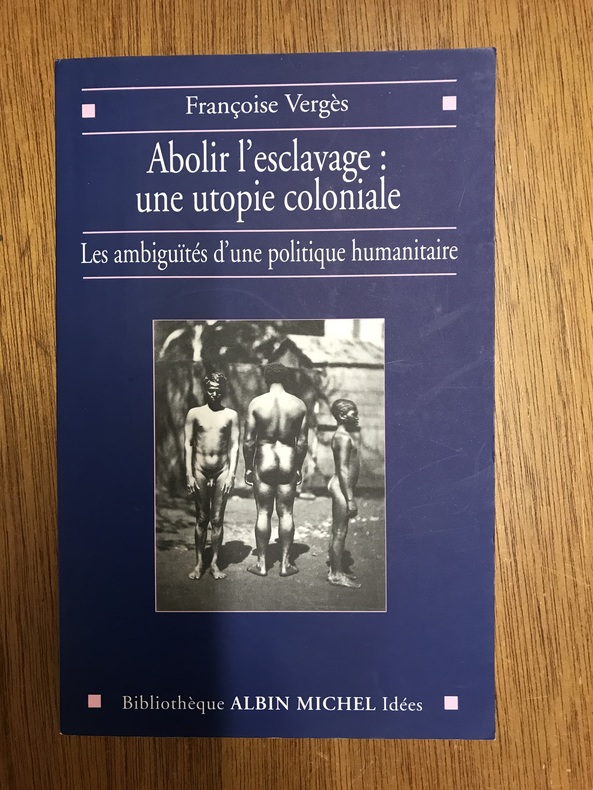
IDE200C190Albin Michel, Idées, Paris, 2001. In-8, broché, 229 pages. Couverture illustrée. Quelques frottements. Intérieur très frais. Quasi neuf. Étiquette magnétique en fin de livre.
2007207841Couverture souple. Broché. 254 pages. Passages surligné.