1 561 résultats
67143aafAmstelodami (Amsterdam), sumptibus Andreae Frisii, 1674, sm. in-8vo, 18 leaves incl. engraved frontispiece title, printed title with printer's mark + 582 pp., illustr. with 28 engraved figures of which 18 full page engravings + 15 folding engraved plates + 19 leaves (Index), light browning in places, marbled endpaper, full calf, red title label on spine, richly gold tooled spine, goldtooled inner dentelle, slight rubbing, red edges. Very Fine copy.
36pp.+ 2 illustraties buiten tekst, 19cm., orig. omslag, roestplekjes, goed, zeldzaam, N97517
1913N97517Arnhem, Suriname-Comité 1863-1913 1913 36pp.+ 2 illustraties buiten tekst, 19cm., orig. omslag, roestplekjes, goed, zeldzaam, N97517
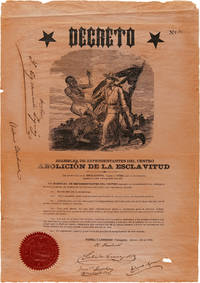
1869WRCAM56566Camagüey Cuba 1869. Pictorial letterpress broadside 18 1/2 x 13 inches. Numbered "54" in manuscript bearing the embossed red seal of the Republica Cubana and signed in ink by Salvador Cisneros y Betancourt Eduardo Agramonte Ignacio Agramonte Loyn áz Francisco Sánchez y Betancourt and Antonio Zambrana. Old horizontal folds minor creasing handful of small edge chips. Small hole in bottom margin just touching one ink signature. Very good condition. A rare and significant pictorial Cuban decree from the provisional rebel government abolishing slavery on the part of the island they controlled issued by the radical faction of the Cuban nationalists fighting against Spanish rule in the first months of the Ten Years' War. <br> <br> This proclamation is illustrated with a dramatic woodcut signed "LFR" depicting an ill-clad but exultant freed slave and a rebel celebrating in front of the Cuban flag. This decree stipulated freedom for all the enslaved people of Cuba in hopes that they would join the revolutionary struggle. The decree also provided for eventual compensation to slaveholders and ordered that freed individuals must serve the revolution either through military service or by continuing with their previous work. Among the important leaders who signed the present document were Salvador Cisneros y Betancourt as president just below the printed text and Ignacio Agramonte y Loynáz as secretary to the left of the engraving. <br> <br> The practical effect of this decree was modest as the rebels only controlled limited territory before their ultimate defeat and their territory was generally under the control of more conservative military commanders but such a proclamation joined a growing chorus of abolitionist sentiment in Cuba which finally realized the end of slavery in 1886. A powerful statement of anti-slavery policy in mid-19th century Cuba with a striking illustration of a jubilant slave celebrating his short-lived freedom. Rare with no copies recorded in OCLC. unknown books
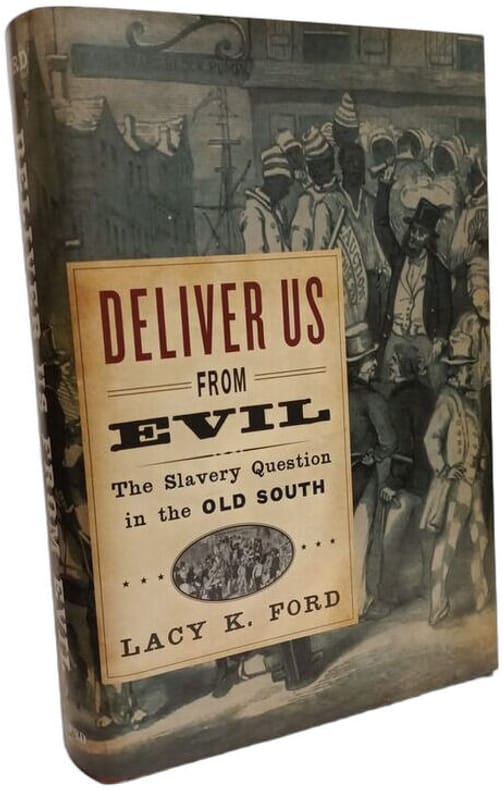
2009100145261Oxford University Press 2009 682 pages 15 748x4 318x23 622cm. 2009. Cartonné jaquette. 682 pages. Cet ouvrage historique analyse les efforts intellectuels et politiques des élites blanches du Sud des États-Unis pour justifier l'esclavage de la rédaction de la Constitution fédérale en 1787 jusqu'à l'ère jacksonienne. Il s'appuie sur une documentation primaire étendue pour explorer les débats contradictoires au sein de la société sudiste sur la place et l'avenir de l'institution esclavagiste
pp. viii, 244. Twenty wood engravings by Atherton. Illustrated title page. Foxed. Early manuscript ownership of George S. Schmidt, York, PA. 12mo. 190 mm. Original green polished linen cloth binding with paper label pasted on front board. Hardbound. Very Good. S&S/AI 18552. PALIB 4
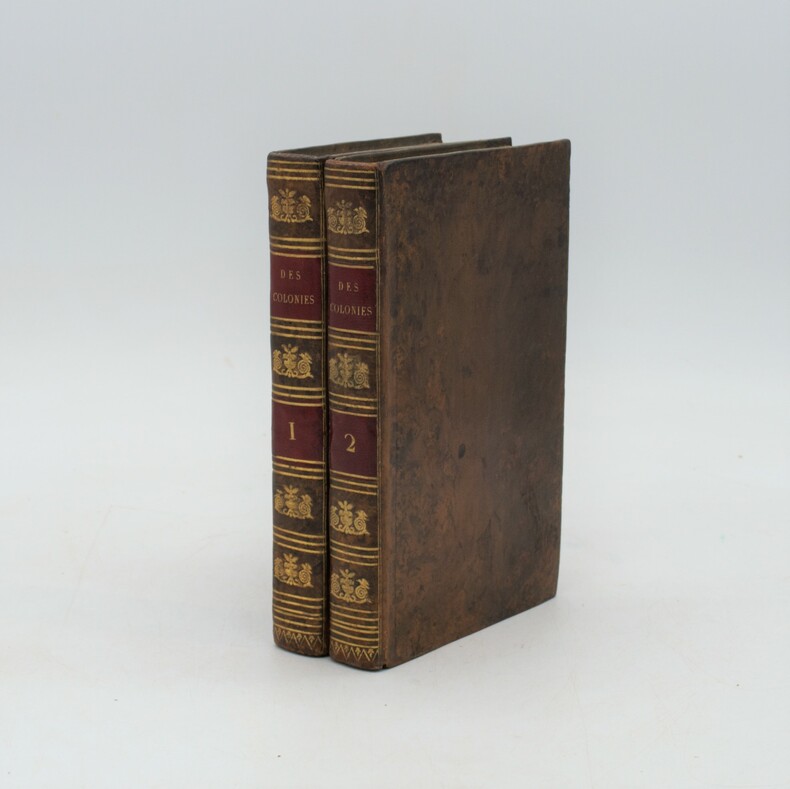
1817PHO-1170Paris, F. Bechet ; A. Égron, février 1817; 2 volumes in-8 ,xxxii,403,[2]; [4],394,[2]pp., relié plein veau raciné époque , dos lisse orné avec pièces de titre et tomaisons rouges, dos lisses. Édition originale.
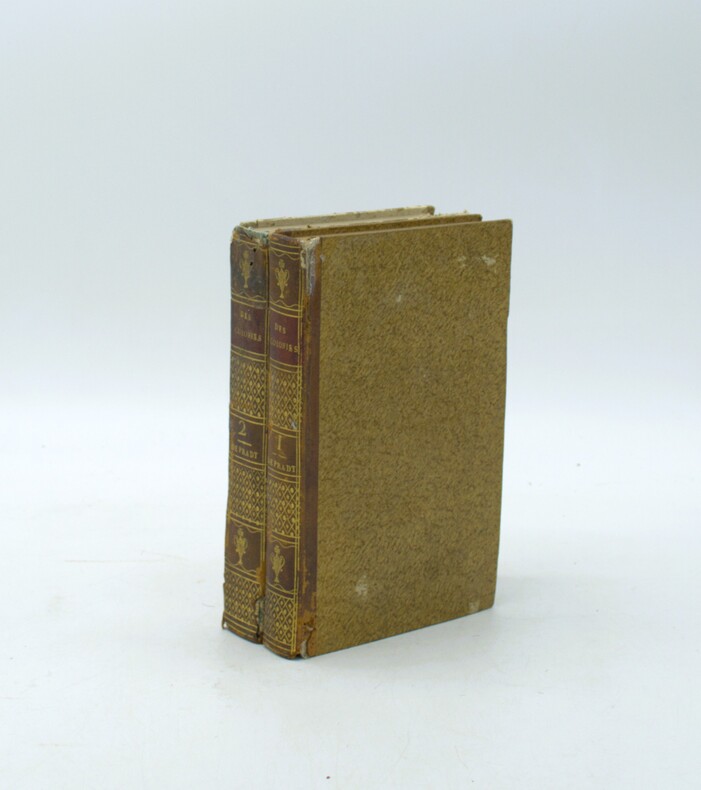
1817PHO-2154Paris, Bechet,1817. 3 parties en 2 vol in 8°, (23x 13cm), demi veau époque, dos lisse orné, pièce de titre rouge, xxxii, 507 pp errata, 394 pp.-1f. (errata)- 2ff.-160pp.-1f (errata), demi veau époque, dos lisse orné avec tomaison et pièce de titre, frottements et épidermures, manque de papier au tome 2 et au dos, intérieur frais.
197615602Basse-TerreFort-de-France Société d'histoire de la Martinique, de la Guadeloupe 1976 Un volume in-8, reliure pleine toile, 443 pages, très bon état.
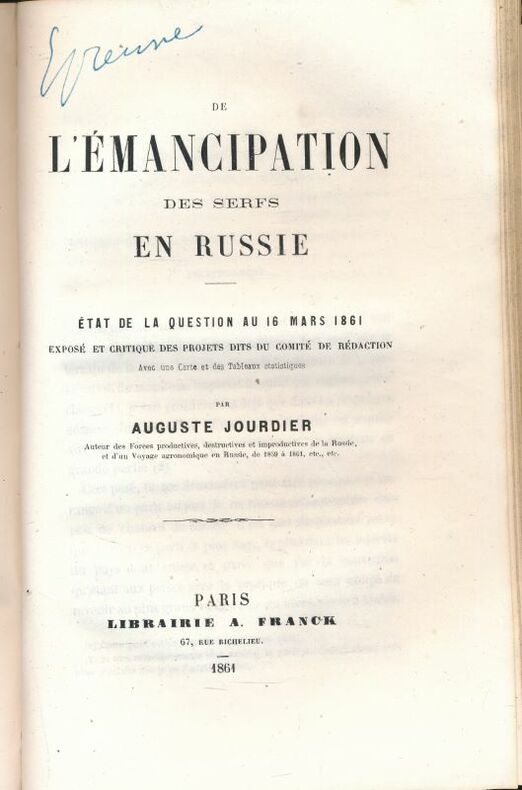
Paris Librairie A. Franck 1860, In-8 relié demi basane verte à petits coins, dos lisse à filets dorés, pièce de titre. Photo contrecollée en frrontispice + 303 pages. Relié en suivant, du même auteur, "De l'émancipation des Serfs en Russie" Etat de la question au 16 mars 1861. Exposé et critique des projets dits du Comité de Rédaction. Avec une carte et des tableaux statistiques, même éditeur, 1861. Le papier recouvrant le cartonnage des plats est abimé en bord, sans aucune gravité, le corps de l'ouvrage est en bon état. Les deux textes sont en édition originale. Rare.
1860164429Librairie Franck Paris, Librairie A. Franck, 1860. In-8 relié demi-basane verte à petits coins, dos lisse à filets dorés, pièce de titre. Photo contrecollée en frrontispice + 303 pages. Relié en suivant, du même auteur, "De l'émancipation des Serfs en Russie" Etat de la question au 16 mars 1861. Exposé et critique des projets dits du Comité de Rédaction. Avec une carte et des tableaux statistiques, même éditeur, 1861. Le papier recouvrant le cartonnage des plats est abimé en bord, sans aucune gravité, le corps de l'ouvrage est en bon état. Les deux textes sont en édition originale. Rare.
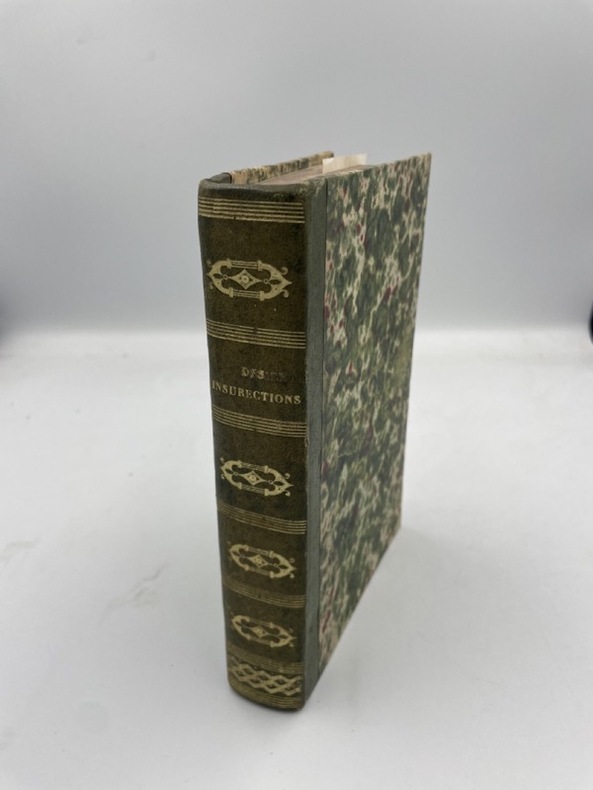
238672Paris, chez les directeurs de l'Imprimerie du Cercle social, 1793 fort volin-8, 614 pp., 3 pp. [Déclaration de l'auteur de l'ouvrage intitulé, Des Insurrections], demi-veau vert, dos lisse orné de filets, guirlande losangée et larges fleurons dorés, tranches marbrées (reliure de la Restauration). Dos uniformément insolé et passé, petite galerie de vers pp. 59-82, 209-226, 257-274, avec perte de quelques lettres.
181518491815 Ed. Athus Bertrand, Paris, 1815. In-8, demi-percaline, dos orné. 2 planches gravées dépliantes, (carte de Ste-Hélène, et vue de la rade de James-Town). Traduction de J. Cohen, notes de Malte-Brun
2002500132264Le Livre de Poche 2002 288 pages 12 6x1 6x17cm. 2002. pocket_book. 288 pages.
1986R100057414Ceger / L'Harmattan. 1986. In-8. Broché. Etat d'usage, Tâchée, Dos satisfaisant, Papier jauni. 341 pages - quelques illustrations, graphiques, tableaux, plans en noir et blanc dans et hors texte - mouillure sur les plats, contre plats et sur les premières et dernières pages du livre ne gênant pas la lecture.. . . . Classification Dewey : 326-Esclavage
Book is in excellent condition with bumps to the upper corners as only flaw. Binding is solid and square, covers have sharp corners, exterior shows no blemishes, text/interior is clean and free of marking of any kind. Dust jacket shows the slightest signs of shelf wear only, no tears, wrapped in clear protective cover. Previous owner's name or sticker in front section of the book. 266 pages, short section of b&w photos.
2016R260256968Au bureau du journal. 2016. In-4. Broché. Bon état, Couv. défraîchie, Dos satisfaisant, Intérieur frais. 142 pages augmentées de quelques photos en couleurs dans texte.. . . . Classification Dewey : 326-Esclavage
#[36399]München ca. 1830 Original lithographed plate by Meier E. Meyer and printed by J. Selb depicting the Brazilian diamond mines of Curralinho. Ca. 39 x 46 cm. From: Johann Baptist von Spix & Karl Friedrich Philipp von Martius Atlas zur Reise in Brasilien. - The atlas appeared in instalments and is rarely found complete. From 1817 to 1820 the botanist and traveller Martius 1794-1868 travelled in Brazil together with the zoologist Spix 1781-1826. Their journey was a scientific expedition financed by king Maximillian Joseph I of Bavaria. - Famous slavery print of the Brazilian diamond mines. - Unobtrusive dampstain in margin left lower corner mainly to be seen on verso few spots in margin otherwise a very fine copy. Borba de Moraes II p.p. 829; Bosch Brasilien-Bibliothek 346. unknown
1994RO40008693Présence africaine. 1994. In-12. Broché. Bon état, Couv. légèrement passée, Dos satisfaisant, Papier jauni. 58 pages.. . . . Classification Dewey : 326-Esclavage
17981244831798. First Edition. SMITH Elihu.Hubbard. A Discourse Delivered April 11 1798 At the Request of and Before the New-York Society for Promoting the Manumission of Slaves and Protecting Such of Them as Have Been or May Be Liberated. New-York: T. & J. Swords 1798. Slim octavo original tan self-wrappers string tied uncut; pp. 1-5 6-30 2. $3500.First edition of Smith's scathing attack on American slavery declaring it a betrayal as ""thousands of your fellow-beings children of the same father and inheritors of the same destiny writhe under the lash of cruelty"" an exceptional 18th-century abolitionist work published barely ten years after ratification of the Constitution exceedingly rare uncut in original wrappers.Trained as a physician under Benjamin Rush ""Smith was an early abolitionist a member and Recording Secretary of the New York Manumission Society and trustee of the city's African Free School"" Stevenson Litchfield Native. ""Passionately committed to the improvement of the fledgling nation through the acquisition and circulation of information"" Smith's analysis of slavery in this very rare work published the same year as his early death at 27 expresses his and the Society's commitment ""to ideals of human perfectibility which they combined with the practical labor of achieving change"" Kelly on Kaplan Men of Letters. Here he takes aim at leaders and nations where the ""spirit of despotism multiplied and extended the evil"" of slavery and ""wrought it into a system."" Noting the influence of renowned abolitionists John Woolman and Anthony Benezet he asserts that it is those in slave trade who particularly ""opened a new field for every baneful enterprise"" when they became ""the first to violate the noble principles by which they had been guided."" Smith especially speaks to American leaders and slaveholders who concede ""slavery is unjust"" but claim ""it is entailed upon us by our fathers; it is interwoven with every part of our social organization."" In reply he declares that it is ""strange reasoning"" to endorse slavery simply because it exists. Arguing ""the laws of our country authorized the possession in human flesh"" he asks: ""Shall the legislators of a great nation be denied the power of acknowledging their errors and laboring to correct them Encumbered as we are with this mighty evil"" Smith proclaims: ""You yes you the Legislators of America you are the real upholders of slavery you foster and protect it you immortalize injustice while thousands of your fellow-beings children of the same father and inheritors of the same destiny writhe under the lash of cruelty."" Evans 34554. Sabin 82502. Dumond 103. ESTC W37980. Not in Blockson. Text quite fresh with only faintest foxing to original wrappers. An excellent about-fine uncut copy in original wrappers. unknown
28345Confidant of Missouri pioneer Jonathan Bryan 1759-1846 of the noted St. Charles family whose relatives included their neighbor Daniel Boone. DS 1p 7½" X 12" St. Charles County MO 1847 February 2. Near fine. Acknowledgment that Tuter who signs himself as "Administrator of the Estate of Johnathan Bryan" has had a writ of replevin made out and issued to the St. Charles sheriff Edward C. Cunningham 1809-65 for delivery to an unnamed offender. The writ seeks to recover the following property apparently wrongfully taken from Jonathan Bryan's estate: "one negro man a Slave named Heney one Two horse waggon and one pair of Briches Two Black horses one Lorrel horse with bold face one walnut Cupboard one clock one Bureau one bedstead and bedding one walnut Table one Trunk one Bible." In other words everything but the kitchen sink. Signed at the conclusion by Tater in his definitely untutored hand. Tales of slaves are found in the Bryan family lore such as: "Mrs. Jonathan Bryan a kinswoman of Daniel Boone was working in her yard with a slave woman when a boy slave screamed. She saw an Indian warrior heading for them with a tomahawk in one hand and a gun in the other. The women ran for the house. Just as they were slamming the door they caught the warrior's head and right arm between the door and facing. The slave woman grabbed the hatchet from his hand and killed him with a sharp blow. The women had barely recovered from their fright when the boy shouted again." Could the slave boy in this old family legend by none less than the "Slave named Heney" whose return is demanded in this replevin suit Quite unusual slavery item with an intriguing history. unknown
28345Confidant of Missouri pioneer Jonathan Bryan 1759-1846 of the noted St. Charles family whose relatives included their neighbor Daniel Boone. DS 1p 7½" X 12" St. Charles County MO 1847 February 2. Near fine. Acknowledgment that Tuter who signs himself as "Administrator of the Estate of Johnathan Bryan" has had a writ of replevin made out and issued to the St. Charles sheriff Edward C. Cunningham 1809-65 for delivery to an unnamed offender. The writ seeks to recover the following property apparently wrongfully taken from Jonathan Bryan's estate: "one negro man a Slave named Heney one Two horse waggon and one pair of Briches Two Black horses one Lorrel horse with bold face one walnut Cupboard one clock one Bureau one bedstead and bedding one walnut Table one Trunk one Bible." In other words everything but the kitchen sink. Signed at the conclusion by Tater in his definitely untutored hand. Tales of slaves are found in the Bryan family lore such as: "Mrs. Jonathan Bryan a kinswoman of Daniel Boone was working in her yard with a slave woman when a boy slave screamed. She saw an Indian warrior heading for them with a tomahawk in one hand and a gun in the other. The women ran for the house. Just as they were slamming the door they caught the warrior's head and right arm between the door and facing. The slave woman grabbed the hatchet from his hand and killed him with a sharp blow. The women had barely recovered from their fright when the boy shouted again." Could the slave boy in this old family legend by none less than the "Slave named Heney" whose return is demanded in this replevin suit Quite unusual slavery item with an intriguing history. unknown books
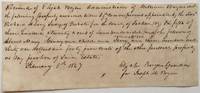
1847266916Jackson County FL 1847. unbound. 1 page 3.5 x 7.5 inches Jackson County Florida February 5 1847 -- a probate court receipt acknowledging that "Elijah Bryon Administrator of William Bryon received the following property awarded to me by the commissioners appointed by the Hon. Richard H. Long Judge of Probate for the County of Jackson one-fifth of three-hundred and twenty acres of land undivided and the following slaves: Mary Ginny and child and Jerry valued at $1500 and three-hundred and thirty one dollars and forty-five cents of the other personal property as my position of said Estate." Signed at the bottom: "Elijah Bryan guardian for Joseph M. Bryan" and docketed on the bacl: "E. Bryan" and "Richard H. Long J.P.C." Richard H. Long 1791 - 1865 was appointed by the Territorial Governor in 1833 to complete the land sale between S. Brown and the Apalachicola Tustenuggee and Hadjo tribes treating the Indians fairly. He was a representative to Florida's first Constitutional Convention and later served as Speaker of the House. During the Civil War he rose to the rank of Colonel of a Florida Regiment and saw much action in the field. His body was recently located in a forgotten Confederate cemetery. Elijah H. Long was known for building a 5200-acre plantation for his mother. The family was well known in Jackson County and evidently all were slave owners. One horizontal fold; uniformly toned. Very good condition.<br/><br/> unknown books
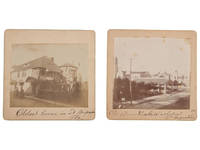
1897185871897. Albumen photographs of slavery-related sites circa 1890s document physical locations tied to the sale and habitation of enslaved people in the United States and the persistence of those sites in post-Emancipation visual culture. The images include a pavilion in St. Augustine Florida identified in contemporary sources as a site where enslaved Africans were bought and sold a photographic negative depicting outbuildings identified as Mississippi slave quarters and a mounted view of the González Alvarez House a colonial structure associated with early settlement in St. Augustine. Together the photographs provide material evidence of how spaces connected to slavery were recorded labeled and circulated in the late nineteenth century linking architectural survival to the historical memory of enslavement in both the Southeast and the Gulf South.<br /> <br /> Collection of three albumen photographs. United States circa 1890s. One mounted photograph approximately 3 3/16 x 3 inches bears the ink inscription "Old Slave Market Cathedral St. Augustine Fla." and depicts the waterfront pavilion constructed in the early nineteenth century originally used as a commercial market and identified in local records as a site of slave trading. One photographic negative approximately 3 1/2 x 3 3/4 inches shows three small structures identified as Mississippi slave quarters. One mounted photograph approximately 3 1/8 x 2 5/8 inches is inscribed "Oldest house in St. Augustine Fla. Built in the early 1700s" depicting the González Alvarez House. Mounts and inscriptions indicate a documentary intent linking the images to historically significant sites.<br /> <br /> By the late nineteenth century sites associated with slavery were being reframed within local historical narratives often presented as landmarks while still retaining traces of their earlier function within systems of forced labor and sale. The identification of the St. Augustine pavilion as a slave market in inscription and record aligns the image with documented urban sites of sale in Spanish and later American Florida while the Mississippi quarters image extends the archive into the plantation landscape of the postbellum South. The grouping provides a concise visual record of how structures tied to enslavement were preserved interpreted and circulated in photographic form decades after abolition. Minor adhesive residue to one mount small tear to negative and light toning and staining to mounts; overall good condition. unknown
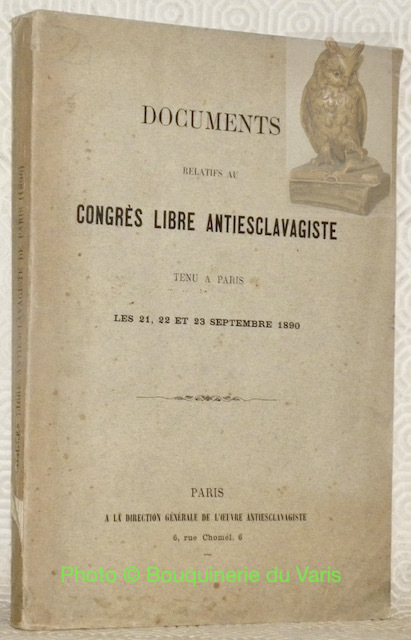
42577Paris, A la direction générale de l’oeuvre antiesclavagiste 1890, 235x155mm, 210pages, broché. Bon état.