(Virginia Slavery). Faulkner, Charles JBiblio.com
1 561 résultats
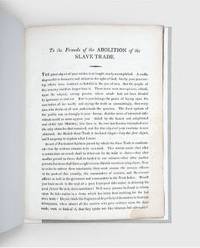
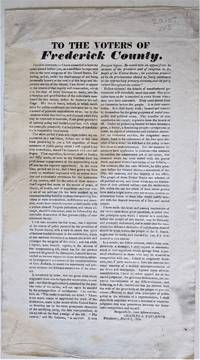
1833713Winchester Va. 1833. Broadside 4to. 290 x 160 mm. 11 ¼ x 6 ¼ inches. Printed in two columns signed in type by Charles J. Faulkner at Winchester dated March 8 1833 at conclusion. Lightly dust-soiled pale stain affecting perhaps one-third of the left-hand margin and column of text. Neatly silked on verso. Withal about very good. Following the August 1831 Nat Turner rebellion in Southampton County a last effort was made by moderate Virginians to gradually abolish slavery. Faulkner a 26-year-old lawyer and assemblyman along with Thomas Jefferson Randolph sponsored legislation to free all children born of slave parents after July 4 1840. His speech emphasized the evil of slavery for Southern white labor noting that slavery "converts the energy of the community into indolence--its power into imbecility--its efficiency into weakness.Shall society suffer that the slave-holder may continue to gather his crop of human flesh" As the Assembly was malapportioned in favor of the Tidewater slaveocracy the proposal lost rather narrowly and nearly thirty years later the Confederacy was assured of Virginia's succession. It is perhaps not surprising that Faulkner "comparatively a stranger" to the county but a member of the Virginia House of Delegates at this time 1831-34 was not successful in his campaign to represent Virginia in the U.S. Senate. However Faulkner was elected to three terms in Congress from Virginia in the 1850s. He was elected to Congress from West Virginia after the Civil War. In the interim he served as Minister to France during the Buchanan administration and on the staff of Stonewall Jackson. Dictionary of American Biography. Not in Hummel. Not found in American Imprints for 1833 and not in the 1830-1839 title index. OCLC records four copies at The Library of Virginia University of Virginia Virginia Historical Society and American Antiquarian Society. unknown
1807190225London: W. Flint 1807. First edition published soon after the abolition of the slave trade in the British Empire appealing for Britain to make the international end of the trade a core part of its aims in the ongoing Napoleonic Wars. Quarto 248 x 194 mm 4 pp. Recent white and grey boards printed paper label to front cover. Light stain at bottom fore corner and light spotting: a good copy. hardcover
in-8, 183 pp., illustrations. Very Good Copy (No Mrks, No Inscriptions). [P-12]
183 pages. Index. "A vivid account of life in the plantation system just after slavery." - Lemuel W. Martin. Moderate wear. Gift greetings inside front cover. Book shop stamp upon title page. Sound copy. Book
1975R240136173FRANCOIS MASPERO. 1975. In-8. Broché. Bon état, Couv. convenable, Agraffes rouillées, Intérieur frais. Tiré à part paginé de 77 à 90 - pages agrafées - hommage de l'auteur sur la page 77 - 2 photos disponibles.. . . . Classification Dewey : 326-Esclavage
192543939Portland: By the Author / Press of A.E. Kern 1925. Second edition same year as first. Octavo 19cm. Original illustrated wrappers; 127pp. Covers moderately dusted and darkened; a few faint corner-creases to text; Very Good. Written as an expose of the bootlegging and white slavery rackets of Oregon the novel chronicles the fall and rise of an innocent country girl who comes to Portland from the cheese-making village of Tillamook. The author's foreword announces that "Law enforcement is the burning topic of the hour and will continue to be while merchant princes as well as members of the United States Senate Conress public officials apologetic judges and parasitical bootleg attorneys keep stocks of fancy liquors in their homes and serve the same to their friends." Uncommon in commerce; this is a tight attractive copy. OCLC finds 15 locations nearly all in Oregon. By the Author / Press of A.E. Kern unknown books
7928Paris, Firmin-Didot, s.d. (1902), 1 percaline rouge, encadrements et ornements floraux dorés, tranches dorées. in-8 de 158 pp., illustré de 19 gravures dont 1 en frontispice ;
LFA-126730525Un ouvrage de 158 pages, format 150 x 230 mm, illustré de 19 gravures, relié cartonnage, s.d. (début du XXe siècle), Librairie de Paris
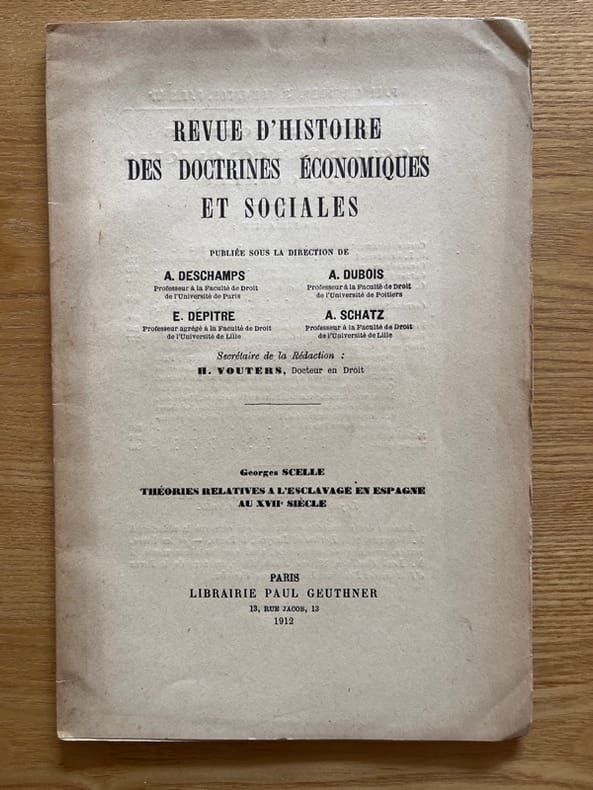
235165Paris, Geuthner, 1912 in-8, 28 pp., broché.
211230Paris, C. Reinwald, J. Cherbuliez, 1865 in-12, [2] ff. n. ch., 330 pp., un f. n. ch. d'errata, demi-chagrin cerise, dos à nerfs orné de filets à froid, tranches mouchetées de bleu (reliure de l'époque). Infimes accrocs au dos.
19739In-12, demi-chagrin bordeaux de l'époque, dos à 5 nerfs orné de filets à froid et dorés, titre doré, (2) f., 330 p., (1) f. d'errata. Paris, C. Reinwald et J. Cherbuliez, 1865.
In-12, demi-chagrin bordeaux de l'époque, dos à 5 nerfs orné de filets à froid et dorés, titre doré, (2) f., 330 p., (1) f. d'errata. Edition originale. Historien et théologien, dans la mouvance du protestantisme libéral, Albert Reville fut nommé professeur au Collège de France en 1880 à la première chaire d'histoire des religions. Il fut lors de sa création en 1886, le premier Président de la section des sciences religieuses de l'Ecole Pratique des Hautes Etudes et le fondateur de la "Revue de l'Histoire des Religions". Très bon exemplaire, bien relié à l'époque.
1970vh3705Fascicule 1970 In-8 (16 x 24 cm), fascicule agrafé, paginé de 214 à 224 ; petites taches autour des agrafes rouillées, par ailleurs assez bon état. Livraison a domicile (La Poste) ou en Mondial Relay sur simple demande.
184537320Havana 1845. Each document 8-1/2" x 12-1/2" entirely in ink manuscript with decorative official printed ornamentation at head of each and signature "O'Donnell" in the left margins. Some toning and a few holes not affecting text. Good. <br/><br/> Leopoldo O'Donnell y Jorris 1st Duke of Tetuán 1809-1867 was a Spaniard of Irish ancestry from Tenerife. He went to Cuba as Captain General in 1843 and later served three separate stints as prime minister of Spain. He approved each of these requests for travel. The named Cuban Slaves are of "Lucumi" ancestry originally from the Yoruba tribes of Benin and Nigeria. The documents all dated in October 1845 refer to the slaves Joaquin Garcia de Angarica and Florentino Armenteroy Regidor.<br/> These requests were made to transfer the slave from one hacienda to another for work purposes the terms of work engagement frequently stated here. unknown books
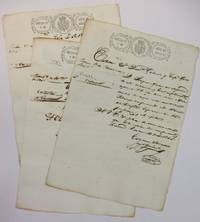
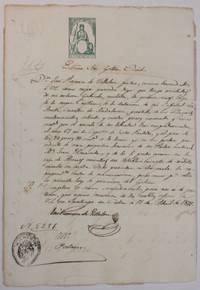
37208Each document a single manuscript page 8-1/2" x 12-1/2." Each with official stamp one also has a decorative illustrated green stamp at the head. Light wear and toning Good.<br/><br/> Each document names the slaveholder and the enslaved person granted "libertad" and the cost in escudos or pesetas of that liberty. The slaves liberated here are Saturnia "morenita criolla" age 14; Gabriela "esclava mulata" age 15; and Dolores "parda criolla" age 16. unknown books
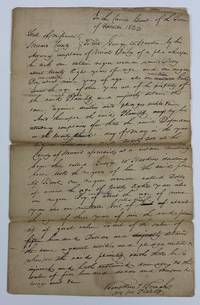
18224276Howard County Mo 1822. Good. Three documents totaling 3pp. folio the two earliest documents written on each side of the same leaf with an integral blank and attached to the third document with sealing wax each document docketed on verso. Some short separations along folds minor spotting two short tape repairs. A series of three documents recording a case of slave theft in Missouri. The plaintiff in the case George W. Hardin sues a man named Urial Bailey for stealing three slaves from the Hardin estate in Howard County Missouri. The first document is a sworn oath dated May 23 1822 by George Hardin stating that "He was lawfully possessed of the negroes.and that the same were unlawfully taken by Urial Bailey.from his properties and with out his consent within one year last past and that he is now lawfully entitled to the possession of the said negroes." The document is attested by the clerk and signed by Hardin.<br /> <br /> The second document is executed by Hardin's lawyers on the verso of his oath dated the same day and constitutes an order from the court to the Sheriff of Howard County informing him that "George W. Hardin hath come into the Circuit Court held in the town of Franklin and found sufficient sureties as well as his clamour to prosecute for a certain woman called Dolly about the age of twenty eight years also one negro boy of about the age of nine years named Nathan also one negro girl called Eliza about the age of three years all the property of the said Plaintiff.which a certain Uriel Bailey.hath taken and unjustly detains. You are hereby commanded that the said goods.be delivered to the said George W. Hardin and that.Uriel Bailey appear before the said Circuit Court to be held at the town of Franklin."<br /> <br /> The third document is executed by Hardin's lawyers on the verso of his oath dated September 1822 and lays out the facts of the case. It reads in part: "George W. Hardin by his Attorney Tompkins & French complains of Urial Bailey that he took the previously named slaves of great value. To wit of the value of fifteen hundred dollars.where fore the said Plaintiff saith that he is injured and hath sustained damages to the value of five hundred dollars and therefore he brings suit." Interestingly in this document Hardin's lawyers refer to the youngest slave Eliza as a "mulatto girl." Docketing on the integral blank attached to the oath and lawyer's document dated May 23 1822 indicate that Hardin was seeking "Replevin Damages" of $500 which the court seems to grant. <br /> <br /> The motive behind Urial or Uriel Bailey's thefts are not recorded here but the issue of slave stealing was not uncommon and had been going on in the American colonies and the fledgling United States for a long time. According to Timothy F. Reilly in "Slave Stealing in the Early Domestic Trade as Revealed by a Loyal Manservant" published in Louisiana History: The Journal of the Louisiana Historical Association Vol. 55 No. 1 Winter 2004 pp.5-39: "Slave stealing plagued domestic slaveholders as far back as the colonial period when those who would unlawfully deprive a property owner of human chattel were detested as 'Negro jockeys.' Whether operating in the northern or southern colonies a 'man-stealer' lurking about either as a piratical thief or as a high-minded abolitionist was guilty of one of the worst crimes against the sanctity of property. By the 1830s man stealing reached epidemic levels in parts of the South."<br /> <br /> Despite the seeming prevalence of slave theft for a long period of time in the United States primary source records of court cases are very scarce. unknown
185327110Washington: C. Alexander Printer 1853. 1st thus Dumond p. 13. Disbound lacking wrappers. Overall VG occasional spot of foxing. 36 pp. 8vo. <br/><br/> C. Alexander, Printer unknown books
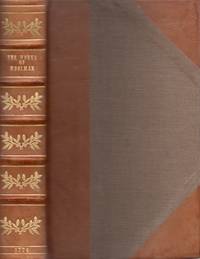
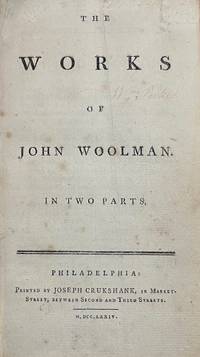
177434482Philadelphia: Joseph Crukshank 1774. First Edition. Three-quarter leather. Good. Octavo. 1 xiv 2 436 pages 1. Rebound in three quarter leather with tan cloth covered boards. Raised bands gilt decorations and title on the spine. Two title pages but continuos pagination. Inscription by the previous owner on the front blank end sheet. Front blank end sheet has some holes upper corner partly affecting the inscription. Moderate toning to the contents. Small worm hole lower back foredge not affecting the text. Pages 407-428 also has a small worm hole top edge not affecting the text. Chapter in part 2 pages 279-311 is titled "Considerations On the Keeping of Negroes."<br /> <br /> This first edition was published after the death of Woolman 1720-1772. Several later editions have been published. John Woolman was a Quaker minister and early abolitionist. He traveled to England in 1772 to promote the abolition of Slavery but died soon after arriving in England. He is buried in York. <br /> <br /> <br /> Howes W 669; Sabin 10524. Joseph Crukshank unknown
177435034Philadelphia: Joseph Crukshank 1774. First Edition. Leather bound. Fair. Octavo. 1 xiv 2 436 pages 1. Polished calf leather covers. Chipped title on the spine. Missing a section of leather bottom spine and another section is coming loose. Front cover is detached. Text lightly toned with scattered light brown stains. <br /> <br /> Two title pages with continuos pagination. Chapter in part 2 pages 279-311 is titled "Considerations On the Keeping of Negroes." This first edition was published after the death of Woolman 1720-1772. Several later editions have been published. John Woolman was a Quaker minister and early abolitionist. He traveled to England in 1772 to promote the abolition of Slavery but died soon after arriving in England. He is buried in York. <br /> <br /> Howes W 669; Sabin 10524. Joseph Crukshank unknown
16453The Light. September-October 1915. La Crosse Wisconsin: World's Purity Federation 1915. The World's Purity Federation focused on fighting public vice such as prostitution and sought to ensure proper morals in society. During the Progressive period reforming public vice was a growing movement that saw victories with the passage of prohibition and other regulations on public decency. Due in part of organziations like the World'd Purity Federation in 1910 the White Slave Trade Act also known as the Mann Act passed in US Congress outlawing the transport of women typically European immigrants across state lines for the purpose of prostitution. Activists continued to meet strategize and organize tactics to ensure that the new legislation would be upheld and expanded. Photo-illustrated portrait of president of Oxford College for Women Jane Sherzer PhD in academic cap and gown. Very good condition. unknown books
191026265Chicago and Boston: The Christian Witness Company 1910. First edition. Cloth. Good . Cloth-covered ocatvo with color illustration tipped on to the front panel. 418 pp. Illustrated frontis. Written and edited by Rev. F. M. Lehman with slum data furnished by Rev. N. K. Clarkson. With illustrations and a photograph. Covers lightly worn. Pages are somewhat darkened with age. The Christian Witness Company unknown books
66 pages. Features: John Chisum - Empire Builder; Little Sister of Courage; Moman Pruiett - Genius of Hate; The Day Wyatt Earp Died; Tragedy on the Sweetwater; Guarding the Rio Grande (cover story); The Northfield Raid; Revival Meeting Cutups; Lake of the Pawnee Blood; "I Met Butch Cassidy"; Poker Alice - the West's First Female Gambler; Early Day Fire Departments; Slavery in the West. Magazine
186064001London UK: William Tweedie 337 Strand 1860. Small 4to. 5.25 x 7.5 in. xv 1 3-172 xi 1 pp. Woodcut-engraved frontisp. of the author still preserving tissue guard. Publisher’s ribbed plum-coloured cloth dark maroon coloured title label & price of 1 shilling 6 pence mounted front cover very minor chipping head & foot of spine slight fraying title label stamping dimmed and minor bumping to a couple corners still a VG copy w/ London UK bookseller’s label partially removed at gutter margin front pastedown. First edition first printing of the first book wholly devoted to the Underground Railroad published only in England and by an African-American/Native-American author. Mitchell was a pivotal figure in the Underground Railroad who also aided the escaped slave “Eliza†whose escape over the Ohio River ice inspired the key dramatic moment in Harriet Beecher Stowe’s pivotal Uncle Tom’s Cabin. “Eliza†was sheltered originally in the network by noted abolitionist John Rankin passed on to Mitchell who then subsequently ensured her safe passage along the network overseen by Levi Coffin 1798-1877. Ironically the passage of the 1850 Fugitive Slave Act which criminalized those aiding in the Underground Railroad to free slaves with fines of $ 1000 and six months imprisonment fueled resistance and forced Mitchell to publish this seminal work in Great Britain rather than the U.S. As a freeborn orphan Black in North Carolina Mitchell was forced into apprenticeship with a North Carolina plantation owner where he witnessed the deprivations of slavery and became inspired to aid African-American slaves to escape to Canada. From 1842-1855 he helped over 1300 slaves reach Canada from his Washington Court House Fayette County Ohio way station. This memoir recounts many anecdotes of the formerly enslaved including: one enslaved woman who died from frostbite while protecting her three children and a former slave John Mason brought Mitchell in just 19 months of that 13 year span “265 human beings whom he had been instrumental in redeeming from slavery.†Mitchell further recounts Mason’s recapture in Kentucky and later escape from New Orleans to Canada. Mitchell estimates in his book that 60000 enslaved peoples escaped into Canada on the Underground Railroad modern estimates range from 40000 to 100000. At the end of the 1850’s he moved to Toronto and began serving as a minister to African-American Baptist Free Mission congregations largely composed of freed slaves and the final section details the lives of these Canadian Black immigrants. In the final appendix he urgently pleads for a boycott of Southern cotton by Great Britain attempting to overcome resistance to the economic impact and hardship it would have on British cotton mills and related industries. Mitchell c. 1826-c.1879 was encouraged to write this historic work by W.H. Bonner A British abolitionist and had toured Britain in 1860 with William Howard Day and British abolitionist George Thompson to oppose the condition of slavery before the outbreak of the Civil War. This work is quite scarce with only 2 copies at auction in the last 50 years and both those appear to have been the 2nd edition which removed the hyphen in “Under-Ground†extended the title and a couple other revisions. William Tweedie, 337, Strand, hardcover
1855WRCAM55824New York: American Anti-Slavery Society 1855. 36pp. Gathered signatures stitched as issued. Minor edge wear spotting and soiling. Very good. The scarce second edition of this anti- slavery pamphlet printed in New York by the American Anti-Slavery Society from the same "stereotype plates.without alteration" as the first edition printed in Hartford earlier the same year. The text focuses on an appeal to the American Tract Society to take a more vocal and concerted stand against slavery. The authors of the text accuse the American Tract Society of "suppression" of anti- slavery sentiment by censorship of certain works it publishes that speak against the institution and an overall sin of "studied and persistent ommission" by not itself issuing "a direct condemnation of the most giant iniquity of our land." The text is signed in print at the conclusion by "The Members of the Fourth Congregational Church Hartford Conn." The work was issued as the sixteenth entry in the American Anti-Slavery Society's "Anti-Slavery Tracts." SABIN 30676. American Anti-Slavery Society unknown books
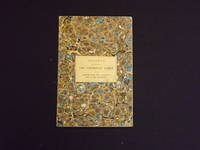
18361005398vo pamphlet marbeled wrappers with printed label on front cover 32 pp.some minor spine snd edge wear slight aging; very good or better.The work begins with the original source of funds for its "Charitable Fund" which began with estate of Robert Boyle in 1691. Since the 500000 Negro Slaves in the West Indies were mostly "infidels and heathens" converting them to Christianity would be doing them a favor and help the empire.Converting the slaves to Christianity would make them more virtuous more comfortable offer them a prospect of eternall happines and even make them better servants. Richard Clay,