1 561 résultats
ORD-6942With Map and Illustrations. London. Sampson Low, Marston, Low and Searle. 1873. In-8 (145 x 204mm) dos à 5 nerfs et coins veau vert foncé, pièce de titre veau rouge, plats toile chagrinée, XIV, (2), 304 pages, grande carte rempliée hors texte (piquée et réparée sans perte), frontispice, illustrations en noir dont 8 hors texte. Des rousseurs éparses sinon assez bon exemplaire.
1988RO80245183Picador. 1988. In-8. Broché. Etat d'usage, Couv. légèrement pliée, Dos satisfaisant, Papier jauni. 417 pages. Texte en anglais.. . . . Classification Dewey : 326-Esclavage
Broch?. 268 pages. Rousseurs. Couverture d?fra?chie.
101.504Paris, Albin Michel, 1929. 12 x 19, 268 pp., broché, état moyen (couverture défraîchie).
2001500074130MAGNARD 2001 80 pages 12 6x0 6x17cm. 2001. pocket_book. 80 pages.
101301 P., Veuve Tilliard et Fils, An VII, petit in-8° de 230 pp.-f.bl., relié demi-basane noire d'époque, dos lisse orné, titre or sur pièce peau rouge ; mouillure angulaire en tête jusqu'à la page 19, à peine perceptible jusquà la page 160 puis descendant vers le deuxième tiers des pages et finissant plus marquée de la p. 209 au feuillet de garde.
229735Paris, Marcel Rivière, 1910 in-8, [2] ff. n. ch., XIX pp., 452 pp., broché.
Two volumes in one, complete. FIRST AND ONLY EDITION OF THIS CLASSIC STUDY OF EUROPEAN AND COLONIAL ECONOMICS, including slavery. 2 leaves; 223 pp; 2 leaves; 267 pp. Printed on fine laid paper. 8vo. Original wraps with paper spine label. Entirely uncut. FINE AND BRIGHT, WITH NO DEFECTS. A pristine copy of an important book, exactly as it came out of the printer's office.
19791232851979 Editions Hachette - 1979 - In-8 broché, avec son bandeau de lancement - 114 pages
2007R200133291L'Harmattan. 2007. In-8. Broché. Etat d'usage, Coins frottés, Dos satisfaisant, Intérieur frais. 123 pages, quelques photos et illustrations en noir et blanc dans le texte, en supplément une carte postale en couleur.. . . . Classification Dewey : 326-Esclavage
7132S.L., (Société des Amis des Noirs), 1790. In 8, [ mm] de 1 ff. en feui11e, tel que paru.
2010120544Clarion Books, 2010, gr. in-8° carré, 166 pp, 75 gravures et photos, 5 cartes, chronologie, notes et sources, biblio, index, reliure toile éditeur, jaquette illustrée, bon état. Texte en anglais
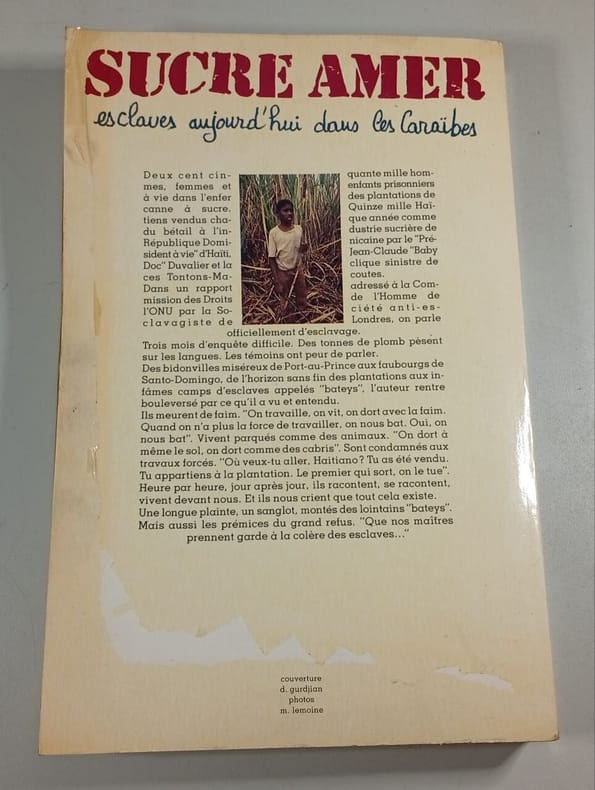
ISBN : 2864181045. ENCRE. 1982. In-8 Carré. Broché. Bon état. Couv. convenable. Dos satisfaisant. Intérieur frais. 291 pages- quelques pages de photos en noir et blanc hors texte
1982R150205957ENCRE. 1982. In-8. Broché. Bon état, Couv. convenable, Dos satisfaisant, Intérieur frais. 291 pages- quelques pages de photos en noir et blanc hors texte. . . . Classification Dewey : 326-Esclavage
1981500375976ENCRE 1981 1981. L'ouvrage de Maurice Lemoine dénonce les conditions de travail proches de l'esclavage subies par des milliers d'ouvriers agricoles haïtiens recrutés pour la récolte de la canne à sucre en République dominicaine. À travers un reportage photographique et une enquête de terrain l'auteur décrit les bidonvilles les plantations et les camps d'esclavage appelés 'bateys' révélant l'oppression humaine derrière la production sucrière dominicaine
18501210761850. First Edition. SLAVERY SMITH Gerrit. Substance of the Speech Made by Gerrit Smith in the Capitol of the State of New York March 11th and 12th 1850. Albany: Jacob T. Hazen 1850. Octavo period-style half calf gilt marbled boards; pp. 1-3 4-25 26-27 28-30. $1500.First edition of the bold abolitionist's Speech proclaiming the Constitution ""does not allow the three million of our colored countrymen to be held in slavery"" a close friend of Frederick Douglass who ""openly embraced Smith's version of an antislavery interpretation of the Constitution"" delivered the same decade as John Brown's Harpers Ferry raid substantially financed by Smith.Smith a wealthy philanthropist was ""among the most outspoken"" of white abolitionists Jackson Force and Freedom 65. Once linked to William Lloyd Garrison's view of the Constitution as a ""covenant with death"" Smith split from Garrison and became a founder of both the Liberty Party and its successor the Radical Abolitionist Party. He was as well key in forging a close interracial alliance between Frederick Douglass Black abolitionist and physician James McCune Smith and John Brown. The four men shared the goal of achieving ""a 'radical change' in government."" By the early 1850s Douglass ""openly embraced Smith's version of an antislavery interpretation of the Constitution"" Blight 213. To Smith Douglass and figures as Alvan Stewart and Lysander Spooner ""the Constitution empoweredeven requiredCongress to abolish slavery in the southern states by direct legislation As an editor Douglass had always engaged with national politics. Now the federal authority at the base of slavery's stranglehold on America became his intensive focus"" Blight 214; emphasis in original.This very scarce first edition captures the force of Smith's groundbreaking 1850 Speech and clearly demonstrates the breadth of his constitutional argument. Declaring ""law is for the protection of rightsnot for the destruction of rights"" emphasis in original he cites passages in the Declaration and Bill of Rights and addresses the pivotal ""three-fifths"" clause. Smith proclaims the Founding Fathers did not intend ""to make this whole land the slaveholder's hunting ground"" and asserts the Constitution ""does not allow the three million of our colored countrymen to be held in slavery."" He would use his wealth to help establish a Black settlement at North Elba N.Y. which was ""John Brown's permanent residence from 1854 until his death"" Stauffer Black Hearts 3. After Harpers Ferry and Brown's execution Smith faced demands that he be tried as an ""accessory after the fact."" While he ""publicly denied it Smith gave warm encouragement and financial assistance"" to Brown and the Harpers Ferry insurrection. Yet ""guilt over the failure of Brown's raid and fear of possible arrest as a co-conspirator caused Smith to commit himself to the Utica State Lunatic Asylum"" ANB. In time he publicly retreated from his Radical Abolitionist stance and died in 1874. Sabin 82670. A fine copy. hardcover
1856257105Washington D.C.: Globe Office 1856. Signed by Kelsey ordering 2500 and by James Livingston for 100 and another. Old folds. Blind embossed " Platner & Porter Cobngress" staionary. Signed by Kelsey ordering 2500 and by James Livingston for 100 and another. Globe Office unknown books
1856257105Washington D.C.: Globe Office 1856. Signed by Kelsey ordering 2500 and by James Livingston for 100 and another. Old folds. Blind embossed " Platner & Porter Cobngress" staionary. Signed by Kelsey ordering 2500 and by James Livingston for 100 and another. Globe Office unknown
With the ownership name to titlepage, ink notes, and underlining, of Julius Moravcsik (one of the contributors). Else minor shelfwear. ; Xxii, 351pp. This volume addresses a wide variety of moral concerns regarding slavery as an institutionalized social practice. By considering the slave's critical appropriation of the natural rights doctrine, the ambiguous implications of various notions of consent and liberty are examined. The authors assume that, although slavery is undoubtedly an evil social practice, its moral assessment stands in need of a more nuanced treatment. They address the question of what is wrong with slavery by critically examining, and in some cases endorsing, certain principles derived from communitarianism, paternalism, utilitarianism, and jurisprudence. ; 351 pages; Signed by Contributor
Small tiny stain to back inner cover and endpaper. Light edgewear. 1 small corner crease to front wrap. ; 424 pages; This is a collection of P. A. Brunt's writings on Greek history and thought--some previously published in journals and others unpublished until now. Subjects covered include Greek political history of the fifth century B. C. And ancient historiography--including an introduction to Thucydides designed for the more general reader, to which the author has now annexed a new study of Thucydides' funeral speech. Four essays concern the relationship between Greek philosophical thinking and social and political conditions, and of these, three, which constitute about a third of the volume, are new. Two examine the extent to which Plato and his pupils sought, or were able, to make any impact on the contemporary world, and the practicality of the model city in Plato's Laws; the third discusses Aristotle's theory of slavery in relation to the actual Greek institution and to other attempts to justify slavery as well as in the context of Aristotle's own ethical doctrines.
8877Nice, imp. Malvano-Mignon, s.d. (fin XIXème), 1 1 cahier. in-4 de 2 feuillets ;
This is a very good softcover copy in the original publisher's tan printed wrappers with almost no wear. Just a little scrape on the right edge of the front cover. Spine has a small stain. Very clean inside and out. No marks. This is one pamphlet from a 6 volume series published by the University of Pennsylvania. This is Number VI: Slavery and the Union, 1845-1861. A collection of documents from various states referring to slavery, the Fugitive Slave Law, the Wilmot Proviso, etc. 8" high X 5" wide, 80 pages. This book will be securely packed and shipped with tracking.
185019425Philadelphia March 20 1850. Portion of the blank leaf clipped traces of a partially-removed decal from the blank verso; a little foxed in very good condition. Quite legible. 1.5 pages in autograph ink on a lined blue folio approx. 250 words. Integral address. On the negotiation for and Methodist process of returning the missionary Seys to Liberia as a colonization agent: "I this morning presented your communication and also Mr. PinneyÃs to my colleagues. Their conclusion was expressed as follows. 'Agreed that we still abide by our decision of last year ñ That we have authority to make appointments to agencies for the Colonization cause ñ 2d That we are not willing to advise Br. Seys as to the expediency of his accepting such an agency but leave that to his own discretion. 3d That at present we see no insuperable difficulty in the way of his appointment as Agent of the Colonization Society of Maryland at the next session of the New York Conference provided that previous to that time he receives a commission from said society and decides to accept the appointment.' In order to relieve your mind on the other point I will inform you that I see no way of deciding the question of a Superintendent to Liberia for some time to come. We do not just it safe and proper to give personal advice to brethren in regard to such appointments." Seys was a native of Trinidad and according to later accounts of colonization societies had been an overseer on a family plantation until a conversion experience led him to Methodism abolition and emigration to the United States. Seys here appears to have been angling for a return to Liberia as a colonization agent a goal at which he seems to have succeeded; he would be named Minister and Consul to Liberia in 1866. With a preliminary typescript. March 20, unknown books
182719400Mount Vernon Alabama April 20 '27 i.e. 1827. Separating at spots along old folds; some staining browning and light soiling; in good condition legible. One page on a lined bifolium 9.75 x 7.75 inches approx. 250 words. A prelude to flush times in Alabama and representative bit of evidence of the growth of the internal slave trade from the soon-to-be commander of the Mount Vernon Arsenal authorized by Congress in May 1828. Harding appears to have had roots in Montgomery County Maryland; this letter includes references to inheritance complications and to Maria's recent misfortunes: "I recd. a letter some days ago from Mr. R. Burdine communicating the disturbing intelligence at the loss of yr. house & effects by fire and by this days post I enclose here a draft on the Bank of the Metropolis for $100 for yr. benefit. ñ this amount althoà small is all I can well afford ñ I have four children to educate who are at very expensive schools and their Mother is now abroad in Pennsylvania superintending their education. . . . I think those who have surreptitiously obtained possession of your Grandfathers property ought to contribute liberally to yr. relief. ñ From that estate you know I have nothing but 5 Negroes the land left me by my father and which I shall ever believe my children were swindled out of. I have long since abandoned the idea of ever being able to recover." Harding notes further "I suppose you are aware my brother H. purchased for me last fall Old Sall and her daughter who joined me in December last. They with the rest of the Negroes are around me & doing well." Maria Queen appears in public records petitioning for compensation in May 1862 for the emancipation of the enslaved Ellen Hanson freed under the Washington D. C. compensated emancipation act: "Said Ellen was given to Me at the age of Ten years by My Grand father Edward Harding of Montgomery County Md Said Ellen has been in my immediate service ever since." Franked by Harding as the postmaster of Mount Vernon. With a preliminary transcript. April 20, '27, [i.e.,] unknown books