111 résultats
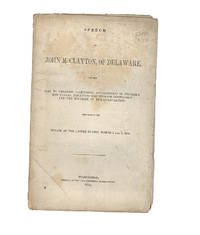
185426154Washington: Printed at the Congressional Glove Office 1854. First edition. pp. 22. 1 vols. 8vo. Self wrappers unsewn as issued. Some browning and spotting wear along spine and edges but a very good copy. First edition. pp. 22. 1 vols. 8vo. Kansas-Nebraska Act. Primarily concerning the issue of slavery in the territories this speech was part of the debates for the Kansas-Nebraska Act. The act initiated by Douglas ultimately repealed the Missouri Compromise allowed the local residents to determine whether the area was free or slave territory allowed for "the doctrine of popular sovereignty of the two territories" and laid the way for a transcontental railroad. The Kansas-Nebraska Act was passed in the Senate on the 3rd of March. Clayton was a lawyer noted agriculturist and long-time member of Congress who was Secretary of State under President Taylor. As Secretary of State he is best remembered for having negotiated the Clayton-Bulwer treaty with Great Britain which provided for a neutral international canal across Central America and "contained pledges which ultimately forced Great Britain to withdraw from large tracts of territory which.it had been occupying on the Isthmus." DAB. Sabin 13576n Printed at the Congressional Glove Office unknown books
1728100536Pamphlet 8vo modern full calf in the style of an 18th century “Cambridge†binding 32 pp.Very slight aging; in excellent condition. This is a rare first edition of a work that presents a complaint by British planters in the West Indies concerning the Assiento or “agreement’ with Spain that gave Britain a virtual monopoly on the African slave trade. This agreement came out of the Treaty of Utrecht which ended the War of the Spanish Succession. This pamphlet indicates that the planters feared as a result of this agreement British slavers might be required to provide African slaves to the Spanish colonies which could result in insufficient numbers available for the West India plantations. The Assiento with Spain would mark the beginning of the Atlantic slave trade as a very powerful economic growth engine. Unfortunately this would translate into millions of Africans being taken from their homes. H. Whitridge unknown books
183519491Boston: James Munroe and Company 1835. First edition. Spine and portions of the rear board sunned and faded; some spotting to the cloth; some foxing and light staining; front hinge just tender; a very good copy. 8vo original embossed purple cloth printed spine label iv 167 1 pages. An important anti-slavery work from the pioneering New England Unitarian. Lib. Company. Afro-Americana 2185; American Imprints 2185. James Munroe and Company, unknown books
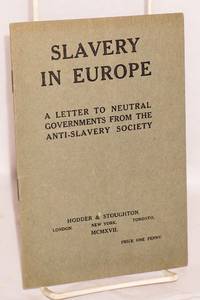
191795392London: Hodder & Stoughton 1917. Pamphlet. 8p. 4.75x7.25 inches very good in original stapled wraps. A call to denounce the actions of Germany in Belgium and the north of France during World War One where the Germans deported large numbers of Belgians and French to slave-labor sites in Germany. Hodder & Stoughton unknown books
186027124Washington DC: Buell & Blanchard Printers 1860. 1st separate. Not in Dumond. Disbound. VG some soiling. 15 1 pp. Last page with printer imprint/date. 8vo. <br/><br/> Buell & Blanchard, Printers unknown books
10137Slavery Handwritten letter signed. Silvanus Patch 1 page March 1823 in which Mr. Hatch writes in somewhat phonetic English to a John Bourding concerning the sale of one of his slaves in part ".I wish you to assist Mr. Nicholson in the gitten sic of the money from the sale of Davis and the 50 of Collens as I am in det debt to Mr. Nicholson.use every excursion to git sic that from him and you will obliage sic your well wisher." Foxing in very good condition. unknown books
1836WRCAM52765N.p. likely Augusta 1836. 62pp. Folded sheets stitched. Minor foxing and toning. Very good. Untrimmed. A rare Maine slip-bill document resolving that the citizens from Maine and other states should not interfere with the issue of slavery in slave-holding states. The legislature writes: "Any interference therefore of a State or the inhabitants of a State with the domestic concerns of another State is dangerous as having a direct tendency to create jealousies between the States and thereby weakening the attachment to the Union which is our only security against domestic dissensions and foreign aggressions." <br> <br> This is a somewhat surprising position for the state of Maine to have taken at the time. Maine came into the Union in 1820 as a free state to balance the admission of the slave- owning state of Missouri. Also Maine opposed the admission of the Republic of Texas in 1836 the same year the present document was printed on the basis of Texas' position on slavery. It is curious that they would take two seemingly opposite positions in the same year. Still the legislature printed the resolution and authorized copies to be sent to the four southern slave-owning states mentioned in the title. unknown books
1818568111818. Calhoun signed the Revolutionary War pension claim of Robert Hamilton of Massachusetts who had been a Lieutenant in the Army of the Revolution. Some marginal chiping and tears at the fold affecting the "J" in the signature of J.C. Calhoun. A good copy. Wikipedia: "John Caldwell Calhoun:March 18 1782 - March 31 1850 was an American statesman and political theorist from South Carolina who is best remembered for his strong defense of slavery and for advancing the concept of minority rights in politics which he did in the context of defending Southern values from perceived Northern threats. He began his political career as a nationalist modernizer and proponent of a strong national government and protective tariffs. By the late 1820s his views reversed and he became a leading proponent of states' rights limited government nullification and opposition to high tariffs-he saw Northern acceptance of these policies as the only way to keep the South in the Union. His beliefs and warnings heavily influenced the South's secession from the Union in 1860-61. Calhoun began his political career with election to the House of Representatives. As a prominent leader of the war hawk faction Calhoun strongly supported the War of 1812 to defend American honor against Britain. He then served as Secretary of War under President James Monroe and in his position reorganized and modernized the War Department. In the 1824 presidential election he was the overwhelming choice of the electoral college for Vice President of the United States. He served under John Quincy Adams and continued under Andrew Jackson who defeated Adams in 1828. unknown books
182532015London: Knight and Bagster 1825. One of several editions issued in 1825. Folio 4pp. Self wraps some marginal soiling and nicks bent at folds a very good copy. Library Company Afro-Americana 4293. OCLC lists just the Library Company copy; not in Dumond or Work. Formed because the 1807 Act to abolish the slave trade had failed to diminish "the prevalence of the very evils which it was one great object of the Abolition to remedy" the Society reviews the stranglehold that West Indian slavery is gaining. Its proceedings examine conditions in each of the West Indian colonies including "the threat of Jamaica to renounce her allegiance" to Britain. Information is also presented concerning Haiti and the effect of that country's upheavals on the British colonies. Knight and Bagster unknown books
186021436San Francisco: T.C. Boyd ca. 1860. Near fine. Broadside 8.5" by 4.5". Printed from type and wood engraving. Very near fine with trivial crease to edges. <br/><br/>Racist slavery-era broadside printed and designed by one T.C. Boyd featuring a drawing and lyrics to a ballad which begins: "Massa's gone to town de news to hear / And he has left the overseer / To look over all de nrs here / While I make love to Sally!" Boyd notes he had 10000 such sheets for sale at his shop. T.C. Boyd unknown books
183319436New-Haven: Published and Sold by A. H. Maltby; Boston: Pierce and Parker 1833. Evident first edition. Wrappers quite foxed; some scattered internal foxing and a little light soiling and wear; a good copy. Original printed yellow wrappers stitched 9.5 x 5.75 inches 24 pages untrimmed. From the Congregationalist clergyman and polemicist gradual emancipationist and advocate of colonization see the ANB an attack on Garrison; per the LCP catalog description "Articles reviewed are William Lloyd GarrisonÃs Thoughts on African colonization; James CropperÃs Letter to Thomas Clarkson; and Abolition of Negro slavery published in American quarterly review September 1832." The edition statement would seem to have been more accurately rendered with a comma "second separate edition" as there appears to be no other edition besides this supposed second separate edition published besides the periodical appearance in the Christian Spectator. Lib. Company. Afro-Americana 759; Dumond page 23; Sabin 2671 & 70214; American Imprints 17489. Published and Sold by A. H. Maltby; Boston: Pierce and Parker, unknown books
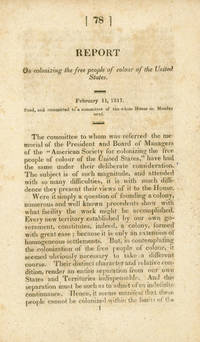
18179350WashingtonCity 1817. First Edition. 5 pp. 1 vols. 8vo. Disbound. Some foxing. First Edition. 5 pp. 1 vols. 8vo. First edition of the government's reply to the request of a group of Virginia planters for a "colony" to essentially rid them of the problem of "free coloured people." In December of 1816 a group of Virginia planters approached the government with a request asking for a location where freed blacks might be sent. In January this "memorial" was presented and in February it was answered with this "Report." This reply discusses location etc. In the end the government officially refused to have anything to do with the plan - thus the American Colonization Society was born. For a detailed account of these events see Dumond Anti-Slavery pp. 126-127. S&S 42738 2 copies unknown books
1842313227Philadelphia: stereotyped by L. Johnson 1842. First edition. 140 pp. 1 vols. 8vo. Original brown ribbed cloth rebacked with original spine laid down titled in gilt. Marginal dampstaining throughout scattered foxing some wear to boards good. First edition. 140 pp. 1 vols. 8vo. First edition of this report of this monumental Supreme Court decision regarding escaped slaves preceding by 15 years and rivaling in importance the Dred Scott case of 1857. "In Prigg the Court identified slavery as a core constitutional commitment with which states could not interfere. In this case the Court struck down northern states' 'personal liberty laws' established to protect alleged fugitive slaves from recapture without due process of law. When the professional 'slave catcher' Edward Prigg tried to remove Margaret Moran an alleged runaway he was unable to meet the burden of proof set out by Pennsylvania's 1826 Personal Liberty Law and failed to obtain the legal certificate permitting him to remove her. When Prigg proceeded to ignore this and removed Moran illegally to Maryland Pennsylvania convicted him of kidnapping. The US Supreme Court however overwhelmingly overturned Prigg's conviction 8-1 and pronounced state laws interfering with the return of alleged runaways a violation of the Fugitive Slave Clause." Beaumont The Civic Constitution 2014 p. 128. Blockson 9905; Dummond p. 140; Sabin 61207 stereotyped by L. Johnson unknown books
1858WRCAM53597Charleston 1858. 16pp. Original printed wrappers. Spine perished held together with brass tacks; light chipping and soiling. Paper lightly and evenly toned. Good. Report submitted to the South Carolina Senate which concludes that slavery is essential to the agricultural production of the South. Additionally the committee felt that the slave trade helped relieve Africa from "the pressure of a redundant population as might be afforded by emigration in the only form in which its benefits can be extended to them." unknown books
1856WRCAM34592Montpelier 1856. 19pp. Self-wrappers. Upper edge gnawed and stained else good. This report from a committee of the Vermont House of Representatives was made in response to events in Kansas resulting from the introduction of slavery into that territory. According to the report Vermonters in Kansas had been harassed and attacked by pro-slavery forces with a situation of lawlessness ensuing. The Vermont House asserts the state's rights to protect its citizens in Kansas and allots a sum of $20000 to alleviate the suffering of afflicted Vermonters. OCLC locates only four copies. Quite scarce. OCLC 34605036. unknown books
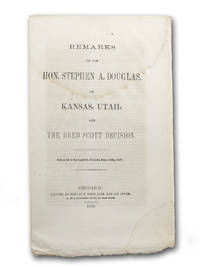
185718536Chicago: Printed at the Daily Times Book and Job Office 1857. First Chicago edition. Light damp-stain to the upper third of the sheet small stain to the lower outer corner; a very good copy. Original self-wrappers 10.25 x 6 inches 15 pages untrimmed. Unopened. Per Byrd "This speech was the first public expression of his views on the Dred Scott decision. In it he accepted the decision and insisted that 'the whole principle of Popular Sovereignty and self-government is sustained and firmly established by the authority of this decision.' " Byrd also notes this pamphlet was intended to lay the groundwork for his 1858 re-election. An edition printed in Springfield and an 8-page edition without an imprint also appeared the same year as well as an edition in German. Flake Mormon Bibliography 2985; Ante-Fire Imprints 250; Byrd 2635. Printed at the Daily Times Book and Job Office, unknown books
18361691Boston: Isaac Knapp 1836. About very good. xvi13-238pp. 12mo. Original publisher's blue boards with black sheep spine gilt. Boards rubbed corners and spine moderately worn. Text lightly foxed. Scarce work addressing the anti-slavery work of George Thompson following his visit to America. Thompson 1804-1878 was British lecturer and reformer who worked as a commercial clerk.<br/><br/>"Thompson first came to prominence in 1831 when he was recruited by the London Anti-Slavery Society's Agency Committee as an itinerant lecturer. In the run up to the Emancipation Act of 1833 he became the most effective British anti-slavery lecturer since Thomas Clarkson. With the struggle against British slavery apparently won Thompson was instrumental in reorienting anti-slavery effort towards the Americas and particularly the United States. . In 1834 he encountered the charismatic American abolitionist William Lloyd Garrison. Recognizing Thompson's talent Garrison invited him to travel to the United States with his growing family to labour there on behalf of the enslaved people of America" - DNB. Thompson employed sarcasm and vitriol in his orations attacking anti-abolitionist sentiment across the northern states. In the process he failed to make very many friends or converts and alienated those with more moderate views.<br/><br/>"Opponents attacked him as a foreign interloper and an anti-American agitator. They also discovered a scandal in Thompson's past alleging that in 1829 he had absconded with £80 embezzled from his employer. His supporters angrily rejected this charge though Thompson later privately admitted it was true he eventually repaid the sum in full. Hostility increasingly turned violent and in fear of his life he was smuggled out of the country in October 1835 returning to a hero's welcome in Britain" - DNB.<br/><br/>This work is a rebuttal made by Thompson's American supporters aggregating information from British sources to defend his good name and abolitionist efforts after fleeing America for his homeland. It includes some of Thompson's speeches on slavery in America given before audiences in Scotland and England and discusses his work with the American Anti-Slavery Society. Though there are a handful of institutional copies the work is scarce on the market and does not appear in auction records over the pasty forty years.<br/> Sabin 9324. American Imprints 36449. Isaac Knapp unknown books
1833WRCAM40207Boston 1833. 28pp. Original tan printed wrappers. Wrappers lightly soiled. Spine chipped. Front cover separating at bottom. Lightly creased down the center. Some light foxing. About very good. Untrimmed. The Massachusetts Colonization Society was a regional subdivision of the American Society for Colonizing the Free People of Colour. The Society attempted to alleviate the problem of slavery and degradation of free blacks by establishing a colony for them outside the United States preferably in Africa thereby "separating them WITH THEIR OWN CONSENT from the white race." The Society established the colony of Liberia in 1822 assisting African Americans to resettle there. The colony continued to grow for the next twenty years and Liberia declared itself an independent state in 1847. AMERICAN IMPRINTS 20051. unknown books
1858714Jefferson County State of Mississippi 1858. 4to. 315 x 200mm. 12 ½ x 8 inches. 2 pp. Docket on verso. Blue legal paper; folds edges browned and slightly frayed; top page cut 2 inches shorter no loss. The first page dated July 27 1858 shows the value of two slaves Juda and Emma owned by the named wards to be valued at $40 together. The three appraisers of the above slave property signed their names on the first page. The second page is an application of Mary Shaw dated April 9 guardian of the four Killingsworth wards to appoint the appraisers for the slaves. It is signed by Albert N. Ford clerk. There is an interesting story behind these records. William Anderson Killingsworth owner of about thirty slaves was born 1821 in Tennessee. He married Nancy Ann Shaw who was born 1820 in Mississippi and died 23 June 1853 in Jefferson County MS. Their children were Francis Horace Valencia William and Albert. On July 19 1854 William Killingsworth was murdered by two of his slaves named Jesse and Albert. Two more slaves Bill and Charles were accused of torching the house. Unnamed slaves retrieved William's body and his three children from the burning house. The slaves' trial was in the fall of 1854. Jesse and Albert were hung November 21 1854. Jesse confessed that he alone committed the murder. This information is recorded in a diary written by Susan Sillers Darden which began in January 1854.  Darden was thirty-eight years old when she wrote the diary. The diary reads in part; "July 20 1854: There was an awful murder committed at Killingsworth's last night. He was murdered by his negroes and the house burned down; he had four children but the house was discovered and taken out." "November 21 1854: Our negroes went to Fayette to see Jesse and Albert hung for murdering their master W. Killingsworth. Jesse confessed that he had done it all that no one helped to do it; exhorted his fellow servants to be faithful and do their duty." Since both parents were deceased the Killingsworth children were the wards of their grandmother Mary Shaw and Uncle William Shaw. Frances Chalmers Killingsworth 1842-1910 was the oldest child.  See The Diary of Susan Sillers Darden on-line at the Mississippi Department of Archives and History Jackson Mississippi. . unknown books
18562026Remedios 1856. About very good. 4pp. on a large bifolium. Printed form completed in manuscript. Separated at fold repaired with tissue. Light wear at edges. Light tanning and foxing. Rare Cuban population census form listing the number of residents in and around the town of Remedios located on the northern central coast of Cuba in 1856. The present document completed in manuscript lists the population according to various categories such as ethnicity and race age range occupations marital status location of residence and several others. The census includes slaves of African origin newly arrived Chinese indentured servants "colonos Asiaticos" immigrant laborers from Yucatan freedmen and free white residents "Blancos". In all there are just over 2000 people living in and around Remedios at this time comprising just over 1300 free whites over 300 free people of color 460 slaves and 19 Chinese laborers. One of the most interesting sections records the population by place of residence which shows that the great majority people in the area lived on estancias with a good part of the remaining population living on livestock farms and sugar plantations. On the final page are two additional sections which enumerate the types of property farms and other enterprises in the regions and provide statistics on agricultural and industrial production and land usage along with some manuscript notes with the signatures of the census takers or local magistrates. An interesting document of slavery agriculture and population in rural Cuba during the mid-19th century. unknown books
1836WRCAM46521Pittsburgh: Alexander Jaynes 1836. 8pp. Dbd. Lightly and evenly tanned. Very good. "The question of Slavery being before the General Assembly of 1836 on petition from many members of the church that the Assembly would bear their testimony against the practice of slaveholding as a SIN it has been thought proper to reprint the testimonies and acts of former Assemblies on the same subject from the official Minutes without note or comment." Only three copies located in OCLC at Princeton Oberlin and the Library Company of Philadelphia. Alexander Jaynes unknown books
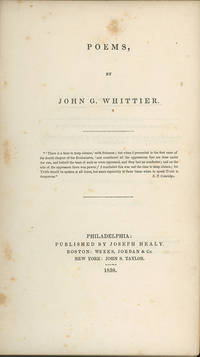
183828115Philadelphia: Joseph Healy; Boston: Weeks Jordan; New York: John S. Taylor 1838 1838. First edition. BAL 21710 binding A; American Imprints 53638. Edges a little rubbed; light foxing; very good copy. 12mo original floral patterned blue-green cloth gilt lettering on the upper board. ¶ An early and substantial collection of over 50 poems by John Greenleaf Whittier 1807-1891. The first part contains 24 of his memorable abolitionist poems collected for the first time with his approval. In 1837 Isaac Knapp of Boston published Whittier's Poems Written During the Progress of Abolition Question but it was issued without Whittier's permission and according to the poet was riddled with errors. Lending library label of the Suffolk Lyceum Library with their rules on the front paste-down. On the front free endpaper is an intriguing faint pencil inscription to a "Mrs. Mary Lincoln / a present from / Mr. Lincoln / March 10th 1845." Extensive research on this has led . . . nowhere. <br/><br/> Philadelphia: Joseph Healy; Boston: Weeks, Jordan; New York: John S. Taylor, 1838 unknown books
188814044New York: Metropolitan Pub. Co 1888. First Edition. Octavo 19cm. Publisher's decorated deep mustard cloth stamped in gilt on spine; viii 431pp. First issue per Wright with no printer's statement on verso of title page. Bit of grubbiness to boards; donation bookplate and private ownership stamp to prelims; else a tight unmarked copy on the better side of VG. Thomas Manson Norwood 1830-1913 was a U.S. Senator and later a Democratic Member of the House from Georgia. In this his only novel he assails the trusts the stock market and the unequal distribution of wealth as the source of vice in America. The setting is New York City with much of the action set on Wall Street. WRIGHT III:3999. Metropolitan Pub. Co unknown books
186223579<p><i>"It is a fact that the enslavement of human beings has so far infused its insidious poison into the very hearts of the Southern people that they have come to believe and declare the evil of slavery to be a good and to require the power of Government to be exerted to maintain extend and perpetuate an institution that enables thousands to sell their own children to be enslaved with all their posterity into hopeless bondage." </i></p><p>The founder of New York City's Cooper Union for the Advancement of Science and Art echoes the language and logic of the Emancipation Proclamation as well as citing some Southern pro-slavery arguments to demonstrate their ridiculousness in this open letter to President Lincoln. Cooper and the Cooper Union had long been advocates of abolition and both Lincoln and Frederick Douglass had famously lectured at the institution.</p> <b>PETER COOPER. SLAVERY.</b>Pamphlet. <i>Letter of Peter Cooper on Slave Emancipation</i> Loyal Publication Society New York 1862 8pp. disbound.<p><b><br /></b></p><p><b>Excerpts:</b></p><p><i>"It is a fact that the enslavement of human beings has so far infused its insidious poison into the very hearts of the Southern people that they have come to believe and declare the evil of slavery to be a good and to require the power of Government to be exerted to maintain extend and perpetuate an institution that enables thousands to sell their own children to be enslaved with all their posterity into hopeless bondage." </i></p><p><i>"In the original formation of that Constitution it became absolutely necessary to make a compromise with that great and all pervading interest which had then already entered into the very life-blood of the nation rendering the formation of an union of States hopeless without such a compromise."</i></p><p><i>"The constitutional requirement to return fugitive slaves on their being demanded by Southern men having been acknowledged and performed by the States has been reaffirmed by an almost unanimous vote in Congress.These honest efforts on the part of the North to maintain peace and friendship were met by a relentless war waged for the destruction of the Constitution and the dissolution of the Union.<i>"</i></i></p><p><i>"The time has now come when Southern men must know that the Union must be preserved and it is for them to determine whether they will persevere in their rebellion until the North shall be compelled in the most reluctant self defence to render contraband of war the slaves and property of all persons found in arms against the laws and Government of the country."</i></p><p><b>Condition</b></p><p>Fine. Disbound and lacking front wrap.</p> books
185562372Boston: Bela Marsh 1855. Second printing. Frontispiece portrait. 122 pp. 1 vols. Small 8vo. Brown cloth stamped in blind and gilt. Upper half of spine shaky else a nice tight copy. Second printing. Frontispiece portrait. 122 pp. 1 vols. Small 8vo. The author was convicted of aiding slaves to escape from Washinton D.C.--Blockson. Sabin 20912 Blockson 9838 for first ed. Bela Marsh unknown books