111 résultats
1864106405<p>Single 8vo sized sheet 5 1/2" x 8 1/2" duplicate receipt signature printed and hand written some aging; but very good or better. This receipt is signed by A.M. Kennedy for John D. Kennedy. Printed and Handwritten Document Signed. Columbia South Carolina. Jan. 18 1864 "Duplicate Receipt" for $2000 paid by the state to Confederate commander John D. Kennedy as "compensation for his slave named Robert lost by reason of the employment of said slave by the authorities of the Confederate Government upon the military fortification in this State." John Doby Kennedy was born on January 5 1840 in Camden South Carolina the son of a Scots immigrant. John was a student at South Carolina College. He was a wealthy man and reportedly owned 60 slaves. On the day this receipt was issued to his brother 24 year-old John Doby Kennedy was on the battlefield commanding his South Carolina Infantry regiment having fought in the battles of Chancellorsville and Gettysburg and that year in the Shenandoah Campaigns after which he was given the rank of Brigadier General. Opposing General Sherman's advance until the bitter end he did not surrender until two weeks after Lee met Grant at Appomattox. civilwarintheeast website. </p> books
18842025Matanzas 1884. Still very good. 3 leaves plus 4pp. pamphlet in original plain wrappers string tied. Light wear at edges. A few very small worm holes. Contemporary ink stamps. Light tanning and foxing. The Spanish Cortes approved a gradual manumission law in 1880 for slaves in Cuba that provided for an eight-year period of patronato tutelage for all slaves liberated according to the law which essentially amounted to indentured servitude. The transition to the patronato system was overseen by a provincial network of government agencies called Juntas de Patronato. Most of the workings of the slave system were preserved but patrocinados as former slaves came to be known received a minimal set of legal rights and were to be paid a token wage. <br/><br/>This fascinating set of Cuban manumission documents from the Junta de Patronato of Matanzas records this process and contains a rare cedula de patrocinado an identification booklet stating a slave is now a freedman with a supporting sponsor. The cedula completed in manuscript states that "Moreno Luis Morejon Natural de Africa.Vecino del Potrero Miraflores.Patrocinado de Da Josefa Morejon de Rodriguez" is "Gratis Sin Enmienda" as of September 15 1881. The second leaf of the pamphlet prints the rights of the freedman and the responsibilities of the sponsor such as the provision of food clothing and nominal salary. <br/><br/>The second document present here is a contemporaneous manuscript letter from Josefa Morejon de Rodriguez confirming that she will act as sponsor for the freedman and the final document dated January 28 1884 and signed by Rodriguez and the relevant local magistrates states that the sponsorship has been completed and is now legally concluded. With the ink stamp of the Matanzas Junta Provincial on first page and the contemporary stamps of several other relevant authorities. An outstanding record of the process of gradual manumission in Cuba during the last years of legal slavery on the island with a rare surviving freedman's identification book. unknown books
197515257Berkeley: University of California Press 1975. First Edition. Octavo. Cloth boards; dustjacket; 172pp; 5 inserted leaves of black and white plates; includes bibliography. Removed from a non-circulating private library with ink ownership markings to front endpaper and accompanying black ink elisions from de-accession. Else an unmarked copy in a lightly worn dustwrapper. Translated by J.W.S. Judge. University of California Press unknown books
196315364Denver: Sage Books 1963. First Edition. Octavo. Cloth boards; dustjacket; 218pp. Removed from a non-circulating private library with ink ownership markings to front endpaper and accompanying black ink elisions from de-accession. Moderate dusting and rubbing to jacket; else clean crisp copy in very good jacket with unmarked text. Sage Books unknown books
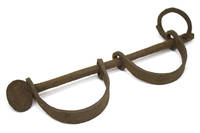
18003062751800. Wrought iron two semicircular wrist pieces approx. 4 inch in diameter attached to an 11-inch long bar. Oxidization consistent with age and material. Wrought iron two semicircular wrist pieces approx. 4 inch in diameter attached to an 11-inch long bar. A set of shackles of the type used in the Middle Passage slave route from Africa to the Americas in the 18th century. An illustration of this type of shackle appears on page 16 of Lydia Maria Child's Appeal in Behalf of that Class of Americans Called Africans Boston 1833 where she notes that these shackles were used to secure the ankles of adjacent slaves. "Yet even thus secured they do often jump into the sea and wave their hands in triumph at the approach of death unknown books
186062260Atlanta: Printed at the Daily Locomotive Job Office 1860. 47 pp. 1 vols. 8vo. Original blue printed wrappers. Wrapper a bit chipped else Fine. 47 pp. 1 vols. 8vo. Printed at the Daily Locomotive Job Office unknown books
1842106407<p>Folded letter sheet four pages and remnant of wax seal. Creases at folds normal aging; otherwise very good or better. The letter is to Henry J. Carter Stockbridge Mass. from his brother. An unemployed 20 year-old Massachusetts teacher who had left home the year before in "exceeding hard times" Edward had gone to Baltimore – where some 50 teachers were out of work – and taken a job working for a wealthy man who had 4 acres of farm land worked by slaves. "…he has given me the office of overseer to look after the blacks in their work. O but you ought to see me walk over the lot with my cane in my hand to see how my work is going on. Then you ought to see the darky when he wants anything of me come up and take off his hat before he speaks…" Praising the "fine folks live in this beautiful part of the world" Carter proves that even a Massachusetts Yankee could quickly adapt to Southern culture and make peace with slavery. The letter is unsigned. </p> books
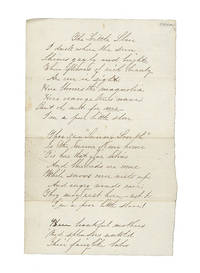
186134365Waterford Maine Feb 3rd 1861. In a neat nineteenth-century hand on a single leaf torn from a larger sheet of note paper. 1 vols. 5 x 8 inches. Old folds else fine. In a neat nineteenth-century hand on a single leaf torn from a larger sheet of note paper. 1 vols. 5 x 8 inches. "My mammy's worked out". Thirty-two line poem expressing pious sentiments at the plight of the child slave: "Here orange trees wave / But oh not for me -- / I'm a poor little slave . My mammy's worked out / And lies here in the grave / There's none to kiss me / I'm a poor little slave". unknown books
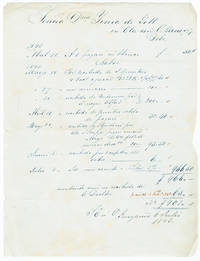
1843WRCAM55715Guayama Puerto Rico 1843. 1p. Quarto. Old folds a few short closed tears minor wrinkling. About very good. A record of a slave sale in Puerto Rico during the late Spanish colonial period. The document records various expenditures for "Senora Dna Yrma de Gott" for the spring and summer of 1843. Along with other expenditures from April to July 1843 the present manuscript document includes a line item from March 30 reading "recibido de Antonini por el negro Alfred." Apparently the señora received 200 Spanish dollars or pesos for Alfred the slave. The Spanish brought slavery to the island of Puerto Rico during the early colonial period. Slave labor fueled sugar production on the island reaching its peak in the early to mid-19th century. Slavery was finally abolished in Puerto Rico 1873 after years of slave revolts against Spanish colonial rule which began in 1868. Despite its long history of slavery records of slave sales from Puerto Rico are rarely encountered in the market. unknown books
1793106470<p>12 lines in brown ink with paper seal on sheet of paper 34x21 cm 13½x8¼". Signed by Thomas Hamilton clerk. Remnant of seal old folds with splitting along them normal aging and browning some offsetting very good overall. Amazing little document relating to the enforcement of Pennsylvania's groundbreaking effort to begin the abolition of slavery "An Act for the Gradual Abolition of Slavery" passed by the Pennsylvania legislature in 1780. The Act prohibited further importation of slaves into the state required Pennsylvania slaveholders to annually register their slaves with forfeiture for noncompliance and manumission for the enslaved and established that all children born in Pennsylvania were free persons regardless of the condition or race of their parents. Those enslaved in Pennsylvania before the 1780 law entered effect remained enslaved for life. The present document seems to reveal non-compliance with the law by Hugh Neilly in part: "I hereby certify on application of Ralph Cherry that a careful search hath been made by me among the Records of Negro's sic entered on the Records of Westmoreland County and that on such search it doth not appear that any Negro's hath been registered in the name of Peter or any other name as his property by Hugh Neilly of Westmoreland County aforesaid under the laws passes for the gradual abolition of slavery. Thomas Hamilton clerk." Docketed on the back "Certificate that no Negro's hath been registered in Westmoreland as the property of Hugh Neilly." </p> books
18772027Havana 1877. Very good. 1p. on a bifolium. Removed from a a bound volume with unobtrusive stabholes at gutter margin. Light wear at edges; light dust soiling and damp staining. Remarkable bidsheet submitted by a Cuban business in response to a newspaper advertisement for an auction of slaves for hire held in Havana during November 1877. The firm Jado Sarasúa y Compañia writes that "Enterada del anuncio publicado en la Gaceta fecha 9 del corriente para el arrendamineto en publica subasta de los esclavos existentes en el Asilo de San Jose pertenecientesa Bienes Embargados y sujentadose en un todo al pliego de Condiciones inserto en la misma Gaceta hace la siguente proposicion." Below is a list of fourteen slaves mostly women and the prices that the company is willing to offer for the slaves being rented ranging from ten to seventeen pesos per month. Signed and dated at the bottom "Habana Noviembre 14 de 1877. unknown books
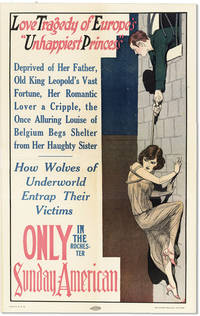
190415411Rochester: Office of the American 1904. Broadside extra lithographed in colors; 18" x 11". Single fold else fine. Colorful graphic depicting Princess Louise escaping from her asylum cell with the help of her illegitimate lover Geza Mattattich. The caption tempts readers with a White Slavery theme suggesting that Princess Louise has been lured to her ruin by a "Wolf of the Underworld." Unlocated. Office of the American unknown books
1855CAT0116Peterboro: Self-Published 1855. First Edition. Single sheet folded 10 x 10 inches. Very Good. One of several public letters by Smith to Seward this one discussing the Fugitive Slave Law. Smith by the mid-1850s had grown increasingly frustrated by the abolitionist movement's willingness to compromise. Seward an early figure in the Republican party sought more gradual measures. Smith writes: "Instead of interpreting constitutions and statutes in the light of human rights you interpret human rights in the light of constitutions and statutes. I own that you stand as an antislavery man very far above most of our statesmen. but I would have you stand farther above them." Smith's growing impatience with the compromising nature of the abolitionist movement would later lead him to support the efforts of John Brown and the free-state movement in Kansas. "When most Liberty party leaders agreed to merge with more moderate antislavery factions to form the Free Soil party in 1848 Smith balked at what he regarded as abandonment of the abolitionist commitment to immediate emancipation." - ANB. A very good copy with a light stain to margin else near fine. Six copies in OCLC. Self-Published unknown books
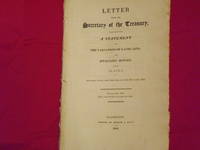
1816100537Pamphlet formate folio disbound first pamphlet 3 leaves printed on recto only second 7pp. third 6 pages and folding chart. Pamphlet extracted from larger volumne chipping along spine and edges not affecting text second papmple completely disbound paper browned and somewhat dry These pamphlets are rare and represent an important source of information on the numbers and values of slaves in early 19th century America. The first title presents the value assigned to slaves in 11 states including New York. The second lists the number and values of slaves in the various counties in the state of Maryland. The final pamphlet presents real estate values and values on dwellings including slaves in the counties of Pennsylvania. The information in these reports was compiled by Alexander James Dallas 1759-1817 who was the Secretary of the Treasury. Dallas born in Kingston Jamaica settled in Pennsylvania and practiced law there. Eventually he would become Secretary of the Treasury in 1814 when the nation was almost bankrupt. He managed to reorganize the department get the country out of debt created a surplus and even helped promote what would become the Second Bank of the United States. ANB. William A. Davis, books
1850106404<p>Folio manuscript legal sheets 11 pp. plus docketing on final back sheet. Traces of wax in some margins. Paper is browned and aged some minor creasing at folds margin hole on a couple of pages not affecting text; otherwise very good. This is a very complex legal case about the ownership of two slaves. These manuscript documents are signed by the three Constables deposed as witnesses. The testimony is taken at the law offices of Lysander G. Gordon. It seems that an individual who owed people money was forced to give the slaves to a sheriff and were then sold to William Knox in Southern Tennessee. However it appears that the slaves actually belonged to someone else. These documents try to sort though this mess. </p> books
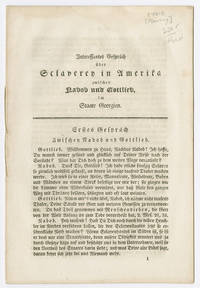
1840WRCAM54016N.p. but Germany 1840. 16pp. text in German. Stitched as issued. Very light dampstaining at top edge. Very good. An imaginary dialogue between a slaveholder and a missionary in Georgia. They debate the rights and wrongs of slavery with the slaveholder gradually crumbling before biblical evidence. A most unusual German tract on the American slavery controversy. unknown books
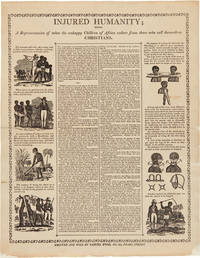
1808WRCAM54959New York: Samuel Wood 1808. Broadside 16 1/2 x 13 inches with main text printed in two center columns flanked on both sides by seven woodcut illustrations with descriptive text. The entire broadside surrounded by an ornamental border. Old folds minor chipping to edges short repaired tears small smudge in right column. Backed on acid-free tissue. Very good. A rare and powerful illustrated broadside describing in text and images the cruelties suffered by Africans in the West Indies slave trade. The main text is largely adapted from a work published in London in 1793 REMARKS ON THE METHODS OF PROCURING SLAVES WITH A SHORT ACCOUNT OF THEIR TREATMENT IN THE WEST- INDIES in support of an abolitionist boycott of West Indian goods with information gleaned from Parliamentary reports. It describes slave auctions and the "scrambles" by which sickly Africans are sold and gives details of the treatment of field and house slaves. The illustrations are horrifying showing slave families being separated at auction and then branded floggings at the hands of black overseers and various restraints to keep the slaves from eating or escaping including head-frames and mouthpieces neck braces weights leg spurs and shackles and yokes. The printer of this broadside Samuel Wood was a noted Quaker- reformist and the illustrations are credited to pioneering New York wood engraver Alexander Anderson. <br> <br> OCLC locates eleven copies and gives a publication date of 1802 though Pomeroy the American Antiquarian Society and Princeton give a date of 1805 to 1808 based on Samuel Wood's address as noted in the imprint. The Gilder Lehrman Institute also holds a copy as does the Rosenbach Museum. Rare and very interesting and a powerful manifestation of the growing abolitionist sentiment in the United States in the early 19th century. POMEROY ALEXANDER ANDERSON 169. HAMILTON EARLY AMERICAN BOOK ILLUSTRATORS AND WOOD ENGRAVERS 252. OCLC 33989651 476101156 945084251. Samuel Wood unknown books
1858660371858. Dividing Prize Money After the Capture of a Slave Ship Slavery. United States. In the Senate of the United States. February 21 1858-Ordered to Be Printed. Mr. Polk Made the Following Adverse Report To Accompany Bill S. C. of C. 108.: The Committee of Claims To Whom was Referred the Opinion of the Court of Claims in the Case of O.H. Berryman and Others Report: The Claimants in this Case are the Officers and Crew of the United States Schooner "On-Ka-Hy-E" drop-head title. Washington DC: S.n. 1858. 13 pp. Octavo 9" x 5-1/2". Disbound light rubbing to extremities some toning and light foxing. $100. 35th Congress 1st Session Senate Rep. Com. No. 33. This speech disputes the distribution of prize money between the Federal government and the crew that captured the slave ship Laurens. unknown books
18379Used; Like New/Used; Like New. An English tobacco box bearing the kneeling slave iconography of the abolitionist movement dating to the mid-19th Century. Height 4 x width 3.75 x depth 5.5 inches 10 x 9.5 x 14 cm. Oxidation and pitting from age handle is old but may not be original to the box else fine.<br style="">Josiah Wedgewood 1730-1795 a dedicated abolitionist and close friend of Thomas Clarkson designed the "logo" of the kneeling slave for the Society for the Abolition of Slavery in 1787. This was taken up by the American abolitionists and in 1835 Patrick Reason a young black engraver created a version of a kneeling woman that bore the caption "Am I not a Woman and a Sister" This image together with that of the infamous slave ship's hold are without question the most iconic of the anti-slavery movement on both sides of the Atlantic. unknown books
183612488New York September 1836. Used; Like New/Used; Like New. Folio. 4 pp printed in four columns per page. Tears around edges creased and with significant toning to the upper front half and extensive foxing throughout. <br><br><br />This rare monthly an organ of the American Anti-Slavery Society began in July 1835 and ended with the February 1839 issue. Among other interesting features the present issue prints a "Form of a Petition for the Abolition of Slavery in the District of Columbia. To The Congress of the United States." Not in Lomazow Mott Sabin. OCLC records copies from all the other years but no copies of this issue. <br><br><br />While there was opposition to slavery in the nation's capital the greater forces against slavery came from the outside through newspapers and petitions. Many petitioned Congress to end slavery in the nation's capital and the organizing efforts in the District included the Washington Abolition Society which was organized in 1827. But the opposition to ending slavery and the slave trade in the District was such a contested issue that a gag rule instituted in 1836 prohibited a discussion of slavery on the floor of Congress. Though Abolitionists including John Quincy Adams vehemently opposed the gag rule standard-bearers of slavery in the District fought tirelessly for it. Eventually in 1848 the House of Representative passed a resolution to prohibit the slave trade in the District of Columbia. Although the resolution did not gain enough traction to end the slave trade in the District it played an influential role in the congressional debates over slavery and the slave trade. The Compromise of 1850 admitted California in the Union as a free state; the former Mexican territories were admitted as part slaveholding states and part free soilers states; and the slave trade in the District of Columbia was abolished. The 1850 Compromise provided the necessary momentum for the enactment of the District of Columbia Compensated Emancipation Act of April 16 1862 that abolished slavery in the Nation's Capital. unknown books
184524737<p>Mary B. Selden was the grandmother of Eleanor Love Selden who married John Augustine Washington III in 1843. She regrets not being able to furnish Washington with the services of one of her slaves as a stacker for the upcoming wheat harvest.</p><p>Still a faithful employee West Ford worked for the Washington family well into the nineteenth century including delivering this letter.</p><p>The letter includes a list of two dozen slaves written in pencil by John Augustine Washington III.</p> <b>SLAVERY. MOUNT VERNON. WEST FORD. MARY BOWLES ARMISTEAD SELDEN.</b>Autograph Letter Signed to John Augustine Washington III hand delivered by West Ford; <b>JOHN AUGUSTINE WASHINGTON III</b>. Autograph List of Slaves. Single folio leaf with autograph address on verso. Alexandria Virginia 1845.<p><b>Complete Transcript</b></p><p><i>My dear Augustine</i></p><p><i> I am very sorry to be unable to render you the service you require. I have a very fine stacker but he is hired by the year to M<u>r</u> Young as I did not expect to have employment enough for him at M<u>t</u>Ida. Another year if you wish it you can have him I receive very small wages for him and as a stacker I have never known any one equal to him.</i></p><p><i>I am very sorry to hear that Nelly is sick. I hope she will be well enough to come up and meet the bridal party on thursday.</i><i> I received a letter from Eliza to day in which she says they will be at M<u>t</u> Ida that day but will bring no company with them. It will give great pleasure to them and to me if M<u>rs</u> Washington</i><i> Nelly and yourself will come up on that day. M<u>rs</u> Lippitt</i><i> will have a room ready for any of the party that will favour her with their company she must by no means be left behind.</i></p><p><i> Most truly and affectionately / yrs</i></p><p><i>M. B. Selden</i></p><p><2></p><p>Address: <i>John A. Washington Esq. / M<u>t</u> Vernon / By West Ford</i></p><p>Docketing by John Augustine Washington III: <i>Mrs. M. B. Selden</i></p><p>List of slaves in pencil by John Augustine Washington III:</p><p><i>Phil</i> b. 1790</p><p><i>Hannah</i> b. 1826</p><p><i>Gabe</i> b. 1820 <i>Eliza</i> b. 1811</p><p><i>Ned</i> b. 1827 <i>Jim</i>Michum b. 1795</p><p><i>Edmund</i> b. 1827 <i>John</i> b. 1833</p><p><i>Betty</i> b. 1833 <i>Mary</i> b. 1819</p><p><i>West</i> <i>Fanny</i> "Belongs to my wife"</p><p><i>Sarah </i> b. 1809 <i>Dennis</i> b. 1838</p><p><i>Hannah</i> <i>Nelly</i> b. 1836</p><p><i>William</i> b. 1830 <i>Jim</i>Starks b. 1805</p><p><i>Joe</i> b. 1832 <i>Sally</i> b. 1827</p><p><i>Ephraim</i> b. 1834 <i>Tom</i> b. 1835 "bound to me till Oct 1856"</p><p><i>West</i> b. 1838</p><p><i>Jesse</i> b. 1785</p><p><b>Historical Background</b></p><p>Farmers in mid-nineteenth-century Virginia typically planted winter wheat in September and October and harvested it in the following June. After wheat had been cut a stacker tied the wheat into bundles and piled the bundles in shocks to dry in the field. After the shocks dried they would be stored in a barn or carefully built stack capped with grass to shed the rain until threshing time. Even after Cyrus McCormick developed his mechanical grain reaper in the 1830s men needed to follow the machine to bundle and stack the wheat. Building a good stack was an important skill and those workers free or enslaved who knew how to do so were very valuable at harvest time.</p><p><b>Mary Bowles Armistead Alexander Selden</b> 1783-1846 was born in Hanover Virginia. She married Charles Alexander Jr. 1772-1812 with whom she had five children including Louisa Elizabeth Fontaine Alexander 1802-1827. After her first husband's death she married Dr. Wilson Cary Selden 1761-1835. She was his third wife and they had three children. By his first wife Dr. Selden was the father of Wilson Cary Selden Jr. 1796-1843. In 1822 Wilson Cary Selden Jr. married Louisa Elizabeth Fontaine Alexander and they became the parents of Eleanor Love Selden 1824-1860 who married John A. Washington III. Thus Mary Bowles Selden was both the grandmother and step-grandmother of Eleanor Nelly Washington. At the time she wrote this letter she was living at Mount Ida a 6000-acre plantation that stretched along two miles of the Potomac River north of Alexandria Virginia and fewer than ten miles from Mount Vernon. Her first husband built the neoclassical mansion of Mount Ida in 1808.</p><p><b>John Augustine Washington III</b> 1821-1861 was born in Blakeley West Virginia the son of John Augustine Washington II and Jane Charlotte Blackburn Washington and graduated from the University of Virginia in 1840. His father inherited George Washington's Mount Vernon estate in 1829 but it passed to his wife at his death in 1832. In 1841 Augustine Washington proposed to manage Mount Vernon for his mother. When she died in 1855 the plantation passed to him. In 1858 after offering the property to both the federal government and to the State of Virginia he sold 200 acres of the Mount Vernon estate including the mansion outbuildings and family tomb to the Mount Vernon Ladies' Association for $200000. Washington married Eleanor Nelly Love Selden 1824-1860 in 1843 and they had seven children. In 1860 he owned 22 slaves. In 1861 Washington joined the Confederate Army as a lieutenant colonel and served as an aide-de-camp to General Robert E. Lee. He was killed while conducting reconnaissance at the Battle of Cheat Mountain in September 1861.</p><p><b>West Ford</b> ca. 1784-1863 was born on the Bushfield Plantation in Westmoreland County Virginia to an enslaved woman owned by George Washington's brother John Augustine Washington. When George Washington visited West Ford was his personal attendant. When John Augustine Washington's widow Hannah died in 1802 she granted Ford his freedom at age 21. Bushrod Washington George Washington's nephew and heir to Mount Vernon freed Ford in 1806 and Ford continued working for the Washington family. According to family oral history Ford's mother Venus told her mistress Hannah Washington that he was George Washington's son. Nearly all historians doubt the claim though one of Washington's nephews certainly could have been the father.</p><p>In 1812 West Ford married Priscella Bell a free woman. Their four children—William Daniel Jane and Julia—were educated on the Mount Vernon Plantation despite laws which restricted the instruction of African Americans. When Bushrod Washington died in 1829 he willed 160 acres of land adjacent to Mount Vernon to West Ford who continued to live on the Mount Vernon estate.</p><p>Over the next several years West Ford was frequently highlighted in the media making his private life a matter of public record. In 1850 two Virginia newspapers—the <i>Alexandria Gazette</i> and the <i>Virginia Advertiser</i>—carried articles describing his prestigious position and authority at Mount Vernon. In 1857 an entry in the Fairfax County Deed Books noted that Ford divided his land among his four children. In 1858 Ford was sketched a second time this time by historian and artist Benson Lossing. In March 1859 <i>Harper's New Monthly Magazine</i> published Lossing's feature on Mount Vernon and included his sketch of Ford. Ford told the reporter of his property on Little Hunting Creek where he planned to retire after the Washington estate was no longer in the Washington family.</p><p>In June 1863 an ailing West Ford was brought back to the Mount Vernon estate by the Mount Vernon Ladies' Association. The association cared for West Ford until his death on July 20 1863.</p><p><b>Condition</b></p><p>Foxing and show through particularly near the signature.</p> books
15101This rare pamphlet "Act No. XIX of 1929 Passed by the Indian Legislature.An Act to Restrain the Solemnisation of Child Marriages" was a critical step in protecting girls. No other copies in OCLC Worldcat<br/><br/>Child marriage was historically prevalent in India where the International Center for Research on Women reported that 47% of Indian weddings in the early 20th century involved brides under the age of 18. Poverty was a driving factor in child marriage as families in financial straits could improve their economic standing by marrying their daughters to wealthier older men. Yet as other countries began making improvements for women and girls India too recognized the dangers inherent to girls' health and well-being when they were married and became mothers while still in their own childhoods. This pamphlet which is the only known copy according to OCLC Worldcat details the "punishment for male adult below twenty one years of age marrying a child punishment for male adults over twenty one years of age marrying a child and punishment for solemnizing a child marriage." While child marriage does persist in India its rates have gone down and modern India has joined the South Asian Initiative to End Violence Against Children SAIEVAC which adopted a regional action plan to enforce the marriage bans and end child marriage in and beyond its own borders. unknown books
186014411New-York John A. Gray Printer 1860. First edition. Some foxing; a couple of small spots of light staining; a very good copy. 16mo original printed self-wrappers 29 pages. In the wake of John Brown's Harpers Ferry raid long-time abolitionist Gerrit Smith who had been one of the covert backers of the raid--the "Secret Six" was evidently so horrified once he realized the scope of the violence the raid unleashed that he had a breakdown and entered an asylum. Smith returned from his insensibility to find that--perhaps not surprisingly--some northern Democrats had published attacks on his links to the raid. Smith responded by suing for libel and this pamphlet reproduces correspondence between his son-in-law Charles D. Miller and the subjects of the suit with extracts from Smith's writings and abolitionist polemics. Sabin 82609; LCP Afro-Americana 9498. John A. Gray, Printer unknown books
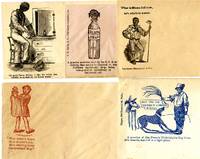
186536346Philadelphia Lancaster PA and elsewhere: Magee Philadelphia Zahm Lancaster and three others 1865. Five postal covers all in Very Good condition:<br/> a. "The latest Contraband of War." A working slave stands confidently: "Whar is Massa Jeff now dat's what's de matter."<br/>Weiss C-BL-16.<br/> b. "Him fader's hope / Him moder's joy / Him darling little / Contraband Boy." A white man holds a little black baby.<br/>Weiss C-BL-11.<br/> c. A medicine bottle labeled "Black Drop" with the head of a Negro at its top: "A popular medicine used by the C.S.A. aristocracy that cannot be obtained in any Northern apothecary shop being com-POUND-ed exclusively on the sacred soil." italics instead of caps in the original. "S.H. Zahm & Co. Publishers Lancaster Pa." <br/>Weiss C-BL-12.<br/> d. A black man polishes boots in a house. Referring to Ben Butler's capture of New Orleans he says "By golly Massa Butler I like dis better dan workin' in de field for ole Sesesh massa." <br/>Weiss C-BL-59.<br/> e. "A member of Jim Francis' Philadelphia Dog Detective Gards has Jeff in a tight place." A black man holding some twigs looks down at a dog with collar labeled "Jeff." An observing donkey says "Jeff has the feelings of a prince of wails." Published by Magee 316 Chestnut Street Philadelphia.<br/>Weiss C-BL-35. Magee [Philadelphia], Zahm [Lancaster], and three others unknown books
1826WRCAM40209Philadelphia 1826. 40pp. Original tan wrappers. Wraps a bit creased spine slightly chipped. Contemporary ownership inscription on titlepage. Text a bit tanned. very good. A call for the abolition of the slave trade with sections regarding the involvement of a number of foreign countries in the trade. This copy belonged to the Rev. Leonard Worcester of Peacham Vt. Worcester was a member of the Auxiliary Colonization Society of the State of Vermont a regional subgroup of the American Colonization Society. A nice association copy. SHOEMAKER 23434. paperback books