608 résultats
16702332Stampatus in Stampatura Stampatorum" i.e. Paris 1670. 12mo 142 x 80 mm. 191 pp. Two parts separately titled but continuously paginated. Woodcut peacock device on title. A pretty copy; occasional light foxing to upper margins. Eighteenth-century French red morocco sides with triple gilt fillet smooth spine gold-tooled with green morocco lettering-piece edges gilt over marbling marbled endpapers edges slightly scuffed. Provenance: Marquis de Rognes engraved armorial bookplate signed Nicolas de Mire 1777.<br/><br/>Most complete edition of one of the earliest collections of French macaronic poetry an often burlesque admixture of the vernacular and Latin celebrated for its valuable descriptions of and notations of early Provençal dance. The preface from the supposed publisher "Librarius" is addressed to the "bragardissimis" dancers of France: bragare in Arena's personal brand of Latin means to "have fun" but Arena's work addressed to students was intended to meet a semi- serious need: To attract students to the University of Aix less popular than the faculties of Avignon and Montpellier the rector had decided to authorize a ball at the time of graduation for the graduates and their families but "for certain students dancing in public was a much more forbidding test than all of those that they had undergone during their studies" Louisson-Lassablière p. 268 our translation. Thus Arena's goal was to familiarize students with the many different "basses danses" currently in fashion. <br/><br/>Following a prose introduction to the subject the poem in 1896 lines is in two parts the first being an autobiography in which the author successively a law student soldier and lawyer of whom little else is known recalls his horrific experiences in the Italian campaigns including an eye-witness account of the Sack of Rome in 1527. Following his final return from Italy in 1528 he had given his first dance lessons and thus the work segues into a largely tongue-in-cheek introduction to dance and to proper comportment. Of greatest interest for dance historians are the technical descriptions of dances found in a four-page section pp. 86-90 in French in which the author uses a stenographic notation system in which each step is designated by the initial of its name repeated to indicate a repetition of the step. Thus in the description "R c ss d ss d d d ss r c ss a ss r c" "c" signifies "congé" "ss" signifies "deux simples" "d d d" signifies "trois doubles" and so on. Such detailed choreographic records are rare for this period. Each dance description occupying no more than one line is prefaced by the title or titles of popular songs or melodies to which it should be danced. The earliest known edition of the work was printed anonymously probably in Lyons in 1528; at least 40 more editions followed the last from 1758 a full census including untraced and "ghost" editions is provided by R. Mullally. The present edition includes other previously published macaronic verse including Rémy Belleau's "Poema macaronicum de bello huguenotico" and separately titled a collection of Italian macaronic poetry by Bartolomeo Bolla first printed in 1604 with satirical poems such as one addressed to the "culinary Muse" p. 147 humourous lists of attributes including types of women associated with various Italian towns pp. 121-129 and poems in the patois of Bergamo. On textual grounds Mullally revised the attribution of this edition to Paris; it was traditionally assigned to Lyon. Brunet I 393 "Edition la plus complète que l'on ait de ce recueil" ; Fletcher Bibliographical Descriptions of Forty Dance Books 3a ; Clarke Four Hundred Years of Dance Notation 1987 no. 6; Robert Mullally "The editions of Antonius Arena's Ad suos compagnones studiante" Gutenberg-Jahrbuch 1979:146-57 edition P12. Cf. Marie-Joëlle Louisson-Lassablière "Antonius Arena ou le Latin macaronique" in E. Bury Tous vos gens à Latin 2005. Stampatus in Stampatura Stampatorum," [i.e., Paris] unknown books
16702332Stampatus in Stampatura Stampatorum" i.e. Paris 1670. 12mo 142 x 80 mm. 191 pp. Two parts separately titled but continuously paginated. Woodcut peacock device on title. A pretty copy; occasional light foxing to upper margins. Eighteenth-century French red morocco sides with triple gilt fillet smooth spine gold-tooled with green morocco lettering-piece edges gilt over marbling marbled endpapers edges slightly scuffed. Provenance: Marquis de Rognes engraved armorial bookplate signed and dated Nicolas de Mire 1777; coded purchase note "ca" in pencil on recto of final free endleaf probably from Jean-Jacques Debure ca. 1800 thanks to Erick Aguirre for this information.<br/> <br/> Most complete edition of one of the earliest collections of French macaronic poetry an often burlesque admixture of the vernacular and Latin celebrated for its valuable descriptions of and notations of early Provençal dance. The preface from the supposed publisher "Librarius" is addressed to the "bragardissimis" dancers of France: bragare in Arena's personal brand of Latin means to "have fun" but Arena's work addressed to students was intended to meet a semi- serious need: To attract students to the University of Aix less popular than the faculties of Avignon and Montpellier the rector had decided to authorize a ball at the time of graduation for the graduates and their families but "for certain students dancing in public was a much more forbidding test than all of those that they had undergone during their studies" Louisson-Lassablière p. 268 our translation. Thus Arena's goal was to familiarize students with the many different "basses danses" currently in fashion. <br/> <br/> Following a prose introduction to the subject the poem in 1896 lines is in two parts the first being an autobiography in which the author successively a law student soldier and lawyer of whom little else is known recalls his horrific experiences in the Italian campaigns including an eye-witness account of the Sack of Rome in 1527. Following his final return from Italy in 1528 he had given his first dance lessons and thus the work segues into a largely tongue-in-cheek introduction to dance and to proper comportment. Of greatest interest for dance historians are the technical descriptions of dances found in a four-page section pp. 86-90 in French in which the author uses a stenographic notation system in which each step is designated by the initial of its name repeated to indicate a repetition of the step. Thus in the description "R c ss d ss d d d ss r c ss a ss r c" "c" signifies "congé" "ss" signifies "deux simples" "d d d" signifies "trois doubles" and so on. Such detailed choreographic records are rare for this period. Each dance description occupying no more than one line is prefaced by the title or titles of popular songs or melodies to which it should be danced. The earliest known edition of the work was printed anonymously probably in Lyons in 1528; at least 40 more editions followed the last from 1758 a full census including untraced and "ghost" editions is provided by R. Mullally. The present edition includes other previously published macaronic verse including Rémy Belleau's "Poema macaronicum de bello huguenotico" and separately titled a collection of Italian macaronic poetry by Bartolomeo Bolla first printed in 1604 with satirical poems such as one addressed to the "culinary Muse" p. 147 humourous lists of attributes including types of women associated with various Italian towns pp. 121-129 and poems in the patois of Bergamo. On textual grounds Mullally revised the attribution of this edition to Paris; it was traditionally assigned to Lyon. <br /> <br /> Brunet I 393 "Edition la plus complète que l'on ait de ce recueil" ; Fletcher Bibliographical Descriptions of Forty Dance Books 3a ; Clarke Four Hundred Years of Dance Notation 1987 no. 6; Robert Mullally "The editions of Antonius Arena's Ad suos compagnones studiante" Gutenberg-Jahrbuch 1979:146-57 edition P12. Cf. Marie-Joëlle Louisson-Lassablière "Antonius Arena ou le Latin macaronique" in E. Bury Tous vos gens à Latin 2005. Stampatus in Stampatura Stampatorum," [i.e., Paris] unknown
201098337Brick Tower Press. New. 2010. Paperback. 1883283760 . FREE UPGRADE to Courier/Priority Shipping Upon Request - IN STOCK AND IMMEDIATELY AVAILABLE FOR SHIPMENT - Flawless copy brand new pristine never opened -- 136 pp; 45 illus. 42 in color. -- with a bonus offer-- . Brick Tower Press paperback
2009122226CUECM. New. 2009. Hardcover. 8895104927 . FREE UPGRADE to Courier/Priority Shipping Upon Request - IN STOCK AND IMMEDIATELY AVAILABLE FOR SHIPMENT - Flawless copy brand new pristine never opened. Text in Italian. with a bonus offer-- . CUECM hardcover
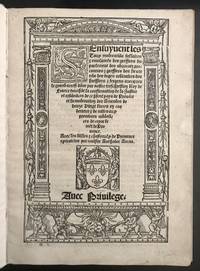
154009792Lyon: T. Payen for Dominique de Portonariis at Aix 1540. 20th-century vellum over thin flexible boards spine title lettered in black. <p>First Edition. From printed and manuscript sources jurist and poet Antoine Arena compiled the privileges duties and wages of every court office in Provence and the fees levied by them for services including the preparation and execution of documents. in provençal the final five pages list the towns and fortified castles in Provence under the French crown's authority.<br /> Lyonese printer Payen struggled to cast off copy or made a stop-press correction. To fit the text he began one medial quire with 45 lines per page jumped to 49 lines in the middle and settled back to 45 at the end. In good condition small portion of the first blank margin neatly supplied.<br /> ¶Davies Catalogue of.Early French Books.Fairfax Murray 4112; Bechtel Catalogue des gothiques T-26; Cioranesco 2608; Dollieule Antoine Arena 70-71; Répertoire bibliographique des livres imprimés en France au XVIe siècle I: 211; Gültlingen Bibliographie des livres imprimés à Lyon au 16e siècle VII: 1661 = VII: 17736; USTC 55894 = 24264 =79997 and Pettegree et al. French Vernacular Books.before 1601 1663-66 the usual messes.</p> [T. Payen for Dominique de Portonariis at Aix] unknown
In folio (mm. 428 x 278), 4 parti in 1 volume, p. pergamena coeva, titolo oro su tassello mod. al dorso (antico restauro per manc.), pp. XII,396; X,298; IV,294,(3); (6),214; (testo e numeraz. su due colonne), tit. in rosso e nero con bella vignetta ai 4 frontesp., inc. in rame da Heylbrouck su disegno del Balestra, ornato da testate, iniziali e finali silografati. L'opera è ben illustrata nel testo da 88 inc. in rame di F. Zucchi (1 a p. pag.), che raffigurano monete e grandi medaglioni (recto e verso), monumenti, epigrafi, sculture, testate con fregi, grandi iniziali ornate, inclusi i 12 busti antichi disegnati da Giambattista Tiepolo e la pianta di Verona. Questa ediz. è cosi' suddivisa: vol. I - "L'istoria della città e insieme dell'antica Venezia dall'origine fino alla venuta in Italia di Carlo Magno" - vol. II "L'istoria letteraria o sia la notizia de' scrittori veronesi" - vol. III "La notizia delle cose in questa città piu' osservabili" - vol. IV "Il trattato degli anfiteatri e singolarmente del Veronese, in questa seconda edizione accresciuto anche di figure (la prima ediz. del "trattato" è del 1728 e usci' anonima)". "Edizione originale" di questa fondamentale opera su Verona, "ricca sorgente di cognizioni" sulla sua storia civile, religiosa, monumentale ed artistica. Cfr. Schlosser Magnino, p. 550: "con magnifiche tavole in rame disegnate in parte da Tiepolo, e utilissime per la concezione dell'antichità in quel tempo" - Parenti,324 - Lozzi,II,6300 - Gamba,2325 - Cicognara,4034 - Brunet,III,1291 - Morazzoni, p. 171 lo cita per la sua bellezza, pur non essendo edito a Venezia. Solo 1 carta con lieve macchia al margine super. bianco e 2 cc. finali con restauro pure al margine super., altrimenti esemplare ben conservato.
19623185Éditions Cercle d'Art, Paris 1962. Un volume in-folio (390 x 330 mm) relié sous cartonnage toilé illustré, dans l'étui de l'éditeur décoré de deux compositions en couleur de Picasso. - 45 LINOGRAVURES DE PABLO PICASSO EN PLANCHES HORS-TEXTE réalisées d’après les linogravures originales. - PREMIER TIRAGE. Édition originale française, le texte de W. Boeck est traduit par Jacques Chavy. Remarquable publication d'art. Très bel exemplaire en parfait état. Infimes imperfections à l'étui, en excellent état. Très recherché.-- ENGLISH DESCRIPTION : 1 volume oblong folio in the original slipcase. Introduction by W. Boeck. Illustrated with 45 colour plates engraved and remarkably printed on one side only after the original linocuts by Pablo Picasso (approx. 13" x 15"). A state of the art production by Cercle d'Art in 1962. 1st printing. In perfect condition and complete. The decorated slipcase is in excellent condition. Scarce in this condition.
108-Io.J. Bleistift, grau laviert und mit Deckweiß gehöht, auf bräunlichem Karton, auf Untersatz montiert, links unten signiert und datiert ?Karl Lindemann-Frommel Rom 1847?. 16,5:23,3 cm. Vorzeichnung zu einer Lithographie. Literatur: Vgl. Freude D/XVI/14, Abb. 51; vgl. Freude D/XXI/45, Abb. 108.