2 100 résultats
Very Good French Original b/w map. Oblong: 57x66 cm. In French. Folded. It includes for pieces: Title, structure physique de la region, Thessalie and main part which shows the area from Ohrida Lake on the west to Golf of Thessaloniki on the east. [MAP] Mission antipaludique de l'Armee d'Orient: Carte des indices endemiques Macedoine, Thessalie, Serbie meridionale, confins albanais 1917 et 1918.
Very Good Turkish, Ottoman (1500-1928) Original color map of Erzurum city center and it environment. Folded. 69x42,5 cm. In Ottoman script. One sheet. Shows center of Erzurum city and topography environment. No scale info. Hegira: 1336 = Gregorian: 1920. Not description on map-maker. This is one the serie of the Bonn projection maps which are the first map series in modern techniques in Turkey and the Ottoman Empire. In order to produce these maps covering Turkish territory, Reconnaissance Branch was incorporated into The Mapping Commission. The maps were produced in the datum based on the latitude and longitude of Ayasofya Mosque in equal area Bonn Projection. The field works for the 123 sheets covering the country were conducted by 76 staff. The production was completed in 18 years starting from east west. Field works continued without stopping except in years 1914 and 1920. This map series called also reconnaissance maps contributed a lot to producing 1:25.000 scale maps. Extremely rare.
Very Good German Original color map on cloth. Folded. Oblong folio. (45 x 51 cm). In German. [MAP] Q.11. Cap Gülgrad. Kaliakra, Capo Calacria, Celigra Burun [and] Schwarzes Meer (Black Sea). Bulgarian Black Sea shores. A sheet of the collection of 'The general map of Central Europe'. appeared in the years between 1873-1876 with the work of Joseph Ritter von Scheda, (1815-1888) who was a general, geographer and cartographer.
Very Good German Original color map on cloth. A little foxing on cloth. Very good. Folded. Oblong folio. (45 x 59 cm). In German. Shows Kujaljnickij Limani, Dnjesstrowskij Liman, Odessa shores and hinterland. Rare. A sheet of the collection of 'The general map of Central Europe'. appeared in the years between 1873-1876 with the work of Joseph Ritter von Scheda, (1815-1888) who was a general, geographer and cartographer.
Good Greek, Modern (post 1453) Original booklet. Cr. 8vo. (20 x 14 cm). In Greek (Modern). 8 p. Heavily stains on pages, tear on lower spine and lower right cover, staple rusted. Fair copy. Extremely rare pamphlet of the regulations of "the Maronite Brotherhood, or Enosis" which consists of 27 articles in modern Greek. The Maronites constitute a Christian group whose members adhere to the Syriac Maronite Church with the largest population around Mount Lebanon in Lebanon. The Maronite Church is an Eastern Catholic sui iuris particular church which is in full communion with the Pope and the Catholic Church, with the right of self-governance under the Code of Canons of the Eastern Churches, one of more than a dozen individual churches which are in full communion with the Holy See. The Maronites derive their name from the Syriac Christian Saint Maron, some of whose followers migrated to the area of Mount Lebanon from their previous place of residence which was located around the area of Antioch, and established the nucleus for the Syriac Maronite Church. Saint Maron sent Saint Abraham, often referred to as the Apostle of Lebanon, to convert the non-Christian native population to Maronite Christianity. The name of the Adonis River was changed to Abraham's river by the inhabitants after Saint Abraham preached there. Mass emigration to the Americas at the outset of the 20th century, due to famine mainly resulting from Ottoman blockades and confiscations during World War I, which killed an estimated one third to one half of the population during the Lebanese Civil War between 1975-1990 and the low fertility rate greatly decreased their numbers in the Levant. Maronites today form more than one-quarter of the total population in the Republic of Lebanon. All Lebanese presidents have been Maronites as part of a tradition that persists as part of the National Pact, by which the Prime Minister has historically been a Sunni Muslim and the Speaker of the National Assembly has historically been a Shi'i Muslim. Enosis is the movement of various Greek communities that live outside Greece, for incorporation of the regions they inhabit into the Greek state. Widely known is the case of the Greek-Cypriots for the union of Cyprus into Greece. The idea of enosis is related to the Megali Idea, an irredentist concept of a Greek state which dominated Greek politics following the creation of the modern Greek state in 1830. The Megali Idea was a project which called for the annexation of all ethnic Greek lands, parts of which had participated in the Greek War of Independence in the 1820s but were unsuccessful and remained under foreign rule. In 1821, several parts of Western Thrace rebelled against Ottoman rule, participating in the Greek War of Independence. During the Balkan Wars, Western Thrace was occupied by Bulgarian troops and in 1913 Bulgaria gained Western Thrace under the terms of the Treaty of Bucharest. Following World War I, Western Thrace was withdrawn from Bulgaria under the terms of the 1919 Treaty of Neuilly and put temporarily under Allied management before being given to Greece at the San Remo conference in 1920. Following the conclusion of World War I, Greece began the occupation of Smyrna and surrounding areas of Western Anatolia in 1919 at the invitation of the victorious Allies of World War I, particularly David Lloyd George the British Prime Minister. The occupation was given official status in the 1920 Treaty of Sèvres, with Greece being awarded most of Eastern Thrace and a mandate to govern Smyrna and its hinterland. Smyrna was declared a protectorate in 1922. However, the attempted Enosis failed when the new Turkish Republic prevailed in the resulting Greco-Turkish War of 1919-1922, after which most Anatolian Christians who had not already fled during the war were forced to relocate to Greece in the 1923 population exchange treaty executed between Greece and Turkey. Not located in OCLC.
Very Good French Original albumen print. Mounted on thick cardboard. 25,5x19,5 cm. Descriptive text in French on the lower right corner with the photographer's name on the lower left. A splendid early albumen print photograph of the gate of the treasury of the Dolmabahçe Palace, which is one of three gates. The palace is located on the European coast of the Bosporus strait and served as the main administrative center of the Ottoman Empire from 1856 to 1887 and from 1909 to 1922. The Abdullah Frères were a group of three Ottoman brothers of Armenian descent, Viçen Abdullahyan (1820-1902), Hovsep Abdullahyan (1830-1908), and Kevork Abdullahyan (1839-1918), who were photographers of international fame during the late Ottoman Empire. They took pictures of scenic views and notable individuals, including sultans. Most of their photography was of the Ottoman Empire. Viçen (later known as Abdullah Sükrü after converting to Islam) began his photographic career touching up photos for Rabach, who opened his photography studio in 1856 in the Bayazid district of Constantinople. In 1858, when Viçen's younger brother Kevork returned from his studies at the Murad Raphaelian Armenian Academy in Venice, they and another brother Hovsep decided to take over Rabach's photography studio and open their own, The Abdullah Frères. In 1867, they sold their shop in Beyazid and moved to a more favorable location in Pera. Abdullah Frères subsequently became one of the most famous photographers in the Ottoman Empire. In 1863, Sultan Abdulaziz declared the Abdullah Frères as the official court photographers and Outstanding Artists of the City, an epithet they used until the closure of the shop in 1899. In 1886, at the request of the Khedive in Egypt, they opened a branch in Cairo, Egypt. Over their lengthy career, Abdullah Frères photographed numerous Ottoman Sultans, Ottoman statesmen such as Ibrahim Edhem Pasha and Osman Nuri Pasha, international figures such as Mark Twain, scenic views, and more.
Very Good French Original two photos (stereoscope and gelatin silver prints). 9x18 cm, 19x25 cm. Rare two photographs of early 20th century Constantinople, "Cimetiere Turc" and "Une Rue a Stamboul" [i.e. Eyup Cemetery and a street (probably from Kandilli)], taken and printed by "Verlag der Neuen Photogr. Gesellschaft A. G., Steglitz-Berlin in 1905. The Neue Photographische Gesellschaft (NPG) was the first and for many years the biggest factory for real photographic bromide printing and the production of real photograph postcards. Arthur Schwarz (1862-1944) founded the company in 1894 in Berlin-Schöneberg, and there were later subsidiary companies in various cities including London, New York, Paris, Vienna, Brussels, and Milan. The company closed in 1921, although the NPG trademark and the postcard department were acquired by E. A. Schwerdtfeger, located first in Berlin and then in Dresden. That business closed with the outbreak of the Second World War. About 1906, the NPG was one of the postcard manufacturers that formed the Verein Photographischer Reproduktions-Anstalten GmbH (P.R.A.) (Association of Institutions of Photographic Reproductions) with headquarters in Berlin and directed by Arthur Schwartz. By 1907, the P.R.A. represented thirteen German and four Austrian publishing companies with the aim to have guaranteed minimum prices and fixed terms and conditions to avoid ruinous competition.
Very Good French A small original albumen print photograph by Sebah & Joaillier mounted on paper. Size: 6,5x8 cm. Rare albumen print photograph mounted on a grey album paper taken by Sebah & Joaillier photograph studio of Constantinople, showing Syrian women and men in their traditional clothes. In 1857 photographer Pascal J. Sébah opened a studio in Constantinople, today Istanbul, Turkey. Photographing city views, daily activities, and ancient ruins in the surrounding area, Sébah sold many of his prints to visiting tourists, a prosperous and common market for other contemporary photographers, such as the well-known Abdullah Frères. Tourists would select a range of prints from professional photo studies in the countries they visited and compile a travel album of their journey. In 1888, two years after Pascal J. Sébah passed away, his 16-year-old son Jean (Johannes) became involved in the studio work. Jean started a partnership with another photographer from Istanbul, the Frenchman Policarpe Joaillier, which became a great success. Jean worked both on assignments for the studio and as an individual photographer, which can be determined from the signatures on the works: some prints were signed "Sébah & Joaillier," and others have the signature "J.P. Sébah" The studio flourished and Sébah & Joaillier were named as the official photographers of the Ottoman Empire by the Turkish sultan. In the early 1900s, Joaillier returned to Paris and Sébah continued his work in Constantinople. After different partnerships, the studio was taken over by Ismail Insel and renamed "Foto Sabah" [i.e. Photo Morning].
Very Good English Original two b/w photos of Trabzon. 16,5x12 cm. Stamp on verso by Copyright Photograph Victor Glasstone 62, Westbourne Terrace, London". Two rare photographs showing a neighborhood of Trabzon city with women and children in the street, and a Byzantine fortress behind the traditional Greek and Turkish houses of the city.
Very Good Turkish Original photograph taken by Ozan Sagdiç. 18x24 cm. Stamped on verso by Ozan Sagdiç. A fine and artistic photo of little ballerinas bowing to the audience including Ismet and Mevhibe Inönü after a ballet show in Ankara city. Sagdiç made very important contributions to Turkey's visual memory, especially in his career, which he started in Hayat Magazine in the second half of the 20th century.
Very Good Turkish, Ottoman (1500-1928) Original b/w map on cloth. Very good. Folded. Oblong atlas folio. (54 x 71 cm). In Ottoman script. Scale: 1/2.000.000. [MILITARY MAP of OTTOMAN CAUCASUS] Kafkasya Darü'l-Harekâti. (Fasil: 3 - Numero: 3). Tiflis ve civari, Bahr-i Siyah, Don Kazaklari, Kalmuk, Kirgiz, Bahr-i Hazer-i Kuzgun Denizi (Derya-i Hazar), Kuban Kazaklari, Çerkezistan, Nogay, Termerek Kazalari etc. Military map of Ottoman Caucasus. Shows Tbilisi and around, Khazar Sea, Kuban Cosacks, Don Cosacks, Kalmuks, Kyrgyzstan, Circassia, Nogai, Termerek Cosacks, Maveraünnehir, etc.
Very Good Turkish, Ottoman (1500-1928) Original color map. Folded. Oblong folio. (35 x 52 cm). In Ottoman script. Color lithograph. A very detailed and attractive Ottoman map of America. Scale: 1:12.000.000. Otherwise a very good copy. Slightly chipped extremities. Dated Hegira: 1311 = [Gregorian 1895]. Ali Seref Pasa or Hafiz Ali Esref. He was a soldier, who was schooled in Paris as a cartographer around 1862. Already in Paris he published his first atlas with 22 maps, called 'Yeni atlas'. Upon his return to Istanbul he became a chief cartographer at the Maatbaa-i amire Printing Press in Beyazit, which was the successor of the Muteferrika press from 1727. Among others he translated the large Kiepert map of Anatolia to Ottoman. He died in 1907, leaving his large project of a gigantic map of Anatolia in 100 sheets unfinished. Ali's name is often misunderstood or even listed as two different people: Ali Seref Pasa and Hafiz Ali Esref. Until the surname law adopted on June 21, 1934, Turks did not have surnames. They were born with one first name and were until the adulthood described only as sons or daughters of their parent's names. Later they were given titles such as Effendi (Sir), Bey (Chief) or Hanim (Madam) for higher classes, or they were given names according to their work or class. The names were not inherited by children until 1934, when the surname law was enforced. The map maker Ali received names Seref, the honourable, and Pasa, the dignitary. He was also known as Hafiz, the memorizer of Qur'an and Esref, Proud. So Ali Seref Pasa would have a meaning 'Honourable Dignitary Ali, and Hafiz Ali Esref, Memorizer of Qur'an, Proud Ali. Daruttibaa - Matbaa-I Amire Printing Press: The first press in the Muslim world, called Daruttibaa, was founded in Istanbul by Ibrahim Muteferrika in 1727, with a permission of Sultan Ahmeet III. It was located in Muteferrika's house. The first book was published in 1729 and until 1742 sixteen other works followed. After Muteferrika's death, the press was supressed for printing, as printed books were considered dangerous. In 1796 the press was purchased by the government and moved to Uskudar in Istanbul, and in 1831 finally to Beyazit, where it was renamed to Matbaa-i Amire in 1866. The press was closed in 1901 and was reopened in 1908 under the name 'Âmire' In 1927 the name changed to State Printing House. The press still exists and is known for publishing school and educational books. Extremely rare. Not in OCLC.; Not in TBMM Map Collection.
Very Good Turkish Original b/w painting of a Bosphorus yali -sea-side- by Necdet Çatak. Oblong. 23x27 cm. [Original painting of a Bosphorus yali]. Necdet Çatak graduated from the Faculty of Architecture of Istanbul State Academy of Fine Arts in 1982. His interest and predisposition to painting led him to illustrative painting based on architecture. His love for Istanbul and painting has made him work in nearly 2500 works (some of which are original prints).
Very Good Turkish, Ottoman (1500-1928) Original document partly printed and handwritten - manuscript. 49x29 cm. In Ottoman script. Lithograph. A fine pictorial and calligraphic title. "Her nev'i bina insaat ve tamîrâta mahsûs ruhsat tezkîresidir". Given to Captain Mustafa Efendi and his wife Nigâr Hanim. Restoration license for a wooden house with a "hârîk" [i.e. fire] protected in Sinan Pasha district, Kasimpasha, Ayyuk Street in Constantinople, Istanbul. Stamped and signed. Dated 1325 AH [1909 AD]. [OSMANLI ARCHITECTURE - RESTORATION] A fine restoration license for a fire-protected wooden house in Kasimpasa Beyoglu, Constantinople in 1909.
Very Good Turkish, Ottoman (1500-1928) Original color chromo-lithograph map. Folded. Oblong folio. (40 x 50 cm). In Ottoman script. Color lithograph. An attractive map which shows Austria-Hungary land with Venice Bay and North Italy. Scale: 1:3.500.000. Dated Hegira: 1310 = [Gregorian 1894]. This uncommon map of Austria-Hungary in Ottoman script was published in an atlas, 'Yeni cografya atlasi', which was issued in Istanbul in the late 19th century. Ali Seref Pasa or Hafiz Ali Esref. He was a soldier, who was schooled in Paris as a cartographer around 1862. Already in Paris, he published his first atlas with 22 maps, called 'Yeni atlas'. Upon his return to Istanbul, he became a chief cartographer at the Matbaa-i Amire Printing Press in Beyazit, which was the successor of the Muteferrika press from 1727. Among others, he translated the large Kiepert map of Anatolia to Ottoman. He died in 1907, leaving his large project of a gigantic map of Anatolia in 100 sheets unfinished. Ali's name is often misunderstood or even listed as two different people: Ali Seref Pasa and Hafiz Ali Esref. Until the surname law adopted on June 21, 1934, Turks did not have surnames. They were born with one first name and were until adulthood described only as sons or daughters of their parent's names. Later they were given titles such as Effendi (Sir), Bey (Chief), or Hanim (Madam) for higher classes, or they were given names according to their work or class. The names were not inherited by children until 1934 when the surname law was enforced. The mapmaker Ali received names Seref, the honorable, and Pasa, the dignitary. He was also known as Hafiz, the memorizer of the Qur'an and Esref, Proud. So Ali Seref Pasa would have a meaning 'Honourable Dignitary Ali, and Hafiz Ali Esref, Memorizer of Qur'an, Proud Ali. Daruttibaa - Matbaa-I Amire Printing Press: The first press in the Muslim world, called Daruttibaa, was founded in Istanbul by Ibrahim Muteferrika in 1727, with permission of Sultan Ahmet III. It was located in Muteferrika's house. The first book was published in 1729 and until 1742 sixteen other works followed. After Muteferrika's death, the press was suppressed for printing, as printed books were considered dangerous. In 1796 the press was purchased by the government and moved to Uskudar in Istanbul, and in 1831 finally to Beyazit, where it was renamed to Matbaa-i Amire in 1866. The press was closed in 1901 and was reopened in 1908 under the name 'Âmire' In 1927 the name changed to State Printing House. The press still exists and is known for publishing school and educational books. Extremely rare. Not in OCLC.; Not in TBMM Map Collection.
Very Good Turkish, Ottoman (1500-1928) Original color map on cloth. Oblong atlas folio. (44 x 58 cm). Scale: 1/200.000. Toponyms in Ottoman script /Turkish with Arabic letters). Shows southwest of the Gallipoli Peninsula [and the Hellespont], Edremid Gulf, Tenedos, and North Aegean shores of Anatolia]. Folded. This is one of the series of the Bonn projection maps which are the first map series in modern techniques in Turkey and the Ottoman Empire. In order to produce these maps covering Turkish territory, Reconnaissance Branch was incorporated into The Mapping Commission. The maps were produced in the datum based on the latitude and longitude of the Ayasofya Mosque in equal area Bonn Projection. The field works for the 123 sheets covering the country were conducted by 76 staff. The production was completed in 18 years starting from east-west. Fieldworks continued without stopping except in the years 1914 and 1920. This map series called also reconnaissance maps contributed a lot to producing 1:25.000 scale maps. Hegira: 1336 = Gregorian: 1920. Not description on map-maker. Extremely rare.
Very Good Turkish, Ottoman (1500-1928) Original color map. Folded. Oblong folio. (35 x 52 cm). In Ottoman script. Color lithograph. It shows Sudan and West Africa, Atlas Ocean shores, Sahra Desert, and other parts of Africa. Scale: 1:15.000.000. A very detailed and attractive map. Slightly fading. Otherwise a very good copy. Dated Hegira: 1310 = [Gregorian 1894]. [EARLY OTTOMAN MAP of SUDAN] Sudan. Sâye-i Türkiye Hazret Gazi Sultan Abdülhamid Hân-i Sâni'de Maarif Umûmiye Nezâret-i Celîlesi ruhsatiyle meshur Haset tarafindan Fransa Cemiyet-i Cografya âzâlarindan mütesekkil komisyona mahsûs tanzîm edilmis oldugu son defaki atlasinin tercümesi olarak bu def'a Erkân-i Umûmiyye Dairesi Besinci Fen Subesi'ne me'mûr piyade mirlivâlarindan saâdetlü Ali Seref Pasa ve rifatlubinbasi fütûvvetlü Muhyiddin Efendi maarifetleriyle tertib ettirilmistir. Ali Seref Pasa or Hafix Ali Esref. He was a soldier, who was schooled in Paris as a cartographer around 1862. Already in Paris he published his first atlas with 22 maps, called 'Yeni atlas'. Upon his return to Istanbul he became a chief cartographer at the Maatbaa-i amire Printing Press in Beyazit, which was the successor of the Muteferrika press from 1727. Among others he translated the large Kiepert map of Anatolia to Ottoman. He died in 1907, leaving his large project of a gigantic map of Anatolia in 100 sheets unfinished. Ali's name is often misunderstood or even listed as two different people: Ali Seref Pasa and Hafiz Ali Esref. Until the surname law adopted on June 21, 1934, Turks did not have surnames. They were born with one first name and were until the adulthood described only as sons or daughters of their parent's names. Later they were given titles such as Effendi (Sir), Bey (Chief) or Hanim (Madam) for higher classes, or they were given names according to their work or class. The names were not inherited by children until 1934, when the surname law was enforced. The map maker Ali received names Seref, the honourable, and Pasa, the dignitary. He was also known as Hafiz, the memorizer of Qur'an and Esref, Proud. So Ali Seref Pasa would have a meaning 'Honourable Dignitary Ali, and Hafiz Ali Esref, Memorizer of Qur'an, Proud Ali. Daruttibaa - Matbaa-I Amire Printing Press: The first press in the Muslim world, called Daruttibaa, was founded in Istanbul by Ibrahim Muteferrika in 1727, with a permission of Sultan Ahmeet III. It was located in Muteferrika's house. The first book was published in 1729 and until 1742 sixteen other works followed. After Muteferrika's death, the press was supressed for printing, as printed books were considered dangerous. In 1796 the press was purchased by the government and moved to Uskudar in Istanbul, and in 1831 finally to Beyazit, where it was renamed to Matbaa-i Amire in 1866. The press was closed in 1901 and was reopened in 1908 under the name 'Âmire' In 1927 the name changed to State Printing House. The press still exists and is known for publishing school and educational books. Extremely rare. Not in OCLC.; Not in TBMM Map Collection.
Very Good Turkish, Ottoman (1500-1928) Original color map. Oblong atlas folio. (51 x 61 cm). In Ottoman script. Folded. Topography and toponyms of East Anatolia: Shows Erzurum region, Hasankale (Pasinler), Oltu, Hinis, Karakilise and surroundings. Scale: 1: 200.000. This is one the serie of the Bonn projection maps which are the first map series in modern techniques in Turkey and the Ottoman Empire. In order to produce these maps covering Turkish territory, Reconnaissance Branch was incorporated into The Mapping Commission. The maps were produced in the datum based on the latitude and longitude of Ayasofya Mosque in equal area Bonn Projection. The field works for the 123 sheets covering the country were conducted by 76 staff. The production was completed in 18 years starting from east west. Field works continued without stopping except in years 1914 and 1920. This map series called also reconnaissance maps contributed a lot to producing 1:25.000 scale maps. Rare.
Very Good Turkish, Ottoman (1500-1928) Original color map. Folded. Oblong atlas folio. (50 x 60 cm). In Ottoman script. Shows Rhodes and Tilos Islands. Scale: 1/200.000. Hegira: 1332 = Gregorian: 1916. Not description on map-maker. This is one of the series of the Bonn projection maps which are the first map series in modern techniques in Turkey and the Ottoman Empire. This is one of the series of the Bonn projection maps which are the first map series in modern techniques in Turkey and the Ottoman Empire. In order to produce these maps covering Turkish territory, Reconnaissance Branch was incorporated into The Mapping Commission. The maps were produced in the datum based on the latitude and longitude of Ayasofya Mosque in an equal area Bonn Projection. The field works for the 123 sheets covering the country were conducted by 76 staff. The production was completed in 18 years starting from east-west. Fieldworks continued without stopping except in the years 1914 and 1920. This map series called also reconnaissance maps contributed a lot to producing 1:25.000 scale maps. A very detailed and attractive map of Rhodes Island showing its harbors and Ottoman place names.
Very Good Turkish, Ottoman (1500-1928) Original color map from an early 20th century Turkish atlas. Oblong folio. (25 x 35 cm). In Ottoman script. No scale. Shows South Iran with Lake Urmia at north and Iraq border at west. Toponyms are mostly in old Turkish. [OTTOMAN MAP of SOUTH IRAN and IRAQ] Simâlî Irak ve Iran haritasi.
Very Good Turkish, Ottoman (1500-1928) Original color chromo-lithograph map. Folded. Oblong folio. (40 x 50 cm). In Ottoman script. Color lithograph. It Portugal and Spain with Gibraltar and North African shores. Scale: 1:3.500.000. Dated Hegira: 1310 = [Gregorian 1894]. OTTOMAN MAP of SPAIN & PORTUGAL] Ispanya & Portekiz: Sâye-i Türkiye Hazret Gazi Sultan Abdülhamid Hân-i Sâni'de Maarif Umûmiye Nezâret-i Celîlesi ruhsatiyle Haset tarafindan Fransa Cemiyet-i Cografya âzâlarindan mütesekkil komisyona mahsûs tanzîm edilmis oldugu son atlasinin tercümesi olarak bu def'a Erkân-i Umûmiyye Dairesi Besinci Fen Subesi'ne me'mûr piyade mirlivâlarindan saâdetlü Ali Seref Pasa maarifetleriyle tersîm ettirilmistir. This uncommon map of Spain and Portugal in Ottoman script was published in an atlas, 'Yeni cografya atlasi', which was issued in Istanbul in the late 19th century. Ali Seref Pasa or Hafix Ali Esref. He was a soldier, who was schooled in Paris as a cartographer around 1862. Already in Paris he published his first atlas with 22 maps, called 'Yeni atlas'. Upon his return to Istanbul he became a chief cartographer at the Maatbaa-i amire Printing Press in Beyazit, which was the successor of the Muteferrika press from 1727. Among others he translated the large Kiepert map of Anatolia to Ottoman. He died in 1907, leaving his large project of a gigantic map of Anatolia in 100 sheets unfinished. Ali's name is often misunderstood or even listed as two different people: Ali Seref Pasa and Hafiz Ali Esref. Until the surname law adopted on June 21, 1934, Turks did not have surnames. They were born with one first name and were until the adulthood described only as sons or daughters of their parent's names. Later they were given titles such as Effendi (Sir), Bey (Chief) or Hanim (Madam) for higher classes, or they were given names according to their work or class. The names were not inherited by children until 1934, when the surname law was enforced. The map maker Ali received names Seref, the honourable, and Pasa, the dignitary. He was also known as Hafiz, the memorizer of Qur'an and Esref, Proud. So Ali Seref Pasa would have a meaning 'Honourable Dignitary Ali, and Hafiz Ali Esref, Memorizer of Qur'an, Proud Ali. Daruttibaa - Matbaa-I Amire Printing Press: The first press in the Muslim world, called Daruttibaa, was founded in Istanbul by Ibrahim Muteferrika in 1727, with a permission of Sultan Ahmeet III. It was located in Muteferrika's house. The first book was published in 1729 and until 1742 sixteen other works followed. After Muteferrika's death, the press was supressed for printing, as printed books were considered dangerous. In 1796 the press was purchased by the government and moved to Uskudar in Istanbul, and in 1831 finally to Beyazit, where it was renamed to Matbaa-i Amire in 1866. The press was closed in 1901 and was reopened in 1908 under the name 'Âmire' In 1927 the name changed to State Printing House. The press still exists and is known for publishing school and educational books. Extremely rare. Not in OCLC.; Not in TBMM Map Collection.
Fine Greek, Modern (post 1453) Paperback. Small. 4to. (26 x 20 cm). In Greek. 171, [2] p., color and b/w ills. [Our trial of Cappadocia. A wandering pilgrimage]. E dikia mas Kappadokia. Ena odoiporiko proskunema. Signed and inscribed by Kekes.
New English Paperback. Pbo. 4to. (29 x 24 cm). In English and Turkish. 64 p., color ills. [Painter's Istanbul].= Ressamlarin Istanbul'u. 18 Mart - 11 Nisan 2009. [Exhibition catalogue]. 1000 copies were printed.
Very Good English Fine and attractive original panoramic photograph of Constantinople, Istanbul, printing-out paper, 4-part, buildings captioned and credits in negatives in French. 70x9 cm. A dark print. This panoramic photograph was taken by Gülmez Freres inside Robert College. Robert College was founded in Bebek by Christopher Robert, a wealthy American philanthropist, and Cyrus Hamlin, a missionary devoted to education in 1863. The Gülmez Frères were three brothers, of Armenian origin, who established a photography studio in Istanbul, Turkey in 1870. A short time later, they took photos for the Ottoman court and Sultan Abdulhamid II.
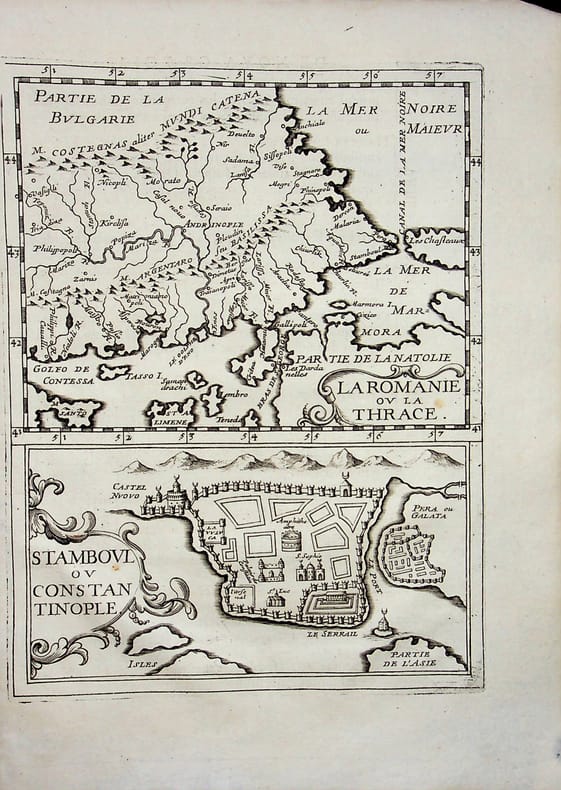
018796[Philippe Briet, Parallela geographiae veteris et novae] La Romanie ou la Thrace - Stamboul ou Constantinople - Grèce et Turquie. Gravure originale, 1649, environ 240*170mm. Gravure tirée de l'ouvrage du savant jésuite Philippe Briet (1601-1668) publié en 1648-1649. Texte au dos. [436]