2 100 résultats
New English Paperback. 8vo. In English and Turkish. 352 p., ills. A city that remembers: Space and memory from Taksim to Sultanahmet.= Hatirlayan Sehir: Taksim'den Sultanahmet'e mekân ve hafiza. "The publication offers its readers an opportunity to get acquainted with Istanbul - whether they be its resident or a tourist, as it presents the suppressed histories of the Ottoman era and Republican Turkey by looking at Istanbul from the lens of a tour guide. The places we pass by or visit on a daily basis are, inevitably, places with certain histories. These are mostly histories of appropriation and violation, injustice and power, but at times also histories of struggle. A City That Remembers sheds light on this rather 'unofficial' version of Istanbul's history through a total of 17 spaces, squares and buildings.".
New English Original bdg. HC. Roy. 8vo. (23 x 16 cm). In English and Turkish. With a CD. 30 p., ills. A composer of Beyoglu: Karnik Garmiyan.= Bir Beyoglu bestekâri: Karnik Garmiyan. [CD - Book]. Compositions of Armenian compositor Karnik Garmiyan come alive in this book with a CD. Songs by Sema Moritz.
New New English Original bdg. Dust wrapper. 4to. (34 x 24 cm). In English. 368 p., color and b/w ills. A garden for the Sultan: Gardens and flowers in the Ottoman culture. Contents: Ottoman and other gardens. The features of Ottoman gardens. Ottoman gardens and Europe. Flowers among the Ottomans. The concepts of paradise and garden among the Ottomans. Ottoman palace gardens. Imperial gardens in Istanbul other than palace agdrens. References to Istanbul gardens and flowers in contemporary memoirs. Treatises on gardening and flowers. "True lover who has exprienced this blossoming of eternal rose in himself understands that the gardens of this world are only a lovelyn pretext for the Beloved to veil and unveil Himself at the same time. The hidden treasure of his beauty needs the garden to become visible to those who are still bound to sensible and tangible beauty. The eye of love sees behind the roses and trees, in the shade of the slender cypress and in the modest genuflection of the little violet, in the limpid water of basins and in the gushing fountains faint remembrances of the garden of Paradise with its Tuba tree, kauthar and salsabil; a Paradise which is, in turn, only a sensual symbol of God's everlasting beauty". OTTOMANIA Ottoman court Palace Istanbul Constantinople Flower Garden Turkish and Islamic art.
160p. ilus maps.index Book
New English Paperback. 4to. (30 x 22 cm). In English. 328 p., ills. A history of healthcare in Istanbul. Health organizations - Epidemics, infections and disease control - Preventive health institutions - Hospitals - Medical education.
New New English Original bdg. Dust wrapper. 4to. (29 x 24 cm9. In English. 2 volumes set: (678 p.), richly ills., photos. A history of Robert College: The American College for Girls and Bogaziçi University (Bosphorus University). This two volume slipcased set is the story of two American Schools in Istanbul – Robert College and American College for Girls- both of them founded in the third quarter of the nineteenth century. The story takes the two schools through the last half-century of the Ottoman Empire and the first half-century of the Turkish Republic. The last part of the book tells the story of the founding of Bogazici University on the campus of the old Robert College in Bebek-Rumeli Hisarý , and the establishment of the new co-educational Robert College on the campus of the old American College for Girls in Arnavutköy. The principal characters in the story are the men and women who worked at the two colleges as teachers and administrators, and the students who studied there, many of them going on to distinguished careers, including two prime ministers of Turkey and two of Bulgaria. Bogazici University and the new Robert College, both founded in 1971, continued a tradition that has now linked east and west for over a century, perpetuating bonds of culture and friendship that have endured through wars and the fall and rise of nations. Hundreds of photographs in each volume visually trace the history of these two venerable institutions. A very heavy and oversize set.
New New English Original bdg. Dust wrapper. In publisher's special box. 4to. (1934, [4] p.), color and b/w ills. A journey through maps from the Ottoman world to the Republic of Turkey. From Constantinople to Istanbul between the 15th and the 20th centuries. The cartographic collection of Erhan Öner. 4 volumes set. A project of passion and patience: For four decades Erhan Öner has been painstakingly collecting maps of Turkey, assembling a cartographic collection that is now one of the largest and most comprehensive of the area. His maps range in date from the 15th century, the early days of the Ottoman Empire, through to the 20th century and the early days of the Republic, and encompass historical, military, marine and archaeological maps, and even postcards with maps on them. Examples by the renowned cartographers Abraham Ortelius, Gerardus Mercator, Jodocus Hondius, Homann Heirs, Freres Lotter, Visscher Family, Sanson Family, John Speed and Frederick de Wit are among the highlights. A project of passion and patience, Öner's collection is finally being published in a four-volume catalogue. Displaying as many as 1,500 maps on 2,000 pages, it will be an important reference work for academics, researchers and fellow collectors. At the same time it is a visual feast, with beautiful illustrations, engravings and vignettes. Contents: Vol. 1: HISTORICAL MAPS OF TURKEY. 15th - 16th Centuries, 17th Century, 18th Century, 19th Century, 20th Century. TURKEY IN EUROPE. Vol. 2: REGIONAL MAPS. Black Sea, Thrace, Sea of Marmara Dardanelles, Aegean Archipelago. Mediterranean Sea, Central, Eastern and South East of Turkey,Middle East, Serial. OTTOMAN VILAYETS AND SANCAKS Postcard Maps, Yumni Maps. Other Vilayet Maps PORT PLANS. RAILWAYS. RELIGION RELATED MAPS, THE RETREAT OF THE TEN THOUSAND MAPS. GEOLOGICAL MAPS. POSTCARD MAPS. CLIPPINGS. Vol. 3: MILITARY MAPS. War and Peace Maps and Plans Maps of Erkan-¿ Harbiye. Harita Umum Müdürlügü, Milli Müdâfaa Vekâleti. Harita Genel Müdürlügü, Harita Genel Direktörlügü Maps of War Office & Ordnance Survey Office, Henri & Richard Kiepert Maps. ATLASES. Vol. 4: ISTANBUL NECIP BEY MAPS OF ISTANBUL: Societe Anonyme, Ottomane d'etudes et d'entreprises Urbanies. KESFlYÂT VE ¿NSAAT TÜRK ANON¿M S¿RKETl, TURKISH SURVEY AND CONSTRUCTION COMPANY UNFINISHED MAP OF ¿STANBUL, INSURANCE PLANS OF ISTANBUL. ARCHEOLOGICAL MAPS. OTHER CITIES. INFORMATION ABOUT CARTOGRAPHERS. ENGRAVERS AND BOOK PUBLISHERS.
New English Paperback. Pbo. Large Roy. 8vo. (24 x 19 cm). In English. 142 p. Color ills. "Turkish Baths: A light onto a Tradition and Culture, is a lively pictorial jaunt through the history, traditions and culture of the Turkish bath. Discover the bath's contribution to Islamic culture and health, its role in the social lives of sequestered Ottoman women, the tale of the street ruffians who slept in its back corners, its environmental impact as Istanbul's greatest forests succumbed to the giant stokepits, and the sexual activities (primarily same gender) that were an acknowledged part of the bath 'scene.' The architecture of the bath is its crown, as light filters down onto the bathers stretched languorously on the large, common 'reclining' stone, demonstrated here with scores of beautiful contemporary photographs of Istanbul baths and bathers. This book is also a detailed guide to 'bath etiquette'--and a guide to fifty historic baths in Istanbul (some dating as far back as the 15th century) that continue in regular use today. This book is a must for those searching for the perfect Turkish bath experience and those who want to understand what this tradition is all about! Contents Bath Culture: Past and Present Roman Baths Baths during the Ottoman Empire Islam and Baths The Only Place a Woman Could Visit The Turkish Bath through European Eyes Ottoman Bath Architecture The Essential Components of the Bath: Tellak and Natir The Baths and Sex Tellak: Then and Now The Star of the Turkish Bath: Kulhanbey A Guide to the Historic Turkish Baths of Istanbul In the Bath. The Bath and Health Within the City Walls of Old Istanbul Beyoglu Side Anatolian/Asian Side References".
New English Paperback. Pbo. Roy. 8vo. (24 x 17 cm). In English. 362 p. Part One: Vienna, Graz, and Venice; Part Two: Karlovac, the Danube and the Balkans; Part Three: Istanbul; Epilogue. LITERATURE Novel Vienna Istanbul Constantinople Memoirs.
New English Original bdg. HC. 4to. (27 x 23 cm). In English and Turkish. [4], 198 p., color and b/w ills. A mansion in Sisli and architect Giulio Mongeri.= Sisli'de bir konak ve mimar Giulio Mongeri.
New English Paperback. Pbo. Large 8vo. (23 x 22 cm). In English, Turkish and Russian. 216 p., color and b/w ills. A passion for the sea: The secret diary of Ivan Konstantinovich Aivazovsky.= Ask-i derya: Ayvazovski'nin gizli Istanbul güncesi.
New New English Original bdg. Dust wrapper. Folio. (41 x 30 cm). In English and Turkish. [22], 189, [18] p., b/w photos. A photographical sketch on lost Istanbul.= Eski Istanbul anilari. [Album of photographs]. A very heavy volume. Contents: The Light of Istanbul: Boatmen of the Golden Horn, old Galata Bridge and the New Mosque, 1956. Midday hours on the old Galata Bridge, 1954. Ferries of the Bosphorus and the Prince Islandsbound to the old Galata Bridge, 1955. "Salep" merchant in early morning lights on the old Galata Bridge, 1957. Traffic on the old Galata Bridge, 1956. Wool hanks hung to dry up in Ortaköy and the sea, 1964. The bridge and the ferry, 1955. Barges and ferries in the Golden Horn, 1958. Süleymaniye Mosque as seen from the old Galata Bridge, 1956 10 Haliç, 1956 - The Golden Horn, 1956. Eminönü Square after the demolishment, 1959. Carters near the Oil Quay, 1957. View from the Oil Quay, 1955. View from the Oil Quay, 1955. Boat maintanance in Ayvansaray, 1969. A barge withdrawn to the coast in Üsküdar and children, 1954. Bargeman fishing at the caulking yard, 1958. Boatmen at the caulking yard, 1956. Boatmen waiting for customers at the caulking yard, 1957. Loading at the Oil Quay, 1957. The caulking yard front of the Golden Horn and rowing-boats, 1957. Boats at Balat, Golden Horn, 1969. Eminönü boatmen, 1958. A leaping boatman in Golden Horn and a cargo ferry, 1960. Children at the local grocer¿s in Vefa disctrict, 1975. The Ottoman Fountain and the childeren at Azapkapi, 1965. Children at the gypsy disctrict in Sishane, 1969. Horse cart passing under an archway near Sehzadebasi, 1958. Inner courtyard of an old wooden house and playing children at Tophane, 1954. Elderly Beyoglu woman taking food to her cats in front of the Flower Arcade at Balikpazari, 1980. A husband and wife heading home in the evening at Zeyrek disctict, 1960. A street in Tarlabasi, 1965. Horse carts and old houses in Unkapani, 1955. Provincials watching the boats from the Galata Bridge, 1956. Card-players at a shore coffee-house in Salacak, 1956. Süleymaniye Mosque and the shore of Unkapani as seen from the old Galata Bridge on a winter's day, 1955. A touristicferryas seen from the old Galata Bridge, 1959. Separation on the Galata Quay, 1955. An old street in Rumelihisari, 1962. A boatpainter on the quay, Karaköy, 1956. Fishermen at the old Galata Bridge, 1968. Vintage outdoor fish restaurants on the shore of Eminönü in the Golden Horn, 1965. A wooden mansion in Kandilli, 1985. Little boys chasing a kittenin Zeyrek, 1968. A chimney and the domes of a Turkish Hamam in Beyoglu, 1957. The evening ferry in Beylerbeyi, Bosphorus, 1960. Ramparts and horses, 1969. Man climbing the hill in Feriköy, 1985. Boat approaching the quay at night, Kandilli, 1965. Massage at the Cagaloglu Hamam, 1965. Boats heading to the Bosphorus, 1975. Salacak ferry pier and the Istanbul silhouette, 1968. A man reading the newspaper on a ferry heading to the Princes Islands, 1955. Children getting out of a rowboat in the old Salacak Bay, 1964. A Bosphorus ferry sailing past Beylerbeyi, 1957. The Mystery of Labour: A boy worker at the caulkingyard, 1972. Porters waiting for work on the caulkingyard, Galata, 1958. Workers at the caulkingyard, 1969. An old worker drinking water in an old "han" in Galata, 1950. Worker looking out of a window in the old Yakut Han at the caulkingyard, 1988. Caulkingyard, 1957. Boy casting iron at the caulkingyard, 1988. Sailors at the caulkingyard, 1957. A blacksmith at the caulkingyard, 1988. Carriers at the caulkingyard, 1969. Porters waiting for work on the Oil Quay, 1954. Porter carrying a barrel at the Oil Quay, 1958. Street vendors at Sishane, 1990. Street restaurants on the shores of the Golden Horn and an old porter, 1965. Young workers at the caulkingyard, 1969. Man carrying a mattress in the Grand Bazaar, 1965. Shopkeeper and his shop at the Grand Bazaar, 1965. Grand Bazaar, 1972. Woman selling antiques in the Inner Bedesten in the Grand Bazaar
1926052475Istanbul-Beyoglu: Zelliç Biraderler Matbaasi = Zellitch Brothers 1926. 1st Edition . Hardcover. Very Good. 8vo - over 7¾ - 9¾" tall. In contemporary decorative cloth bdg. Demy 8vo. 22x 14 cm. In Ottoman script and English. 4 295 1 p. A practical English grammar for use in Turkish schools.= Türk mektebleri için Ingilizce amelî gramer. Only one copy in OCLC 82745106 Bogaziçi University Library.; Özege 21473. First and Only Edition. <br/> <br/> Zelliç Biraderler Matbaasi = Zellitch Brothers hardcover
New English Paperback. 4to. (30 x 21 cm). In English. 224 p., color ills. A restoration story [of] Seyh Süleyman Masjid. (Turkey - Italy collaboration of restoration approach). This publication, for which Nicola Berlucchi wrote a significant contribution, is the result of intense international collaboration favored by the Vakiflar Genel Müdürlügü association, which is involved in the management of the Ottoman church property estate in Turkey. The work, which describes the application to a Turkish religious structure of a typical European restoration approach, particularly Italian, which involves the reconstruction of all the architectural-architectural phases of the building, is therefore an important witness to the attempt to international dialogue made by Turkey, despite the period of strong instability it faces.
Fine English Paperback. Demy 8vo. (22 x 14 cm). In English. [xxi], 354 p., 50 numerous b/w ills. A social history of Ottoman Istanbul. Using a wealth of contemporary Ottoman sources, this book recreates the social history of Istanbul, a huge, cosmopolitan metropolis and imperial capital of the Ottoman Empire. Seat of the Sultan and an opulent international emporium, Istanbul was also a city of violence shaken regularly by natural disasters and by the turmoil of sultanic politics and violent revolt. Its inhabitants, entertained by imperial festivities and cared for by the great pious foundations which touched every aspect of their lives, also amused themselves in the numerous pleasure gardens and the many public baths of the city. While the book is focused on Istanbul, it presents a broad picture of Ottoman society, how it was structured and how it developed and transformed across four centuries. As such, the book offers an exciting alternative to the more traditional histories of the Ottoman Empire. First Edition.
Fine Turkish In modern clothes. 4to. (33 x 24 cm). In English and Turkish. 2 volumes set: (xvii, [3], 357 p.; [8], 447 p.), b/w and color plates. Sedad Hakki Eldem was a Turkish Architect. One of the pioneers of nationalized modern architecture in Turkey. He was born in Constantinople (1908). He graduated from the Academy of Fine Arts (department of Architecture). Between 1931 and 1932 he travelled to France, England and Germany with a scholarship of the academy. In 1932 he opened his own office, also started teaching at the Academy of Fine Arts and continued until retirement in 1978. In 1934 he worked for the National Architecture Seminar in Turkey which was a complete disaster for him because of the discussions between modern architecture and traditional architecture. In 1938 he designed the Turkish Pavilion in New York Exhibition. Sedad Hakki Eldem represented Turkish Republic at International Union of Architects in Lausanne (1948) after Second World War. Also in the same year Sedad Hakki worked with his colleague Emin Onat on the project of Istanbul Palace of Justice. He worked on proportions and architectural organizations of Ottoman domestic houses, 18th and 19th century palaces and mansions. He was known as a role model and pioneer to reinterpret the Classical Ottoman Patterns in modern architecture. He was a part of Former Artifacts Maintain Council (Eski Eserleri Muhafaza Encümeni) between 1941 and 1945 and also a part of Supreme Council of Antiquities and Monument Real Estate (Gayrimenkul Eski Eserler ve Anitlar Yüksek Kurulu) between 1962 and 1978. His thought was about nationalizing the Modern Architecture. He basically thought that International Style in architecture should not applied everywhere. Some things should be changed in the design by considering the national and domestic texture. He has won the international Aga Khan Award for Architecture in 1986 with the project of Zeyrek Social Security Facilities. Sedad Hakki Eldem's architecture has basically 4 main periods. The first of them, between 1928 and 1934, is known by the instability of his work. After that, the second period is popular with modern trials on Ottoman architectural organization. The time frame of this period spans from 1934 until 1952. The third period of his architecture has lost its Ottoman influence, it looks more modernized between 1952 and 1962. The last part of Eldem's Architecture known for his double approach on projects.This final period started in 1962, and lasted until his death in 1988. (Source: Wikipedia). Extremely rare.
Very Good English Paperback. Pbo. Cr. 8vo. (19 x 13 cm). In English. 64 p., 30 plates of Istanbul in old photographs from the Çelik Gülersoy's collection. A taste of old Istanbul. Contents: The Orient Express.; The Pera Palas Hotel.; The Rejans Restaurant and Beyoglu District.; The Flower Passage.; The Park Hotel.; The Baroness.; Arzumanova.; Tadori and the Balikpazari (Fish Market).; Cahide: A Star Who Climbed High and Fell Hard.; The Russian Restaurant in Ayaspasa.
New English Paperback. 4to. (31 x 24 cm). Edition in English. 208, [1] p., color ills. A treasured memory: Ecclesiastical silver from late Ottoman Istanbul in the Sevgi Gönül Collection.
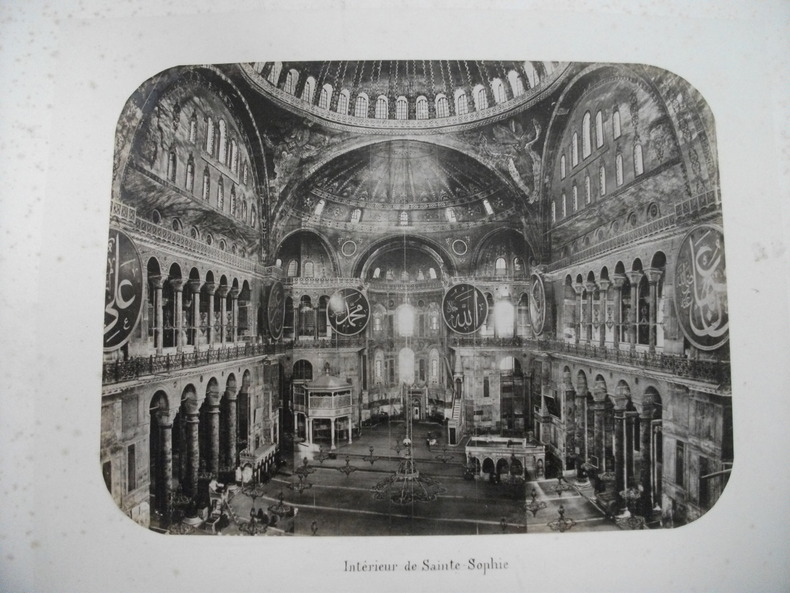
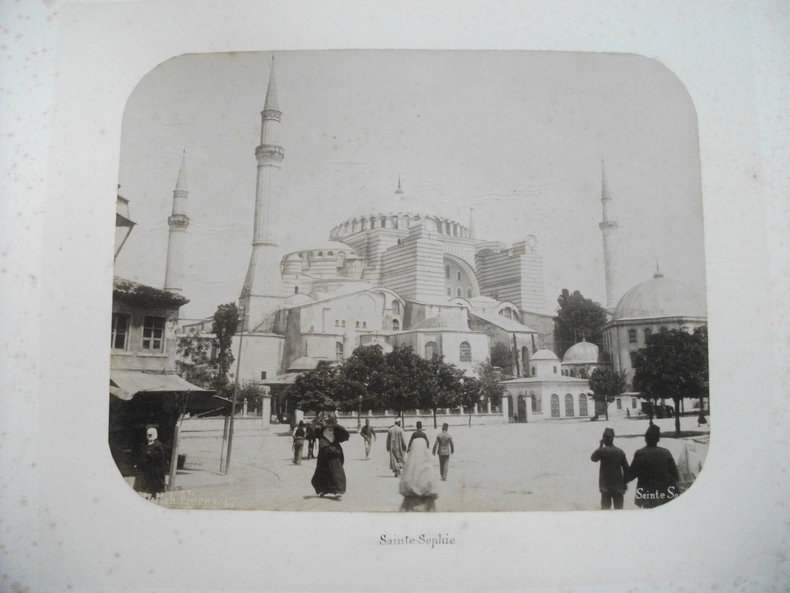
FO0562 albumen photographs c. 1875 mounted on strong paper recto/verso, photos dimensions 20x 25 cms. Humidity light stains on the frames not affecting the photos, light undulation on the paper.
FO0572 albumen photographs c. 1875 mounted on strong paper recto/verso, photos dimensions 20 x 25 cms. Humidity light stains on the frames not affecting the photos, light undulation on the paper.
FO0582 albumen photographs c. 1875 mounted on strong paper recto/verso, photos dimensions 20x 25 cms. Humidity light stains on the frames not affecting the photos, light undulation on the paper.
19189Paris P.-V. Stock, Editeur 1901 in 12 (19x13) 1 volume reliure demi basane bleue de l'époque, dos à nerfs orné de fleurons dorés, VI [4] et 222 pages [1], avec 27 gravures hors-texte et le fac-similé d'un autographe du Sultan. Préface de Pierre Quillard. Ex-libris de la bibliothèque A. Lang (avec la devise: Sitôt lu, sitôt vendu, sitôt perdu). Bon exemplaire ( Photographies sur demande / We can send pictures of this book on simple request )
Fine English Paperback. Pbo. Cr. 8vo. (20 x 14 cm). In Turkish. [xvii], 347 p., b/w ills. Abdülhak Sinasi Hisar'in eserlerinde geçmis zaman ve Istanbul. Istanbul in literary works of Abdulhak Sinasi Hisar, (1887-1963). ISTANBUL Constantinople Social life Ottoman / Turkish society TUrkish literature Novel.
5296Ouvrage complet en deux vol., 4ème éd. revue et corrigée ; Paris, Louis Colas libr., L. Hachette, 1839 — in-8, 568 pp., 678 pp. — demi-rel. chagrin rouge d'ép.
196943425Paris 1969. In-4 Paris 1969. In-4 agrafé.