2 100 résultats
New English Original bdg. HC. Oblong 4to. (24 x 31 cm). In English and Turkish. 223, [9] p., color and b/w ills. The book includes the research deducted by Mr. Alper, who had an important archive about the historical building and site. The first confrontation with the building goes back to 1991. The relationship which Mehmet Alper and his team established and their ongoing commitment of responsibility and interest with the structure they have monitored over the years have continued with certain intervals until the present day. The main objective of this study is to share archives, documents, and information they have compiled over the years with the pertinent parties in order to speed up the conservation process. An attempt to access all types of documents was made while meticulously researching its architectural history, whereas the compiled data was evaluated in the historical process flow. This research was initiated with written/printed / online scanning of local and foreign sources that produced works pertaining to the orphanage. The architect and his team collaborated with many academicians and specialists who had written valuable articles and papers such as Akillas Millas, Berrin Alper, Çelik Gülersoy, Hakki Göktürk, Oguz Ceylan, etc and the General Manager of the Ottoman Public Debt Administration, Edgar Vincent in order to access Ottoman documents and the Istanbul Metropolitan Municipality's Ataturk Library to acquire maps and postcards of the Prinkipo Orphanage. Therefore, this research is an important effort to save the Orphanage's cultural heritage and to convey it to the future with the proper work.
NEW YORK, Harper & Brothers, 1893 - T. I seul - In-8 - Cartonnage éditeur frotté & illustré - 502 pages - Bel ex-libris illustré avec mention "War Service library" - Correct - Envoi rapide et soigné
New New English Original binding with original dust wrapper. 3 volumes set in special slip case. Large 4to. (43 x 33 cm). [xi], 1182 p. in total. 2400 postcards. Born in 1852 in Kalucz, a town on the eastern border of the Austro-Hungarian Empire, Max Fruchtermann came to Istanbul in 1867 and two years later opened a picture framing shop in the city. Having decided to have the first Ottoman Postcard Series printed at Breslau in 1895, he ensured through his cards, which number in the millions, that the name "Turkey and the multifarious images associated with it" spread throughout the entire world from Canada to New Zeland. In 1966 when Fruchtermann's daughter-in-law Anna, before closing down the establishment, sold her remaining stock (subsequently realized to number around 600,000) to a secondhand dealer for 2500 liras, she probably never imagined the importance of her father-in-law's postcards. They are not simply photographs of landscape panoramas monumental buildings and people of the time. They are individual documents that reflect in their human types and cross-sections of everyday life the noteworthy political incidents of the late 19th and early 20th centuries and the ethnic and cultural diversity embodied in the Ottoman identity. As such they have acquired significance far in excess of original expectations. It always comes as a pleasant surprise to collectors to see that ordinary objects left to us from the past, and usually assumed to be of mere functional value, in time acquire special significance. For us, however, far more than a pleasant surprise these postcards are a door opening up on our recent history. The places, incidents and types that Fruchtermann saw and appraised with his own eyes have been given new life and brought together as a whole thanks to this study and up-to-date treatment by Mert Sandalci.
New English Paperback. 4to. (30 x 24 cm). In English. 285 p. Color and b/w ills. "This unique collection takes a fresh look at Orientalism by shifting its center from Europe to Ottoman Istanbul and thinking about art in terms of exchange, reciprocity, and comparative imperialisms. This new lens reveals the essential role of the Ottoman city and its patrons and artists in the dialogues that facilitated production, circulation, and consumption of British Orientalist cultures. In this volume, art works are conceptualized as traveling artifacts produced through localized interactions. World renowned scholars and curators analyze the diverse audiences for such art works and the range of differing contexts for their reception both in the 19th century and more recently. In this way, British art is put into a dynamic relationship with an historicized understanding of cultures of collecting and display during the formation of comparative modernities and also with the contemporary postcolonial creation of new national models of exhibition and education. Featuring stunning visuals, this book puts art history in the context of cultural, visual, and literary studies, challenging the orthodoxies of postcolonial theory with the materiality of multiple imperialisms and modernities to offer a new take on the collection, display, and consumption of Orientalist cultures.".
New New English Original bdg. Dust wrapper. 4to. (34 x 24 cm). In English. 2 volumes set: (735 p.), b/w and color ills. The photographers of Constantinople. Pioneers, studios and artists from 19th century Istanbul. 2 volumes set. Prep. by Bahadir Taskin. Vol. 1: Texts and photographs: Istanbul photographers of the 1850"s exhibiting in London, Paris and Brussels; Ottoman court photographers; and studios and artists that made their mark. Vol. 2: The Album: the imperial family; statesmen, celebrities and court officials; memories of a vanished world; costumes; professions and street sellers; everyday life; palaces and other edifices; the sea and Istanbul; panoramas; bibliography and index.
New English Paperback. Pbo. Roy. 8vo. (24 x 17 cm). In English. 140 p., ills. The Pera Palas: The historical hotel overlooking the Golden Horn.
Fine English Paperback. Small 4to. (27 x 20 cm). In English. 54, [2] p., 53 numerous b/w plts., 46 numerous color plates. The people & places of Constantinople. Watercolours by Amadeo Count Preziosi, (1816-1882). It's prepared for the first exhibition on Count Amadeo Preziosi, (1816-1882) in Great Britain. "This is the first exhibition of the work of Amadeo Preziosi to be held in this ccountry. It does not cclaim to be definitive, but it centered on the Museum's substantial holdings and augmented by loans from collections in Great Britain. Preziosi's name is now little known except to specialists, but in the period 1840-70 he was by far the most reknowned artist in Constantinople. He was only retrieved from the critical neglect into which he had fallen in the 20th century by Rodney Searight who began to appreciate his importance while building up his unsurpassed collection of views of the Near and Middle East. Indeed, it is fitting that the exhibition honours not only Preziosi himself but also Rodney Searight, pioneer of the study of this field, whose collection the Museum is raising funds to acquire. It is hoped that the enthusiasm Preziosi's contemporaries felt foe his lively and colourful studies of a now vanished way of life will be appreciated by visitors to the exhibition". (From the Kaufmann's preface).
Useful Reference for Classical, Byzantine, Oriental and African Literature and History. ; The Penguin companion to world literature; 360 pages
New English In one slip-case, two volumes set: One is HC, One is PB. 4to. (29 x 22 cm). Parallel text in English and Turkish. 2 volumes set: (93, [1] p.; 1 folded huge reprinted color panorama). The panorama of the Marmara Sea Walls by Dimitriadis Efendi. Texts & The Panorama.= Dimitriadis Efendi'nin Marmara Sahil Surlari panoramasi. Yazilar & Panorama. Foreworded by Zeynep Kiziltan. Preface by Engin Akyürek. Texts by Üzeyir Altekin, Nisa Semiz. "The 28-metre-long depiction of Marmara Sea Walls, rendered in watercolour by the Istanbulite Chief Engineer Dimtriadis Effendy in 1875, has been preserved at he Istanbul Archaeological Museums since it was donated to Müze-i Hümâyûn (The Imperial Museum) in 1917. This publication was prepared in order to introduce this important document, which has been available to be studied by scholars, to a wider audience. Also within the scope of the project, to be able to allow the preservation of the original document, a one to one scale copy of the scroll was produced and presented to the Museum.". Dimitriadis Efendi is the son of Dimitri Efendi ofthe Ottoman Greeks. He studied at the Greek school in Beyoglu and later at the French Missionary Schools and received lessonsin mathematics from a private teacher. He was speaking Turkish, and able to read and write in French and Greek. In 1871, he joined the Greek Philosophical Syllogos of Constantinople. He acted as a permanent member of the Archaeological Committee of the Society between 1871 and 1876, and as a member of the Science Committee of the Society from 1876 to 1882. He gave lectures on Practical Geometry, Applied Geometry, and Applied Engineering. On 31 May, 1882, he was appointed as the Umûr-u Nâfia Mühendisi of the Province of Thessaloniki. In consideration of his services, he was later decorated with the Fourth class of the Order of Medjidie on 22 September 1890 and to being promoted to the rank of assistant chief engineer, he was also appointed as the structural ccommissioner of waterworks. His Marmara Sea Walls is a drawing and watercolour on paper, with a size of 47,7x2800 cm. The lower, righthand corner bears the signature of G. A. Demetriades, dated 1875. The scroll contains the Marmara Sea façade of the Istanbul Walls, starting from the Seraglio Point and reaching all the way to the section located just before Yedikule. It could be observed that the names of some doors, mosques, pavilions, and piers were marked on the scroll with a pencil, sometimes in Arabic and at other times in Latin letters. The expressions written in pencil on certain parts of the walls and bastions...". Contents: The panorama of the Marmara Sea Walls by Dimitriadis Efendi.; Foreword by Zeynep Kiziltan.; Preface by Engin Akyürek.; Chief Engineer Dimitridis Efendi by Üzeyir Altekin.; Evaluations on the panorama of the Marmara Sea Walls by DImitriadis Efendi by Nisa Semiz.; And the Panorama volume including the folded color original huge panorama in its wrapper.
Fine Fine English Original bdg. Dust wrapper 4to. (28 x 20 cm). In English and Turkish. [viii], 351, [9] p., b/w and color ills. The Ottoman palace women (Women in Turkey).= Osmanli saray kadinlari (Türkiye'de kadin). Ottoman palace women is the third volume of study entitled Women in Turkey, and is a detailed and documentational account of how women of many races, faiths and creeds entered palace service, and of their lifestyles from the humblest to those who attained the coveted position of favourite of wife to the sultan. It was impossible for anyone but the members of the sultan's own household to see and describe the harem of the Ottoman palace. That is why, with rare exceptions, the portrayals of palace officials, female slaves, odalisques, favourites, wives and sultan mothers by foreign artists who visited Istanbul at various times are mere figments of the imagination and as such are interesting testimony to the power of imagination and artistic ability of European painters...".
New English Paperback. Pbo. 4to. (29 x 22 cm). In English. 276 p., color and b/w ills. "Zeytinburnu: A quarter monography: A common but wrong belief about the Zeytinburnu District is that the settlement in this area has begun with the slum formation and has had a past of about thirty of forty years. However, the studies carried out show that the settlement in the area has a very old past. This area was very important militarily and religiously the Byzantine Istanbul, known as the 'Second Romeî'. Among the historical structures taken over in this period by our district that was on the passage way of the Byzantine Army were Yedikule Fort to which Sultan Mehmed II Conqueror made some editions and Baliklama Ayazma (Holy Spring) and Church. Balikli Spring first became the subject of an epic on the Byzantine enthronement Of Leon I and became known with its modern name owing to an epic that is rumored to have been created during the conquest of Istanbul (Constantinople). Also, we can wholeheartedly say that our Zeytinburnu District has a rare wealth in terms of Islamic mysticism. Dervish Lodges within the boundaries of our district such as Perisan Baba, Hadji Mahmud Aga, Seyyid Nizam and Merkez Effendi Dervish lodges, as well as Yenikapi Mevlevi House, mentioned as a music academy, have been occasion for the education of extremely important figures of our mystic history.".
Report on some of the work done in Haghia Sophia between 1934-1938. It includes a double page colored cloured frontispiece, 51 pages of text describing the process of restoration,followed by 36 pages of plates with XXXVI images illustrating the condition of the Deesis panel before and after the reconstructon of the mosaics. It was covered up again from 1940-1945 for protection..Slight wear to wraps, else fine Book
New English Paperback. Pbo. Oblong large 8vo. 62, [2] p. In English and Turkish. Color and b/w ills. The management of water in Istanbul from the past to the present.= Geçmisten günümüze Istanbul'da suyun yönetimi. Prep. by Tevfik Gürsu, Ulvi Ünal, Ahmet Öz, Hamit Tokmak.
"An excellent assessment . of the Byzantine empire during a crucial phase in the history of the Near East. Well illustrated with original maps, it covers the last decade of the Roman Empire as a superpower of the ancient world, the crisis of the seventh century, and the means whereby its embattled Byzantine successor hung on to Constantinople ans Asia Minor until the Abbasid Caliphate's decline opened up new perspectives for Christian power in the Middle East. 477p. index Remainder mark, else as new, unread copy Book
New English Paperback. 4to. (28 x 24 cm). In English and Turkish. 360 p., color ills. The lure of the East: British orientalist painting.= Dogu'nun cazibesi: Britanya oryantalist resmi. [Exhibition catalogue]. This exhibition focused on the paintings made by British artists of the 'Orient', primarily during the nineteenth century. In this context the term 'Orient', to Western Europeans, meant those parts of the eastern Mediterranean world which could be accessed relatively easily such as Egypt, Palestine and Turkey, particularly after the development of steamboat and rail travel in the 1830s. In these places, predominantly Muslim and at least nominally under the control of the Ottoman Empire, British artists, such as David Roberts, David Wilkie, William Holman Hunt, John Frederick Lewis and Frederic Leighton, sought to develop imagery which captured what they believed to be characteristic of the people, cities and landscapes of the region. In the 1970s the Palestinian-American academic Edward Said published his treatise on Orientalism, initiating a global debate over Western representations of the Middle East. For many, such representations now appeared to be a sequence of fictions, serving the West's desire for superiority and control over the East. The argument for and against Said's Orientalism has continued for thirty years. Its resonance for an exhibition such as this one, however, is as strong as ever given that, by the 1920s (the end of the period covered by this exhibition), Britain was in direct control of much of the newly abolished Ottoman Empire, including Egypt, Palestine and Iraq. As Said argued, these images cannot be viewed in isolation from their wider political and cultural context. Keeping the debates around Orientalism in mind, "The Lure of the East" focuses on the range of pictorial options open to British artists, within five major themes: portraits, genre, religious and domestic subjects and landscape. British painters came to the Middle East from a culture steeped in technical and compositional artistic traditions. Such traditions were not easily unlearned, despite the apparent difference of the people and places the artists encountered on their travels. Given this, British Orientalist painters found many challenges in attempting to represent the Middle East, but they also found inspiration and, more importantly, the freedom to rework, reinvent and even discard those conventions that defined picture-making in Britain.
As New English Paperback. Pbo. Mint. Demy 8vo. (22 x 14 cm). In English. 121, [1] p. "The Lost Diaries of Constantinople frames faded pictures of Constantinople's past lives in the breathless Ottoman centuries".
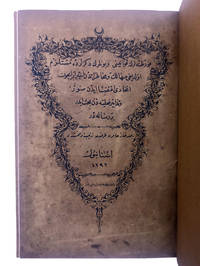
1875055260Constantinople Istanbul: Neologos Litografyasi - Votîra ve Sürekasi Matbaasi. AH 1292 1875. 1st Edition . Leather. Very Good. 8vo - over 7¾ - 9¾" tall. Contemporary 1/4 leather bdg. with marbled boards. Small 4to. 27 x 19 cm. 23 p. 11 p. in Ottoman script Old Turkish with Arabic letters; 12 p. in French with rare 4 folded maps. A very good copy. First and only edition of this extremely rare bilingual book in French and Ottoman Turkish including the first records on the formation and characteristics of storms to explain how storms and hurricanes occurred which route they followed and how they were conveyed to the regions that need to be warned by telegraph for the vessels sailing in the seas by French expert Coumbary who was founded the Rasathâne-i Âmîre i.e. Ottoman Imperial Observatory. Both the original French and Turkish translations of the work were published together in one volume. The work also included four maps which were drawn for this work only. The first map shows the movement of a storm that occurred on March 8 1865 the second one shows the occurrence between the Tropic Cancer and Capricorn whirlwinds storms in the Atlas and Indian oceans the movements in the Bay of Bengal the storms in different directions in the China Sea the Gulfstream Grönland and Azores. The second observatory in the Ottoman era was established for meteorology. Before this center was established beginning from the Reformation 1839 many meteorological observatories were built by foreigners in various cities such as Istanbul Smyrna Trebizond Tekirdag and Merzifon both as private and public establishments. The very first known temperature readings are the meteorological observations made by the Priest Dalmas at the St. Benôit monastery between 1839-1847. Later William Lane an Englishman who came to Istanbul during the Crimean War made observations at the British Cemetery at Haydarpasa. W. Noe director of the Mekteb-i Fünûn-u Sahane made observations at the house in Kalyoncukulluk where he lived until the Beyoglu Fire in 1848; and finally it is known that French engineer Ritter who was invited by the government for waterworks in Kuruçesme 1856-1860 also conducted meteorological observations. Observations on precipitation and humidity conducted between 1875-1892 by an amateur observer on the Thomson Farm in Erenköy are invaluable on the subject of Istanbul's climate. These observations have been published in Budapest in 1928. Excellent observations on heat pressure and humidity made in the summer residence of the Russian ambassador on Büyükada have also been published in Annales St. Petersburg. In 1858 the French government established the first observatory communicating data over the telegraph and in 1863 by compiling meteorological data in France the French National Meteorological Network started operations. In 1868 upon the recommendation of the French government the Rasathane-i Âmire was founded to convey meteorological forecasts to certain centers by telegraph. Instruments were purchased from leading European factories and operations started on top of a hill 74 meters high on Pera. The first director was Mr. Aristide Coumbray who came to Istanbul to renovate the telegraph network. Instruments commissioned from France were set up at Mr. Coumbary's home which stood at the garden of the Swedish Embassy. The observatory was later moved after its offices were prepared. Coumbary represented Turkey in the first international meteorology congress convened in Wien five years later in 1873. Rasathane-i Âmire worked by the same system as the National Meteorology Center in France. In the observation books of 1868 August-November names of affiliated stations are given to us Soulina Köstence Constantia Varna Burgaz Valona Elbasan Durazzo and Beirut. Later stations in Izmir Diyarbakir Baghdad and Fao were also added. The observatory founded by Aristide Coumbary in 1868 in Istanbul operated until the end of the First World War. Özege 5735.; TBTK 7688 10862.; Not in OCLC. <br/> <br/> Neologos Litografyasi - Votîra ve Sürekasi Matbaasi., [AH 1292] hardcover
451 p. + Engraved half title and Frontis. Lacks rear folding map. Foxed. Early bookseller's label, Tewskbury & Brothers, Manchester, NH, embossed in blind on front fly leaf. 12mo. Original patterned publisher's cloth binding. Boards embossed in blind and decorated with interlocking flowers. Gold lettered spine. Extremities worn with slight loss. Boards rubbed. Hardbound. Born in Kennett Square, Chester County, PA, Bayard Taylor (1825-1878) was a popular and influential American poet, literary critic, journalist, translator, and travel author. HOLY LAND BOX 1
New English Paperback. Roy. 8vo. (24 x 17 cm). In English. 170 p. The Kohens del de Campavias. A family's sweet and sour story in Ottoman and Republican Turkey.
As New English Original bdg. HC. 233, [1] p., 1 map and 1 folding huge family tree. B/w and color ills. Mint. The Khedives and the Çubuklu Summer Palace. Translated into English: Adair Mill.
New English Paperback. Pbo. Roy. 8vo. In English. 124 p. Ills. Contents: Abbreviations, Introduction, The place of the Jews in the prostitution marketplace of Constantinople, Michel Salomonovich chef des marchands, olice secrete a Constantinople, Edited by Albert Ettiges, 'Report of an enquiry made in Constantinople by S. Cohen., 'Prostitution' by Charles Trowbridge Rigss., Bibliography., Illustrations.
New English Paperback. Pbo. Cr. 8vo. (19 x 13 cm). In English. [iv], 100 p. The Jewish sites of Istanbul. A guide book.
Fine English Paperback. Pbo. Cr. 8vo. (19 x 13 cm). In English. [iv], 100 p. The Jewish sites of Istanbul. A guide book.
New English Paperback. Pbo. Roy. 8vo. (24 x 17 cm). In English. [xiv], 152 p. The Jewish community of Istanbul in the nineteenth century. Social, legal and administrative transformations.