5 326 résultats
199136935Pittsburgh PA: Pittsburgh. New. 1991. Paperback. FREE UPGRADE to Courier/Priority Shipping Upon Request IN STOCK AND IMMEDIATELY AVAILABLE FOR SHIPMENT - FLAWLESS COPY BRAND NEW PRISTINE NEVER OPENED 13 pages; 4 black and white illustrations. -- with a bonus offer-- . Pittsburgh paperback
199838769Bloomington Indiana U.S.A.: Indiana Univ Pr. New. 1998. Paperback. 0253211875 . FREE UPGRADE to Courier/Priority Shipping Upon Request IN STOCK AND IMMEDIATELY AVAILABLE FOR SHIPMENT - FLAWLESS COPY BRAND NEW PRISTINE NEVER OPENED -- with a bonus offer-- . Indiana Univ Pr paperback
199829144Bloomington Indiana U.S.A.: Indiana Univ Pr. New. 1998. Paperback. 025320884X . FREE UPGRADE to Courier/Priority Shipping Upon Request - IN STOCK AND IMMEDIATELY AVAILABLE FOR SHIPMENT - FLAWLESS COPY BRAND NEW PRISTINE NEVER OPENED -- with a bonus offer-- . Indiana Univ Pr paperback
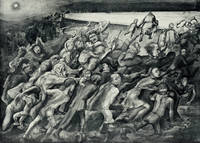
194434835Tel Aviv: Haaretz Printing House 1944. First Edition with annotations in Hebrew. Illustrated with 17 full-page Zinco engravings created by Zincographies Ltd. Oblong folio 34 x 25 cm publisher's original linen backed boards the upper cover printed in Hebrew. 4 text and 17 plates pp. A very good copy well preserved with minor evidence of age or use. RARE EARLY ILLUSTRATED WORK ON THE HORRORS OF THE HOLOCAUST. The evocative illustrations include Jews being rounded up for transport to the camps a depiction of the "death wagons" used for transport the rebellion in the ghetto partisans Treblinka the "monster" Nazi the Underground resistence and more. The album of illustrations was prepared and published during the most intense years of the Holocaust.<br> Lea Grundig 1906 – 1977 was a German painter and graphic artist. In the mid-1930s her work reflected themes of the new Nazi age with her cycles "Harzburger Front" "Unterm Hakenkreuz" 1936 "Der Jude ist schuld!" 1935–38 "Krieg droht!"1935–37 "Im Tal des Todes" 1942/43 and "Ghetto".<br> In 1935 a ban was imposed on exhibits of her work and in May 1936 she was arrested. Later in 1936 she traveled to Switzerland but she then returned to her home city and it was in Dresden that in May 1938 she was again arrested. In March 1939 she was found guilty of "Preparing to commit High Treason" »Vorbereitung zum Hochverrat« as a result of her Communist activities and/or her Jewish provenance and was sentenced to four months imprisonment. She served her sentence which in the event lasted till November/December 1939 in a prison in Dresden. However on her release she was granted an emigration permit. She emigrated to Bratislava then the capital of the still notionally independent Slovak Republic Slovakia. In 1940 she reached a refugee camp in Slovakia from where she moved as an exile to Palestine. Here she survived in a British internment camp at Atlit till 1942. On release she remained till the end of 1948 in Palestine living successively in Haifa and Tel Aviv. She was again able to show her work legally: exhibitions of her work took place not just in Palestine where she was living but also in the USA France South Africa and Great Britain. Haaretz Printing House hardcover
1943BRzz1310Berlin, Decker 1934-1943. 4°. je Band ca 800 S. Schwarze HLnBde mit Rückenpräg., Vorsatz u. Titelbll. gestempelt "Staatsanwaltschaft Wr. Neustadt" Nahezu vollständige Folge des von 1933-1945 erschienenen amtlichen NS-Rechtsorgans.
1st edition, Later cloth with original wrappers bound in, 4to, approximately 200 leaves. 28 1/2cm. "Published ... Under the auspices of the American Jewish congress. "-- Foreword. Collection of detailed reports on the Jewish persuctions as of late 1941 throughout Europe, and organized by region, with anecdotal as well as statistical evidence and sources cited. The report came out just 2 months before the notorious Wansee Conference where German extermination policy became official, and the reports here, in detail and in in broad brush stroakes, reflect the quickly deteriorating situation for Jews under German occupation. For example from the Polish section: We must declare at the very outset that words are powerless to portray the agony and suffering of Polish Jewry in the 80 days of Germany role. The hell-like reality of the Polish Jews, a hell-like reality which has already lasted more than 80o days, and where literally every minute, every second demands Jewish victims, without a stop, without any interruption, and the hand of the torturer and murderer, the robber and offender is still unwearied, --this reality is not to he described in words. Let the reader multiply what is described tenfold, twentyfold, and he will perhaps come near to an idea of the life of our brothers under the German lash (p. POL-9) Sections include: Greater Germany, Rumania, Hungary, Italy, Czechoslovakia, Poland, Denmark, Norway, Belgium, Luxemburg, Holland, France, Yugoslavia, Bulgaria, Greece, Finland, Nazi-Soviet War Area, Refugees, Relief, & Conclusions. Prepared by the Institute of Jewish Affairs ; submitted to the Inter-American Jewish Conference, November 23-24-25, 1941, Baltimore, Md. Includes refugee and relief activity at conclusion, and 2 pages of corrections and addenda at rear. Even at this date, of course, the nature of the what was to be the total devastation was not yet clear. Very Good Condition. Rare. With original hole punches, as issued. Ex-library, but only one stamp on original pages, to blank rear of title page. Other markings are only to later-added endpapers and binding, not to any original pages, Very Good Condition thus. An important collection of evidence from the period. (Holo2-120-27)
1st edition. Original paper wrappers. 4to, approximately 200 leaves. 28 1/2cm. "Published ... Under the auspices of the American Jewish congress. "-- Foreword. Collection of detailed reports on the Jewish persuctions as of late 1941 throughout Europe, and organized by region, with anecdotal as well as statistical evidence and sources cited. The report came out just 2 months before the notorious Wansee Conference where German extermination policy became official, and the reports here, in detail and in in broad brush stroakes, reflect the quickly deteriorating situation for Jews under German occupation. For example from the Polish section: We must declare at the very outset that words are powerless to portray the agony and suffering of Polish Jewry in the 80 days of Germany role. The hell-like reality of the Polish Jews, a hell-like reality which has already lasted more than 80o days, and where literally every minute, every second demands Jewish victims, without a stop, without any interruption, and the hand of the torturer and murderer, the robber and offender is still unwearied, --this reality is not to he described in words. Let the reader multiply what is described tenfold, twentyfold, and he will perhaps come near to an idea of the life of our brothers under the German lash (p. POL-9) Sections include: Greater Germany, Rumania, Hungary, Italy, Czechoslovakia, Poland, Denmark, Norway, Belgium, Luxemburg, Holland, France, Yugoslavia, Bulgaria, Greece, Finland, Nazi-Soviet War Area, Refugees, Relief, & Conclusions. Prepared by the Institute of Jewish Affairs ; submitted to the Inter-American Jewish Conference, November 23-24-25, 1941, Baltimore, Md. Includes refugee and relief activity at conclusion, and 2 pages of corrections and addenda at rear. Even at this date, of course, the nature of the what was to be the total devastation was not yet clear. Very Good Condition. Rare. With original hole punches, as issued. Markings on endpaper, title page, and back wrapper. Very Good Condition thus. An important collection of evidence from the period. (Holo2-120-27A)
1st edition. original Paper Wrappers, 4to, [48] pages. Unpaginated. Text in Hungarian. Mostly illustrations. One of the first collections of Holocaust drawings published after the war. Original illustrated wrappers with red lettering on front cover. A pictorial album by Holocaust survivor Péter Áldor, depicting the atrocities of the German occupation and the repression of the local fascists. This work is profusely illustrated with 18 heart-gripping sketches illustrating in all its horror, human madness and misery. Light stains and wear to cover, internally extremely clean, Overall Very Good Condition, a nice copy. (Holo2-125-25)
Original Wraps. 4to. 112, [1] pages. 28 cm. First edition. In French. Includes 50 original color illustrations throughout of Compiegne Gusen 2, Buchenwald, Mauthausen, & Gusen 1. Illustrated narrative by the artist and survivor Bernard Aldebert. Jean Bernard-Aldebert (1909-1974) was born in Saint-Etienne, and began his career as an illustrator for Le Pêle-Mêle in 1928. He was arrested and deported to the Gusan extermination camp in early 1944, after publishing a satirical drawing in Ric et Rac. His deportation was via Compiegne, KZ Buchenwald, KZ Mauthausen, KZ Gusen I to KZ Gusen II (Bergkristall-Esche II underground plant) . One of the very few survivors of Gusen, he captured his experiences during this ordeal in the album 'Chemin de Croix en 50 Stations', published by the Arthème Fayard group in 1946 (Lambiek Comicopedia, 2014) . Subjects: Guerre mondiale (1939-1945) - Camps de concentration - Récits personnels français. Déportés français - 1939-1945 - Récits personnels français. Gusen (Concentration camp) - Pictorial works. Gusen (Concentration camp) . Pictorial works. OCLC lists 19 copies. Clean and fresh. Very good condition. (HOLO2-118-31) xx
Original Wraps. 4to. [32] pages. 27 cm. First edition. In French. Catalogue of the Exposition Crimes hitlériens. Page [2] contains color reproduction of lithograph poster 'S. S. Crimes Hitlériens' exhibition in Paris at the Grand-Palais, which was originally held from June 10 until July 31, 1945. Committee of honor includes Mitterand; organizing committee includes Coste-Floret, Boissieu, Webel, Paoli, Herst, Billiet. Page [3] includes plan and legend for lay out of the exposition. Complete illustrated throughout, in red and black ink. Includes many gruesome photos of the fate met by members of the French Resistance throughout France, photographs from the Struthof Camp, tallies of deportations of French Jews, tallies of the numbers of forced laborers from France, etc. In June 1945, the French government sponsored a huge exhibition, filling twenty-nine rooms of the Grand Palais, entitled 'Hitler's Crimes'. One of the rooms was devoted, according to the catalogue, to 'The Jews'. It presented a chronology of the internment of Jews in the French Camps of Pithiviers, Beuane-la-Rolande, and Drancy, in the occupied zone, and at Gurs in Southwestern France under the rule of Vichy. It also gave a tally of deportations from Drancy to Germany: 62, 608. Subjects: World War, 1939-1945-Atrocities-Exhibitions World War, 1939-1945-France-Exhibitions France-History-German occupation, 1940-1945-Exhibitions. OCLC lists 6 copies. Some wear and staining to wraps. Closed tears, tape repairs and pen markings. Interior clean and fresh. Good condition. Scarce. (HOLO2-118-28A)
Original Wraps. 4to. [32] pages. 27 cm. First edition. In French. Catalogue of the Exposition Crimes hitlériens. Page [2] contains color reproduction of lithograph poster 'S. S. Crimes Hitlériens' exhibition in Paris at the Grand-Palais, which was originally held from June 10 until July 31, 1945. Committee of honor includes Mitterand; organizing committee includes Coste-Floret, Boissieu, Webel, Paoli, Herst, Billiet. Page [3] includes plan and legend for lay out of the exposition. Complete illustrated throughout, in red and black ink. Includes many gruesome photos of the fate met by members of the French Resistance throughout France, photographs from the Struthof Camp, tallies of deportations of French Jews, tallies of the numbers of forced laborers from France, etc. In June 1945, the French government sponsored a huge exhibition, filling twenty-nine rooms of the Grand Palais, entitled 'Hitler's Crimes'. One of the rooms was devoted, according to the catalogue, to 'The Jews'. It presented a chronology of the internment of Jews in the French Camps of Pithiviers, Beuane-la-Rolande, and Drancy, in the occupied zone, and at Gurs in Southwestern France under the rule of Vichy. It also gave a tally of deportations from Drancy to Germany: 62, 608. Subjects: World War, 1939-1945-Atrocities-Exhibitions World War, 1939-1945-France-Exhibitions France-History-German occupation, 1940-1945-Exhibitions. OCLC lists 6 copies. Creased, hole in front cover, light wear to wraps. Interior unaffected. Good condition. Scarce. (HOLO2-118-28B)
1st edition. Original illustrated wrappers, 4to (large) , 34 pages. Loaded with illustrations. Event program. Striking cover illustration and one text illustration by Mitchell Loeb. Includes illustrations in text (halftones) and a section of ads. The World Labor Athletic Carnival was organized to directly oppose U. S. Athletes' participation in the 1936 Berlin Olympic Games, which were viewd as providing both legitimacy and a prime propaganda opportunity to Hitler's Nazi government. Put together in 1936 by a coalition of New York left-wing political organizations and labor unions including the heavily Jewish International Ladies' Garment Workers Union (ILGWU) , the Socialist and Communist Parties, the Jewish Labor Committee, and others, the Carnival took place over two days, coinciding with the two final days of the Berlin Games, and involved an array of high-profile American, Canadian, and a few international competitors including high-jumper Walter Marty, sprinters Eulace Peacock and Perrin Walker, and pole vaulter George Varoff. In the end, the Carnival proved something of a disappointment from both an attendance and an athletic perspective. Aside from Varoff's world-record setting performance in the pole vault, "... The New York Herald Tribune described the athletic performances as 'mediocre' and noted that the spectators were unenthusiastic'" (for a detailed account of the event, see Edward S. Shapiro, "The World Labor Athletic Carnival of 1936: an American Anti-Nazi Protest, " in American Jewish History v.74, no.3 (Mar 1985) , pp.255-273) . No copies anywhere in OCLC. Exceedlingly rare, we have never seen a copy offered for sale. Slightly stained and creased, but Very Good. A few event results have been supplied by the original owner in pencil. (holo2-149-1)
Original Wraps. 8vo. 16 pages. 24 cm. First edition. In French. Buchenwald; 2me année, no 5. 'Special number'. Dated May 1945. Illustrated brochure on the horrors of Buchenwald. Demands vengeance for the dead. Subjects: Holocaust, Jewish (1939-1945) - Pictorial works. Concentration camps - Pictorial works. Concentration camps. Holocaust, Jewish (1939-1945) Pictorial works. OCLC lists 6 copies worldwide. Aged, edges of cover previously strengthened with tape, overall clean and fresh. Good condition. (HOLO2-124-10) xx
First edition and 1 of 5000 copies published. Period boards with photographic front cover mounted on front. 4to, 136 pages. Folio. In Russian. Jewish Massacre. 1918-1921. With numerous photographic illustrations. A detailed album highlighting the horrific results of a wave of ferocious pogroms afflicted upon Jewish communities in the Ukraine including Skvira (Skver) , Poltava, Uman, Kiev and Yelizavetgrad during the Civil War years of 1918-21. The text has a distinctly Nationalist element, portraying Jews saved from the attacking native population by the Red Army. The publication was issued by Z. S. Ostrovsky on behalf of the Jewish Committee for Aid to Victims of Pogroms. With well over 200 photos, this work is based on an exhibit of images and documents put together by the Jewish Committee of Victims of Pogroms which was shown in 1923 in Moscow. Its a brutal depiction of the third set of pogroms which swept in Russia from 1918 and 1921 in the wake of the Russian Revolution, much worse than the earlier massacres in the 1880s and then again in 1903-1906. This post-war set of pogroms were led by bands of soldiers from the disintegrating tsarist army. Ostrovsky's work doesnt state the fact that the first pogroms to be accompanied by slaughter of Jews were perpetrated by units of the Red Army which retreated from the Ukraine in the spring of 1918 before the German army. These pogroms took place under the slogan "Strike at the bourgeoisie and the Jews." The Jewish communities of Novgorod-Severski and Glukhov in northern Ukraine were the most severely affected. These pogroms reached their climax in the massacre at Proskurov on Feb. 15, 1919, when 1,700 Jews were done to death within a few hours. On the following day, a further 600 victims fell in the neighboring village of Felshtin (Gvardeiskoye). Those responsible for these pogroms went unpunished, and henceforward the Ukrainian soldiers considered themselves free to spill Jewish blood. The Jews regarded Simon Petlyura, the prime minister of the Ukraine and commander of its forces, as responsible for these pogroms. The general chaos which reigned in the Ukraine in 1919 resulted in the formation of large and small bands of peasants who fought against the Red Army. The Jews in the villages, shtetls, and towns there were constantly terrorized by the peasants, who extorted money and supplies from them or robbed and murdered them. One of the most notorious pogroms carried out by the peasant bands was that in Trostyanets in May 1919, when over 400 people lost their lives. In the fall of 1919, there was a wave of pogroms committed by the counterrevolutionary White Army, under the command of General A.I. Denikin. (credit: Klinebooks). See Z. Gitelman, A Century of Ambivalence: The Jews of Russia and the Soviet Union 1881 to the Present (1988) pp. 97-108. SUBJECT(S): Pogroms -- Soviet Union. Jews -- Persecutions Antisemitism -- Massacres -- Jews -- Ukraine. -- Belarus. -- URSS. Juifs -- Perse´cutions -- URSS. Antise´mitisme -- Massacres -- Juifs -- Bie´lorussie. Soviet Union -- History -- Revolution, 1917-1921. URSS -- Histoire -- 1917-1921 (Re´volution) OCLC: 702135039. OCLC lists 18 copies. Clean internal binding repair, paper toning, wear to boards, later front blank endpaper loose, Good Condition. Dramatic piece. (SPEC-35-4-BLV).
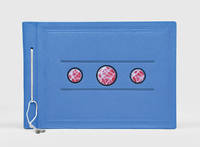
19671824721967. Auschwitz memorialized - a record of "the first fully 'international' event" at the former camp A commemorative album for the opening of the memorial at Auschwitz on 16 April 1967 an important stage in its transition to an international memorial site. Situated at the western end of the railway lines that cross the camp the memorial remains a central part of the Auschwitz complex. The large granite memorial was designed by the Italian architects Andrea and Pietro Cascella. Approximately 200000 people attended the unveiling including Polish state officials the East German and Italian foreign ministers and prisoner organisations. The first two photographs show the memorial the third the crowd bound in by the barbed wire and the fourth the Polish prime minister Józef Cyrankiewicz laying a tribute. The remainder show the attendees eating lunch food stalls and chefs preparing the food. Given this the album was presumably produced for the organizers of the catering. "Abstract in form and vague in its message the monument and the events surrounding its unveiling in April 1967 certainly furthered the memorial site's growing international character and testified to the waning relevance of a traditional Polish-national commemorative idiom at Auschwitz. At the same time however the Birkenau monument failed to specify or acknowledge explicitly the suffering and death of Jews as Auschwitz and therefore took its place in the continuum of commemorative marginalization of the Shoah at the site" Huener pp. 145-6. The memorial does not mention the Jews specifically nor did Cyrankiewicz in his remarks at the event as he wished to continue to present the camp as a specifically Polish tragedy. Nonetheless the unveiling "drew tremendous attention from abroad and can therefore be understood as the first fully 'international' event held at the State Museum at Auschwitz. The highly publicized April ceremonies. reached the wider European public and through the presence of countless journalists the world" Huener p. 146. Oblong quarto 36 x 25 cm containing 28 silver gelatin prints ranging from 17 x 12 to 17 x 23 cm mounted on 21 leaves of thick black card string-tied within blue cloth covers. Fore edge of first leaf a little chipped otherwise binding and contents in excellent condition. Jonathan Huener Auschwitz Poland and the Politics of Commemoration 1945-1979 2003. hardcover
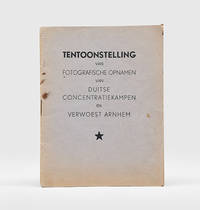
1945174825Amsterdam: United States Information Service 1945. Nazi crimes publicly revealed First edition first printing of the catalogue of one of the earliest Holocaust exhibitions held in the Netherlands soon after the war. The exhibition and catalogue were funded by the United States Information Service which supported exhibitions of photographs across Europe to show what had been done by the Nazis and build support for the coming war crimes trials. It includes one of the defining images of the Holocaust - the future Nobel laureate Elie Wiesel among other prisoners on the barracks at Buchenwald. Sextodecimo. With 25 half-tone photographs. Original grey wrappers printed in black. Short split at head of spine and 50 mm split at foot a little soiling to wrappers wrappers and contents slightly toned. A very good copy. unknown
1st edition. Period boards. 8vo. 16 volumes, 31 cm. Early volumes are generally around 200 pages each; later volumes end up more like 125 pages. Ca. 2800 pages total this run. Published quarterly, or ever 3 months; the run here includes the first 6 years of the Nazi period. After 1946, this publication was known as the JWB Circle. The National Jewish Welfare Board (JWB) was formed on April 9, 1917, three days after the United States declared war on Germany, in order to support Jewish soldiers in the U.S. military during World War I .In 1921, several organizations merged with the JWB to become a national association of Jewish community centers around the country in order to integrate social activities, education, and active recreation. These merged organizations included the YWHA, YMHA, and the National Council of Young Men's Hebrew and Kindred Association (Wikipedia). These quarterly journals report on those efforts and make suggestions for how to improve outreach, activities, and leadership; they also make other proposals and raise questions for the Jewish Community Center movement to grapple with. SUBJECTS: Jews - United States - Periodicals. OCLC: 2262910. Most OCLC holdings appear to be fragmentary. Excellent condition. (YID-33-10-el)
1942. First Edition. Paper Wrappers, 8vo, 61 pages. Includes eight photographic illustrations, including three full-page photomontages by Polish avant-garde artist Teresa Zarnower, and original pictorial wrappers with two additional photomontages by Zarnower. Text in Polish. Published by the heavily Jewish Polish Labor Group in New York. The Destruction of Warsaw. Light wear to covers, with light crease through part of front cover and unobtrusive 4 digit number in pen at top near spine. Touch of wear to top of spine, Otherwise Very Good Condition, far better than generally seen of this rare and important Holocaust related avant-gard photography title. (HOLO2-117-61)
21118° (30 x 21 cm). vo. [5] 27 Blatt mit 27 Zinkographien von Maurice Littner nach Originalzeichnungen des Verfassers. Typographisch gestalteter Original-Pappband. Sehr gutes Exemplar mit leichten Alterungsspuren. Vorderer Deckel mit kleinem Einriss.
Original paper wrappers. 8vo. 36 pages each volume, 22 cm. In Hebrew. Title translates to Essays from Conversations with Rav Yerucham Halevi Levovitz. Levovitz was the Mashgiach Ruchani of the Mirrer Yeshiva in Poland. One of the great exponents of Mussar. He was a talmid or Rav Simcha Zissel Broida one of the foremost disciples of Rabbi Yisroel Salanter. Below are eight fascicles printed in Shanghai. The first three fascicles were first published before the Holocaust in Baranovitch, the fourth was published in Kaiden due to the war. For a period during 1940, the town served as home to about 300 students and teachers from the Mir Yeshiva. After WWII, much of orthodox Jewry in Europe was wiped out, along with their many yeshivas (Jewish schools of higher learning) . One of the only yeshivas to survive as a whole body was the Mir Yeshiva, which managed to escape miraculously to Shanghai, China, and then on to America. Many of the new leaders of the American and Israeli yeshivas in the post-war period were students of the Mir, and thus followers of Rabbi Leibovitz. SUBJECTS: Litvak Holocaust Displaced Persons. There are no copies listed on OCLC. Wear and soiling to outer wrappers, along with small chip missing from bottom left corner. Internally Good. Overall Good Condition. Rare. (RAB-60-12-13-14)
1st edition, original portfolio wrappers, 8vo. 53 pages, plus many blank and unnumbered pages. Illustrations throughout. In French. Title translates as, Without Flowers Nor Crowns. This book is told in the first person, in a succession of scenes, impressions, portraits, thoughts, reflections and emotions that, in chapters very brief and titled, make up a devastating panorama about Elinas experience in Auschwitz. (elcultural.com 2018). "When I returned from Auschwitz in 1945, I felt what I had just experienced with such acuteness that it was impossible for me to keep it to myself. I recorded it in notes and drawings. This constituted Without flowers nor Crowns. I do not regret having written these notes as soon as I returned from camp because, over time, memories become distorted, they become watered down or dramatized, but always move away from the truth. (...)" Odette Elina (1910-1991) was a painter, was deported by the Gestapo to Auschwitz-Birkenau in April 1944 as a communist, but above all and above all because she was Jewish. In 1940, she entered the French Resistance network, she had had an initial function to establish the liaison between the writers residing in the South zone (notably Mauriac, Aragon and Julien Benda) before entering the Secret Army in 1942. We actually know very little about the biographical career of Elina before and after her deportation, apart from her exacerbated desire on leaving the Camp to testify to her life in the Camp. Without Flowers nor Crowns, [was] originally published in 1948 in the wake of the first testimonies on the Holocaust that appeared in the post-war years..." (Isabelle Dumont). SUBJECT(S): World War, 1939-1945 -- Prisoners and prisons, German. Guerre mondiale (1939-1945) -- Camps de concentration -- Récits personnels. Französin. Elina, Odette. Auschwitz (Concentration camp). Konzentrationslager. OCLC: 58452978 (2005 edition by later publisher, with the OCLC record incorrectly listing the original 1st edition as 1947 instead of 1948). OCLC lists no 1948 (or 1947) copies online. Pages are loose as issued, in an illustrated portfolio. This book is one of 270 numbered copies. Illustrated with 12 inset drawings, one reproduced on the cover; the title page mentions 13 drawings (?), but there are only 12, the same number as reproduced in the 1982 reissue [and also in the other copy of this first edition we examined], so "13" would seem to be incorrect or possibly counting the repeated drawing on the cover. Portfolio is slightly rubbed with short closed tear at lower front inside fold and spine has some creasing, else Very Good Condition. Important and exceedingly rare (HOLO2-141-27-IIIXX)
1st Edition: Original Boards with Original Dust Jacket. 8vo. 437 pages ; 21 cm. In the original Czech, later issued in English as A Box of Lives. This is a beautiful copy of the scarce first edition with the original illustrated dust jacket. Norbert Frýd (born Norbert Fried) (1913 1976) was a Czech writer, journalist and diplomat. He is known mainly for his autobiographical novel Krabice ivých (A Box of Lives, 1956) , in which he describes his experiences in Nazi concentration camps. During World War II, he was imprisoned in the Theresienstadt, Auschwitz and Dachau-Kaufering concentration camps The plot is set in the last months of 1944, in the fictional concentration camp of Gigling. The main character, the young intellectual Zdenek Roubík, is an assistant in the camp office. One of his jobs is to maintain the card index of the inmates, hence the title of the novel, A Box of Lives. In the camp, Roubík gradually manages to overcome the apathy and depression caused by the death of his brother and he becomes more actively involved in camp life. The author attempts to depict everyday life, social interactions and relationships in the camp, and the work and hardships of the inmates. The description of the SS guards in the camp is a focus of particular attention The novel was acclaimed by contemporary critics, and republished in numerous editions and translations. (Wikipedia, 2017) Frýds successful novel was published twice in Czech in 1956, with this 1st edition being much rarer than the stated 2nd edition. OCLC lists just 4 copies worldwide (Emory, Wisconsin, Johannes-Gutenberg-Universitat Mainz, Univ Of Basel) , and none in New York City or in the North East United States. Slight toning. And minor edgewear to dust jacket but overall both book and jacket are in very good condition. Attractive, rare, and important. (holo2-135-48)
1st edition. Original Paper Wrappers, 8vo 32 pages. In Hungarian. Title translates as, Those who Died and Fought for the Honor of our People. Heavily illustrated catalog of an exhibit in Budapest, 1946, to illustrate the persecution of the Hungarian Jews during World War II. Printed entirely on glossy paper, this catalog includes 55 photos, facsimiles, and other images from the exhibition, primarily anti-Nazi Hungarian Jewish artwork and posters, but also anti-Semitic posters, death cam photos, and scenes of new life in Palestine. The picture material was collected by the Jewish Agency for Palestine Documentation Department in January 1946 (translated from page 2) . The Foreword notes (translated) that The first anniversary of the liberation of the Budapest ghetto has arrived. It is time to bring to the world the terrible documents of the tragedy of Judaism and put the still unbelievers who turn their heads into thinking; those who do not believe because they do not want to believe. But not only the persuasion of the doubters is the goal of this attempt, but also of recalling over and over again for those who forget quickly. This is the purpose of this sad picture book, with all the cries, complaints and death blows coming from all sides. These pictures are just dull shadows of reality. Subjects: Jews--Persecutions--Hungary--History--20th century. Holocaust, Jewish (1939-1945) --Hungary--Exhibitions. OCLC: 1022126577. OCLC lists just one copy anywhere (NLI) . Light wear to wrappers, old dampstains to margins, but no images or text affected. Very Rare and important. (HOLO2-139-13U)
Original Cloth. 8vo. 384; 394; 414; 328; 356; 336; 324; 84 pages. 24 cm. First edition. In German and Hebrew. Periodical. Published partially under Nazism. Complete run for the first 7 years; 1930 through 1937; only lacks final two issues from 1938 [Heft 4-6 (Januar 1938) ; Heft 7-9 (April 1938) ]. Organ of the Rabbiner-Hirsch-Gesellschaft. Began 1930, ceased in 1938. Years 1930-1937 bound in cloth (7 volumes) ; Issue 1- 3 for year 8, 1938 in original wraps. Cloth and paper quality of years 1-4 superb; later volumes, from year 5 on, printed on lower quality paper, and year 7 is handbound in recycled cloth, as issued. Important organ of German orthodoxy; contains many articles dealing with the life, thought, and correspondence of Samson Raphael Hirsch. Contains many important essays from Isaac Breuer (including his 'Der neue Kusari') , Elie Munk, Moses Findling, Harry Abt, Jakob Katz, Jacob Levy, Joseph Breuer, Moses Auerbach, and many others. These essays detail German-Orthodox thought and the response to contemporary events of the period (marxism, zionism, youth movements, Agudas Jisroel, the Prussian state, etc. ) . Subjects: Orthodox Judaism - Periodicals. Hirsch, Samson Raphael, 1808-1888 - Societies, etc. OCLC lists 21 copies. Soiling to cloth, later issues aged (printed on low quality paper) ; last issue wraps soiled, fragile, loose. Otherwise fresh and clean. Good condition. (GER-44-28)
1945STAN0099Praha, Delnicke Nakladatelstvi 1945. 22x15cm. 80 unpaginierte lose Seiten, 27 ganzseitige photogr. Abb., in ill. OUmschlag. Umschlag gering randrissig u. rückseitig etwas stockfleckig, sonst sehr gut erhalten. Die erste Bilddokumentation aus dem befreiten KZ Theresienstadt. Von großer Seltenheit.