5 326 résultats
1st edition in English. Original string-bound Paper Wrappers, 18, [6] pages plus [5] leaves of tissued photo plates 25 cm. "Translated from the German by Rev. C. A. Rubenstein, A. M. , Rabbi, Har Sinai Congregation, in commemoration of the centenary of the birth of David Einhorn, Nov. 10, 1909 . Personal recollections of Dr. David Einhorn by Solomon Lauer. " SUBJECT (S) : Jewish sermons -- Maryland -- Baltimore. OCLC lists 8 copies worldwide, none west of Cincinnati. Touch of edgewear to wrapper which is splitting at spine, all tissued plates and text pages very good. Scarce and important. (kh-3-21)
First edition. Original illustrated orange paper wrappers with framed illustration of a mother holding her children. 4to. 32 pages; 22 x 28 cm. The 1945 Annual Report of the JDC detailing their aid to Holocaust survivors and refugees from around the globe including Europe, South America, Shanghai, and Palestine. Includes several articles by various authors such as J. D. C. -A Living Tradition, So They May Live Again, and The American Scene, as well as facsimiles of letters from President Harry S. Truman amongs others. Peppered with captioned black-and-white photographs, some full page, of Jewish refugees around the world. The year 1945 opened with much of Europe still under the heel of the Germans. Again, as in previous years, the first task was to rescue the Jews in deadly peril of their lives. SUBJECT (S) : Jewish refugees, Holocaust, WWII. OCLC lists 4 holdings worldwide (UC Southern California, Spertus, Tel Aviv Univ, Staats- & Uni-bib Hamburg) . 4 hole punches. Minimal edgewear. Library stamp. Very minimal markings. Otherwise very good condition. (Holo2-103-47B)
1st postwar Yiddish edition (issued the same year in Lodz) of Ber Mark's centrally important work on the Warsaw Ghetto uprising of 1943, published originally in Russian in 1944. Original multicolor illustrated boards, 12mo, [207] pages. Title translates into English as, The Uprising of the Warsaw Ghetto. Issued under Soviet auspices, it was written by a participant, the Polish historian, journalist and anti-Fascist activist, Bernard Mark (1908-1966) . Mark narrates the events immediately preceding and during the 1943 armed uprising of Warsaw's Jews, and presents Jewish, Polish, and German documents pertaining to the Warsaw and other ghetto and camp rebellions. (Google Books, 2017) SUBJECT(S) : Holocaust, Jewish (1939-1945) -- Poland -- Warsaw. Jews -- Poland -- Warsaw. Warsaw Ghetto Uprising. OCLC: 174887984. OCLC lists only 5 copies of this rare edition anywhere (NLI, Ben Gurion, Miami-Ohio, NYBC, Senckenberg & ULeeds). A similar number are listed for the 1945 Paris edition (the 1947 Lodz edition is far more common). Stain to rear board, light wear to front, paper and binding remain bright white and gorgeous, about Very good condition overall, a very nice copy. (Holo2-148-4-'+)
Presume 1st edition. Unknown date or publisher [1950's? ]. Original wraps. 4to. [8] pages. 34 cm. First edition. In Dutch. Reproduction of eight ink drawings by Alfred Mazure on the subject of the Hongerwinter of 1944-1945, when thousands of Dutch civilians starved to death. Mazure, a comic book artist of the period, whose work was banned owing to his refusal to make nazi cartoons, worked in the soup kitchens during the Hunger Winter period; he drew these ink sketches at the time. Mazure left Holland postwar after being declared a collaborator, his work and support with the resistance notwithstanding. Subjects: Netherlands - History - German occupation, 1940-1945. None listed on OCLC. Scarce. Clean and fresh. Very good condition. (HOLO2-113-50)
1st Edition. Original Paper Wrappers. 8vo. 12 pages ; 22cm. In English and Hebrew on opposite pages. In December 1942 Jewish communities in 30 countries worldwide held a day of fasting for the Jewish victims of the ongoing Nazi massacres across Europe. This is the official service published by the Office of the Chief Rabbi for use on this historic day of Fasting in the United Kingdom. The British fast took place 4 days before the British and American governments issued The Joint Declaration by Members of the United Nations condemning the ongoing events of the Holocaust. OCLC lists 6 copies worldwide (Harvard, LBI, ULondon, British Lib, NLI, Senckenberg) only 2 in the United States Small stain on cover margin and at staples, Very Good- Condition. (HOLO2-130-26)
1st edition, original wrappers , 4to. 32 pages. In French. Tables and charts throughout. Inscription on title page by Francis Robin. Title translates to The Mayenne Under German Occupation, 1940-1944. Deportations, Internments, Shootings. M. Francis Robin was able to mitigate the dryness of this account by using brief comments that illuminate all the sacrifices of the Mayenne under occupation... I pay tribute to him for the pure feelings that inspired his contribution to the history of the Second World War (Translted from the preface) . Robin was part of Comité d'histoire de la 2ème guerre mondiale, or the History Committee of the 2nd World War. OCLC: 491859518, OCLC lists 3 copies worldwide (Bibliotheque Nat, University Strasbourg and Paris-Ihtp) , none outside France. Cover has a line drawing depicting people in striped clothes huddled together surrounded by barbed wire while others look on. Cover is bent on edge and has a small piece missing, splatter stains in cover and title page, and a few other pages, Otherwise Very Good Condition. Rare and important (HOLO2-141-33)
1st edition. Cloth. 4to. Unpaginated (142 pages). 29 cm. First edition. In Slovak. Title translates as: The tragedy of Slovak Jewry: photographs and documents. Published in Bratislava by the Documentation Centre of CUJCR [Documentation project of the union of Jewish religious congregations in Bratislava]. Principally a phto-illustrated volume depicting the various facets of the destruction of the Jews of Slovakia; includes graph of deportation convoy charts, photographs from the extermination camps, photographs of leading Czech collaborators, anti-semitic wall propaganda posters, etc. Subjects: Jews - Czechoslovakia - Pictorial works. World War, 1939-1945 - Atrocities - Pictorial works. Holocaust, Jewish (1939-1945) - Slovakia - Pictorial works. Judenverfolgung. Slowakei. New blank endpapers, some staining on last few leaves, otherwise Very good condition. (HOLO2-105-17)
21078° (23,5 x 15,5 cm). 24 Seiten, 2 fotografische Abbildungen (Portrait der Verfasserin, an Typhus erkranktes Kind im Lager). Farbig illustrierte Originalbroschur. Hinterer Umschlag fleckig. Sonst sehr gut erhaltenes, sauberes Exemplar mit leichten Alterungsspuren.
1st Polish edition. Later boards, 8vo, 91 pages. Includes 12 illustrated plates. In Polish. Title translates to Majdanek: Court Proceedings of the Special Criminal Court in Lublin. A recording of court Preceedings of the Polish-Soviet Special Criminal Court established in Lublin in August 1944, in order to investigate the Nazi crimes in the Majdanek extermination camp. This Polish edition was published with several photographic reproductions, showing the members of the commission, the Nazi officers of the camp, the findings, human remains in Majdanek. The Majdanek concentration camp was established on Heinrich Himmler's order and operated from October 1, 1941 until it was liberated by the Soviet Army on July 22, 1944. It is known to be the best preserved Nazi concentration camp of the Holocaust, as the Germans did not have enough time to destroy the evidences of their crimes. The Commission for investigating the German crimes was established in August 1944 and soon they published this booklet in several languages. Despite of the importance of this statement it must be mentioned that the Commission made many erroneous assumptions regarding the duration of the camp or number of people killed at Majdanek, probably because they were motivated rather by political and propaganda agenda than by a search for historical facts. The total number of the victims is still controversial, in this report 1.5 million victims of different nationalities were counted, however according to the latest researches there were 79, 000 victims, 59, 000 of whom were Jews. [Kranz, T. : Bookkeeping of Death and Prisoner Mortality at Majdanek. Pp. 81-110. In: Silberklang, D. (ed. ) : Yad Vashem Studies. Vol. 35: 1. Jerusalem, 2007.].. WorldCat lists 15 copies worldwide. Overall in very good condition. (HOLO-2-140-1U) .
198775666New York: Beate Klarsfeld Foundation 1987-. First edition. Five large octavo volumes. 22 493 `; 4 364; 4 467 plus some facsimile illustrations; 4 643 1; 4 561 1 pp/ Pubisher's yellow wrappers lettered in black and each front with an illustration of the Jews of the Grodno Ghetto. Unfortunately a couple of volumes have some tide marks but not horrifiically so. Part 3 has taken the brunt of it. Still an invaluable source record of a great sin of mankind.Comprosed of; v. 1. A. Accounts by Jewish survivors residing in the West. B. Accounts recorded in Poland and the Soviet Union. -- v. 2. Accounts by German witnesses or perpetrators of the final solution. -- v. 3. A. German justice seeking the truth. B. Documents. -- v. 4. Grodno in the Bialystok trial 1966-1967. -- v. 5. The Grodno trial in Cologne 1968. Jewish community in pre-war Grodno includes "Lista Platnikow Skladki Gmninnej Gminy Wyznaniowej Zydowskiej w Grodnie na rok 1937" v. 5 p. 1-97 in the section headed "Jewish Community in Pre-War Grodno"; German documents in Grodno archives: Testimonies concerning Grodno gathered by Jewish underground and recovered after the war; Testimonies gathered in years 1944-1946.; Testimonies gathered in Israel around 1957 in archives of Yad Vashem.From 1939 to 1941 the Soviet Union occupied Grodno. During this time some 4000–5000 Jewish refugees arrived from German-occupied lands to the west. About half of these refugees were later deported into the interior of the USSR. On 13 July 1941 after taking over the city the Germans executed 100 Jews among the intelligentsia and in November of that year they created two ghettos one in the city’s center—to house 15000 Jews designated as “productiveâ€â€”and the other in its suburb of S obodka to house 10000 “unproductive†Jews. The liquidation of the ghettos began in November 1942. The Germans deported Grodno’s Jews to Auschwitz—some via a transit camp in nearby Kelbasin where many died as a result of disease and inhumane conditions—and to Treblinka. On 12 March 1943 the approximately 1000 Jews remaining in the city were deported to the Bia ystok ghetto. When the Red Army entered Grodno on 14 July 1944 only about 250 Jews remained. Beate Klarsfeld Foundation unknown
1st edition. Original stapled paper covers, 4to (8.5x11 inch) mimeographed sheets stapled at left, 11, 11 and 4 pages. First three issues of the bulletin for members of the Youth Section of the Workmens Circle (Arbayter Ring) . Updates on Jewish socialists active in southern California. The second issue includes a poignant piece about a college student who committed suicide in despondence over the situation in Europe and the fear that immigrants in the US would be expelled or put in camps. Interesting war-time look at how young left-wing American Jews were responding to the unfolding Holocaust in Europe and changing conditions in the US. No copies on OCLC, so unknown if any later issues were published, but quite possibly complete. First issue has creased pages and a long closed tear to the back cover. Exceedingly rare. Important. (holo2-139-16A)
Original Orange printed paper wrappers, showing distinctive elements of both modern and traditional typeface. 8vo, 24 pages, 21 cm. In Yiddish. Rare 1940 Riga edition of the 1936 Soviet constitution, certainly one of the last Yiddish publications in Latvia; OCLC-Worldcat literally lists not a single Yiddish publication from Riga 1941-1987. Immediately after the establishment of German authority [in Latvia] in the beginning of July 1941, the elimination of the Jewish and Roma population began, with major mass killings taking place at Rumbula and elsewhere. The killings were committed by the Einsatzgruppe A, and the Wehrmacht. Latvian collaborators, including the 5001, 500 members of the Arajs Commando (which alone killed around 26, 000 Jews]) and other Latvian members of the SD, were also involved. 30, 000 Jews were shot in the autumn of 1941 with most of the remaining Jewish people being rounded up and put into ghettos. In November and December 1941 the Riga Ghetto became crowded and to make room for the imminent arrival of German Jews, who were being shipped out of the country, all the remaining 30, 000 Jews in Riga were taken from the ghetto to the nearby Rumbula Forest and shot (Wikipedia, 2016) . SUBJECT(S) : Soviet Union. Konstitutsiia (1936) -- Politics and government. OCLC lists only 1 copy anywhere (Harvard) . Only the lightest wear to wrappers, an amazingly well-preseverd copy of this exceedingly rare Yiddish imprint. (yid-26-6)
1st edition. Original illustrated paper wrappers, 12mo, 64 pages. 4.75x7 inches. Cover shows a miserable prisoner flanked by ball & chains of swastika and hammer & sickle, behind whom hover Hitler, Mussolini, Stalin, and front and center The Pope. "Jehovah's Witnesses were subjected to intense persecution under the Nazi regime. The Nazis targeted Jehovah's Witnesses because they were unwilling to accept the authority of the state, because of their international connections, and because they were strongly opposed to both war on behalf of a temporal authority and organized government in matters of conscience. Within months of the Nazi takeover, regional governments, primarily those of Bavaria and Prussia, initiated aggressive steps against Jehovah's Witnesses, breaking up their meetings, ransacking and then occupying their local offices. By April 1, 1935, the Reich and Prussian Minister of the Interior ordered the responsible local officials to dissolve the Watchtower Society. Many actions of Jehovah's Witnesses antagonized Nazi authorities. While Witnesses contended that they were apolitical and that their actions were not anti-Nazi, their unwillingness to give the Nazi salute, to join party organizations or to let their children join the Hitler Youth, their refusal to participate in the so-called elections or plebiscites, and their unwillingness to adorn their homes with Nazi flags made them suspect. A special unit of the Gestapo compiled a registry of all persons believed to be Jehovah's Witnesses. Gestapo agents infiltrated Bible study meetings" (USHMM 2016) No copies listed in OCLC. Evenly- toned newsprint, Very Good Condition. Holocaust-related Jehovah's Witnesses material is rare, this imprint especially so. (HOLO2-134-61) xx
No Date [1947-1948] 1st Edition Thus. Original Paper Wrappers, Tall 12mo, [1], 32, [1] pages. In Hebrew. "Printed for the American Jewish Joint Distribution Committee." Stamped "Bethaus-Vorstand der Israel. Kultusgemeinde Wien" on cover ("Chapel of the Board of the Jewish Religious Community Vienna") Printed in Tel Aviv for the use of Holocaust survivors in the American DP camps in Europe, this copy was clearly used by survivors in the Vienna region. During the Holocaust, as European Jewry was pushed to the brink of annihilation by Nazi Germany, the American Jewish Joint Distribution Committee was the main financial benefactor towards Jewish emigration from Europe and rescue attempts of Jews from Nazi-controlled territories. From the outbreak of World War II through 1944, American Jewish Joint Distribution Committee made it possible for more than 81,000 Jews to emigrate out of Nazi-occupied Europe to safety. JDC also smuggled aid to Jewish prisoners in labor camps and helped finance the Polish Jewish underground in preparations for the 1943 Warsaw Ghetto revolt. In addition, JDC was a major channel keeping American Jewish leaders informedoften in detailabout the holocaust. Yudlov 4109; Yaari 2370 or 2371; Berman (LOC) no. 1112. Bibliography of the Hebrew Book 1470-1960 #000187706. SUBJECT(S): Seder -- Liturgy -- Texts. Judaism Haggadot. OCLC: 930762932. OCLC lists only 4 copies worldwide (Stanford, LOC, Gottfried Wihelm Leibniz Bibliothek, Staatsbibliothek Berlin). Light toning and wear Good Condition, nice copy. Scarce (HAG-25-6B) x
First volume in later boards, second volume in original wrappers. 8vo. 156 and 272, [4] pages. 20 cm. First Edition. In Russian. The authors prepared"The Essays of History of Jewish in Ukraine" to publication in two volumes. They will be published in Kiev (Ukraine) and Germany soon. It is the first attempt in Ukraine to review on the documentary basis the main periods of the Jews' life in the area of present-day Ukraine for two thousand years â from the first Jewish communities in the colonies of Crimea, founded by ancient Greeks, till now; from the first persecutions of Jews â the fascist genocide and the state antisemitism in the former Soviet Union. [â¦] We hope this book will be interesting and useful to those, who is holding the attention on the history of the Jewish people. " (Preface) Subjects: Jews -- Ukraine -- History. Ukraine -- Ethnic relations. Both volumes ex-library, with volume one rebound in later boards. Small tear to lower front cover of second volume. Both have inscriptions on title page. Very good condition. (UKR-1-35)
1st edition. Original paper wrappers, 4to, each issue has 8-16 pages. Broken run of 11 issues, including the first and final issues, of this important Anti-Nazi monthly from England. It began with Nr 1 (present here) following the assumption of Power by Hitler, changing names from Monthly Survey to Europe To-Morrow after Nr 65 (also present here) following the German invastion of Poland. Europe To-Morrow saw its final issue with Nr 3, issued in December 1939 (also present here) . The Friends of Europe was a British group of anti-fascists and enemies of the Nazi regime in the 1930s and 1940s. The group worked mainly through publication of a series of writings, of which appeared between 1933 and 1939. Their stated goal was to encourage effective co-operation for the prevention of war and the establishment of peace, as well as to provide accurate informations about Nazi Germany for use throughout Great Britain, the British Empire, the USA, Europe, and wherever the English tongue is known. Horizontal folds as expected, with occational wear, but no text loss, overall very good condition. (Holo2-126-15)
Paperback. 8vo. 92 pages. Published in exile by the heavily Jewish SPD, these monthly reports covered sociopolitical and economic conditions in Germany, and were harshly critical of the Nazi regime. CONTENTS: The Situation of the Evacuated Families: Reports from South West and Central Germany, The German Rule of Terror in Poland. OCLC lists 5 copies worldwide (Staats & Universitatsbibliothek Hamburg, Univ m Hannnover & TIB, Universitatsbibliothek Oldenburg Ibit, Bibliothek Des Herder-Instituts, Universitatsbibliothek Passau) . Some chipping at edges of covers and small tears on backstrip. Writing in pencil from previous owner on cover. Pages darkened at edges but all text is clear. Good condition. (HOLO2-33-12)
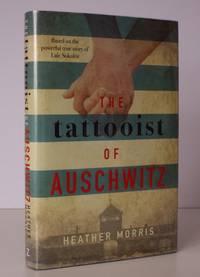
201843212Zaffre 2018. 8vo. First Edition First Issue with photographs full-page map and full-page plan in the text; black cloth backstrip lettered in silver red endpapers a near fine copy in unclipped dustwrapper. The first issue produced in a small print run without 'bestseller' blurb on dustwrapper front. VERY SCARCE ESPECIALLY IN THIS CONDITION. Zaffre, hardcover
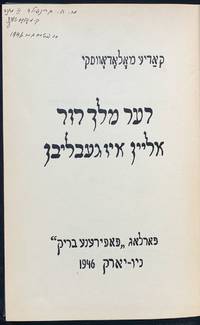
194643238New York: Papirene Brik 1946. First edition. Original boards. 8vo 156 pages 24 cm. In Yiddish. Title appears in English as “Only King David Remained.â€<br> <br> Inscribed by Molodowsky on title page in year of publication<br> <br> Early post-war book of poems by Kadya Mololdowsky that is composed of poems about the Holocaust and that “draw upon traditional Jewish literary responses to catastrophe.†Contains some of Molodowsky’s most well regarded poems.<br> <br> Kadya Molodowsky was a major figure in the Yiddish literary scene in Warsaw from the 1920s through 1935 and in New York from 1935 until her death in 1975. A teacher in the Yiddish schools in Warsaw as a young woman she was best known for her children's poems.<br> <br> In the United States she wrote for the Yiddish press and founded and edited a journal Sviva Surroundings which she published for three decades. Living in Israel 1948-52 she founded and edited a journal Heym. She published six major books of poems 1927-1965 novels short stories plays and essays. Recurrent themes in her work include the lives of Jewish women and girls Jewish tradition in the face of modernity Israel and the Holocaust.<br> <br> SUBJECTS: Yiddish poetry. David King of Israel -- Poetry. David King of Israel. Poetry. OCLC: 19314664.<br> <br> Clean copy with book stamp from “Emil Gorovets’s Library.†Very Good Condition. An attractive inscribed work by a leading female Yiddish writer. YID-48-47-LEXCCM!-’gg. New York: Papirene Brik unknown
1945296615L. B. Fischer 1945. First Edition. Hardcover. Near Fine. Small 8vo in red cloth spine title in black. Binding tight and square corners and spine ends very mildly pushed but absolutely not rubbed. The dustjacket is not price-clipped virtually no rubbing to the corners and spine ends. L. B. Fischer hardcover
8vo., First Edition, First Issue, with photographs, full-page map and full-page plan in the text; black cloth, backstrip lettered in silver, red endpapers, a near fine copy in unclipped dustwrapper. The first issue, produced in a small print run without 'bestseller' blurb on dustwrapper front. VERY SCARCE, ESPECIALLY IN THIS CONDITION.
VG; 8vo; 1st edition. Later Wrappers, 4to, 471 pages.This volume only, complete for Juden-Jüdische Literatur (essentially the section of the encyclopedia dealing with Jews) Excellent mid-19th Century German overview of Jewish hsitory, with an empahsis on the Medieval & Modern periods. Contibuters Jewish and Christian scholars. Sections Include Juden (Geschichte) ; Judenchristen; Judenemancipation; Judenschlacht; Judenteutsch (i. E. Judeo-German) ; etc The entire Encyclopedia was a collasal work, 167 volumes publihsed between 1818-1889--and the editors only made it A-Phyx ! Heavy mid-19th Century rag paper has held up very well; Very Good Condition (KH-3-26)
1937JUDA1826Hamburg, Hanseatische Verlagsanstalt 1937. Gr.-8°. 205 S.; 232 S., OLnbde. mit goldener Deckel- u. Rückenprägung, minimal bestoßen u. berieben, Schnitt leicht fleckig, innen sauber u. einwandfrei. [2 Warenabbildungen]
Original Wraps. 8vo. 30, [2] pages. 21 cm. In Hebrew and Yiddish (Taitsh) , not the more common Hebrew-English edition. 'Haggadah Shel Pesah, in Hebrew and Yiddish; Stories of the Exodus from Egypt'. Illustrated throughout. An English and Hebrew Haggadah was issued in the same year by Cailingold, arranged by H. Meiliz; the English Haggadah was often reissued throughout the 1930's. Our copy is similar to the English-Hebrew copy, with the same illustrations. Very scarce. Subjects: Haggada shel Pesah. Haggadot - Texts. Yiddish, Hebrew Haggadah London 1939.Passover - Liturgy. Seder - Liturgy Texts. None of this edition on OCLC. Wraps loose, pages lightly soiled, brittle, with wine stains. Fair condition. (HAG-13-41)
1st edition. 4to. Later Cloth, 4to, Approximately 20 pages each, approximately 520 pages total. Issues were published weekly. Holocaust-era American weekly Jewish magazine. From the time of its founding, The American Hebrew covered many topics of intense Jewish interest internationally (wikipedia 2018). This set of magazines contain articles about WWII, such as the topic of Jewish refugees, Behind the War, Relationship Between Religion and Democracy, War Propaganda in England and Germany, as well as things essays as a Resort Guide: Another List of Ideal Vacation Spots Selected for American Hebrew Readers. SUBJECT(S): Jewish newspapers. -- United States. OCLC: 1479954. Many copies have a YMHA stamp on cover of magazine. Cloth cover has staining and dampstains, pages are not affected. Spine says American Hebrew 147 May-Nov. 1940. Magazines in Very Good Condition. (HOLO2-140-11-J)