7 089 résultats
1st edition, original cloth, 8vo. 518 + 96 pages. In Hebrew and Yiddish with an English section. Eight years have gone by since we first began preparations for this book on the Jewish community of Rozhan, until at long last it can be published now. It was a great effort made by a number of people devoted to the weighty and difficult task to erect a fitting memorial to our community. It is what other communities of Israel have done and no doubt it is the right thing to do for the people of the book. Rozhan was no different from other Jewish townships in Poland that are no more, but to us, who were born and grew up there, she has something unique. It is not only the landscape, the topographic situation on the high bank of the River Narew. It was also the Jews, who had been living at the place for generations, rebuilding it stubbornly and assiduously many times. In fact after each of the many wars that swept over the region, that lies on the road from Russia to Warsaw. Those were homely Jews of all social strata, orthodox and freethinkers, Zionists and anti-Zionists. Above all we have at heart the Jewish youth of Rozhan that took upon itself the task to redeem the world and the nation - and only few of them have reached the final haven of rest here in Israel, while others, of the few who did survive, have found shelter in the West and built their homes there. It is the intention of this book to keep our past alive and to preserve the shining memory of those who lived and were active there, to show that they were not anonymous and to describe their striving and struggling to maintain a definitely Jewish, religious, social and political existence. This book wants to tell future generations how the Jews of Rozhan created Jewish life in the midst of a hostile environment, how they built for themselves the framework of a society and filled it with deep-rooted national values, how they created their own institutions, that were able impose their authority - after democratically arrived at decisions with no governmental powers behind them. The book also wants to keep alive the old Jewish spirit maintained by our people everywhere, the rule Jews stand by each other that found its expression in individual help as well as in organized assistance such as various mutual funds. The book is also meant as a memorial to the tragedy of our people. Jews of Rozhan had to run for their lives during the very first days of the war, and one after the other they fell as victims on the bloodstained roads of Poland. Some survived after having passed through the hell of exile in the vastness of Russia and Siberia and back; only a few were lucky enough to reach Israel and to build new homes here. The book contains about 600 pages and it reflects a collective effort. It was not easy to obtain the material, as there are next to no writers among our people. So we had to apply to as many of our townsfolk as possible in order to make them talk or write - those who did write were a minority and most contributions were given orally and had to be taken down. We endeavoured to get in touch with as many as possible and to give a rounded out picture of the town, its history, people and folklore, but we feel that in spite of all our efforts we could not note everything worth remembering. All we can say is that we have done our best to present a many-sided picture of everything that was human and Jewish and good. (from English preface) SUBJECT(S) : Jews -- Poland -- Ro´z? An -- History. Holocaust, Jewish (1939-1945) . Ethnic relations.
Original wrappers. 4to. 21 pages. 28 cm. First Edition. About Jews in the Holocaust. "Jewish New Year Broadcast auspices of the American Jewish Committee. 2: 00 - 2: 30 P. M. (EWT) . September 17, 1944. Sunday. Tonight at sundown Americans of the Jewish faith and Jews the world over will begin the traditional services of Rosh Hashonah, the Jewish New Year, ushering in the Year 5705. This afternoon the National Broadcasting Company in cooperation with the American Jewish Committee brings you a special Rosh Hashonah broadcast. You will hear a dramatization of "Behold the Jew, " written by one of Britain's foremost poets, Ada Jackson. This poem, which was awarded Britain's Greenwood Poetry Prize for 1943, was adapted for radio by Milton Geiger. The dramatization will star Miss Florence Eldridge of the stage and screen, as narrator. (Page 1) Subjects: Radio Play WWII. Rosh Hashonah. OCLC lists 3 copies worldwide. (Spertus Institute, Boston Anthenaeum, UPenn) Crease from original horizontal fold, with opened paper seal. Very good + condition. (HOLO2-112-19)
First separate edition. Original black boards. 4to. 204 pages; 30 cm. Written in Hebrew. Title translates to Questions and Responses Avne Hefetz. A book of responsum by Aharon Levin, a rabbinic scholar who died in the Holocaust. Contains texts from the Talmud, Midrash, Zohar, and Targum. The Vaad Hatzalah was an organization to rescue Jews in Europe from the Holocaust. It was founded in November 1939 by the Union of Orthodox Rabbis of the United States and Canada (Wikipedia) . After the war, the Vaad Hatzalah printed a select number of Jewish texts for the survivors living in the DP camps. Additional title page in Polish. SUBJECT(S) : Rabbinic literature, Responsa. OCLC lists 1 holding worldwide (UCLA) . Original cover peeling of cover board with chunks missing that do not affect text. Library markings. Browning to pages. Good + condition. (Holo2-134-10)
(FT) Hardcover, 98, vi pages, 8vo, 25 cm. In Hebrew. SUBJECT(S) : Judaism -- Customs and practices. Marti, Ramon, d. Ca. 1286. Pugio fidei. Includes bibliographical references and index. Other Titles: Shkiin "A few words on some Jewish legends, customs and literary sources found in Karaite and Christian works (including an index of the Jewish books cited in Pugio Fidei of Raymund Martini) ". OCLC lists 17 copies worldwide. Ex-library. Chipping to edges of jacket. Otherwise, very good condition in the scarce dust jacket. A beautiful copy (Holo2-19-53)
Moskve [Moscow]: Melukhe-farlag "Der Emes", 1946. Cloth, 8vo, 167 pages. Includes portraits. 20 cm. In Yiddish. SUBJECT (S) : Jews -- Persecutions -- Belarus -- Minsk. Holocaust, Jewish (1939-1945) -- Belarus -- Minsk -- Personal narratives. World War, 1939-1945 -- Jewish resistance -- Belarus -- Minsk. OCLC: 12284925. Backstrip replaced. Very Good Condition. (YID-17-15A-ALEX)
Newsletter, Legal Sized. 2 pages. The Seven Arts Feature Syndicate was a weekly, New York-based, Ango-Jewish weekly periodical in the 1930s. This article, presenting the standpoint of one individual is published because it presents a point of view which is of unusual significance at this juncture. Mr. Montors stand has the support of many leaders in this country and is as fervently opposed by other outstanding personalities. Joseph Brainin, who disagrees with many of the arguments advanced by Henry Montor, will answer this article in our next issue. Leaders [sic] are invited to express their reaction to this interesting debate. Editor. OCLC lists one copy (National Library of Israel) , although which issue is unclear. Crease through middle of sheets and some light blurring of type, but all text is legible. Very good condition. (HOLO2-37-28)
No Date (1937). 1st edition. Original Wrappers; 8vo. 58 pages. Dutch Antifascist pamphlet. E. D. D. -Serie. No. 4. Second edition. In Dutch. Contains much material on anti-Semitism. "Facts and data concerning the goals of the N. S. B. Collected by the press service of the Dutch movement for Unity and Democracy. " Very good condition. (H-35-7)
Paper Wraps. 8vo. 40 pages. In German. Title translates to English as: Youth at Risk. Nazi-era publication warning of the degeneracy of youth brought about by the disintegration of society and reflecting the fear that Germany and German culture were on the brink of disaster. OCLC lists 6 libraries worldwide. Front cover detached, but included, with small stains, darkening and ripping on some corners. Lacks backstrip. Pages have some darkening but text is clear and internal binding is in tight. Good condition with gorgeous period cover. Scarce. (HOLO2-29-20)
Original Wrappers. 8vo. 166 pages. 21 cm. First Edition. In Ukrainian. "Although his first poems were written in 1916, Osmachka began his literary career while he was a student at the Kyiv Institute of People's Education from 1920 to 1923. He belonged to the literary organizations Aspys and Lanka [Later known as 'Maisternia Revoliutsiinoho Slovaâ' (Workshop of the Revolutionary Word) or MARS] and published his first collection of poetry, Krucha (The Precipice) , in 1922; it was followed by two more collections, Skytski vohni (The Scythian Fires, 1925) and Klekit ([Crane's] Clacking, 1929) . Like other members of MARS he was attacked and arrested for his 'unpolitical' literary works, but managed to save himself from execution by feigning insanity. During the 1930s he faced constant persecution by the authorities and was unable to publish any works. During the Second World War he fled to Western Ukraine, then to displaced persons camps in Germany, and finally to the United States. Osmachka's personal ordeal had lasting effects on him, and until his death he suffered from a persecution complex. Nonetheless he resumed his literary career in 1943 in Lviv with the publication of his fourth collection of poetry, Suchasnykam (To My Contemporaries) . In the displaced persons camps, where he was a member of the MUR literary organization, he published his epic poem, written in octaves, Poet (Poet, 1946) , as well as his first prose work, Starshyi Boiaryn (The Best Man, 1946)." (Encyclopedia of Ukraine. ) Subjects: Ukraine; Fiction; Short Stories. OCLC lists 2 copies worldwide. (Cleveland Pub. Libr. , Toronto Pub. Libr. ) Light age toning and edgewear. Very good contion. Scarce and important (UKR-1-29)xx
1st edition. Original cloth with dust jacket. 4to, 316 + 48 pages. Illustrations throughout. Hebrew with English section in back. In our present research we are interested in the Jewish settlement in Vishogrod, its beginnings, its roots, its social image up from the beginning, its transformations until assuming Hassidism as its main aspect, and also in the period of revival before the destruction.
Original Cloth. 8vo. 159 pages. 22 cm. First edition. In Hebrew and Yiddish. With 17 illustrations. Cover title: Yizkor li-kehilat Svislots. The Community of Swislocz, Grodno District: Memorial to the Community of Swislocz; Svislach memorial book. Yizkor for Svislots, published by former residents of Swislocz in Israel. Subjects: Jews - Belarus - Svislach (Hrodzenskaia voblasts') Holocaust, Jewish (1939-1945) - Belarus - Svislach (Hrodzenskaia voblasts') Ethnic relations. Jews. Holocaust, Jewish (1939-1945) 1939 - 1945 Svislach (Hrodzenskaia voblasts', Belarus) - Ethnic relations. OCLC lists 16 copies. Light wear to cloth, light ageing to pages, otherwise fresh and clean. Very good condition. (HOLO2-115-29)
st edition. Original boards with gilt lettering. 8vo. 304 pages. 24cm. Decorative inscription from Sutskever, the subject of the book. It is written in Yiddish and spirals off into a drawing self portrait. In Hebrew and Yiddish. Title translates to The Lineage of a Song: In Honor of Avraham Sutskever. A commemorative book for Abraham Sutzkever on his seventieth birthday. Sutzkever was an acclaimed Yiddish poet who the NY Times referred to as the greatest poet of the Holocaust. (Wikipedia, 2018) . Edited by Dov Sadan (1902-1989) who was an Israeli literary critic and politician who served as a member of the Knesset. He was awarded the Israel Prize for Jewish Studies and the Bialik Prize for Literature. (Wikipedia, 2018) . SUBJECTS: Sutzkever, Abraham, 1913-2010 -- Criticism and interpretation. OCLC lists 4 copies worldwide (Royal Danish Lib. , NYBC, Haifa, Hebrew U. ) . A beautiful copy. Very Good Condition. (YID-30-24)
1st Edition. Original Wrappers. 8vo. 13 pages ; 21 cm. In Dutch. A very scarce post-Holocuast report on aid for Dutch survivors. Title translates into English as, Overview of Relief Lending to War Victims in the Hague. Compiled by the Office of the Social Council (Poverty Council) . OCLC lists only 1 copy worldwide (USHMM) . Library stamp and number on cover and titlepage, Otherwise Very Good condition. Rare. (HOLO2-135-87A)
(FT) Original Publishers Cloth. Folio. [104] pages. Illus. (some color) 33 cm. In Hebrew and English. Illustrated childrens haggadah; includes two-page black and white illustration depicting the Holocaust, with SS officers with whips, side by side with Jews slavery in Egypt with the caption, This Year Slaves. SUBJECT(S) : Jews -- Liturgy and ritual. Illustrated by Siegmund Forst. Music arranged by G. Ephros. (3 pages at end). Stains and marks on boards on several pages, internal hinge repair, still good. (HOLO2-70-13)
Newsletter, Legal Sized. 2 pages. The Seven Arts Feature Syndicate was a weekly, New York-based, Ango-Jewish weekly periodical in the 1930s. Recently there was a published novel, The Spectacle of a Man, written by a New York physician under the pseydonym [sic] of John Coignard. Mr. Coignard has definite views on how to cure the Jews so as to kill anti-Semitism. In this interview he presents his views, which in many respects have a rather humorous though not always intentionally so aspect. Read it think it over and smile, if you feel like it. Editor. OCLC lists one copy (National Library of Israel) , although which issue is unclear. Crease through middle of sheets and some wear to edges, but all text is clear. Very good condition. (HOLO2-37-29)
1st Bergen-Belsen edition. Original boards with gilt lettering. 8vo. 160 pages. 21 cm. In Hebrew. Title translates to Teachings of the School of Elijah. This edition was reprinted from the Warsaw, 1874 edition printed by Yitzhak Goldman. Bergen-Belsen was the largest displaced persons (DP) camp in Germany and was the center of Jewish DP political and social activity in the British zone of occupation. The camp was established in July 1945 near the concentration camp after the British burned the camp barracks during liberation. In 1946, the DP camp housed over 11, 000 Jews. Survivors of the Bergen-Belsen concentration camp organized political, cultural, and religious activities just weeks after liberation. The DPs of Bergen-Belsen also created and maintained a lively cultural life and published Unzer Shtimme (Our Voice) , the main Jewish newspaper of the British zone. By the middle of 1950, the camp was nearly empty; the last DPs left in August 1951. The majority of Bergen-Belsen's DPs emigrated to Israel. Many others went to the United States and Canada (USHMM, 2018) . SUBJECTS: Displaced Persons. OCLC lists 5 copies online, three of which are in Israel and two of which are in Germany. Binding is starting. Pages are browning, but in very good condition with very few tears to the first few pages. Some edge wear to boards. Overall in Good Condition. (RAB-64-10)xx
10, [20], 9 pages. Illustrated. In English. Series: Guides and catalogues Yivo Archives ; ; 1. SUBJECT (S) : Jews -- Persecutions -- Poland -- Warsaw -- Pictorial works -- Catalogs. Holocaust, Jewish (1939-1945) -- Poland -- Warsaw -- Pictorial works -- Catalogs. Warsaw (Poland) -- Ethnic relations -- Pictorial works -- Catalogs. OCLC lists 11 copies worldwide. In good condition (HOLO2-10-20)
Newsletter, Legal Sized. 3 pages. The Seven Arts Feature Syndicate was a weekly, New York-based, Ango-Jewish weekly periodical in the 1930s. While the world stands aghast at the ferocity of the renewed anti-Jewish terror in Germany, decent men and women everywhere, revolted by sadism and brutality, are asking why this Medievalism, why this needless cruelty? Mr. Zukerman provides the answer in this startling analysis of the financial side of official anti-Semitism. Editor. OCLC lists one copy (National Library of Israel) , although which issue is unclear. Crease through middle of sheets, but all text is clear. Very good condition. (HOLO2-37-25)
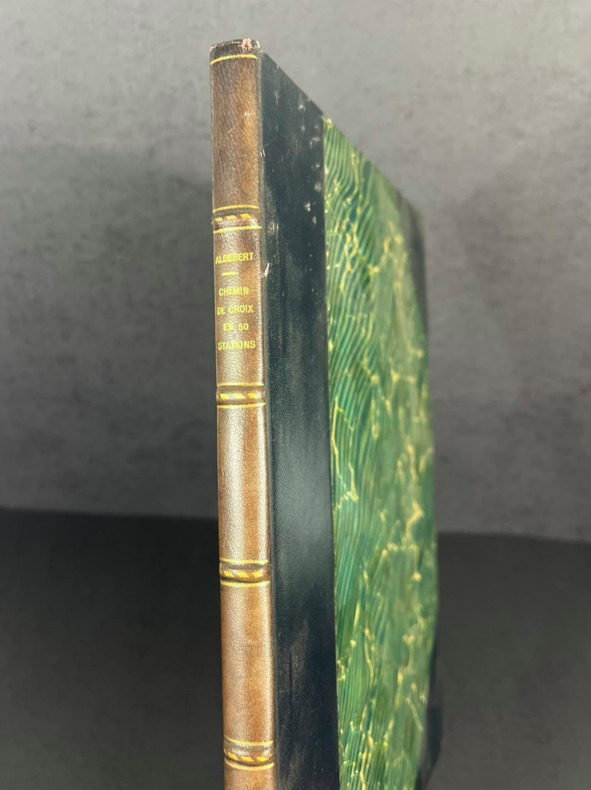
1946563Paris, Arthème Fayard, 1946. Édition originale. Grand album de 22 x 28 cm, 112 (2) pp. Relié demi-cuir noir à coins, dos à 5 nerfs ornés de pointillés et traits dorés, nom d'auteur et titre en doré. Plats marbrés. Couverture originale conservée. Tranchefile. Ouvrage illustré d'une cinquantaine de dessins en noir et blanc de l'auteur. Cet ouvrage est un puissant récit autobiographique illustré de l'artiste français Jean Bernard-Aldebert (connu sous le nom de Bernard-Aldebert, 1909-1974), relatant sa captivité dans cinq camps de concentration nazis différents entre 1944 et 1945. Après avoir bâti une carrière d'illustrateur, de caricaturiste et de satiriste, l'artiste voit son destin basculer tragiquement en novembre 1943. Pour avoir caricaturé Hitler sous les traits d'un chimpanzé dans le numéro du 1er août de l'hebdomadaire humoristique français *Ric et Rac*, Bernard-Aldebert est arrêté par la Gestapo. Il est ensuite transféré en janvier 1944 au camp d'internement de Royallieu-Compiègne, puis successivement à Buchenwald, Mauthausen, Gusen I et enfin Gusen II, où il demeure jusqu'à sa libération le 5 mai 1945. Le texte et les illustrations de l'auteur dévoilent les horreurs subies par les prisonniers dans ces camps : travaux forcés brutaux, famine, tortures sadiques et violences diverses. Si Bernard-Aldebert était surtout connu pour des caricatures au style léger et de charme, les images présentées ici versent dans un tout autre registre. Elles rappellent son style habituel, mais se révèlent bien plus dépouillées, sombres et austères, comme un reflet des émotions des personnages qui y apparaissent. Le texte est accompagné, presque systématiquement sur la page en regard, d'une reproduction en noir et blanc d'un dessin original de l'artiste, pour un total de 50 images. Celles-ci sont issues d'une série de croquis dessinés par Bernard-Aldebert peu après sa libération ; ils offrent, encore aujourd'hui, un témoignage visuel et émotionnel inestimable.
1st edition, original cloth, 8vo. 806 pages, illustrations throughout. In Yiddish with a Spanish title page. German soldiers first passed through Ratne at the end of June 1941, but Nazi rule was established in the town only in July. Between the retreat of the Soviets and the arrival of German security forces and administrators, locals plundered Jewish homes and businesses. Shortly after the Germans arrived, they shot 27 Jews and 30 Soviet prisoners of war. Acting through the Ukrainian police, they also introduced an array of anti-Jewish measures: Jews had to wear identifying armbands (later yellow patches) , comply with a curfew, hand in valuables, including ritual objects, and provide forced labor. It was forbidden for Jews to speak to Ukrainians. As early as July 1941, Jews from the countryside were already being relocated to Ratne. In the spring of 1942, a ghetto was set up there. After a partisan raid on Ratne in June 1942, the Germans shot more than 110 Jews, along with a few Ukrainians. The Destruction of the Jewish Community. In August, the Germans recruited Ukrainian peasants from Prokhid to dig pits at a nearby sand lot. On August 26, the ghetto was liquidated by a unit from the Gestapo outpost in Brest supported by the local German Gendarmerie post and Ukrainian auxiliary police force. Although several hundred Jews fled before they could be taken to Prokhid. Many others hid in the ghetto. Most were eventually caught and murdered as well. Between 1, 300 and 1, 500 Jewish men, women, and children were killed during this operation. A few dozen skilled laborers were left alive and employed in a workshop. They were shot in February 1943. (protecting-memory.org 2018) SUBJECT(S) : Jews -- Ukraine -- Ratne. Holocaust, Jewish (1939-1945) Ratno (Ukraine) -- Ethnic relations. OCLC: 38702086. Light wear on cover and spine, page edges yellowed, previous owners name and imprint on front end page. Good Condition Overall. Inscription on Spanish title page. (YIZ-19-16A)
1943yl8033 Epis Broché 1943 "In-8 (13.5x20cm), 111 pages, rare plaquette de propagande datant de 1943, textes extraits d'un numéro spécial de la revue ""Notre Combat"" du 20 avril 1943, où l'on retrouve notamment Brasillach, Déat et Chateaubriant, avec une introduction de ce dernier, riche iconographie de photos de propagande ; dos montrant une réparation, intérieur frais malgré de très légères annotations au crayon gris dans l'introduction, bon état général. Livraison a domicile (La Poste) ou en Mondial Relay sur simple demande."
2003fa1005Editions du Septentrion Dos carré collé 2003 RARE. In-8 (16 x 24 cm), dos carré collé, 463 pages, ouvrage épuisé ; quelques rousseurs sur la tranche, par ailleurs très bon état général. Livraison a domicile (La Poste) ou en Mondial Relay sur simple demande.
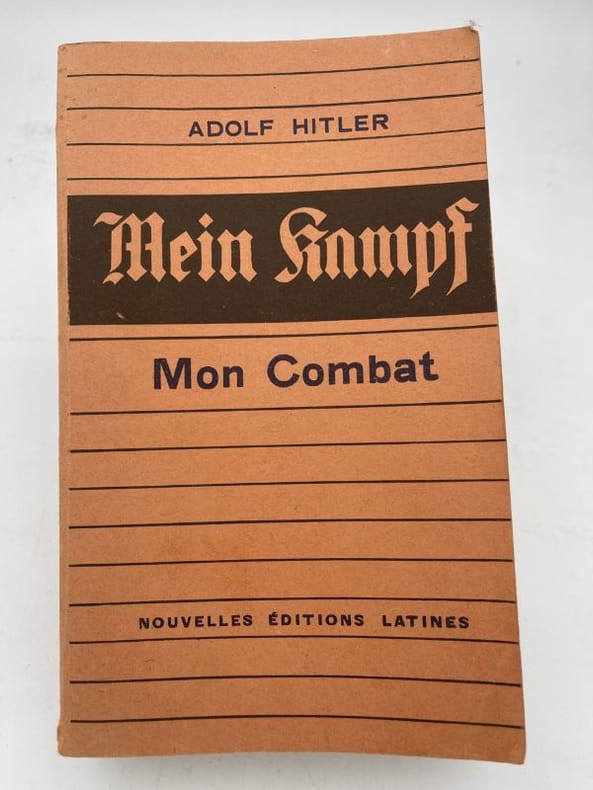
1970190423Nouvelles Editions Latines Nouvelles Editions Latines, sans date, vers 1970. Fort In-8 broché, 688 pages. Imprimerie off-set Jean Grou Radenez à Paris. Exemplaire antérieur à 1979 car c'est à cette date que l'éditeur (Fernand Sorlot) n'a été autorisé à publier ce titre qu'à "condition qu'il soit accompagné d'un rappel de la loi de 1972 contre le racisme et d'un texte rappelant aux lecteurs l'étendue et l'horreur des crimes contre l'humanité commis par les nazis ou en leur nom. Ce texte, imposé à l'éditeur couvrira 8 pages". Il n'est pas présent dans notre exemplaire, nous datons donc antérieurement à 1979, avant la date d'obligation, sans pouvoir apporter plus de précisions. Ouvrage en bon état, la plus grande partie des pages ne sont pas coupées.
781, [1] p. con un ritratto in antiporta; 19,5 cm. Tutta tela blu con titoli in oro al dorso. Ottimo stato
82401Paris, Robert Laffont / Collection Vécu, 10 octobre 1972, in-8, broché, 401p. Edition originale. Exemplaire signé. Ouvrage illustré de photographies N/B. Joint quelques coupures de presse.