Ruzzi CristianoMareMagnum

7 091 résultats
ill., br.
1943122503Couverture souple. Broché. 11 x 15 cm. 64 pages. Abondamment illustré.
Hardcover, 270 pages, illustrated, 4to, 28 cm. SUBJECT (S) : Jews -- Hungary -- Biography. Jewish youth -- Hungary -- Biography. Zionism -- Hungary -- History -- 20th century. World War, 1939-1945 -- Jewish resistance -- Hungary. Jews, Hungarian -- Israel -- Biography. Holocaust survivors -- Israel -- Biography. Ondergrondse organisaties. Joden. Zionisten. Hongarije. Note(s) : "Copyright (c) The Society for the Research of the History of the Zionist Yorth Movement in Hungary. "-Title page verso. Includes bibliography (p. 261-264) and index. Wear to corners and binding. Otherwise, good condition. (Holo2-16-23)
Hardcover, 270 pages, illustrated, 4to, 28 cm. SUBJECT (S) : Jews -- Hungary -- Biography. Jewish youth -- Hungary -- Biography. Zionism -- Hungary -- History -- 20th century. World War, 1939-1945 -- Jewish resistance -- Hungary. Jews, Hungarian -- Israel -- Biography. Holocaust survivors -- Israel -- Biography. Ondergrondse organisaties. Joden. Zionisten. Hongarije. Note(s) : "Copyright (c) The Society for the Research of the History of the Zionist Yorth Movement in Hungary. "-Title page verso. Includes bibliography (p. 261-264) and index. Very good condition. (Holo2-16-23A)
Original illustrated cover, Large 8vo; 133 pages; In Polish. To the Victims of the Brigade of Death. Wolff # I: 1354. Weliczker was in the Sonderkommando. "Leon Weliczker Wells was born in Lvov, Poland, on March 10, 1925. Wells was a prisoner in the Janowska concentration camp outside Lvov during World War II. He escaped from the camp in an uprising in 1943 and was hidden in the basement of the Kalwinski family on the outskirts of Lvov. Wells kept a written record of his experiences as a member of the "Death Brigade," and these memoirs were published in Poland after the war and reissued in the United States as The Janowska Road. In 1946 Wells left Poland for the American Zone in Germany, and while in Munich he helped organize the Jewish Historical Commission there. This group gathered documents on the Holocaust which became part of the original collection of the Yad Vashem archive in Israel. Wells gave testimony at both the Nuremberg trials and the Eichmann trial....Wells published Who Speaks for the Vanquished? in 1987. In this work Wells investigated the "non-response" of American Jewish leaders of theplight of Jews in Nazi Europe. He contended that Zionist organizations in America failed to respond in a significant way to save the Jews of Europe because they were focusing their time, influence, and money on preparations for a Jewish state in Palestine" (Yale 2002).Repair to spine. Cover wrappers are edgeworn and chipped without any significant damage to illustration. Pages are browning. Overall Fair Condition. (H-17-1)
1979182289Hachette Paris, Hachette, 1979. In-8 broché de 60 pages. Illustartions hors texte en noir et blanc. Bon état.
1979sa979Hachette Classiques Broché 1979 In-8 (13,6 x 21 cm), broché, 60 pages, photos en noir et blanc ; couverture brunie, dos frotté, quelques rousseurs et traces de décoloration sur les plats et gardes, tampon 'specimen' sur la page de titre, par ailleurs intérieur frais, assez bon état général. Livraison a domicile (La Poste) ou en Mondial Relay sur simple demande.
Hachette, 1979. In-8 broché de 60 pages illustrées. Bon état
727007Calmann Levy, Editeurs Paris 1951 In-8 carré ( 215 X 140 mm ) de 397 pages, broché sous couverture imprimée. Petits défauts au dos. Bon exemplaire.
82008Paris, Calmann-Lévy, 22 janvier 1979, in-8, broché, 397p. Edition originale. Bon état. Table des matières : PRODOMES .Fondements et sens de l'antisemitisme hitlerien. —La tragédie des Juifs allemands. — Le mois crucial de novembre 1938. — La derniere année de paix. DECHAINEMENT Projet de " réserve" à Lublin. Les deportations sauvages. — Chasse ouverte en Pologne. — Le « plan Madagascar .. — Le déchainement en France et dans les pays limitrophes. — Le drame des Juifs français. — Coup d'ceil sur les autres pays d'Europe. — L'ago-nie des Juifs allemands. CHAPITRE 111. — PILLAGES ET MISE EN ESCLAVAGE . . Les pillages • ideologiques L'etat-major special de Alfred Rosenberg. — La Mise en esclavage. — L'ultime detroussement. — LES GHETTOS. UNE COLLECTIVITE EN VASE CLOS . . Vie et structure d'un ghetto. — La lutte contre la faim. — Psychologie du ghetto : l'évasion de l'esprit. — Le crépuscule du ghetto. — Les destinées des autres ghettos. LES EXTERMINATIONS . La décision. — Les étapes. LES EXTERMINATIONS CHAOTIQUES ... . Formation et missions des groupes d'action. — Tech-nique des exterminations chaotiques. — La psychologie des exécuteurs. — Attitude de la Wehrmacht et des pouvoirs civils. — Bilan des exterminations chaotiques. La liquidation des traces. LES DÉPORTATIONS L'appareil déportationnaire. — Les déportations de Grande Allemagne ». — Les déportations de Pologne. — Caractères propres des déportations en Pologne. —Les déportations de l'Europe du Sud-Est. — L'Italie et la zone d'influence italienne. Les zones « refuge ». — Les déportations de l'Ouest. — Le cas particulier de la France de Vichy. — Les pays scandinaves. LES EXTERMINATIONS MÉTHODIQUES . L'euthanasie. — Arrêt de l'euthanasie. — Les camps d'extermination polonais. — Historique du camp d'Auschwitz. — Les sélections : le « Cyclone B ». — Les bourreaux : méthodes et psychologie. — L'agonie des esclaves. CHAPITRE VI.— LA RÉSISTANCE JUIVE. La bataille du ghetto de Varsovie. — La résistance dans les autres ghettos de Pologne. Les partisans juifs. — La résistance juive en Europe occidentale. CHAPITRE VII. — TENTATIVES D'UNE EXPLOr-TATION PLUS RATIONNELLE DES JUIFS. LES GRANDES IDÉES DE HEINRICH HIMMLER. Heinrich Himmler, l'inquisiteur modèle. — Rayons X et Cakidium sereguinum. —« L'Europa-plan ». CHAPITRE VIII. — LES GRANDS DESSEINS NAZIS. L'EXTERMINATION DIRECTE Les Tziganes. — Les Russes. — Les Polonais et les Tchèques. — Les travailleur de l'Est. L'EXTERMINATION DIFFÉRÉE Le génocide par les « entraves â la fécondité des-peuples ». — Le génocide par rapt d'enfants. — Le génocide par dégradation mentale des peuples. — Le génocide par la déportation. CONCLUSION LE GÉNOCIDE ET LES PEUPLES DE L'EUROPE. L'Allemagne : réactions individuelles et complicité collective. — L'attitude populaire dans les pays occupés. — Les églises chrétiennes. Dogmes et réalité. — Réactions juives. APPENDICE. Sources et documents cités. NOTE SUR LE CHIFFRE TOTAL DES VICTIMES JUIVES DES PERSÉCUTIONS RACIALES PENDANT LA DERNIÈRE GUERRE . Isbn 2702102921
198254049Couverture souple. Brochure de 48 pages.
198254050Couverture souple. Brochure de 48 pages.
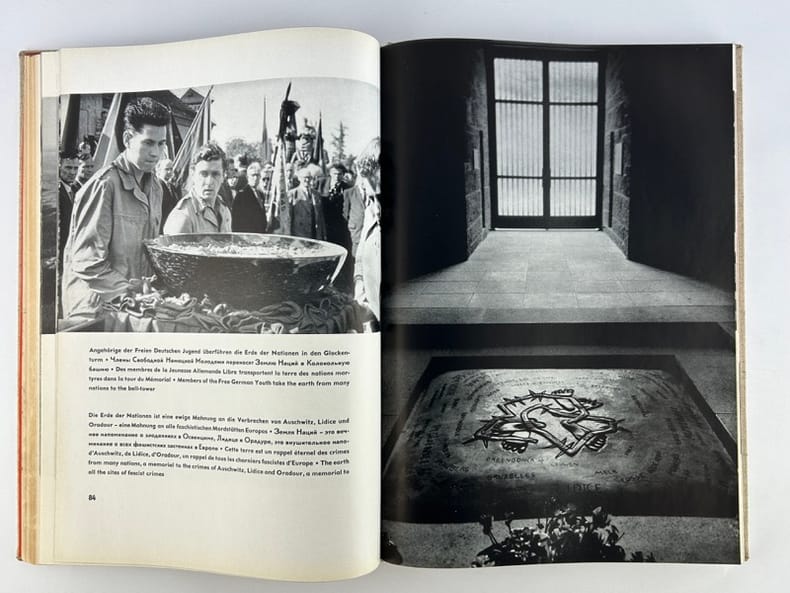
19601260331960 Kongress-Verlag, Berlin - 1960 - 187 pages - Nombreuses reproductions photographiques en N&B, in et hors texte, dans l'ouvrage - Texte en français, russe et allemand
53821Berlin, Kongress-Verlag, in-4, reliure éditeur toilée.,, 187 pages. Ex-dono sur page de garde. Bon état.
32pp. (waarvan 28pp. illustraties), 34cm., ingebonden in gecart. band, originele omslag mee ingebonden, ex.bibl. (enkele stempeltjes), G93008
122725Imprimerie Artistique en couleurs, Lyon - 1946 - In-folio, chemise broché avec papier cristal, couverture illustrée, feuillets détachés, dans une chemise cartonnée, dans un emboitage gris neutre - 78 planches illustrées hors-texte en N&B - Exemplaire numéroté sur Vélin pur fil Lafuma, Ex N°274/1200.
fascicolo di 32 pagine, bross. edit. ill., minime rotture in sovrac.
Volume 3, Number 9. December 30, 1937. Wrappers; 16mo. 35 pages. Also includes "The Ludlow Resolution" by General William C. Rivers and Major George Fielding Eliot, and "After the Town Meeting" by Edward Hodnett. A transcript of a broadcast from the League for Political Education's Town Hall in cooperation with the National Broadcasting Company. Debates and debating -- Periodicals. Radio addresses, debates, etc. -- Periodicals. Social problems -- Periodicals. Title Subject: America's town meeting of the air -- Periodicals. Pages brown; lower right-hand corner bent; small piece of back page gone. Good condition. (H-31-4)
(FT) Original Paper Wrappers. 4to. 65, 15 pages. Illus. 26 cm. In English and Yiddish. Cover Subtitles: Israels 36th Anniversary Year, 1948-1984, Dedicated to 20 Years Monument, 1964-1984. SUBJECT(S) : Jews -- Pennsylvania -- Philadelphia -- Periodicals. Jewish refugees -- Pennsylvania -- Philadelphia -- Periodicals. Holocaust survivors -- Pennsylvania -- Philadelphia -- Periodicals. Association of Jewish Holocaust Survivors (Philadelphia, Pa. ) -- Periodicals. OCLC lists two copies worldwide (University of Southern California, US Holocaust Memorial Museum) . Covers stained, slightly wavy from water, but still solid. Internal pages are clean. Good condition. (HOLO2-64-16)
Paper Wrappers, 8vo, 164 pages. 23 cm. In German. "mit einer Einfuhrung von H. G. Van Dam, mit Gesetz zur Aenderung des BEG (Mantelgesetz) ...Verordnung zur Durchführung des [sect. ] 31d des Gesetzes zur Regelung der Wiedergutmachung nationalsozialistischen Unrechts für Angehörige des öffentlichen Dienstes vom 6. Juli 1956." Inscribed by the author in year of publication to Moses Leavitt, chairman of the Claims Conference negotiating delegation at the Hague. Subject(s) : World War, 1939-1945 --Claims --Germany (West) . Very Good Condition. (h2-3-13)
In 8°, br. edit. ill. (lievi tracce d'uso), pp. 381,(3); coll. "La storia da vicino"; prima ed., nel complesso buon es.. (x068/d) (spedizione standard SEMPRE tracciata con raccomandata-piego di libri, eventuale FATTURA da richiedere all'ordine)
U. Bahnsen; J- O'Donnel Bunker. Reportage sulla fine della Cancelleria del Reich. Milano, Rusconi 1977 italian, 381 1977. "La storia da vicino". Opera con copertinamorbida in brossura. Numerose illustrazioni in b/n ft. N 17
8vo; pp. 157; illustrazioni in b/n nel testo; legatura editoriale cartonata con titolo al dorso; sovraccoperta figurata.<BR>In ottimo stato.<BR>Prima edizione.
Original Wrappers. 4to. 39 pages. 30 cm. First Edition. In Polish. Title translates as, There Were More Deaths, Than Bread: Jednodniowka Released On the Occasion of the Exhibition Oswiecim accuses. " Jednodniowka publications are typically journals or pamphlets issued by organizations with no regular publications, but may also be published quarterly or on a semi-regular basis. Contains period advertisements. Journal containing poetry, prose and articles related to the conditions of Polish concentration camps. The Polski Zwiazek Bylych Wiezniów Politycznych Hitlerowskich Wiezien I Obozów Koncentracyjnych, (translates to Polish Association of Former Political Prisoners of Nazi Concentration Camps and Prisons) was formed in 1946, and existed until 1949. Later reformed in the 1990s the organization focuses on youth outreach and Holocaust education. Subjects: Holocaust. Concentration camps. Auschwitz-Birkenau. OCLC lists 2 copies worldwide. (Natl. Libr. Of Poland, Central Connecticut State University) Light soiling and age toning. Dramatic color cover illustration. Very good + condition. (HOLO-114-15)
1st edition, original cloth, 4to, xix+ 288+ (2) pages. On title page: Brzezin memorial book. Illustrations throughout. Yiddish, with English introduction. There once was a town of Jewish tailors Brzezin. From early dawn until late at night one could hear the music of the Singer sewing machines. It was the music of hard work, of intense anxiety, of a hard life, but also of noisy youth, semi-intellectuals, observant Jews, Hasidim who lived and had aspirations in the small Jewish town Brzezin. The Nazi savages extinguished this life forever, transformed it into ashes. Only a few Jews from the tailoring town Brzezin, by some miracle, remain, scattered over the entire world, individuals who were witnesses to the German cannibalism. May these words, frail in print, but inscribed not with ink but with blood, be a modest contribution to the matseve [gravestone] for my native town, Brzezin. Brzezin was one of the oldest and most popular Jewish communities in Poland. When this community was established, it carried the name Krakowek [Little Krakow]. At that time, the community extended from the Strykower highway to beyond the Jewish besoylem [cemetery] to the surrounding hills. The Polish noblewoman, Anna Lasocka, had brought the first weavers from afar into this community. Then the community developed even further and began to broaden its borders. At that time, the town already carried the name Brzezin. Jewish tailors came to Brzezin from many places, and after several generations, the town developed its own type of tailoring industry, by which it was known all over the world. A cottage industry was the main occupation here. As early as 1772, Brzezin was famous for its mass production in tailoring. Until 1914 the great Czarist Russia was flooded with the inexpensive products of Brzeziner tailors. In the years between the two world wars, the export of Brzezin industry was spread over many lands in Europe and into other parts of the world. In this, the great Jewish magaziners [owners of clothing enterprises] exporters such as Frankensztejn, Tuszynski, Sulkowicz, and others played a great role. The Jews in Brzezin did not only work, they also participated actively in the socio-political and cultural life of the town, had their representatives on the town council in town hall, and had their religious and secular educational, cultural, and social organizations. Materially, it was a life of Jewish poverty, but spiritually, socially, and culturally, it was rich. (translated from book) SUBJECT(S) : Holocaust, Jewish (1939-1945) -- Poland -- Brzeziny (Lo´dz´) ; Jews. OCLC: 19306453. Light wear on cover, some wear on spine. Good Condition Overall. (YIZ-16-6A)