542 résultats
190461283Cleveland OH: Arthur H. Clark Co 1904. First edition thus issued separately from Clark's "Early Western Travels" series. 8vo. 2 volumes: 306 2; 342 3 ads pp. Illustrated with 16 plates and two facsimiles. Howes F-63 for the 1823 original of Faux: "Bitterly unfavorable." Howes W-229 for the 1821 original of Welby who comments "to a rough untutored set of savages another race of little less than savages has succeeded". Clark/Brunet 253: "For the Faux volume 316 separates and for the Welby volume 287 separates." Very good. Original maroon cloth gilt spine titles top edge gilt others untrimmed. #8270. <br/><br/> Arthur H. Clark Co hardcover books
19047900Cleveland: The Arthur H. Clark Co. 1904 32 octavo volumes and large atlas. First edition. Very scarce. Number 555 of 750 complete sets SIGNED and numbered by the publisher. Edited with Notes Introductions Index etc. by Reuben Gold Thwaites. 32 octavo volumes large atlas. Each volume approx. 300 pages. Illustrated with plates from original sources; atlas with 81 plates by Karl Bodmer. All volumes bound in matching burgundy cloth gilt. 2 bookplates on inner cover of all volumes. Slight but even fading to volumes 14-31. Atlas is an ex-library binding. Last 2 volumes provide the index. With the exceptions noted a fine and complete set most volumes are unopened and unread. The large atlas contains 81 full-page plates by Karl Bodmer to illustrate Prince Maximilians travels volumes XXII XXIII and XXIV of the set. An extremely important collection of significant early travels and expeditions of exploration into the uncharted West reprinted from scarce original editions. Contains the journals of Brackenridge Bradbury Bullock De Smet Farnham Flagg Franchere Gregg James Long Maximilian Michaux Nuttall Pattie Ross Wyeth and others. The Arthur H. Clark Co. hardcover books
190953246Madison: published by the Wiscon Historical Society 1909. Slim 8vo pp. 5 234-259 1 i.e. 32 pages; portrait frontispiece and 2 illustrations on 1 plate; McCormick centennial slip tipped in at title page; light spotting of covers otherwise near fine in oruiginal cloth-backed paper-covered boards. Originally published in the Proceedings of the State Historical Society of Wisconsin for 1908. Separately issued by the society on the centenary of McCormick's birth. <br/><br/> published by the [Wiscon Historical] Society hardcover books
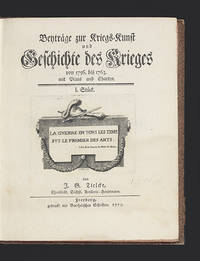
5632Finely engraved vignette on titles each different 48 engraved plates of maps plans & charts six heightened in color on 40 folding sheets & one folding printed table. Six vols. Large 4to cont. speckled boards several with minor rubbing red vellum lettering pieces on spines. Freiberg: Barthel 1775-76-78-81-84-86. First edition of this outstanding history of the German campaigns during the Seven Years' War describing the strategies employed during the conflict. Tielke 1731-87 wrote a series of works on military history and science based on his extensive theoretical knowledge as well as first-hand combat experience - he was wounded at the Battle of Torgau. Tielke not only recapitulates the decisive moments of these campaigns he also furnishes case studies regarding tactics artillery and fortification. The present work received much praise for its precise methodology presentation of arguments and judicious use of historical examples. The finely executed plates include highly detailed maps and battle-plans including those for Schweidnitz and Maxen plans and cross-sections of fortifications and charts of formations and their evolution during the course of the battles. Many of the plates contain complex diagrams highlighting trajectories and lines-of-sight and are clearly intended for the instruction of field engineers. A fine copy. ❧ A.D.B. Vol. 38 pp. 286-88. Jähns 1870f.: "Die wissenschaftliche Gründlichkeit der Beiträge die Sicherheit der Behandlung die Genauigkeit in den Angaben und nicht zum wenigsten die kluge und massvolle Art in welcher der Verfasser die geschichtliche Darstellung für seine theoretischen Anschauungen nutzbar macht verschafften dem votrefflichen Werke den lebhaften Beifall aller Einsichtigen.In so lehrreicher Weise wie dieser Ingenieur für sein Fach hat kein damaliger Taktiker Friedrichs Feldzüge für das seinige ausgebeutet.". hardcover books
15548113Paris: Jacobum Kerver 1554. Second printing. Vellum. Very Good. 8vo. 64416pp. Woodcut portrait of the author on title. Orig. limp vellum somewhat soiled and spine a bit chipped at top. Some text soiling. Front free endpaper lacking. French legal scholar's 1488-1558 treatise on the aspect of Roman law pertaining to inheritance and succession. It was first printed in 1550. Jacobum Kerver hardcover books
16176779Basel: Ludovici Regis 1617. Later printing. Full pigskin. Very Good. Thick 8vo. 9694272pp. Indices. Printer's woodcut device on title. Orig. roll-tooled pigskin somewhat rubbed. Fore-edge clasps. Small hole at outer blank edge of title & next two leaves. The author's d. 1524 often reprinted work on numerous topics of ancient history. This edition has additions by L. Geoffroi and L. G. Giraldi and is edited by Johann Jakob Grasser. Ludovici Regis unknown books
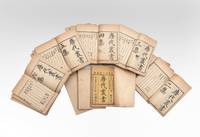
670514; 13 folding leaves. Two parts in one vol. Large 8vo cont. or later dark wrappers dyed with persimmon juice shibubiki new stitching. Japan probably Kyoto: printed with moveable types ca. 1615-40. A very rare edition printed with moveable types apparently unrecorded in the standard bibliographies of the story - or legend - of the creation of the first statue of Siddhartha Gautama or Gautama Buddha the founder of Buddhism. The statue executed while Buddha was still alive was commissioned by King Udayana of Kaushambi a contemporary of Buddha. It was the very first image of Buddha and is especially important as it was carved from life. Copies of this statue made their way to China with the spread of Buddhism and later as we shall see to Japan. The text provides a history of the creation of the first statue of Buddha which is perhaps the most famous of all Buddha images. King Udayana commissioned the statue "so that he could gaze upon the sacred form of the Buddha while the latter was off preaching to his mother in the heaven of Indra. Buddha's disciple Maudgalyayana transported thirty-two craftsmen up to the heavenly realm so that they could observe the special marks of the Buddha firsthand thereby insuring the representational accuracy of the image they created. When the Buddha eventually returned to the earth King Udayana's statue rose into the air to greet him of its own accord and the Buddha proclaimed that it would one day help to transmit his teachings."-Brown ed. The Oxford Handbook of Religion and the Arts p. 371. We learn that the statue was carved out of sandalwood and that later copies were made of gold silver bronze lead tin or iron as well as of wood. This text was translated by the Khotanese monk Tiyunbanruo d. 691 or 692 whose original Sanskrit name was Devendraprajna. Khotan was an ancient Iranian Saka Buddhist kingdom on the branch of the Silk Road that ran along the southern edge of the Taklamakan Desert near modern-day Xinjiang. Tiyunbanruo came to Luoyang the "Eastern Capital" of the Tang dynasty of China in about 688 with a considerable reputation as a Buddhist missionary and set up a bureau to translate Buddhist texts into Chinese. An earlier edition of this text was published in Beijing in 1593 and only one copy is known at the BnF. This book was probably printed and issued as a way to reinforce the legitimacy of the famous Buddha statue of the temple of Seiryoji in the Saga fields of Kyoto. It is one of the chief objects of religious veneration in Kyoto. A copy of the original statue also commissioned by King Udayana was brought from the castle at Kaushambi in north-central India to China by Hsuan-tsang in 645. The statue moved many times and ultimately arrived at Kaifeng the Sung capital. The Japanese monk Chonen 938-1016 who spent the years 983-86 in China studying and collecting texts had worshiped the statue in Kaifeng and commissioned men in 984 to carve a copy to bring back to Japan. The copy was ultimately installed at Seiryoji and according to Japanese tradition the Chinese "original" and Chonen's copy had miraculously changed places - the Seiryoji Buddha was actually the authentic example commissioned by Udayana. The Seiryoji Buddha is "probably the most important best-documented and best-preserved sculpture now existing which represents the school and tradition of Buddhist sculpture connected with the sacred Udayana image of the living Buddha of which Hsuan-tsang brought a copy to the court at Ch'ang-an."-Henderson & Hurvitz "The Buddha of Seiryoji: New Finds and New Theory" Artibus Asiae Vol. 19 No. 1 1956 p. 43-and see the whole fascinating article. As mentioned above this rare work is printed with moveable types. It was at one time owned by the great Japanese dealer Shigeo Sorimachi. The chitsu has the characteristic handwriting on the label of Sorimachi's assistant Mr. Mori who has written: "Zozo kudoku kyo. Genna kan'ei chu kan. Kokatsu ban" "Creation of the Statue a Pious Act. From Genna to mid-Kan'ei edition ca. 1615-40. Moveable type". It is not cited by Kazuma Kawase Kokatsuji-ban no kenkyu Study of the Early Typographic Editions of Japan 1967 the definitive bibliography of Japanese moveable type books. There is no copy in WorldCat nor the Union Catalogue of Early Japanese Books. In very good condition. The first ten folding leaves which are a little stained have some repaired worming and strengthening. The following leaves have some worming some carefully repaired and others as the worming lessens not repaired. Several characters affected by the worming. As mentioned above the wrappers have been dyed with persimmon juice which serves a dual purpose: to strengthen the paper and act as an insect repellent. ❧ Wang Zhenping "Chonen's Pilgrimage to China 983-986" Asia Major Third Series Vol. 7 No. 2 1994 pp. 63-97. Martha L. Carter The Mystery of the Udayana Buddha Naples: 1990. unknown books
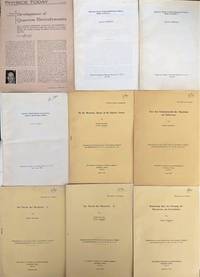
1940S13395Tokyo:: Scientific Papers of the Institute of Physical and Chemical Research 1940. 1940. 8 offprints 1 extract. Original wrappers. From the collection of Abraham Pais. Very good. INVENTORY: 1. TOMONAGA Sin-itiro. Uber den Zusammenstoß des Mesotrons mit Elektronen. Offprint from: Scientific Papers of the Institute of Physical and Chemical Research no. 976 vol. 37 pp. 399-413 June 1940. Original yellow printed wrappers. Signed by Pais. "In 1940 Dr. Tomonaga directed his attention to the meson theory and developed the intermediate coupling theory in order to clarify the structure of the meson cloud around the nucleon." :: Nobel Lectures 1972. 2. TOMONAGA Sin-itiro. Zur Theorie des Mesotrons. I. Offprint from: Scientific Papers of the Institute of Physical and Chemical Research no. 1071 vol. 39 pp. 247-266 Dezember 1941. Original yellow printed wrappers. Signed by Pais. 3. TOMONAGA Sin-itiro. Bemerkung uber die Streuung der Mesotronen am Kernteilchen. Offprint from: Scientific Papers of the Institute of Physical and Chemical Research no. 1105 vol. 40 pp. 73-86 September 1942. Original yellow printed wrappers. Signed by Pais. 4. TOMONAGA Sin-itiro; Miyazima Tatuoki. Zur Theorie des Mesotrons. II. Offprint from: Scientific Papers of the Institute of Physical and Chemical Research no. 1103 vol. 40 pp. 21-67 August 1942. Original yellow printed wrappers. Signed by Pais. 5. TOMONAGA Sin-itiro; Miyazima Tatuoki. On the Mesotron Theory of the Nuclear Forces. Offprint from: Scientific Papers of the Institute of Physical and Chemical Research no. 1124 vol. 40 pp. 274-310 March 1943. Original yellow printed wrappers. Signed by Pais. 6. TOMONAGA Sin-itiro. Remarks on Bloch's Method of Sound Waves applied to Many-Fermion Problems. Offprint from: Progress of Theoretical Physics vol. 5 no. 4 pp.544-569 July-August 1950. Signed by Pais. 7. TOMONAGA Shin-ichiro. Elementary Theory of Quantum-Mechanical Collective Motion of Particles I. Offprint from: Progress of Theoretical Physics vol. 13 no. 5 pp.467-481 May 1955. 8. TOMONAGA Shin-ichiro. Elementary Theory of Quantum-Mechanical Collective Motion of Particles II. Offprint from: Progress of Theoretical Physics vol. 13 no. 5 pp. 482-496 May 1955. 9. TOMONAGA Sin-itiro. Development of Quantum Electrodynamics. Extracted from: Physics Today vol. 19 no. 9 pp. 25-32 September 1966. Signed by Pais. . / BIOGRAPHY: Tomonaga was a prominent Japanese physicist influential in the development of quantum electrodynamics work for which he was jointly awarded the 1965 Nobel Prize in Physics :: along with Richard Feynman and Julian Schwinger :: for the study of QED specifically for the discovery of the renormalization method. Nobel biography: Tomonaga completed work for Rigakushi bachelor's degree in physics at Kyoto Imperial University in 1929 with one of his intimate friends. Dr. Hideki Yukawa Nobel laureate. He was engaged in graduate work for three years at the same university and was then appointed a research associate by Dr. Yoshio Nishina at the Institute of Physical and Chemical Research Tokyo where he started to work in a newly developed frontier of theoretical physics quantum electrodynamics - under the guidance of Dr. Nishina. His paper on the photoelectric pair creation is well-known. Tomonaga stayed in Leipzig Germany from 1937 to 1939 to study nuclear physics and the quantum field theory in collaboration with the theoretical group of Dr. W. Heisenberg where he published a paper "Innere Reibung und Warmeleitfahigkeit der Kernmaterie" which was chosen as the thesis for Rigakuhakushi Doctor of Science at Tokyo Imperial University in December1939. In 1940 Dr. Tomonaga directed his attention to the meson theory and developed the intermediate coupling theory in order to clarify the structure of the meson cloud around the nucleon. He joined the faculty of Tokyo Bunrika University which was absorbed into the Tokyo University of Education in 1949 as Professor of Physics in 1941. It was in 1942 when he first proposed the covariant formulation of the quantum field theory in which the concept of the quantum state was generalized so as to be relativistically covariant. During the Second World War Dr. Tomonaga was interested in developing a theory of microwave systems. He solved the motion of electrons in the magnetron and also developed a unified theory of the systems consisting of wave guides and cavity resonators. As soon as the War was over Tomonaga came back to academic research again with a programme in which he was first to summarize and extend the intermediate coupling theory and secondly to apply the covariant field theory to actual physical systems. His aim was to investigate the nature of field reaction in the meson theory as well as in quantum electrodynamics. He was confident prior to the Lamb-Retherford experiment by means of a model calculation that divergence difficulty in quantumelectrodynamics could be overcome simply by handling the infinite mass and charge due to field reactions in some way or another. It was only a step further for him to develop the renormalization theory with covariant formalism in his right hand and experimental support in his left. Dr. Tomonaga was invited to the Institute for Advanced Study Princeton in 1949 where he was engaged in the investigation of a one-dimensional fermion system. Thus he first succeeded in clarifying the nature of collective oscillations of a quantum-mechanical many-body system and opened a new frontier of theoretical physics modern many-body problem. In 1955 he published an elementary theory of quantum mechanical collective motions. Dr. Tomonaga took the leadership in establishing the Institute for Nuclear Study University of Tokyo in 1955. From 1956 to 1962 he was appointed President of the Tokyo University of Education and since 1963 he has been President of the Science Council of Japan and Director of the Institute for Optical Research Tokyo University of Education. He occupies an important position in various governmental committees for scientific research and policymaking. Tomonaga's honours and awards include the Japan Academy Prize 1948; the Order of Culture 1952; the Lomonosov Medal U.S.S.R. 1964. Dr. Tomonaga is a member of the Japan Academy the Deutsche Akademie der Naturforscher "Leopoldina" and a foreign member of the Royal Swedish Academy of Science. He is a corresponding member of the Bayerische Akademie der Wissenschaften and a foreign associate of the National Academy of Science of U.S.A. Tomonaga has published widely in scientific journals on such subjects as quantum electrodynamics the meson theory nuclear physics cosmic rays and the many-body problem. His book "Quantum Mechanics" was published in 1949 and translated into English in 1963. Scientific Papers of the Institute of Physical and Chemical Research, 1940. unknown books
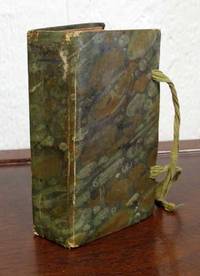
162926858Coloniæ Agrippinæ: Bernardi Gvalteri 1629. Later green marbled vellum boards with green cloth ties & title hand-inked to spine. Overall VG minor rubs to extremities. 4 504 66 pp. Printer's device to t.p. 12mo: 2 A - Z12 2A9. <br/><br/> Bernardi Gvalteri hardcover books
15465968Venice: Cornelio Adelkind for Daniel Bomberg 1546. First edition. Very Good/First printed edition editio princeps of the 11th century commentary on portions of the pentateuch by the Bulgarian poet and Talmudist Tobiah ben Eliezer. Published by the house of the seminal printer of Hebrew books Daniel Bomberg under the supervision of his scholar-in-residence extraordinaire Cornelio Adelkind. Venetian law at this time limited Hebrew publishing to Gentile printers. Bomberg a protestant from Antwerp entered this lucrative market and with Adelkind's help became its prime exponent until his death in 1549. . Folio 32 cm; 93 leaves. Text in Hebrew. Title within architectural border reproduced in Amram "Makers of Hebrew Books in Italy" p. 215 also in the Jewish Museum's 1989 exhibition catalogue "Gardens and Ghettos: the Art of Jewish Life in Italy" page 50. Some section headings within ornamental borders. Bound in c19 or c20 dark red crushed morocco ruled in gilt and decorated with arabesques on both boards; spine with raised bands and compartments tooled and titled in gilt; green polished leather doublures with red crushed morocco dentelles bordered in pointillé accented with arabesques; green moiré free endleaves. Edges gilt. Binding not signed. Joints and crown adroitly reinforced with Japanese paper; corners somewhat worn down. Occasional contemporary notes in manuscript in text; brief stain on leaf mem-tet and lightly along the bottom edge of leaves nun-bet and nun-gimmel. Text otherwise pristine. Title page light possibly washed. Old library ink stamps from an institution in Warsaw on title page. Red morocco ex-libris of mining magnate and philanthropist Adolph Lewisohn 1849-1938. References: Adams T-766; BM Italian 674; Steinschneider 7304 #1; Amram 215 illustration and 222. Cornelio Adelkind for Daniel Bomberg hardcover books
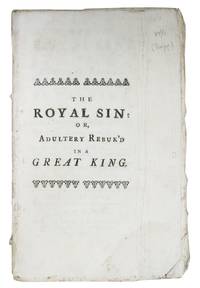
173848531London: Printed and sold by J. Huggonson in Chancer - lane 1738. The Second Edition. Disbound now housed in an archival mylar sleeve. Faint evidence of damping in pamphlet's lower margin otherwise VG. 2 29 1 blank pp. Headpiece. Decorative initial capital letter. 8vo in 4s. 8-1/2" x 5-3/8" <br/><br/> Printed and sold by J. Huggonson, in Chancer - lane unknown books
15386173Venice: Per Agostino de Bindoni 1538. Sm. 8vo. 344pp. Illustrated with a large woodcut vignette on title page verso of title and colophon with devices and 78 woodcuts of hands keyed to the text. Cont. vellum with manuscript spine lettering. Light browning and soiling including title page but overall a very nice copy in a contemporary binding. An early Italian language edition of one of the most popular works on chiromancy of the 16th century. Tricasso 1491-c.1550 was a disciple of Barthelemy Cocles. At variance with Cocles on a number of points he set out in this work to analyze the significance of 78 configurations of hands as well as to outline the supposed astrological implications. His work is frequently cited by many later writers on the subject. As with other copies cited in OCLC the date at the conclusion of the author's preface is misprinted "1635" it should be "1535" the date of the first Italian edition of this title. Brunet V:945; STC of Italian Books p. 680. Caillet 10830. Per Agostino de Bindoni hardcover books
15384474Venice: Per Agostino de Bindoni 1538. Sm. 8vo. 344pp. Illustrated with a large woodcut vignette on title page verso of title and colophon with devices and 78 woodcuts of hands keyed to the text. Nicely rebound in faux period calf gilt tooled spine in 3 compartments. Small chip and tear into blank upper margin of B1 and small printing flaw at bottom corner of A2 verso. An early Italian language edition of one of the most popular works on chiromancy of the 16th century. Tricasso 1491-c.1550 was a disciple of Barthelemy Cocles. At variance with Cocles on a number of points he set out in this work to analyze the significance of 78 configurations of hands as well as to outline the supposed astrological implications. His work is frequently cited by many later writers on the subject. As with other copies cited in OCLC the date at the conclusion of the author's preface is misprinted "1635" it should be "1535" the date of the first Italian edition of this title. Brunet V:945; STC of Italian Books p. 680. Caillet 10830. Per Agostino de Bindoni unknown books
5595148 leaves including the final blank Roman letter except for the two-line title in gothic type 51 lines & headline capital spaces with guide letters. Folio 290 x 188 mm. late 17th-cent. panelled English speckled calf rebacked with the orig. spine laid-down minor staining to a few leaves in blank upper margins. Basel: J. Amerbach 1494. First edition of the "first bibliography to be compiled as a practical work of reference."-Grolier Club Bibliography 7. Tritheim 1462-1516 one of the leading polymaths of his age was appointed the 25th abbot of the monastery at Sponheim in 1483. "One of the first of his many self-imposed tasks was the reorganization and cataloguing of the monastic library if one can call reorganization the process of transforming forty-eight mongrel volumes into a splendid collection of 2000 printed books and manuscripts many of great importance and rarity. "It was during the progress of this work no doubt as his exceptional knowledge of books caused inquiries frequently to be addressed to him that he conceived the notion of compiling a new and ambitious bibliography of ecclesiastical writers. He began work in 1487 and by the spring of 1492 he was able to send the complete manuscript to the bishop of Worms. He then revised it and in 1494 the Liber de scriptoribus ecclesiasticis a folio of nearly 300 pages issued from the Basle press of Johann Amerbach. "From Alexander bishop of Cappadocia down to himself Tritheim sets out in chronological order nearly a thousand writers largely but not exclusively ecclesiastical giving a short account of each followed by a list of his or her writings. Nor are these lists merely perfunctory: it is obvious from such a heading as that for St. Augustine under which he enumerates 277 works that Tritheim must have lavished an immense amount of genuine research on his bibliography. In all about 7000 books are recorded. An alphabetical index of authors arranged of course by Christian names is added. The contrast between the feeble theological bibliographies of the manuscript age and this first attempt in the printing era is very striking."-Besterman The Beginnings of Systematic Bibliography pp. 7-8. The title of the book is somewhat misleading since the work is not restricted to ecclesiastical writers but also includes authors such as Dante Poggio and Sebastian Brant. A fine and crisp copy of a book which has become uncommon on the market preserved in a box. Bookplate of the Society of St. John the Evangelist Cowley Oxford. With a note on the rear paste-down referring to "Derby" the Earls of Derby and a shelf-mark. ❧ Goff T-452. unknown books
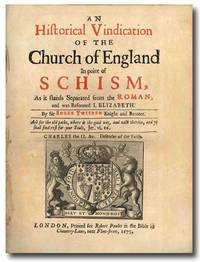
1675WRCLIT67247London: Printed for Robert Pawlet . 1675. 81982pp. Quarto. Extracted from binding. Title in red and black Royal Coat of Arms on title slight tanning and faint foxing R2-3 with clean tears in from foremargin no loss otherwise a very good copy. Third edition of one of Twysden's most widely read antiquarian works first published in 1657. It is a "detailed account of the increase of papal powers over England from the Saxons to the Reformation . arguing . that it was the Church of England rather than Rome which had held fast to the true faith. Twysden denied that the English church 'made a departure from the Church which is the ground and pillar of truth' p. 196. This temperate and urbane argument placed Twysden within the tradition of earlier apologists for the Church of England such as Richard Hooker and Thomas Fuller" - DNB. ESTC R15191. WING T3554. McALPIN III:717. Printed for Robert Pawlet ... unknown books
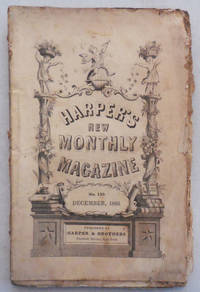
186624824New York: Harper & Brothers 1866. First edition. Paperback. Fair. Single bound issue of Harper's New Monthly Magazine No. 199 December 1866. Notable for the inclusion of "Forty Three Days In An Open Boat" pp 104-113 now recognized as the first appearance of Mark Twain in a national magazine. Noted apparently as Mark Swain in the list of contributors. This copy in relatively poor condition with some substantial soiling chipping to edges and other general wear. However still bound with most of the spine intact. Not often found as a separate issue it is much more common for this to be found as part of a bound set of twelve issues. Harper & Brothers paperback books
1711LLV2175Oxoniae:: E. Theatro Sheldoniano 1711. 1711. 8vo. xvi 140 44 60 pp. Title engraved vignette index; few stains. Original gilt-stamped decorative panels mottled calf; joints reinforced stickers on spine. Former ownership blind emboss stamps on first and last few leaves including title. Very good. Second edition issued earlier in 1693. This edition printed at the Sheldonian Theatre of Paterculus’ Roman history contains the addition of 44 pages of additional notes. It contains not all copies do Dodwell’s Annales Velleiani. Lowndes vol. 4 p. 1798. "His Compendium of Roman History consists of two books dedicated to M. Vinicius and covers the period from the dispersion of the Greeks after the siege of Troy down to the death of Livia AD 29. The first book brings the history down to the destruction of Carthage in 146 BC; portions of it are missing including the beginning. The later history especially the period from the death of Julius Caesar 44 BC to the death of Augustus AD 14 is treated in much greater detail. / The author does not display real historical insight although generally trustworthy in his statements of individual facts. He may be regarded as something of a courtly annalist rather than an historian. His chronology is inconsistent though sometimes useful. On Caesar Augustus and above all on his patron Tiberius he lavishes praise or flattery; but his portrait of the latter is a useful corrective to the sensationalist attacks of a Tacitus as is his treatment of Livia. The repetitions redundancies and slovenliness of expression may be partly due to the haste with which as the author frequently states it was written. The inflated rhetoric the straining after effect by means of hyperbole antithesis and epigram belong firmly to the Silver Age of which Paterculus is the earliest example. He purposed to write a fuller history of the later period including the civil war between Caesar and Pompey and the wars of Tiberius; but there is no evidence that he did so. His chief authorities were Cato’s Origines the Annales of Quintus Hortensius Pompeius Trogus Cornelius Nepos and Livy." Wikip. See: Eleanor Cowan ed. Velleius Paterculus: Making History Classical Press of Wales 2011. E. Theatro Sheldoniano, 1711. unknown books
1719LV2044Lugduni Batavorum Leiden Netherlands:: Apud Samuelem Luchtmans 1719. 1719. 8vo. xl 748 118 pp. Engraved half title plate by F. Bleyswyk Bleyswyck red and black title with printer’s device woodcut decorative initials and tailpieces index; occasional light foxing. Original gilt and blind-stamped full calf five raised bands with gilt-stamped maroon spine piece; worn joints cracked but reinforced with painted Kozo paper. Ownership blind emboss stamps on first and last few leaves including title. Binding worn internally very good. This Compendium of Roman History by Velleius is an early edition of Dutch classical scholar Pieter Burman the elder. His history written in a rhetorical style covered the period from the end of the Trojan War to the death of Livia in 29 A.D. and most useful for the period from the death of Julius Caesar in 44 B.C. to the death of Augustus in 14 A.D. Bryan Michael. Bryan’s Dictionary of Painters and Engravers Volume 1. G. Bell 1903. p. 145. "Velleius Paterculus’ short work is the earliest surviving attempt on the part of a post-Augustan historian to survey the history of the res publica from its origins to his own times. In a period from which no other contemporary historical narrative survives in more than meagre fragments Velleius’ work is uniquely important. It is a critical counter to the later accounts of Tacitus Suetonius and Cassius Dio not simply because it offers a different view of Tiberius but because Velleius saw continuity where later authors saw only radical change which destroyed the Republic and put monarchy in its place. For other reasons too Velleius occupies a unique position in Roman historiography." – See: Eleanor Cowan ed. Velleius Paterculus: Making History Classical Press of Wales 2011. Apud Samuelem Luchtmans, 1719. hardcover books
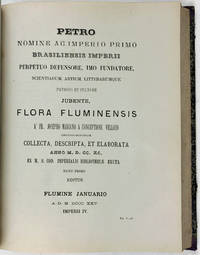
188145183Flumine Januario / Rio de Janeiro: Typ. Economica 1881. First complete edition. Half black morocco over marbled boards gilt spine title. A very good copy boards rubbed repaired tear and closed tear on Volume V half title and title page. xii vii 467 1 pp. 4to. Published in and taking up the entire volume of Archivos do Museu Nacional do Rio De Janeiro. Volume V. 1880 1881. Added title page: Petro nomine ac imperio primo Brasiliensis imperii perpetuo defensore . jubente Flora fluminensis a' fr. Josepho Mariano a Conceptione Vellozo Ordinis monorum collecta descripta et elaborata anno M.D. CC. XC. Ex M.S. cod. Imperialis bibliothecæ eruta nunc primo etitur. Flumine Januario A.D.M. DCCC. XXV imperii IV. José Xavier Veloso 1742-1811 born in what is now Minas Gerais Brazil was ordained in 1766 in the convent of St. Anthony in Rio de Janeiro where he studied philosophy and theology later geometry in San Paulo and finally natural history. He collected plants animals and minerals in the Rio de Janeiro area from 1783 to 1790 at which time he moved to Lisbon where he worked at the Royal Academy of Sciences while preparing Florae Fluminensis his greatest work for publication. Using the Linnaeus' system of sexual classification of plants he prepared very highly detailed texts and 1700 prints many of them of new species. But the publication of the work was beset by problems. First sent to Venice the plates were never completed. Later the French invasion of the Iberian peninsular sent the Portuguese government then Veloso and his manuscripts into exile in Brazil where he died in 1811. In 1825 an abbreviated version of the text was published followed by the eleven volumes of the Icones in 1827 of which few copies survive. The complete text was not published until this edition in 1881. Bound with and proceeded by Archivos do Museu Nacional do Rio De Janeiro. Volume IV. 1879. Rio 1881. viii 151 1 pp vii plates. Folded color plate split at fold. Volume subtitle: Insectologia. Includes Müller Fritz: A metamorphose de um insecto diptero among other works. Rodrigues 2473. Sabin 98833n. For the shorter version of 1825 see: Barba de Moraes II p. 343. Pritzel 468. Jackson 377. Innocencio V.5 4258; V.13 p.122. Also see Nissen BBI 2046. Typ. Economica hardcover books
17253447London: Np 1725. Second English language edition. Very good. Second English edition see below. Sm. 8vo. 680pp. Modern 1/2 black morocco gilt over marbled boards. Title lightly soiled. A few leaves closely trimmed at top margin. Foxon R264 noting "all copies seen were issued in Rooke's "Select Translations" 1726. It may never have been separately published." The pagination of the 1723 first printing is 12431pp. Np hardcover books
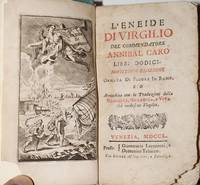
1750002388Venezia: Giammaria Lazaroni e Domenico Tabacco 1750. Pebbled Half Cloth Faux Leather over Paper Pastedown on Boards. Good Minus. 8vo. 20 568 pp. With fifteen woodcut plates with frontis one for each canto of the Aenied and one for the Bucolica and Georgica respectively. Some soiling throughout. All leaves of the Bucolica and a few of the Georgica have severe wormholing in the lower corner with only trivial touching of text. A few other leaves have corners overtrimmed or with loss. Still an uncommon edition with only three copies located on OCLC. <br /><br /> Giammaria Lazaroni, e Domenico Tabacco hardcover books
19476055131947. 8 3/4" x 11 5/8"; 1 page recto and verso; very good fresh; 1947. Rare and unique! Signed on the front by: Agnes Moorehead; Brian Donlevy; Robert Walker; Tom Drake; Beverly Tyler; Audrey Totter; Hume Cronyn; Hurd Hatfield; Joseph Calleia; Godfrey Tearle; Jonathan Hale; Henry O'Neill; Warner Andersen; Art Baker; Ludwig Stossel; Arno Frey; William Wright; Erville Alderson; Nella Walker; Barry Nelson; Moroni Olsen; Trevor Bardette; Robert Considine - story; Frank Wead - writer; Ray June - Cinematographer; Stanley Goldsmith - assistant director; Joe Edmondson - sound technician; Samuel Marx - producer; Signed on the back by: George Boemler - film editor; H.T. Wensel Harry - technical advisor; Tessa Primock - script; Gertrude Kupwood Ward; Hans Peters - art direction; Dick Campbell - sound; Frank Myers - assitant director; and many others! Although contemporary sources indicate that Leon Ames and Agnes Moorehead were cast they did not appear in the released film. The film marked the motion picture debut of Guy Williams who played the title character in the Walt Disney television series "Zorro" 1957-1959. According to HR news items in June 1946 a controversy erupted when former First Lady Eleanor Roosevelt objected to the casting of Lionel Barrymore as Franklin D. Roosevelt alleging that the actor had made desparaging remarks about the late president. Production on the film had already begun when the studio decided to replace Barrymore's scenes with actor Godrey Tearle. "The Beginning or the End" was released February 19 1947 directed by Norman Taurog. Signed by Authors. No Binding. Very Good. paperback books
7194164 stories in six series bound in 18 vols. Small 8vo orig. wrappers new stitching. China: Bian shan lou cang ban 1806. An early edition of Tang Dynasty 618-907 fiction containing 164 stories some of which are concerned with gastronomy medicine calligraphy and tea. Others concern extraordinary events and strange spirits. Nice set. Scarce. unknown books
1973S9238Ottawa:: Royal Society of Canada 1973. 1973. Tall 8vo. xiii 403 pp. Figs. refs. index. Blue cloth gilt-stamped spine title; sine sun-faded corners bumped. Ink stamps of Stanley L. Miller on all three edges. Scarce. Very good. Royal Society of Canada, 1973. hardcover books
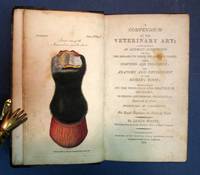
180229918Canterbury: Printed by W. Bristow for J. Badcock 1802. 1st edition Canterbury issue. Period brown half-sheep binding with marbled paper boards. Some rubs & general wear to binding. Period pos to ffep. A VG copy. vi 7 - 20 232 pp. Illustrated with 15 copperplate engravings 4 color and the 6th Fig 1 serving as frontis. 12mo signed in 6s. 6-3/4' x 3-7/8" <br/><br/> Printed by W. Bristow, for J. Badcock hardcover books